|
表情符号
|
单词 | Images | 翻译 | 过去时 | 过去分词 | 第三人称单数 | 动名词 | 含义 | 例句 | 例句翻译 | 示例表达 | 示例表达含义 | 示例表达翻译 | 同义词 | 反义词 | 搭配词 | 助记符 |
|---|---|---|---|---|---|---|---|---|---|---|---|---|---|---|---|---|---|
|
📈
••••••
|
/ˈkɒmpɪtəns/
noun
(kōngpìtènsī)
••••••
|
- •••••• |
能力
nengli
••••••
|
- •••••• | - •••••• | - •••••• | - •••••• |
the ability to do something successfully or efficiently
••••••
|
Her competence as a manager impressed the board. |
作为经理,她的能力给董事会留下了深刻印象。
zuo wei jingli, ta de nengli gei dongshihui liuxia le shenke yinxiang.
••••••
|
professional competence |
the required ability and skill in a profession
••••••
|
职业能力
zhiye nengli
••••••
|
ability, capability, skill, proficiency, expertise
••••••
|
incompetence, inability, ineptness
••••••
|
competence level, demonstrate competence, competence in
••••••
|
能力意味着成为有能力的人 – 有能力的人就是能干的人。
••••••
|
|
✅
••••••
|
/ˈkɒmpɪtənt/
adjective
(kom-pi-tent)
••••••
|
- •••••• |
称职
chengzhi
••••••
|
- •••••• | - •••••• | - •••••• | - •••••• |
having the necessary ability, knowledge, or skill to do something successfully
••••••
|
He is a competent driver who rarely makes mistakes.
他是一个称职的司机,几乎不犯错误。
••••••
|
他是一个称职的司机,几乎不犯错误。
Tā shì yīgè chēngzhí de sījī, jīhū bù fàn cuòwù.
••••••
|
competent authority
称职的权威
••••••
|
a person or body with the legal power to decide or enforce something
••••••
|
称职的权威
chēngzhí de quánwēi
••••••
|
capable, skilled, qualified, proficient
••••••
|
incompetent, unskilled
••••••
|
competent staff, competent professional, competent enough
••••••
|
称职的就像称职的司机,驾驭能力强,工作不出错。
••••••
|
|
🤼
••••••
|
/ˌkɒmpəˈtɪʃən/
noun
(kŏm-pĭ-tĭ-shŭn)
••••••
|


|
竞争
jingzheng
••••••
|
- •••••• | - •••••• | - •••••• | - •••••• |
a situation in which people or organizations try to be more successful than others
••••••
|
The competition in the tech industry is very intense. |
科技行业的竞争非常激烈。
keji hangye de jingzheng feichang jilie.
••••••
|
cut-throat competition |
extremely fierce and ruthless competition
••••••
|
残酷竞争
cánkù jìngzhēng
••••••
|
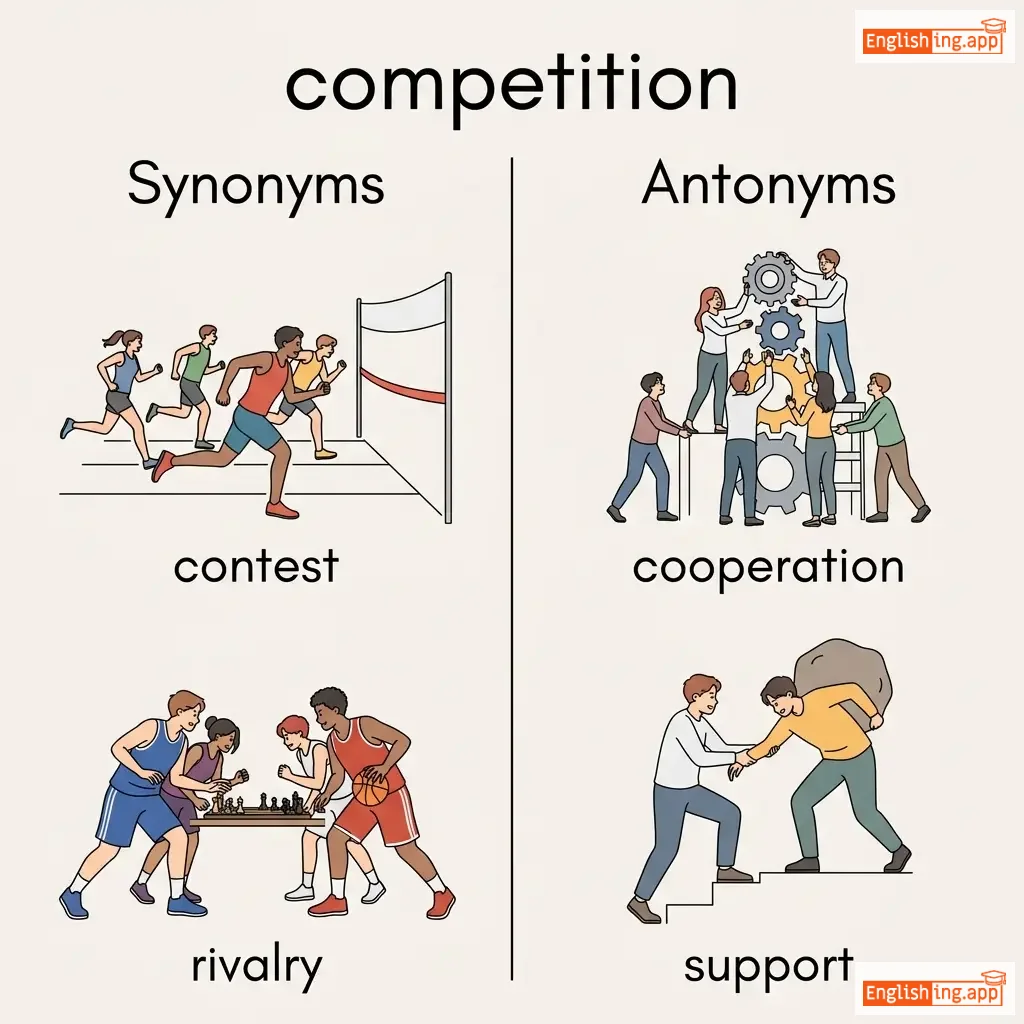
contest, rivalry, challenge, race, opposition
••••••
|
cooperation, support, alliance
••••••
|
intense competition, healthy competition, business competition, market competition
••••••
|
COMPETITION = 竞争 - 总是有竞争在大学里
••••••
|
|
🏆
••••••
|
/kəmˈpetətɪv/
adjective
(kəmˈpɛtɪtɪv)
••••••
|
- •••••• |
竞争的
jingzheng de
••••••
|
- •••••• | - •••••• | - •••••• | - •••••• |
relating to or characterized by competition; having a strong desire to win or be more successful
••••••
|
She has a competitive spirit that drives her to excel. |
她有一种竞争精神,推动她追求卓越。
Ta you yizhong jingzheng jingshen, tuidong ta zhuiqiu zhuoyue.
••••••
|
competitive edge |
an advantage that makes someone more successful
••••••
|
竞争优势
jingzheng youshi
••••••
|
ambitious, rivalrous, aggressive, contesting
••••••
|
uncompetitive, passive
••••••
|
competitive market, competitive advantage, highly competitive
••••••
|
Competitive 意味着总是处于竞争模式 – 总是想赢,像奖杯一样。
••••••
|
|
⚔️
••••••
|
/kəmˈpɛtɪtər/
noun
(kəmˈpɛtɪtər)
••••••
|
- •••••• |
竞争者
jingzhengzhe
••••••
|
- •••••• | - •••••• | - •••••• | - •••••• |
a person, team, or company that competes with others
••••••
|
The company lowered its prices to beat its main competitor. |
公司降低了价格以击败其主要竞争者。
Gongsi jiangdi le jiage yi jiba qi zhuyao jingzhengzhe.
••••••
|
know your competition |
to understand your rivals in order to succeed
••••••
|
了解你的竞争对手
Liaojie nide jingzheng duishou
••••••
|
rival, challenger, opponent, contender, adversary
••••••
|
ally, partner, supporter
••••••
|
main competitor, direct competitor, strong competitor, market competitor
••••••
|
竞争者是与你竞争的人,像比赛中的对手一样。
••••••
|
|
📝
••••••
|
/kəmˈpaɪl/
verb
(kōngpái)
••••••
|
- •••••• |
编制
bian zhi
••••••
|
compiled
kōngpáid
••••••
|
compiled
kōngpáid
••••••
|
compiles
kōngpáils
••••••
|
compiling
kōngpáilíng
••••••
|
to collect information or material and put it together in a list, report, or book
••••••
|
She compiled the research data into a detailed report.
她将研究数据编纂成一份详细报告。
••••••
|
她将研究数据编纂成一份详细报告。
Tā jiāng yánjiū shùjù biānzuǎn chéng yí fèn xiángxì bàogào.
••••••
|
compile a list
编制清单
••••••
|
to gather and arrange items in a list format
••••••
|
编制清单
biānzhì qīngdān
••••••
|
collect, assemble, gather, organize, arrange
••••••
|
scatter, disperse
••••••
|
compile data, compile report, compile information, compile list
••••••
|
Compile的意思是编制 — 就像计算机中的编译器将数据编制到一起。
••••••
|
|
😒
••••••
|
/kəmˈpleɪn/
verb
(kəmplen)
••••••
|
- •••••• |
抱怨
bàoyuàn
••••••
|
complained
kəmplɛɪnd
••••••
|
complained
kəmplɛɪnd
••••••
|
complains
kəmpleɪnz
••••••
|
complaining
kəmpleɪnɪŋ
••••••
|
to express dissatisfaction or annoyance about something
••••••
|
He often complains about the noise in the neighborhood.
他经常抱怨邻里的噪音。
••••••
|
他经常抱怨邻里的噪音。
Tā jīngcháng bàoyuàn línlǐ de zàoyīn.
••••••
|
complain bitterly
痛苦地抱怨
••••••
|
to express strong dissatisfaction
••••••
|
痛苦地抱怨
tòngkǔ de bàoyuàn
••••••
|
grumble, protest, whine, criticize, object
••••••
|
praise, applaud, compliment
••••••
|
complain about, complain to, constantly complain, complain bitterly
••••••
|
如果你抱怨太多,人们会说‘别再抱怨了!’
••••••
|
|
📄
••••••
|
/kəmˈpleɪnt/
noun
(kompleint)
••••••
|
- •••••• |
投诉
tousu
••••••
|
- •••••• | - •••••• | - •••••• | - •••••• |
a statement that something is wrong or not satisfactory
••••••
|
The manager received a complaint from a customer about poor service.
经理收到了一名客户关于糟糕服务的投诉。
••••••
|
经理收到了一名客户关于糟糕服务的投诉。
Jingli shoudao le yi ming kehu guanyu zaogao fuwu de tousu.
••••••
|
file a complaint
提交投诉
••••••
|
to officially report dissatisfaction
••••••
|
提交投诉
Tijiao tousu
••••••
|
objection, grievance, criticism, protest, allegation
••••••
|
praise, compliment
••••••
|
make a complaint, file a complaint, customer complaint, formal complaint
••••••
|
COMPLAINT - 需要提交的正式的投诉。
••••••
|
|
➕
••••••
|
/ˈkɒmplɪmənt/
noun/verb
(补充)
••••••
|

|
补充
buchong
••••••
|
complemented
补充
••••••
|
complemented
补充
••••••
|
complements
补充
••••••
|
complementing
补充
••••••
|
something that completes or goes well with something; to add something that enhances or improves
••••••
|
The scarf complements her outfit perfectly.
围巾完美地补充了她的装束。
••••••
|
围巾完美地补充了她的装束。
wei jin wan mei di buchong le ta de zhuang shu.
••••••
|
perfect complement
完美的补充
••••••
|
something that completes another thing in the best possible way
••••••
|
完美的补充
wan mei de buchong
••••••
|
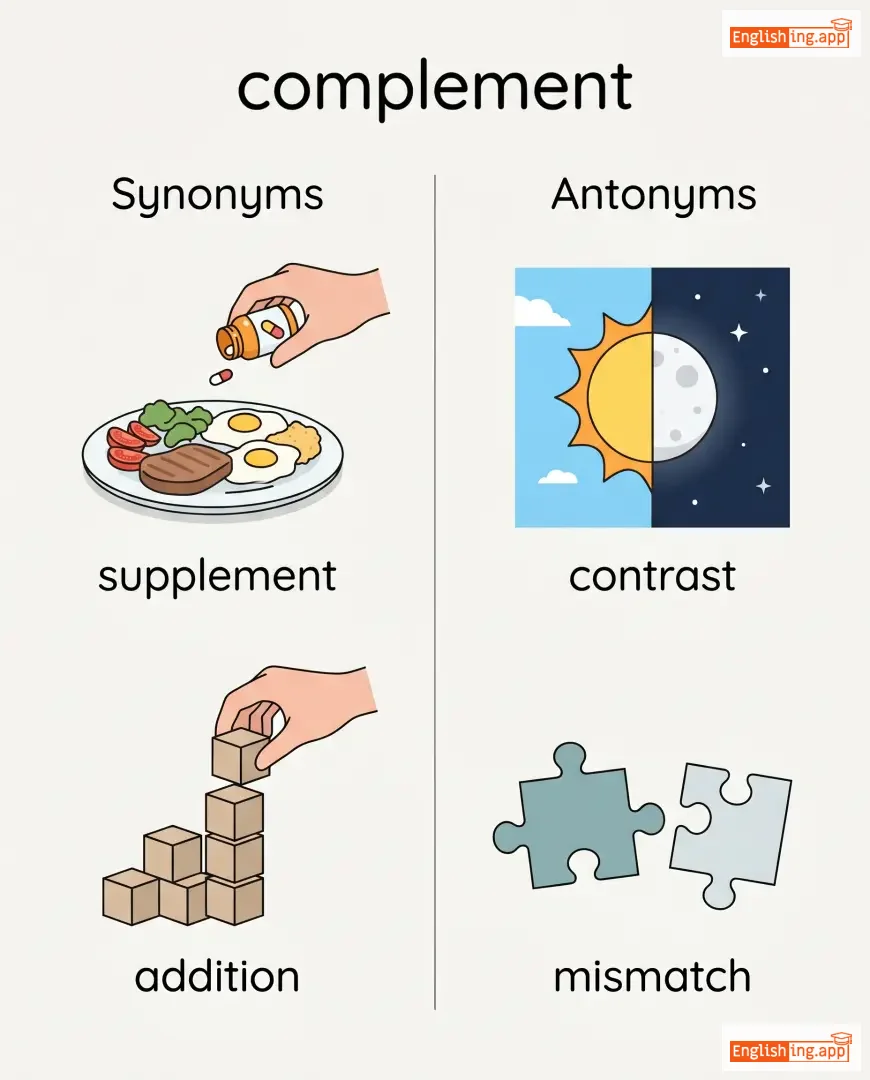
supplement, addition, counterpart, companion, match
••••••
|
contrast, mismatch
••••••
|
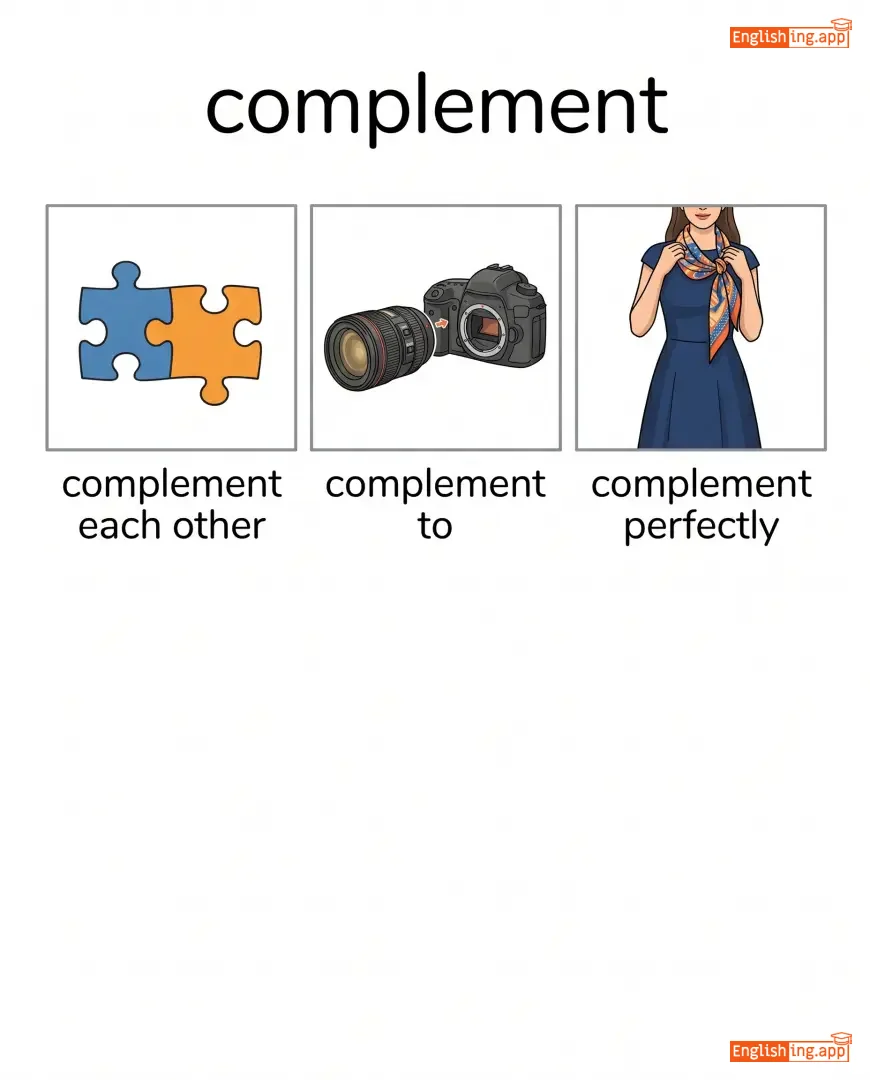
complement each other, complement to, complement perfectly, complement system
••••••
|
补充 = 完成 + 添加,让其他事物更好
••••••
|
|
✅
••••••
|
/kəmˈpliːt/
verb
(kōngplīte)
••••••
|
- •••••• |
完成
wánchéng
••••••
|
completed
kōngplīted
••••••
|
completed
kōngplīted
••••••
|
completes
kōngplīts
••••••
|
completing
kōngplīting
••••••
|
to finish making or doing something; to bring something to an end
••••••
|
She managed to complete the project on time.
她按时完成了这个项目。
••••••
|
她按时完成了这个项目。
Tā ànshí wánchéngle zhège xiàngmù.
••••••
|
complete the circle
完成这个圈
••••••
|
to bring something to its conclusion or to make something whole
••••••
|
完成这个圈
wánchéng zhège quān
••••••
|
finish, accomplish, achieve, conclude, finalize
••••••
|
incomplete, unfinished, halt
••••••
|
complete a task, complete a form, complete the project, complete successfully
••••••
|
完成意味着结束,就像完成一个圆圈。
••••••
|
|
🔄
••••••
|
/kəmˈpliːtli/
adverb
(kəmˈpliːtli)
••••••
|
- •••••• |
完全地
wánquán de
••••••
|
- •••••• | - •••••• | - •••••• | - •••••• |
totally; in every way possible
••••••
|
The room was completely silent. |
房间完全安静。
Fángjiān wánquán ānjìng.
••••••
|
- •••••• | - •••••• | - •••••• |
totally, entirely, fully, utterly
••••••
|
partially, incompletely
••••••
|
completely different, completely silent, completely destroyed, completely wrong
••••••
|
Completely意味着完全地,就像完全安静。
••••••
|
|
✅
••••••
|
/kəmˈpliːʃən/
noun
(kōng-pu-lì-shēn)
••••••
|
- •••••• |
完成
wancheng
••••••
|
- •••••• | - •••••• | - •••••• | - •••••• |
the action or process of finishing something
••••••
|
The completion of the project will take another few weeks. |
项目的完成将再需要几周时间。
Xiàngmù de wánchéng jiāng zài xūyào jǐ zhōu shíjiān.
••••••
|
- •••••• | - •••••• | - •••••• |
finalization, conclusion, fulfillment, accomplishment
••••••
|
beginning, initiation
••••••
|
project completion, timely completion, successful completion
••••••
|
Completion = 完成, 意味着完成某事
••••••
|
|
🧩
••••••
|
/ˈkɒm.pleks/
adjective, noun
(kɔmˈplɛks)
••••••
|
|
复杂的
fuza de
••••••
|
- •••••• | - •••••• | - •••••• | - •••••• |
Consisting of many different and connected parts; not easy to understand or analyze.
••••••
|
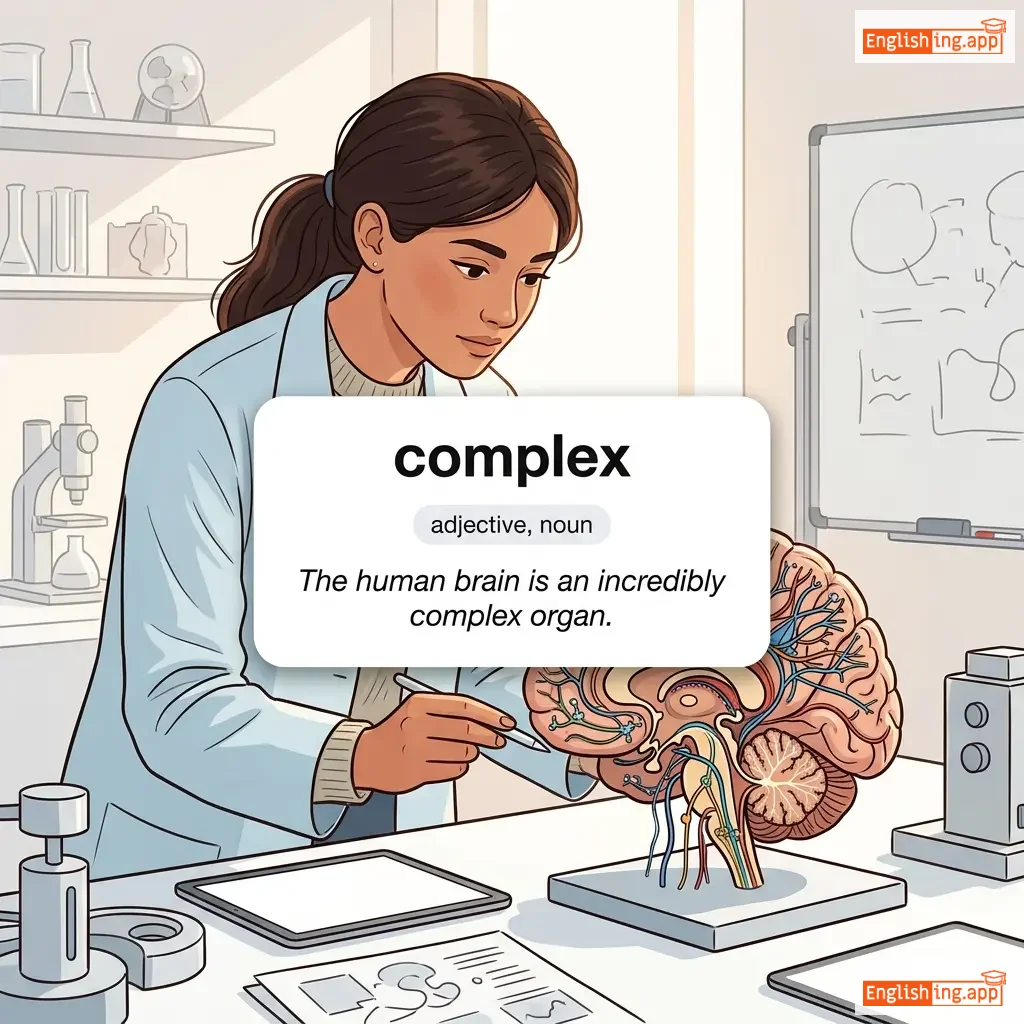
The human brain is an incredibly complex organ. |
人类的大脑是一个极其复杂的器官。
Renlei de dainao shi yi ge jiqi fuza de qiguan.
••••••
|
Oedipus complex |
A psychoanalytic theory referring to a child's feelings of desire for the opposite-sex parent.
••••••
|
俄狄浦斯情结
Édí pǔ sī qíngjié
••••••
|
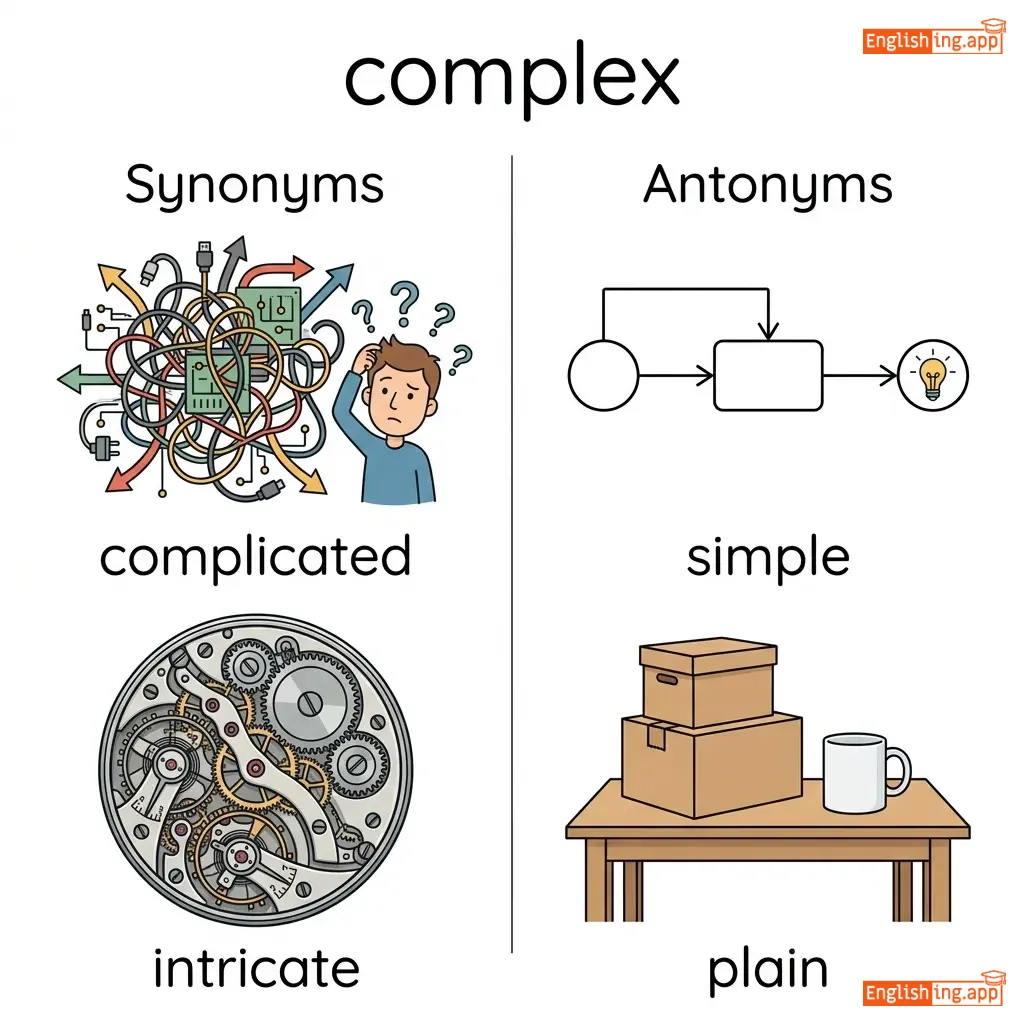
complicated, intricate, elaborate, sophisticated, multifaceted
••••••
|
simple, plain, straightforward
••••••
|
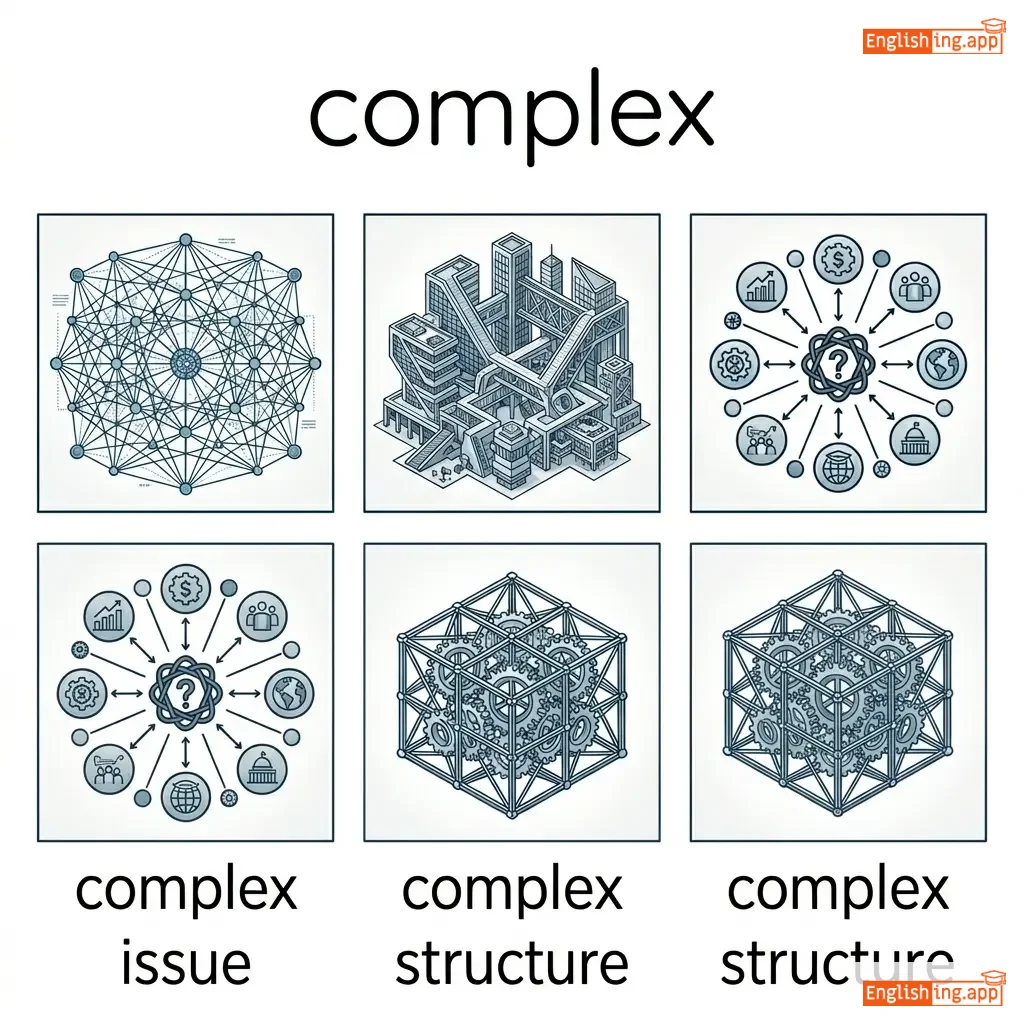
complex system, complex structure, complex issue, highly complex, complex problem
••••••
|
复杂的就像拼图 🧩,许多块拼成完整的图像。
••••••
|
|
🧩
••••••
|
/kəmˈplɛksɪti/
noun
(kəmˈplɛksɪti)
••••••
|
|
复杂性
fuza xing
••••••
|
- •••••• | - •••••• | - •••••• | - •••••• |
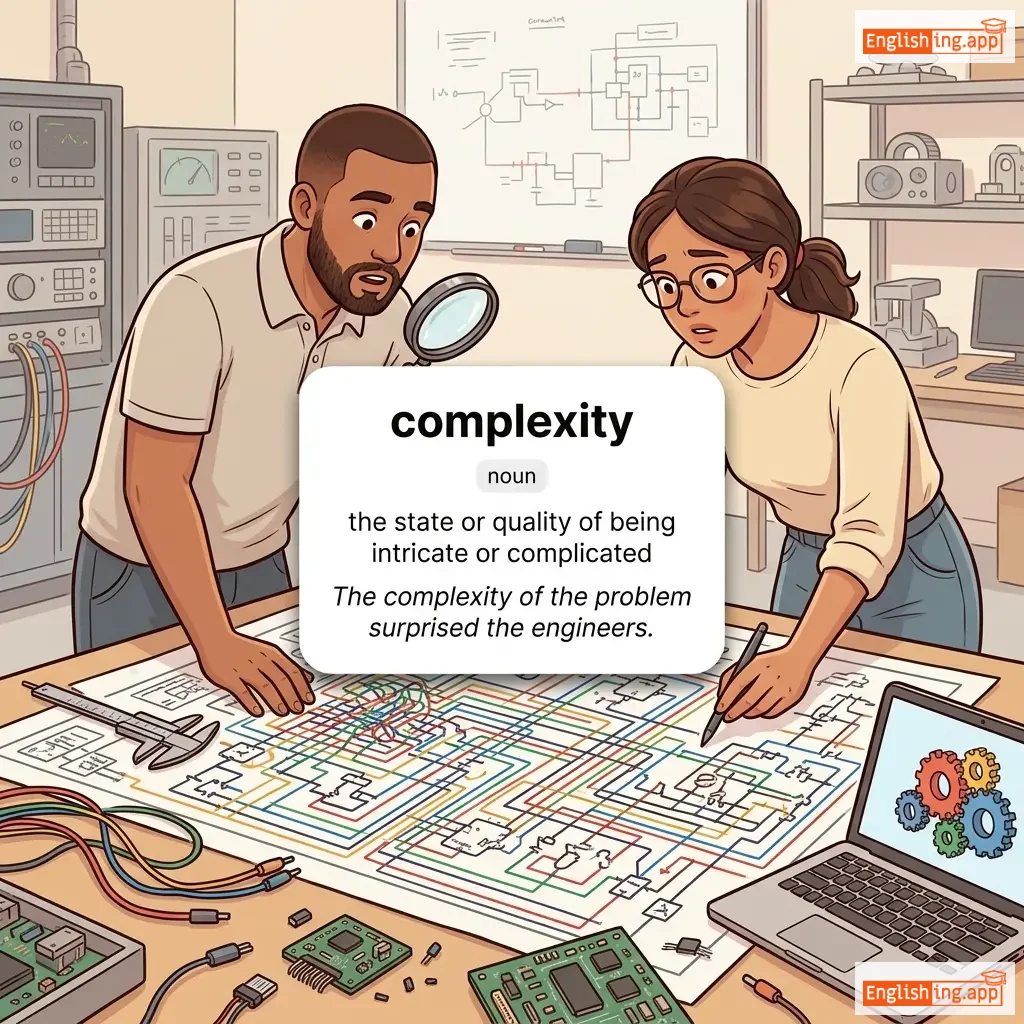
the state or quality of being intricate or complicated
••••••
|
The complexity of the problem surprised the engineers. |
问题的复杂性使工程师感到惊讶。
Wenti de fuza xing shi gongchengshi gandu jingya.
••••••
|
reduce complexity |
to make something simpler or easier to understand
••••••
|
降低复杂性
jiangdi fuza xing
••••••
|
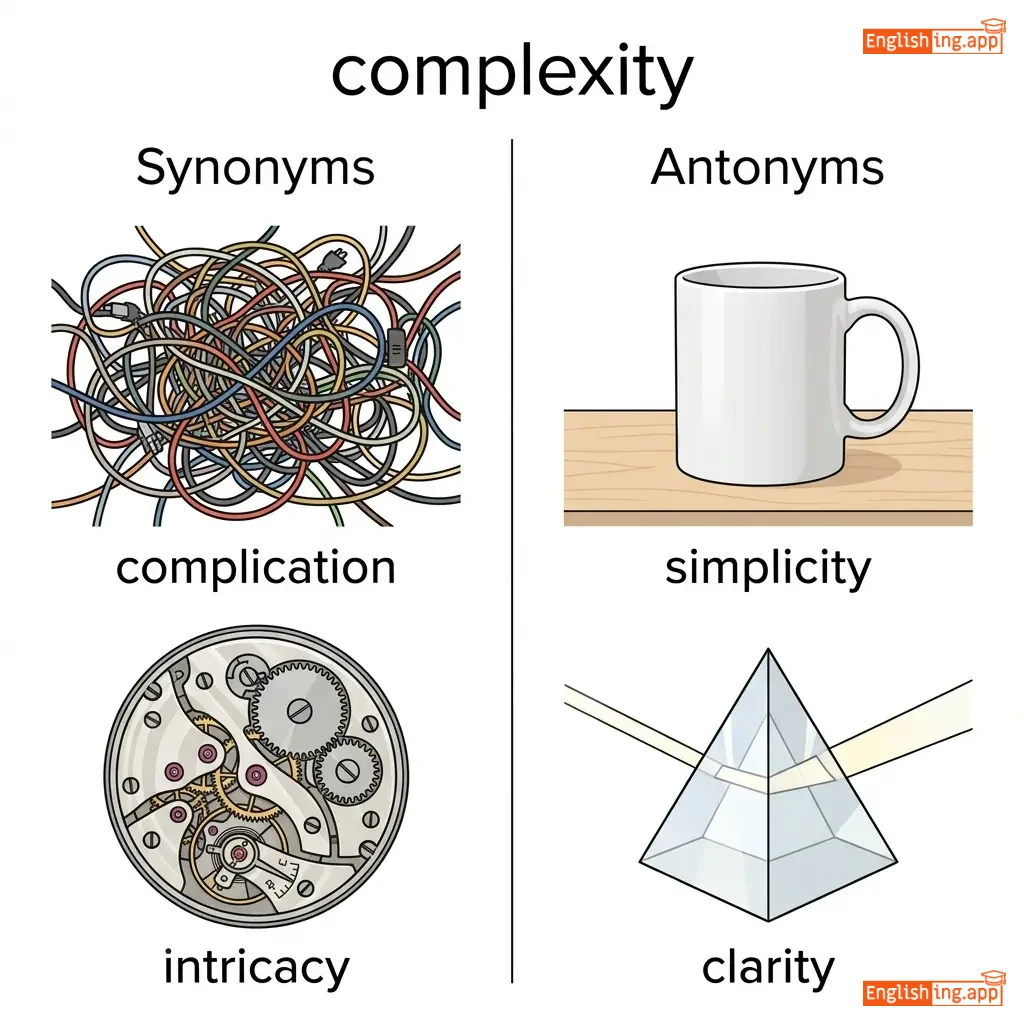
complication, intricacy, difficulty, sophistication, depth
••••••
|
simplicity, clarity, ease
••••••
|
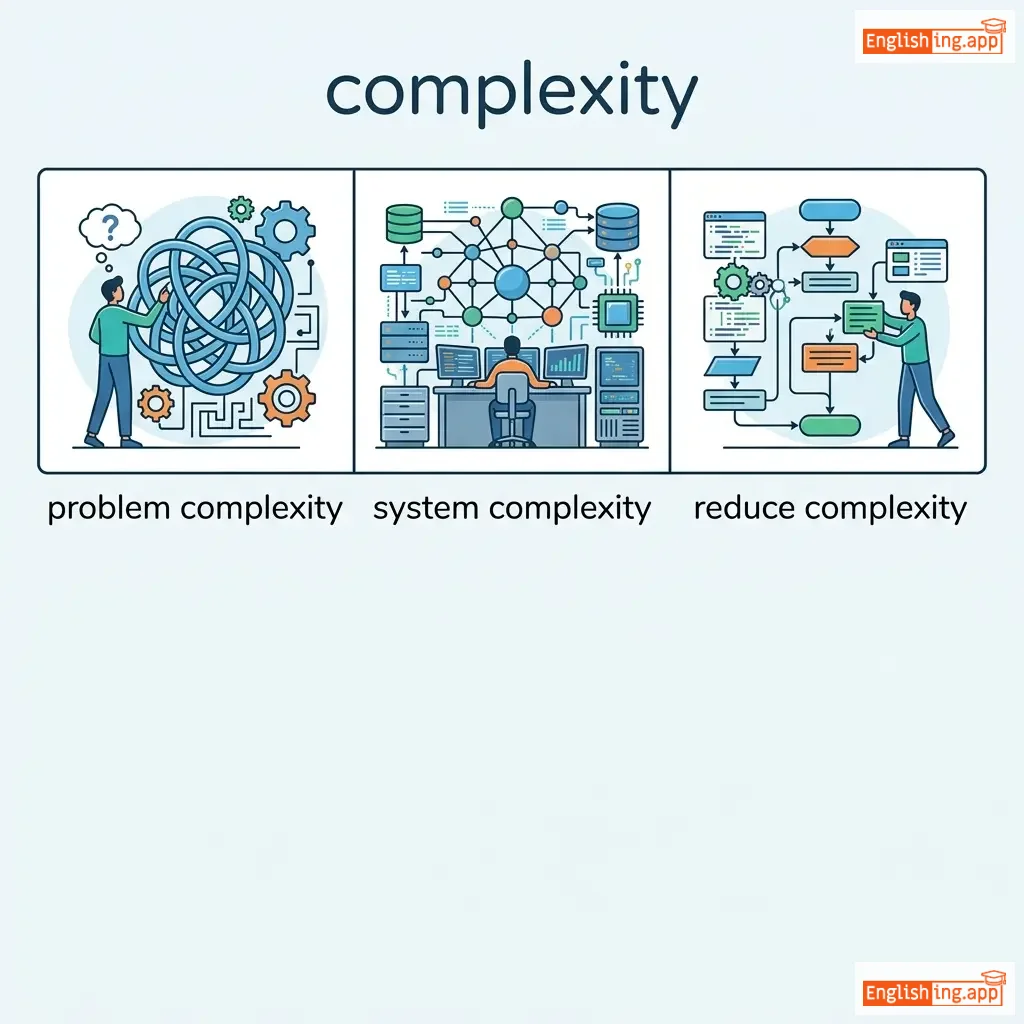
problem complexity, system complexity, reduce complexity, increasing complexity
••••••
|
复杂性代表事情的复杂程度,复杂的事情总是有挑战性的。
••••••
|
|
✅
••••••
|
/kəmˈplaɪəns/
noun
(compliance)
••••••
|
|
合规
hegui
••••••
|
- •••••• | - •••••• | - •••••• | - •••••• |
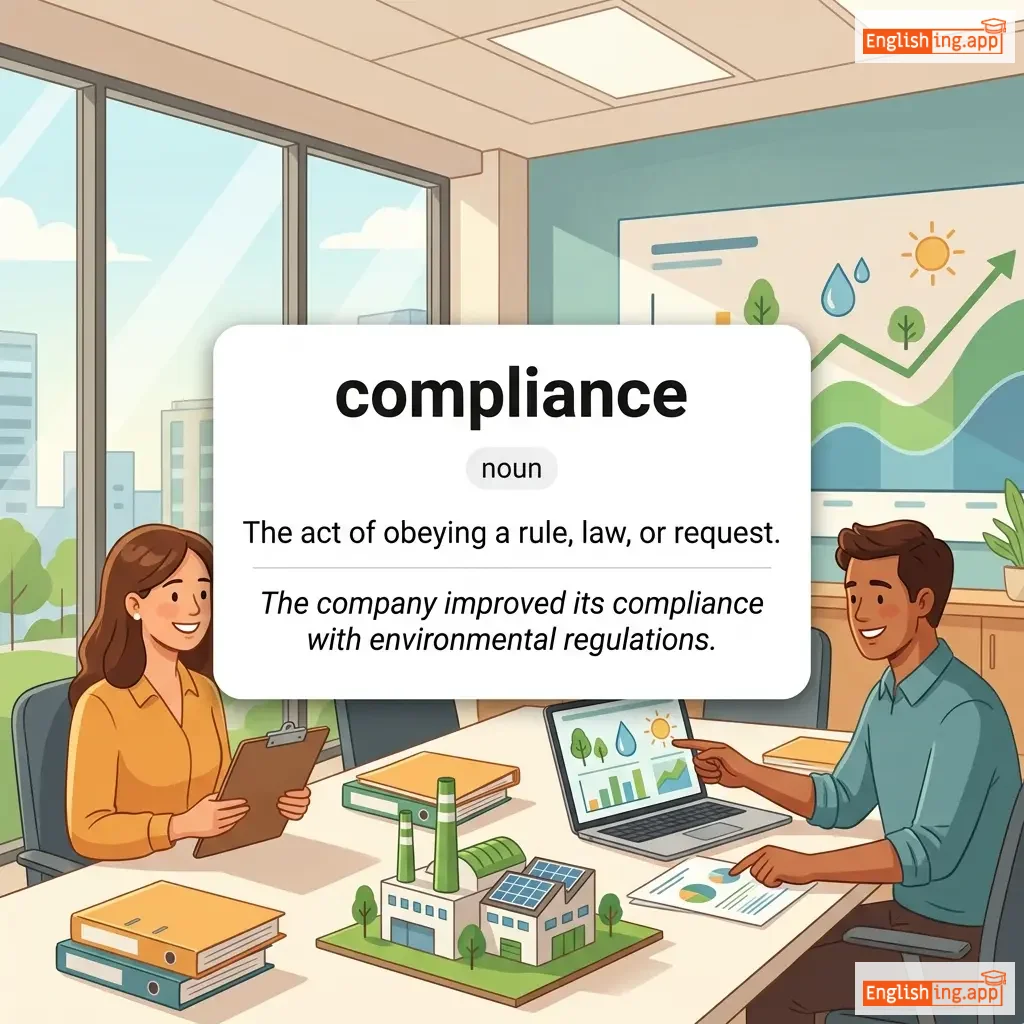
The act of obeying a rule, law, or request.
••••••
|
The company improved its compliance with environmental regulations. |
公司改善了其在环保规定方面的合规性。
Gongsi gaishanle qi zai huanbao guiding fangmian de heguixing.
••••••
|
in compliance with |
Acting according to rules, laws, or standards.
••••••
|
遵守规定
zunshou guiding
••••••
|
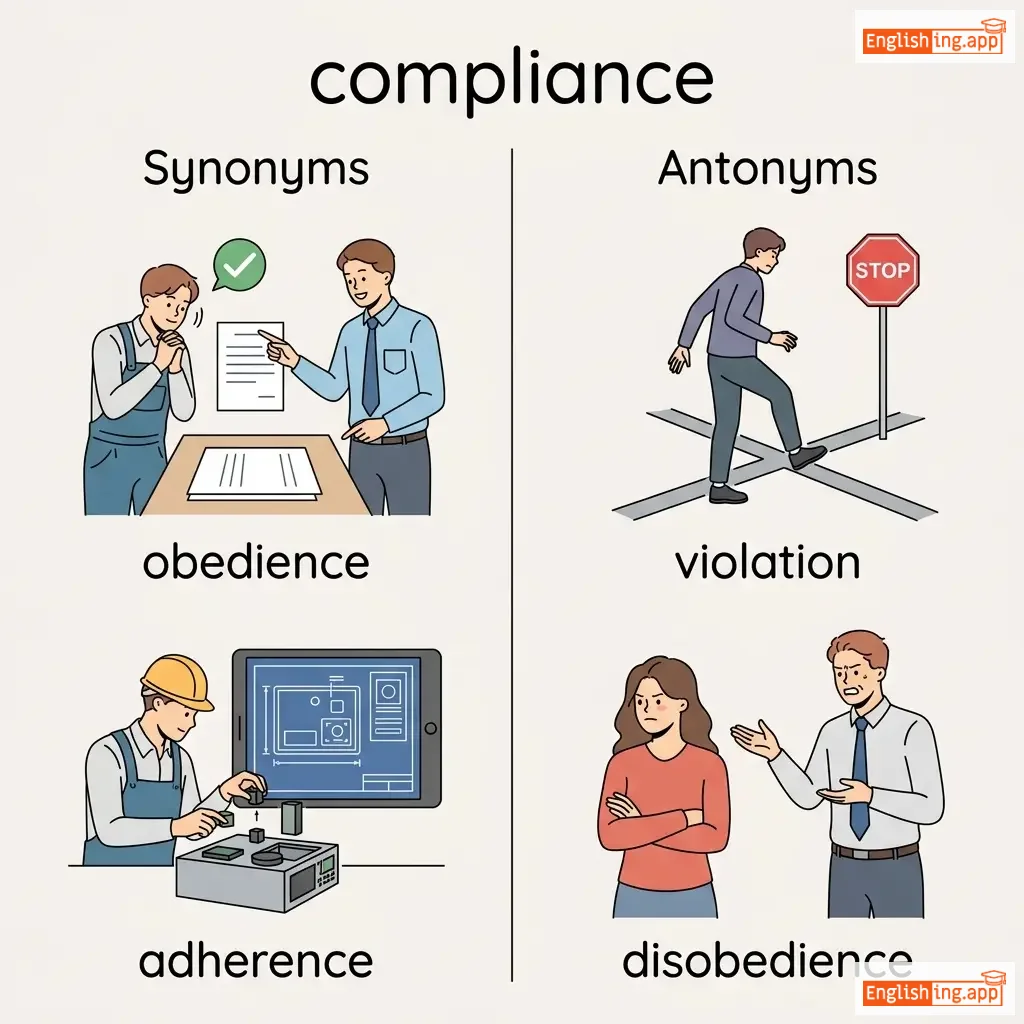
obedience, adherence, conformity, observance
••••••
|
violation, disobedience, defiance
••••••
|
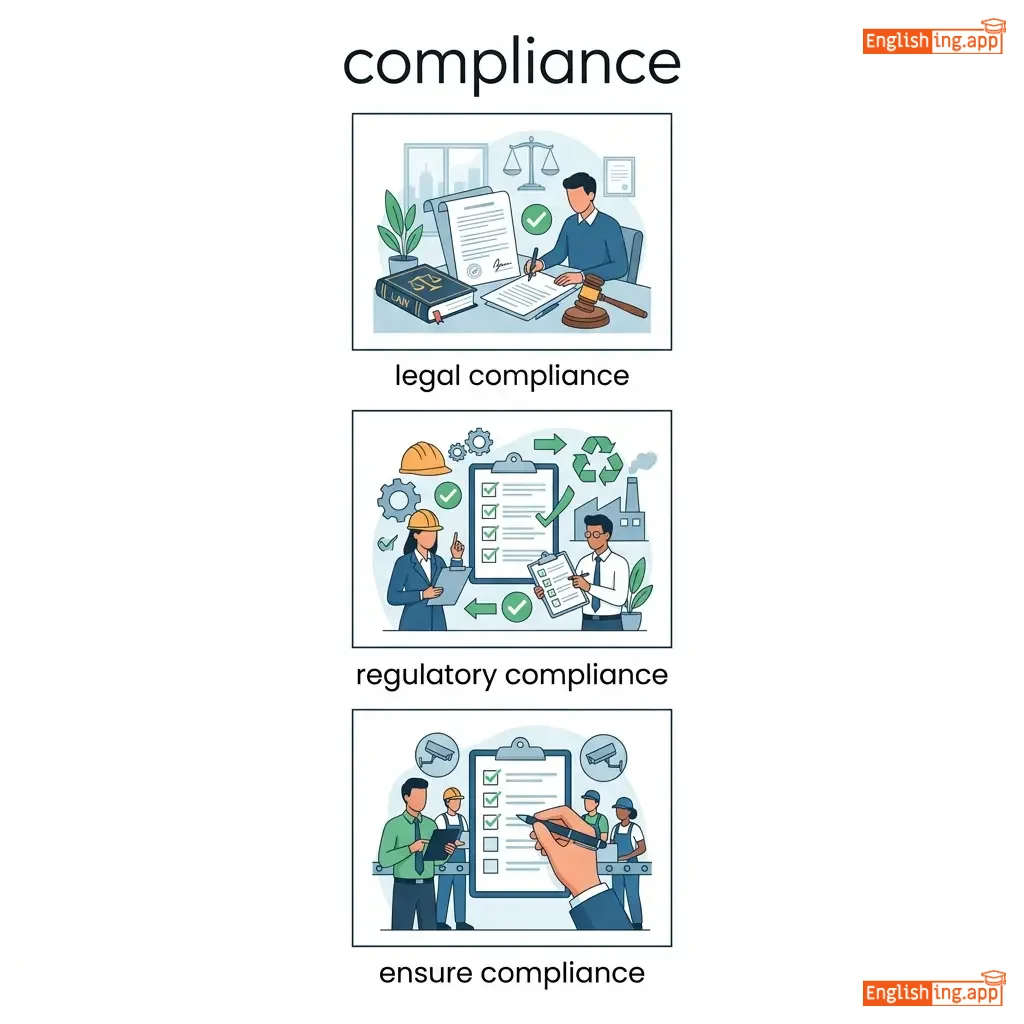
legal compliance, regulatory compliance, ensure compliance, compliance check
••••••
|
合规意味着遵守所有规则和法律 ✅
••••••
|
|
🔀
••••••
|
/ˈkɒm.plɪ.keɪt/
verb
(kòng-pu-lì-kèi-tè)
••••••
|
- •••••• |
使复杂
shǐ fùzá
••••••
|
complicated
kòng-pu-lì-kèi-tèd
••••••
|
complicated
kòng-pu-lì-kèi-tèd
••••••
|
complicates
kòng-pu-lì-kèts
••••••
|
complicating
kòng-pu-lì-kèi-tīng
••••••
|
To make something more difficult or confusing.
••••••
|
The new rules will only complicate the process.
新规则只会使这个过程更加复杂。
••••••
|
新规则只会使这个过程更加复杂。
Xīn guīzé zhǐ huì shǐ zhège guòchéng gèngjiā fùzá.
••••••
|
- •••••• | - •••••• | - •••••• |
confuse, entangle, muddle, perplex
••••••
|
simplify, clarify, ease
••••••
|
complicate matters, complicate life, further complicate, unnecessarily complicate
••••••
|
Complicate 意味着把事情变得更复杂,就像一块拼图。
••••••
|
|
🌀
••••••
|
/ˈkɒmplɪˌkeɪtɪd/
adjective
(kɒmplɪˌkeɪtɪd)
••••••
|
- •••••• |
复杂
fuza
••••••
|
- •••••• | - •••••• | - •••••• | - •••••• |
consisting of many interconnected parts; difficult to understand
••••••
|
The instructions for the machine are too complicated to follow. |
机器的说明书太复杂,无法跟随。
Ji qi de shuoming shu tai fuza, wu fa gensui.
••••••
|
make things complicated |
to make something unnecessarily difficult
••••••
|
使事情复杂
shi shi qing fuza
••••••
|
complex, difficult, intricate, involved, confusing
••••••
|
simple, easy, clear
••••••
|
complicated process, complicated situation, complicated issue, complicated relationship
••••••
|
复杂 = 困难,就像复杂的数学问题。
••••••
|
|
⚠️
••••••
|
/ˌkɒmplɪˈkeɪʃən/
noun
(kɑmplɪˈkeɪʃən)
••••••
|
- •••••• |
并发症
bingfa zheng
••••••
|
- •••••• | - •••••• | - •••••• | - •••••• |
A problem or difficulty that makes a situation harder to deal with.
••••••
|
His illness led to serious complications after surgery. |
他的病情在手术后导致了严重的并发症。
Tā de bìngqíng zài shǒushù hòu dǎozhìle yánzhòng de bìngfāzhèng.
••••••
|
- •••••• | - •••••• | - •••••• |
difficulty, obstacle, setback, issue, hindrance
••••••
|
solution, advantage, benefit
••••••
|
medical complication, unexpected complication, serious complication, complication arises
••••••
|
并发症 = 让事情变得更复杂的东西。
••••••
|
|
✅
••••••
|
/kəmˈplaɪ/
verb
(kəmˈplaɪ)
••••••
|
- •••••• |
遵守
zūnshǒu
••••••
|
complied
kəmˈplaɪd
••••••
|
complied
kəmˈplaɪd
••••••
|
complies
kəmˈplaɪz
••••••
|
complying
kəmˈplaɪɪŋ
••••••
|
to act in accordance with a rule, request, or law
••••••
|
All companies must comply with safety regulations.
所有公司必须遵守安全规定。
••••••
|
所有公司必须遵守安全规定。
Suǒyǒu gōngsī bìxū zūnshǒu ānquán guīdìng.
••••••
|
comply with orders
遵守命令
••••••
|
to follow instructions or commands
••••••
|
遵守命令
zūnshǒu mìnglìng
••••••
|
obey, follow, conform, observe, respect
••••••
|
disobey, resist, ignore
••••••
|
comply with law, comply with order, comply with standard, comply fully
••••••
|
遵守意味着遵循规定 (rules)。
••••••
|
|
⚙️
••••••
|
/kəmˈpoʊnənt/
noun
(kěn pónèn t)
••••••
|
- •••••• |
组件
zujiàn
••••••
|
- •••••• | - •••••• | - •••••• | - •••••• |
a part or element of a larger whole, especially a machine or system
••••••
|
The engine is the most important component of the car. |
引擎是汽车最重要的组件。
Yǐnqíng shì qìchē zuì zhòngyào de zǔjiàn.
••••••
|
- •••••• | - •••••• | - •••••• |
part, element, piece, unit, section
••••••
|
whole, entirety, totality
••••••
|
key component, essential component, electronic component, major component
••••••
|
组件就像机器的各个部分,像电脑的各个组件。
••••••
|
|
✍️
••••••
|
/kəmˈpəʊz/
verb
(kənˈpəʊz)
••••••
|

|
作曲
zuòqǔ
••••••
|
composed
kəmˈpoʊzɪd
••••••
|
composed
kəmˈpoʊzɪd
••••••
|
composes
kəmˈpoʊzɪz
••••••
|
composing
kəmˈpoʊzɪŋ
••••••
|
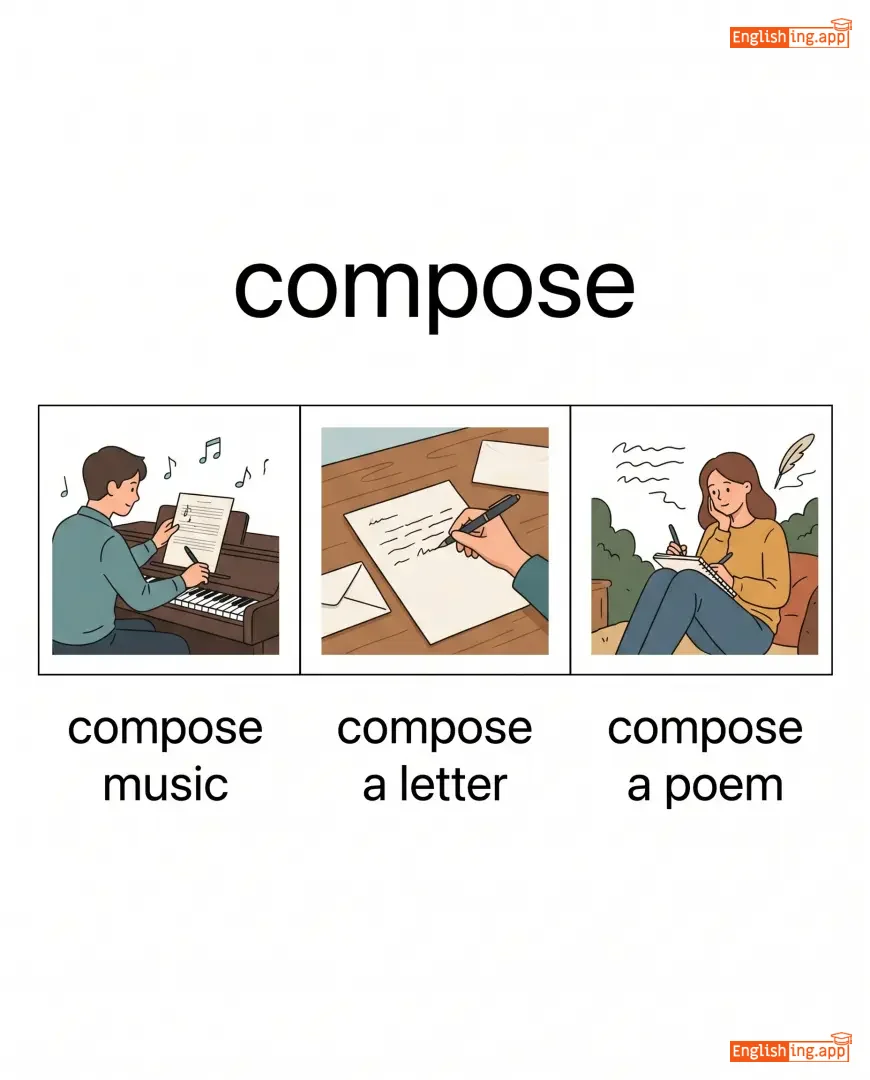
to create or write something, especially music, poetry, or a letter
••••••
|
She likes to compose songs in her free time.
她喜欢在空闲时间作曲。
••••••
|
她喜欢在空闲时间作曲。
Tā xǐhuān zài kòngxián shíjiān zuòqǔ.
••••••
|
compose oneself
冷静下来
••••••
|
to calm down and control your emotions
••••••
|
冷静下来
lěngjìng xiàlái
••••••
|
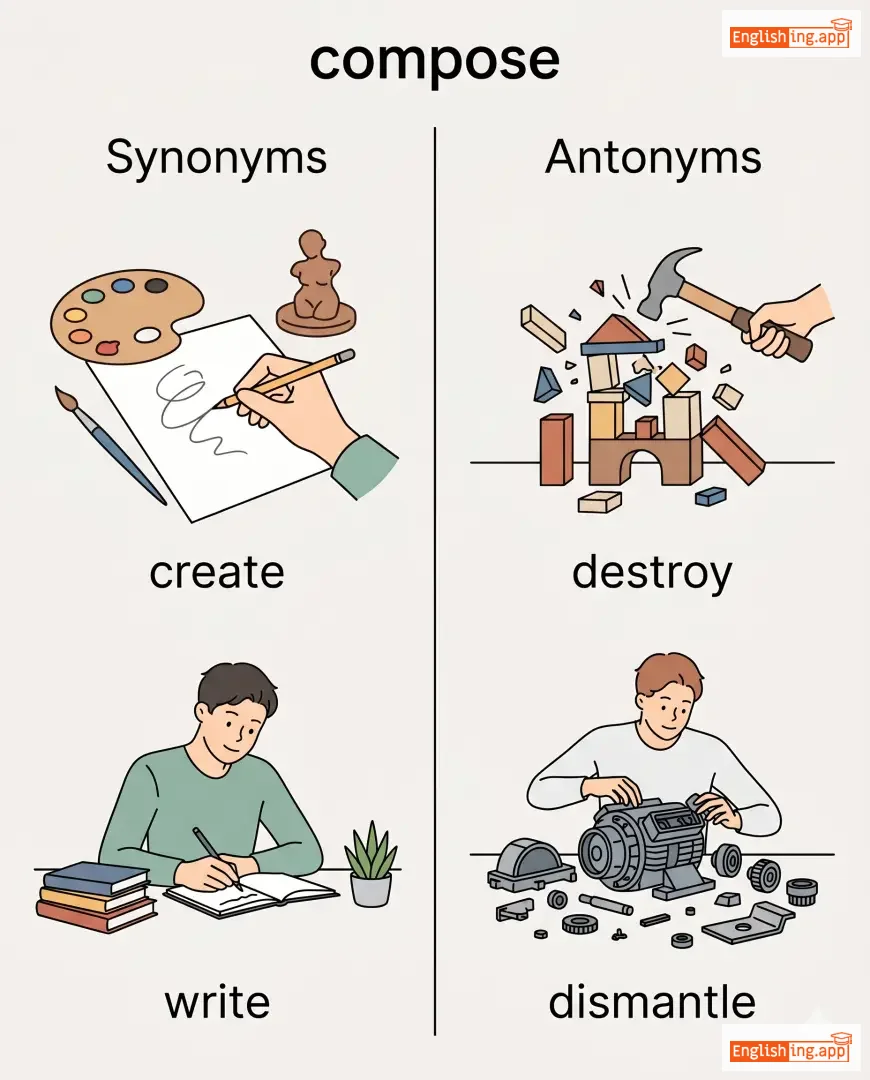
create, write, craft, construct, devise
••••••
|
destroy, dismantle, ruin
••••••
|
compose music, compose a letter, compose a poem, compose oneself
••••••
|
作曲或写诗就像在电脑上写文本一样。
••••••
|
|
🎶
••••••
|
/kəmˈpəʊzə(r)/
noun
(作曲家)
••••••
|
- •••••• |
作曲家
zuòqǔ jiā
••••••
|
- •••••• | - •••••• | - •••••• | - •••••• |
a person who writes music, especially classical music
••••••
|
The composer is working on a new symphony.
作曲家正在创作一部新的交响曲。
••••••
|
作曲家正在创作一部新的交响曲。
Zuòqǔ jiā zhèngzài chuàngzuò yī bù xīn de jiāoxiǎngqǔ.
••••••
|
- •••••• | - •••••• | - •••••• |
musician, songwriter, arranger, conductor
••••••
|
listener, audience
••••••
|
music composer, famous composer, classical composer
••••••
|
作曲家 = 创作音乐的人
••••••
|
|
🎶
••••••
|
/ˌkɒmpəˈzɪʃən/
noun
(kōngpòzīxiàn)
••••••
|
- •••••• |
作文
zuòwén
••••••
|
- •••••• | - •••••• | - •••••• | - •••••• |
the act of creating a piece of writing, music, or art; the way parts are arranged
••••••
|
Her composition won first prize in the contest. |
她的作文在比赛中获得了第一名。
Tā de zuòwén zài bǐsài zhōng huòdéle dì yī míng.
••••••
|
- •••••• | - •••••• | - •••••• |
essay, creation, arrangement, piece, structure
••••••
|
disorder, disorganization
••••••
|
musical composition, written composition, composition skills, composition contest
••••••
|
作文意味着创作艺术作品,就像在考试中写作文。
••••••
|
|
⚗️
••••••
|
/ˈkɑːmpaʊnd/
noun
(kōngpào dé)
••••••
|
- •••••• |
化合物 / 封闭区域
huàhéwù / fēngbì qūyù
••••••
|
- •••••• | - •••••• | - •••••• | - •••••• |
a thing that is composed of two or more separate elements; an enclosed area with buildings
••••••
|
The scientist studied the chemical compound in the lab.
科学家在实验室研究了化学化合物。
••••••
|
科学家在实验室研究了化学化合物。
Kēxuéjiā zài shíyànshì yánjiū le huàxué huàhéwù.
••••••
|
compound interest
复利
••••••
|
interest calculated on both the initial principal and the accumulated interest
••••••
|
复利
fùlì
••••••
|
mixture, combination, blend, complex
••••••
|
element, simple
••••••
|
chemical compound, compound interest, compound sentence
••••••
|
复利像化合物一样,随着时间的推移不断增长
••••••
|
|
🧠
••••••
|
/ˌkɒmprɪˈhɛnd/
verb
(kěnpriénd)
••••••
|
- •••••• |
理解
lǐjiě
••••••
|
comprehended
kěnpriénded
••••••
|
comprehended
kěnpriénded
••••••
|
comprehends
kěnpriénds
••••••
|
comprehending
kěnpriénding
••••••
|
to understand or grasp the meaning of something
••••••
|
It is difficult to comprehend the scale of the disaster.
理解灾难的规模很困难。
••••••
|
理解灾难的规模很困难。
Lǐjiě zāinàn de guīmó hěn kùnnán.
••••••
|
beyond comprehension
超出理解范围
••••••
|
something too difficult to understand
••••••
|
超出理解范围
chāo chū lǐjiě fànwéi
••••••
|
understand, grasp, perceive, fathom, apprehend
••••••
|
misunderstand, confuse
••••••
|
comprehend fully, difficult to comprehend, unable to comprehend
••••••
|
Comprehend 意味着理解,就像你需要理解一本书才能享受它。
••••••
|
|
📚
••••••
|
/ˌkɒm.prɪˈhen.sɪv/
adjective
(kòng-pu-lei-hen-si-fu)
••••••
|
|
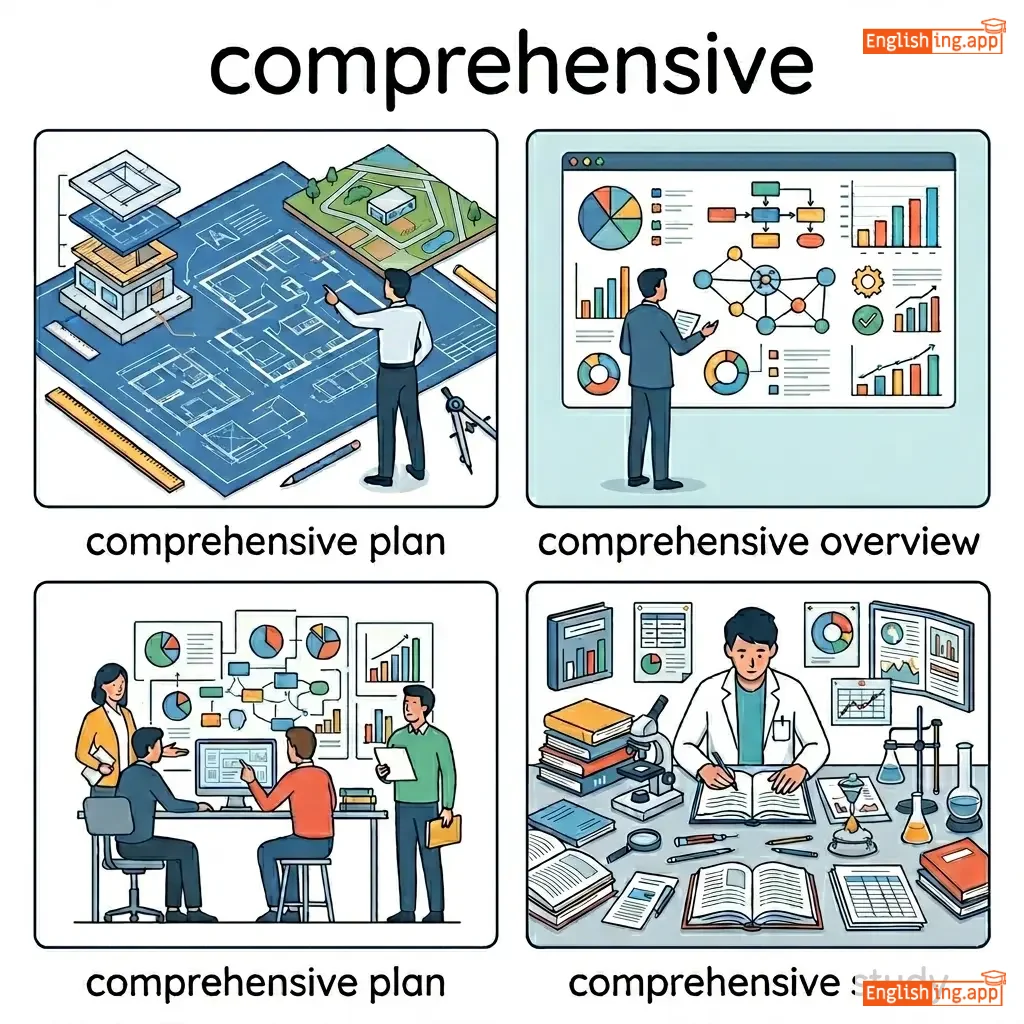
全面的; 综合的; 包罗万象的
quánmiàn de; zōnghé de; bāoluó wànxiàng de
••••••
|
- •••••• | - •••••• | - •••••• | - •••••• |
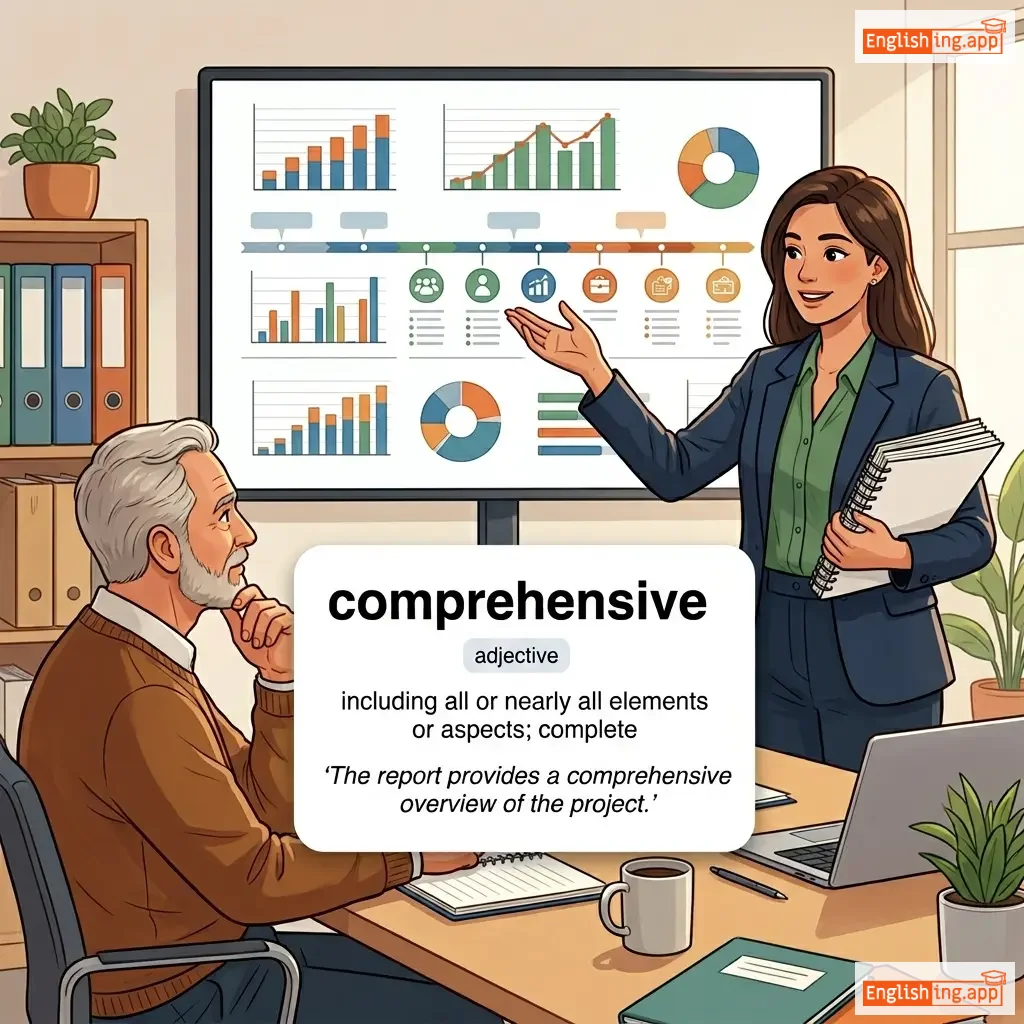
complete and including everything that is necessary; covering a wide range of topics
••••••
|
The report provides a comprehensive analysis of the market trends. |
报告提供了对市场趋势的全面分析。
bàogào tígōngle duì shìchǎng qūshì de quánmiàn fēnxī.
••••••
|
- •••••• | - •••••• | - •••••• |
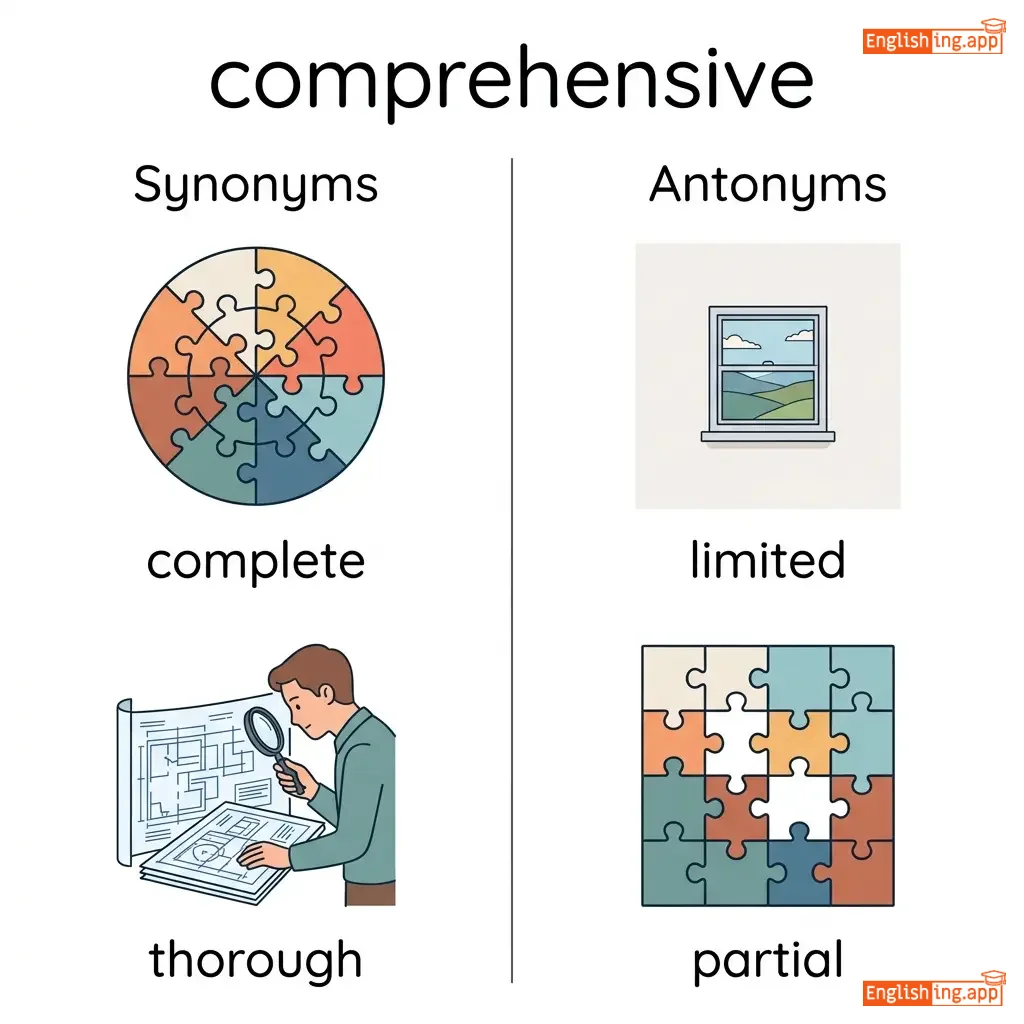
complete, thorough, extensive, all-inclusive
••••••
|
partial, incomplete, limited, narrow
••••••
|
comprehensive study, comprehensive report, comprehensive coverage
••••••
|
理解一个问题,必须看到全局。
••••••
|
|
🧩
••••••
|
/kəmˈpraɪz/
verb
(kəmpraiz)
••••••
|
- •••••• |
由...组成
you...zuchéng
••••••
|
comprised
kəmpraizd
••••••
|
comprised
kəmpraizd
••••••
|
comprises
kəmpraizes
••••••
|
comprising
kəmpraizing
••••••
|
To consist of or be made up of something.
••••••
|
The committee comprises five members.
委员会由五个成员组成。
••••••
|
委员会由五个成员组成。
Wěiyuánhuì yóu wǔ gè chéngyuán zǔchéng.
••••••
|
- •••••• | - •••••• | - •••••• |
consist of, include, contain, encompass
••••••
|
exclude, lack
••••••
|
comprise of, committee comprises, group comprises, comprises elements
••••••
|
就像一个委员会是由成员组成的,comprise
••••••
|
|
⚖️
••••••
|
/ˈkɒmprəmaɪz/
noun, verb
(kòng pì rù mǐ sī)
••••••
|

|
妥协
tuǒxié
••••••
|
compromised
kòng pì rù mǐ sī
••••••
|
compromised
kòng pì rù mǐ sī
••••••
|
compromises
kòng pì rù mǐ sī
••••••
|
compromising
kòng pì rù mǐ sī
••••••
|
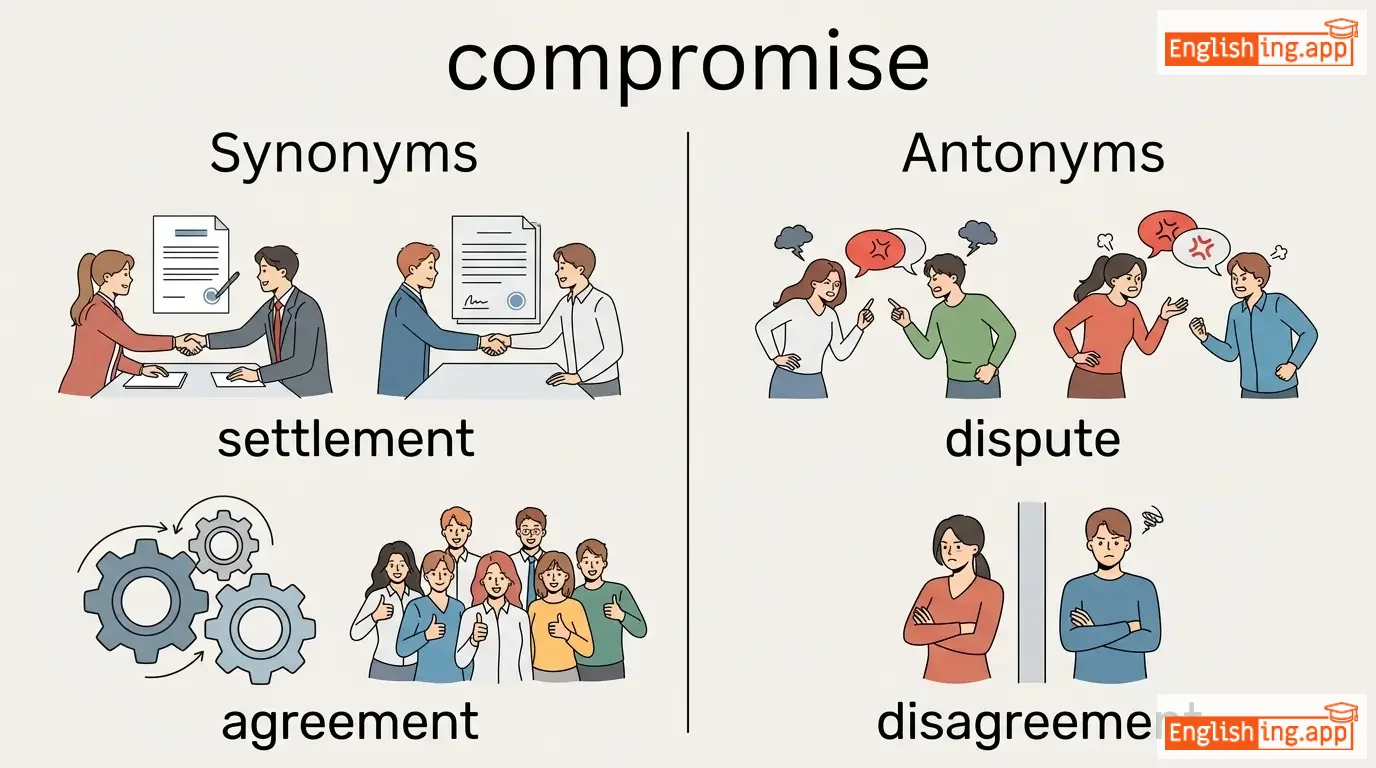
A settlement of differences in which each side makes concessions; or to weaken or put at risk.
••••••
|
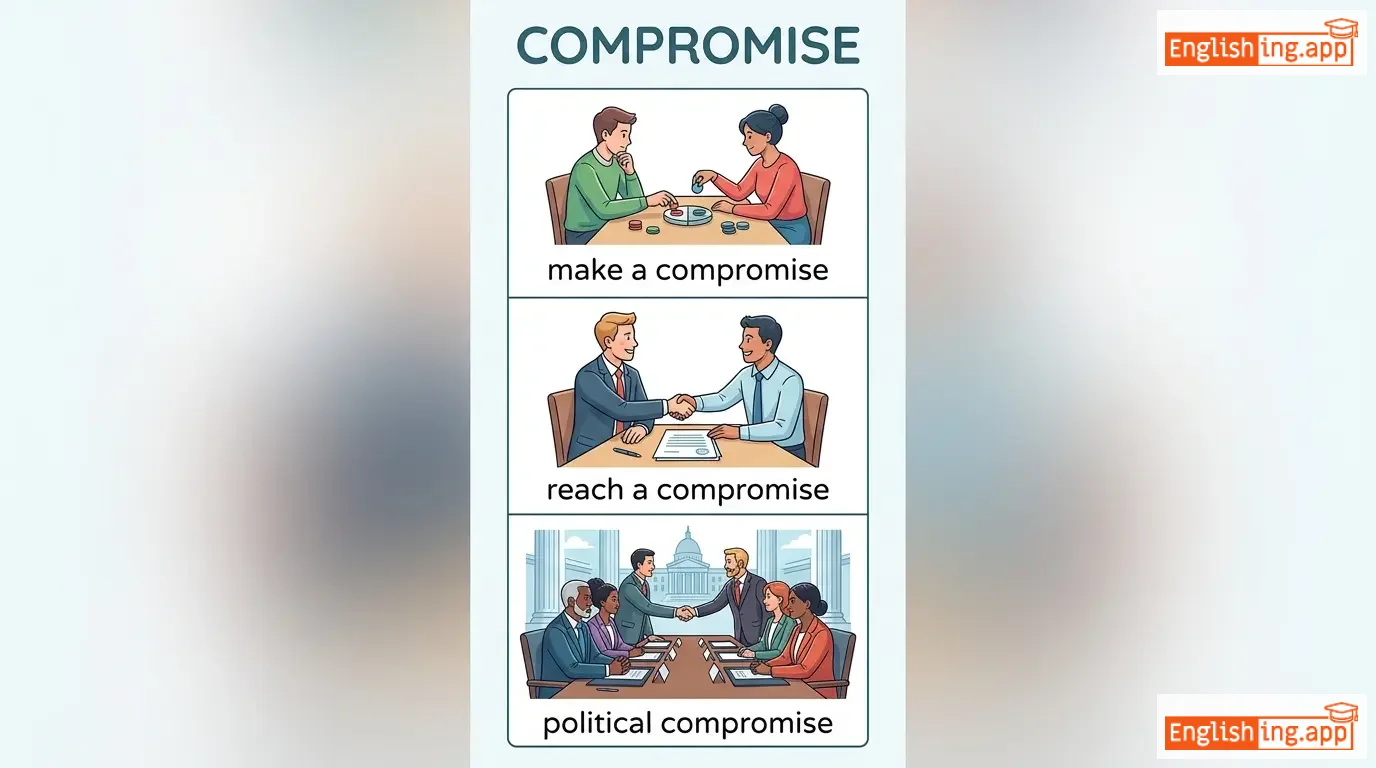
They reached a compromise after long negotiations.
他们在长时间的谈判后达成了妥协。
••••••
|
他们在长时间的谈判后达成了妥协。
Tāmen zài cháng shíjiān de tánpàn hòu dáchéngle tuǒxié.
••••••
|
reach a compromise
达成妥协
••••••
|
To come to an agreement by mutual concession.
••••••
|
达成妥协
dáchéng tuǒxié
••••••
|
settlement, agreement, deal, concession
••••••
|
dispute, disagreement
••••••
|
make a compromise, reach a compromise, political compromise, compromise solution
••••••
|
妥协 — 比如通过让步做出决定
••••••
|
|
📘
••••••
|
/kəmˈpʌlsəri/
adjective
(kèpùlsǒlì)
••••••
|
- •••••• |
强制性
qiángzhìxìng
••••••
|
- •••••• | - •••••• | - •••••• | - •••••• |
Required by law or a rule; obligatory.
••••••
|
Wearing seat belts is compulsory in most countries. |
在大多数国家,佩戴安全带是强制性的。
Zài dà duōshù guójiā, pèidài ānquán dài shì qiángzhìxìng de.
••••••
|
- •••••• | - •••••• | - •••••• |
mandatory, required, obligatory, necessary
••••••
|
optional, voluntary, discretionary
••••••
|
compulsory education, compulsory subject, compulsory service
••••••
|
Compulsory 意味着强制性,像强制性的学校科目。
••••••
|
|
💻
••••••
|
/kəmˈpjuːt/
verb
(kəmˈpjut)
••••••
|
- •••••• |
计算
jisuan
••••••
|
computed
kəmˈpjuːtɪd
••••••
|
computed
kəmˈpjuːtɪd
••••••
|
computes
kəmˈpjuːts
••••••
|
computing
kəmˈpjuːtɪŋ
••••••
|
To calculate or determine by using a computer or mathematical methods.
••••••
|
The software can compute the total cost in seconds.
该软件可以在几秒钟内计算出总成本。
••••••
|
该软件可以在几秒钟内计算出总成本。
Gai ruanjian keyi zai ji miaozhong nei jisuan chu zong chengben.
••••••
|
compute the odds
计算概率
••••••
|
to calculate the probability of an outcome
••••••
|
计算概率
jisuan gailv
••••••
|
calculate, reckon, estimate, process, figure out
••••••
|
guess, ignore
••••••
|
compute result, compute data, compute power, compute value
••••••
|
通过计算机来计算!
••••••
|
|
💻
••••••
|
/kəmˈpjuːtə(r)/
noun
(kèng-pyù-tè)
••••••
|
- •••••• |
计算机
jisuanji
••••••
|
- •••••• | - •••••• | - •••••• | - •••••• |
an electronic device for storing and processing data
••••••
|
I bought a new computer for my office work.
我为我的办公室工作买了台新电脑。
••••••
|
我为我的办公室工作买了台新电脑。
Wo wei wode bangongshi gongzuo maile tai xin dian nao.
••••••
|
- •••••• | - •••••• | - •••••• |
PC, laptop, desktop, machine, device
••••••
|
manual work, paper-based system
••••••
|
personal computer, computer program, computer science, computer system
••••••
|
计算机就像计算一样,帮助完成工作。
••••••
|
|
🤫
••••••
|
/kənˈsiːl/
verb
(kənˈsiːl)
••••••
|
- •••••• |
隐藏
yin cang
••••••
|
concealed
kənˈsiːld
••••••
|
concealed
kənˈsiːld
••••••
|
conceals
kənˈsiːlz
••••••
|
concealing
kənˈsiːlɪŋ
••••••
|
to hide something or keep it secret
••••••
|
He tried to conceal his disappointment behind a smile.
Hi traɪd tu kənˈsiːl hɪz dɪsəˈpɔɪntmənt bɪˈhaɪnd ə smaɪl.
••••••
|
他试图用微笑掩饰自己的失望。
Ta shitu yong weixiao yanshi ziji de shiwang.
••••••
|
conceal the truth
kənˈsiːl ðə truθ
••••••
|
to hide or withhold the truth from others
••••••
|
隐藏真相
yin cang zhenxiang
••••••
|
hide, cover, disguise, mask, secrete
••••••
|
reveal, expose, uncover
••••••
|
conceal identity, conceal weapon, conceal fact, conceal smile
••••••
|
隐藏就像把秘密藏在盒子里
••••••
|
|
🙇
••••••
|
/kənˈsiːd/
verb
••••••
|
- •••••• | - •••••• |
conceded
••••••
|
conceded
••••••
|
concedes
••••••
|
conceding
••••••
|
to admit something is true or valid, often reluctantly
••••••
|
She finally conceded that she was wrong. |
- •••••• |
concede defeat |
to admit that you have lost
••••••
|
- •••••• |
admit, acknowledge, grant, allow, yield
••••••
|
deny, refuse, reject
••••••
|
concede defeat, concede point, concede ground, concede goal
••••••
|
No •••••• |
|
💡
••••••
|
/kənˈsiːv/
verb
(kön-siv)
••••••
|
- •••••• |
构思, 怀孕
gousi, huaiyun
••••••
|
conceived
kön-sivd
••••••
|
conceived
kön-sivd
••••••
|
conceives
kön-sivs
••••••
|
conceiving
kön-sivin
••••••
|
to form or imagine an idea in the mind; to become pregnant
••••••
|
It is hard to conceive how such an idea could succeed.
很难想象这样的想法如何能够成功。
••••••
|
很难想象这样的想法如何能够成功。
Hen nan xiangxiang zheyang de xiangfa ruhe nenggou chenggong.
••••••
|
conceive a plan
构思一个计划
••••••
|
to think of or develop a plan
••••••
|
构思一个计划
gousi yige jihua
••••••
|
imagine, envision, devise, formulate, originate
••••••
|
misunderstand, overlook, neglect
••••••
|
conceive an idea, conceive a plan, conceive child, conceive possibility
••••••
|
conceive 意味着构思一个新的计划。
••••••
|
|
🎯
••••••
|
/ˈkɒnsəntreɪt/
verb
(kānsèntèruò)
••••••
|
- •••••• |
集中
jízhōng
••••••
|
concentrated
kānsèntèruò
••••••
|
concentrated
kānsèntèruò
••••••
|
concentrates
kānsèntèruò
••••••
|
concentrating
kānsèntèruò
••••••
|
to focus all one's attention or mental effort on a particular object or activity
••••••
|
She tried to concentrate on her studies despite the noise.
尽管有噪音,她仍试图集中精力学习。
••••••
|
尽管有噪音,她仍试图集中精力学习。
jǐnguǎn yǒu zàoyīn, tā réng shìtú jízhōng jīnglì xuéxí.
••••••
|
concentrate on
集中在
••••••
|
to give your full attention to something
••••••
|
集中在
jízhōng zài
••••••
|
focus, direct, center, apply, dedicate
••••••
|
distract, neglect
••••••
|
concentrate on work, concentrate efforts, concentrate deeply, concentrate hard
••••••
|
为了专注,必须集中精力。🎯
••••••
|
|
🎯
••••••
|
/ˌkɒnsnˈtreɪʃən/
noun
(kòn sèntè réi shén)
••••••
|

|
集中力
ji zhong li
••••••
|
- •••••• | - •••••• | - •••••• | - •••••• |
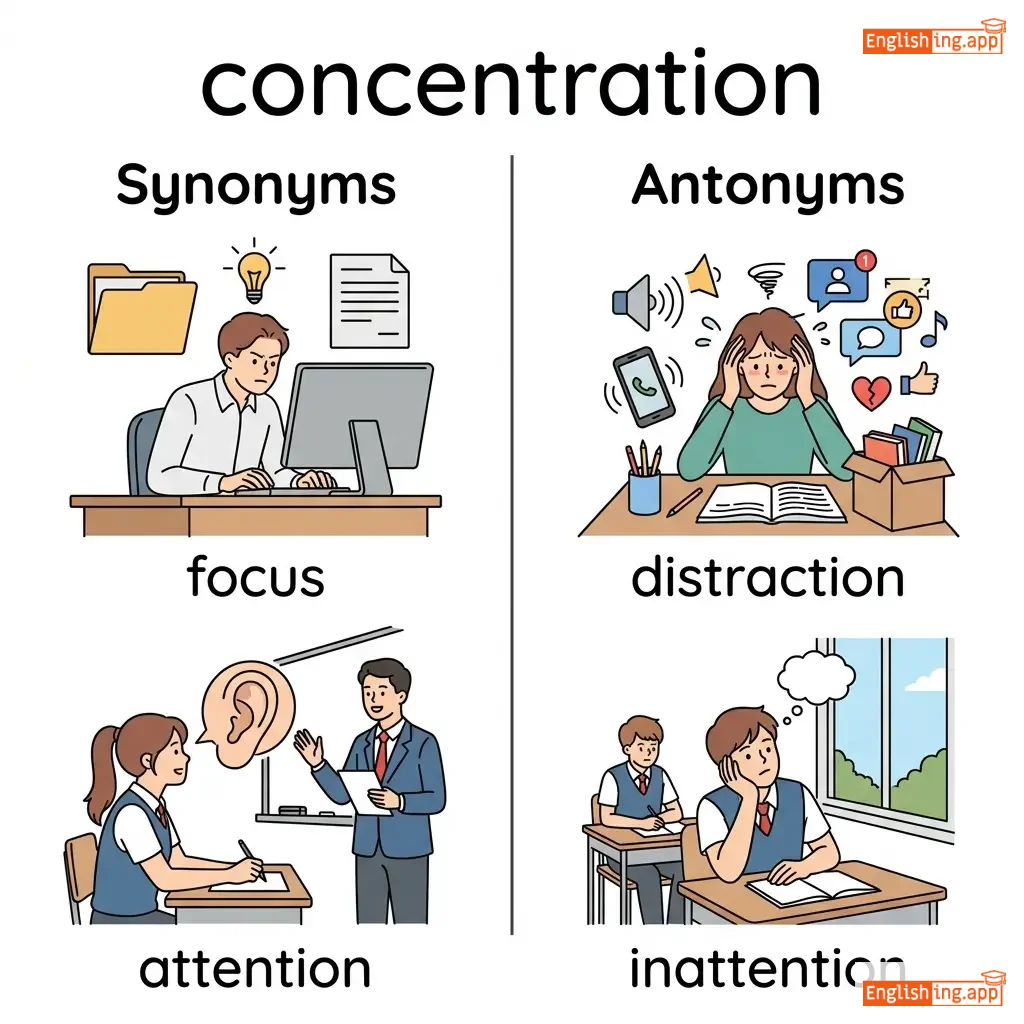
the act of focusing one's attention or mental effort on something
••••••
|
Good concentration is essential for success in exams.
良好的专注力对于考试成功至关重要。
••••••
|
良好的专注力对于考试成功至关重要。
Liánghǎo de zhuānzhù lì duìyú kǎoshì chénggōng zhìguān zhòngyào.
••••••
|
lose concentration
失去集中力
••••••
|
to be distracted and unable to focus
••••••
|
失去集中力
shīqù jízhōng lì
••••••
|
focus, attention, absorption, mindfulness
••••••
|
distraction, inattention
••••••
|
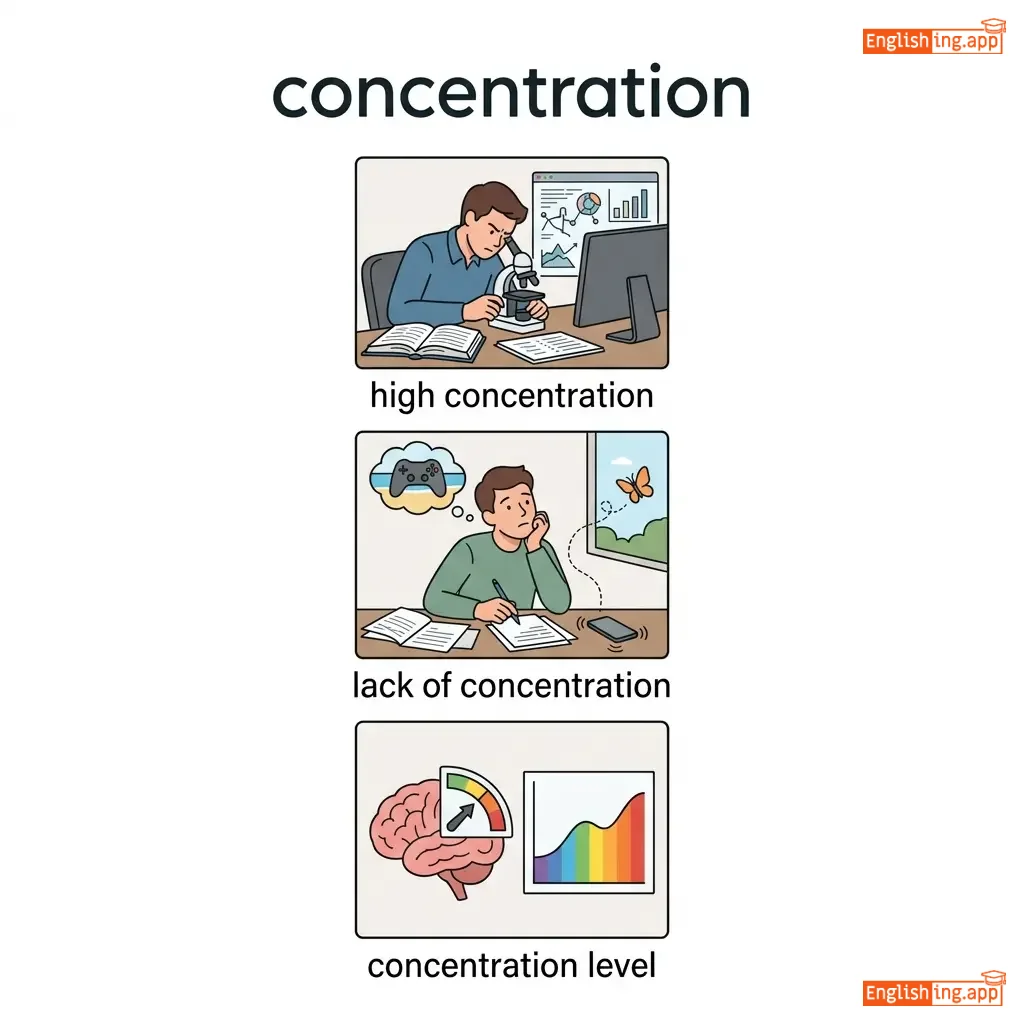
high concentration, lack of concentration, concentration level, concentration power
••••••
|
专注力:就像考试中的激光一样聚焦目标。
••••••
|
|
💡
••••••
|
/ˈkɑn.sept/
noun
(kàngsèpǔ)
••••••
|
|
概念; 一般概念
gainian, yiban gainian
••••••
|
- •••••• | - •••••• | - •••••• | - •••••• |
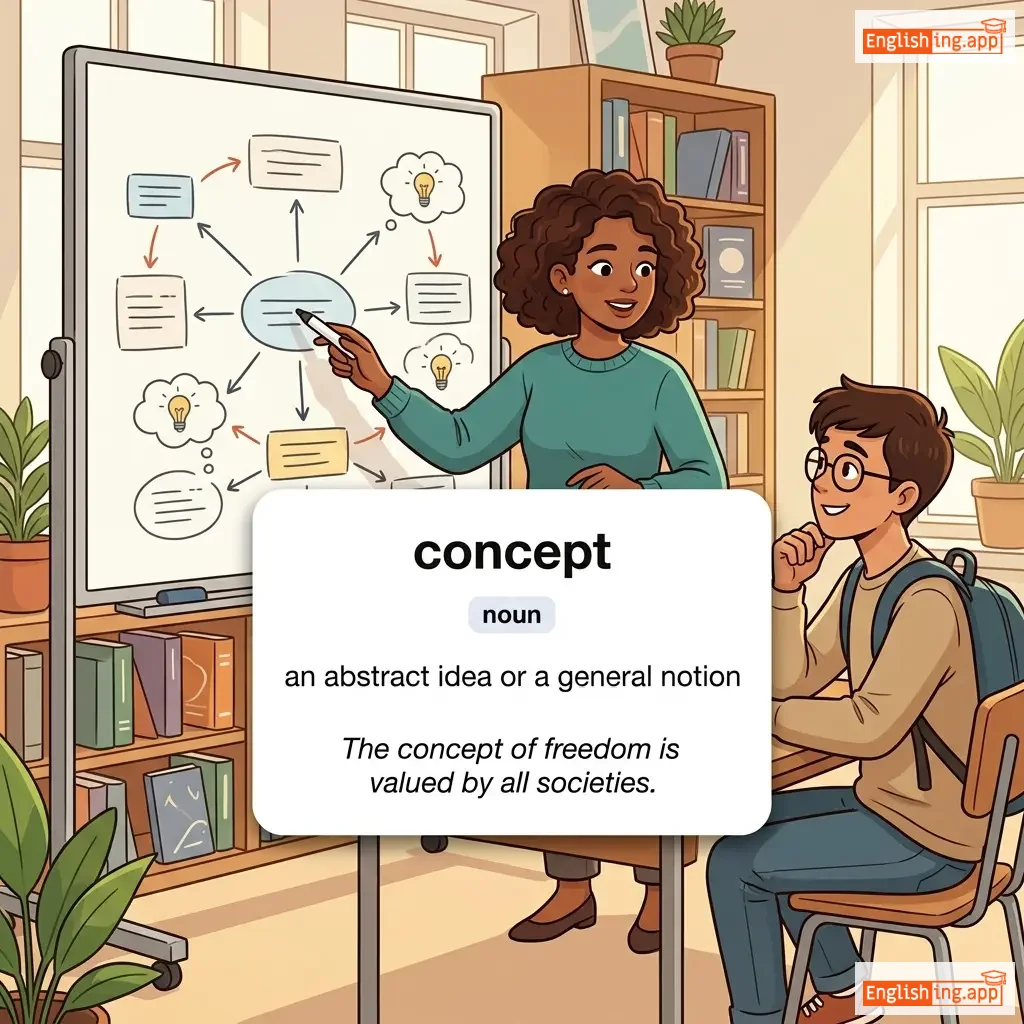
an abstract idea; a general notion or understanding of something; a plan or intention
••••••
|
The concept of democracy is based on the idea that people should govern themselves. |
民主的概念基于这样一个思想:人们应该自己管理自己。
mínzhǔ de gàiniàn jīyú zhèyàng yīgè sīxiǎng: rénmen yīnggāi zìjǐ guǎnlǐ zìjǐ.
••••••
|
- •••••• | - •••••• | - •••••• |
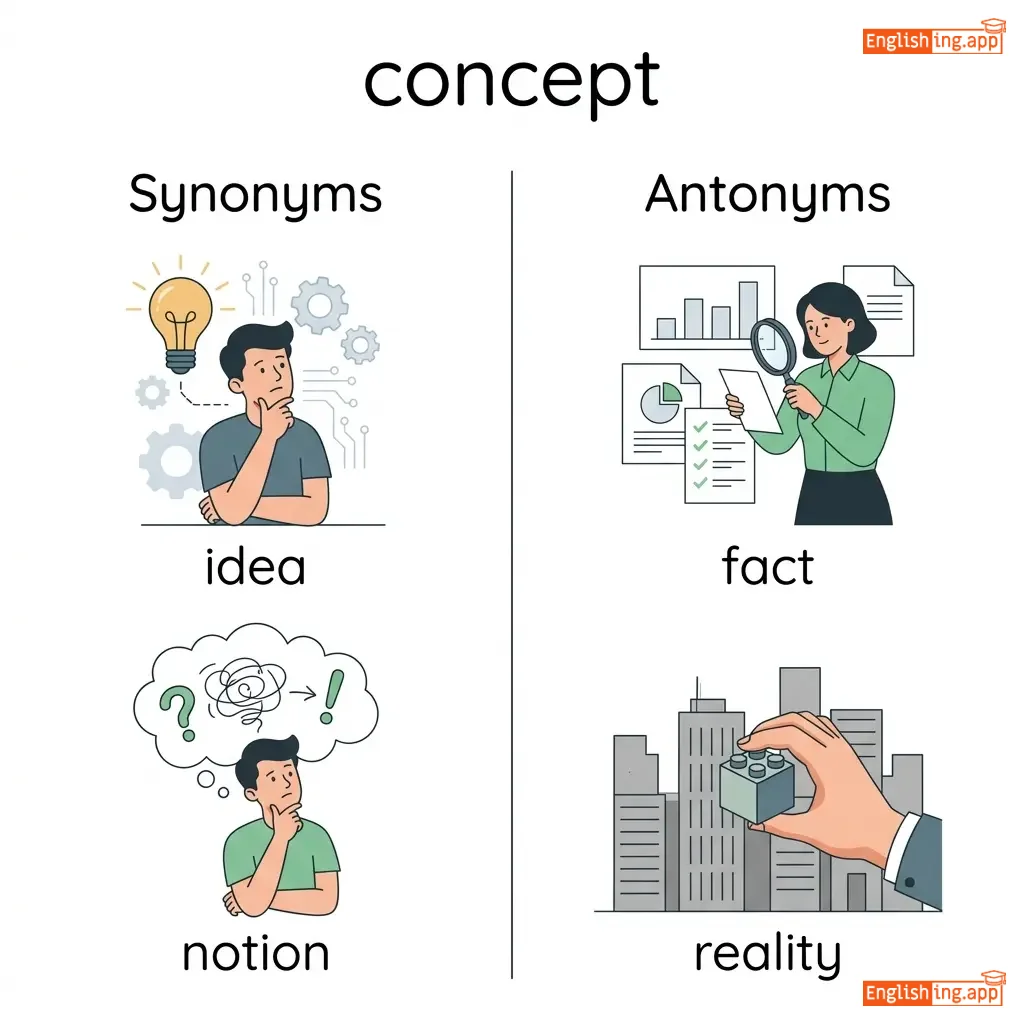
idea, notion, thought, principle
••••••
|
reality, fact, concrete example
••••••
|
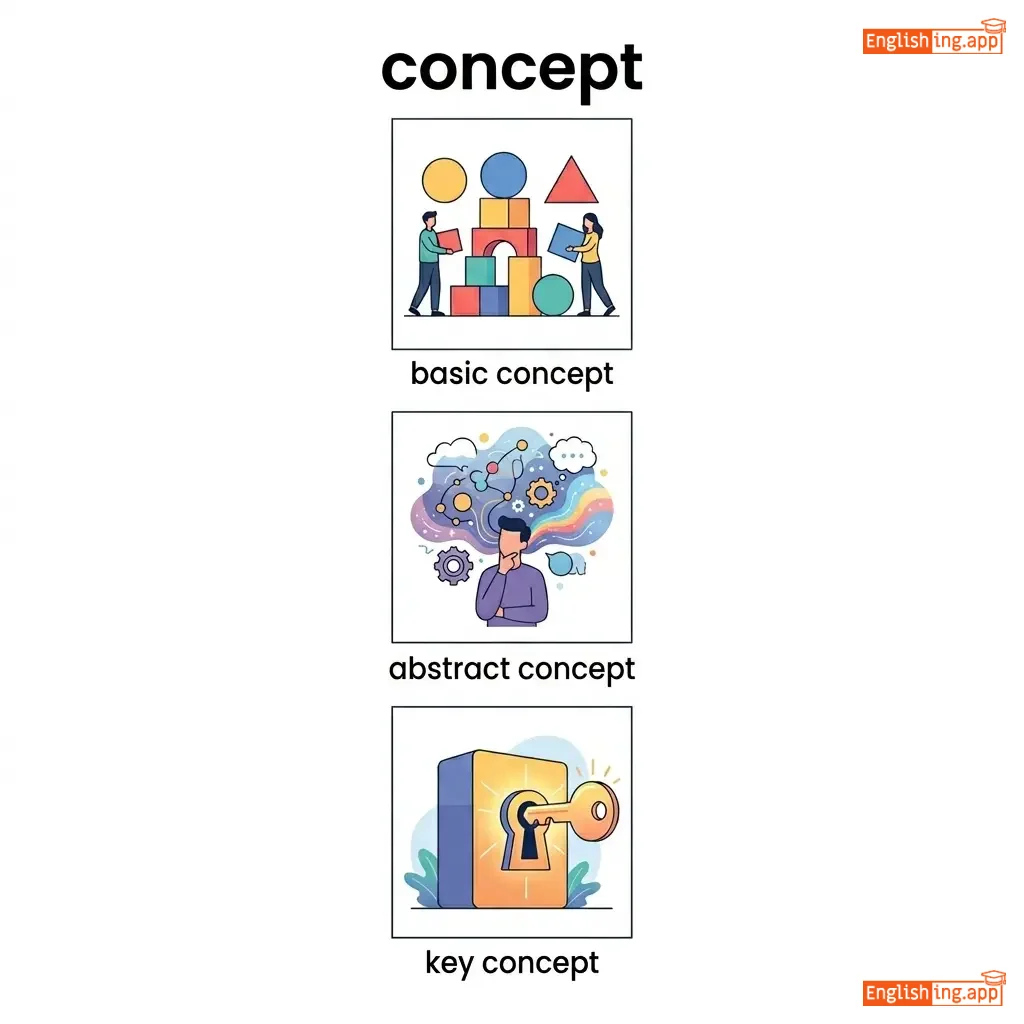
basic concept, new concept, concept development
••••••
|
中文 – 概念清晰,民主作为基本理念
••••••
|
|
🧠
••••••
|
/kənˈsɛpʃən/
noun
(kənˈsɛpʃən)
••••••
|
- •••••• |
构思, 受孕
gòusī, shòuyùn
••••••
|
- •••••• | - •••••• | - •••••• | - •••••• |
the forming or understanding of an idea; the act of conceiving a child
••••••
|
Her conception of the project was very different from ours. |
她对这个项目的构思与我们的完全不同。
tā duì zhège xiàngmù de gòusī yǔ wǒmen de wánquán bùtóng.
••••••
|
from conception to completion |
from the beginning of an idea to its final result
••••••
|
从构思到完成
cóng gòusī dào wánchéng
••••••
|
idea, notion, understanding, perception
••••••
|
misunderstanding, misconception
••••••
|
original conception, artistic conception, false conception
••••••
|
Conception 是想法,婴儿的 conception 是新生命的开始 🧠
••••••
|
|
😟
••••••
|
/kənˈsɜːrn/
noun/verb
••••••
|
- •••••• | - •••••• |
concerned
••••••
|
concerned
••••••
|
concerns
••••••
|
concerning
••••••
|
to relate to or affect; a matter of worry or interest
••••••
|
Environmental issues concern all of us. |
- •••••• |
of concern |
something that causes worry or interest
••••••
|
- •••••• |
worry, anxiety, interest, care, matter
••••••
|
indifference, unconcern
••••••
|
main concern, express concern, raise concern, serious concern
••••••
|
No •••••• |
|
😟
••••••
|
/kənˈsɜːnd/
adjective
(kənˈsɜːnd)
••••••
|
- •••••• |
担忧的
dānyōu de
••••••
|
- •••••• | - •••••• | - •••••• | - •••••• |
worried or anxious about something; involved or interested in something
••••••
|
She was concerned about her mother's health. |
她对母亲的健康感到担忧。
Tā duì mǔqīn de jiànkāng gǎndào dānyōu.
••••••
|
concerned with |
interested in or related to
••••••
|
关心
guānxīn
••••••
|
worried, anxious, troubled, uneasy
••••••
|
unconcerned, indifferent
••••••
|
concerned about, deeply concerned, concerned parents, concerned citizens
••••••
|
担忧的就是对事物感到焦虑,就像关心母亲的健康。
••••••
|
|
🎵
••••••
|
/ˈkɒnsət/
noun
(kǎnsèrt)
••••••
|
- •••••• |
音乐会
yīnyuè huì
••••••
|
- •••••• | - •••••• | - •••••• | - •••••• |
A musical performance given by one or more singers or musicians.
••••••
|
We went to a concert last night and enjoyed the live music. |
我们昨晚去了一场音乐会,并享受了现场音乐。
Wǒmen zuó wǎn qùle yīchǎng yīnyuè huì, bìng xiǎngshòule xiànchǎng yīnyuè.
••••••
|
in concert |
working together in agreement or harmony
••••••
|
齐心协力
qíxīnxiélì
••••••
|
show, performance, recital, gig, event
••••••
|
silence, solitude
••••••
|
live concert, rock concert, attend a concert, concert hall
••••••
|
音乐会是大家一起欣赏音乐的活动。
••••••
|
|
🤲
••••••
|
/kənˈsɛʃən/
noun
(kənˈsɛʃən)
••••••
|
- •••••• |
让步
rangbu
••••••
|
- •••••• | - •••••• | - •••••• | - •••••• |
something that is granted, especially in response to demands; a compromise
••••••
|
The company made several concessions during the negotiations. |
公司在谈判中做出了几次让步。
Gongsi zai tanpan zhong zuo chule jici rangbu.
••••••
|
make concessions |
to give up certain demands in order to reach an agreement
••••••
|
做出让步
zuo chu rangbu
••••••
|
compromise, allowance, adjustment, grant, yield
••••••
|
refusal, denial, resistance
••••••
|
make a concession, grant a concession, trade concession, minor concession
••••••
|
让步意味着在谈判中妥协
••••••
|
|
🔚
••••••
|
/kənˈkluːd/
verb
(kēnklúdì)
••••••
|
|
结束,做出决定
jiéshù, zuò chū juédìng
••••••
|
concluded
kēnklúdì le
••••••
|
concluded
kēnklúdì le
••••••
|
concludes
kēnklúdì
••••••
|
concluding
kēnklúdìng
••••••
|
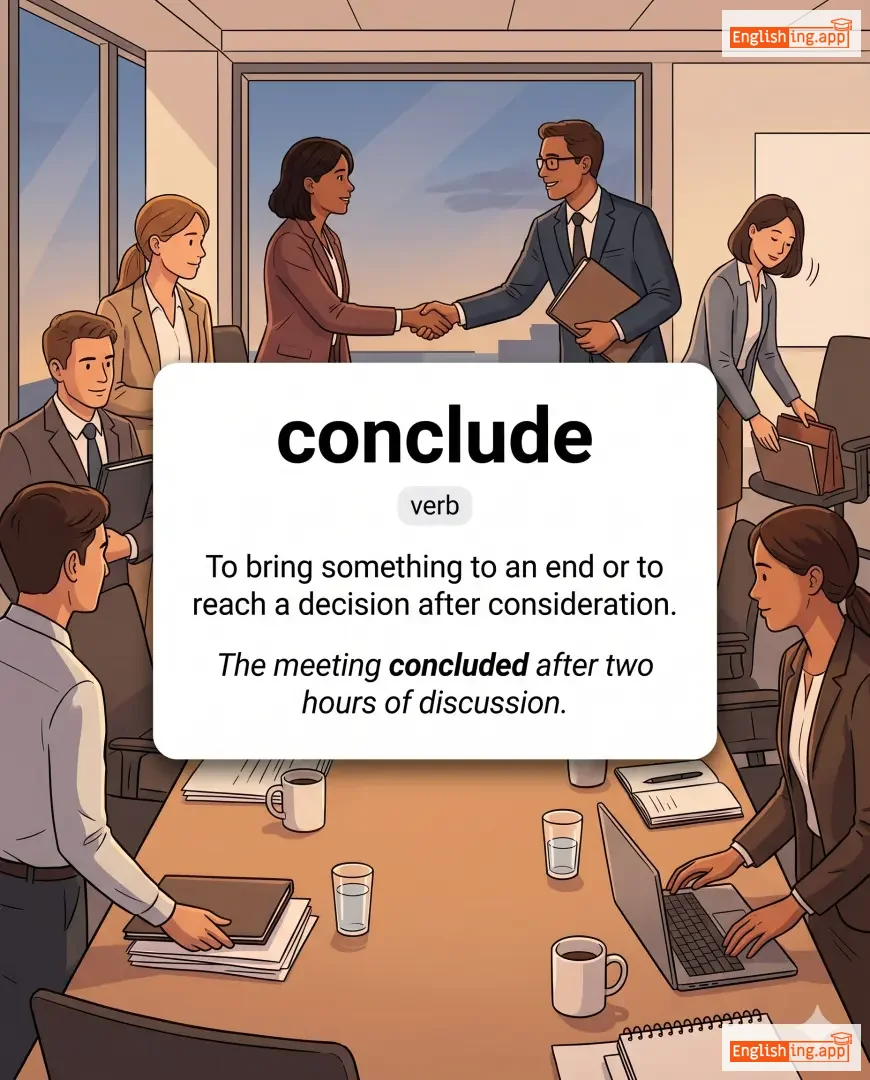
To bring something to an end or to reach a decision after consideration.
••••••
|
The meeting concluded after two hours of discussion.
会议在两个小时的讨论后结束。
••••••
|
会议在两个小时的讨论后结束。
Huìyì zài liǎng gè xiǎoshí de tǎolùn hòu jiéshù.
••••••
|
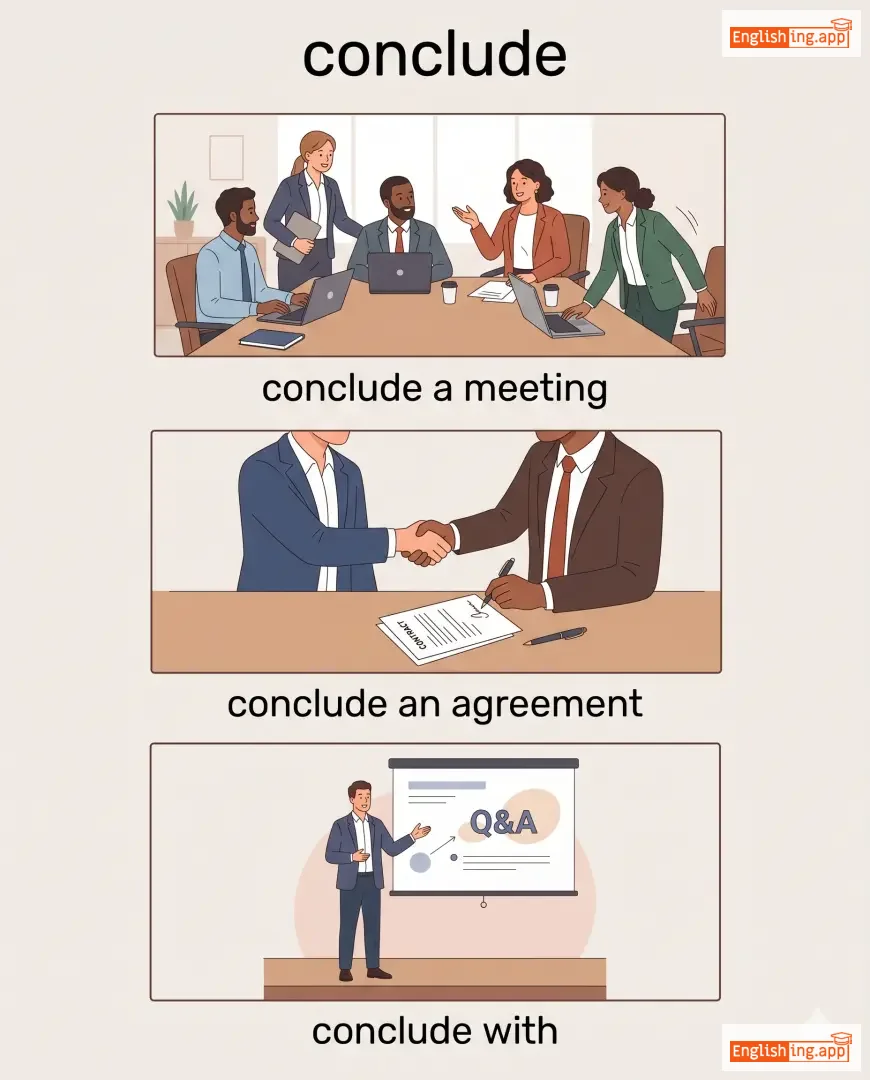
to conclude with
以...结束
••••••
|
to end something by doing or saying a final thing
••••••
|
以...结束
yǐ...jiéshù
••••••
|
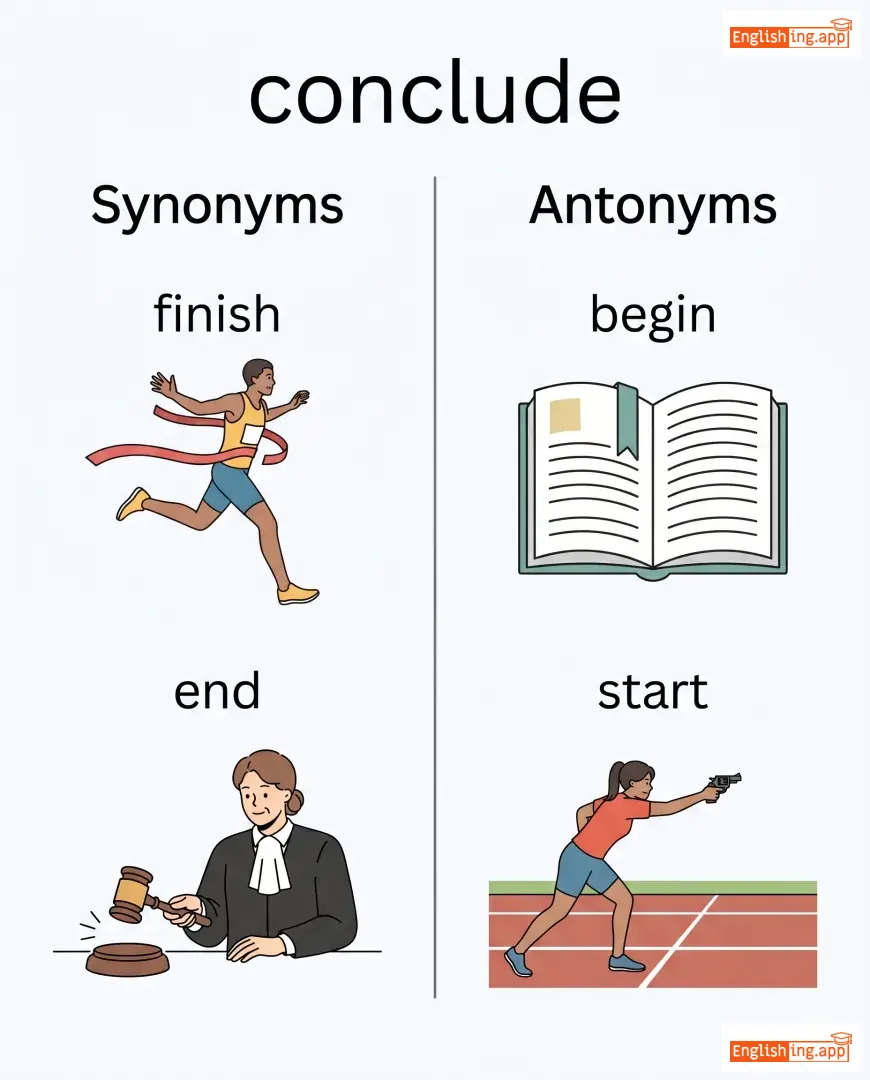
finish, end, determine, decide, finalize
••••••
|
begin, start, continue
••••••
|
conclude a meeting, conclude an agreement, conclude with, conclude that
••••••
|
Conclude 就是结论,意思就是结束
••••••
|
|
📘
••••••
|
/kənˈkluːʒən/
noun
(kənˈkluːʒən)
••••••
|
- •••••• |
结论
jie lun
••••••
|
- •••••• | - •••••• | - •••••• | - •••••• |
The end or finish of an event, process, or text; a judgment reached after consideration.
••••••
|
The research paper ends with a strong conclusion. |
研究论文以一个有力的结论结束。
Yánjiū lùnwén yǐ yīgè yǒulì de jiélùn jiéshù.
••••••
|
jump to conclusions |
to make a decision without having all the facts
••••••
|
匆忙下结论
cōngmáng xià jiélùn
••••••
|
end, result, outcome, judgment, decision
••••••
|
beginning, start, opening
••••••
|
draw a conclusion, reach a conclusion, in conclusion, strong conclusion
••••••
|
Conclusion 就是结论 – 思考后的最终结果。
••••••
|
|
🏗️
••••••
|
/ˈkɒŋkriːt/
adjective
(kōngkè lǐtè)
••••••
|
- •••••• |
具体
juti
••••••
|
- •••••• | - •••••• | - •••••• | - •••••• |
based on facts, not on ideas or guesses; specific and real
••••••
|
She gave a concrete example to support her argument. |
她举了一个具体的例子来支持她的论点。
Tā jǔle yīgè jùtǐ de lìzi lái zhīchí tā de lùndiǎn.
••••••
|
set in concrete |
to be fixed and unchangeable
••••••
|
固定不变
gùdìng bù biàn
••••••
|
tangible, solid, real, specific
••••••
|
abstract, vague, unreal
••••••
|
concrete example, concrete evidence, concrete plan, concrete structure
••••••
|
Concrete 就是像混凝土一样,坚固而具体。
••••••
|
|
❌
••••••
|
/kənˈdɛm/
verb
(kān-dēm)
••••••
|

|
谴责
qianze
••••••
|
condemned
kān-dēm-d
••••••
|
condemned
kān-dēm-d
••••••
|
condemns
kān-dēm-s
••••••
|
condemning
kān-dēm-ing
••••••
|
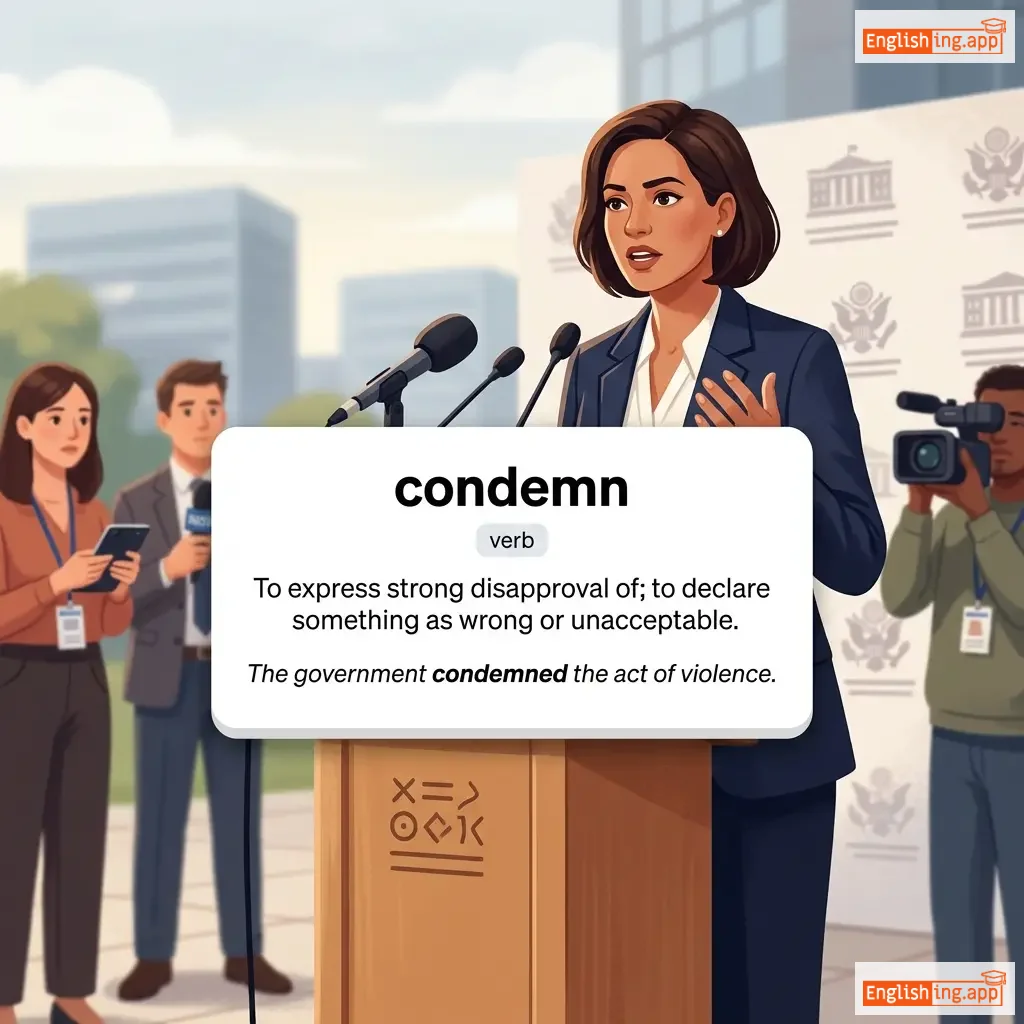
To express strong disapproval of; to declare something as wrong or unacceptable.
••••••
|
The government condemned the act of violence.
政府谴责了暴力行为。
••••••
|
政府谴责了暴力行为。
zhèngfǔ qiǎnzéle bàolì xíngwéi.
••••••
|
condemn to death
判处死刑
••••••
|
to sentence someone to death as punishment
••••••
|
判处死刑
pànchǔ sǐxíng
••••••
|
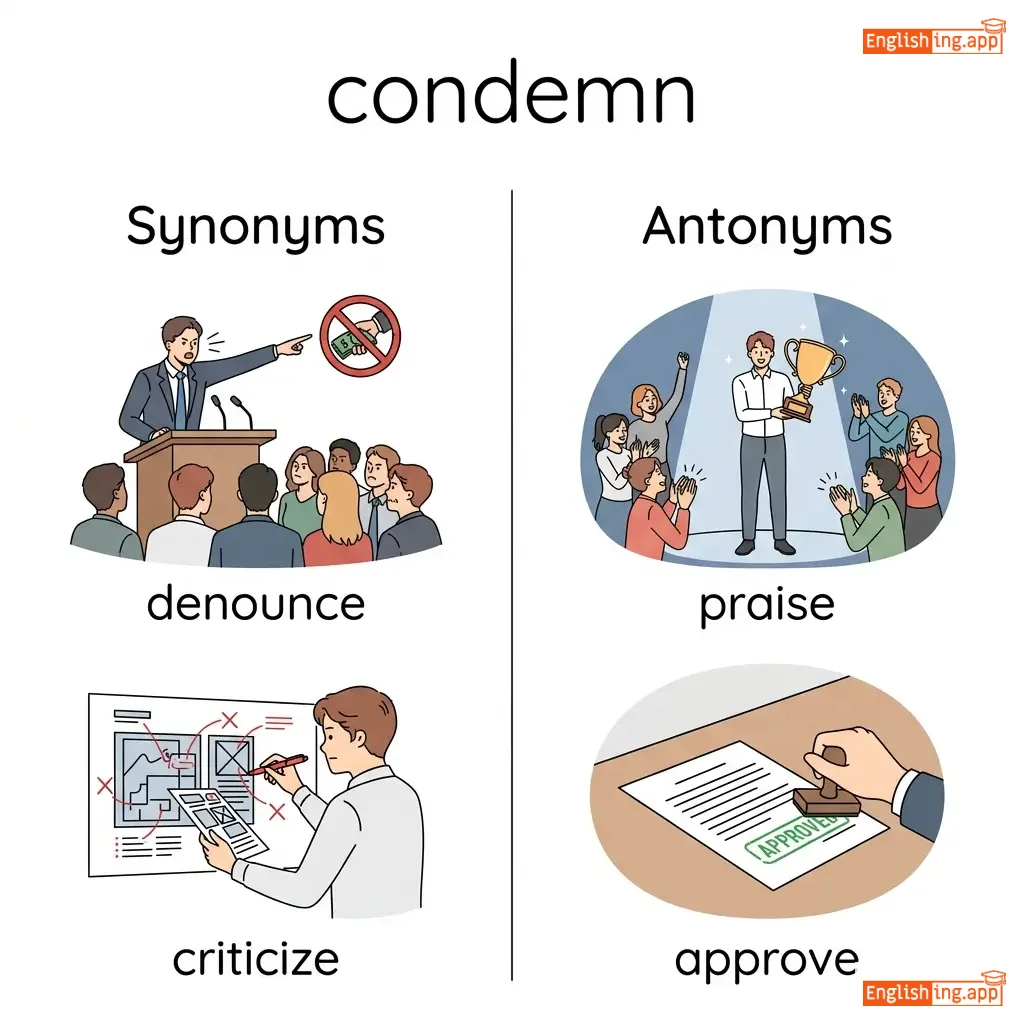
denounce, criticize, censure, blame
••••••
|
praise, approve, support
••••••
|
condemn strongly, condemn violence, condemn publicly, condemn actions
••••••
|
Condemn 就是'谴责',好像在惩罚某人做错的事。
••••••
|
|
⚙️
••••••
|
/kənˈdɪʃən/
noun
(条件)
••••••
|

|
状态, 条件
zhuangtai, tiaojian
••••••
|
- •••••• | - •••••• | - •••••• | - •••••• |
The state of something with regard to its appearance, quality, or working order; a requirement that must be met.
••••••
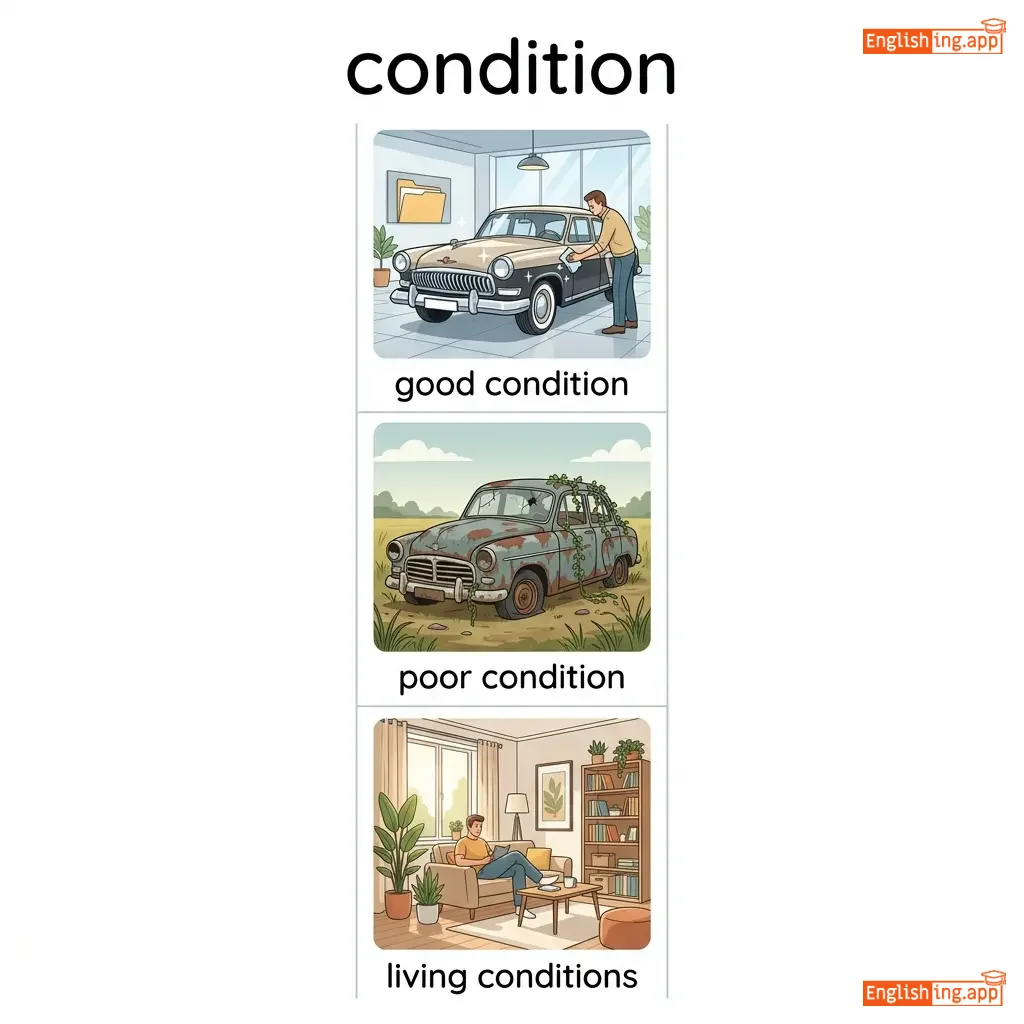
|
The car is in excellent condition. |
这辆车的状态很好。
Zhe liang che de zhuangtai hen hao.
••••••
|
on condition that |
only if something else happens or is done
••••••
|
在...条件下
zai... tiaojian xia
••••••
|
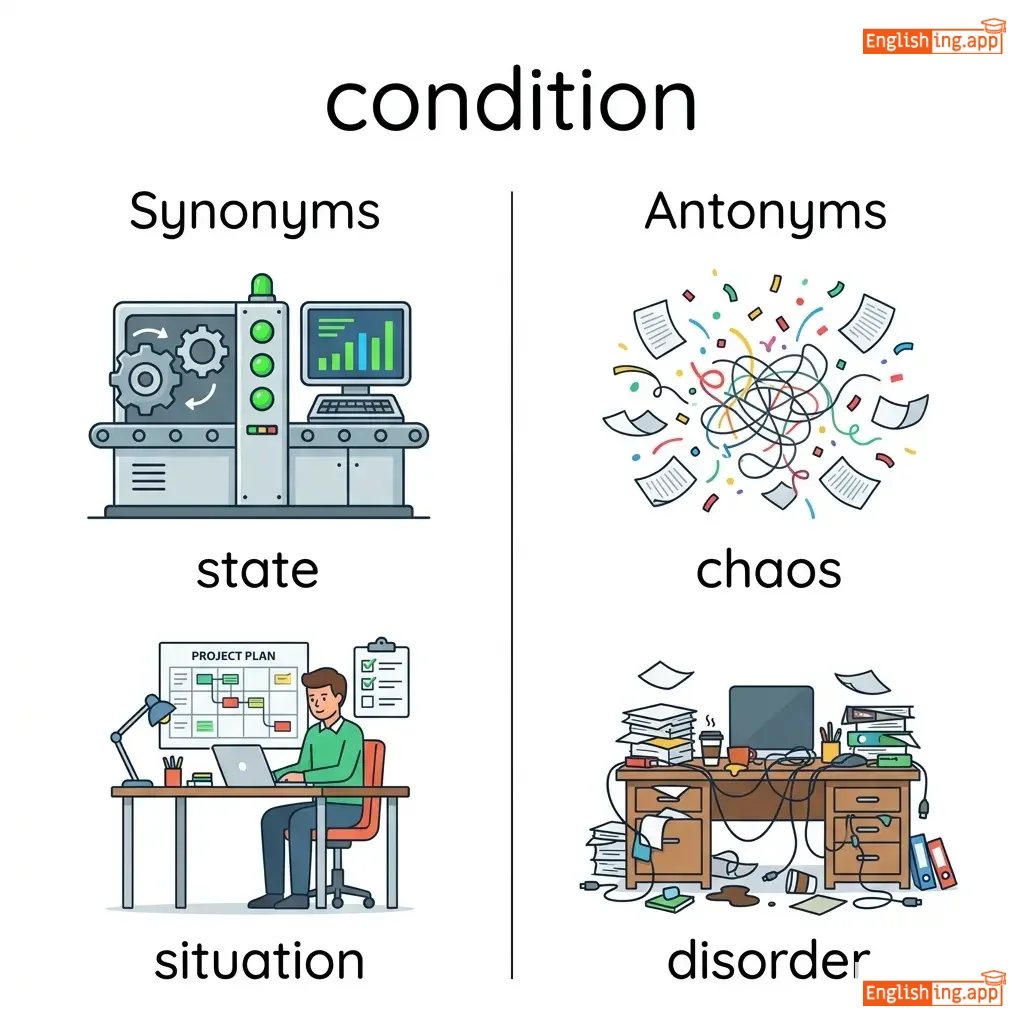
state, situation, requirement, circumstance, health
••••••
|
chaos, disorder
••••••
|
good condition, poor condition, living conditions, under condition
••••••
|
Condition 是条件 - 就像通过考试的条件。
••••••
|
|
🧑🏫
••••••
|
/ˈkɒndʌkt/ (noun), /kənˈdʌkt/ (verb)
noun, verb
••••••
|
- •••••• | - •••••• |
conducted
••••••
|
conducted
••••••
|
conducts
••••••
|
conducting
••••••
|
to organize or carry out; or a person's behavior
••••••
|
The teacher conducted the exam fairly. |
- •••••• |
conduct oneself |
to behave in a particular manner
••••••
|
- •••••• |
manage, carry out, perform, behavior, demeanor
••••••
|
mismanage, neglect, misconduct
••••••
|
conduct research, conduct business, professional conduct
••••••
|
No •••••• |
|
💬
••••••
|
/kənˈfɜːr/
verb
••••••
|
- •••••• | - •••••• |
conferred
••••••
|
conferred
••••••
|
confers
••••••
|
conferring
••••••
|
to discuss something important or to grant or bestow something
••••••
|
The committee will confer to decide on the new policy. |
- •••••• |
confer a degree |
to officially give someone a degree
••••••
|
- •••••• |
consult, discuss, grant, bestow, award
••••••
|
withhold, deny
••••••
|
confer with, confer about, confer a degree, confer title
••••••
|
No •••••• |
|
👥
••••••
|
/ˈkɒnfərəns/
noun
(kōng fēi lún sī)
••••••
|


|
会议
huiyi
••••••
|
- •••••• | - •••••• | - •••••• | - •••••• |
A formal meeting for discussion, especially about a particular subject.
••••••
|
She is attending an international business conference. |
她正在参加一个国际商业会议。
Tā zhèngzài cānjiā yīgè guójì shāngyè huìyì.
••••••
|
press conference |
a meeting where journalists are given information by a public figure
••••••
|
新闻发布会
xīnwén fābù huì
••••••
|
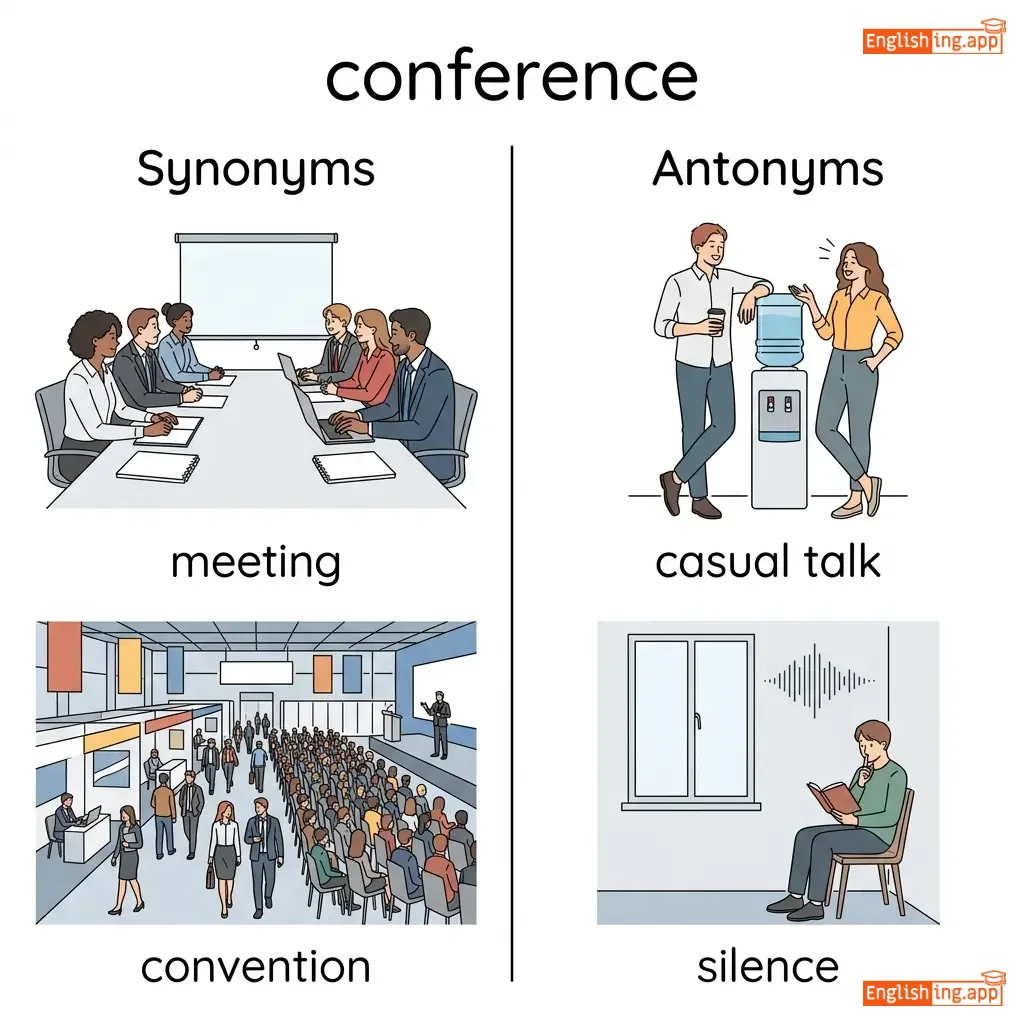
meeting, convention, seminar, summit, symposium
••••••
|
casual talk, silence
••••••
|
business conference, international conference, annual conference, conference hall
••••••
|
会议是一个讨论重要话题的地方,就像新闻发布会。
••••••
|

