Получите неограниченный доступ ко всем словам с подпиской Pro
Обновить до ProПолучите неограниченный доступ ко всем предложениям с подпиской Pro
Обновить до Pro|
Эмодзи
|
Слово | Images | Перевод | Прошедшее | Причастие прошедшего времени | Третье лицо единственного числа | Герундий | Значение | Пример предложения | Перевод примера предложения | Пример выражения | Значение примера выражения | Перевод примера выражения | Синонимы | Антонимы | Коллокации | Мнемоника |
|---|---|---|---|---|---|---|---|---|---|---|---|---|---|---|---|---|---|
|
🎓
••••••
|
/ˈklɑːsmeɪt/
noun
(классмейт)
••••••
|
- •••••• |
одноклассник
odnoklassnik
••••••
|
- •••••• | - •••••• | - •••••• | - •••••• |
a person who is in the same class or course of study as another
••••••
|
I met one of my old classmates at the university event.
Ай мет уан оф май олд классмейтс эт зе юниверсити ивент।
••••••
|
Я встретил одного из своих старых одноклассников на университетском мероприятии.
ya vstretil odnogo iz svoikh starykh odnoklassnikov na universitetskom meropriyatii
••••••
|
- •••••• | - •••••• | - •••••• |
schoolmate, peer, fellow student, class fellow
••••••
|
enemy, stranger
••••••
|
old classmate, former classmate, close classmate, classmate reunion
••••••
|
class + mate = одноклассник
••••••
|
|
🏫
••••••
|
/ˈklæsˌruːm/
noun
(klasrum)
••••••
|
- •••••• |
классная комната
klassnaya komnata
••••••
|
- •••••• | - •••••• | - •••••• | - •••••• |
A room in which classes are held in a school or college.
••••••
|
The teacher entered the classroom and greeted the students. |
Учитель вошел в классную комнату и поприветствовал студентов.
Uchitel' voshel v klassnuyu komnatu i poprivetsvoval studentov.
••••••
|
empty classroom |
A classroom with no students or teacher inside.
••••••
|
пустой класс
pustoy klass
••••••
|
lecture room, study room, hall, learning space
••••••
|
playground, office
••••••
|
classroom activities, classroom management, classroom environment, classroom learning
••••••
|
Классная комната значит classroom 🏫, место для обучения.
••••••
|
|
🧹
••••••
|
/kliːn/
verb
(klīn)
••••••
|
- •••••• |
чистить
chistit'
••••••
|
cleaned
klīnd
••••••
|
cleaned
klīnd
••••••
|
cleans
klīns
••••••
|
cleaning
klīnɪng
••••••
|
To make something free from dirt, marks, or mess.
••••••
|
She cleaned the kitchen before the guests arrived.
Она убрала кухню перед тем, как пришли гости.
••••••
|
Она убрала кухню перед тем, как пришли гости.
Ona ubrala kukhnyu pered tem, kak prishli gosti.
••••••
|
clean slate
чистая доска
••••••
|
A fresh start without any past problems.
••••••
|
чистая доска
chistaya doska
••••••
|
wash, scrub, wipe, tidy, purify
••••••
|
dirty, pollute, soil
••••••
|
clean room, clean clothes, clean water, clean environment
••••••
|
Clean означает чистить — 🧽 'Чистить' означает все очищать.
••••••
|
|
🧹
••••••
|
/klɪr/
verb
(klir)
••••••
|
|
очищать
ochishchat'
••••••
|
cleared
klíerd
••••••
|
cleared
klíerd
••••••
|
clears
klíers
••••••
|
clearing
klíering
••••••
|
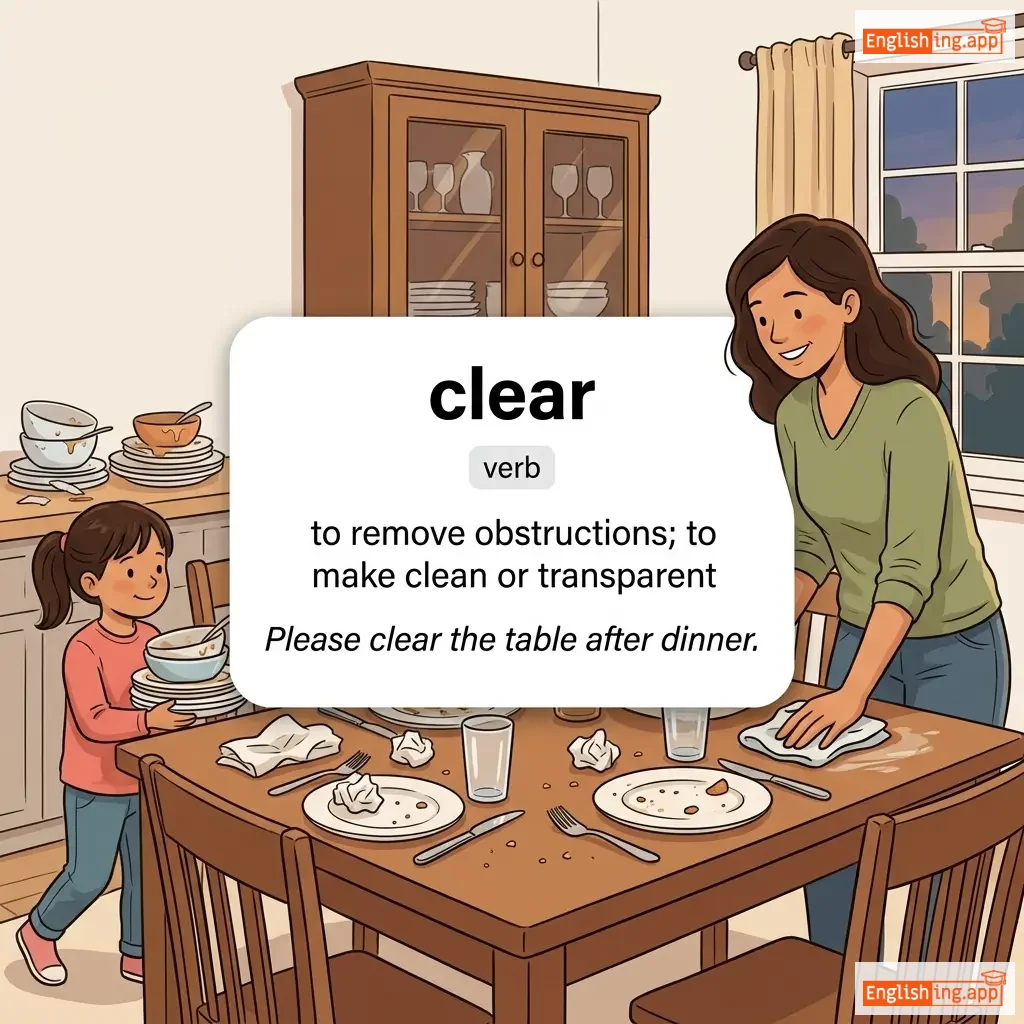
to remove obstructions; to make clean or transparent
••••••
|
Please clear the table after dinner.
Пожалуйста, очистите стол после ужина.
••••••
|
Пожалуйста, очистите стол после ужина.
Pozhaluysta, ochistite stol posle uzhina.
••••••
|
- •••••• | - •••••• | - •••••• |
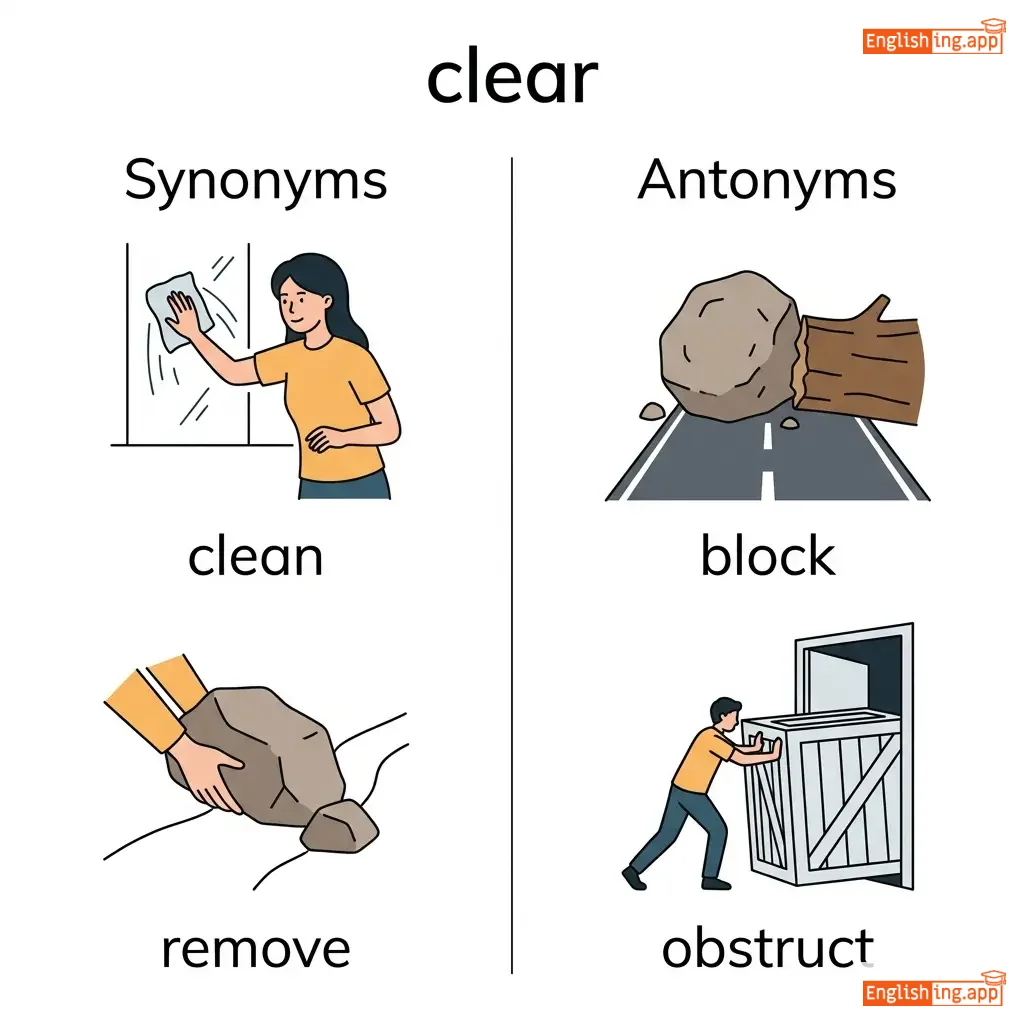
clean, remove, empty, tidy
••••••
|
block, obstruct, dirty, clutter
••••••
|
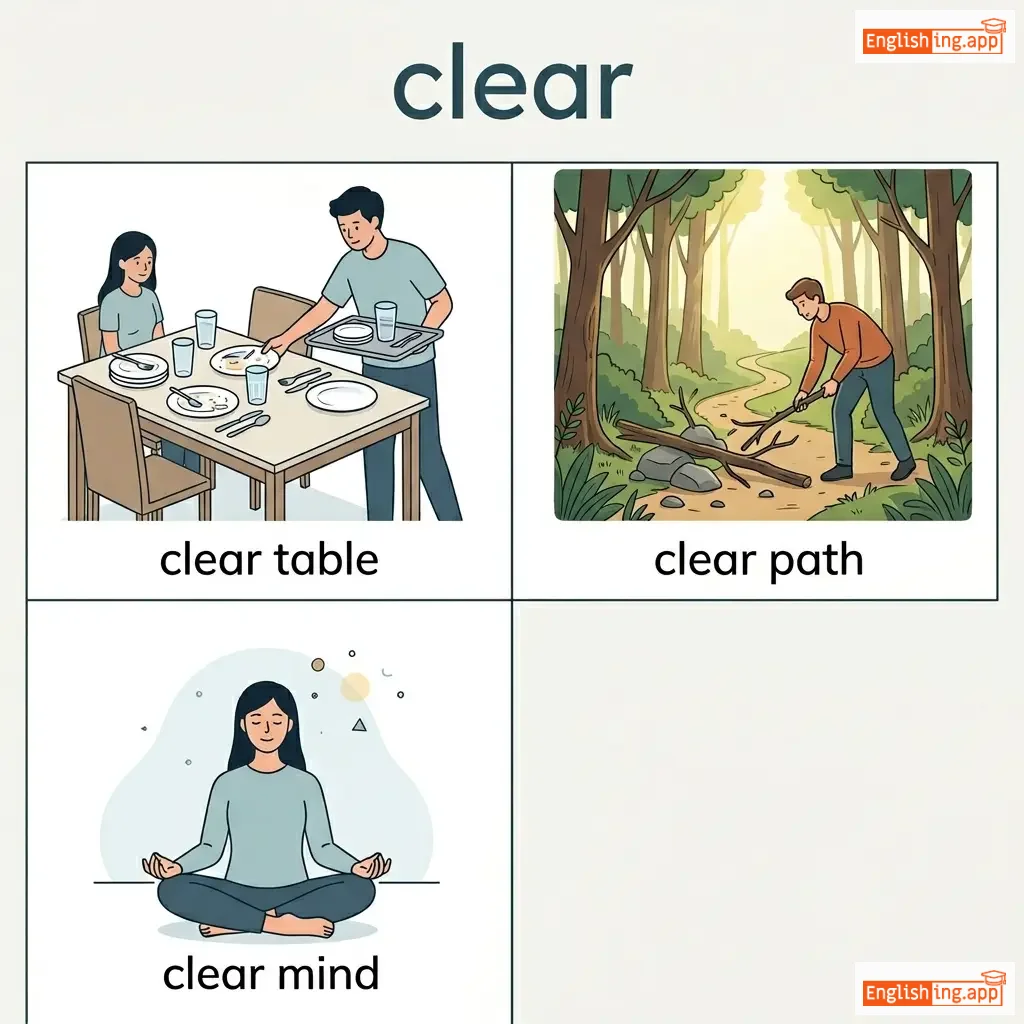
clear table, clear path, clear mind, clear sky, clear water, clear debt
••••••
|
Clear the table just like clearing away obstacles in life
••••••
|
|
🔍
••••••
|
/ˈklɪrli/
adverb
(klirli)
••••••
|
- •••••• |
ясно
yasno
••••••
|
- •••••• | - •••••• | - •••••• | - •••••• |
In a way that is easy to perceive, understand, or see.
••••••
|
She spoke clearly so that everyone could understand. |
Она говорила ясно, чтобы все могли понять.
Ona govoryla yasno, chtoby vse mogli ponyat'.
••••••
|
- •••••• | - •••••• | - •••••• |
plainly, distinctly, obviously, transparently
••••••
|
vaguely, unclearly
••••••
|
speak clearly, see clearly, think clearly, explain clearly
••••••
|
Clearly означает ясно 🔍 — 'Если говорить ясно, все поймут четко.'
••••••
|
|
🗂️
••••••
|
/klɑːrk/
noun
(клерк)
••••••
|
- •••••• |
клерк
klerk
••••••
|
- •••••• | - •••••• | - •••••• | - •••••• |
A person employed in an office or bank to keep records, accounts, and undertake other routine administrative duties.
••••••
|
The clerk helped me find the correct form. |
Клерк помог мне найти правильную форму.
Klerk pomog mne nayti pravil'nuyu formu.
••••••
|
- •••••• | - •••••• | - •••••• |
assistant, cashier, teller, secretary, bookkeeper
••••••
|
manager, employer
••••••
|
office clerk, bank clerk, sales clerk, law clerk
••••••
|
Клерк — это человек, который помогает в офисе с документами.
••••••
|
|
🧠
••••••
|
/ˈklɛvər/
adjective
(кле́вер)
••••••
|
- •••••• |
умный, сообразительный
umnyj, soobrazitel'nyj
••••••
|
- •••••• | - •••••• | - •••••• | - •••••• |
Quick to understand, learn, and devise ideas or solutions; intelligent.
••••••
|
She is clever enough to solve the puzzle quickly.
Она достаточно умна, чтобы быстро решить головоломку.
••••••
|
Она достаточно умна, чтобы быстро решить головоломку.
Ona dostatochno umna, chtoby bystro reshit' golovolomku.
••••••
|
clever trick
хитрый трюк
••••••
|
A smart or ingenious method to achieve something.
••••••
|
хитрый трюк
khitryj tryuk
••••••
|
smart, intelligent, bright, witty, sharp
••••••
|
dull, foolish, stupid
••••••
|
clever idea, clever trick, clever solution, clever child
••••••
|
Clever - это как 'умный кот' 🐱 всегда находит решение.
••••••
|
|
👤
••••••
|
/ˈklaɪənt/
noun
(klajənt)
••••••
|
- •••••• |
клиент
klient
••••••
|
- •••••• | - •••••• | - •••••• | - •••••• |
A person or organization using the services of a professional or company.
••••••
|
The lawyer met with her client to discuss the case. |
Адвокат встретился с её клиентом, чтобы обсудить дело
Advokat vstretilsya s yeё klientom, chtoby obsluzhivat' delo
••••••
|
client base |
The group of clients a company serves.
••••••
|
клиентская база
klientskaia baza
••••••
|
customer, patron, consumer, buyer
••••••
|
seller, provider
••••••
|
client meeting, client relationship, client support, client base
••••••
|
Клиент = тот, кто всегда получает услугу
••••••
|
|
⛰️
••••••
|
/klɪf/
noun
(клиф)
••••••
|
- •••••• |
обрыв
obryv
••••••
|
- •••••• | - •••••• | - •••••• | - •••••• |
a high, steep face of rock or earth
••••••
|
The waves crashed against the bottom of the cliff. |
Волны ударили о дно обрыва.
Volny udarili o dno obryva.
••••••
|
on the edge of a cliff |
in a very dangerous or risky situation
••••••
|
в очень опасной или рискованной ситуации
v ochen' opasnoi ili riskovannoi situatsii
••••••
|
precipice, bluff, escarpment, rock face
••••••
|
valley, plain
••••••
|
high cliff, sea cliff, steep cliff, rocky cliff
••••••
|
ОБРЫВ означает обрыв, представь, что ты падаешь с обрыва, 'жизнь' в опасности!
••••••
|
|
🌦️
••••••
|
/ˈklaɪ.mət/
noun
(klai-mit)
••••••
|
|
климат
klimat
••••••
|
- •••••• | - •••••• | - •••••• | - •••••• |
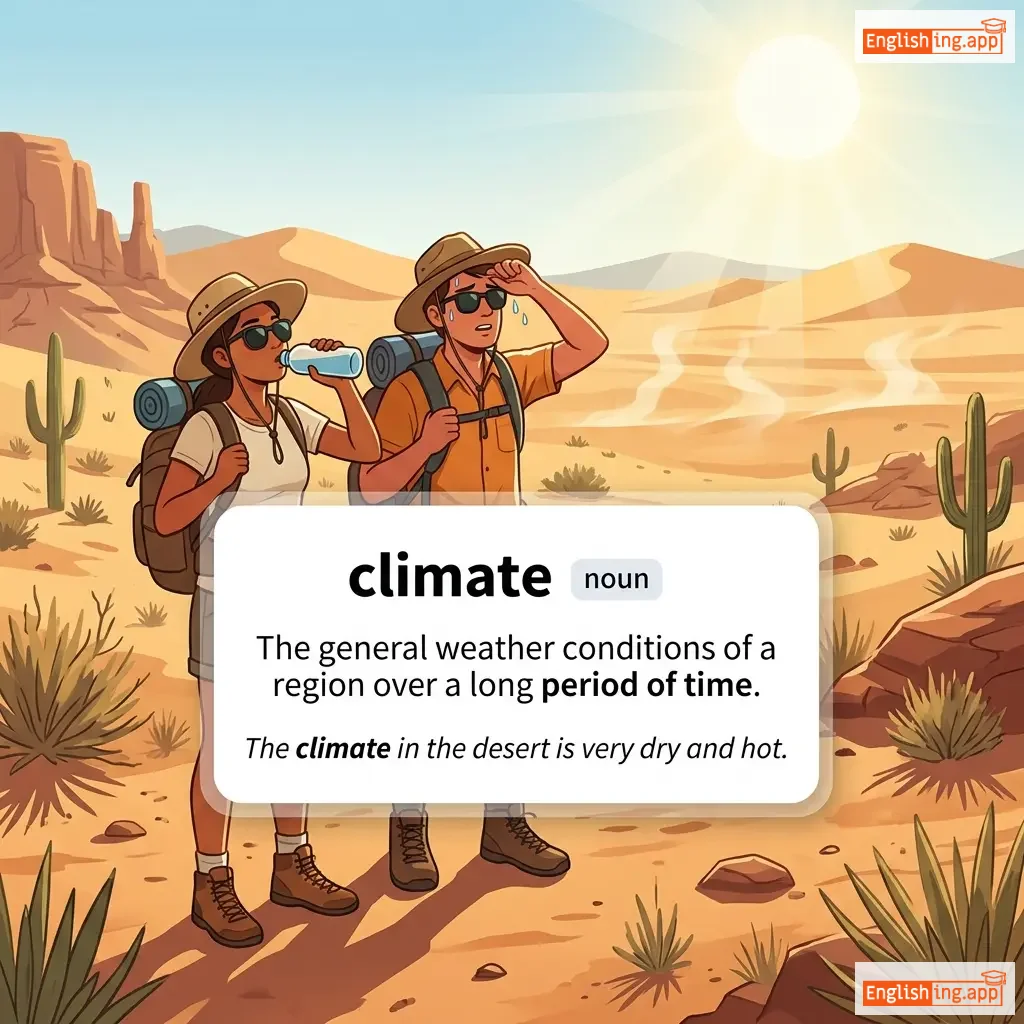
The general weather conditions of a region over a long period of time.
••••••
|
The climate in the desert is very dry and hot. |
Климат в пустыне очень сухой и жаркий.
Klimat v pustyne ochen' sukhoy i zharkiy.
••••••
|
climate change |
Long-term alteration of temperature and typical weather patterns in a place.
••••••
|
изменение климата
izmenenie klimata
••••••
|
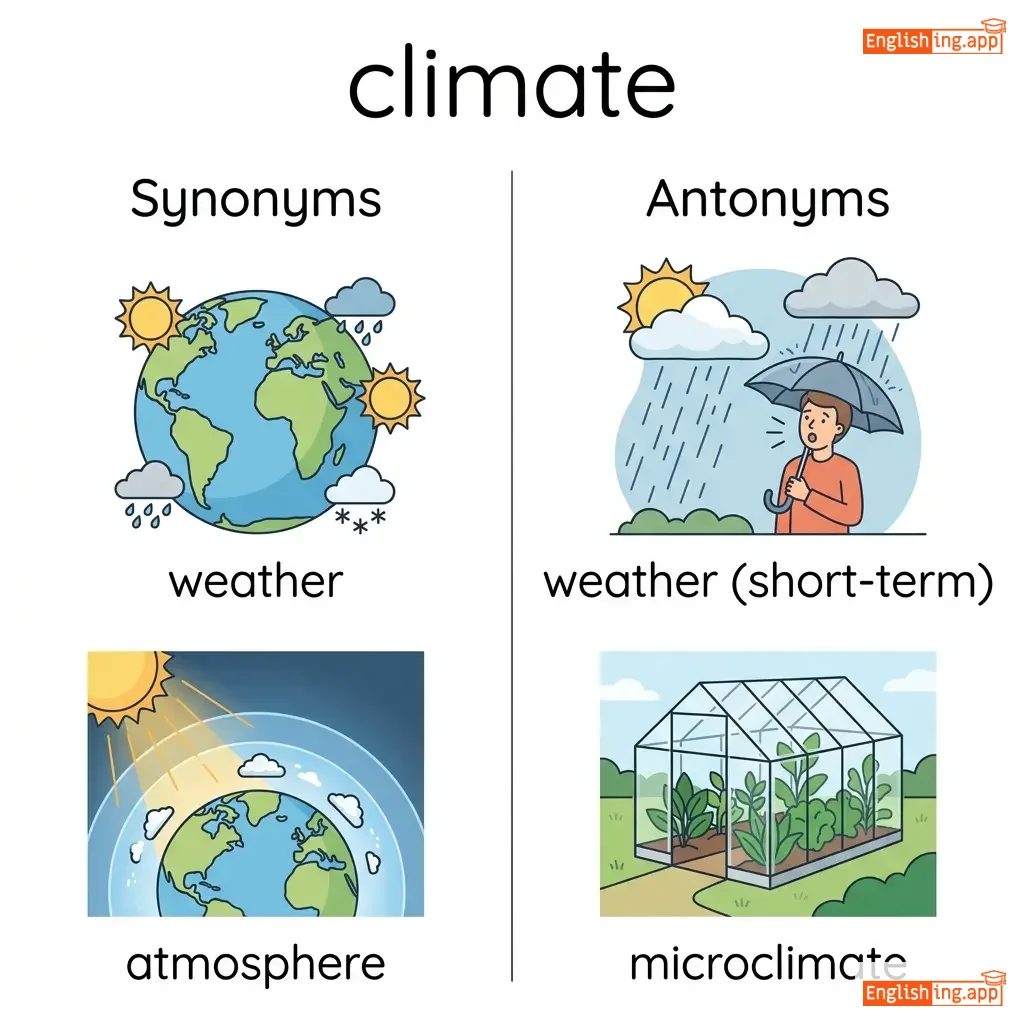
weather, atmosphere, environment, conditions, surroundings
••••••
|
weather (short-term), microclimate
••••••
|
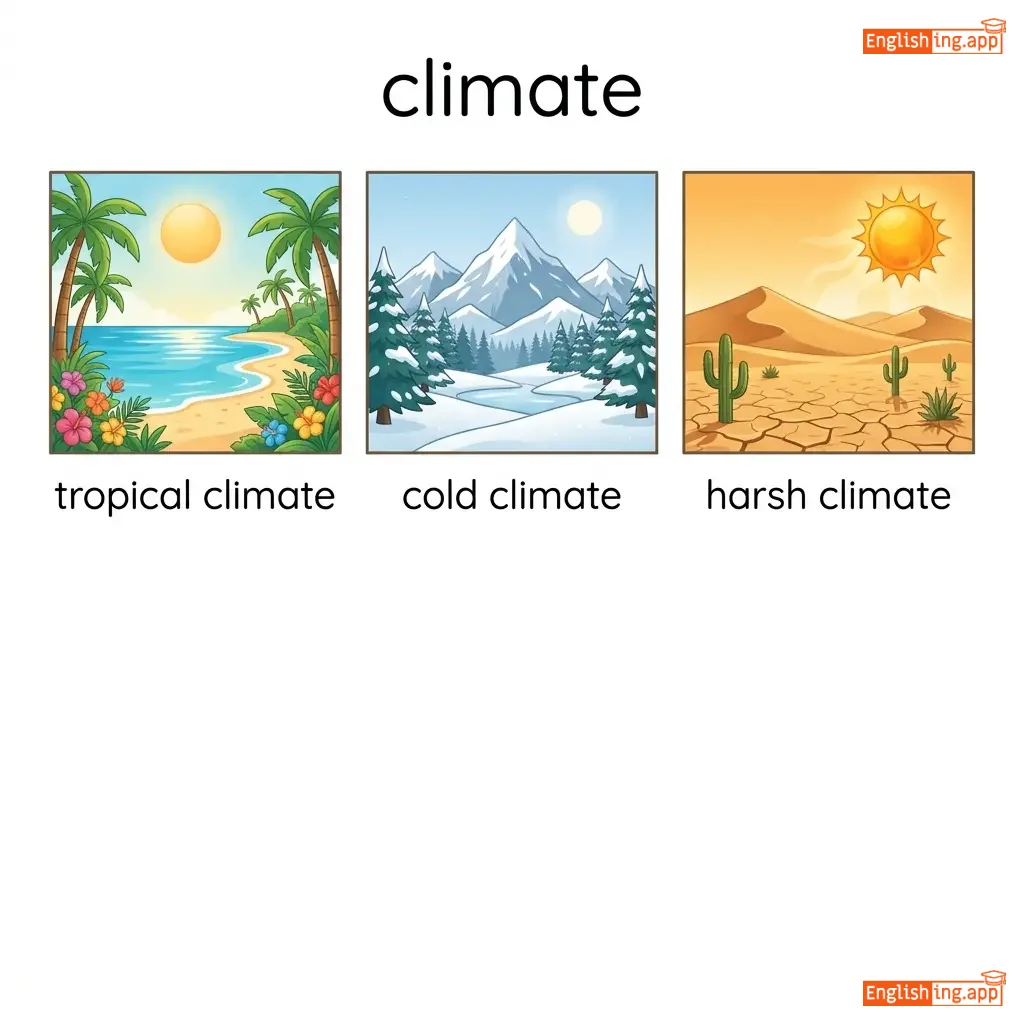
tropical climate, cold climate, harsh climate, political climate, climate change
••••••
|
Климат = изменение! Подумай об изменении климата.
••••••
|
|
🧗
••••••
|
/klaɪm/
verb
(клайм)
••••••
|
|
подниматься
podnimatsya
••••••
|
climbed
клаймд
••••••
|
climbed
клаймд
••••••
|
climbs
клаймс
••••••
|
climbing
клайминг
••••••
|
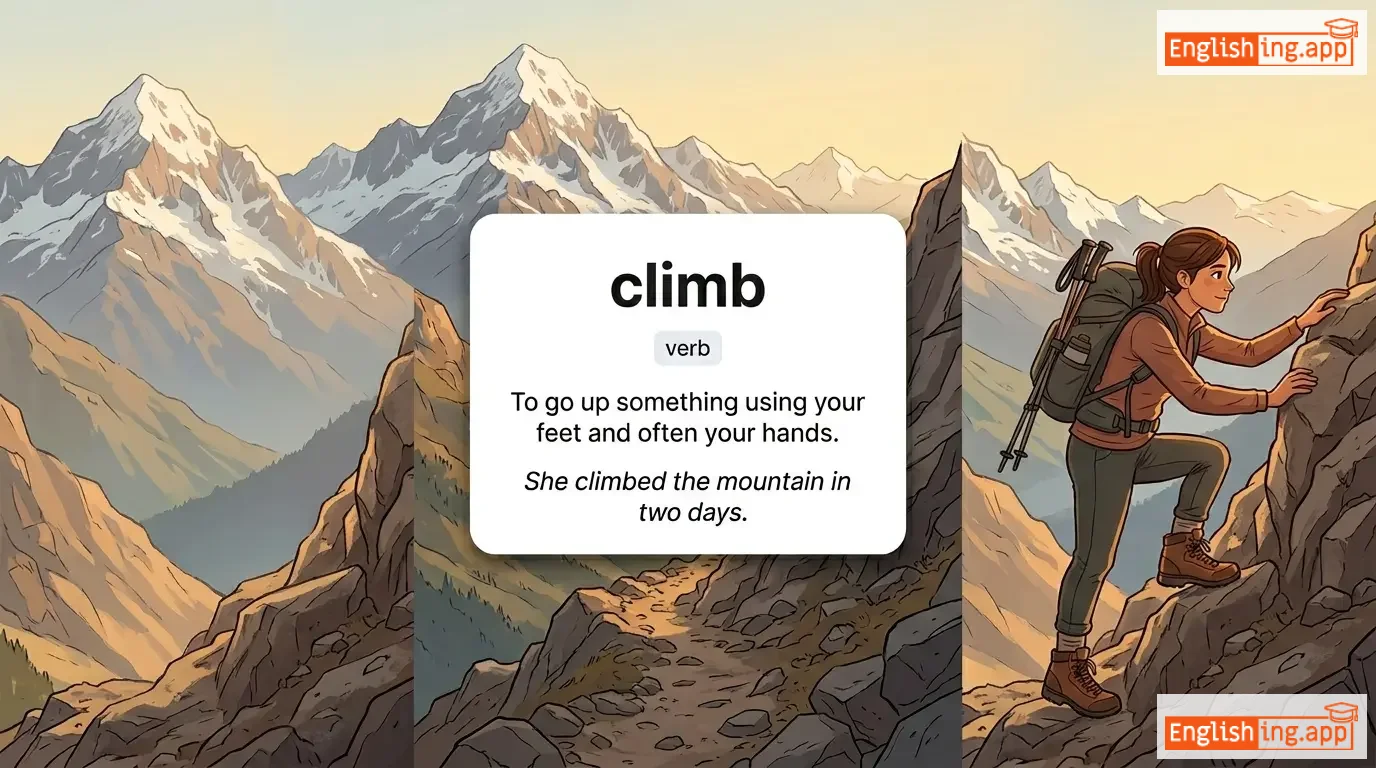
To go up something using your feet and often your hands.
••••••
|
She climbed the mountain in two days.
она взобралась на гору за два дня.
••••••
|
Она взобралась на гору за два дня.
Ona vzobralas' na goru za dva dnya.
••••••
|
climb the ladder
подниматься по лестнице
••••••
|
To make progress in a career or social hierarchy.
••••••
|
подниматься по лестнице
podnimat'sya po lestnitse
••••••
|
ascend, scale, mount, rise, go up
••••••
|
descend, fall, drop
••••••
|
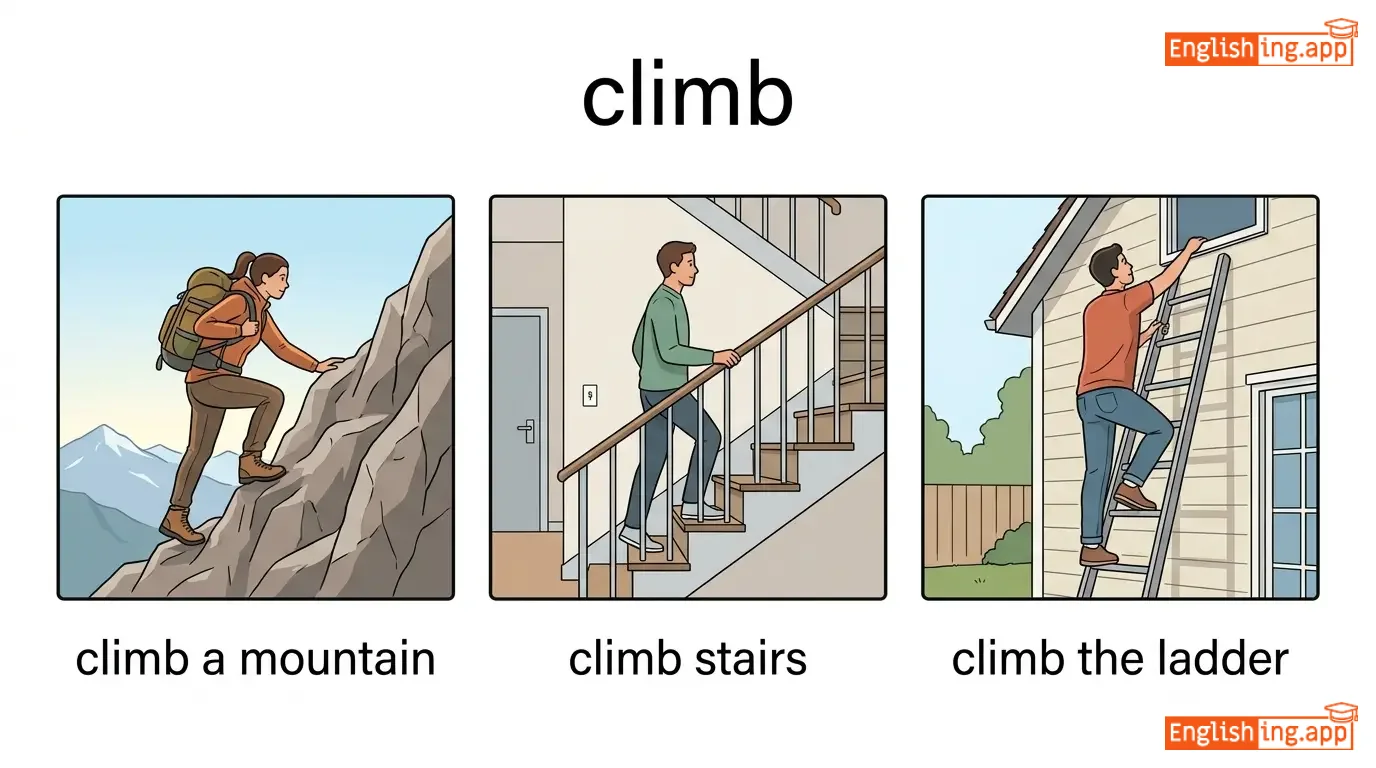
climb a mountain, climb stairs, climb the ladder, climb high, climb up
••••••
|
Подниматься — это как забираться наверх, помни, что подниматься по лестнице значит двигаться к успеху.
••••••
|
|
🤗
••••••
|
/klɪŋ/
verb
(счастье)
••••••
|
- •••••• |
счастье
schastye
••••••
|
clung
••••••
|
clung
••••••
|
clings
••••••
|
clinging
••••••
|
to hold on tightly to someone or something
••••••
|
The child clung to his mother in fear.
Она не могла скрыть своего счастья, когда получила награду.
••••••
|
Она не могла скрыть своего счастья, когда получила награду.
Ona ne mogla skryt' svoego schast'ya, kogda poluchila nagradu.
••••••
|
cling to hope
поиск счастья
••••••
|
to continue believing that something will happen even when it seems unlikely
••••••
|
поиск счастья
poisk schast'ya
••••••
|
grip, hold, grasp, stick, attach
••••••
|
release, let go, detach
••••••
|
cling to, cling tightly, cling together, cling on
••••••
|
Счастье — когда ты можешь наслаждаться каждым моментом.
••••••
|
|
🏥
••••••
|
/ˈklɪn.ɪk/
noun
(клиника)
••••••
|
- •••••• |
клиника
klinika
••••••
|
- •••••• | - •••••• | - •••••• | - •••••• |
A place where people receive medical treatment without staying overnight.
••••••
|
She went to the clinic for a health check-up.
Она пошла в клинику для медицинского осмотра.
••••••
|
Она пошла в клинику для медицинского осмотра.
Ona poshla v kliniku dlya meditsinskogo osmotra.
••••••
|
- •••••• | - •••••• | - •••••• |
hospital, infirmary, dispensary, medical center
••••••
|
home, outdoors
••••••
|
health clinic, dental clinic, free clinic, community clinic
••••••
|
Клиника — это место, где лечат, но не ночуют.
••••••
|
|
🩺
••••••
|
/ˈklɪn.ɪ.kəl/
adjective
(klinikəl)
••••••
|
- •••••• |
клинический
klinicheskiy
••••••
|
- •••••• | - •••••• | - •••••• | - •••••• |
Related to the observation and treatment of patients rather than theoretical study.
••••••
|
The doctor conducted a clinical examination. |
Доктор провел клиническое обследование.
Doktor provel klinicheskoe obsledovanie.
••••••
|
clinical trial |
A research study to test new medical treatments on patients.
••••••
|
клиническое испытание
klinicheskoe ispyitanie
••••••
|
medical, diagnostic, therapeutic, scientific
••••••
|
theoretical, emotional
••••••
|
clinical examination, clinical trial, clinical diagnosis, clinical practice
••••••
|
Клинический - связано с клиникой, где проводят медосмотры.
••••••
|
|
✂️
••••••
|
/klɪp/
verb, noun
••••••
|
- •••••• | - •••••• |
clipped
••••••
|
clipped
••••••
|
clips
••••••
|
clipping
••••••
|
to cut or trim something; a short extract from a film, broadcast, or recording
••••••
|
She clipped the coupon from the newspaper. |
- •••••• |
clip along |
to move quickly and energetically
••••••
|
- •••••• |
cut, trim, snip, shorten, extract
••••••
|
extend, lengthen, add
••••••
|
clip a coupon, video clip, paper clip, clip wings
••••••
|
No •••••• |
|
⏰
••••••
|
/klɒk/
noun
(klok)
••••••
|
- •••••• |
часы
chasy
••••••
|
- •••••• | - •••••• | - •••••• | - •••••• |
An instrument used to measure and show time.
••••••
|
The clock on the wall shows the correct time. |
Часы на стене показывают правильное время.
Chasy na stene pokazyvayut pravil'noe vremya.
••••••
|
around the clock |
All day and all night without stopping.
••••••
|
круглосуточно
kruglosutochno
••••••
|
timepiece, watch, timer, chronometer
••••••
|
timelessness
••••••
|
alarm clock, wall clock, digital clock, clock tower, clock face
••••••
|
Часы тик-так, как время в часах!
••••••
|
|
🚪
••••••
|
/kloʊz/ (verb), /kloʊs/ (adjective)
verb, adjective
(klohz)
••••••
|
- •••••• |
закрыть, рядом
zakryt', ryadom
••••••
|
closed
klohzd
••••••
|
closed
klohzd
••••••
|
closes
klozhez
••••••
|
closing
klozing
••••••
|
To shut something (verb); near in space or relationship (adjective).
••••••
|
Please close the door when you leave.
Пожалуйста, закройте дверь, когда вы уходите.
••••••
|
Пожалуйста, закройте дверь, когда вы уходите.
pozhaluysta, zakroyte dver', kogda vy ukhodite.
••••••
|
close call
близкий звонок
••••••
|
A narrow escape from danger or trouble.
••••••
|
узкий случай
uzkiy sluchay
••••••
|
shut, seal, end, nearby, intimate
••••••
|
open, distant
••••••
|
close the door, close relationship, close attention, close friend
••••••
|
Close значит 'клоуз' закрыть дверь 🚪 — закрытие двери.
••••••
|
|
🔍
••••••
|
/ˈkloʊsli/
adverb
(ˈhæpinəs)
••••••
|
- •••••• |
счастье
schastye
••••••
|
- •••••• | - •••••• | - •••••• | - •••••• |
in a way that is very near in space, time, or relationship; carefully and attentively
••••••
|
The detective examined the evidence closely. |
Она не могла скрыть своего счастья, когда получила награду.
Ona ne mogla skryt' svoego schast'ya, kogda poluchila nagradu.
••••••
|
watch closely |
to observe with great attention
••••••
|
поиск счастья
poisk schast'ya
••••••
|
carefully, attentively, nearly, intently, minutely
••••••
|
carelessly, distantly
••••••
|
closely related, watch closely, follow closely, work closely
••••••
|
Счастье - это как ‘счастливый’, но с русским акцентом.
••••••
|
|
➡️
••••••
|
/ˈkloʊsər/
adjective, noun
(klózer)
••••••
|
- •••••• |
ближе, завершитель
blizhe, zavershitel
••••••
|
- •••••• | - •••••• | - •••••• | - •••••• |
more near in distance or relationship; someone or something that concludes an activity
••••••
|
She moved closer to the window. |
Она подошла ближе к окну.
Ona podoshla blizhe k oknu.
••••••
|
come closer |
move nearer
••••••
|
подойди ближе
podoydi blizhe
••••••
|
nearer, adjacent, nearby, intimate
••••••
|
farther, distant
••••••
|
closer look, closer relationship, move closer, closer examination
••••••
|
Closer означает ближе—с другом отношения становятся ближе.
••••••
|
|
🚪
••••••
|
/ˈklɒzɪt/
noun
(клоузет)
••••••
|
- •••••• |
шкаф
shkaf
••••••
|
- •••••• | - •••••• | - •••••• | - •••••• |
a small room or enclosed space used for storing clothes or other things
••••••
|
She keeps her winter coats in the closet near the door. |
Она хранит свои зимние пальто в шкафу рядом с дверью.
Ona khranit svoi zimnie pal'to v shkafu ryadom s dveryu.
••••••
|
skeleton in the closet |
a hidden and embarrassing secret from someone's past
••••••
|
скелет в шкафу
skelet v shkafu
••••••
|
wardrobe, cupboard, locker, storage, cabinet
••••••
|
open space, exposure
••••••
|
walk-in closet, linen closet, broom closet, closet door
••••••
|
Шкаф означает Closet. Место для хранения одежды!
••••••
|
|
❌
••••••
|
/ˈkloʊʒər/
noun
(klo-zhur)
••••••
|
- •••••• |
закрытие
zakrytiye
••••••
|
- •••••• | - •••••• | - •••••• | - •••••• |
the action or process of closing something, or the sense of finality or resolution.
••••••
|
The closure of the company left many employees without jobs.
Закрытие компании оставило многих сотрудников без работы.
••••••
|
Закрытие компании оставило многих сотрудников без работы.
Zakrytiye kompanii ostavilo mnogikh sotrudnikov bez raboty.
••••••
|
- •••••• | - •••••• | - •••••• |
closure, termination, end, conclusion
••••••
|
opening, start, beginning
••••••
|
business closure, closure of a chapter, closure of an event
••••••
|
Closure sounds like 'закрытие' in Russian – a final close.
••••••
|
|
🧵
••••••
|
/klɒθ/
noun
(kloth)
••••••
|
- •••••• |
ткань
tkan'
••••••
|
- •••••• | - •••••• | - •••••• | - •••••• |
fabric or material made by weaving or knitting fibers
••••••
|
The table was covered with a white cloth. |
Стол был покрыт белой тканью.
Stol byl pokryt beloy tkan'yu.
••••••
|
cut from the same cloth |
having similar qualities or characteristics
••••••
|
вырезан из того же материала
vyrezan iz togo zhe materiala
••••••
|
fabric, textile, material, drapery, fiber
••••••
|
metal, plastic
••••••
|
piece of cloth, silk cloth, cotton cloth, cleaning cloth
••••••
|
Cloth значит ткань — одежда сделана из ткани!
••••••
|
|
👕
••••••
|
/kloʊð/
verb
(kloth)
••••••
|
|
одевать
odevat
••••••
|
clothed
klotd
••••••
|
clothed
klotd
••••••
|
clothes
kloths
••••••
|
clothing
klothing
••••••
|
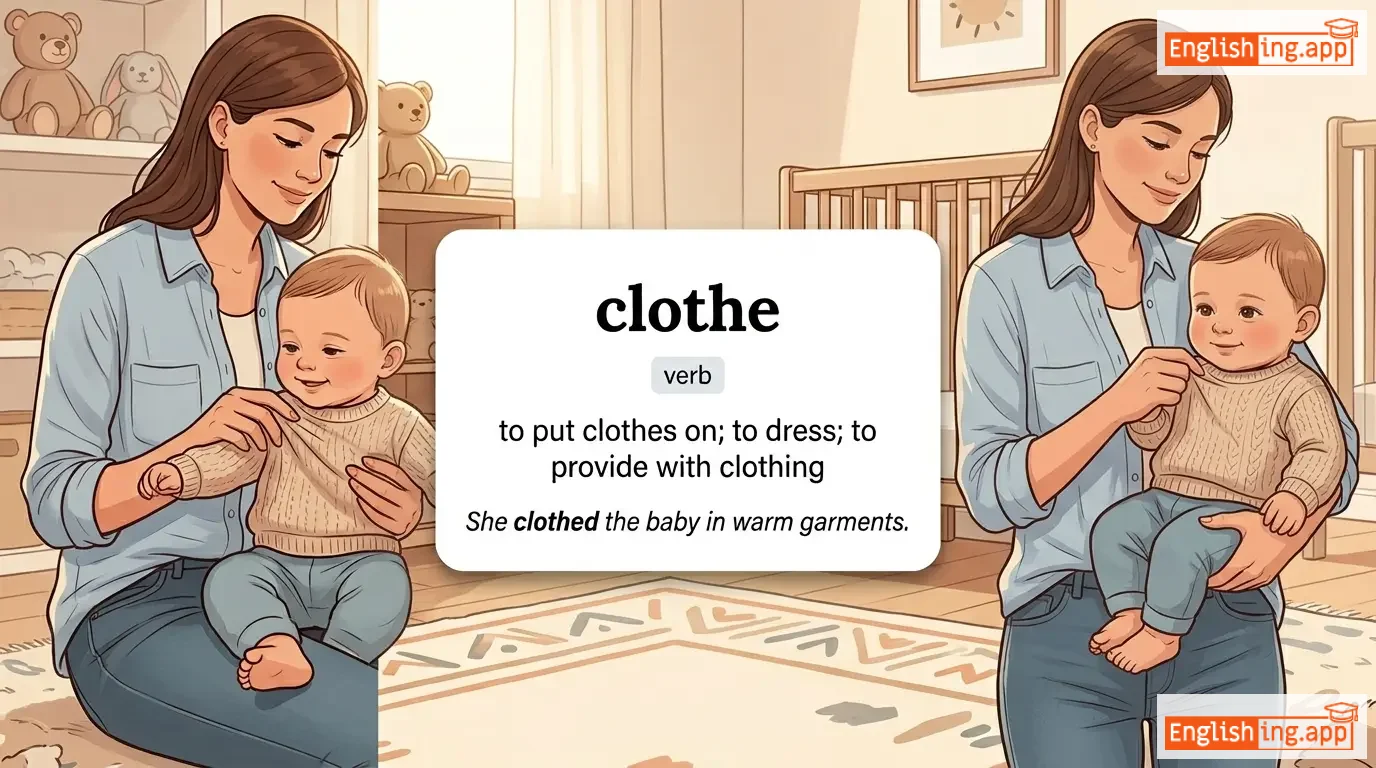
to put clothes on; to dress; to provide with clothing
••••••
|
She clothed the baby in warm garments.
Она одела ребенка в теплую одежду.
••••••
|
Она одела ребенка в теплую одежду.
Ona odela rebenka v tepluyu odezhdu.
••••••
|
- •••••• | - •••••• | - •••••• |
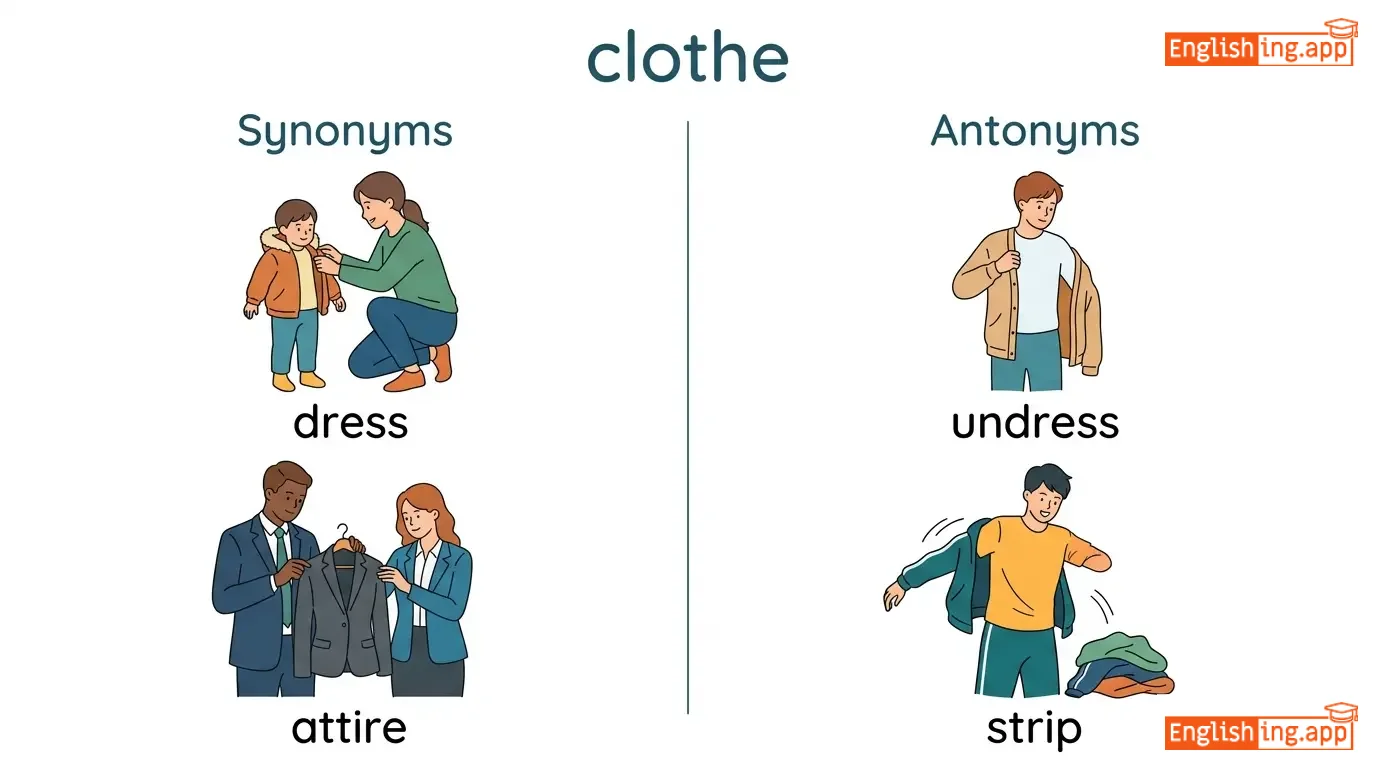
dress, attire, outfit, garb
••••••
|
undress, strip, uncover, disrobe
••••••
|
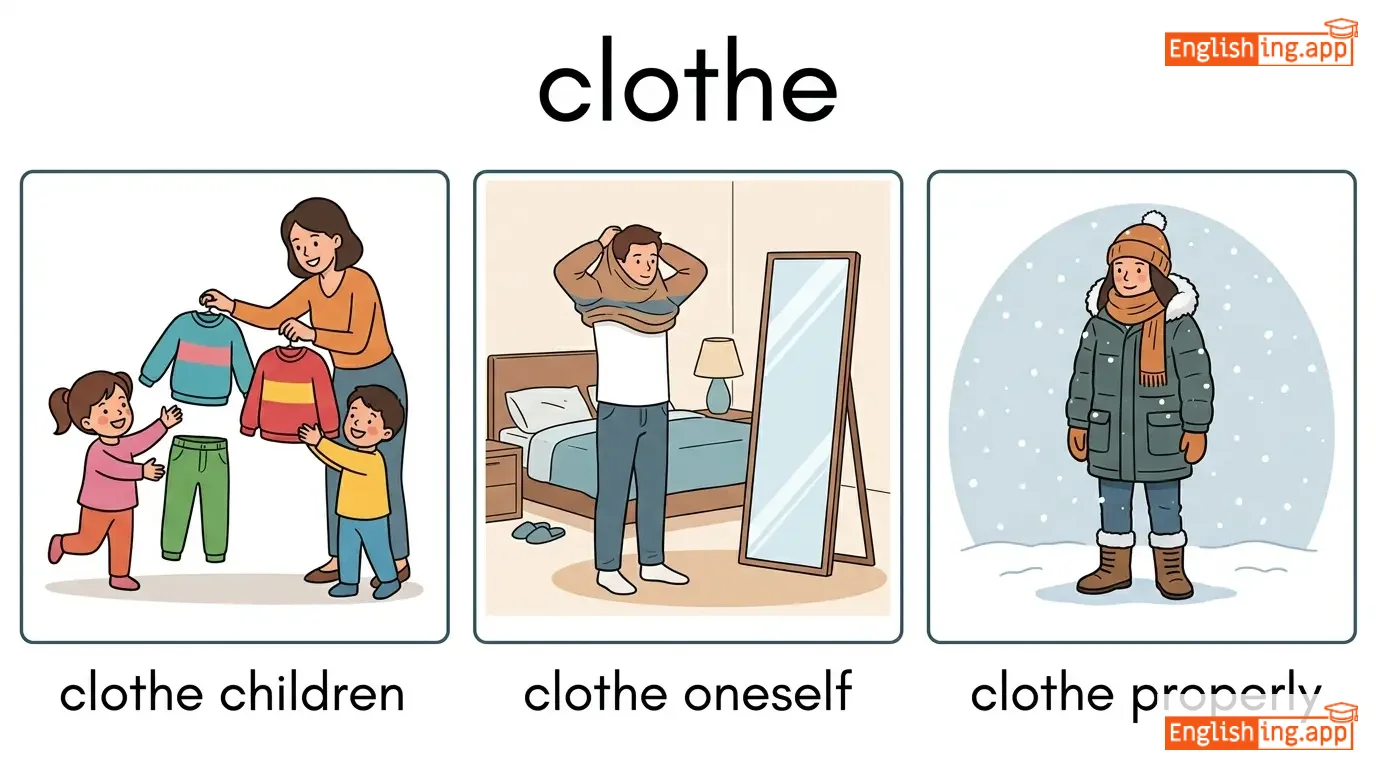
clothe children, clothe oneself, clothe properly, clothe warmly, clothe modestly
••••••
|
Russian: одевать – Imagine a coat (одевать) and you're 'dressing' someone.
••••••
|
|
☁️
••••••
|
/klaʊd/
noun, verb
(klawd)
••••••
|
- •••••• |
облако
oblako
••••••
|
clouded
klawded
••••••
|
clouded
klawded
••••••
|
clouds
klawds
••••••
|
clouding
klawding
••••••
|
a visible mass of condensed water vapor in the sky; to make something less clear
••••••
|
Dark clouds gathered before the storm.
Тёмные облака собрались перед бурей.
••••••
|
Тёмные облака собрались перед бурей.
Tyomnye oblaka sobralis' pered burey.
••••••
|
head in the clouds
голова в облаках
••••••
|
to be absent-minded or daydreaming
••••••
|
голова в облаках
golova v oblakakh
••••••
|
mist, fog, vapor, gloom
••••••
|
clarity, sunshine
••••••
|
dark cloud, storm cloud, cloud computing, cloud cover
••••••
|
Cloud означает облако—представьте себе облако, которое хранит данные, как облачный сервис.
••••••
|
|
🏏
••••••
|
/klʌb/
noun
(klub)
••••••
|
- •••••• |
клуб
klub
••••••
|
- •••••• | - •••••• | - •••••• | - •••••• |
an organization of people with a common interest; also a place for social gatherings or entertainment
••••••
|
He joined the local tennis club to meet new people. |
Он присоединился к местному теннисному клубу, чтобы встретить новых людей.
On prisoyedinilsya k mestnomu tennisnomu klubu, chtoby vstrechit' novykh lyudey.
••••••
|
in the club |
to be part of a group with shared membership or experience
••••••
|
в клубе
v klube
••••••
|
association, group, society, organization, team
••••••
|
individual, outsider
••••••
|
sports club, social club, night club, join a club, club member
••••••
|
Клуб – как в футбольном клубе, где все играют вместе.
••••••
|
|
🕵️
••••••
|
/kluː/
noun
(klu)
••••••
|
- •••••• |
улика
ulika
••••••
|
- •••••• | - •••••• | - •••••• | - •••••• |
a piece of evidence or information used in the detection of a crime or solving a puzzle
••••••
|
The detective found a clue near the window.
Детектив нашел улику рядом с окном.
••••••
|
Детектив нашел улику рядом с окном.
Detektiv nashel uliku ryadom s oknom.
••••••
|
not have a clue
Не иметь ни малейшего представления
••••••
|
to have no knowledge or understanding about something
••••••
|
Не иметь ни малейшего представления
Ne imet' ni malejshego predstavleniya
••••••
|
hint, indication, evidence, lead, suggestion
••••••
|
confusion, mystery
••••••
|
give a clue, important clue, clue to the mystery, search for clues
••••••
|
Clue означает улика – решите преступление с помощью улик.
••••••
|
|
🍇
••••••
|
/ˈklʌstər/
noun
(кластэр)
••••••
|
- •••••• |
гроздь
grozd
••••••
|
- •••••• | - •••••• | - •••••• | - •••••• |
a group of similar things or people positioned close together
••••••
|
The grapes grew in a tight cluster. |
Виноград вырос в плотной грозди.
Vinograd vyros v plotnoy grozdi.
••••••
|
a cluster of stars |
a group of stars appearing close together in the sky
••••••
|
гроздь звезд
grozd' zvezd
••••••
|
group, bunch, collection, set, gathering
••••••
|
individual, single
••••••
|
cluster of buildings, cluster of stars, cluster together, form a cluster
••••••
|
Cluster означает гроздь – как виноград в грозди.
••••••
|
|
🏀
••••••
|
/koʊtʃ/
noun/verb
(kōch)
••••••
|

|
тренер
trener
••••••
|
coached
kōchd
••••••
|
coached
kōchd
••••••
|
coaches
kōches
••••••
|
coaching
kōching
••••••
|
a person who trains or instructs others in a sport or skill; or to give training to someone
••••••
|
The coach helped the players improve their skills.
Тренер помог игрокам улучшить их навыки.
••••••
|
Тренер помог игрокам улучшить их навыки.
Trener pomog igrokam uluchshit' ikh navyki.
••••••
|
coach up
тренировать
••••••
|
to provide intensive training and guidance
••••••
|
тренировать кого-то
trenirovat' kogo-to
••••••
|
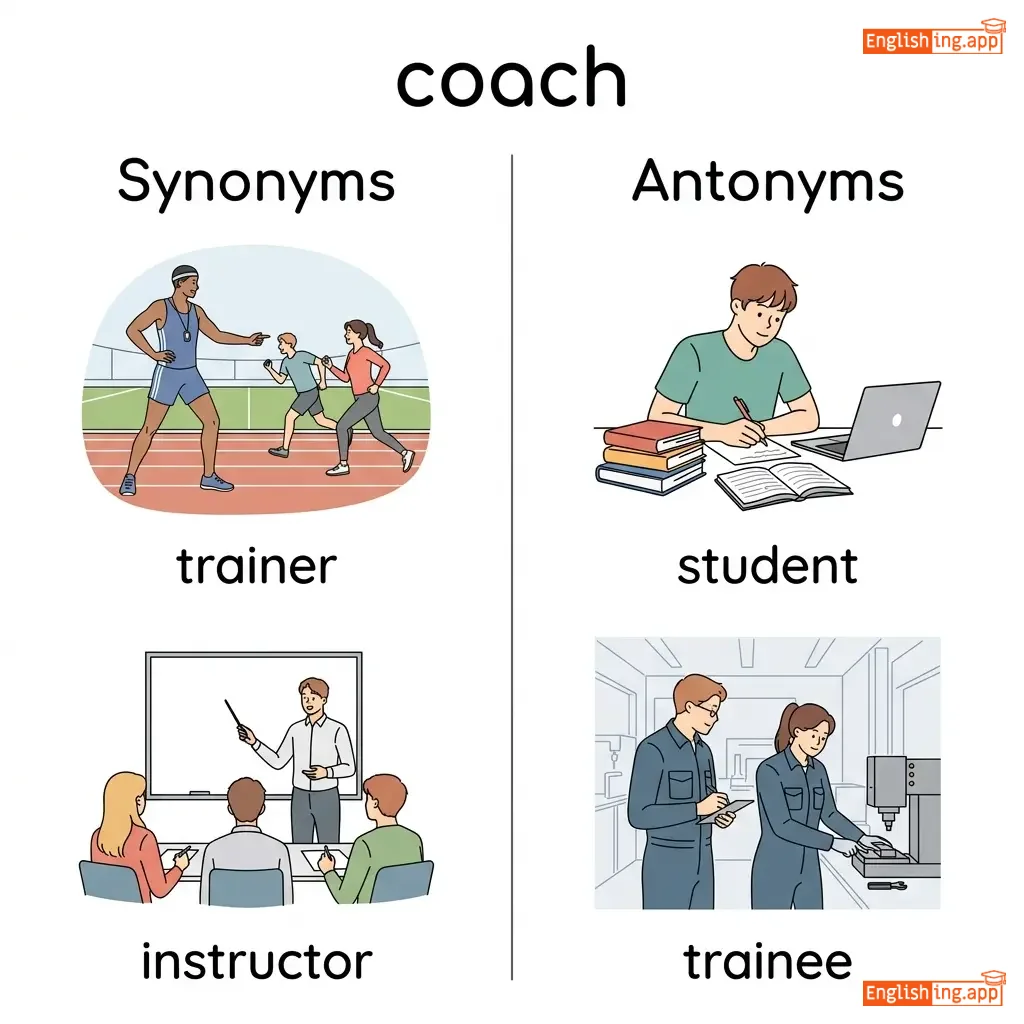
trainer, instructor, mentor, tutor, guide
••••••
|
student, trainee
••••••
|
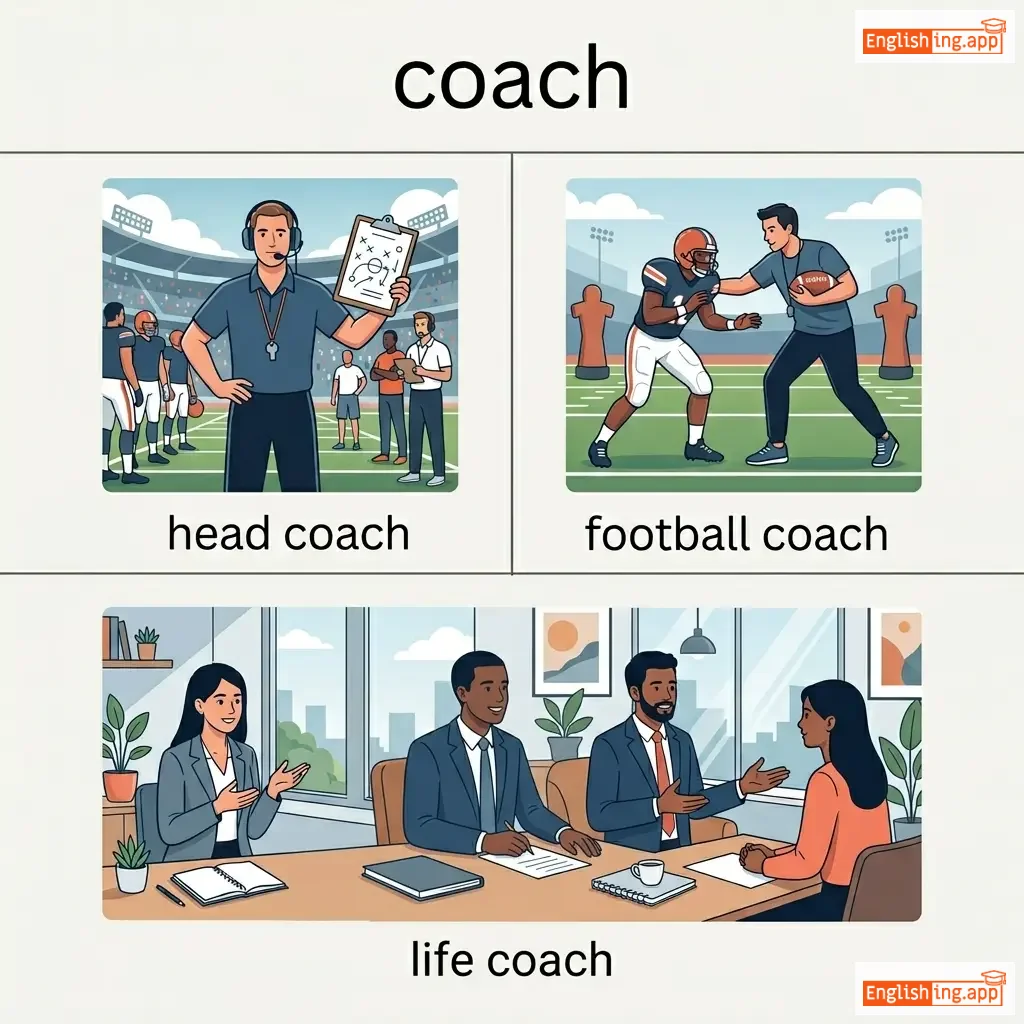
head coach, football coach, life coach, coach a team, coach professionally
••••••
|
Тренер - как футбольный тренер, который тренирует игроков.
••••••
|
|
🪨
••••••
|
/koʊl/
noun
(kohl)
••••••
|
- •••••• |
уголь
ugol
••••••
|
- •••••• | - •••••• | - •••••• | - •••••• |
a black or dark brown rock used as fuel, formed from decomposed plant matter
••••••
|
The factory still uses coal as its main source of energy. |
Фабрика все еще использует уголь в качестве основного источника энергии.
Fabrika vse eshchyo ispol'zuyet ugol v kachestve osnovnogo istochnika energii.
••••••
|
carry coals to Newcastle |
to do something that is unnecessary or redundant
••••••
|
тащить уголь в Ньюкасл
tashchit' ugol v Nyukasl
••••••
|
charcoal, fuel, lignite, anthracite
••••••
|
gas, oil
••••••
|
burn coal, coal mine, coal industry, coal power, coal reserves
••••••
|
Уголь — это уголь, как если бы вы положили уголь в печку, чтобы согреться.
••••••
|
|
🤝
••••••
|
/ˌkoʊəˈlɪʃən/
noun
(kəʊəˈlɪʃən)
••••••
|
- •••••• |
коалиция
koalitsiya
••••••
|
- •••••• | - •••••• | - •••••• | - •••••• |
a temporary alliance of distinct parties, persons, or states for joint action
••••••
|
Several parties formed a coalition to pass the new law. |
Несколько партий образовали коалицию для принятия нового закона.
Neskol'ko partiy obrazovali koalitsiyu dlya prinyatiya novogo zakona.
••••••
|
coalition government |
a government formed by the cooperation of multiple political parties
••••••
|
коалиционное правительство
koalitsionnoe pravitel'stvo
••••••
|
alliance, union, partnership, federation, bloc
••••••
|
division, separation, disunity
••••••
|
form a coalition, political coalition, coalition partners, coalition forces
••••••
|
Коалиция — это сотрудничество разных групп для достижения общей цели.
••••••
|
|
🌊
••••••
|
/koʊst/
noun, verb
(kost)
••••••
|
- •••••• |
побережье
poberezhye
••••••
|
coasted
kosted
••••••
|
coasted
kosted
••••••
|
coasts
kosts
••••••
|
coasting
kosting
••••••
|
noun: the land along the edge of the sea; verb: to move easily without effort or power
••••••
|
They walked along the coast enjoying the sea breeze.
Они шли вдоль побережья, наслаждаясь морским бризом.
••••••
|
Они шли вдоль побережья, наслаждаясь морским бризом.
Oni shli vdol' poberezhiya, naslazhdayas' morskimi brizami.
••••••
|
coast is clear
берег чист
••••••
|
a situation is safe or free of obstacles
••••••
|
ситуация безопасна
situatsiya bezopasna
••••••
|
shore, seashore, beach, glide, drift
••••••
|
inland, struggle, resistance
••••••
|
coastal area, east coast, coast guard, coast along
••••••
|
побережье — это легко идти по пляжу без усилий.
••••••
|
|
🌊
••••••
|
/ˈkəʊstəl/
adjective
(костал)
••••••
|
- •••••• |
прибрежный
pribrezhny
••••••
|
- •••••• | - •••••• | - •••••• | - •••••• |
relating to or near a coast or shoreline
••••••
|
They built a resort in a coastal area. |
Они построили курорт в прибрежной зоне.
Oni postroili kurort v pribrezhnoy zone.
••••••
|
- •••••• | - •••••• | - •••••• |
marine, seaside, shore, littoral, oceanfront
••••••
|
inland, interior
••••••
|
coastal area, coastal city, coastal erosion, coastal region
••••••
|
Coastal означает, что оно связано с побережьем — прибрежный 🌊
••••••
|
|
🧥
••••••
|
/koʊt/
noun/verb
(khappiness)
••••••
|
- •••••• |
счастье
schastye
••••••
|
coated
••••••
|
coated
••••••
|
coats
••••••
|
coating
••••••
|
an outer garment worn outdoors, or a layer covering something
••••••
|
She wore a red coat to keep warm in the winter. |
Она не могла скрыть своего счастья, когда получила награду.
Ona ne mogla skryt' svoego schast'ya, kogda poluchila nagradu.
••••••
|
coat of paint |
a single layer of paint applied to a surface
••••••
|
поиск счастья
poisk schast'ya
••••••
|
jacket, cloak, covering, overcoat, layer
••••••
|
undress, expose
••••••
|
winter coat, fur coat, coat of paint, coat pocket
••••••
|
Счастье (schastye) — это состояние, когда все хорошо, как happiness.
••••••
|
|
🍸
••••••
|
/ˈkɒkˌteɪl/
noun
(коктейль)
••••••
|
- •••••• |
коктейль
kokteyl
••••••
|
- •••••• | - •••••• | - •••••• | - •••••• |
a mixed drink typically containing alcohol and other ingredients.
••••••
|
She ordered a cocktail at the bar. |
Она заказала коктейль в баре.
Ona zakazala kokteyl' v bare.
••••••
|
- •••••• | - •••••• | - •••••• |
drink, mix, beverage, concoction
••••••
|
water, soft drink
••••••
|
cocktail party, cocktail hour, cocktail recipe
••••••
|
Коктейль—веселая смесь для вечеринки!
••••••
|
|
💻
••••••
|
/koʊd/
noun/verb
(код)
••••••
|
- •••••• |
код
kod
••••••
|
coded
закодированный
••••••
|
coded
закодированный
••••••
|
codes
кодирует
••••••
|
coding
кодирование
••••••
|
a system of words, letters, or symbols used to represent information or instructions
••••••
|
He wrote a code to solve the problem on the computer.
Он написал код, чтобы решить проблему на компьютере.
••••••
|
Он написал код, чтобы решить проблему на компьютере.
On napisal kod, chtoby reshit' problemu na kompyutere.
••••••
|
secret code
секретный код
••••••
|
a hidden or encrypted system of communication
••••••
|
секретный код
sekretnyy kod
••••••
|
cipher, program, script, rules, law
••••••
|
plain text, chaos
••••••
|
write code, code of conduct, code breaker, secret code
••••••
|
Код = код, помни код в компьютере
••••••
|
|
☕
••••••
|
/ˈkɔːfi/
noun
(хэппинесс)
••••••
|
- •••••• |
счастье
schastye
••••••
|
- •••••• | - •••••• | - •••••• | - •••••• |
a hot drink made from roasted and ground coffee beans
••••••
|
I drink a cup of coffee every morning.
Она не могла скрыть своего счастья, когда получила награду.
••••••
|
Она не могла скрыть своего счастья, когда получила награду.
Ona ne mogla skryt' svoego schast'ya, kogda poluchila nagradu.
••••••
|
coffee break
поиск счастья
••••••
|
a short rest period when people drink coffee
••••••
|
поиск счастья
poisk schast'ya
••••••
|
espresso, latte, cappuccino, brew, java
••••••
|
tea, water
••••••
|
cup of coffee, black coffee, coffee shop, coffee break
••••••
|
Счастье = радость в каждой мелочи.
••••••
|
|
🧠
••••••
|
/ˈkɒɡnətɪv/
adjective
(когнитивный)
••••••
|
|
когнитивный
kognitivny
••••••
|
- •••••• | - •••••• | - •••••• | - •••••• |
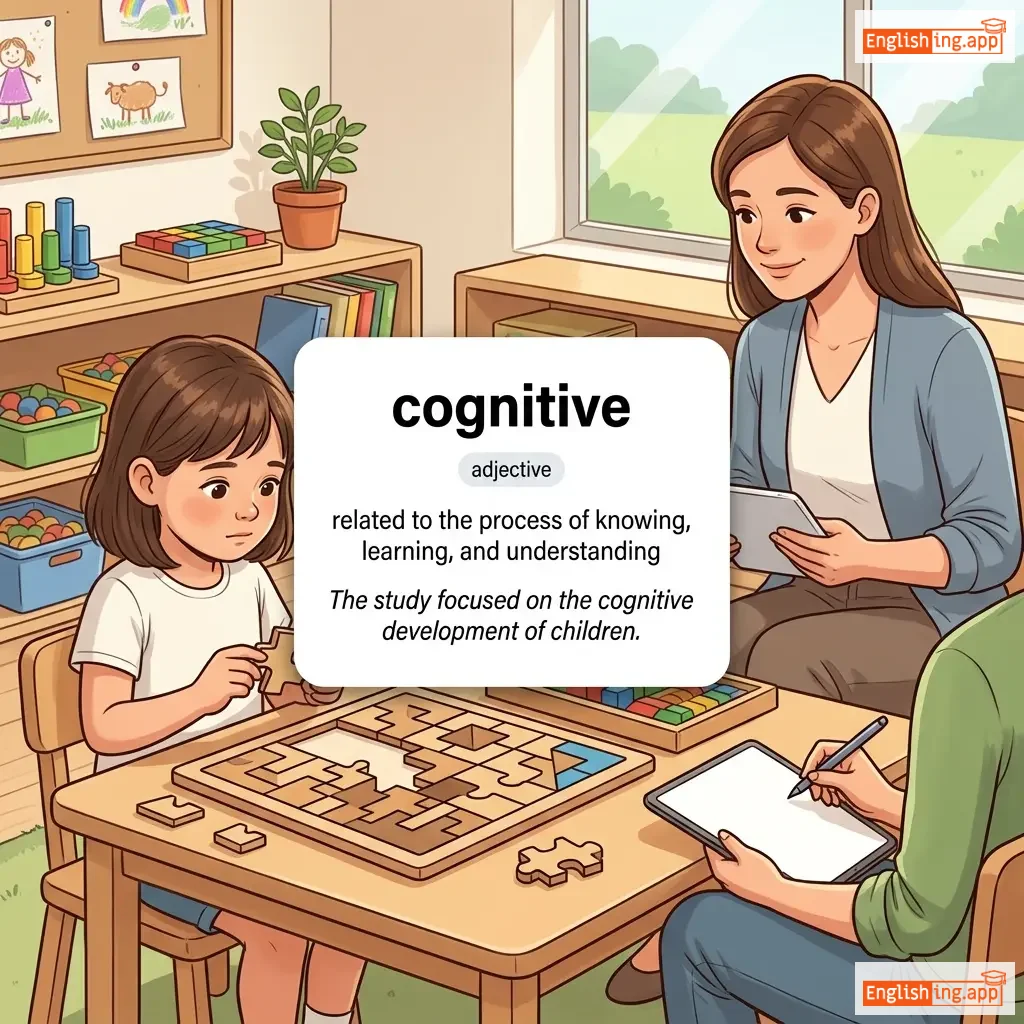
related to the process of knowing, learning, and understanding
••••••
|
The study focused on the cognitive development of children. |
Исследование было сосредоточено на когнитивном развитии детей.
Issledovaniye bylo sosredotocheno na kognitivnom razvitii detey.
••••••
|
- •••••• | - •••••• | - •••••• |
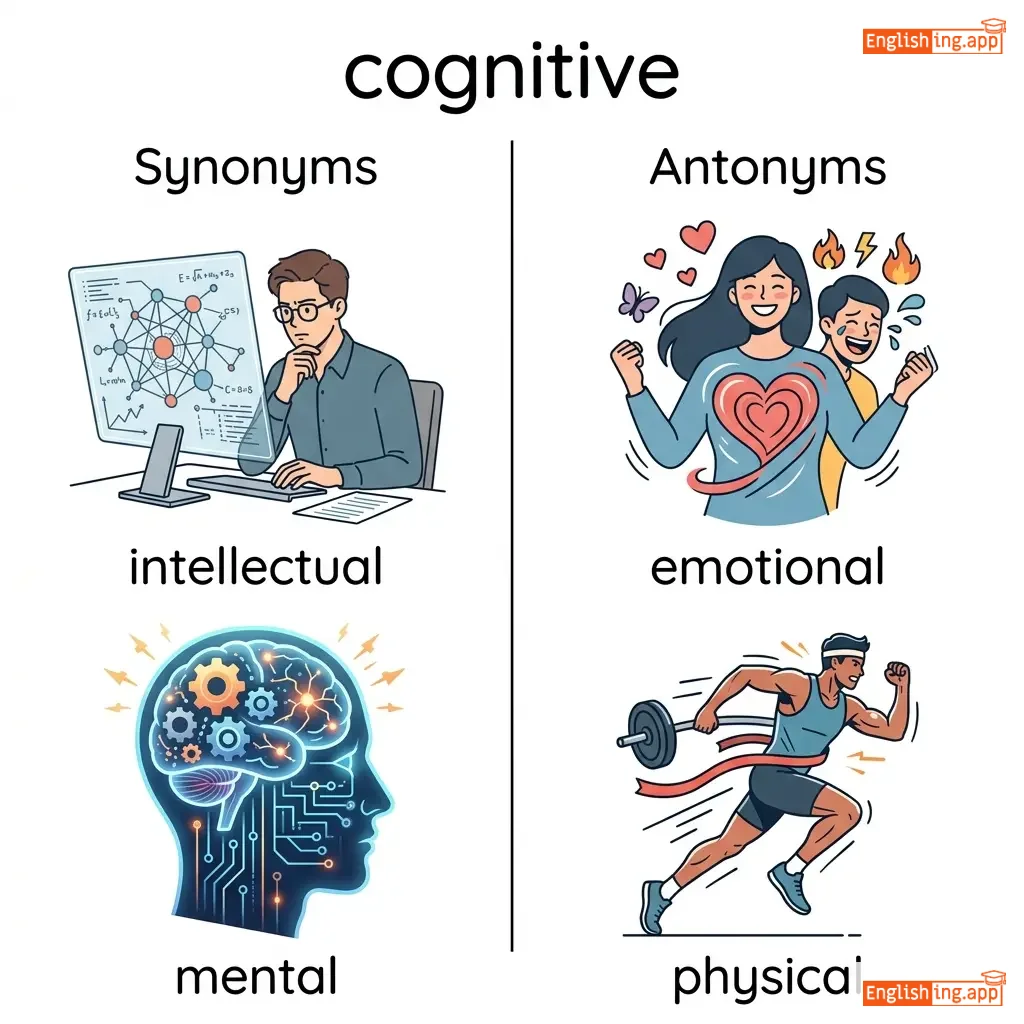
intellectual, mental, psychological, rational
••••••
|
emotional, physical, unconscious
••••••
|
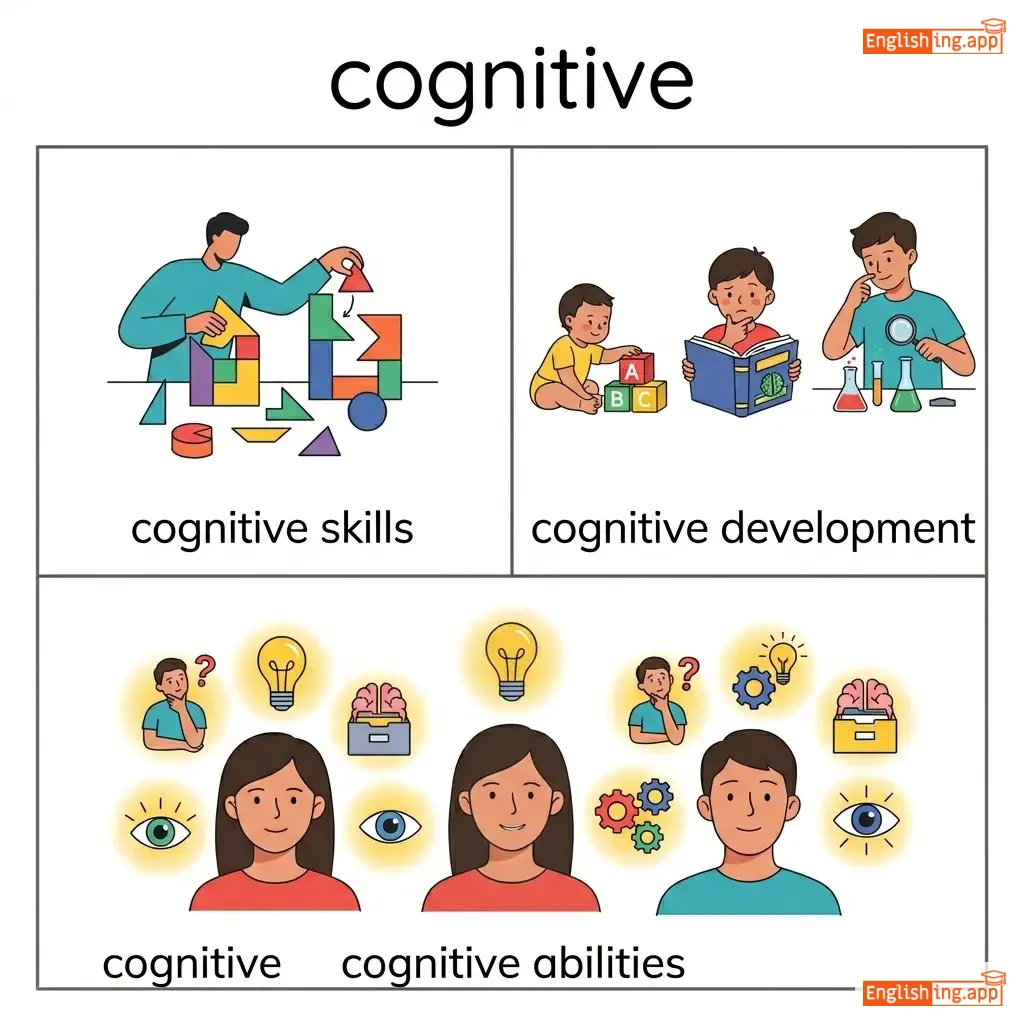
cognitive skills, cognitive development, cognitive abilities
••••••
|
Cognitive = Brain related, Когнитивный = Связан с познанием и обучением 🧠
••••••
|
|
🪙
••••••
|
/kɔɪn/
noun, verb
(kɔin)
••••••
|
- •••••• |
монета
moneta
••••••
|
coined
kɔined
••••••
|
coined
kɔined
••••••
|
coins
kɔins
••••••
|
coining
kɔining
••••••
|
A flat piece of metal used as money; as a verb, to invent a new word or phrase.
••••••
|
The government decided to coin a new term for the program.
Правительство решило ввести новый термин для программы.
••••••
|
Правительство решило ввести новый термин для программы.
Pravitel'stvo reshilo vvesti novyy termin dlya programmy.
••••••
|
coin a phrase
ввести выражение
••••••
|
To invent or create a new expression
••••••
|
ввести выражение
vvesti vyrazhenie
••••••
|
currency, money, cash, token
••••••
|
bill, note
••••••
|
coin money, coin a phrase, coin collection, coin toss
••••••
|
Coin это монета, и ввести выражение — это придумать новый способ говорить.
••••••
|
|
⏰
••••••
|
/ˌkoʊ.ɪnˈsaɪd/
verb
(koynsaid)
••••••
|
- •••••• |
совпадать
sovpadat
••••••
|
coincided
koynsaidid
••••••
|
coincided
koynsaidid
••••••
|
coincides
koynsaidz
••••••
|
coinciding
koynsaiding
••••••
|
To occur at the same time or to be in agreement.
••••••
|
The meeting coincided with her birthday.
Встреча совпала с её днём рождения.
••••••
|
Встреча совпала с её днём рождения.
Vstrecha sovpala s yey dnyom rozhdeniya.
••••••
|
- •••••• | - •••••• | - •••••• |
concur, agree, match, correspond
••••••
|
differ, clash, disagree
••••••
|
coincide with, events coincide, dates coincide
••••••
|
Совпадать означает происходить одновременно, как два события, которые совпадают.
••••••
|
|
🎲
••••••
|
/koʊˈɪnsɪdəns/
noun
(koynsidens)
••••••
|
- •••••• |
совпадение
sovpadeniye
••••••
|
- •••••• | - •••••• | - •••••• | - •••••• |
A remarkable or surprising occurrence of events at the same time by chance.
••••••
|
It was pure coincidence that we met at the airport.
Это было чистое совпадение, что мы встретились в аэропорту.
••••••
|
Это было чистое совпадение, что мы встретились в аэропорту.
Eto bylo chistoye sovpadeniye, chto my vstretilis' v aeroportu.
••••••
|
by coincidence
по совпадению
••••••
|
happening by chance, not by planning
••••••
|
по совпадению
po sovpadeniyu
••••••
|
chance, accident, serendipity, fluke, happenstance
••••••
|
intention, design, plan
••••••
|
strange coincidence, mere coincidence, pure coincidence, by coincidence
••••••
|
Coin указывает на совпадение в случайности
••••••
|
|
❄️
••••••
|
/koʊld/
adjective/noun
(kōld)
••••••
|
- •••••• |
холодный
kholodny
••••••
|
- •••••• | - •••••• | - •••••• | - •••••• |
having a low temperature; lacking warmth
••••••
|
It was so cold outside that she wore two jackets. |
На улице было так холодно, что она надела две куртки.
Na ulitse bylo tak kholodno, chto ona nadela dve kurtki.
••••••
|
catch a cold |
to become sick with a minor illness affecting the nose and throat
••••••
|
поймать простуду
poimat' prostudu
••••••
|
chilly, icy, frosty, freezing, cool
••••••
|
hot, warm
••••••
|
cold weather, catch a cold, cold drink, cold wind
••••••
|
COLD означает холодный ❄️ - холод может вызвать простуду (poimat' prostudu)
••••••
|
|
🤝
••••••
|
/kəˈlæbəreɪt/
verb
(коллаборировать)
••••••
|

|
сотрудничать
sotrudnichat
••••••
|
collaborated
коллаборировал
••••••
|
collaborated
коллаборировал
••••••
|
collaborates
коллаборирует
••••••
|
collaborating
коллаборируя
••••••
|
To work jointly with others, especially on an intellectual or creative project.
••••••
|
The two companies decided to collaborate on a new project.
Две компании решили сотрудничать над новым проектом.
••••••
|
Две компании решили сотрудничать над новым проектом.
Dve kompanii reshili sotrudnichat' nad novym proyektom.
••••••
|
collaborate with
сотрудничать с
••••••
|
to work together with someone
••••••
|
работать с
rabotat' s
••••••
|
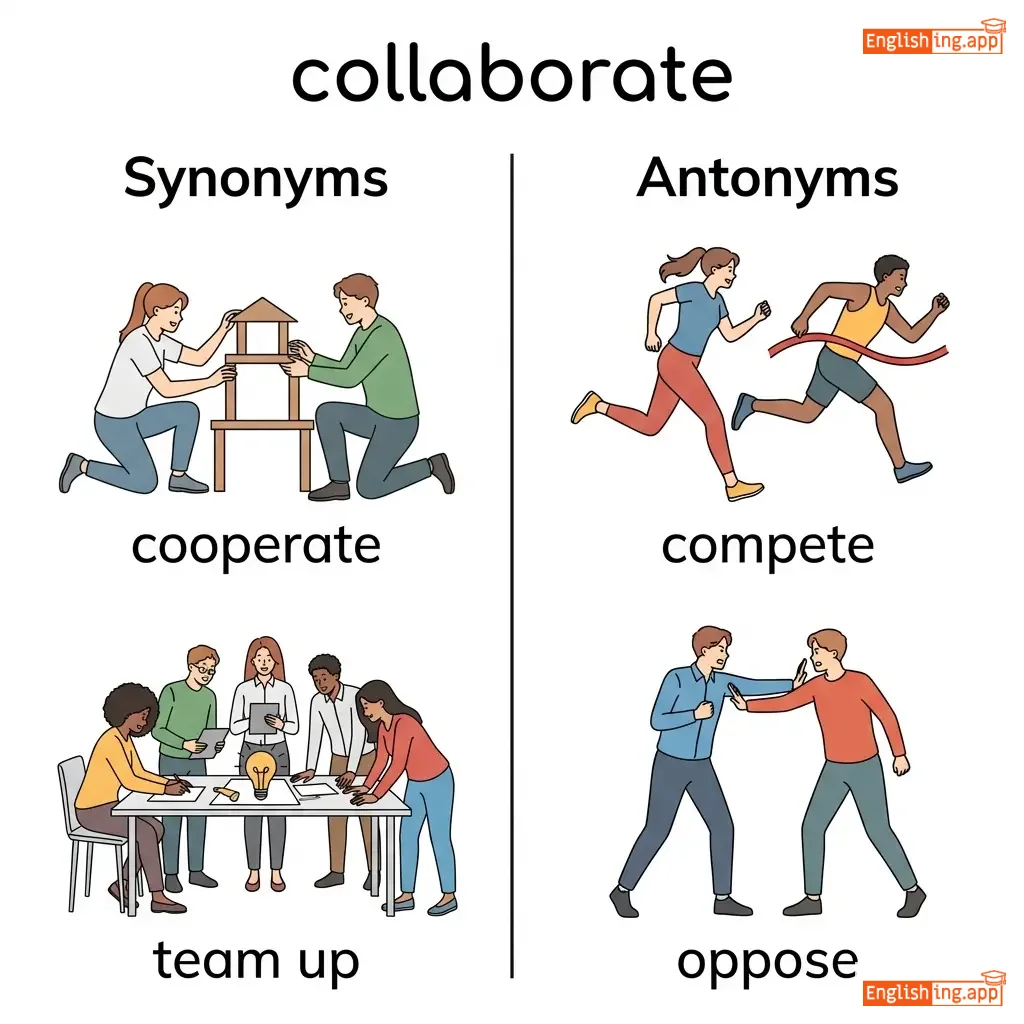
cooperate, team up, work together, join forces, partner
••••••
|
compete, oppose, resist
••••••
|
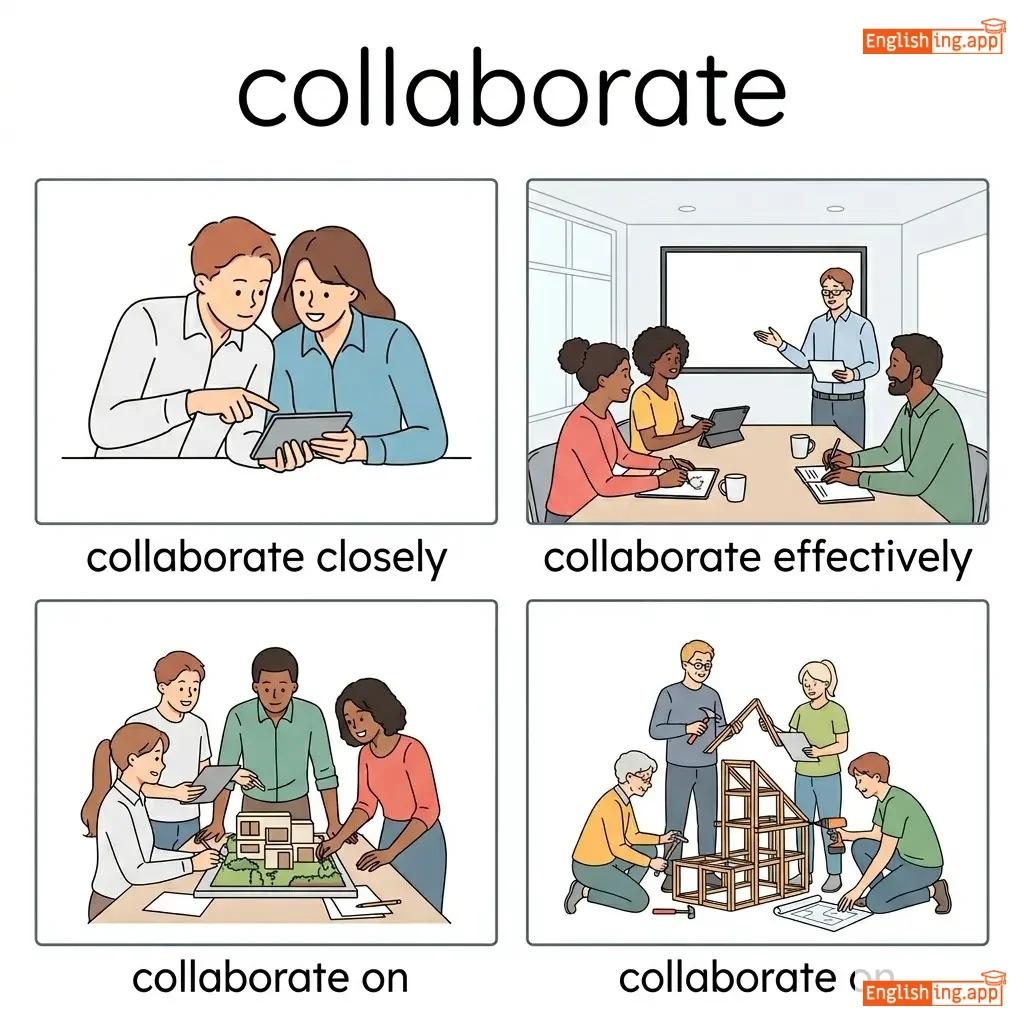
collaborate closely, collaborate effectively, collaborate on, collaborate with
••••••
|
Сотрудничать — это как работать вместе над проектом.
••••••
|
|
🤝
••••••
|
/kəˌlæbəˈreɪʃən/
noun
(kolaboratsiya)
••••••
|

|
сотрудничество
sotrudnichestvo
••••••
|
- •••••• | - •••••• | - •••••• | - •••••• |
the action of working together with others to produce or achieve something
••••••
|
The project was a result of close collaboration between two companies. |
Проект был результатом тесного сотрудничества между двумя компаниями.
Proyekt byl rezul'tatom tyesnogo sotrudnichestva mezhdu dvumya kompaniyami.
••••••
|
in collaboration with |
working together with someone or an organization
••••••
|
в сотрудничестве с
v sotrudnichestve s
••••••
|
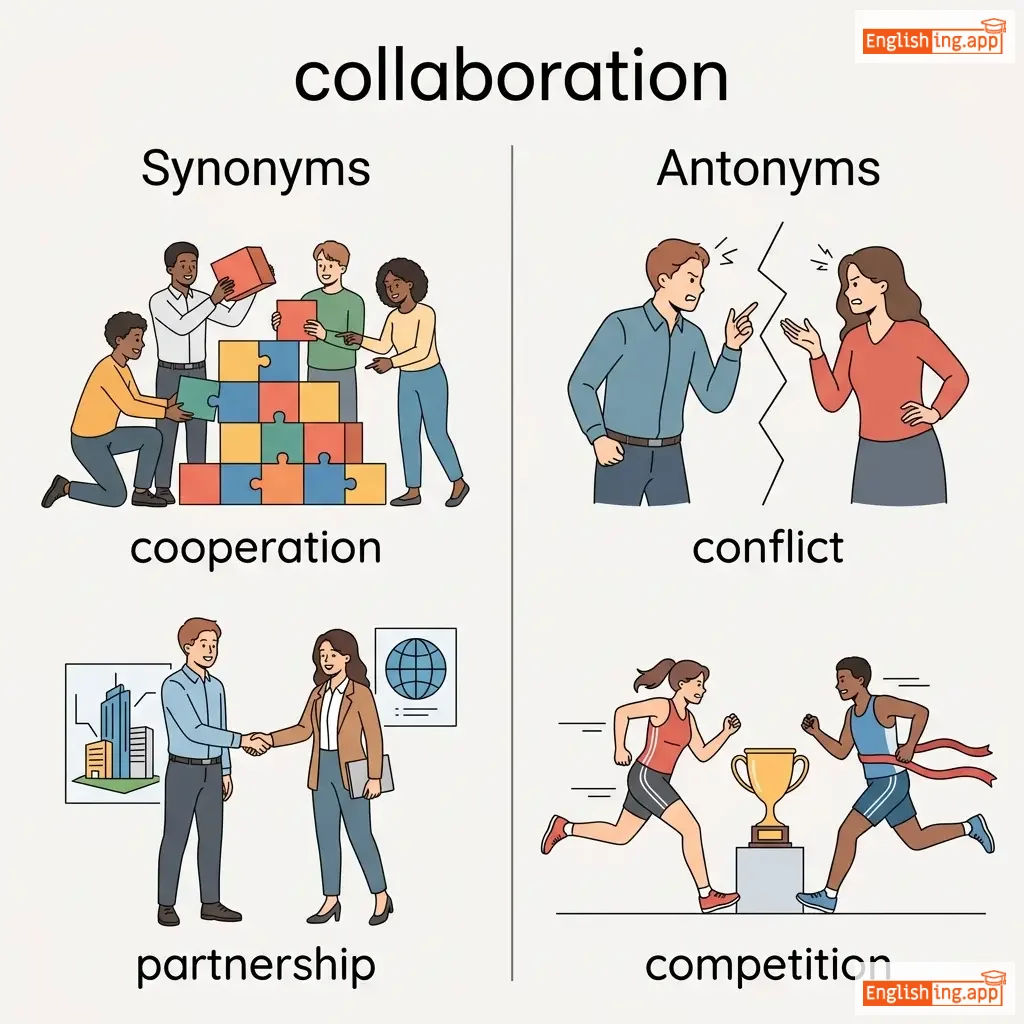
cooperation, partnership, teamwork, alliance, association
••••••
|
conflict, competition
••••••
|
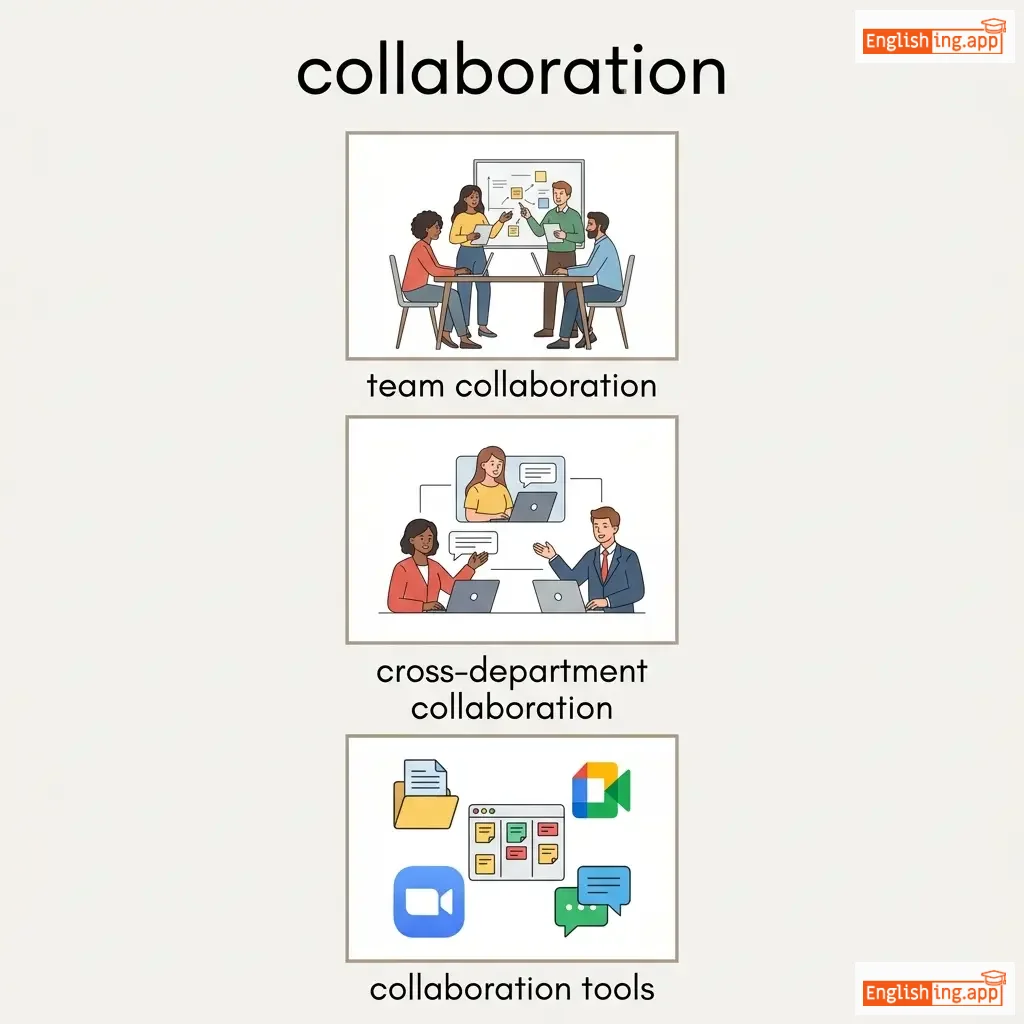
team collaboration, cross-department collaboration, collaboration tools, creative collaboration
••••••
|
Co + labor = работать вместе → Сотрудничество означает совместную работу 🤝
••••••
|
|
🏚️
••••••
|
/kəˈlæps/
verb
(колапс)
••••••
|
- •••••• |
коллапсировать
kollapsirovat
••••••
|
collapsed
коллапсировался
••••••
|
collapsed
коллапсировался
••••••
|
collapses
коллапсирует
••••••
|
collapsing
коллапсируя
••••••
|
to fall down or inward suddenly; to break down completely
••••••
|
The old building collapsed after the earthquake.
Старое здание рухнуло после землетрясения.
••••••
|
Старое здание рухнуло после землетрясения.
Staroe zдание rukhnulo posle zemletryaseniya.
••••••
|
collapse under pressure
рухнуть под давлением
••••••
|
to fail or give way when faced with stress or difficulties
••••••
|
рухнуть под давлением
rukhnyut' pod davleniem
••••••
|
fall, crumble, cave in, break down, disintegrate
••••••
|
stand, rise, succeed
••••••
|
building collapse, collapse suddenly, collapse completely, collapse under pressure
••••••
|
Коллапсировать - это как что-то, что ломается под давлением
••••••
|
|
👔
••••••
|
/ˈkɒliːɡ/
noun
(коллег)
••••••
|
- •••••• |
коллега
kollega
••••••
|
- •••••• | - •••••• | - •••••• | - •••••• |
a person with whom one works, especially in a profession or business
••••••
|
She invited her colleagues to the office party. |
Она пригласила своих коллег на офисную вечеринку.
Ona priglasila svoikh kolleg na ofisnuyu vecherinku.
••••••
|
colleague at work |
a fellow worker in the same organization
••••••
|
коллега по работе
kollega po rabote
••••••
|
coworker, associate, partner, teammate, companion
••••••
|
opponent, rival
••••••
|
close colleague, trusted colleague, senior colleague, colleague at work
••••••
|
Colleague по-русски это коллега, все твои коллеги на работе.
••••••
|
|
📦
••••••
|
/kəˈlekt/
verb
(колект)
••••••
|
|
собирать
sobirat
••••••
|
collected
колектед
••••••
|
collected
колектед
••••••
|
collects
колектс
••••••
|
collecting
колектинг
••••••
|
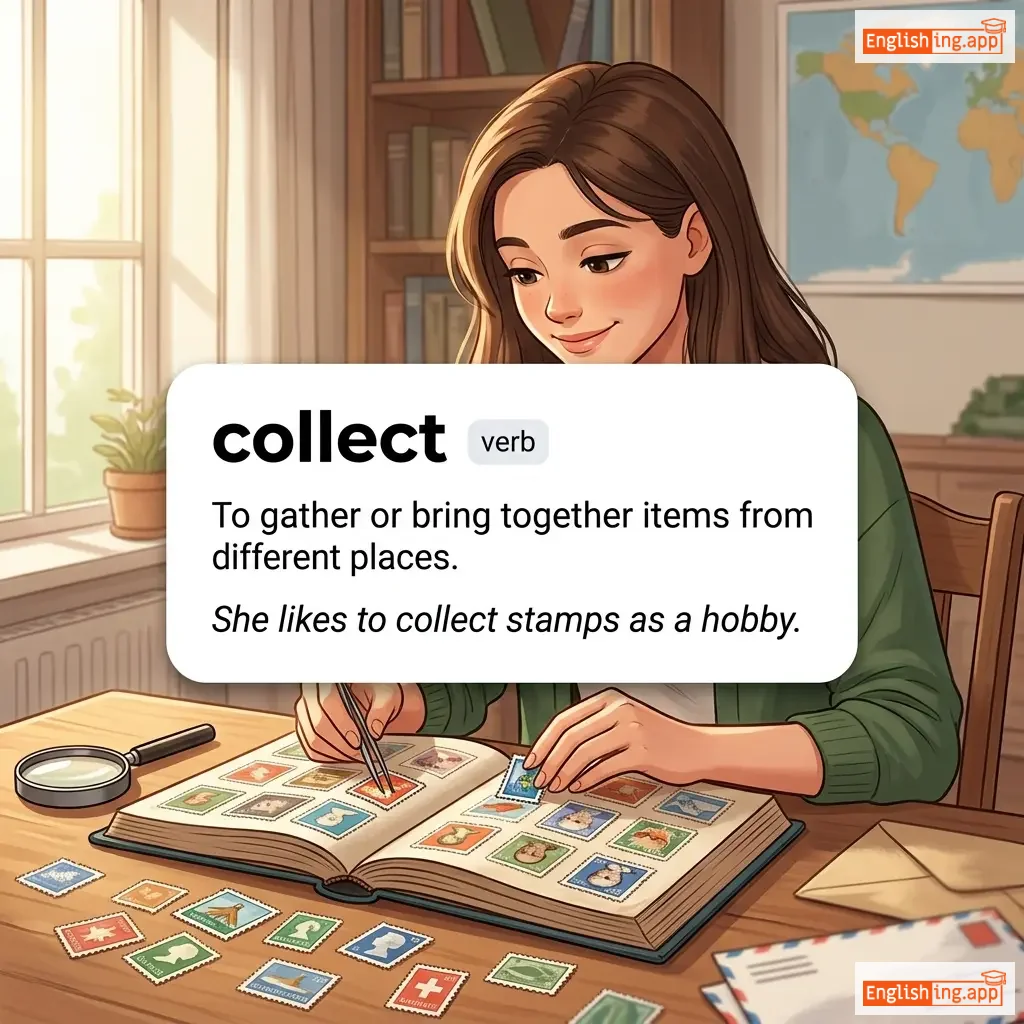
To gather or bring together items from different places.
••••••
|
She likes to collect stamps as a hobby.
Она любит собирать марки как хобби.
••••••
|
Она любит собирать марки как хобби.
Ona lyubit sobirat marky kak hobbi.
••••••
|
collect yourself
успокойся
••••••
|
To regain control over one's emotions or thoughts.
••••••
|
успокойся
uspokoysya
••••••
|
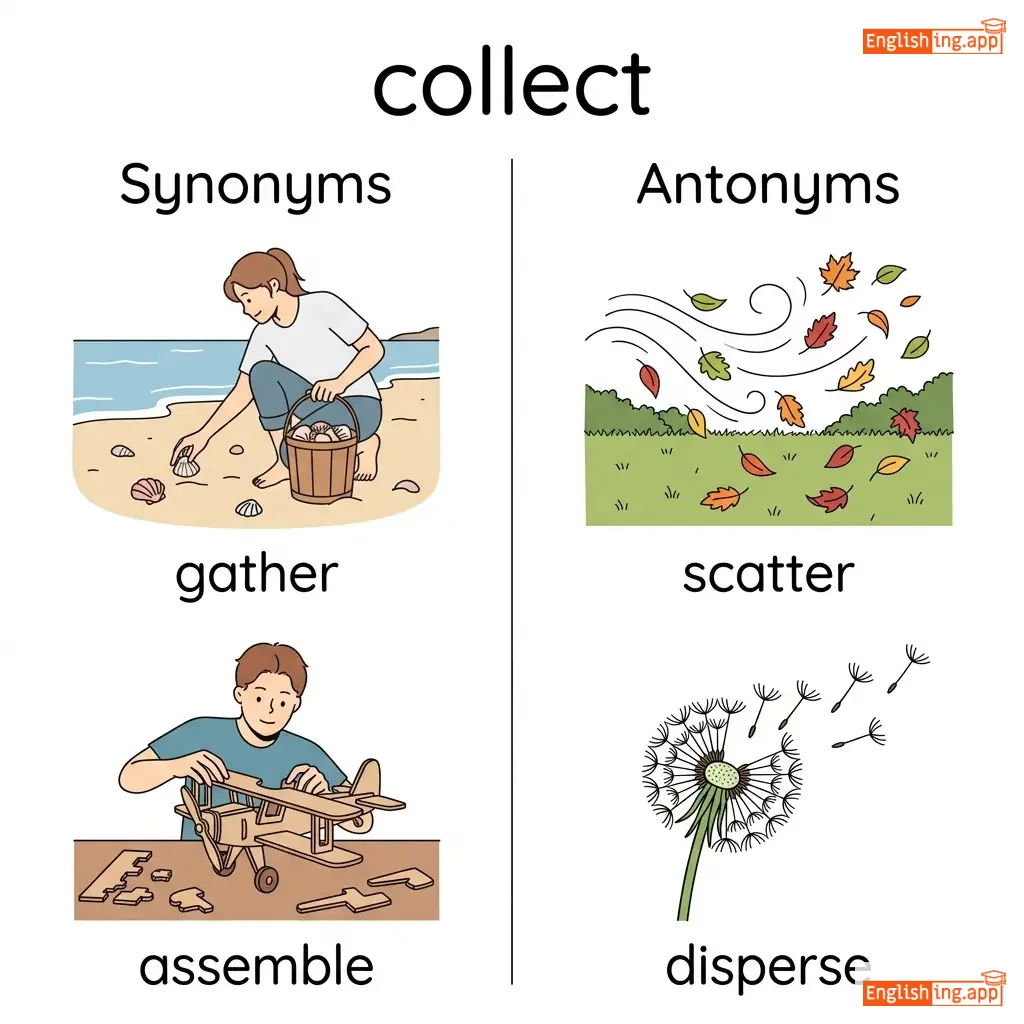
gather, assemble, accumulate, amass, hoard
••••••
|
scatter, disperse, distribute
••••••
|
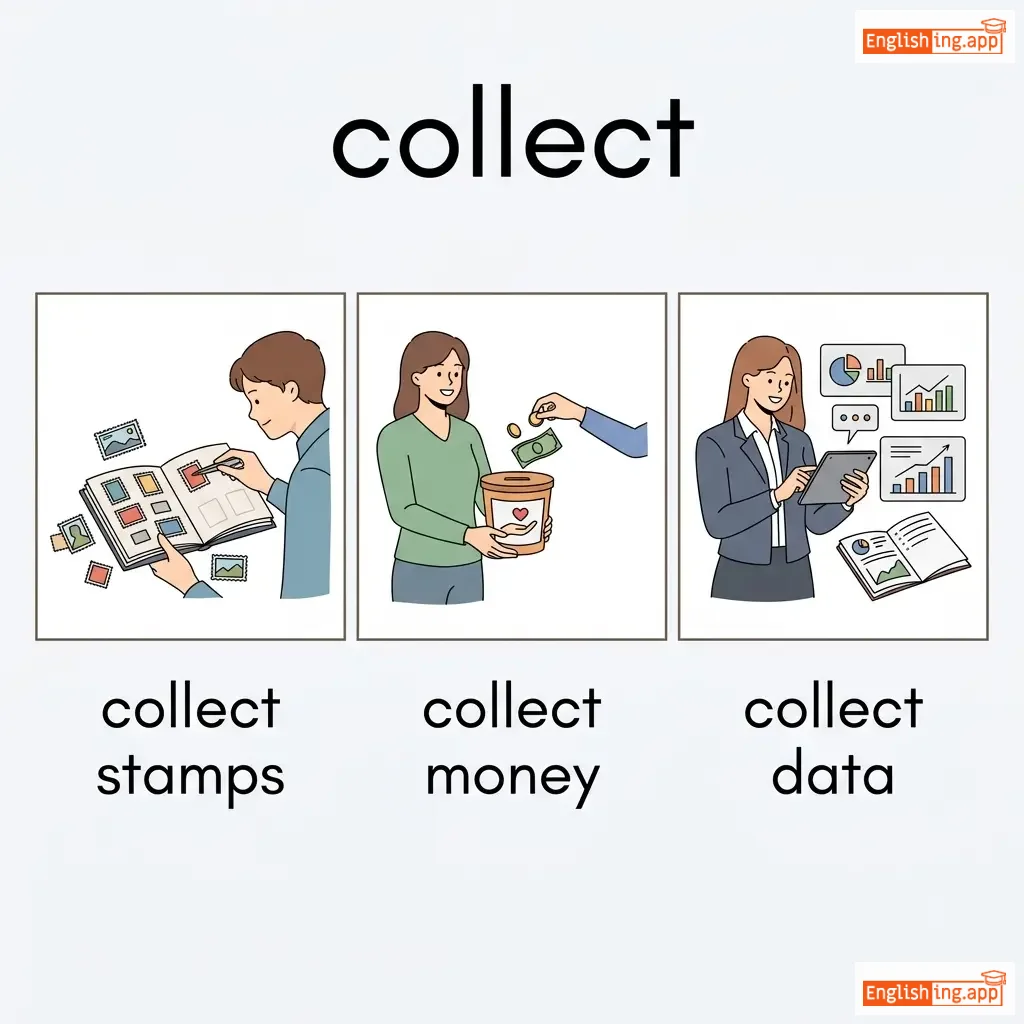
collect stamps, collect money, collect data, collect garbage
••••••
|
Collect (собирать) все вещи и чувства для счастья.
••••••
|
|
📚
••••••
|
/kəˈlɛkʃən/
noun
(коллекшн)
••••••
|
- •••••• |
коллекция
kollekciya
••••••
|
- •••••• | - •••••• | - •••••• | - •••••• |
a group of things gathered together
••••••
|
She has a large collection of rare books.
У нее большая коллекция редких книг.
••••••
|
У нее большая коллекция редких книг.
U nee bol'shaya kollekciya redkikh knig.
••••••
|
debt collection
взыскание долгов
••••••
|
the act of recovering money owed
••••••
|
взыскание долгов
vzyiskanie dolgovi
••••••
|
group, set, assortment, accumulation, compilation
••••••
|
scattering, dispersal
••••••
|
collection of books, stamp collection, art collection, debt collection
••••••
|
Collection означает коллекция 📚 - собирая вещи, создаешь коллекцию.
••••••
|
|
👥
••••••
|
/kəˈlɛktɪv/
adjective
(кəˈлɛктɪв)
••••••
|

|
коллективный
kollektivnyy
••••••
|
- •••••• | - •••••• | - •••••• | - •••••• |
done by people acting as a group
••••••
|
The decision was made by collective agreement. |
Решение было принято по коллективному соглашению.
Resheniye bylo prinyato po kollektivnomu soglasheniyu.
••••••
|
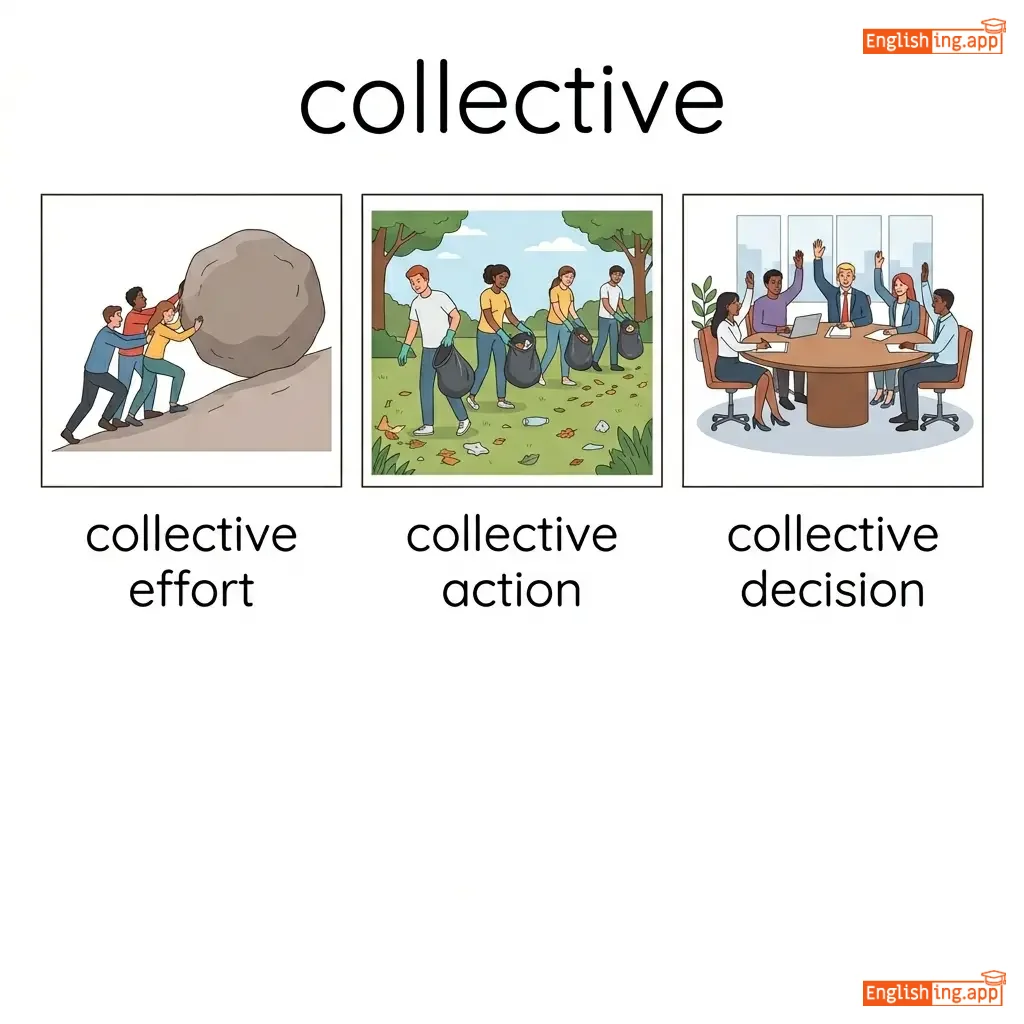
collective effort |
a combined effort by many people working together
••••••
|
коллективные усилия
kollektivnye usiliya
••••••
|
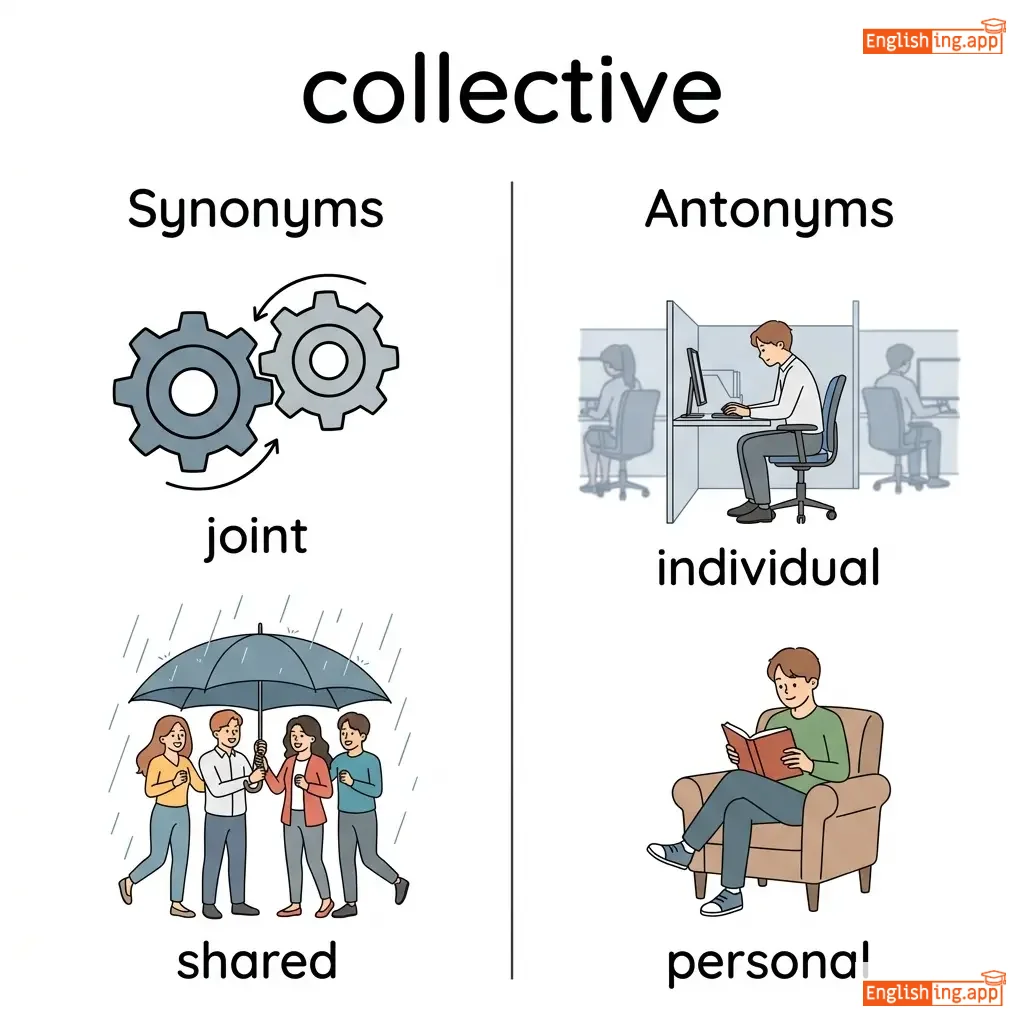
joint, shared, communal, mutual, cooperative
••••••
|
individual, personal
••••••
|
collective effort, collective action, collective decision, collective responsibility
••••••
|
Коллективное усилие означает работать вместе для достижения цели.
••••••
|
|
📮
••••••
|
/kəˈlɛktər/
noun
(кəˈлɛктər)
••••••
|
- •••••• |
коллекционер
kollektsioner
••••••
|
- •••••• | - •••••• | - •••••• | - •••••• |
a person who collects things as a hobby or job
••••••
|
He is a stamp collector with thousands of rare items.
Он коллекционер марок с тысячами редких предметов.
••••••
|
Он коллекционер марок с тысячами редких предметов.
On kollektsioner marok s tysyachami redkikh predmetov.
••••••
|
tax collector
сборщик налогов
••••••
|
a government official who collects taxes
••••••
|
сборщик налогов
sborщik nalogov
••••••
|
accumulator, gatherer, curator, hoarder
••••••
|
spender, giver
••••••
|
stamp collector, coin collector, tax collector, art collector
••••••
|
Collector значит Collect — Коллекционер марок значит коллекционер марок.
••••••
|

