語彙集

英単語辞書 | 単語の意味、定義、例文

noun C2
/ˈpɒliˌɑːrki/
多元治理 (duōyuán zhìlǐ)

government by many people

"Polyarchy allows multiple parties to share power."

"多元治理允许多个党派共享权力。" (Duōyuán zhìlǐ yǔnxǔ duō gè dǎngpài gòngxiǎng quánlì.)
noun C2
/ˈpɒliˌkreɪsi/
多元统治 (duōyuán tǒngzhì)

rule by many; government by multiple authorities

"The nation experienced a polycracy after decentralization reforms."

"该国在去中心化改革后经历了多元统治。" (Gāi guó zài qù zhōngxīnhuà gǎigé hòu jīnglìle duōyuán tǒngzhì.)
👨‍👩‍👧‍👦

polygamist (多配偶者)

noun C2
/ˈpɒlɪɡæmɪst/
一夫多妻者 (yī fū duō qī zhě)

a person who has more than one spouse at the same time

"The polygamist had three wives living in different houses."

"这个多配偶者有三个妻子,他们住在不同的房子里。" (Zhè ge duō pèi'ǒu zhě yǒu sān ge qīzi, tāmen zhù zài bùtóng de fángzi lǐ.)
noun C2
/ˌpɒlɪˈhiːdrən/
具有平面多边形面的固体 (juyou pingmian duobianxing mian de gudi)

a solid object with flat polygonal faces, straight edges, and vertices

"The mathematician studied a complex polyhedron model."

"数学家研究了一个复杂的多面体模型。" (Shuxuejia yanjiule yige fuzade duomian ti moxing.)
noun C2
/ˈpɒl.i.mæθ/
博学者 (bóxué zhě)

a person with knowledge of many different subjects

"Leonardo da Vinci was a true polymath, excelling in art, science, and engineering."

"列奥纳多·达·芬奇是一个真正的博学者,擅长艺术、科学和工程。" (Liè ào nà duō · Dá · fēn qí shì yí gè zhēn zhèng de bóxué zhě, shàncháng yìshù, kēxué hé gōngchéng.)
noun C2
/ˌpɒl.iˈsɪl.ə.bəl/
多音节词 (duo yin jie ci)

a word with more than one syllable

"The word 'elephant' is a polysyllable because it has three syllables."

"‘大象’是一个多音节词,因为它有三个音节。" ('Da xiang' shi yi ge duo yin jie ci, yinwei ta you san ge yin jie.)
noun C2
/ˈpɒl.iˌθi.ɪz.əm/
多神教 (duō shén jiào)

the belief in or worship of multiple gods

"Ancient Greeks practiced polytheism, worshiping gods like Zeus and Athena."
"古希腊人实践多神教,崇拜像宙斯和雅典娜这样的神灵。" (Gǔ xīlà rén shíjiàn duōshénjiào, chóngbài xiàng Zhòusī hé Yǎtiǎnnà zhè yàng de shénlíng.)
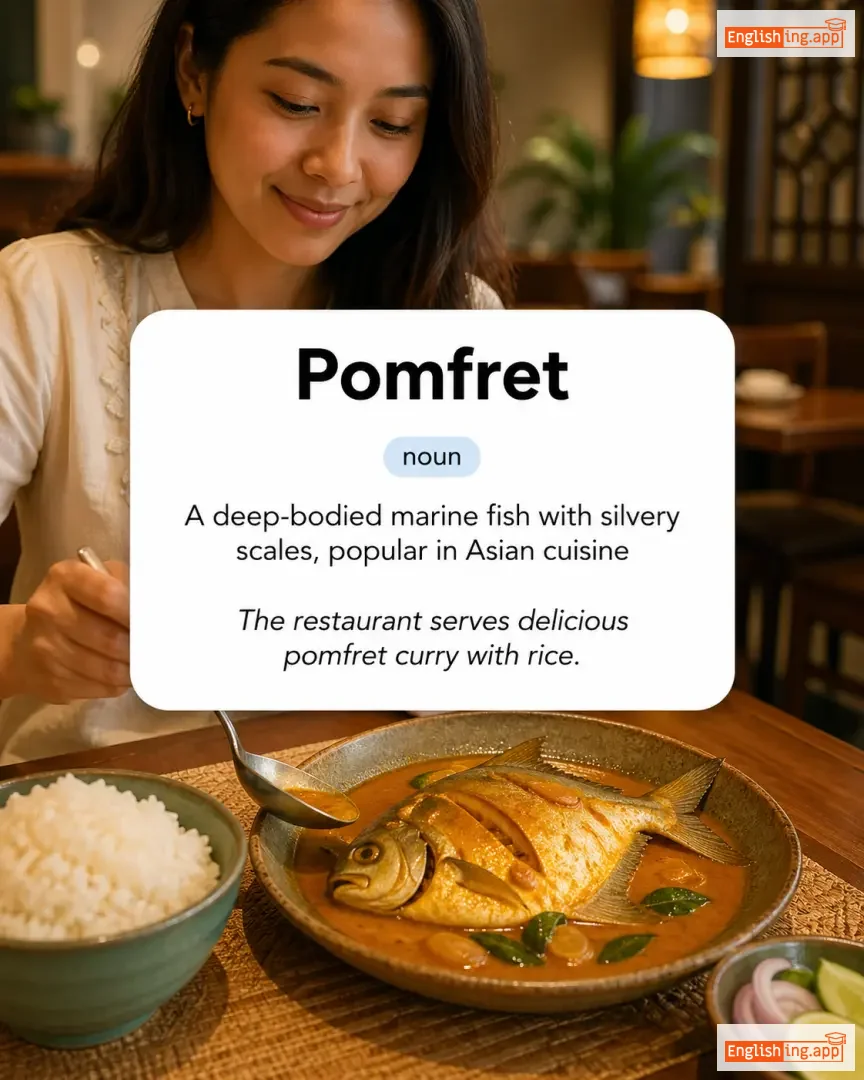
Pomfret definition card — visual illustration of the meaning
noun C2
/ˈpɒmfrɪt/
鲳鱼 (chang yu)

A deep-bodied marine fish with silvery scales, popular in Asian cuisine

"The restaurant serves delicious pomfret curry with rice."

"餐厅提供美味的鲳鱼咖喱配米饭。" (can ting ti gong mei wei de chang yu ka li pei mi fan)
noun C2
/ˈpɒm.əl/
剑柄或鞍座上的圆形按钮 (jiàn bǐng huò ān zuò shàng de yuán xíng àn niǔ)

the rounded knob on the handle of a sword or saddle

"He gripped the sword firmly by the pommel."

"他紧紧地抓住剑柄的波梅尔部分。" (Tā jǐn jǐn de zhuā zhù jiàn bǐng de bō méi ěr bù fèn.)
noun C2
/pɒmˈpɒsəti/
自大, 傲慢 (zì dà, ào màn)

self-important behavior or exaggerated dignity

"His speech was full of pomposity and arrogance."

"他的演讲充满了自大和傲慢。" (Tā de yǎnjiǎng chōngmǎnle zì dà hé ào màn.)
adjective C2
/ˈpɒndərəbl/
可以考虑的, 可思考的 (keyi kaolü de, ke sikao de)

able to be considered or thought about

"The evidence was substantial and ponderable."

"证据是实质性的,并且是可以思考的。" (zhengju shi shizhixing de, bingqie shi keyi sikao de.)
noun C2
/ˈpɒntɪf/
教皇或高级主教 (jiaohuang huo gaoji zhujiao)

the pope or a high-ranking bishop in the Christian church

"The pontiff addressed the nation in a televised speech."

"教皇在电视演讲中向国家发表讲话。" (Jiaohuang zai dianshi yanjiang zhong xiang guojia fabiao jianghua.)
adjective C2
/pɒnˈtɪfɪkəl/
与教皇或主教相关的;浮夸的或自命不凡的 (yu jiao huang huo zhu jiao xiang guan de; fu kua de huo zi ming bu fan de)

relating to a pope or bishop; pompous or self-important

"His pontifical manner annoyed the other members of the committee."

"他的傲慢态度让委员会的其他成员感到不悦。" (Ta de aoman taidu rang weiyuanhui de qita chengyuan gan dao buyue.)
verb C2
/ˈpɒntɪfɪkeɪt/
自负或武断地讲话或行动;担任教皇职务 (zìfù huò wǔduàn de jiǎnghuà huò xíngdòng; dān rèn jiàohuáng zhíwù)

to speak or act in a pompous or dogmatic way; to officiate as a pontiff

"He pontificated on the importance of education for over an hour."

"他在一个小时内讲述了教育的重要性。" (Tā zài yī gè xiǎoshí nèi jiǎngshùle jiàoyù de zhòngyào xìng.)
noun C2
/ˈpɔːrfəri/
一种硬的火成岩 (yī zhǒng yìng de huǒchéng yán)

A hard igneous rock containing crystals, often used for decorative or building purposes.

"The ancient Romans used porphyry to make columns and statues."

"古罗马人使用波斐里石制作柱子和雕像。" (Gǔ Luómǎ rén shǐyòng bō fěi lǐ shí zhìzuò zhùzi hé diāoxiàng.)
verb C2
/pɔːrˈtɛnd/
预示 (yùshì)

To be a sign or warning that something, especially something bad, is going to happen.

"Dark clouds portend a storm."

"暗云预示着暴风雨。" (Àn yún yùshì zhe bàofēngyǔ.)
noun C2
/ˈpɔːrtɛnt/
前兆 (qián zhào)

A sign or warning that something, especially something momentous or calamitous, is likely to happen.

"The sudden drop in stock prices was seen as a portent of economic trouble."

"股票价格的突然下跌被视为经济问题的前兆。" (Gǔ piào jià gé de tú rán xià diē bèi shì wéi jīng jì wèn tí de qián zhào.)
adjective C2
/pɔːrˈtɛntəs/
不祥的,严肃的 (bùxiáng de, yánsù de)

Giving a sign or warning that something, often bad or serious, is going to happen; or overly solemn and pompous.

"His portentous tone made everyone nervous about the news."

"他那不祥的语气让大家因新闻感到紧张。" (Tā nà bùxiáng de yǔqì ràng dàjiā yīn xīnwén gǎndào jǐnzhāng.)
adjective C2
/ˈpɔːrtli/
肥胖 (feipang)

Having a stout or somewhat fat body, often implying dignity or authority.

"The portly man entered the room with confidence."

"那个肥胖的男人自信地走进房间。" (Nàgè féipàng de nánrén zìxìn de zǒu jìn fángjiān.)
noun C2
/poʊˈzɜːr/

A person who pretends to be something they are not, often to impress others.

"Many considered him a poseur because he exaggerated his accomplishments."

noun C2
/ˈpɒsi/
帮派 / 朋友群 (bāng pài / péng yǒu qún)

A group of people, often friends or a group organized to support or enforce the law.

"He arrived at the party with his posse of friends."

"他和他的朋友帮派一起到达了派对。" (Tā hé tā de péng yǒu bāng pài yī qǐ dào dá le pài duì.)
adjective C2
/ˌpəʊstˈprændɪəl/
餐后 (cān hòu)

Occurring after a meal.

"He went for a postprandial walk after dinner."

"他在晚餐后去散步。" (Tā zài wǎncān hòu qù sànbù.)
noun C2
/ˈpɒtˌbɔɪlə/
低级文学作品 (dijí wénxué zuòpǐn)

a book, play, or film produced quickly to make money rather than for artistic value

"The novel was dismissed by critics as a mere potboiler."

"这本小说被评论家视为仅仅是一本低级文学作品。" (Zhè běn xiǎoshuō bèi pínglùn jiā shì wéi jǐnjǐn shì yī běn dījí wénxué zuòpǐn.)
noun C2
/ˈpoʊtənˌteɪt/
君主 (junzhu)

A monarch or ruler, especially one with absolute power.

"The ancient land was ruled by a powerful potentate."

"古老的土地由一个强大的君主统治。" (Gulǎo de tǔdì yóu yīgè qiángdà de jūnzhǔ tǒngzhì.)
verb C2
/poʊˈtɛnʃiˌeɪt/
增强 (zengqiang)

To increase the power, effect, or likelihood of something.

"Caffeine can potentiate the effects of some medicines."

"咖啡因可以增强某些药物的效果。" (Kafein keyi zengqiang moxie yao wu de xiaoguo.)
noun C2
/ˌpoʊpʊˈriː/
干花混合物 (gan hua hunhe wu)

a mixture of dried flowers and spices kept in a bowl to perfume a room; a miscellaneous collection

"The living room was filled with the scent of potpourri."

"客厅里充满了波普瑞的香气。" (Keting li chongman le bopuri de xiangqi.)
noun C2
/ˈpoʊltɪs/
温暖的草药敷料 (wēnnuǎn de cǎoyào fūliào)

a soft, moist mass of material applied to the body to relieve soreness and inflammation

"The nurse applied a warm poultice to his injured leg."

"护士把温暖的敷料敷在他受伤的腿上。" (hùshì bǎ wēnnuǎn de fūliào fū zài tā shòushāng de tuǐ shàng.)
noun C2
/ˈpaʊ.waʊ/
非正式会议 (fei zhengshi huiyi)

an informal meeting or conference to discuss something

"The team held a quick powwow before the presentation."

"团队在演示之前举行了一个快速的非正式会议。" (tuandui zai yanshi zhīqián jǔxíngle yīgè kuàisù de fēi zhèngshì huìyì.)
verb C2
/preɪt/
喋喋不休 (diede buxiu)

to talk foolishly or at tedious length about something

"He would prate endlessly about his minor achievements."

"他会不停地谈论他的微小成就。" (Tā huì bù tíng de tán lùn tā de wēi xiǎo chéng jiù.)
verb C2
/ˈprætəl/
喋喋不休 (diédié bùxiū)

to talk at length in a foolish or inconsequential way

"The children would prattle on about their games."

"孩子们会不停地谈论他们的游戏。" (Háizimen huì bùtíng de tánlùn tāmen de yóuxì.)
adjective C2
/ˌprɛsɪˈdɛnʃəl/
先例的 (xiān lì de)

Relating to, or serving as, a precedent; having authority as an example.

"The court’s decision has precedential value."

"法院的判决具有先例价值。" (Fayuan de pànjué jùyǒu xiānlì jiàzhí.)
noun C2
/ˈpriːsɛpt/
教条 (jiaotiao)

A general rule intended to regulate behavior or thought.

"Honesty is a fundamental precept in all religions."

"诚实是所有宗教中的一个基本教条。" (Chéngshí shì suǒyǒu zōngjiào zhōng de yīgè jīběn jiàotiáo.)
noun C2
/prɪˈsɛʃən/
进动 (jindong)

The slow movement of the axis of a spinning body around another axis, often referring to Earth's rotation.

"Astronomers study the precession of the equinoxes."

"天文学家研究春分点的进动。" (Tiānwénxuéjiā yánjiū chūn fēn diǎn de jìndòng.)
noun C2
/ˌprɛsiˈɒsɪti/
过度的精致 (guòdù de jīngzhì)

Excessive refinement or affected elegance in language, style, or behavior.

"The author's preciosity made the novel difficult to read for some audiences."

"作者的过度精致使得这本小说对于一些读者来说很难阅读。" (zuòzhě de guòdù jīngzhì shǐdé zhè běn xiǎoshuō duì yīxiē dúzhě lái shuō hěn nán yuèdú.)
noun/adjective C2
/prɪˈsɪpɪtənt/
沉淀剂 (chéndiàn jì)

As a noun: a substance that causes a substance to be deposited from a solution; as an adjective: acting hastily or impulsively.

"The chemist added a precipitant to the solution to observe the reaction."

"化学家向溶液中加入了沉淀剂,以观察反应。" (Huàxué jiā xiàng róngyè zhōng jiārùle chéndiàn jì, yǐ guānchá fǎnyìng.)
verb C2
/priːˈdɛstɪn/
预定 (yùdìng)

to determine or decide something in advance, often regarded as being fixed by fate or divine will

"They believed their paths were predestined by fate."

"他们相信他们的道路是命运注定的。" (Tāmen xiāngxìn tāmen de dàolù shì mìngyùn zhùdìng de.)
noun C2
/ˌpriːdɪˈlɛkʃən/
偏好 (pianhao)

A strong liking or preference for something.

"She has a predilection for classical music."

"她有一个偏好,喜欢古典音乐。" (Ta you yi ge pianhao, xihuan gudian yinyue.)
noun C2
/priːˈɛmɪnəns/
卓越 (zhuóyuè)

The fact of surpassing all others; superiority.

"The university has gained preeminence in medical research."

"该大学在医学研究中已获得卓越地位。" (Gāi dàxué zài yīxué yánjiū zhōng yǐ huòdé zhuóyuè dìwèi.)
noun C2
/priˈɛmpʃən/
优先购买权 (yōuxiān gòumǎi quán)

The act of taking action before someone else; the right to purchase or act before others.

"The company exercised preemption to acquire the land before competitors."

"公司行使优先购买权,在竞争对手之前购买了土地。" (Gōngsī xíngshǐ yōuxiān gòumǎi quán, zài jìngzhēng duìshǒu zhīqián gòumǎile tǔdì.)
verb C2
/ˌpriːɪnˈɡeɪdʒ/
预先雇佣 (yùxiān gùyōng)

To contract or engage beforehand; to arrange in advance.

"The workers were preengaged before the project officially started."

"项目正式开始前,工人们已被预先雇佣。" (Xiàngmù zhèngshì kāishǐ qián, gōngrénmen yǐ bèi yùxiān gùyōng.)
verb C2
/ˌpriːɪˈstæblɪʃ/
预先设定 (yùxiān shèdìng)

To establish or set up beforehand.

"Certain rules were preestablished before the meeting."

"在会议之前,一些规则已经预先设定。" (Zài huìyì zhīqián, yīxiē guīzé yǐjīng yùxiān shèdìng.)
verb C2
/ˌpriːɪɡˈzɪst/
提前存在 (tíqián cúnzài)

to exist beforehand or before something else

"These customs preexist the arrival of modern technology."

"这些习俗早于现代技术的到来而存在。" (Zhèxiē xísú zǎo yú xiàndài jìshù de dàolái ér cúnzài.)
noun C2
/ˌpriːɪɡˈzɪstəns/
预存在 (yù cúnzài)

the state of existing before something else

"Philosophers often debated the preexistence of the soul."

"哲学家们常常辩论灵魂的预存在。" (Zhéxuéjiā men chángcháng biànlùn línghún de yù cúnzài.)
adjective C2
/ˈprɛfətɔːri/
前言 (qianyan)

serving as an introduction or preface

"He made some prefatory remarks before the lecture began."

"他在讲座开始前做了一些前言性的评论。" (Ta zai jiangzuo kaishi qian zuo le yixie qianyanxing de pinglun.)
noun C2
/prɪˈfɜːrmənt/
晋升 (jinsheng)

promotion or advancement in rank, position, or office

"He hoped for preferment in the government office."

"他希望在政府办公室得到晋升。" (Tā xīwàng zài zhèngfǔ bàngōngshì dédào jìnshēng.)
verb C2
/priːˈfɪɡjər/
预示 (yùshì)

to represent, show, or foreshadow something in advance

"The economic reforms prefigure major social changes."

"经济改革预示着重大社会变革。" (Jīngjì gǎigé yùshì zhe zhòngdà shèhuì biàngé.)
adjective C2
/prɪˈhɛnsɪbəl/
可抓取的 (ke zhua qu de)

capable of being grasped or seized

"The tool has a prehensible handle that improves safety."

"这个工具有一个可抓取的把手,能提高安全性。" (Zhege gongju you yige ke zhua qu de bashou, neng tigao anquanzhi.)
adjective C2
/prɪˈhɛnsaɪl/
可抓取的 (kě zhuāqǔ de)

adapted for seizing or grasping, especially by wrapping around an object

"The monkey used its prehensile tail to hang from the branch."

"猴子用它的抓握尾巴从树枝上挂下来。" (Hóuzi yòng tā de zhuāwò wěibā cóng shùzhī shàng guà xiàlái.)
noun C2
/prɪˈhɛnʃən/
抓握的动作; 抓住某物的能力 (zhuā wò de dòngzuò; zhuā zhù mǒu wù de nénglì)

the act of grasping or seizing; the ability to take hold of something

"Therapists assessed the patient's prehension during hand therapy."

"治疗师在手部治疗中评估了患者的抓握能力。" (Zhìliáo shī zài shǒubù zhìliáo zhōng pínggūle huànzhě de zhuā wò nénglì.)
noun C2
/ˈprɛləsi/
教主制 (jiaozhuzhi)

The office, dignity, or system of church government by prelates.

"The medieval church was dominated by prelacy and its traditions."

"中世纪的教会由教主制及其传统主导。" (Zhongshiji de jiaohui you jiaozhuzhi ji qi chuántǒng zhǔdǎo.)