वोकैबुलरीज

इंग्लिश वोकैबुलरी डिस्कवर, लर्न और मास्टर करें

adjective C2
/prəˈhɪbɪtɔːri/
प्रतिबंधात्मक (pratibandhatmak)

Serving or tending to prohibit or forbid.

"The prohibitory laws were strictly enforced in the region."

"प्रतिबंधात्मक क़ानूनों को क्षेत्र में कड़ाई से लागू किया गया था।" (Pratibandhatmak kanoonon ko kshetra mein kadayi se lagu kiya gaya tha.)
adjective C2
/ˈprəʊ.lɪks/
अत्यधिक लंबा (atyadhik lamba)

using too many words; tediously lengthy

"The professor’s prolix lecture put many students to sleep."

"प्रोफेसर का अत्यधिक लंबा व्याख्यान कई छात्रों को सोने पर मजबूर कर दिया।" (Professor ka atyadhik lamba vyakhyan kai chatron ko sone par majboor kar diya.)
noun C2
/prəˈlɪksɪti/
अत्यधिक शब्दजालिता (atyadhik shabdajalita)

the quality of being tediously wordy and long

"The book’s prolixity made it difficult to read in one sitting."

"पुस्तक की अत्यधिक शब्दजालिता ने इसे एक ही बैठक में पढ़ना कठिन बना दिया।" (Pustak ki atyadhik shabdajalita ne ise ek hi baithak mein padhna kathin bana diya.)
adjective C2
/ˈprɒmɪsəri/
प्रति‌श्रुतिमूलक (pratishrutimulak)

Containing or conveying a promise, especially in writing.

"He signed a promissory note to repay the loan."

"उसने ऋण चुकाने के लिए एक प्रति‌श्रुतिमूलक नोट पर हस्ताक्षर किए।" (Usne rin chukane ke liye ek pratishrutimulak note par hastakshar kiye.)
noun C2
/ˈprɒm.ən.tɔːr.i/
कटी हुई भूमि (kati hui bhumi)

A high point of land or rock projecting into a body of water.

"The lighthouse stood on a promontory overlooking the sea."

"灯塔 खाड़ी के ऊपर एक कटी हुई भूमि पर खड़ा था।" (Dengta khadi ke upar ek kati hui bhumi par khada tha.)
verb C2
/ˈprɑː.məl.ɡeɪt/
घोषित करना (ghoshit karna)

To announce or make a law, decree, or idea officially known.

"The government promulgated new regulations on data privacy."

"सरकार ने डेटा प्राइवेसी पर नए नियम घोषित किए।" (Sarkar ne data privacy par naye niyam ghoshit kiye.)
noun C2
/prɔːŋ/
चमच की नोक (chamach ki nok)

a projecting pointed part, such as one of the pointed ends of a fork

"The fork has four prongs."

"चमच में चार नोकें होती हैं।" (Chamach mein chaar nokein hoti hain.)
adjective C2
/ˌprɒfɪˈlæktɪk/
रोकथाम करने वाला (roktam karne wala)

intended to prevent disease or an unwanted outcome; protective

"The doctor prescribed a prophylactic treatment to prevent infection."

"डॉक्टर ने संक्रमण को रोकने के लिए एक रोकथाम उपचार निर्धारित किया।" (Daktar ne sankraman ko rokne ke liye ek roktam upchar nirdharit kiya.)
noun C2
/prəˈpɪŋkwɪti/
निकटता (nikatata)

the state of being close to someone or something; proximity

"The propinquity of their houses made them close friends."

"उनके घरों की निकटता ने उन्हें करीबी दोस्त बना दिया।" (Unke gharon ki nikatata ne unhe kareebi dost bana diya.)
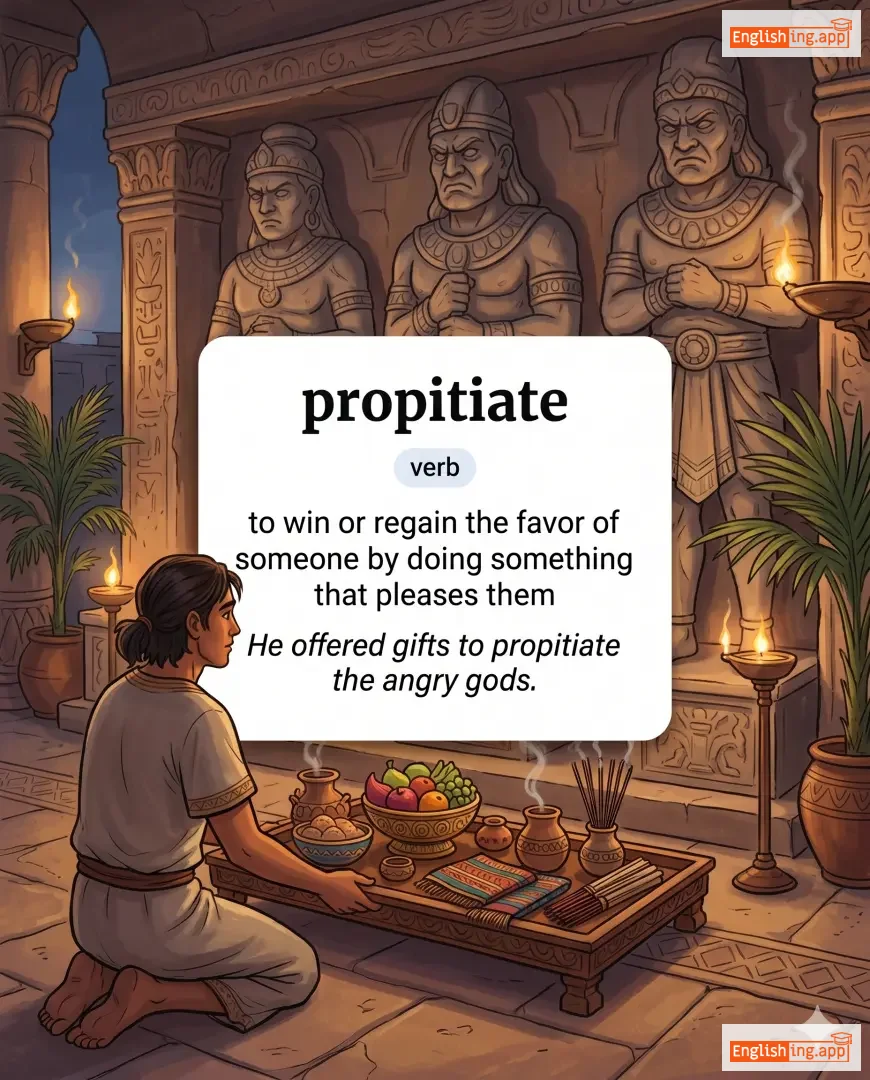
propitiate definition card — visual illustration of the meaning
verb C2
/prəˈpɪʃieɪt/
किसी को प्रसन्न करने के लिए उसका आशीर्वाद प्राप्त करना (kisi ko prasann karne ke liye uska aashirwad prapt karna)

to win or regain the favor of someone by doing something that pleases them

"He offered gifts to propitiate the angry gods."

"उसने गुस्साए हुए देवताओं को प्रसन्न करने के लिए उपहार दिए।" (Usne gussaaye huye devtaon ko prasann karne ke liye uphaar diye.)
adjective C2
/prəˈpɪʃəs/
शुभ, अनुकूल (shubh, anukul)

giving or indicating a good chance of success; favorable

"The sunny weather was a propitious start to the picnic."

"सनी मौसम पिकनिक के लिए शुभ शुरुआत थी।" (Sani mausam picnic ke liye shubh shuruat thi.)
verb C2
/prəˈpaʊnd/
प्रस्तावित करना (prastavit karna)

To put forward an idea, theory, or point for consideration.

"The professor propounded a new theory on climate change."

"प्रोफेसर ने जलवायु परिवर्तन पर एक नया सिद्धांत प्रपाउंड किया।" (Professor ne jalvayu parivartan par ek naya siddhant prapound kiya.)
adjective C2
/prəˈpʌlsɪv/
प्रेरक (prerak)

Having the power to drive or push something forward.

"The propulsive force of the rocket lifted it off the ground."

"रॉकेट की प्रेरक शक्ति ने उसे ज़मीन से ऊपर उठा लिया।" (Rocket ki prerak shakti ne use zameen se upar utha liya.)
verb C2
/prəˈroʊɡ/
सत्र स्थगित करना (satra sthagit karna)

to discontinue a session of a parliament or assembly without dissolving it

"The president decided to prorogue parliament until the crisis was resolved."

"राष्ट्रपति ने संकट सुलझने तक संसद को स्थगित करने का निर्णय लिया।" (Rashtrapati ne sankat sulajhne tak sansad ko sthagit karne ka nirnay liya.)
noun C2
/proʊˈsiː.ni.əm/
मंच का अग्रभाग (manch ka agrabhag)

the part of a theater stage in front of the curtain; the arch framing the stage

"The actors bowed at the proscenium before leaving the stage."

"अभिनेता मंच छोड़ने से पहले प्रोसीनियम में झुके।" (Abhineta manch chhodne se pehle proscenium mein jhuke.)
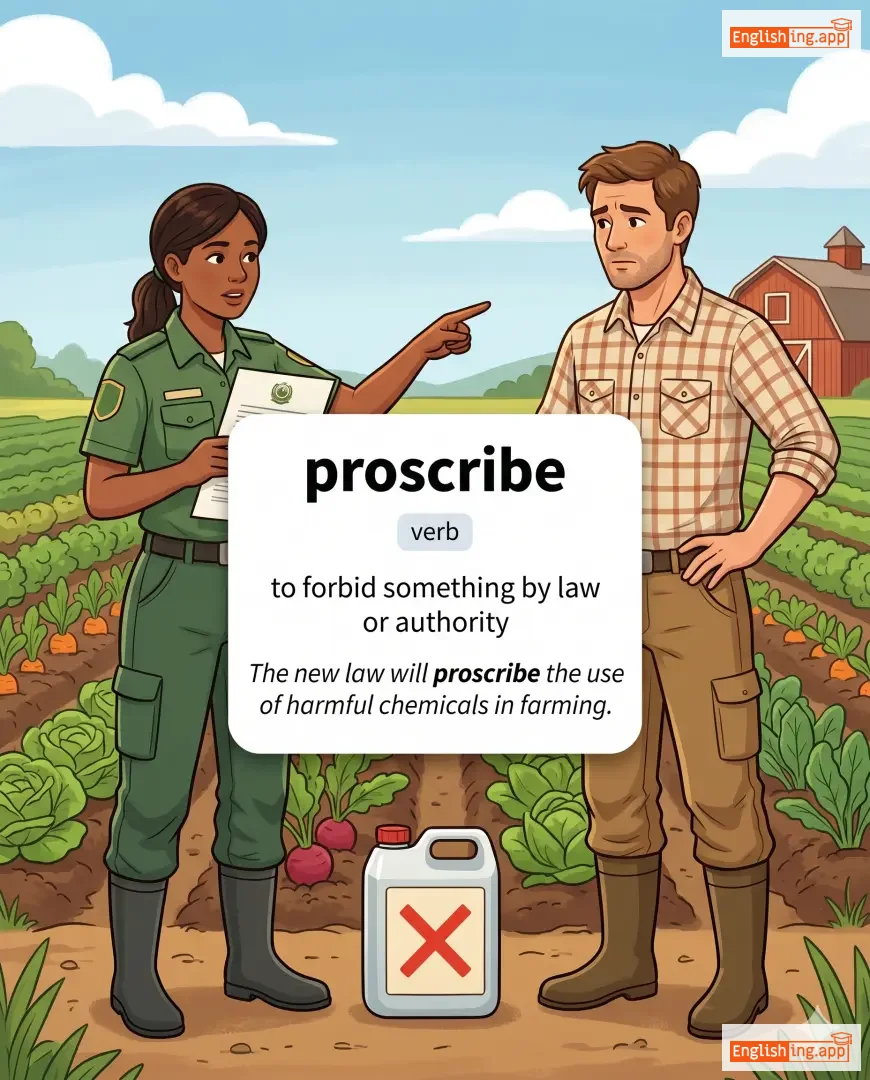
proscribe definition card — visual illustration of the meaning
verb C2
/proʊˈskraɪb/
निषिद्ध करना (nishiddh karna)

to forbid something by law or authority

"The new law will proscribe the use of harmful chemicals in farming."

"नया कानून कृषि में हानिकारक रसायनों के उपयोग को निषिद्ध कर देगा।" (Naya kanoon krishi mein haanikarak rasanayon ke upyog ko nishiddh kar dega.)
noun C2
/proʊˈskrɪp.ʃən/
प्रतिबंध (pratibandh)

the act of forbidding something, especially by law

"The proscription of child labor is an important human rights achievement."

"बाल श्रम पर प्रतिबंध मानवाधिकार की एक महत्वपूर्ण उपलब्धि है।" (Baal shram par pratibandh manavadhikar ki ek mahatvapurn uplabhdhi hai.)
noun C2
/ˈprɒsɪlaɪt/
धर्मांतरण करने वाला व्यक्ति (dharmantaran karne wala vyakti)

A person who has converted from one belief, opinion, or religion to another.

"She became a proselyte after converting to a new faith."

"वह एक नए विश्वास में परिवर्तित होने के बाद एक धर्मांतरण करने वाला व्यक्ति बन गई।" (Vah ek naye vishwas mein parivartit hone ke baad ek dharmantaran karne wala vyakti ban gayi.)
verb C2
/ˈprɒsəˌlaɪtaɪz/
धर्मांतरण करने की कोशिश करना (dharmantaran karne ki koshish karna)

To try to persuade someone to convert to a different belief or religion.

"They tried to proselytize the villagers with their new ideas."

"वे अपने नए विचारों से गाँववालों को धर्मांतरण करने की कोशिश कर रहे थे।" (Ve apne naye vicharon se gaonwalon ko dharmantaran karne ki koshish kar rahe the.)
noun C2
/ˈprɒsədi/
छंदविज्ञान (chandavigyan)

The patterns of rhythm and sound used in poetry and speech.

"The professor explained how prosody affects the mood of a poem."

"प्रोफेसर ने समझाया कि कैसे छंदविज्ञान एक कविता के मूड को प्रभावित करता है।" (Professor ne samjhaya ki kaise chandavigyan ek kavita ke mood ko prabhavit karta hai.)
adjective C2
/ˈproʊtiən/
बहुमुखी (bahumukhi)

tending or able to change frequently or easily; versatile

"She is a protean artist who experiments with many styles."

"वह एक बहुमुखी कलाकार है जो कई शैलियों के साथ प्रयोग करती है।" (Vah ek bahumukhi kalakar hai jo kai shailiyon ke saath prayog karti hai.)
noun C2
/prəˈtɛktərət/
संरक्षित राज्य (sanrakshit rajya)

A state that is controlled and protected by another.

"The small country became a protectorate of the empire."

"छोटा देश साम्राज्य का संरक्षित राज्य बन गया।" (Chhota desh samrajya ka sanrakshit rajya ban gaya.)
noun C2
/ˈproʊtoʊˌmɑːrtɚ/
प्रथम शहीद (pratham shaheed)

The first martyr in a cause or religion, often referring to the first Christian martyr.

"St. Stephen is known as the protomartyr of Christianity."

"सेंट स्टीफन को ईसाई धर्म के प्रोटोमार्टिर के रूप में जाना जाता है।" (Saint Stephen ko Isaai dharm ke protomartyr ke roop mein jaana jaata hai.)
noun C2
/ˈproʊtoʊˌplæzəm/
प्रोटोप्लाज्म (protoplazm)

The living substance inside a cell, including the cytoplasm and nucleus.

"Scientists observed the movement of protoplasm under the microscope."

"वैज्ञानिकों ने माइक्रोस्कोप के तहत प्रोटोप्लाज्म की गति का अवलोकन किया।" (Vaigyanikon ne microscope ke tahat protoplasm ki gati ka avlokan kiya.)
noun C2
/prəˈtuːbərəns/
सूजन (sujan)

A rounded swelling or lump on a surface.

"The doctor examined the small protuberance on his arm."

"डॉक्टर ने उसके हाथ पर छोटे सूजन का परीक्षण किया।" (Doktar ne uske haath par chhote sujan ka parikshan kiya.)
adjective C2
/prəˈtuːbərənt/
उभड़ा हुआ या फूला हुआ (ubhda hua ya phoola hua)

Sticking out or bulging.

"His protuberant belly showed after the meal."

"खाने के बाद उसकी फूली हुई पेट दिखाई दी।" (Khaane ke baad uski phooli hui pet dikhayi di.)
verb C2
/ˈproʊtjuːbəreɪt/
फूलना (phoolna)

To swell out or bulge.

"The roots began to protuberate from the ground."

"जड़ें ज़मीन से बाहर उभरने लगीं।" (Jaden zameen se baahar ubharne lagi.)
noun C2
/ˈprɒvəndər/
पशुओं के लिए खाद्य (pashuon ke liye khadya)

food or provisions, especially for livestock

"The barn was filled with provender for the cattle."

"गोशाला में मवेशियों के लिए खाद्य से भरी हुई थी।" (Goshala mein maveshiyon ke liye khadya se bhari hui thi.)
adjective C2
/ˈprɒvɪdənt/
सावधान (savdhan)

making or indicative of timely preparation for the future

"She was provident in saving money for her children’s education."

"वह अपनी बच्चों की शिक्षा के लिए पैसे बचाने में सावधान थी।" (Vah apni bachchon ki shiksha ke liye paise bachane mein savdhan thi.)
adjective C2
/ˌprɒvɪˈdɛnʃəl/
भाग्यशाली (bhagyashali)

occurring at a favorable or opportune time, as if guided by divine intervention

"Their timely rescue was considered providential."

"उनकी समय पर मदद को भाग्यशाली माना गया था।" (Unki samay par madad ko bhagyashali mana gaya tha.)
adjective C2
/prəˈvaɪzəri/
अन्योन्याश्रित (anyonyashrit)

conditional; depending on certain terms being met

"The arrangement was only provisory until the final contract was signed."

"यह व्यवस्था केवल अस्थायी थी जब तक अंतिम अनुबंध पर हस्ताक्षर नहीं हो जाते।" (yah vyavastha keval asthai thi jab tak antim anubandh par hastakshar nahin ho jaate.)
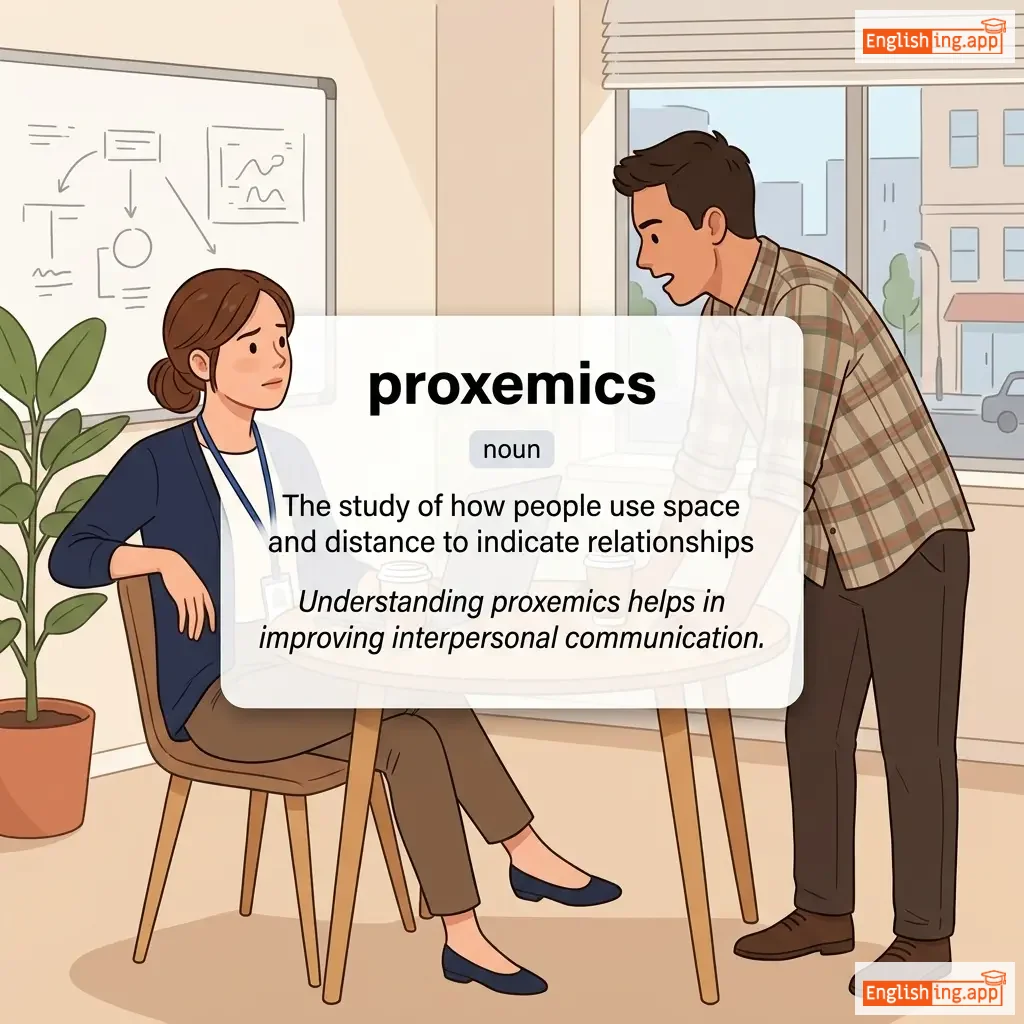
proxemics definition card — visual illustration of the meaning
noun C2
prɒkˈsiː.mɪks
व्यक्तिगत स्थान के उपयोग का अध्ययन (vyaktigat sthaan ke upyog ka adhyayan)

The study of how people use space and distance to indicate relationships

"Understanding proxemics helps in improving interpersonal communication."

"समझना प्रॉक्सेमिक्स अंतरवैयक्तिक संचार को सुधारने में मदद करता है।" (Samajhna proxemics antarayaktik sanchar ko sudharne mein madad karta hai.)
adverb C2
/ˈprɒksɪmətli/
नजदीक (najdik)

In a near or close manner; nearly.

"The village lies proximately to the river."

"गांव नदी के नजदीक स्थित है।" (Gaon nadi ke najdik sthit hai.)
noun C2
/pruːd/
अत्यधिक शालीन या संकोची व्यक्ति (atyadhik shaaleen ya sankochi vyakti)

A person who is easily shocked by matters relating to sex or nudity; someone overly modest.

"He was called a prude for blushing at the movie scenes."

"उसे मूवी सीन में शर्मिंदा होने पर प्रूड कहा गया था।" (Use movie scene mein sharminda hone par prude kaha gaya tha.)
adjective C2
/pruːˈdɛnʃəl/
प्रुडेंशियल (prudenshial)

involving or showing prudence, especially in financial or business matters

"The bank has set prudential rules to protect depositors."

"बैंक ने जमा करने वालों की सुरक्षा के लिए प्रूडेंशियल नियम बनाए हैं।" (bank ne jama karne walon ki suraksha ke liye prudenshial niyam banaye hain.)
noun C2
/ˈpruːdəri/
यौन-विषयक अति-शालीनता (prudri)

the behavior or attitude of people who are too easily shocked or offended by sexual matters

"His prudery often made others uncomfortable during open discussions."

"खुली चर्चाओं के दौरान उसकी अति-शालीनता अक्सर दूसरों को असहज बना देती थी।" (khuli charchaoN ke dauran uski ati shaaleenta aksar dusron ko asahaj bana deti thi.)
adjective C2
/ˈpruːdɪʃ/
संकोची (sankochi)

having or revealing a tendency to be easily shocked by matters relating to sex or nudity

"She was too prudish to watch the movie with her friends."

"वह अपने दोस्तों के साथ फिल्म देखने के लिए बहुत संकोची थी।" (vah apne doston ke saath film dekhne ke liye bahut sankochi thi.)
adjective C2
/ˈprʊəriənt/
कामुक (kamuk)

having or showing an excessive interest in sexual matters

"The magazine was criticized for its prurient content."

"पत्रिका को इसके कामुक सामग्री के लिए आलोचना की गई थी।" (Patrika ko iske kamuk samagri ke liye alochana ki gayi thi.)
noun C2
/ˌsuːdəʊəˈpɒsəl/
झूठा प्रेरित (jhootha prerit)

a false or pretended apostle

"The preacher was condemned as a pseudapostle."

"धर्म उपदेशक को एक झूठे प्रेरित के रूप में निंदा किया गया।" (Dharm updeshak ko ek jhoothe prerit ke roop mein ninda kiya gaya.)
noun C2
/ˌsuːdəˈnɪmɪti/
उपनाम का उपयोग (upnaam ka upyog)

the practice or state of using a pseudonym

"The author maintained pseudonymity throughout her career."

"लेखिका ने अपने पूरे करियर में उपनाम का उपयोग किया।" (Lekika ne apne poore kariyer mein upnaam ka upyog kiya.)
Psychographics definition card — visual illustration of the meaning
noun C2
/ˌsaɪ.kəʊˈɡræf.ɪks/
मनोविज्ञान और व्यवहार के अनुसार लोगों का अध्ययन (manovigyan aur vyavhaar ke anusar logon ka adhyayan)

The study and classification of people according to their attitudes, aspirations, and other psychological criteria.

"Psychographics reveal consumer buying motives."

"मनोविज्ञान उपभोक्ता खरीदारी के कारणों को प्रकट करता है।" (Manovigyan upbhokta khareedari ke kaarano ko prakat karta hai.)
verb C2
/ˈpʌkər/
कुचकाना (kuchkana)

to tighten or contract into small folds or wrinkles

"She puckered her lips before kissing the child."

"उसने बच्चे को किस करने से पहले अपने होठों को सिकोड़ लिया।" (Usne bachche ko kiss karne se pehle apne hothon ko sikod liya.)
adjective C2
/ˈpʌkɪʃ/
चुलबुला (chulbula)

playfully mischievous

"The child gave a puckish grin before hiding the toy."

"बच्चे ने खिलौना छिपाने से पहले चुलबुली मुस्कान दी।" (Bacche ne khilona chhupane se pehle chulbuli muskaan di.)
adjective C2
/ˈpʌdʒi/
थोड़ा मोटा (thoda mota)

slightly fat or chubby in a way that is often cute

"The baby had pudgy cheeks that everyone adored."

"बेबी के गाल थोड़े मोटे थे जिन्हें हर कोई पसंद करता था।" (Baby ke gaal thode mota the jinhen har koi pasand karta tha.)
adjective C2
/ˈpjʊəraɪl/
बालसुलभ (baalsulabh)

childishly silly or immature

"His puerile jokes annoyed the audience."

"उसकी बालसुलभ जोक्स ने दर्शकों को परेशान कर दिया।" (Uski baalsulabh jokes ne darshako ko pareshan kar diya.)
noun C2
/ˈpjuːdʒɪlɪzəm/
मुक्केबाजी (mukkebaazi)

The practice or sport of boxing.

"He studied the art of pugilism in his youth."

"उसने अपने युवावस्था में मुक्केबाजी की कला का अध्ययन किया।" (Usne apne yuvaavastha mein mukkebaazi ki kala ka adhyayan kiya.)
noun C2
/ˈpjuːdʒɪlɪst/
पहलवान (pehalwan)

A professional or skilled boxer.

"The pugilist entered the ring with confidence."

"पहलवान आत्मविश्वास के साथ रिंग में प्रवेश किया।" (Pehalwan atmvishwas ke saath ring mein pravesh kiya.)
adjective C2
/pʌɡˈneɪʃəs/
झगड़ालू (jhagdaalu)

Having a quarrelsome or combative nature; eager to fight.

"His pugnacious attitude often got him into trouble."

"उसका झगड़ालू व्यवहार अक्सर उसे मुसीबत में डालता था।" (Uska jhagdaalu vyavhaar aksar use musibat mein daalta tha.)
noun C2
/pʌɡˈnæsɪti/
लड़ाई-झगड़े की प्रवृत्ति (ladai-jhagde ki pravritti)

A natural disposition to be combative or aggressive.

"The coach admired the player's pugnacity on the field."

"कोच ने मैदान में खिलाड़ी की पगनैसिटी की सराहना की।" (Coach ne maidan mein kheladi ki pugnacity ki sarahna ki.)
noun C2
/ˈpjuːɪsəns/
शक्ति (shakti)

Great power, strength, or influence.

"The empire showed its puissance through vast armies."

"सम्राज्य ने विशाल सेनाओं के माध्यम से अपनी शक्ति दिखायी।" (Samraajya ne vishal senaon ke madhyam se apni shakti dikhayi.)