वोकैबुलरीज

इंग्लिश वोकैबुलरी डिस्कवर, लर्न और मास्टर करें

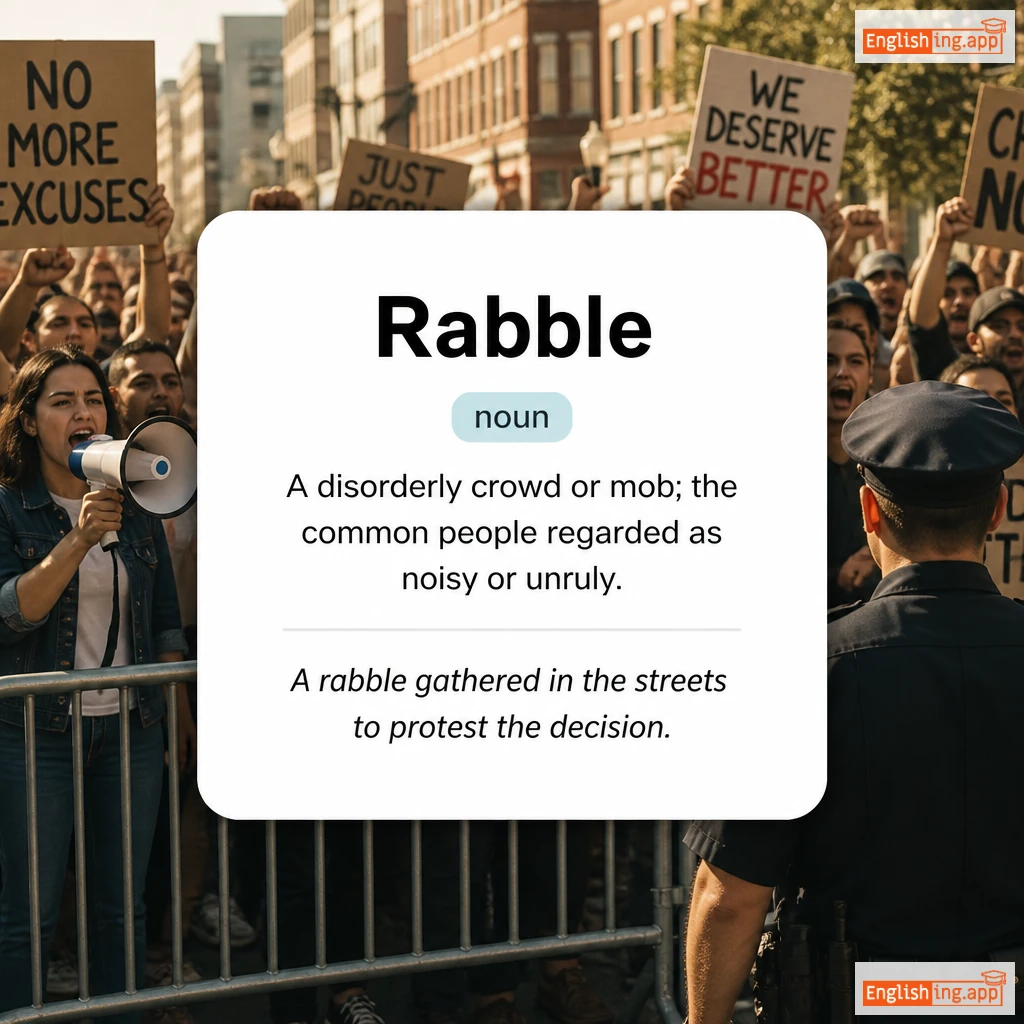
Rabble definition card — visual illustration of the meaning
noun C2
/ˈræb.əl/
multitud desordenada (multitud desordenada)

A disorderly crowd or mob; the common people regarded as noisy or unruly.

"A rabble gathered in the streets to protest the decision."

"Una multitud desordenada se reunió en las calles para protestar contra la decisión." (Una multitud desordenada se reunió en las calles para protestar contra la decisión.)
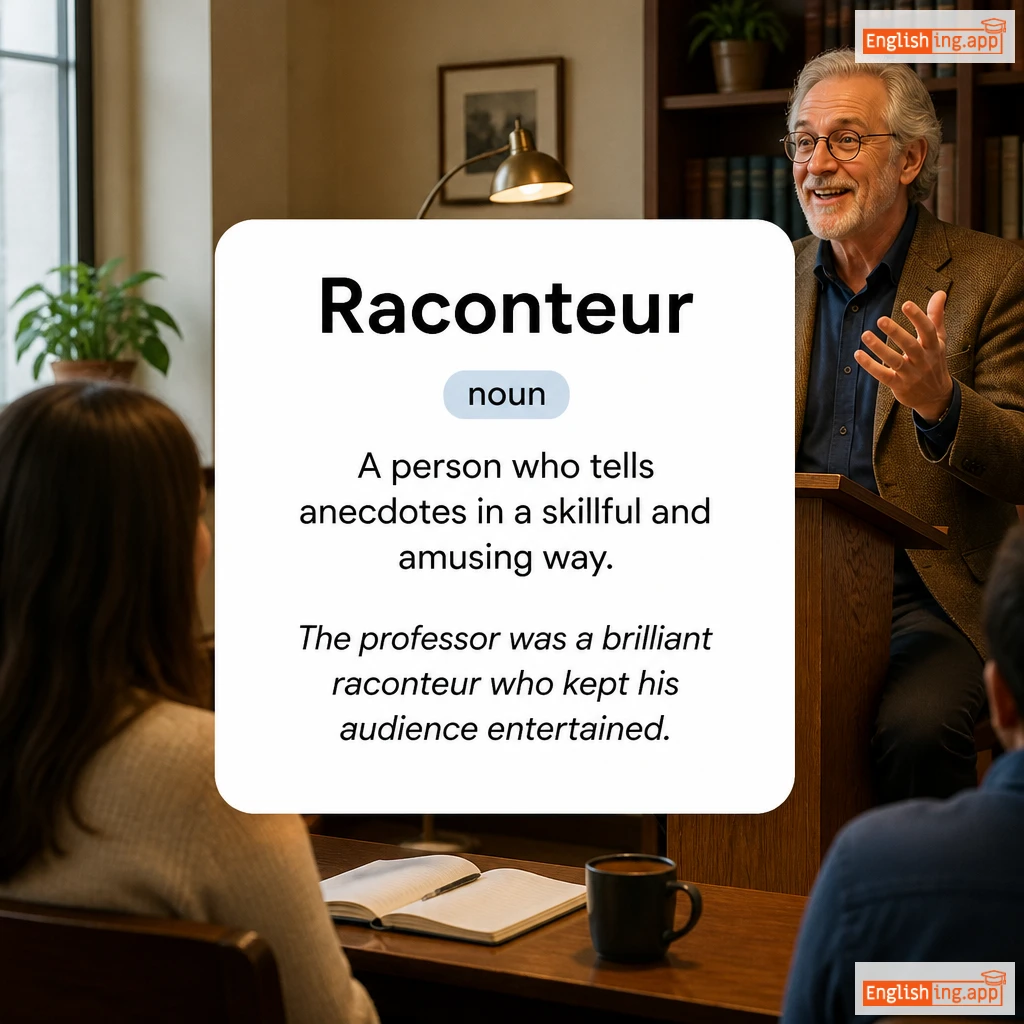
Raconteur definition card — visual illustration of the meaning
noun C2
/ˌræk.ɒnˈtɜːr/
narrador hábil (narrador habil)

A person who tells anecdotes in a skillful and amusing way.

"The professor was a brilliant raconteur who kept his audience entertained."

"El profesor era un brillante narrador que mantenía a su audiencia entretenida." (El profesor era un brillante narrador que mantenía a su audiencia entretenida.)
noun C2
/ˈreɪdɪks/
base (base)

the base or root of something; the number on which a system of numeration is built

"In mathematics, the decimal system has a radix of ten."

"En matemáticas, el sistema decimal tiene una base de diez." (En matematicas, el sistema decimal tiene una base de diez.)
adjective C2
/ˈræfɪʃ/
poco convencional y algo desacreditado pero atractivo (poco convencional y algo desacreditado pero atractivo)

unconventional and slightly disreputable but attractive

"He had a raffish charm that made him popular in the city."

"Él tenía un encanto raffish que lo hizo popular en la ciudad." (Él tenía un encanto raffish que lo hizo popular en la ciudad.)
noun C2
/ˈræɡəmʌfɪn/
niño desaliñado (nino desaliñado)

A person, typically a child, in ragged, dirty clothes.

"The little ragamuffin begged for food on the street."

"El pequeño niño desaliñado pedía comida en la calle." (El pequeno nino desaliñado pedía comida en la calle.)
noun C2
/ˈreɪləri/
burlas amistosas (burlas amistosas)

good-humored teasing or joking

"Their friendship was full of light-hearted raillery."

"Su amistad estaba llena de bromas ligeras." (Su amistad estaba llena de bromas ligeras.)
noun C2
/ˈreɪmənt/
atuendo (atuendo)

clothing, especially fine or formal wear

"The king wore royal raiment during the ceremony."

"El rey usó atuendo real durante la ceremonia." (El rey usó atuendo real durante la ceremonia.)
verb C2
/ˈræm.ɪ.faɪ/
ramificarse (ramificarse)

to spread or branch out into divisions or subdivisions.

"The river ramifies into several smaller streams."

"El río se ramifica en varios arroyos más pequeños." (El río se ramifica en varios arroyos más pequeños.)
adjective C2
/ˈreɪ.moʊs/
ramificado (ramificado)

having many branches.

"The ramose tree shaded the entire garden."

"El árbol ramificado dio sombra a todo el jardín." (El arbol ramificado dio sombra a todo el jardin.)
noun C2
/ˈræŋ.kər/
rencor (rencor)

A feeling of deep and bitter anger or resentment.

"There was a rancor between the two rivals that never faded."

"Hubo un rencor entre los dos rivales que nunca se desvaneció." (Hubo un rencor entre los dos rivales que nunca se desvaneció.)
adjective C2
/ˈræŋ.kər.əs/
rencoroso (rencoroso)

Characterized by bitterness or resentment.

"Their rancorous debate lasted for hours."

"Su rencoroso debate duró horas." (Su rencoroso debate duró horas.)
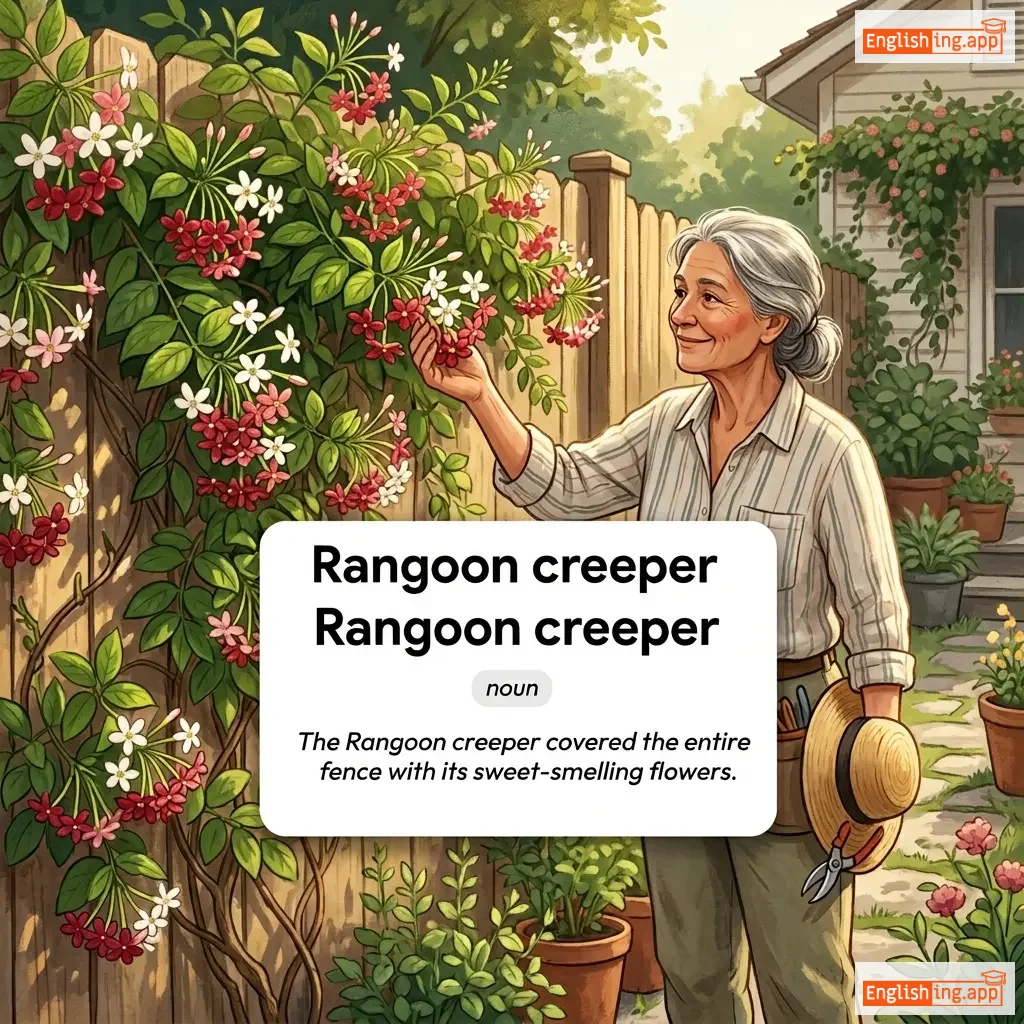
Rangoon creeper definition card — visual illustration of the meaning
noun C2
/ræŋˈɡuːn ˈkriːpər/
Rangoon creeper (Rangoon creeper)

A climbing vine with fragrant flowers that change color from white to pink to red

"The Rangoon creeper covered the entire fence with its sweet-smelling flowers."

"El Rangoon creeper cubrió toda la cerca con sus flores de fragancia dulce." (El Rangoon creeper cubrió toda la cerca con sus flores de fragancia dulce.)
verb C2
/ˈræŋ.kəl/
molestar (molestar)

To cause continuing annoyance or resentment.

"His unfair criticism continued to rankle her for days."

"Su crítica injusta continuó molestándola durante días." (Su critica injusta continuo molestandola durante dias.)
adjective C2
/rəˈpeɪ.ʃəs/
rapaz (rapaz)

having an extreme desire to take things for oneself, greedy

"The rapacious landlord raised the rent without reason."

"El dueño de la casa rapaz subió el alquiler sin razón." (El dueño de la casa rapaz subió el alquiler sin razón.)
noun C2
/ˈræp.aɪn/
saqueo (saqueo)

the violent seizure of someone's property

"The war was marked by rapine and destruction."

"La guerra estuvo marcada por el saqueo y la destrucción." (La guerra estuvo marcada por el saqueo y la destrucción.)
noun C2
/ˌræproʊʃˈmɑːn/
restablecimiento de relaciones (restablecimiento de relaciones)

The establishment or resumption of harmonious relations.

"The two countries signed an agreement that marked a new rapprochement."

"Los dos países firmaron un acuerdo que marcó un nuevo restablecimiento de relaciones." (Los dos países firmaron un acuerdo que marcó un nuevo restablecimiento de relaciones.)
noun C2
/ræpˈskæliən/
persona traviesa (persona traviesa)

A mischievous or cheeky person; a rascal.

"The little rapscallion hid his brother’s shoes as a prank."

"El pequeño rapscallion escondió los zapatos de su hermano como una broma." (El pequeno rapscallion escondió los zapatos de su hermano como una broma.)
adjective C2
/ræpˈtɔːriəl/
rapaz (rapaz)

Relating to birds of prey or predatory behavior.

"The eagle is a raptorial bird with sharp talons."

"El águila es un ave rapaz con garras afiladas." (El águila es un ave rapaz con garras afiladas.)
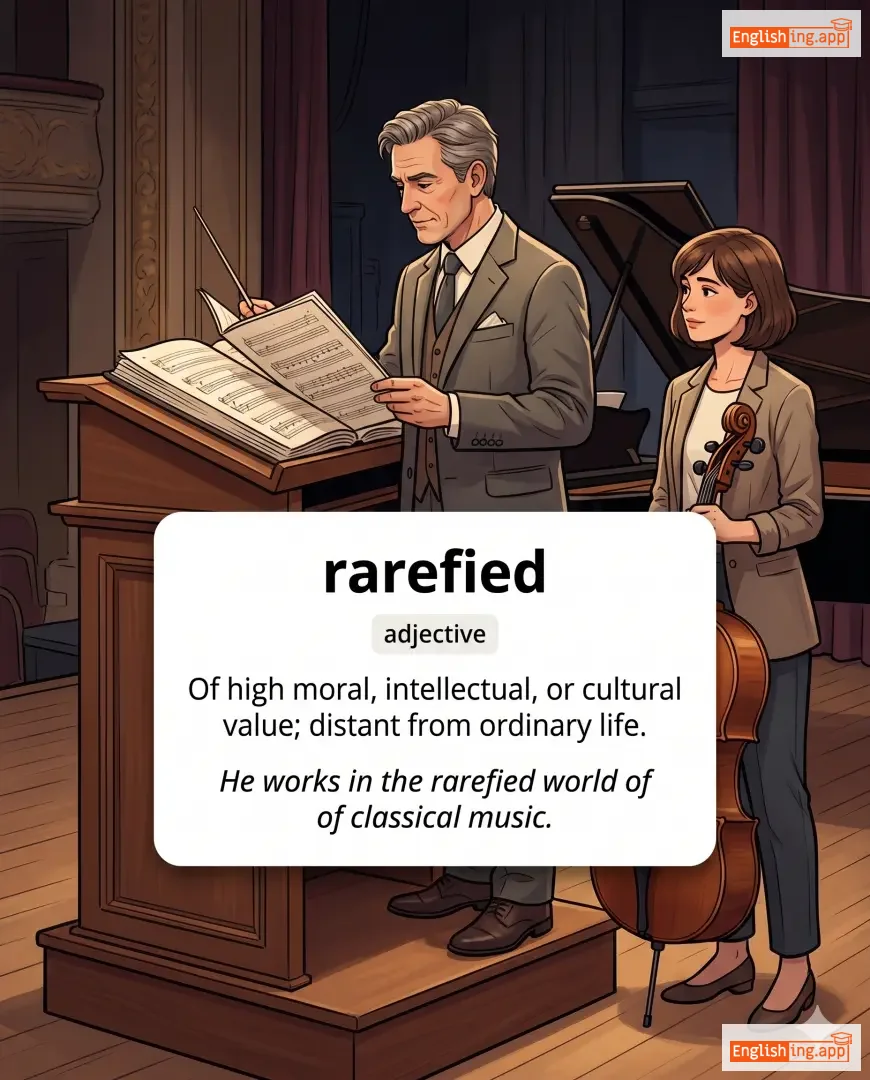
rarefied definition card — visual illustration of the meaning
adjective C2
/ˈreə.rɪ.faɪd/
refinado (rairuhfayd)

Of high moral, intellectual, or cultural value; distant from ordinary life.

"He works in the rarefied world of classical music."

"Él trabaja en el mundo refinado de la música clásica." (El mundo refinado de la musica clasica)
verb C2
/ˈreə.rɪ.faɪ/
diluir, refinar (diluir, refinar)

To make something less dense or more refined.

"The air rarefies as you climb higher into the mountains."

"El aire se diluye a medida que subes más alto en las montañas." (El aire se diluye a medida que subes mas alto en las montañas.)
noun C2
/ˌræʃioʊsɪˈneɪʃən/
razonamiento (razonamiento)

the process of reasoning or logical thinking

"His ratiocination impressed the judges during the debate."

"Su razonamiento impresionó a los jueces durante el debate." (Su razonamiento impresionó a los jueces durante el debate.)
noun C2
/ˈræʃənəlɪzəm/
racionalismo (racionalismo)

a belief or theory that opinions and actions should be based on reason and knowledge rather than religious belief or emotion

"Rationalism emphasizes logic and reasoning over faith."

"El racionalismo enfatiza la lógica y el razonamiento por encima de la fe." (El racionalismo enfatiza la logica y el razonamiento por encima de la fe.)
verb C2
/ˈrævəl/
enredar / deshacer (enredar / deshacer)

to tangle or complicate; to untangle or unravel depending on context

"She began to ravel the loose threads of the sweater."

"Ella empezó a deshacer los hilos sueltos del suéter." (Ella empezo a deshacer los hilos sueltos del sueter.)
adjective C2
/ˈrævənɪŋ/
hambriento y codicioso (hambriento y codicioso)

Extremely hungry and greedy; voracious.

"The ravening wolves circled the camp."

"Los lobos hambrientos rodearon el campamento." (Los lobos hambrientos rodearon el campamento.)
verb C2
/ˈrævɪʃ/
embelesar (embelesar)

To fill with intense delight; to captivate or enchant.

"The beauty of the sunset ravished the travelers."

"La belleza del atardecer cautivó a los viajeros." (La belleza del atardecer cautivó a los viajeros.)
noun C2
/riːm/
resma (resma)

A large quantity of paper (typically 500 sheets); informally, a large amount of something.

"The office ordered ten reams of paper."

"La oficina ordenó diez resmas de papel." (La oficina ordenó diez resmas de papel.)
noun C2
/ˈriːbəs/
rebus (rebus)

a puzzle in which words are represented by pictures, symbols, or letters

"The children enjoyed solving the rebus puzzles in the magazine."

"A los niños les encantaba resolver los rompecabezas de rebus en la revista." (A los niños les encantaba resolver los rompecabezas de rebus en la revista.)
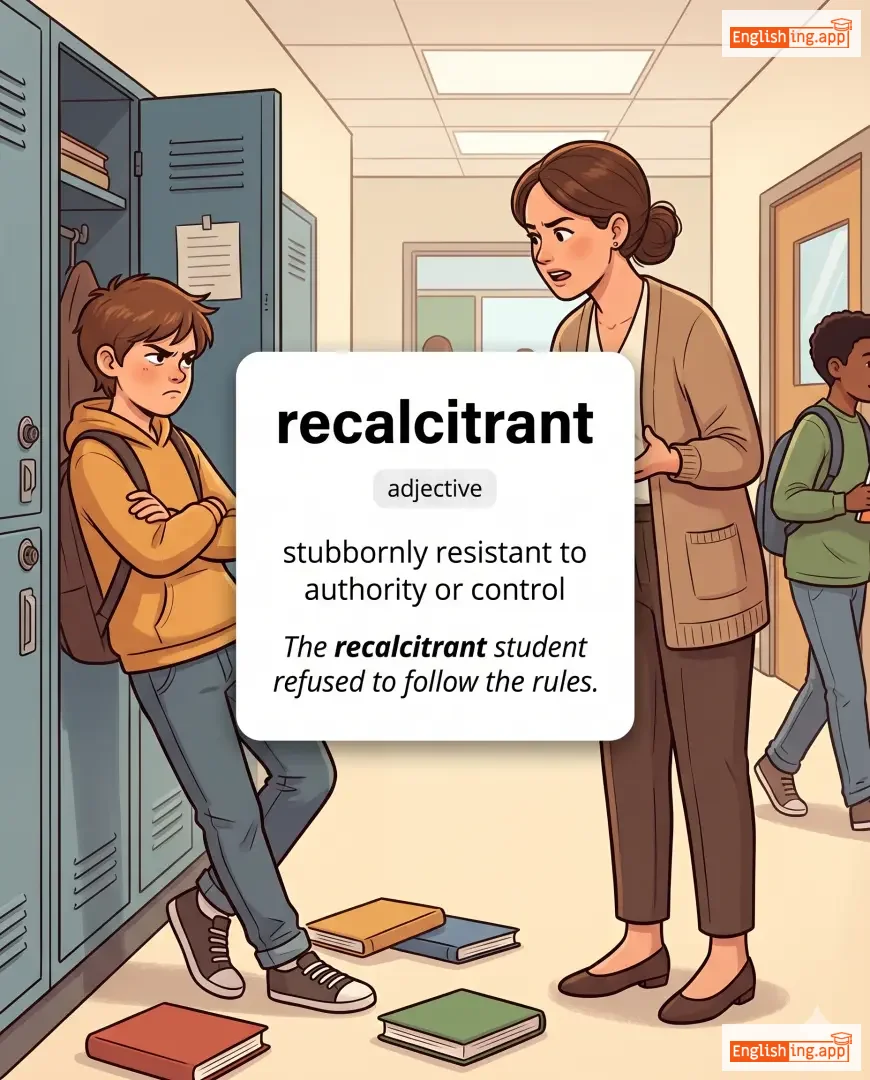
recalcitrant definition card — visual illustration of the meaning
adjective C2
/rɪˈkælsɪtrənt/
recalcitrante (rekalsitrante)

stubbornly resistant to authority or control

"The recalcitrant student refused to follow the rules."

"El estudiante recalcitrante se negó a seguir las reglas." (El estudiante recalcitrante se nego a seguir las reglas.)
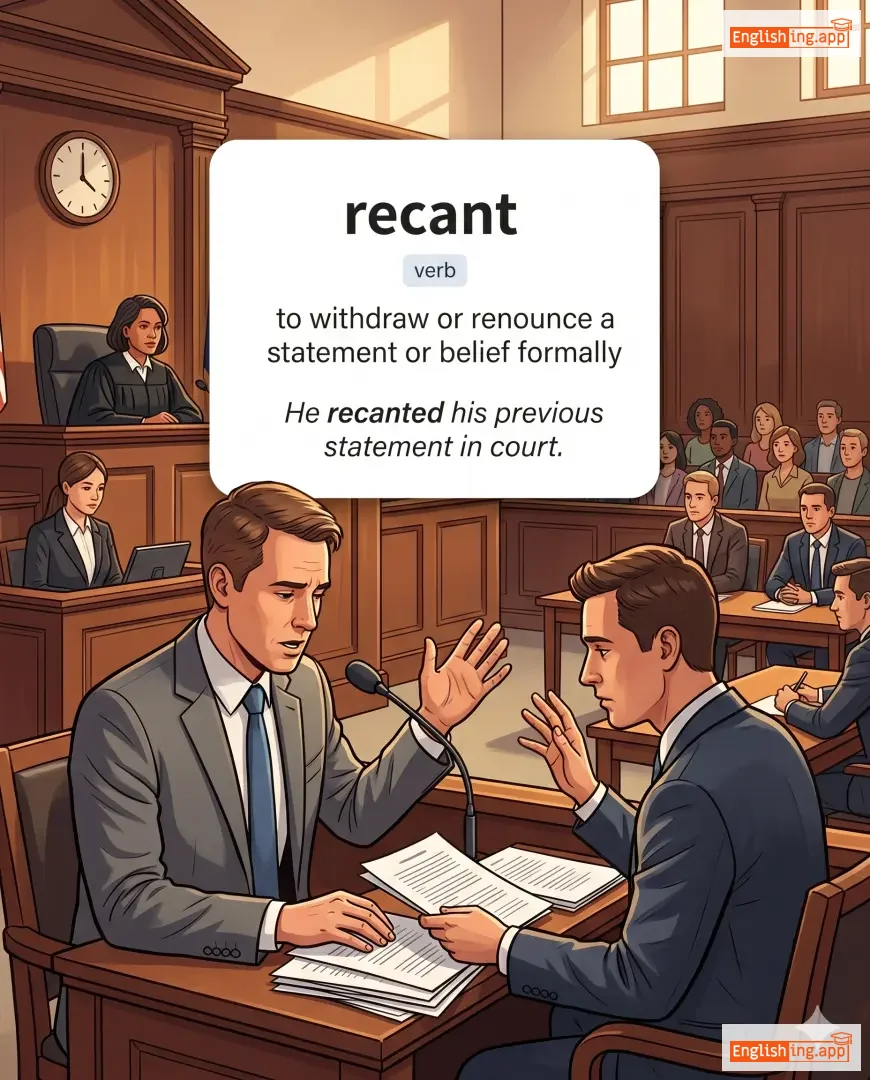
recant definition card — visual illustration of the meaning
verb C2
/rɪˈkænt/
revocar (revocar)

to withdraw or renounce a statement or belief formally

"He recanted his previous statement in court."

"Él retractó su declaración anterior en la corte." (Él retractó su declaración anterior en la corte.)
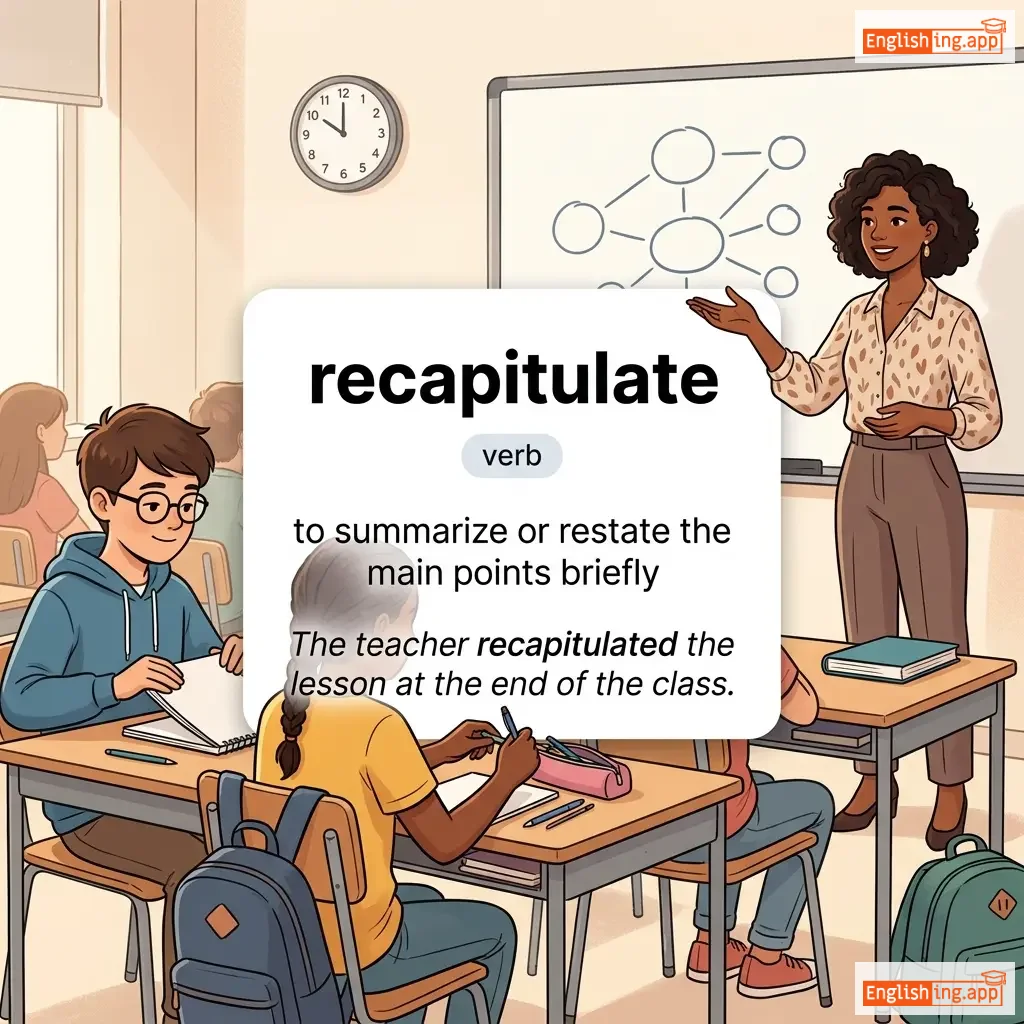
recapitulate definition card — visual illustration of the meaning
verb C2
/ˌriːkəˈpɪtjʊleɪt/
recapitular (recapitular)

to summarize or restate the main points briefly

"The teacher recapitulated the lesson at the end of the class."

"El maestro recapituló la lección al final de la clase." (El maestro recapituló la lección al final de la clase.)
noun C2
/ˌriːkəˌpɪtjʊˈleɪʃən/
recapitulación (recapitulacion)

The act of summarizing or repeating the main points of something.

"The professor gave a brief recapitulation of the lecture before ending the class."

"El profesor dio una breve recapitulación de la conferencia antes de terminar la clase." (El profesor dio una breve recapitulación de la conferencia antes de terminar la clase.)
adjective C2
/rəˈʃɛrʃ/
exclusivo (exclusivo)

Rare, exotic, or obscure, often in a sophisticated or refined way.

"The gallery displayed many recherche artworks from unknown artists."

"La galería exhibió muchas obras de arte exclusivas de artistas desconocidos." (La galeria exhibio muchas obras de arte exclusivas de artistas desconocidos.)
noun C2
/rɪˈsɪdɪˌvɪzəm/
recidivismo (residivismo)

The tendency of a convicted criminal to reoffend or relapse into criminal behavior.

"The government introduced new programs to reduce recidivism among former inmates."

"El gobierno introdujo nuevos programas para reducir el recidivismo entre antiguos reclusos." (El gobierno introdujo nuevos programas para reducir el recidivismo entre antiguos reclusos.)
noun C2
/rɪˈsɪdɪvɪst/
recidivista (recidivista)

A person who repeatedly commits crimes, especially after having been punished.

"The police identified him as a recidivist who had been arrested several times before."

"La policía lo identificó como un recidivista que había sido arrestado varias veces antes." (La policía lo identificó como un recidivista que había sido arrestado varias veces antes.)
verb (archaic/rare) C2
/rɛk/
preocuparse (preocuparse)

To care about or be concerned with (something); to have regard for.

"He does not reck the dangers of his actions."

"Él no se preocupa por los peligros de sus acciones." (Él no se preocupa por los peligros de sus acciones.)
noun C2
/ˈrɛkluːsəri/
lugar de retiro (lugar de retiro)

A place for seclusion or retreat, especially for a recluse or hermit.

"The monk spent years in the reclusory away from society."

"El monje pasó años en el lugar de retiro alejado de la sociedad." (El monje paso años en el lugar de retiro alejado de la sociedad.)
noun C2
/rɪˈkɒɡnɪzəns/
compromiso legal (compromiso legal)

A legal obligation or bond entered into before a court, especially to ensure future appearance.

"He was released on his own recognizance."

"Fue liberado bajo su propio compromiso legal." (Fue liberado bajo su propio compromiso legal.)
noun/verb C2
/ˈrɛkəmˌpɛns/
compensación (compensacion)

to compensate someone for loss or harm suffered; compensation given for damage or injury

"The company offered financial recompense to the injured worker."

"La compañía ofreció una compensación financiera al trabajador herido." (La compania ofrecio una compensacion financiera al trabajador herido.)
adjective C2
/ˈrɛkənˌsaɪləbl̩/

Capable of being resolved or made consistent.

"Their differences are reconcilable with honest communication."

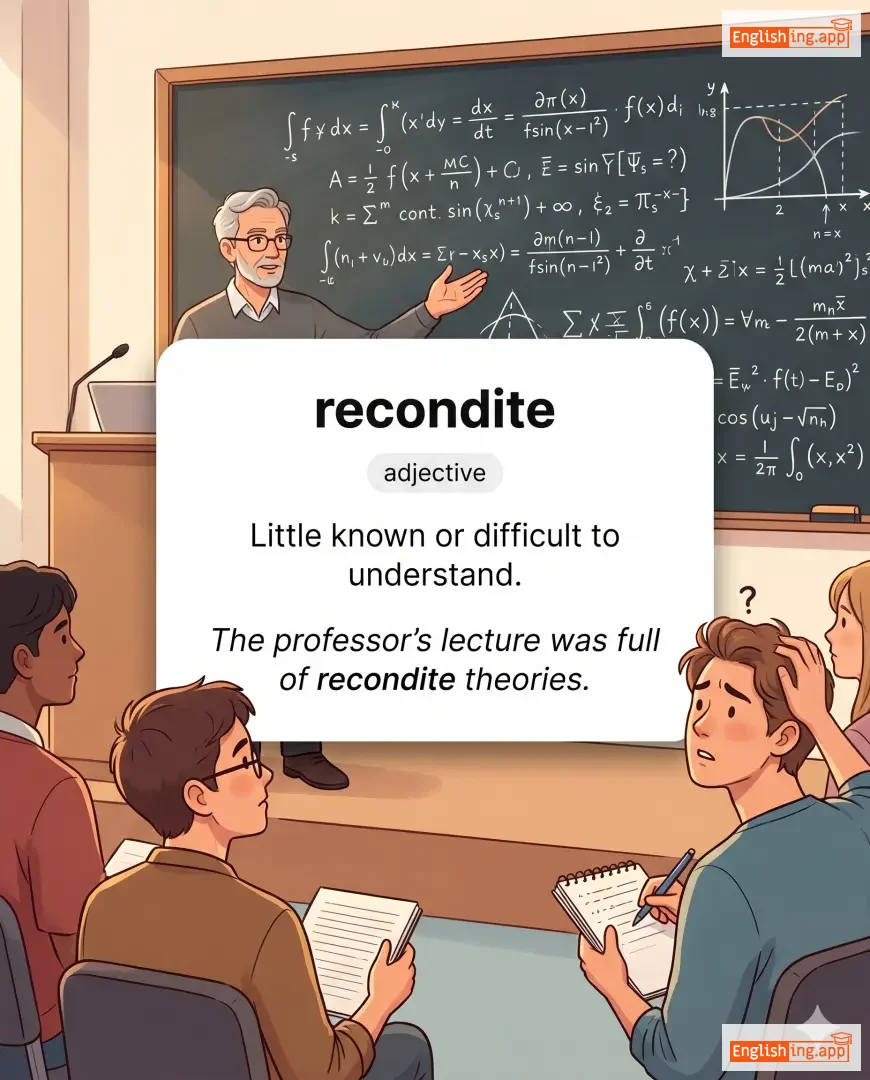
recondite definition card — visual illustration of the meaning
adjective C2
/ˈrɛkənˌdaɪt/ or /ˈrɛkəndaɪt/
poco conocido o difícil de entender (poco conocido o dificil de entender)

Little known or difficult to understand.

"The professor’s lecture was full of recondite theories."

"La conferencia del profesor estaba llena de teorías reconditas." (La conferencia del profesor estaba llena de teorías reconditas.)
verb C2
/ˌriː.kəˈnɔɪ.tər/
reconocer (reconocer)

to make a preliminary inspection or survey, especially of an area for military or strategic purposes

"The soldiers reconnoitered the area before advancing."

"Los soldados reconocieron el área antes de avanzar." (Los soldados reconocieron el área antes de avanzar.)
adjective C2
/ˈrɛkriənt/
cobarde, traidor (cobarde, traidor)

cowardly or unfaithful to duty

"The recreant soldier abandoned his post in fear."

"El soldado cobarde abandonó su puesto por miedo." (El soldado cobarde abandonó su puesto por miedo.)
noun C2
/rɪˌkrɪmɪˈneɪʃən/
contrademanda (contrademanda)

an accusation made in response to an accusation; mutual blaming

"The debate quickly descended into mutual recriminations."

"El debate rápidamente descendió en recriminaciones mutuas." (El debate rapidamente descendio en recriminaciones mutuas.)
verb C2
/ˌriːkruːˈdɛs/
recrudecer (recrudecer)

to break out or appear again after a period of dormancy or decline

"After months of calm, violence recrudesced in the region."

"Después de meses de calma, la violencia recrudeció en la región." (Despues de meses de calma, la violencia recrudecio en la region.)
noun C2
/ˌriːkruːˈdɛsəns/
recrudecimiento (recrudecimiento)

a new outbreak or revival of something that had subsided, especially an undesirable condition

"Health officials warned of a recrudescence of measles in several districts."

"Los funcionarios de salud advirtieron sobre un brote de sarampión en varios distritos." (Los funcionarios de salud advirtieron sobre un brote de sarampión en varios distritos.)
adjective C2
/ˌriːkruːˈdɛsənt/
recrudescente (recrudescente)

reviving or breaking out again after a period of abatement

"Recrudescent tensions threatened the fragile ceasefire."

"Las tensiones recrudecientes amenazaron el frágil alto el fuego." (Las tensiones recrudecientes amenazaron el fragil alto el fuego.)
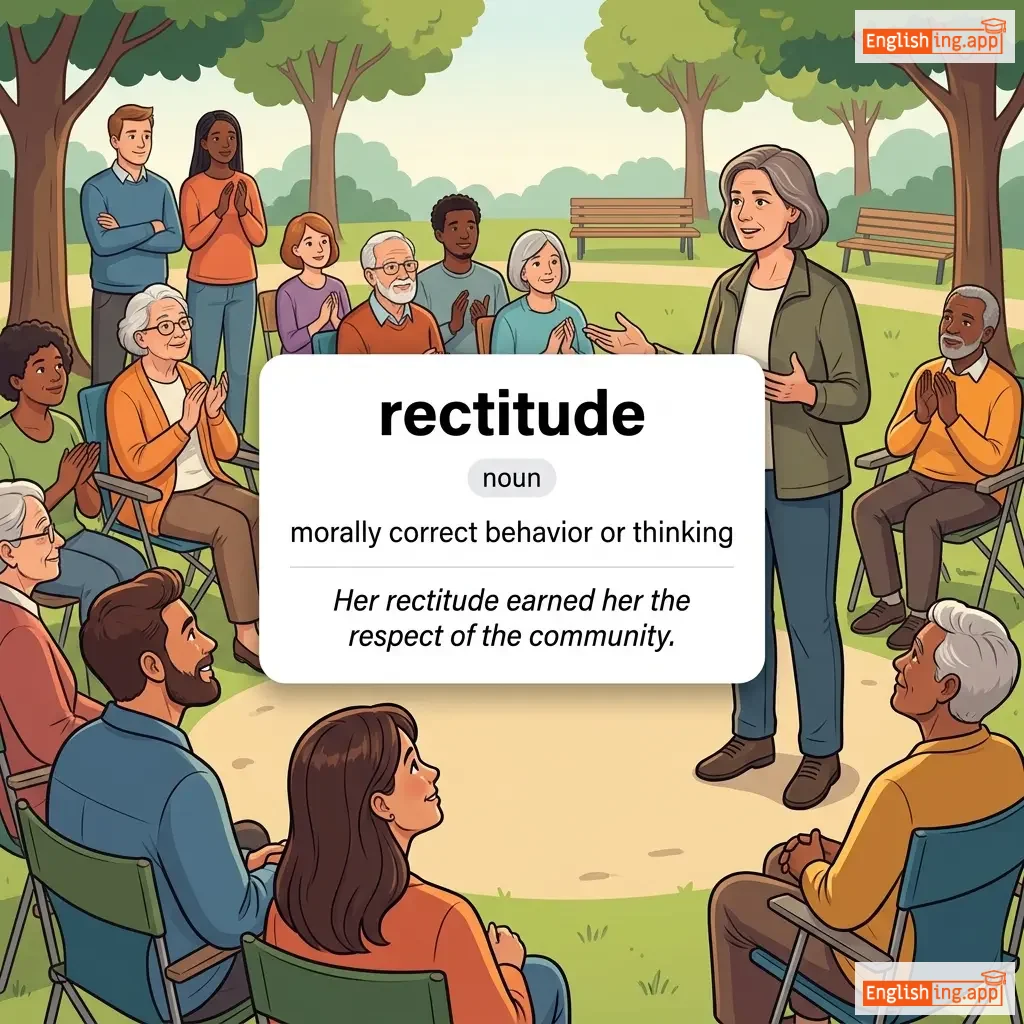
rectitude definition card — visual illustration of the meaning
noun C2
/ˈrɛktɪtjuːd/
rectitud (rectitud)

morally correct behavior or thinking

"Her rectitude earned her the respect of the community."

"Su rectitud le valió el respeto de la comunidad." (Su rectitud le valió el respeto de la comunidad.)
adjective C2
/rɪˈkʌmbənt/
reclinado (reclinado)

lying down or in a resting position

"He was found recumbent on the sofa after a long day."

"Él fue encontrado recostado en el sofá después de un largo día." (El fue encontrado recostado en el sofa despues de un largo dia.)
verb C2
/rɪˈkjʊə/
curar de nuevo (curar de nuevo)

to cure again; to remedy a second time

"The doctor had to recure the wound after it reopened."

"El doctor tuvo que curar nuevamente la herida después de que se reabriera." (El doctor tuvo que curar nuevamente la herida después de que se reabriera.)
noun C2
/ˈrɛkjʊzənt/
refractario (refractario)

a person who refuses to submit to authority or comply with rules

"The recusant opposed the new law."

"El refractario se opuso a la nueva ley." (El refractario se opuso a la nueva ley.)