वोकैबुलरीज

इंग्लिश वोकैबुलरी डिस्कवर, लर्न और मास्टर करें

verb C2
/ɪmˈpɛnd/
acontecer (acontecer)

to be about to happen; to loom threateningly

"Dark clouds suggested that a storm was impeding."

"Las nubes oscuras sugerían que se acercaba una tormenta." (Las nubes oscuras sugerían que se acercaba una tormenta.)
adjective C2
/ɪmˈpɛn.ɪ.tənt/
impenitente (impenitente)

Not feeling regret or shame about one's actions.

"The criminal remained impenitent after the trial."

"El criminal permaneció impenitente después del juicio." (El criminal permaneció impenitente después del juicio.)
adjective C2
/ˌɪm.pəˈfɛk.tə.bəl/
imperfectible (imperfectible)

Incapable of being made perfect or complete.

"Some human qualities are considered imperfectible."

"Algunas cualidades humanas se consideran imperfectibles." (Algunas cualidades humanas se consideran imperfectibles.)
adjective C2
/ɪmˈpɪəriəs/
imperioso (imperioso)

Arrogantly domineering or overbearing.

"Her imperious tone made it hard for others to argue."

"Su tono imperioso dificultaba que los demás discutieran." (Su tono imperioso dificultaba que los demás discutieran.)
adjective C2
/ɪmˈperɪʃəbəl/
imperdurable; eterno; imperecedero (imperdurable; eterno; imperecedero)

not subject to decay; lasting forever; eternal

"The imperishable beauty of classical art continues to inspire generations."

"La belleza imperecedera del arte clásico sigue inspirando generaciones." (La belleza imperecedera del arte clasico sigue inspirando generaciones.)
adjective C2
/ˌɪmpəˈmɪsəbl/
imposible (imposible)

Not permitted or allowed.

"Such behavior is impermissible in the workplace."

"Tal comportamiento es imposible en el lugar de trabajo." (Tal comportamiento es imposible en el lugar de trabajo.)
adjective C2
/ɪmˌpɜːrˈsweɪdəbl/
inconvencible (inconvencible)

not able to be convinced or persuaded

"She remained impersuadable despite all our arguments."

"Ella permaneció inconvencible a pesar de todos nuestros argumentos." (Ella permaneció inconvencible a pesar de todos nuestros argumentos.)
noun C2
/ɪmˌpɜːrtərbəˈbɪləti/
imperturbabilidad (imperturbabilidad)

The quality of being calm and not easily disturbed or upset.

"Her imperturbability during the crisis impressed everyone."

"Su imperturbabilidad durante la crisis impresionó a todos." (Su imperturbabilidad durante la crisis impresionó a todos.)
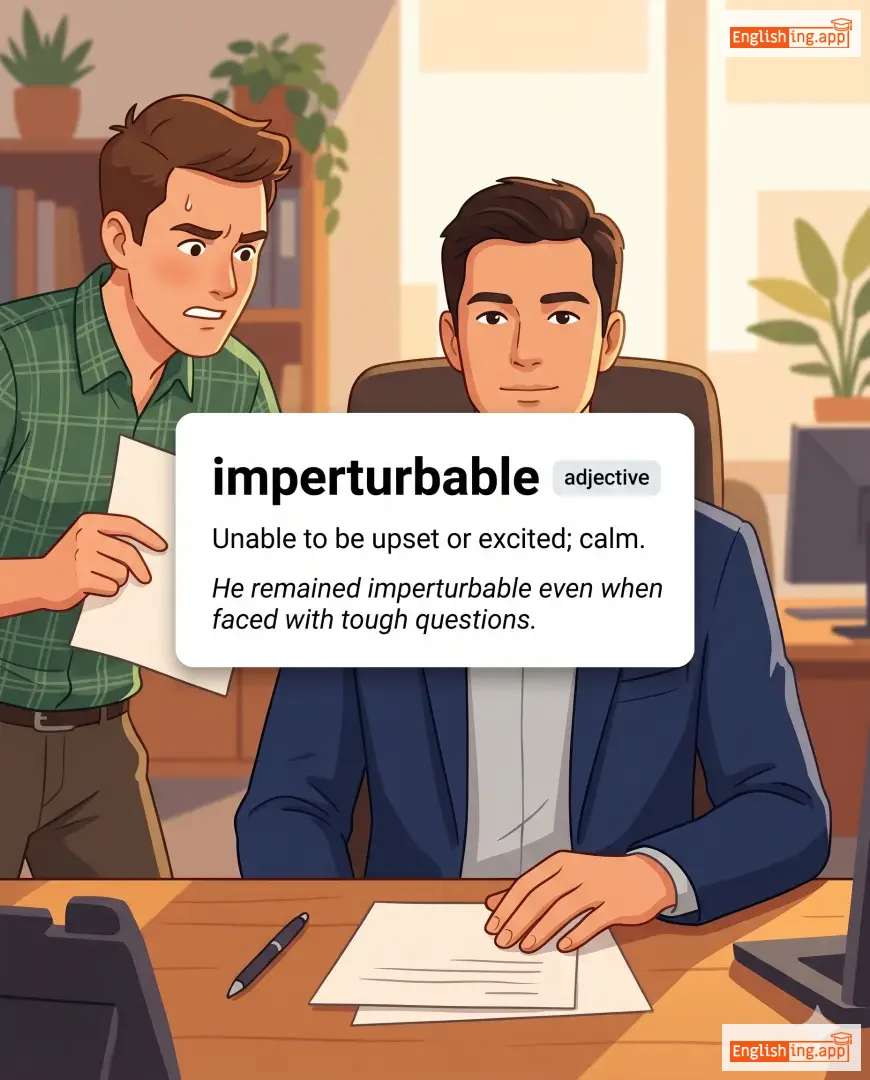
imperturbable definition card — visual illustration of the meaning
adjective C2
/ɪmˈpɜːrtərbəbəl/
imperturbable (imperturbable)

Unable to be upset or excited; calm.

"He remained imperturbable even when faced with tough questions."

"Él permaneció imperturbable incluso cuando se enfrentó a preguntas difíciles." (El permaneció imperturbable incluso cuando se enfrentó a preguntas difíciles.)
noun C2
/ˌɪmpəˈtjuːəsəti/
impetuosidad (impetuosidad)

The quality of being rash or impulsive.

"His impetuosity often got him into trouble."

"Su impetuosidad a menudo lo metía en problemas." (Su impetuosidad a menudo lo metía en problemas.)
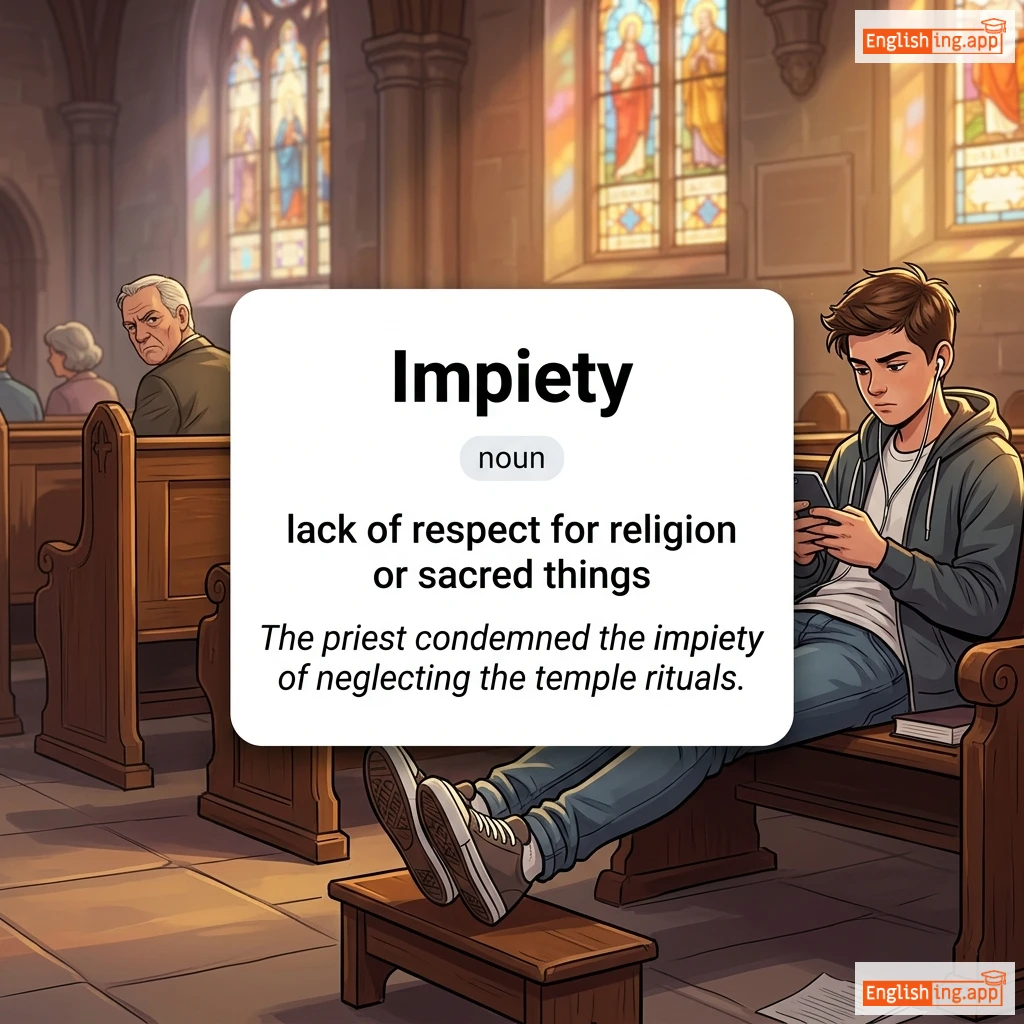
Impiety definition card — visual illustration of the meaning
noun C2
/ɪmˈpaɪəti/
impiedad (impiedad)

lack of respect for religion or sacred things

"The priest condemned the impiety of neglecting the temple rituals."

"El sacerdote condenó la impiedad de descuidar los rituales del templo." (El sacerdote condenó la impiedad de descuidar los rituales del templo.)
adjective C2
/ˈɪmpɪəs/
impío (impio)

showing a lack of respect for God or religion

"It was considered impious to joke about sacred traditions."

"Se consideraba impío hacer chistes sobre tradiciones sagradas." (Se consideraba impio hacer chistes sobre tradiciones sagradas.)
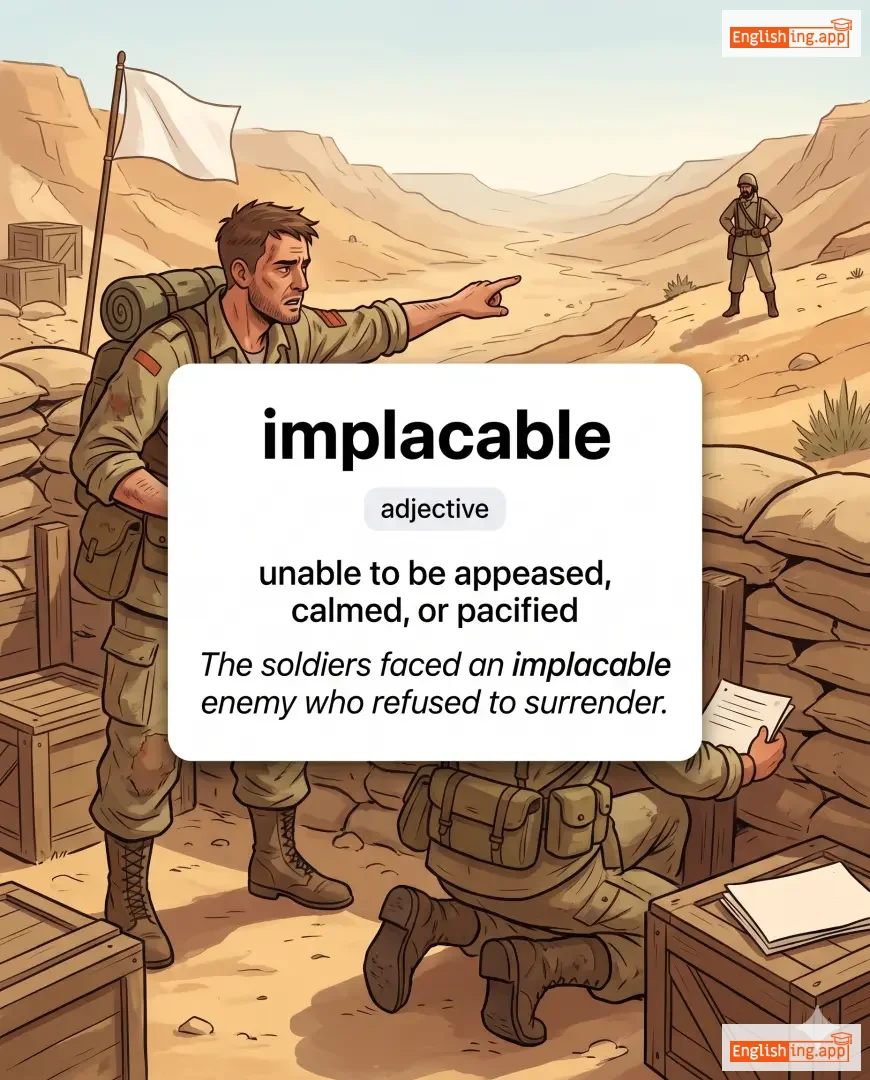
implacable definition card — visual illustration of the meaning
adjective C2
/ɪmˈplækəbl/
implacable (implacable)

unable to be appeased, calmed, or pacified

"The soldiers faced an implacable enemy who refused to surrender."

"Los soldados se enfrentaron a un enemigo implacable que se negó a rendirse." (Los soldados se enfrentaron a un enemigo implacable que se negó a rendirse.)
adjective C2
/ɪmˈplaɪəbl/
implícito (implicit)

Capable of being implied or suggested.

"The meaning of the statement is not directly clear but is impliable from the context."

"El significado de la declaración no es directamente claro, pero es implicable por el contexto." (El significado de la declaración no es directamente claro, pero es implicable por el contexto.)
adjective C2
/ɪmˈpɑːlɪtɪk/
imprudente (imprudente)

Unwise or imprudent; not showing good judgment.

"It would be impolitic to criticize them openly."

"Sería imprudente criticarlos abiertamente." (Sería imprudente criticarlos abiertamente.)
adjective C2
/ɪmˈpɒndərəbl̩/
imponderable (imponderable)

Something difficult or impossible to estimate, assess, or understand

"The outcome of the election depends on many imponderable factors."

"El resultado de las elecciones depende de muchos factores imponderables." (El resultado de las elecciones depende de muchos factores imponderables.)
adjective C2
/ɪmˈpɔːrtʃənət/
importuno (importuno)

Persistent to the point of annoyance or intrusion

"The importunate salesman kept calling despite repeated refusals."

"El vendedor importuno siguió llamando a pesar de las repetidas negativas." (El vendedor importuno siguió llamando a pesar de las repetidas negativas.)
verb C2
/ˌɪmpɔːrˈtuːn/
pedir insistentemente (pedir insistentemente)

To ask someone persistently or pressingly for something

"The child importuned his mother for a new toy."

"El niño importunó a su madre para que le comprara un juguete nuevo." (El niño importunó a su madre para que le comprara un juguete nuevo.)
verb C2
/ˌɪmpɔːrˈtuːnd/
insistir persistentemente (insistir persistentemente)

asked someone persistently and pressingly for something

"She importuned her boss for a raise until he finally gave in."

"Ella insistió persistentemente a su jefe por un aumento hasta que finalmente accedió." (Ella insistió persistentemente a su jefe por un aumento hasta que finalmente accedió.)
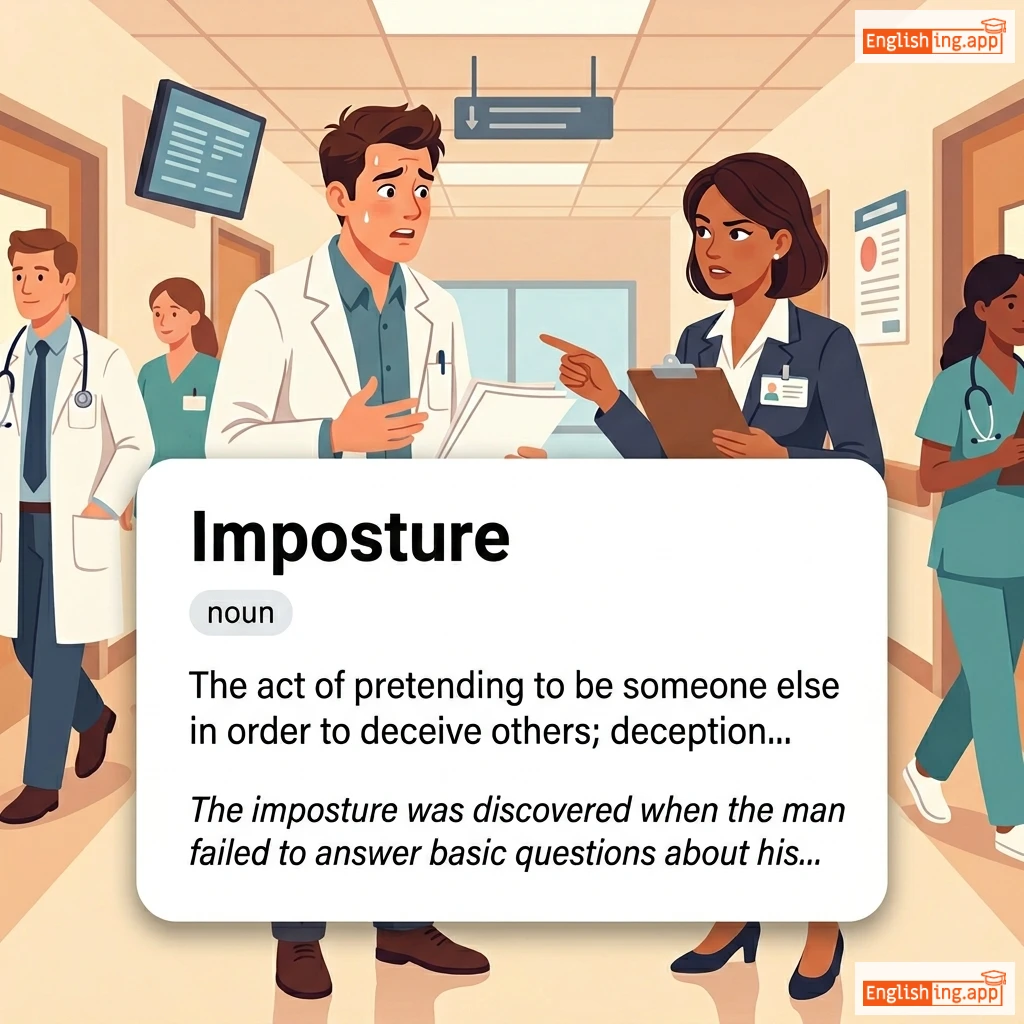
Imposture definition card — visual illustration of the meaning
noun C2
/ɪmˈpɒstʃər/
falsificación (falsificacion)

The act of pretending to be someone else in order to deceive others; deception or fraud.

"The imposture was discovered when the man failed to answer basic questions about his supposed identity."

"La falsificación fue descubierta cuando el hombre no pudo responder a preguntas básicas sobre su supuesta identidad." (La falsificacion fue descubierta cuando el hombre no pudo responder a preguntas basicas sobre su supuesta identidad.)
adjective C2
/ɪmˈpræktɪkəbl/
impracticable (impracticable)

Not capable of being carried out or put into practice.

"The plan seemed impracticable due to limited resources."

"El plan parecía impracticable debido a los recursos limitados." (El plan parecía impracticable debido a los recursos limitados.)
verb C2
/ˈɪmprɪkeɪt/
imprecate (imprecate)

To utter a curse or invoke evil upon someone.

"The old woman imprecated her enemies with dark words."

"La vieja mujer imprecó a sus enemigos con palabras oscuras." (La vieja mujer imprecó a sus enemigos con palabras oscuras.)
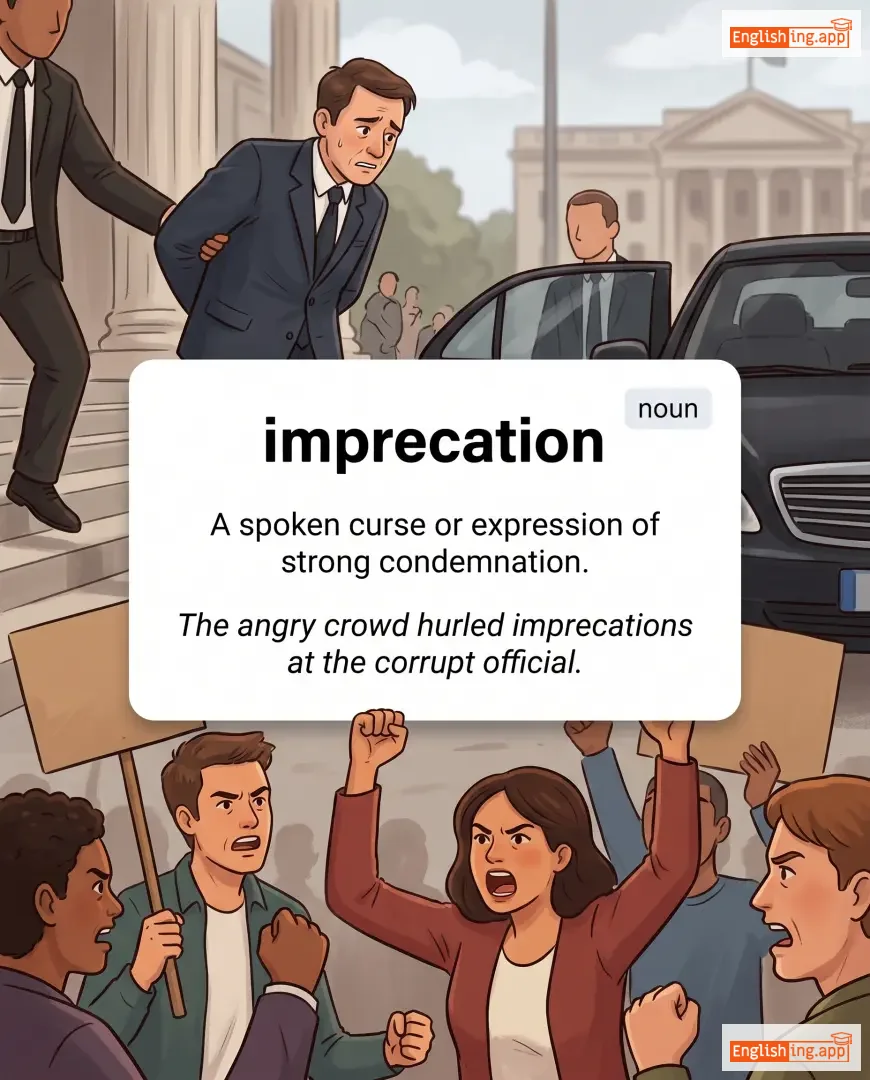
imprecation definition card — visual illustration of the meaning
noun C2
/ˌɪmprɪˈkeɪʃən/
maldición (maldicion)

A spoken curse or expression of strong condemnation.

"The angry crowd hurled imprecations at the corrupt official."

"La multitud enojada lanzó maldiciones al funcionario corrupto." (La multitud enojada lanzo maldiciones al funcionario corrupto.)
adjective C2
/ɪmˈprɛɡnəbl̩/
impenetrable (impenetrable)

Unable to be captured, broken into, or defeated.

"The fortress was considered impregnable by the enemy."

"La fortaleza fue considerada impenetrable por el enemigo." (La fortaleza fue considerada impenetrable por el enemigo.)
verb C2
/ˈɪmprɛɡneɪt/
embarazar / impregnar (embarazar / impregnar)

To make pregnant; to fill or saturate with something.

"The scientist used a method to impregnate the material with resin."

"El científico utilizó un método para impregnar el material con resina." (El científico utilizó un método para impregnar el material con resina.)
noun C2
/ˌɪmprəˈsɑːrioʊ/
productor (productor)

A person who organizes or finances concerts, plays, or operas.

"The impresario arranged a series of concerts for the rising star."

"El impresario organizó una serie de conciertos para la estrella emergente." (El impresario organizó una serie de conciertos para la estrella emergente.)
noun C2
/ˌɪmprɪˈmɑːtər/
imprimátur (imprimatur)

An official license or approval, especially to publish a book.

"The book was released with the official imprimatur of the church."

"El libro fue lanzado con el imprimátur oficial de la iglesia." (El libro fue lanzado con el imprimatur oficial de la iglesia.)
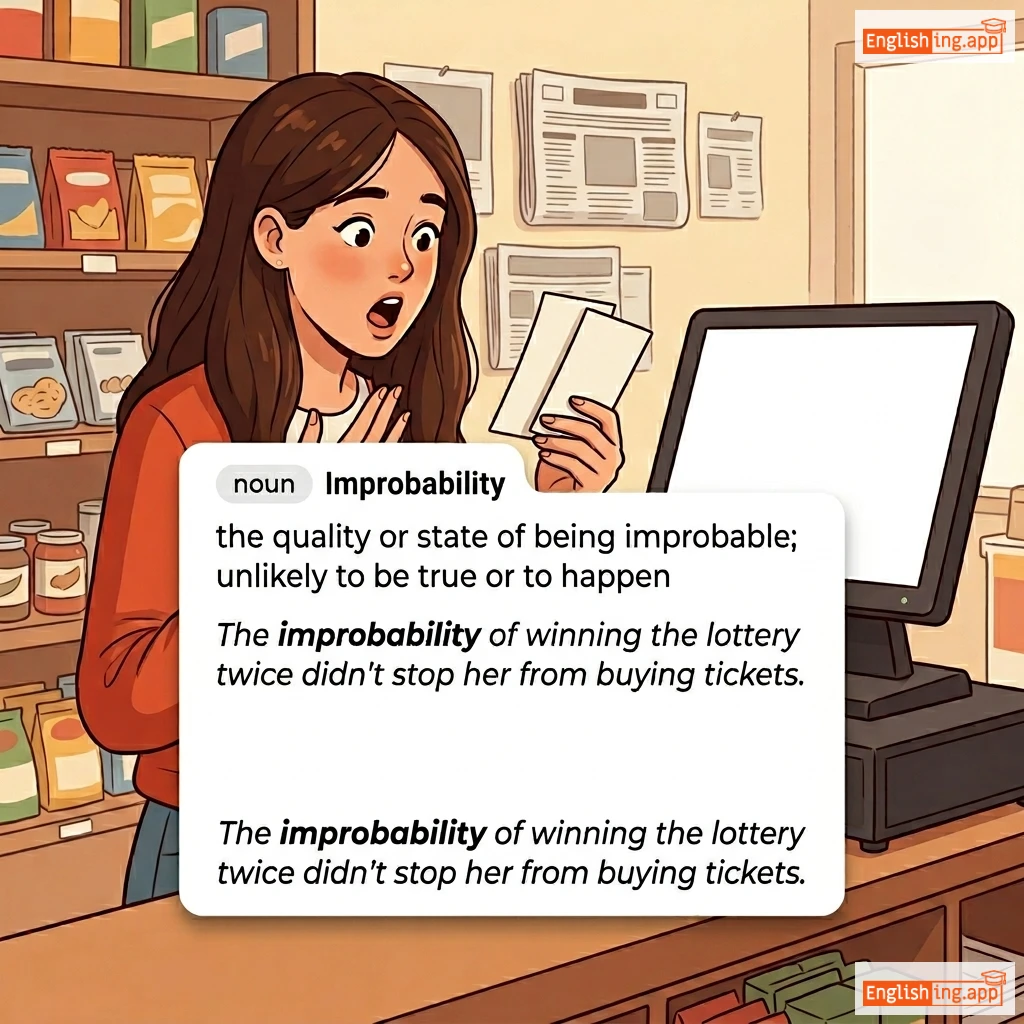
Improbability definition card — visual illustration of the meaning
noun C2
/ɪmˌprɒb.əˈbɪl.ə.ti/
improbabilidad (improbabilidad)

the quality or state of being improbable; unlikely to be true or to happen

"The improbability of winning the lottery twice didn't stop her from buying tickets."

"La improbabilidad de ganar la lotería dos veces no la detuvo de comprar boletos." (La improbabilidad de ganar la lotería dos veces no la detuvo de comprar boletos.)
noun C2
/ˌɪmprəˈpraɪəti/
improiedad (improiedad)

Failure to observe standards of honesty or modesty; improper behavior.

"The politician was accused of financial impropriety."

"El político fue acusado de impropiedad financiera." (El politico fue acusado de impropiedad financiera.)
noun C2
/ɪmˈprɑːvɪdəns/
imprudencia (imprudencia)

Lack of foresight or care for future needs.

"His improvidence led to financial difficulties."

"Su imprudencia lo llevó a dificultades financieras." (Su imprudencia lo llevó a dificultades financieras.)
adjective C2
/ɪmˈprɒvɪdənt/
imprudente (imprudente)

Not having or showing foresight; spending wastefully or without thought for the future.

"His improvident habits left him with no savings."

"Sus hábitos imprudentes lo dejaron sin ahorros." (Sus hábitos imprudentes lo dejaron sin ahorros.)
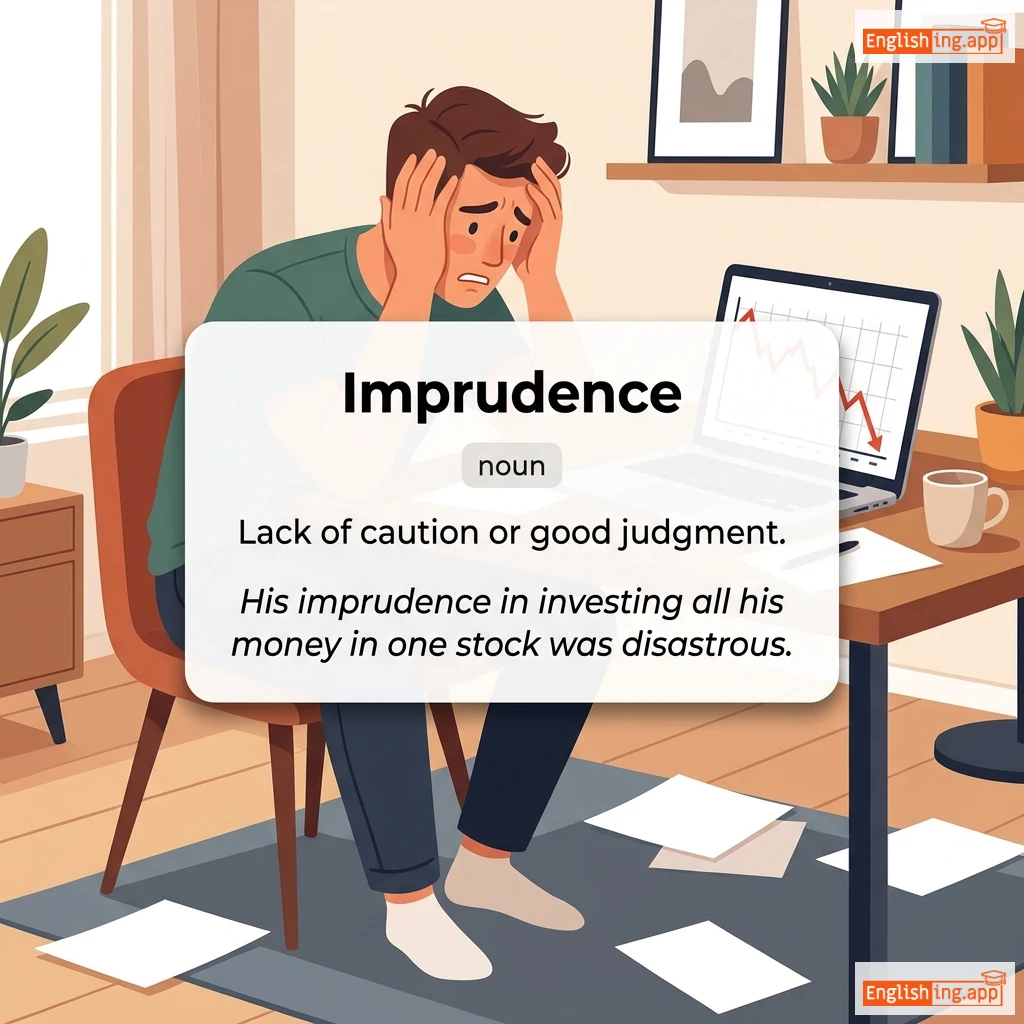
Imprudence definition card — visual illustration of the meaning
noun C2
/ɪmˈpruːdəns/
imprudencia (imprudencia)

Lack of caution or good judgment.

"His imprudence in investing all his money in one stock was disastrous."

"Su imprudencia al invertir todo su dinero en una sola acción fue desastrosa." (Su imprudencia al invertir todo su dinero en una sola accion fue desastrosa.)
adjective C2
/ɪmˈpruːdənt/
imprudente (imprudente)

Not showing care for the consequences of an action.

"It was imprudent to drive in such stormy weather."

"Era imprudente conducir en un clima tan tormentoso." (Era imprudente conducir en un clima tan tormentoso.)
noun C2
/ˈɪmpjʊdəns/
desvergüenza (desverguenza)

Rude and disrespectful behavior.

"The student's impudence shocked the entire class."

"La desvergüenza del estudiante sorprendió a toda la clase." (La desverguenza del estudiante sorprendió a toda la clase.)
verb C2
/ɪmˈpjuːn/
disputar la verdad, validez o honestidad de una declaración o motivo (disputar la verdad, validez o honestidad de una declaracion o motivo)

to dispute the truth, validity, or honesty of a statement or motive

"The lawyer tried to impugn the credibility of the witness."

"El abogado intentó impugnar la credibilidad del testigo." (El abogado intento impugnar la credibilidad del testigo.)
noun C2
/ɪmˈpjuːɪsəns/
impotencia, incapacidad (impotencia, incapacidad)

inability to take effective action; helplessness

"The government’s impuissance in the face of crisis frustrated the people."

"La impotencia del gobierno ante la crisis frustró al pueblo." (La impotencia del gobierno ante la crisis frustro al pueblo.)
noun C2
/ɪmˈpʌlʃən/
impulso (impulsion)

a strong urge or drive to act; the act of impelling

"His impulsion to travel made him leave his job suddenly."

"Su impulso de viajar lo llevó a dejar su trabajo de repente." (Su impulso de viajar lo llevo a dejar su trabajo de repente)
noun C2
/ɪmˈpjuːnɪti/
impunidad (impunidad)

freedom from punishment or harmful consequences for an action

"The dictator ruled with impunity, ignoring international laws."

"El dictador gobernó con impunidad, ignorando las leyes internacionales." (El dictador gobernó con impunidad, ignorando las leyes internacionales.)
noun C2
/ˌɪmpjuˈteɪʃən/
imputación (imputacion)

an accusation or attribution of blame

"The politician denied the imputation of corruption."

"El político negó la imputación de corrupción." (El politico nego la imputacion de corrupcion.)
verb C2
/ɪmˈpjuːt/
imputar (imputar)

to attribute a fault or responsibility to someone

"They imputed the company's success to good leadership."

"Ellos imputaron el éxito de la empresa a un buen liderazgo." (Ellos imputaron el éxito de la empresa a un buen liderazgo.)
noun C2
/ˌɪnədˈvɜːrtəns/
descuido (descuido)

Failure to pay attention; carelessness.

"The error happened through sheer inadvertence."

"El error ocurrió por pura inadvertencia." (El error ocurrio por pura inadvertencia.)
adjective C2
/ɪnˈeɪliənəbl/
inalienable (inalienable)

Unable to be taken away or transferred; absolute and permanent.

"Freedom of speech is an inalienable right."

"La libertad de expresión es un derecho inalienable." (La libertad de expresion es un derecho inalienable.)
noun C2
/ˌɪnəməˈrɑːtə/
amante (amante)

A woman with whom someone is in love; a female lover.

"He wrote a poem dedicated to his inamorata."

"Escribió un poema dedicado a su enamorada." (Escribio un poema dedicado a su enamorada.)
noun C2
/ɪˈnænɪti/
tonterías, necedades (tonterias, necedades)

a nonsensical remark or action; silliness; emptiness

"The speech was full of inanities that bored the audience."

"El discurso estaba lleno de tonterías que aburrían a la audiencia." (El discurso estaba lleno de tonterías que aburrían a la audiencia.)
adjective C2
/ˌɪnæprɪˈhɛnsəbl/
incomprensible (incomprensible)

not understandable; incomprehensible

"The concept was so abstract that it seemed inapprehensible to most students."

"El concepto era tan abstracto que parecía incomprensible para la mayoría de los estudiantes." (El concepto era tan abstracto que parecía incomprensible para la mayoría de los estudiantes.)
adjective C2
/ɪnˈæpt/
inapropiado (inapropiado)

not suitable or appropriate in the circumstances

"His inapt choice of words offended many people."

"Su elección inapropiada de palabras ofendió a muchas personas." (Su eleccion inapropiada de palabras ofendió a muchas personas.)
adverb C2
/ˌɪnəzˈmʌtʃ/
en la medida en que (en la medida en que)

To the extent that; considering that.

"Inasmuch as you are their teacher, you should guide them carefully."

"En la medida en que eres su maestro, deberías guiarlos cuidadosamente." (En la medida en que eres su maestro, deberías guiarlos cuidadosamente.)
conjunction C2
/ˌɪnəzˈmʌtʃ æz/
ya que (ya que)

Because; since.

"He cannot attend, inasmuch as he is unwell."

"Él no puede asistir, ya que está enfermo." (Él no puede asistir, ya que está enfermo.)
adjective C2
/ˌɪnɔːˈspɪʃəs/
desafortunado (desafortunado)

Not conducive to success; unpromising or unlucky.

"The event began under inauspicious circumstances."

"El evento comenzó bajo circunstancias desfavorables." (El evento comenzo bajo circunstancias desfavorables.)
adjective C2
/ˈɪnˌbrɛd/
innato (innato)

existing naturally in a person or animal; also related to reproduction within a limited community

"He has an inbred sense of loyalty."

"Él tiene un sentido innato de lealtad." (El tiene un sentido innato de lealtad.)