वोकैबुलरीज

इंग्लिश वोकैबुलरी डिस्कवर, लर्न और मास्टर करें

noun C1
/ˈpʌntʃ laɪn/
पंच लाइन (panch line)

The final part of a joke or story that makes it funny.

"Everyone laughed loudly at the punch line of his joke."

"सभी ने उसकी मजाक के पंच लाइन पर जोर से हंसी मारी।" (Sabhi ne uski mazaak ke panch line par zor se hansi maari.)
noun C1
/ˈpʌndɪt/
पंडित (pundit)

An expert in a particular subject or field who is frequently called upon to give opinions to the public.

"Political pundits debated the election results on television."

"राजनीतिक पंडितों ने टेलीविज़न पर चुनाव परिणामों पर बहस की।" (Rajnaitik panditon ne television par chunav parinaamon par bahas ki.)
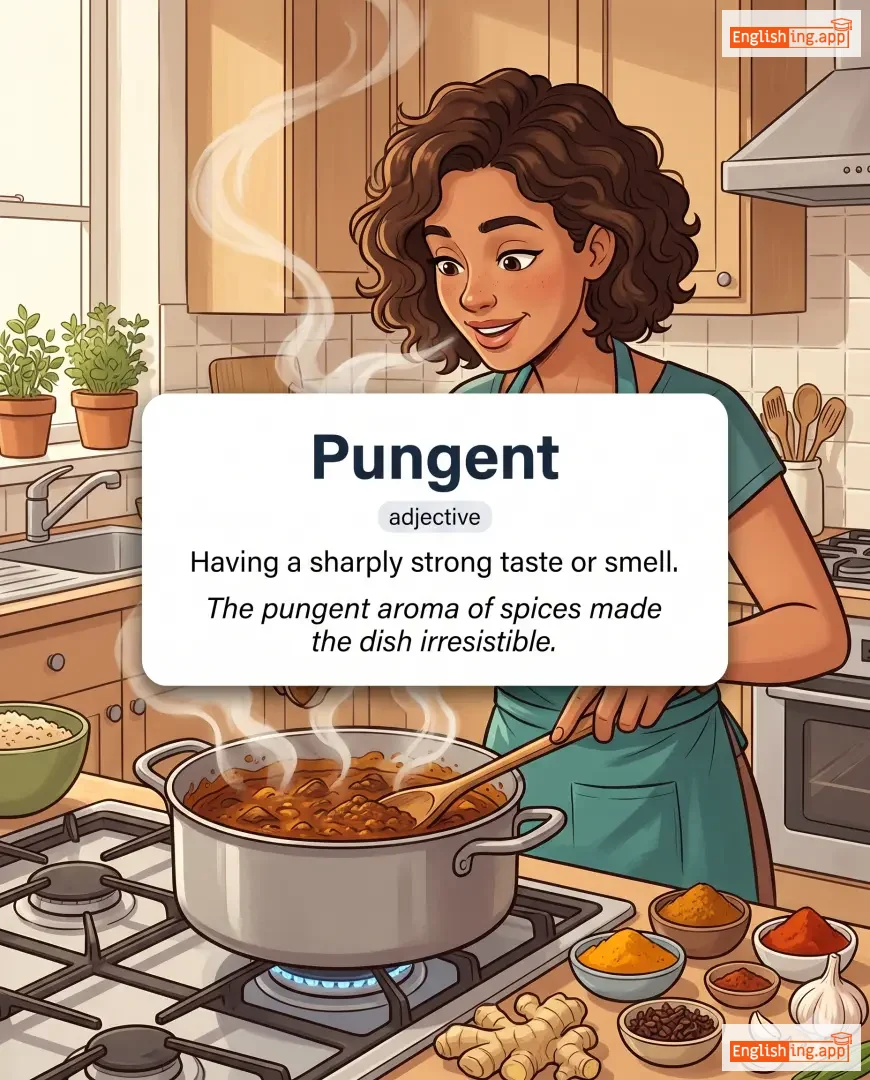
Pungent definition card — visual illustration of the meaning
adjective C1
/ˈpʌndʒənt/
तीव्र गंध या स्वाद (teevr gandh ya swaad)

Having a sharply strong taste or smell.

"The pungent aroma of spices made the dish irresistible."

"मसालों की तीव्र गंध ने व्यंजन को अपरिहार्य बना दिया।" (Masalon ki teevr gandh ne vyanjan ko aparihary bana diya.)
adjective C1
/ˈpjuː.nɪ.tɪv/
दंडात्मक (dantatmak)

Inflicting or intended as punishment.

"The company faced punitive measures for violating the law."

"कंपनी को कानून का उल्लंघन करने के लिए दंडात्मक कदमों का सामना करना पड़ा।" (Kampani ko kanoon ka ullanghan karne ke liye dantatmak kadmon ka samna karna pada.)
noun C1
/pʌnˈdʒɑː.bi/
पंजाबी (punjabi)

a traditional long shirt worn in South Asia, typically loose-fitting

"He wore a white punjabi for the festival celebration."

"उसने त्योहार के अवसर पर सफेद पंजाबी पहना।" (usne tyohaar ke avsar par safed punjabi pehna.)
adjective C1
/ˈpjuː.ni/
निगूड़ा (niguda)

Small, weak, or insignificant.

"He felt puny compared to his stronger classmates."

"वह अपने मजबूत सहपाठियों की तुलना में खुद को कमजोर महसूस कर रहा था।" (Vah apne majboot sahapathiyon ki tulna mein khud ko kamzor mehsoos kar raha tha.)
noun C1
/ˈpɜːrɡəˌtɔːri/
पापियों द्वारा अपने पापों का प्रायश्चित करने से पहले आत्माओं द्वारा पीड़ा का स्थान (paapiyon dwara apne paapon ka prayashchit karne se pehle aatmon dwara peeda ka sthan)

A place or state of suffering inhabited by the souls of sinners who are expiating their sins before going to heaven; a temporary condition of torment or suffering.

"After the accident, the long recovery felt like a kind of purgatory."

"दुर्घटना के बाद, लंबी रिकवरी एक प्रकार का पुर्गेटरी जैसा महसूस हुआ।" (Durghatna ke baad, lambi recovery ek prakaar ka purgatory jaisa mehsoos hua.)
verb C1
/pɜːrdʒ/
हटाना (hatana)

To remove unwanted feelings, people, or things; to cleanse or purify.

"The new leader promised to purge corruption from the government."

"नए नेता ने सरकार से भ्रष्टाचार को समाप्त करने का वादा किया।" (Naye neta ne sarkar se bhrashtachar ko samaapt karne ka vada kiya.)
verb C1
/ˈpɜːrpɔːrt/
दावा करना (daava karna)

to claim or profess something, often falsely

"The document purports to be an official government report."

"दस्तावेज़ का दावा है कि यह एक सरकारी रिपोर्ट है।" (Dastavez ka daava hai ki yah ek sarkari report hai.)
adjective C1
/pərˈpɔːrtɪd/
आरोपित (aaropit)

alleged or claimed to be true, often without proof

"The purported evidence was later proven false."

"आरोपित सबूत बाद में गलत साबित हुआ।" (Aaropit saboot baad mein galat saabit hua.)
noun C1
/pərˈveɪər/
आपूर्तिकर्ता (aapoortikartaa)

a person or business that supplies goods, services, or information

"He is a well-known purveyor of fine wines."

"वह उत्तम वाइनों के प्रसिद्ध आपूर्तिकर्ता हैं।" (hee iz a vel-non parveyar of fain vains)
adjective C1
/ˈpʊʃi/
आक्रामक (aakramak)

excessively assertive or aggressive, often annoyingly so

"The salesperson was too pushy, which drove customers away."

"विक्रेता बहुत आक्रामक था, जिससे ग्राहक दूर भाग गए।" (Vikreta bahut aakramak tha, jisse grahak door bhag gaye.)
adjective C1
/ˈpjuːtrɪd/
सड़ा हुआ (sadā hu'ā)

decayed and emitting a foul smell

"The garbage smelled putrid after days in the sun."

"सूरज की तपन में कुछ दिनों बाद कूड़ा सड़ा हुआ महकने लगा।" (Suraj ki tapan mein kuch dinon baad kooda sadā hu'ā mahakne lagā.)
Quack definition card — visual illustration of the meaning
noun C1
/kwæk/
धोखेबाज़ डॉक्टर (dhokhebaaz doctor)

a fraudulent or ignorant pretender to medical skill; a charlatan

"Beware of the quack who promises miracle cures online."

"जो धोखेबाज़ डॉक्टर ऑनलाइन चमत्कारी इलाज का वादा करता है, उससे सावधान रहें।" (jo dhokhebaaz doctor online chamatkaari ilaaj ka vaada karta hai, usse saavdhaan rahen)
verb C1
/kwɒˈdruːpəl/
चार गुना करना (chaar guna karna)

to increase or make something four times as much or as many

"Within a year, the startup quadrupled its user base through aggressive partnerships."

"एक साल के भीतर, स्टार्टअप ने आक्रामक साझेदारी के माध्यम से अपने उपयोगकर्ता आधार को चार गुना बढ़ा दिया।" (ek saal ke bheetar, startup ne aakramak saajhedaari ke maadhyam se apne upyogakarta aadhar ko chaar guna badha diya.)
noun C1
/ˈkwæɡˌmaɪər/
कीचड़, दलदल (keechad, daldal)

a soft, wet area of land that gives way underfoot; a complex or dangerous situation

"The hikers were trapped in a political quagmire."

"पहाड़ों पर चढ़ाई करने वाले एक राजनीतिक कीचड़ में फंस गए थे।" (Pahaadon par chadhai karne wale ek rajneetik keechad mein fans gaye the.)
verb, noun C1
/kweɪl/
डर महसूस करना; एक छोटा, छोटी पूंछ वाला पक्षी (dar mehsoos karna; ek chhota, chhoti poonch wala pakshi)

verb: to feel or show fear; noun: a small, short-tailed bird

"She quailed at the sight of the approaching storm."

"वह आसन्न तूफान के दृश्य से भयभीत हो गई।" (Wah aassan toofan ke drishya se bhaybheet ho gayi.)
adjective C1
/kweɪnt/
पुरानी या आकर्षक शैली का (purani ya akarshak shaili ka)

attractively unusual or old-fashioned

"They stayed in a quaint little cottage by the sea."

"वे समुद्र के किनारे एक पुराने जमाने के आकर्षक घर में रुके थे।" (Ve samudra ke kinare ek purane jamane ke akarshak ghar mein ruke the.)
noun C1
/kwɑːm/
संदेह (sandeh)

a feeling of doubt, worry, or fear about something

"She had no qualm about speaking her mind."

"उसे अपनी बात कहने में कोई संकोच नहीं था।" (Use apni baat kehne mein koi sankoch nahi tha.)
noun (plural) C1
/kwɑːmz/
संदेह (sandeh)

feelings of doubt, worry, or uneasiness

"He had serious qualms about accepting the offer."

"उसे प्रस्ताव स्वीकार करने पर गंभीर संदेह था।" (Use prastaav sveekar karne par gambheer sandeh tha.)
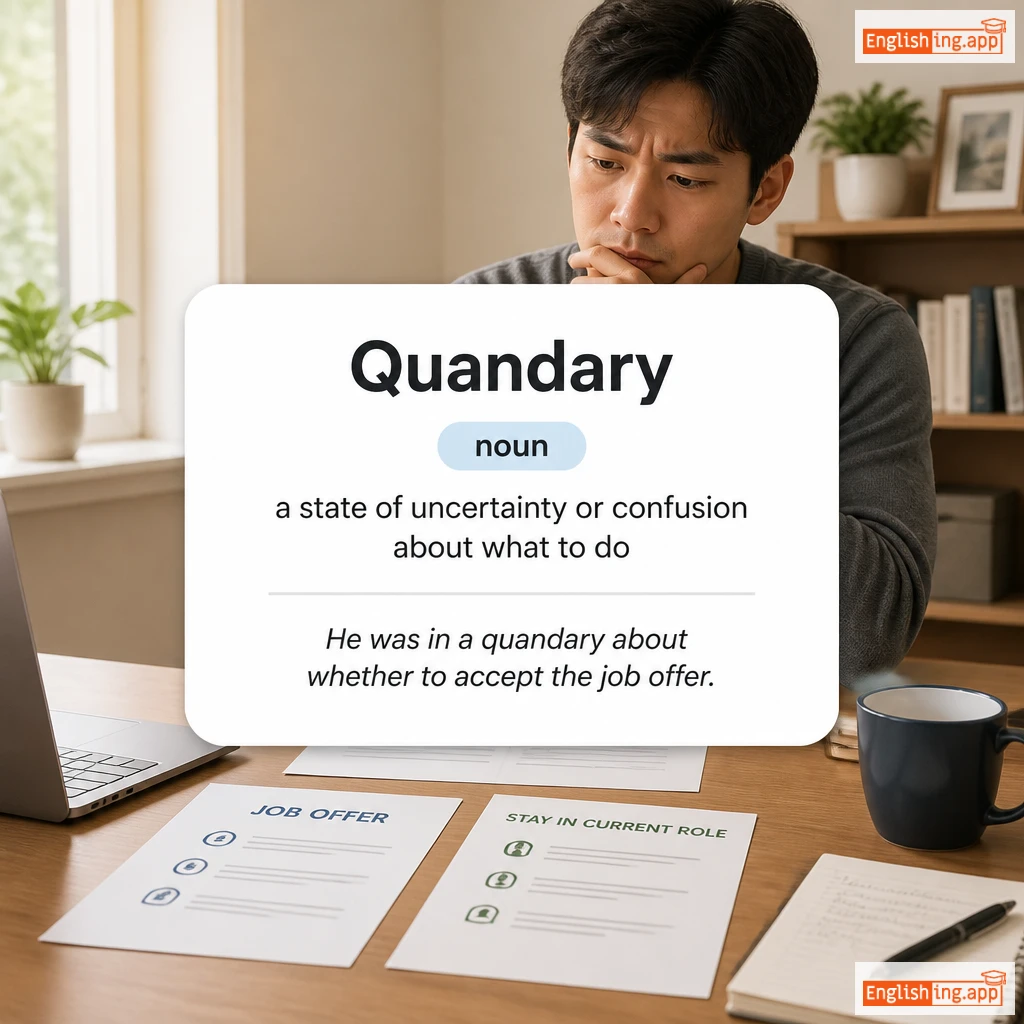
Quandary definition card — visual illustration of the meaning
noun C1
/ˈkwɒndəri/
दुविधा (duvidha)

a state of uncertainty or confusion about what to do

"He was in a quandary about whether to accept the job offer."

"वह नौकरी के प्रस्ताव को स्वीकार करे या नहीं, इसके बारे में वह उलझन में था." (vah naukri ke prastaav ko svikaar kare ya nahin, is baare mein vah uljhan mein tha)
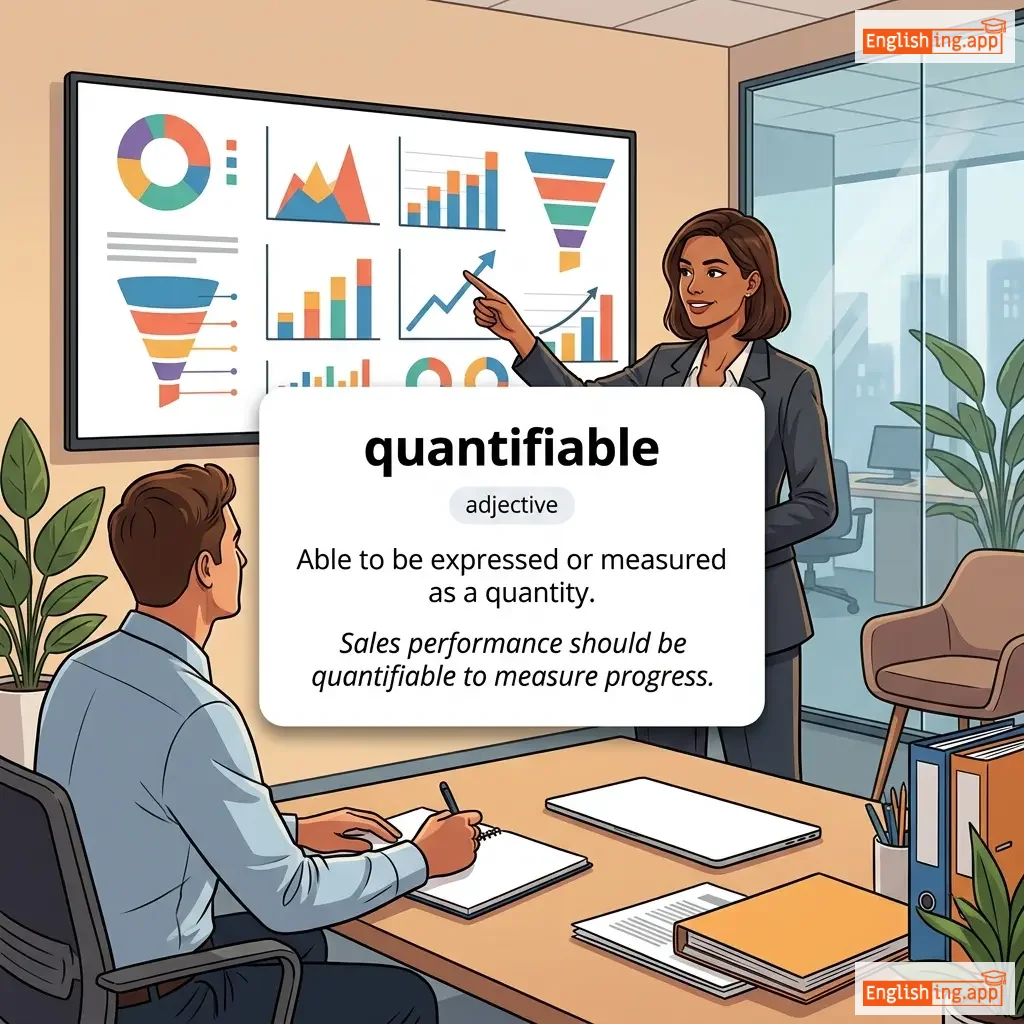
quantifiable definition card — visual illustration of the meaning
adjective C1
ˈkwɒn.tɪ.faɪ.ə.bəl
मापने योग्य (quantifaaybal)

Able to be expressed or measured as a quantity.

"Sales performance should be quantifiable to measure progress."

"बिक्री प्रदर्शन को प्रगति मापने के लिए माप योग्य होना चाहिए." (bikri pradarshan ko pragati maapne ke liye maap yogya hona chahiye)
adjective C1
/ˈkwɒr.əl.səm/
झगड़ालू (jhagdaalu)

Inclined to argue or fight.

"He became quarrelsome after losing the game."

"वह खेल हारने के बाद झगड़ालू हो गया।" (vah khel haarne ke baad jhagdaalu ho gaya.)
noun/verb C1
/ˈkwɒr.i/
खनिज खदान / शिकार (khani khadan / shikar)

A place where stone or minerals are extracted; also means prey when hunted.

"The workers quarried limestone from the hill."

"कर्मचारियों ने पहाड़ से चूना पत्थर निकाला।" (Karmachariyon ne pahar se chuna pathar nikala.)
noun C1
/kwɔːrˈtɛt/
चतुष्कोण (chatushkona)

A group of four people playing music or singing together.

"The string quartet performed beautifully at the concert."

"स्ट्रिंग चतुष्कोण ने संगीत समारोह में सुंदर प्रदर्शन किया।" (String chatushkona ne sangeet samaroh mein sundar pradarshan kiya.)
verb C1
/kwɑːʃ/
रद्द करना (radd karna)

To reject or void something legally or to put an end to something forcefully.

"The court quashed the decision due to lack of evidence."

"कोर्ट ने सबूतों की कमी के कारण निर्णय को रद्द कर दिया।" (Court ne sabooton ki kami ke karan nirnay ko radd kar diya.)
noun C1
/kiː/
घाट (ghat)

A platform lying alongside or projecting into water for loading and unloading ships.

"The cargo was unloaded at the quay."

"कार्गो को घाट पर उतारा गया था।" (Cargo ko ghat par utara gaya tha.)
adjective C1
/ˈkwiːzi/
बेहद उल्टी जैसा महसूस होना (behad ulti jaisa mehsoos hona)

Feeling sick to one's stomach; nauseated.

"She felt queasy after the long boat ride."

"वह लंबी नाव की सवारी के बाद अस्वस्थ महसूस कर रही थी।" (Wah lambi naav ki sawaari ke baad aswasth mehsoos kar rahi thi.)
adjective C1
/kwɪər/
अजीब (ajeeb)

Strange, odd, or unusual.

"He had a queer feeling that something was wrong."

"उसे यह अजीब सा महसूस हुआ कि कुछ गलत था।" (Use yeh ajeeb sa mehsoos hua ki kuch galat tha.)
verb C1
/kwɛl/
दबाना (dabaana)

To suppress or put an end to something, usually by force.

"The police were called to quell the violent protest."

"हिंसक विरोध को दबाने के लिए पुलिस को बुलाया गया था।" (Hinsak virodh ko dabaane ke liye police ko bulaaya gaya tha.)
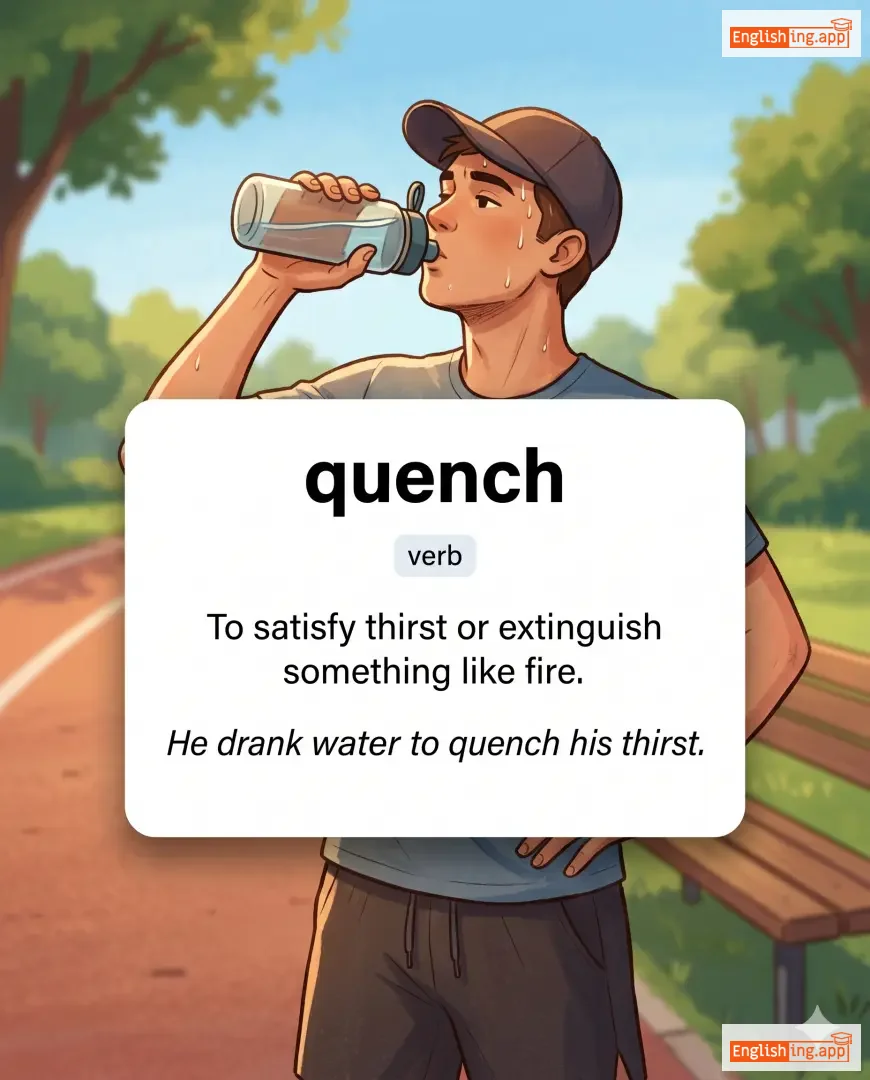
quench definition card — visual illustration of the meaning
verb C1
/kwɛntʃ/
प्यास बुझाना (pyaas bujhaana)

To satisfy thirst or extinguish something like fire.

"He drank water to quench his thirst."

"उसने अपनी प्यास बुझाने के लिए पानी पिया।" (Usne apni pyaas bujhaane ke liye paani piya.)
verb C1
/ˈkwentʃɪŋ/
तृष्णा शान्त करना / आग बुझाना (trishna shant karna / aag bujhana)

The act of satisfying thirst or extinguishing something like fire.

"Drinking cold water was quenching her thirst."

"ठंडी पानी पीना उसकी तृष्णा शान्त कर रहा था।" (Thandi pani peena uski trishna shant kar raha tha.)
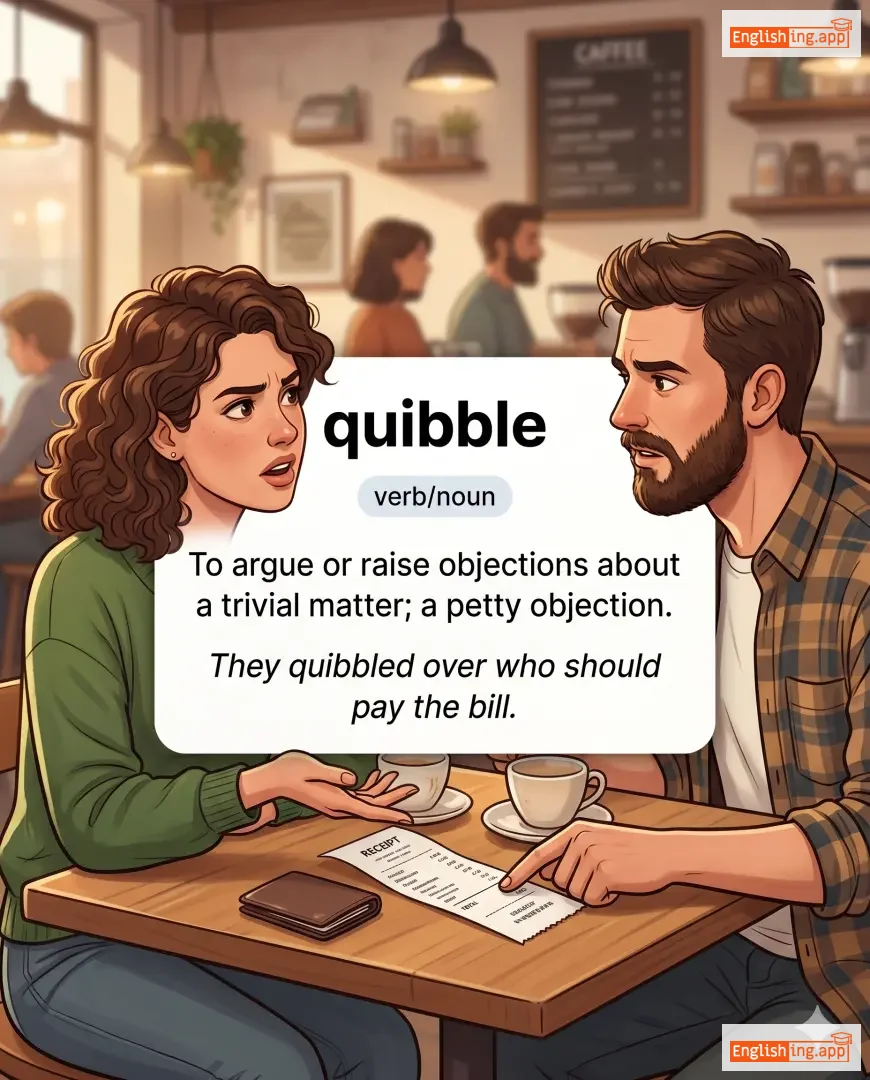
quibble definition card — visual illustration of the meaning
verb/noun C1
/ˈkwɪbəl/
नकली तर्क (nakli tark)

To argue or raise objections about a trivial matter; a petty objection.

"They quibbled over who should pay the bill."

"वे बिल का भुगतान कौन करेगा इस पर तर्क कर रहे थे।" (ve bil ka bhugtan kaun karega is par tark kar rahe the.)
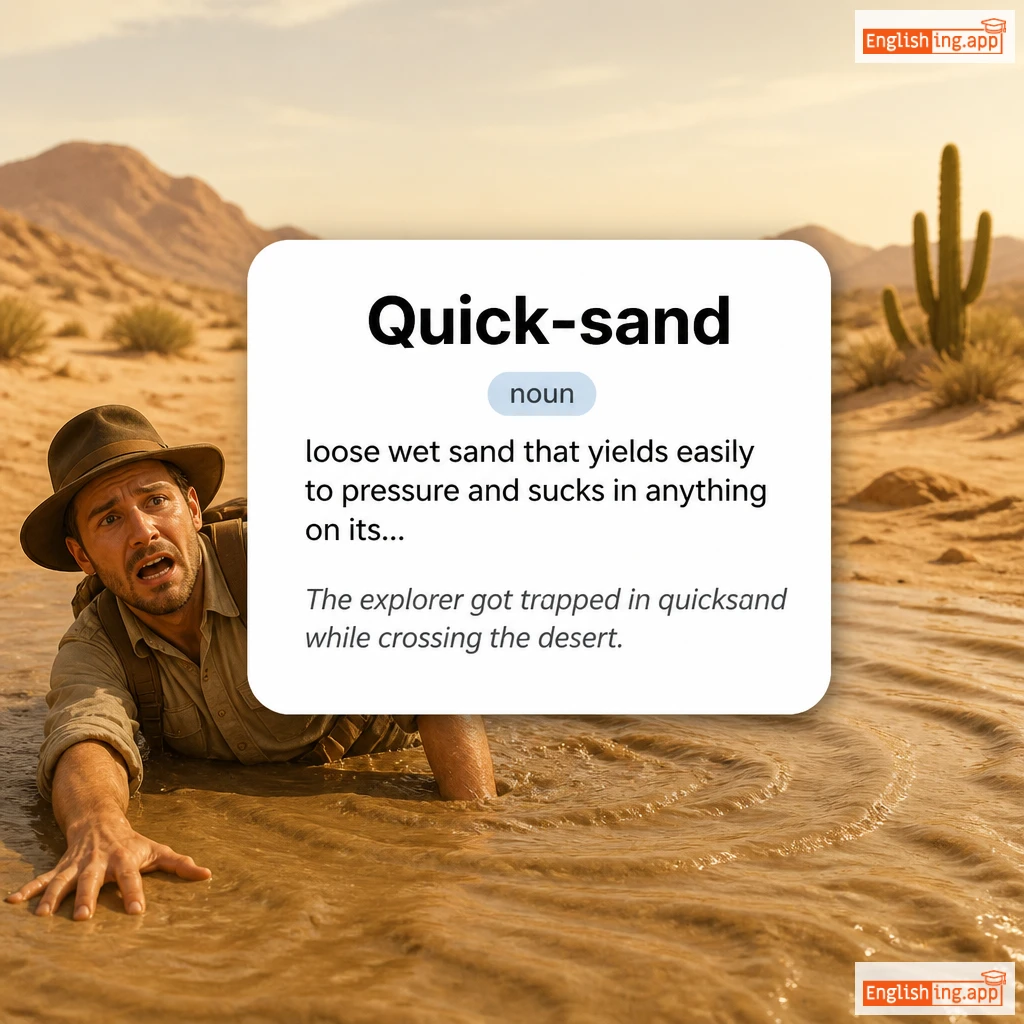
Quick-sand definition card — visual illustration of the meaning
noun C1
/ˈkwɪk.sænd/
क्विकसैंड (quicksand)

loose wet sand that yields easily to pressure and sucks in anything on its surface

"The explorer got trapped in quicksand while crossing the desert."

"अन्वेषक मरुस्थल पार करते समय क्विकसैंड में फंस गया।" (anveshak marusthal paar karte samay quicksand mein fans gaya)
verb C1
/ˈkwɪkən/
तेज करना (tej karna)

to make or become faster; to accelerate

"His pulse began to quicken as he approached the finish line."

"उसकी नाड़ी फिनिश लाइन के पास पहुंचते ही तेज़ होने लगी।" (Uski naadi finish line ke paas pahuchte hi tez hone lagi.)
noun C1
/kwɪnˈtɛsəns/
सर्वोत्तम उदाहरण (sarvottam udaharan)

The purest or most perfect example of something.

"She is the quintessence of elegance."

"वह शास्त्रीय संगीत की सर्वोत्तम उदाहरण है।" (Vah shastriya sangeet ki sarvottam udaharan hai.)
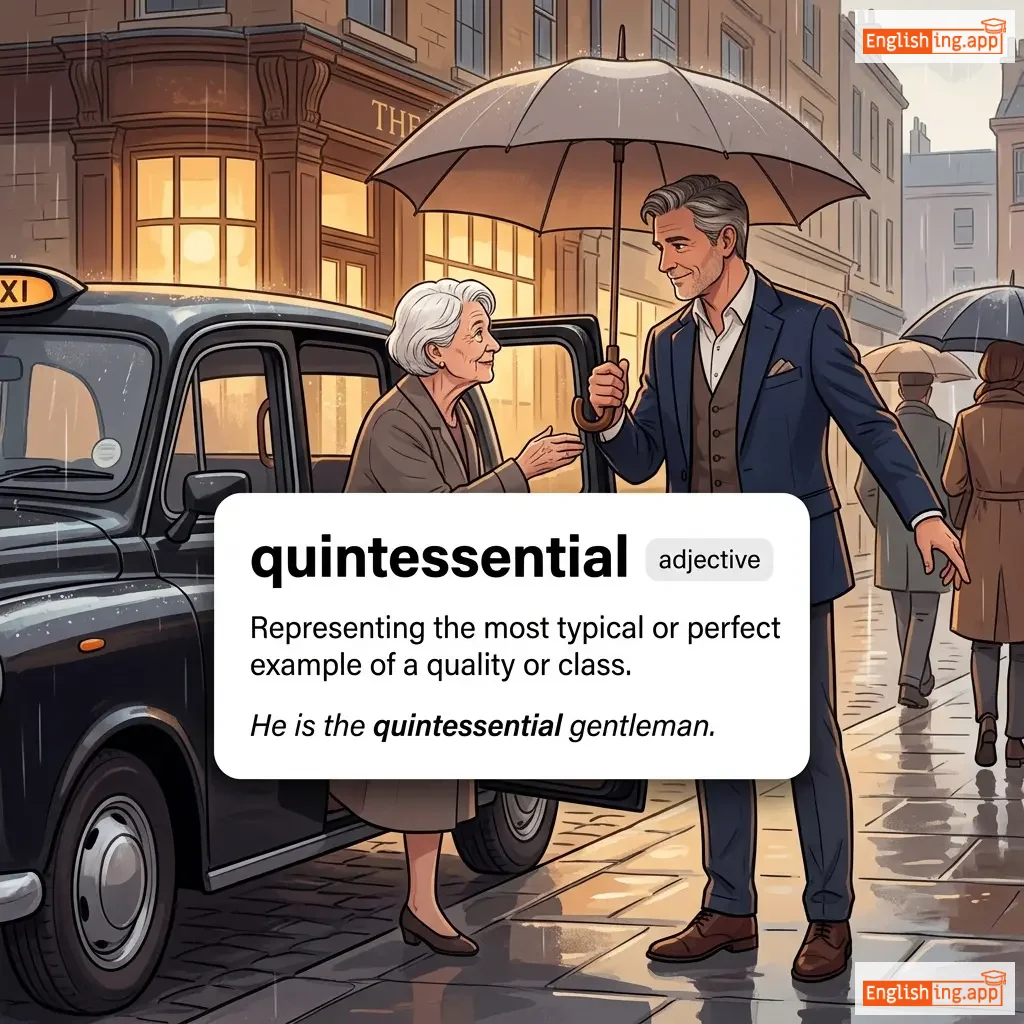
quintessential definition card — visual illustration of the meaning
adjective C1
/ˌkwɪntɪˈsɛnʃəl/
पूर्णत: आदर्श (poornat: aadarsh)

Representing the most typical or perfect example of a quality or class.

"He is the quintessential gentleman."

"वह पूर्णत: आदर्श सज्जन है।" (Vah poornat: aadarsh sajjan hai.)
noun C1
/kwɪnˈtɛt/
पाँच लोगों का समूह (paanch logon ka samuh)

A group of five people or things, especially musicians.

"The jazz quintet performed beautifully."

"जैज़ क्विंटेट ने खूबसूरती से प्रदर्शन किया।" (Jazz quintet ne khoobsurti se pradarshan kiya.)
noun/verb C1
/kwɪp/
चतुर टिप्पणी (chatur tippani)

A witty remark; to make a witty or clever comment.

"She quipped about the weather during the meeting."

"वह बैठक के दौरान मौसम पर मजाक कर रही थी।" (Vah baithak ke dauraan mausam par mazak kar rahi thi.)
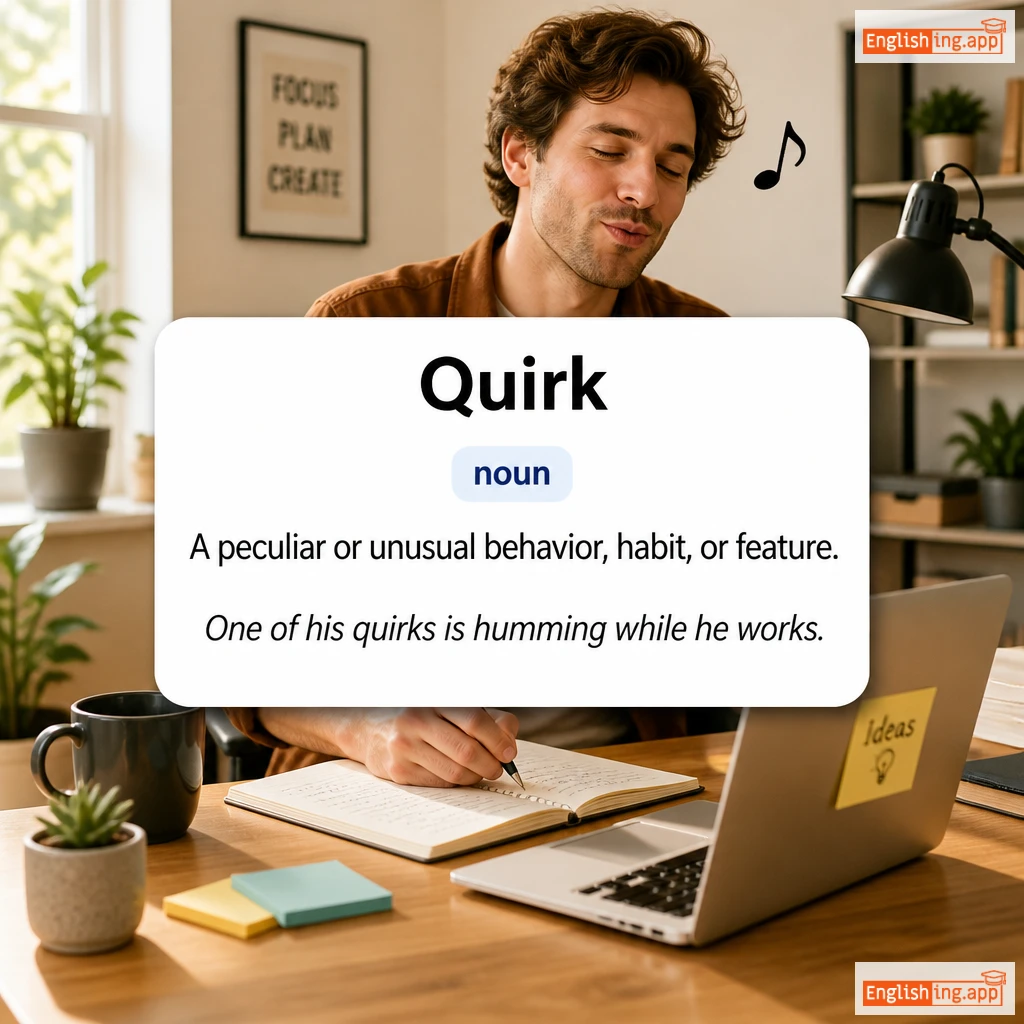
Quirk definition card — visual illustration of the meaning
noun C1
/kwɜːrk/
अजीब आदत (ajeeb aadat)

A peculiar or unusual behavior, habit, or feature.

"One of his quirks is humming while he works."

"उसकी एक अजीब आदत है कि वह काम करते समय गुनगुनाता है।" (uski ek ajeeb aadat hai ki wah kaam karte samay gungunata hai.)
verb C1
/ˈkwɪvər/
काँपना (kaampna)

To tremble or shake with slight but rapid motion.

"Her lips began to quiver as she tried not to cry."

"जब उसने रोने से बचने की कोशिश की, उसकी होठ कांपने लगे।" (jab usne rone se bachne ki koshish ki, uski hoth kaampne lage.)
adjective C1
/ˈkwɪzɪkəl/
हैरान, प्रश्नवाचक (hairaan, prashnavachak)

Expressing mild or amused puzzlement.

"She gave him a quizzical look when he made the strange comment."

"उसने जब अजीब टिप्पणी की तो उसने उसे एक उलझन भरी नज़र दी।" (Usne jab ajeeb tippani ki to usne use ek uljhan bhari nazar di.)
noun C1
/kwoʊ/
स्थिति (stithi)

The existing state of affairs or situation, often used in the phrase 'status quo'.

"He wanted to maintain the status quo at work."

"वह कार्यस्थल पर स्थिति बनाए रखना चाहता था।" (Vah karyasthal par stithi banaye rakhna chahta tha.)
noun C1
/ˈkwɔːrəm/
क्वोरम (quorum)

The minimum number of members needed to conduct official business in a meeting.

"The board meeting was postponed because there was no quorum."

"बोर्ड मीटिंग स्थगित कर दी गई थी क्योंकि कोई क्वोरम नहीं था।" (board meeting sthagit kar di gayi thi kyunki koi quorum nahin tha.)
adjective C1
/ˈræb.ɪd/
उन्मत्त (unmatt)

Having extreme or fanatical support for something; relating to or suffering from rabies.

"He was a rabid fan of the football team."

"वह फुटबॉल टीम का एक उन्मत्त प्रशंसक था।" (vah football team ka ek unmatt prashansak tha.)
noun C1
/ˈreɪ.biːz/
रेबीज़ (rebiz)

A viral disease that causes inflammation of the brain in humans and other mammals, usually transmitted through animal bites.

"The dog was vaccinated against rabies."

"कुत्ते को रेबीज़ के खिलाफ टीका लगाया गया था।" (kutte ko rebiz ke khilaf tika lagaya gaya tha.)
adjective C1
/ˈreɪ.si/
रोमांचक (romanchak)

Lively, entertaining, or slightly shocking (especially in a sexual way).

"The novel was full of racy dialogues."

"उपन्यास रोमांचक संवादों से भरा था।" (upanyas romanchak samvadon se bhara tha.)
noun C1
/ˈreɪdiəns/
प्रकाश (prakash)

the quality of shining with bright light; a glowing or beaming quality

"Her face was filled with radiance after hearing the good news."

"अच्छी खबर सुनने के बाद उसका चेहरा प्रकाश से भर गया था।" (Achhi khabar sunne ke baad uska chehra prakash se bhar gaya tha.)
adjective C1
/ˈreɪdiənt/
चमकदार (chamakdaar)

Shining brightly; expressing great happiness.

"She looked radiant in her wedding dress."

"वह अपनी शादी की ड्रेस में बहुत ही चमकदार लग रही थी।" (Vah apnī śādī kī ḍres men bahut hī chamakdār lag rahī thī.)
verb C1
/ˈreɪdieɪt/
विकिरण करना (vikiran karna)

to emit energy or light; to spread out from a center

"The fireplace radiates warmth throughout the room."

"फायरप्लेस पूरे कमरे में गर्मी उत्सर्जित करता है।" (fireplace poore kamre mein garmi utsarjit karta hai.)