Vokabulare

Englisches Vokabelwörterbuch | Wortbedeutungen, Definitionen & Beispiele

noun/verb C1
/ˈræfəl/
vente de billets de tombola (vente de billets de tombola)

A means of raising money by selling numbered tickets, one or more of which are drawn at random for a prize; to sell something in such a lottery.

"The charity decided to raffle a bicycle to raise funds."

"La charité a décidé de vendre un vélo à travers une tombola pour collecter des fonds." (La charité a décidé de vendre un vélo à travers une tombola pour collecter des fonds.)
noun C1
/ˈræftər/
poutre (poutre)

One of the sloping beams that supports a roof.

"The old barn’s rafters were exposed."

"Les poutres du vieux grenier étaient exposées." (Les poutres du vieux grenier étaient exposées.)
adjective C1
/ˈræɡɪd/
déchiré (dechire)

torn, worn out, or in poor condition

"The homeless man wore a ragged coat."

"L'homme sans-abri portait un manteau déchiré." (L'homme sans-abri portait un manteau déchiré.)
adjective C1
/ˈreɪ.kɪʃ/
d'apparence élégante, confiante et légèrement déshonorée (d'apparence elegante, confiante et legerement deshonoree)

having a stylish, confident, and slightly disreputable appearance

"He walked in with a rakish smile and tilted hat."

"Il entra avec un sourire rakish et un chapeau incliné." (Il entra avec un sourire rakish et un chapeau incline.)
adjective C1
/ræmˈbʌŋk.ʃəs/
bruyant (bruyant)

boisterous, energetic, and difficult to control.

"The rambunctious children filled the house with noise."

"Les enfants bruyants ont rempli la maison de bruit." (Les enfants bruyants ont rempli la maison de bruit.)
Rambutan definition card — visual illustration of the meaning
noun C1
/ræmˈbuːtən/
ramboutan (ramboutan)

a tropical fruit with red spiky skin and white translucent sweet flesh similar to litchi

"The rambutan looks scary with its hairy skin but tastes very sweet inside."

"Le rambutan a l'air effrayant avec sa peau poilue, mais il a un goût très sucré à l'intérieur." (Le rambutan a l'air effrayant avec sa peau poilue, mais il a un goût très sucré à l'intérieur.)
noun C1
/ˌræm.ɪ.fɪˈkeɪ.ʃən/
conséquence (consequence)

a consequence of an action or event, often complex or unwelcome.

"The new law has serious social ramifications."

"La nouvelle loi a de graves conséquences sociales." (La nouvelle loi a de graves consequences sociales.)
adjective C1
/ˈræmpənt/
rampant (rampant)

existing or spreading unchecked, often in an undesirable way

"Corruption was rampant in the city administration."

"La corruption était rampante dans l'administration de la ville." (La corruption etait rampante dans l'administration de la ville.)
noun C1
/ˈræmpɑːrt/
rempart (rempart)

a defensive wall of a castle or fort

"The soldiers stood on the rampart, watching the enemy approach."

"Les soldats se tenaient sur le rempart, observant l'ennemi approcher." (Les soldats se tenaient sur le rempart, observant l'ennemi approcher.)
adjective C1
/ˈræmʃækəl/
délabré (delabre)

poorly built or maintained; in a state of disrepair

"They lived in a ramshackle old house on the edge of town."

"Ils vivaient dans une maison délabrée en bordure de la ville." (Ils vivaient dans une maison délabrée en bordure de la ville.)
adjective C1
/ˈrænsɪd/
rance (rance)

having a bad taste or smell due to being old or spoiled (especially fats or oils)

"The butter had gone rancid after being left out too long."

"Le beurre était devenu rance après être resté trop longtemps dehors." (Le beurre était devenu rance après être resté trop longtemps dehors.)
verb C1
/ˈræn.də.maɪz/
aléatoiriser (aleatoriser)

To make something happen in a random order or manner.

"The software can randomize the order of questions."

"Le logiciel peut randomiser l'ordre des questions." (Le logiciel peut randomiser l'ordre des questions.)
verb C1
/ˈræn.sæk/
mettre à sac (mettre à sac)

to search a place roughly and steal or damage things

"Burglars ransacked the house while the family was away."

"Les cambrioleurs ont mis à sac la maison pendant que la famille était absente." (Les cambrioleurs ont mis à sac la maison pendant que la famille était absente.)
verb C1
/rænt/
rager (rager)

to speak or shout in an angry, uncontrolled way

"He ranted about the unfair treatment at work."

"Il a crié à propos du traitement injuste au travail." (Il a crié à propos du traitement injuste au travail.)
noun C1
/rəˈpɪdəti/
rapidité (rapidite)

The quality of moving or happening quickly; swiftness or speed.

"The rapidity of technological change is astonishing."

"La rapidité du changement technologique est étonnante." (La rapidité du changement technologique est étonnante.)
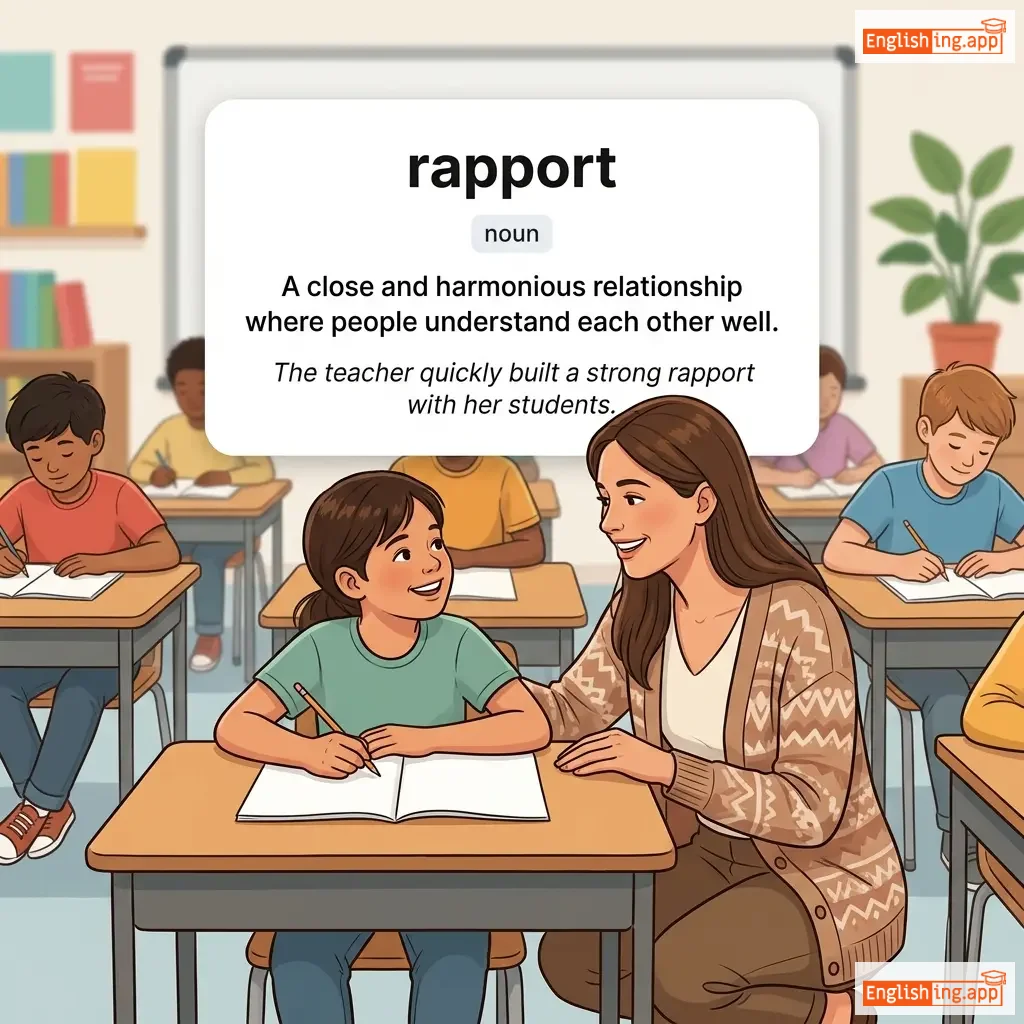
rapport definition card — visual illustration of the meaning
noun C1
/ræˈpɔːr/
relation (relation)

A close and harmonious relationship where people understand each other well.

"The teacher quickly built a strong rapport with her students."

"L'enseignant a rapidement établi une relation forte avec ses élèves." (L'enseignant a rapidement etabli une relation forte avec ses eleves.)
adjective C1
/ræpt/
absorbé (absorbé)

Completely absorbed or fascinated by something.

"She listened with rapt attention to the speaker’s words."

"Elle écoutait avec une attention absorbée les paroles du locuteur." (Elle écoutait avec une attention absorbée les paroles du locuteur.)
noun C1
/ˈræp.tʃər/
extase, ravissement (extase, ravissement)

A feeling of intense joy, delight, or ecstasy.

"She listened to the music in rapture."

"Elle écoutait la musique avec extase." (Elle ecoutait la musique avec extase.)
verb C1
/ræsp/
parler d'une voix rugueuse ou râper avec un bruit grossier (parler d'une voix rugueuse ou raper avec un bruit grossier)

to speak in a rough, harsh voice or to scrape with a coarse sound

"He rasped out a warning before collapsing."

"Il a râpé un avertissement avant de s'effondrer." (Il a rape un avertissement avant de s'effondrer.)
😮‍💨

raspy (raspi)

adjective C1
/ˈræspi/
rude (rude)

having a harsh, rough, or grating sound

"His raspy voice revealed years of smoking."

"Sa voix rude révélait des années de tabagisme." (Sa voix rude révélait des années de tabagisme.)
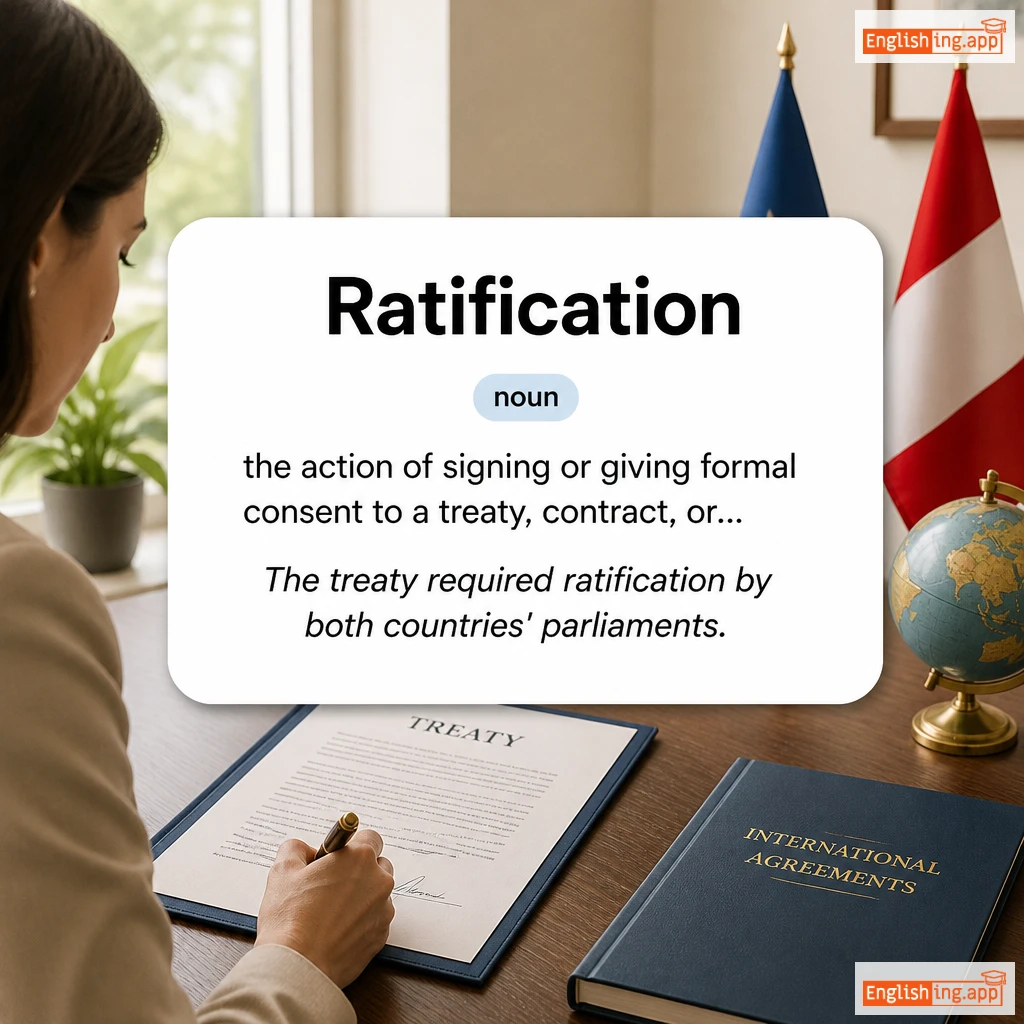
Ratification definition card — visual illustration of the meaning
noun C1
/ˌrætɪfɪˈkeɪʃən/
ratification (ratifikasyon)

the action of signing or giving formal consent to a treaty, contract, or agreement

"The treaty required ratification by both countries' parliaments."

"Le traité nécessitait la ratification par les parlements des deux pays." (Le traite necessitait la ratification par les parlements des deux pays.)
verb C1
/ˈrætɪfaɪ/
ratifier (ratifier)

to approve or confirm something officially, usually by law or formal consent

"The government ratified the trade agreement."

"Le gouvernement a ratifié l'accord commercial." (Le gouvernement a ratifié l'accord commercial.)
noun C1
/ˈræʃən/
ration (rasyon)

a fixed amount of something, especially food, officially allowed to each person

"During the war, each family received a weekly ration of rice."

"Pendant la guerre, chaque famille recevait une ration hebdomadaire de riz." (Pendant la guerre, chaque famille recevait une ration hebdomadaire de riz.)
noun C1
/ˌræʃəˈnæl/
raison sous-jacente (raison sous-jacente)

the underlying reason or explanation for something

"The rationale behind his decision was clearly explained."

"La raison derrière sa décision a été clairement expliquée." (La raison derriere sa decision a ete clairement expliquee.)
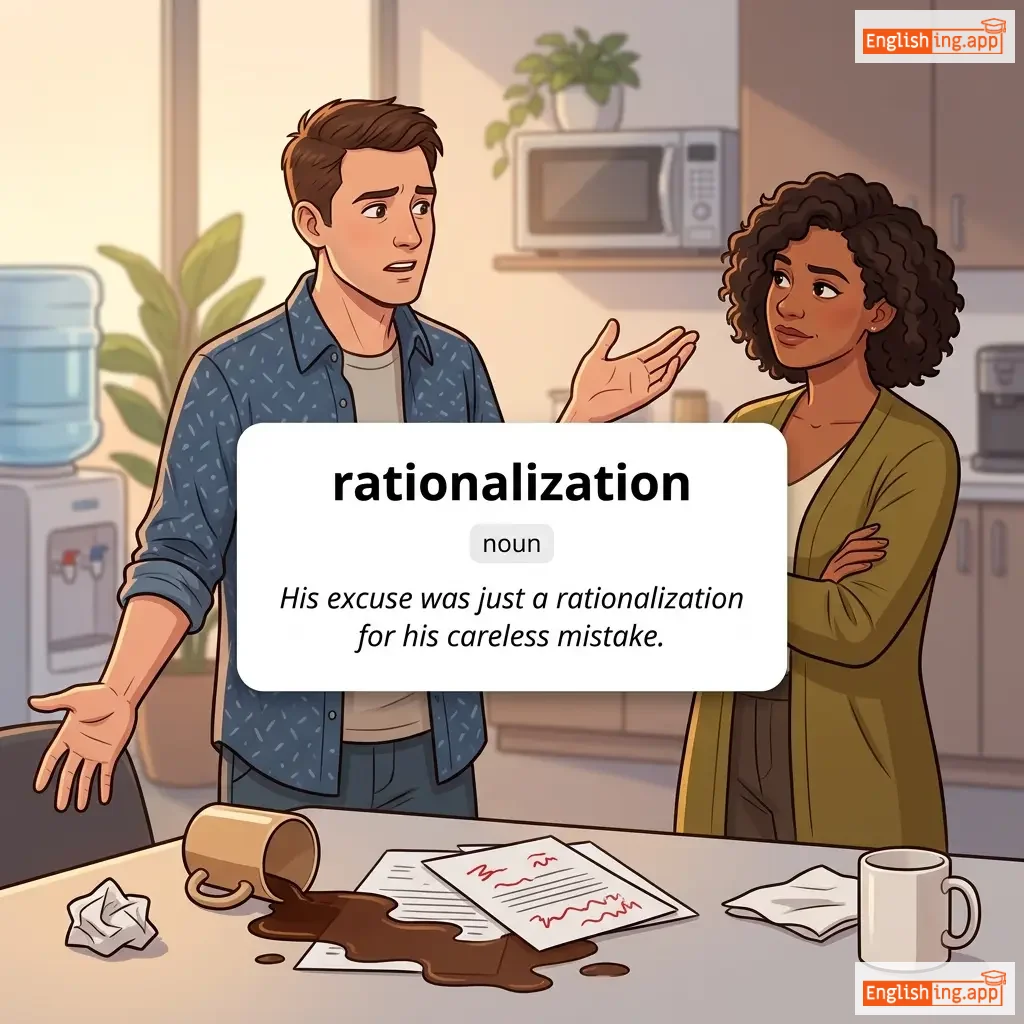
rationalization definition card — visual illustration of the meaning
noun C1
/ˌræʃənəlaɪˈzeɪʃən/
rationalisation (rationalisation)

the action of attempting to explain or justify behavior or an attitude with logical reasons, even if these are not appropriate

"His excuse was just a rationalization for his careless mistake."

"Son excuse n'était qu'une rationalisation de son erreur négligente." (Son excuse n'etait qu'une rationalisation de son erreur negligent.)
verb C1
/ˈræʃənəlaɪz/
rationaliser (rationaliser)

to attempt to explain or justify behavior or decisions with logical reasons, even if they are not true or appropriate

"She tried to rationalize her lateness by blaming the traffic."

"Elle a essayé de rationaliser son retard en blâmant le trafic." (Elle a essaye de rationaliser son retard en blamant le trafic.)
verb C1
/ˈræʃənaɪz/
rationaliser (rationaliser)

to justify or explain something with logical reasons, even if not appropriate or true

"He tried to rationlize his mistake by blaming the system."

"Il a essayé de rationaliser son erreur en blâmant le système." (Il a essayé de rationaliser son erreur en blâmant le système.)
adjective C1
/ˈrɔːkəs/
bruyant, tapageur (bruyant, tapageur)

loud, harsh, and unpleasant sound or behavior

"The crowd became raucous after the team scored."

"La foule est devenue bruyante après que l'équipe a marqué." (La foule est devenue bruyante apres que l'equipe a marque.)
verb C1
/ˈrævɪdʒ/
ravager (ravager)

to cause severe and extensive damage or destruction

"The hurricane ravaged the coastal villages."

"L'ouragan a ravagé les villages côtiers." (L'ouragan a ravagé les villages côtiers.)
verb C1
/reɪv/
aduler (aduler)

to speak or write about something with great enthusiasm or admiration

"Critics rave about the new movie."

"Les critiques adulent le nouveau film." (Les critiques adulent le nouveau film.)
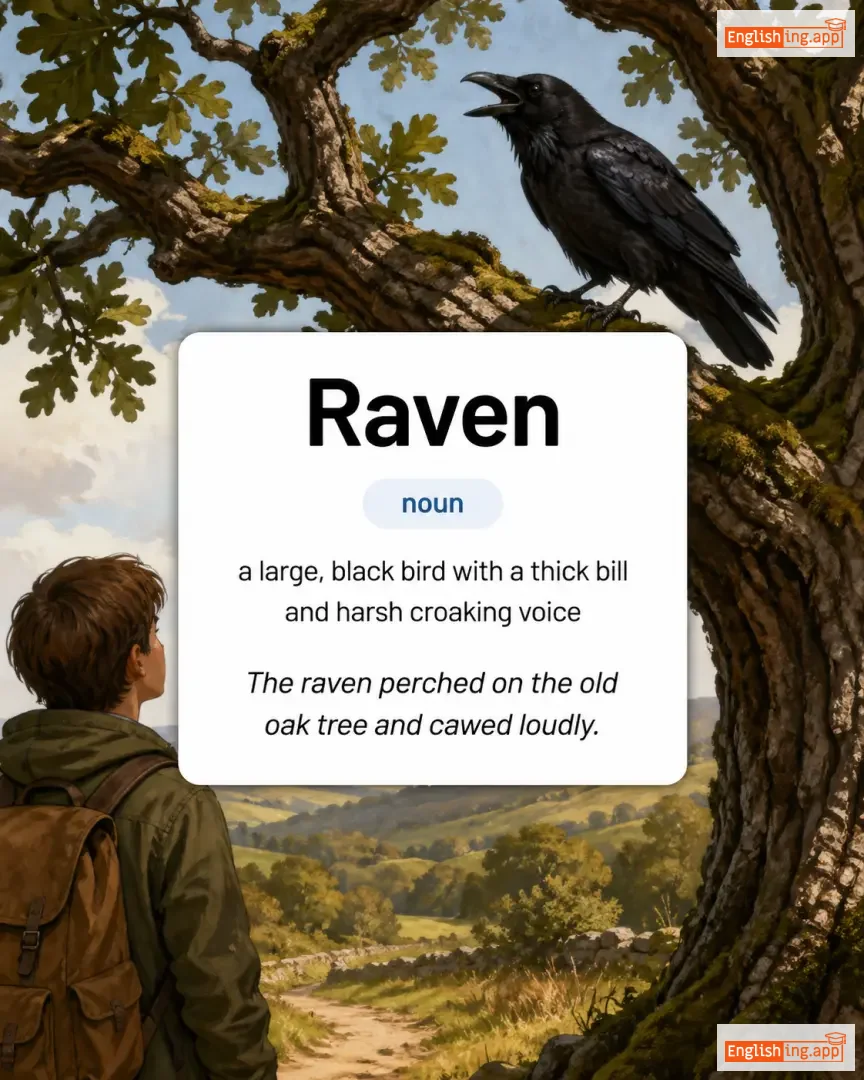
Raven definition card — visual illustration of the meaning
noun C1
/ˈreɪ.vən/
corbeau (korbo)

a large, black bird with a thick bill and harsh croaking voice

"The raven perched on the old oak tree and cawed loudly."

"Le corbeau s’est perché sur le vieux chêne et a croassé bruyamment." (le korbo set perche sur le vieux shen e a kroase bruyaman)
adjective C1
/ˈrævənəs/
affamé (affame)

Extremely hungry; famished.

"After the long hike, she was ravenous and ate quickly."

"Après la longue randonnée, elle était affamée et a mangé rapidement." (Apres la longue randonnee, elle etait affamee et a mange rapidement.)
noun C1
/rəˈviːn/
ravin (ravin)

A deep, narrow valley with steep sides.

"The river carved a deep ravine through the mountains."

"La rivière a creusé un ravin profond à travers les montagnes." (La rivière a creusé un ravin profond à travers les montagnes.)
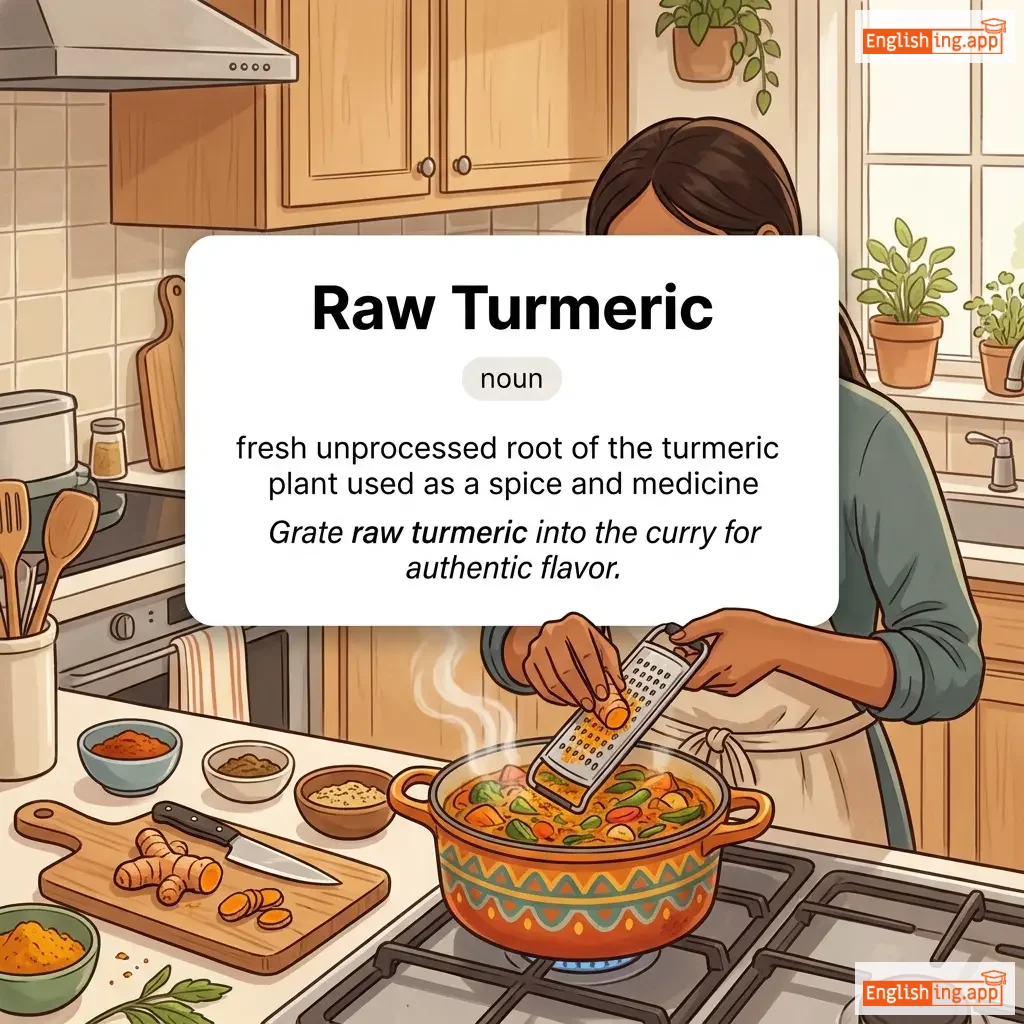
Raw Turmeric definition card — visual illustration of the meaning
noun C1
/rɔ ˈtɜrmərɪk/
curcuma frais (curcuma frais)

fresh unprocessed root of the turmeric plant used as a spice and medicine

"Grate raw turmeric into the curry for authentic flavor."

"Râpez du curcuma frais dans le curry pour une saveur authentique." (Rapez du curcuma frais dans le curry pour une saveur authentique)
verb C1
/reɪz/
raser (raser)

To completely destroy or demolish something, especially a building.

"The old factory was razed to make way for new apartments."

"L'ancienne usine a été rasée pour faire place à de nouveaux appartements." (L'ancienne usine a été rasée pour faire place à de nouveaux appartements.)
noun C1
/riˈæktənt/
réactif (reactif)

A substance that takes part in and undergoes change during a chemical reaction.

"Oxygen is a reactant in the process of combustion."

"L'oxygène est un réactif dans le processus de combustion." (L'oxygene est un reactif dans le processus de combustion.)
adjective C1
/riˈækʃəˌneri/
réactionnaire (reactionnaire)

Opposing political or social progress or reform; extremely conservative.

"The group took a reactionary stance against the new policies."

"Le groupe a adopté une position réactionnaire contre les nouvelles politiques." (Le groupe a adopté une position réactionnaire contre les nouvelles politiques.)
adjective C1
/riˈæk.tɪv/
réactif; chimiquement actif (reactif; chimiquement actif)

responding to situations rather than initiating them; chemically active

"The company took a reactive approach to customer complaints."

"L'entreprise a adopté une approche réactive face aux plaintes des clients." (L'entreprise a adopté une approche réactive face aux plaintes des clients.)
verb C1
/ˌriːəˈdʒʌst/
réajuster (reajuster)

To change or move something again in order to achieve a better fit, condition, or balance.

"He readjusted the chair to make it more comfortable."

"Il a réajusté la chaise pour la rendre plus confortable." (Il a réajusté la chaise pour la rendre plus confortable.)
noun C1
/ˌriː.əˈdʒʌst.mənt/
réajustement (reajustement)

The act of changing or correcting something again to make it suitable or balanced.

"After moving to a new city, he went through a period of readjustment."

"Après avoir déménagé dans une nouvelle ville, il a traversé une période de réajustement." (Apres avoir demenage dans une nouvelle ville, il a traverse une periode de reajustement.)
verb C1
/ˌriːəˈfɜːrm/
réaffirmer (reaffirmer)

To state again strongly; to confirm or strengthen a statement or belief.

"The president reaffirmed his commitment to education reform."

"Le président a réaffirmé son engagement envers la réforme de l’éducation." (Le president a reaffirme son engagement envers la reforme de l education.)
noun C1
/ˈriːpər/
une personne ou une machine qui coupe et ramasse les récoltes (une personne ou une machine qui coupe et ramasse les recoltes)

a person or machine that cuts and gathers crops

"The reaper moved slowly through the golden fields."

"Le riper se déplaçait lentement à travers les champs dorés." (Le riper se deplaçait lentement a travers les champs dores.)
noun C1
/ˈriːbeɪt/
remise/remboursement (remise/remboursement)

a partial refund given to someone who has paid too much money for something

"The store offered a rebate on bulk purchases."

"Le magasin a offert une remise sur les achats en gros." (Le magasin a offert une remise sur les achats en gros.)
adjective C1
/rɪˈbɛljəs/
rebelle (rebelle)

resisting authority or control; showing a desire to rebel

"The rebellious teenager refused to follow the school rules."

"Le jeune rebelle a refusé de suivre les règles de l'école." (Le jeune rebelle a refusé de suivre les règles de l'école.)
verb C1
/rɪˈbʌf/
rejeter (rejeter)

to reject or refuse in a sharp or abrupt way

"She rebuffed his invitation to dinner."

"Elle a rejeté son invitation au dîner." (Elle a rejeté son invitation au dîner.)
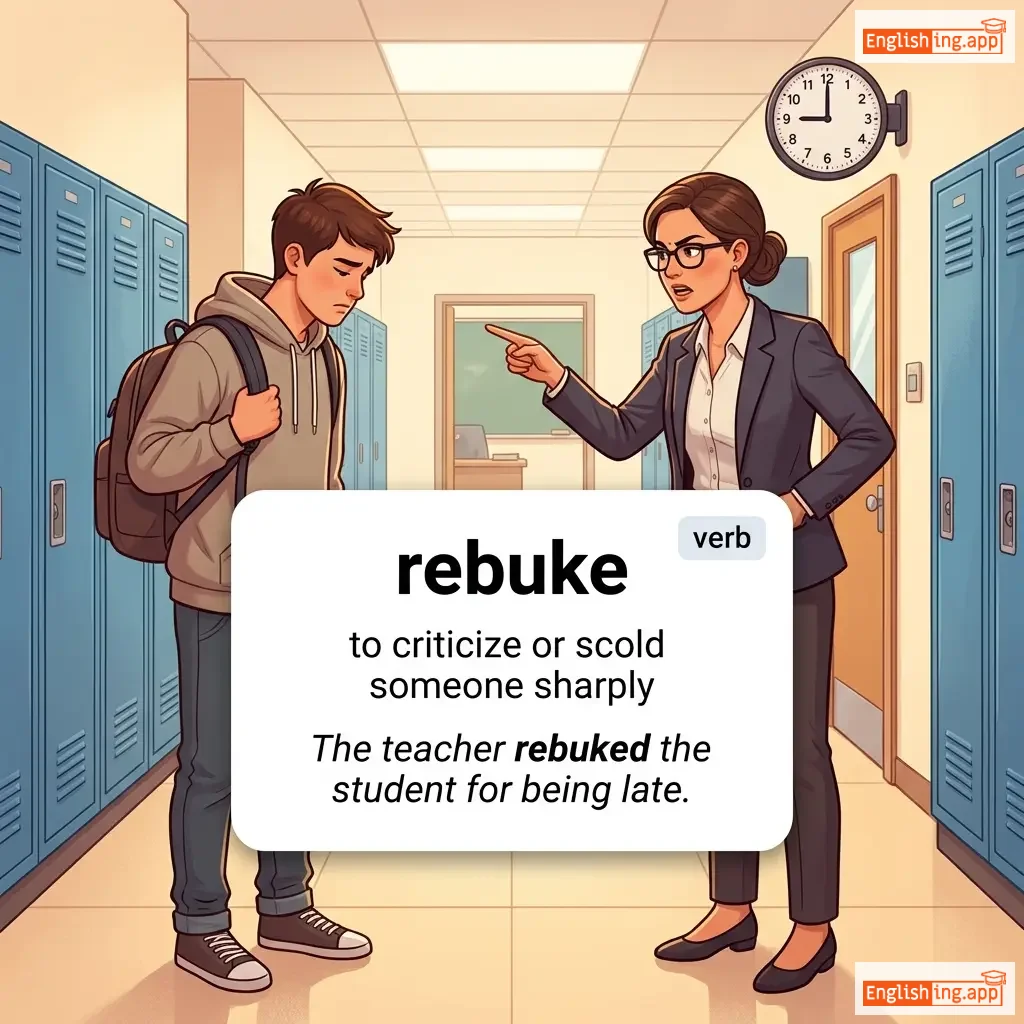
rebuke definition card — visual illustration of the meaning
verb C1
/rɪˈbjuːk/
réprimander (reprimander)

to criticize or scold someone sharply

"The teacher rebuked the student for being late."

"Le professeur a réprimandé l'élève pour son retard." (Le professeur a réprimandé l'élève pour son retard.)
verb C1
/rɪˈbʌt/
réfuter (refuter)

to argue against or prove wrong; to refute

"The lawyer rebutted the false accusations with strong evidence."

"L'avocat a réfuté les fausses accusations avec des preuves solides." (L'avocat a réfuté les fausses accusations avec des preuves solides.)
noun C1
/rɪˈbʌtəl/
réfutation (refutation)

a statement or argument made to oppose or disprove another

"Her rebuttal was clear and convincing."

"Sa réfutation était claire et convaincante." (Sa refutation etait claire et convaincante.)
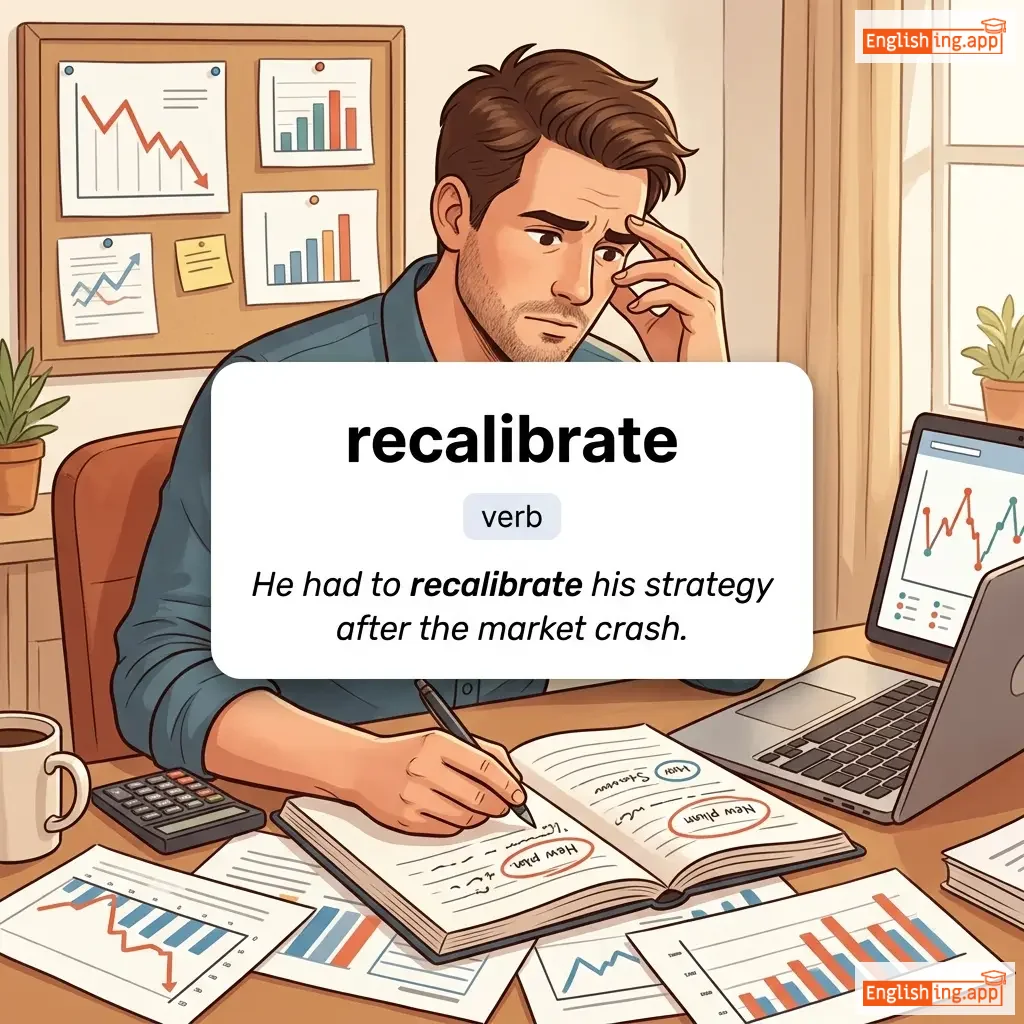
recalibrate definition card — visual illustration of the meaning
verb C1
ˌriːˈkæl.ɪ.breɪt
recalibrer (recalibrer)

To adjust or modify according to a new standard or plan; to reassess and realign.

"He had to recalibrate his strategy after the market crash."

"Il a dû recalibrer sa stratégie après l'effondrement du marché." (Il a dû recalibrer sa stratégie après l'effondrement du marché.)
verb C1
/riːˈkæptʃər/
recapturer (recapturer)

To take back or regain possession of something.

"The army managed to recapture the lost territory."

"L'armée a réussi à recapturer le territoire perdu." (L'armee a reussi a recapturer le territoire perdu.)