词汇表

英语词汇词典 | 单词含义、定义和示例

verb C2
/ˈpɜː.fə.reɪt/
穿孔 (chuān kǒng)

to make a hole or holes through something

"The machine can perforate sheets of paper for easy tearing."

"机器可以穿孔纸张以便于撕裂。" (Jīqì kěyǐ chuān kǒng zhǐzhāng yǐ biànyú sīliè.)
adverb C2
/pəˈfɔːs/
不可避免地 (bukebimian de)

by necessity; inevitably

"He had to perforce accept the decision."

"他不得不不可避免地接受这个决定。" (Tā bùdébù bùkě bìmiǎn de jiēshòu zhège juédìng.)
noun C2
/ˈper.ɪ.dʒiː/
月亮或卫星在轨道上离地球最近的点 (yuèliàng huò wèixīng zài guǐdào shàng lí dìqiú zuìjìn de diǎn)

the point in the orbit of the moon or a satellite at which it is nearest to the Earth

"The moon appeared much larger during its perigee."

"月亮在其近地点时显得更大。" (Yuèliàng zài qí jìndiǎn shí xiǎnde gèng dà.)
noun C2
/ˌpɪəriəˈdɪsɪti/
周期性 (zhouqixing)

The quality or state of being regular or recurring at intervals.

"The periodicity of the moon’s phases has fascinated humans for centuries."

"月亮相位的周期性几个世纪以来一直吸引着人类。" (yueliang xiangwei de zhouqixing ji ge shiji yilai yizhi xiyin zhe renlei.)
adjective C2
/ˌpɛrɪpəˈtɛtɪk/
流浪者 (liúlàng zhě)

Traveling from place to place, especially for work or based on lifestyle.

"He led a peripatetic life as a traveling teacher."

"他作为一名旅行教师过着流动的生活。" (Tā zuòwéi yī míng lǚxíng jiàoshī guòzhe liúdòng de shēnghuó.)
noun C2
/ˈpɛrɪstaɪl/
由柱子环绕的走廊 (yóu zhùzi huánrào de zǒuláng)

A continuous porch formed by a row of columns surrounding the perimeter of a building or courtyard.

"The Roman villa featured a beautiful peristyle garden."

"罗马别墅里有一个美丽的圆柱廊花园。" (Luómǎ biéshù lǐ yǒu yīgè měilì de yuánzhùláng huāyuán.)
verb C2
/ˈpɜːrdʒər/
作伪证 (zuò wěi zhèng)

To knowingly tell a lie in a court of law after swearing to tell the truth.

"He was accused of trying to perjure himself during the trial."

"他被指控在审判过程中试图作伪证。" (Tā bèi zhǐkòng zài shěnpàn guòchéng zhōng shìtú zuò wěi zhèng.)
noun C2
/ˌperəˈreɪʃən/
演讲结尾 (yanjiang jiewei)

The concluding part of a speech, often intended to inspire or persuade.

"The politician's peroration left the audience applauding enthusiastically."

"政治家的演讲结尾让观众热烈鼓掌。" (Zhengzhijia de yanjiang jiewei rang guanzhong relie guzhang.)
perpetuity definition card — visual illustration of the meaning
noun C2
ˌpɜː.pɪˈtʃuː.ɪ.ti
永恒,永久性,连续性 (yǒnghéng, yǒngjiǔxìng, liánxùxìng)

Permanence, eternity, continuity.

"The contract ensures payments in perpetuity."

"合同保证永续付款。" (Hétóng bǎozhèng yǒngxù fùkuǎn.)
Perquisite definition card — visual illustration of the meaning
noun C2
/ˈpɜːrkwɪzɪt/
特权 (tequan)

a special privilege or benefit attached to a position or job

"A company car is one of the perquisites of the job."

"公司车是这份工作的特权之一。" (Gōngsī chē shì zhè fèn gōngzuò de tèquán zhī yī.)
noun C2
/ˈpɜːrkwɪzɪt raɪt/
额外福利的权利 (éwài fúlì de quánlì)

a legal right to certain benefits or privileges associated with a job or office

"The judge enjoyed certain perquisite rights attached to his position."

"法官享受了与其职位相关的某些额外福利。" (Fǎguān xiǎngshòu le yǔ qí zhíwèi xiāngguān de mǒuxiē éwài fúlì.)
noun C2
/ˈpɜːrsɪflɑːʒ/
轻微的讽刺 (qīngwēi de fěngcì)

light and slightly contemptuous mockery or banter

"Their conversation was full of persiflage and jokes."

"他们的对话充满了轻微的讽刺和笑话。" (Tāmen de duìhuà chōngmǎnle qīngwēi de fěngcì hé xiàohuà.)
noun C2
/ˈpɜːrsənɪdʒ/
重要人物 (zhòngyào rénwù)

an important or famous person

"He is considered a great personage in the world of literature."

"他被认为是文学界的伟大人物。" (Tā bèi rènwéi shì wénxué jiè de wěidà rénwù.)
perspicacious definition card — visual illustration of the meaning
adjective C2
/ˌpɜːrspɪˈkeɪʃəs/
有洞察力的 (yǒu dòngchá lì de)

Having a ready insight into and understanding of things.

"The perspicacious student quickly understood the complex problem."
"那个有洞察力的学生迅速理解了复杂的问题。" (Nàgè yǒu dòngchá lì de xuéshēng xùnsù lǐjiě le fùzá de wèntí.)
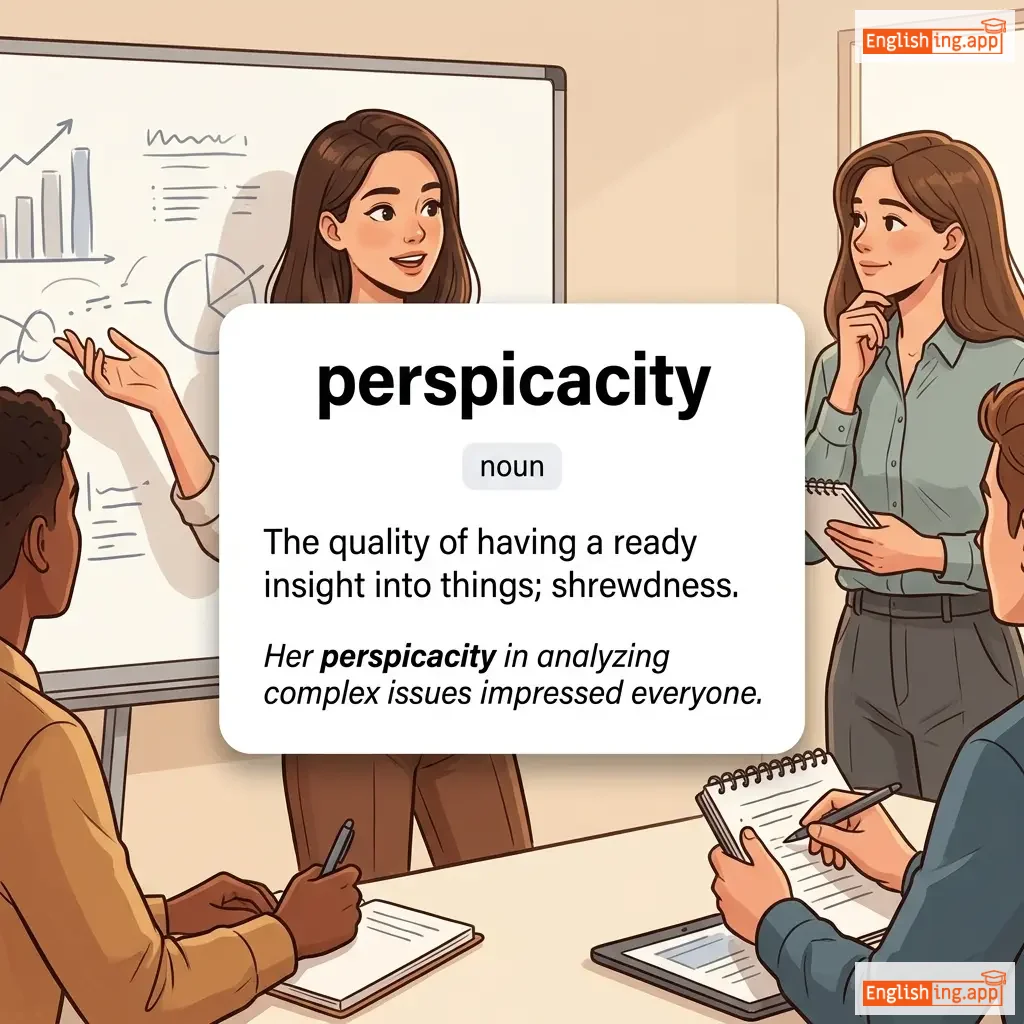
perspicacity definition card — visual illustration of the meaning
noun C2
/ˌpɜːrspɪˈkæsəti/
洞察力 (dòngchá lì)

The quality of having a ready insight into things; shrewdness.

"Her perspicacity in analyzing complex issues impressed everyone."

"她在分析复杂问题时的洞察力给每个人留下了深刻的印象。" (Tā zài fēn xī fù zá wèn tí shí de dòng chá lì gěi měi gè rén liú xià le shēn kè de yìn xiàng.)
noun C2
/ˌpɜːrspɪˈkjuːəti/
清晰度 (qingxidu)

Clarity and ease in speech or writing; the quality of being clearly expressed.

"The perspicuity of his lecture made it easy for students to understand complex topics."

"他的讲座的清晰度让学生们很容易理解复杂的课题。" (Tā de jiǎngzuò de qīngxī dù ràng xuéshēngmen hěn róngyì lǐjiě fùzá de kètí.)
adjective C2
/pərˈspɪkjuəs/
清晰 (qingxi)

Clearly expressed and easily understood; lucid.

"The teacher gave a perspicuous explanation of the theory."

"老师给出了关于理论的清晰解释。" (Lǎoshī gěi chūle guānyú lǐlùn de qīngxī jiěshì.)
adjective C2
/ˌpɜːrtɪˈneɪʃəs/
固执 (gùzhí)

holding firmly to an opinion, purpose, or course of action; stubbornly persistent

"The pertinacious lawyer refused to give up the case."
"固执的律师拒绝放弃案件。" (Gùzhí de lǜshī jùjué fàngqì ànjiàn.)
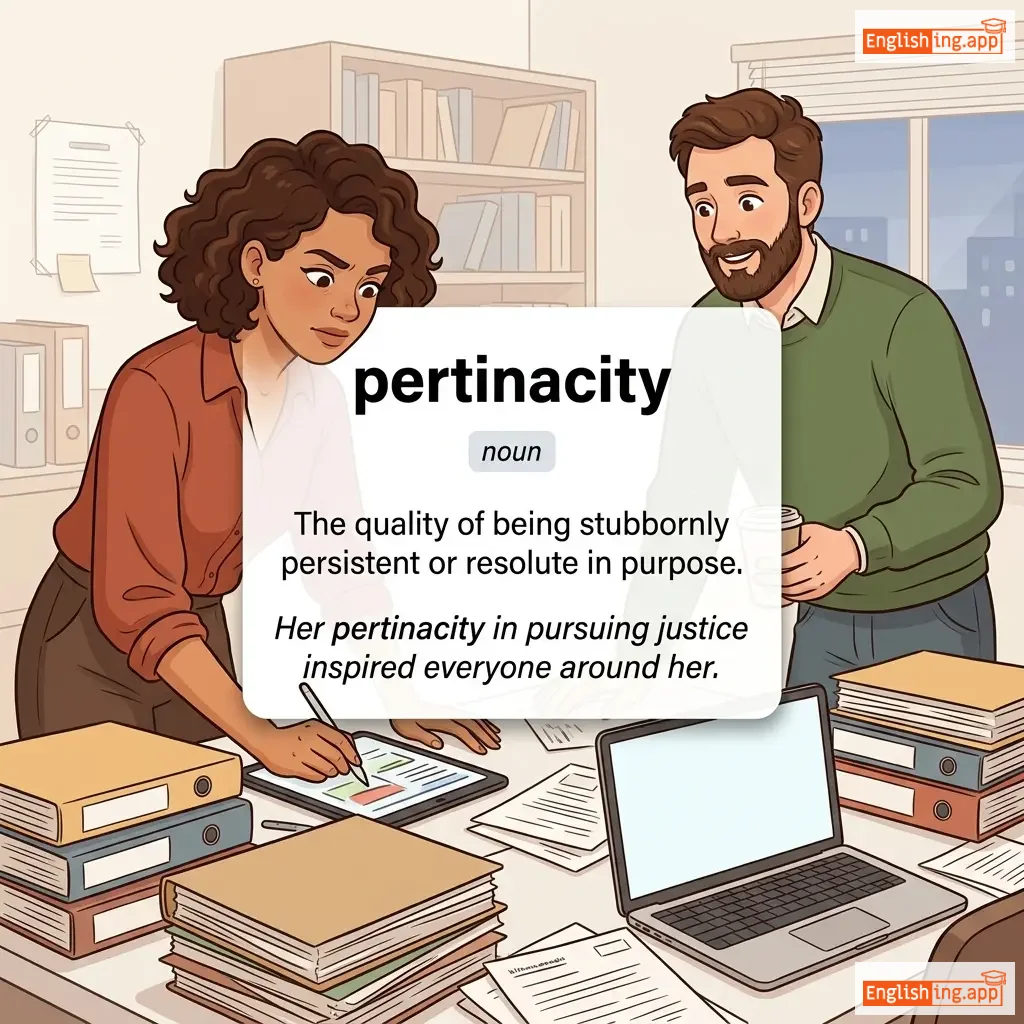
pertinacity definition card — visual illustration of the meaning
noun C2
/ˌpɜːrtɪˈnæsɪti/
执着 (zhizhuo)

The quality of being stubbornly persistent or resolute in purpose.

"Her pertinacity in pursuing justice inspired everyone around her."

"她在追求正义上的执着鼓舞了周围的每一个人。" (ta zai zhuiqiu zhengyi shang de zhizhuo guwu le zhouwei de mei yi ge ren)
noun C2
/ˈpɜːrtnəs/
厚颜无耻 (hòu yán wú chǐ)

boldness or forwardness in speech or behavior; sauciness

"Her pertness during the meeting surprised everyone."

"她在会议中的厚颜无耻让所有人都惊讶。" (Tā zài huì yì zhōng de hòu yán wú chǐ ràng suǒ yǒu rén dōu jīng yà.)
noun C2
/ˌpɜːrtərˈbeɪʃn/
扰动 (raodong)

A state of anxiety, disturbance, or disorder.

"The announcement caused a perturbation in the financial markets."

"公告导致了金融市场的扰动。" (Gōnggào dǎozhìle jīnróng shìchǎng de raodong.)
noun C2
/pəˈruːzl/
仔细阅读 (zǐxì yuèdú)

The action of reading or examining something carefully.

"The contract was given to the lawyer for perusal."

"合同已交给律师以供仔细阅读。" (Hétóng yǐ jiāo gěi lǜshī yǐ gòng zǐxì yuèdú.)
noun C2
/pəˈveɪʒən/
传播 (chuanbo)

the act of spreading through or being present everywhere in something

"There was a pervasion of hope throughout the community."

"整个社区充满了希望的传播。" (Zhěnggè shèqū chōngmǎnle xīwàng de chuánbò.)
adjective C2
/ˈpɜːrviəs/
透水的 (tòu shuǐ de)

Allowing water, air, or other substances to pass through; permeable.

"The soil here is pervious to rainwater."

"这里的土壤允许雨水通过。" (Zhèlǐ de tǔrǎng yǔnxǔ yǔshuǐ tōngguò.)
noun C2
/ˈpɛstɪləns/
瘟疫 (wēn yì)

A deadly or virulent epidemic disease that spreads rapidly.

"The medieval city was devastated by a pestilence."

"中世纪的城市被瘟疫摧毁。" (zhōng shìjì de chéngshì bèi wēn yì cuīhuǐ.)
adjective C2
/ˈpɛstɪlənt/
致命的 (zhìmìng de)

Causing or tending to cause death or destruction; harmful or pernicious.

"The pestilent atmosphere of the swamp made people sick."

"沼泽的致命气氛让人们生病。" (Zhǎozé de zhìmìng qìfēn ràng rénmen shēngbìng.)
adjective C2
/ˌpɛstɪˈlɛnʃəl/
瘟疫的 (wēn yì de)

Relating to or causing pestilence; very harmful, troublesome, or dangerous.

"The pestilential smell of the garbage filled the street."

"垃圾的瘟疫气味充满了街道。" (Lājī de wēn yì qì wèi chōng mǎn le jiē dào.)
noun C2
/ˈpɛtrəˌɡræf/
岩石描述 (yan shi miao shu)

a description or representation of rocks, especially in detailed scientific writing

"The scientist studied the petrograph to understand the rock composition."

"科学家研究了岩石图,以了解岩石的组成。" (Ke xue jia yan jiu le yan shi tu, yi liao jie yan shi de zu cheng.)
verb C2
/ˈpɛtɪˌfɒɡ/
争论琐碎的事情 (zhēnglùn suǒsuì de shìqíng)

to argue or quibble over trivial matters; to engage in petty, dishonest practices

"The lawyer was accused of trying to pettifog instead of addressing the real issue."

"律师被指控试图争论琐碎的事情,而不是解决真正的问题。" (Lǚshī bèi zhǐkòng shìtú zhēnglùn suǒsuì de shìqíng, ér bùshì jiějué zhēnzhèng de wèntí.)
noun C2
/ˈpɛtjʊləns/
暴躁 (bàozào)

The quality of being childishly sulky or bad-tempered.

"His petulance during the meeting annoyed everyone."

"他在会议中的佩图兰斯让所有人都烦恼。" (Tā zài huìyì zhōng de pèi tú lán sī ràng suǒyǒu rén dōu fánnǎo.)
noun C2
/ˈfeɪlæŋks/
方阵 (fāngzhèn)

A group of people or things arranged in a compact, close formation; also an ancient Greek military formation.

"A phalanx of reporters waited outside the courthouse."

"一群记者在法院外等候。" (Yī qún jìzhě zài fǎyuàn wài děnghòu.)
noun C2
/ˈfænˌtæzəm/
幽灵 (youling)

an illusion, ghost, or figment of the imagination

"The child claimed to see a phantasm in the old house."

"孩子声称在旧房子里看见了幽灵。" (Haizi shengcheng zai jiu fangzi li kanjianle youling.)
adjective C2
/ˌfæntæzməˈɡɒrɪkəl/
幻想的 (huànxiǎng de)

Having a fantastic, dreamlike, or surreal appearance, often shifting or illusory.

"The movie created a phantasmagorical vision of another world."

"这部电影创造了另一个世界的幻想。" (Zhè bù diànyǐng chuàngzàole lìng yīgè shìjiè de huànxiǎng.)
adjective C2
/ˌfærɪˈseɪɪkəl/
伪善的 (wěishàn de)

Excessively concerned with formal rules or outward show of morality, often in a hypocritical way.

"His pharisaical behavior made people doubt his sincerity."

"他的伪善行为让人怀疑他的真诚。" (Tā de wěishàn xíngwéi ràng rén huáiyí tā de zhēnchéng.)
noun C2
/ˈfærɪsiː/
伪君子 (wěi jūn zǐ)

A member of an ancient Jewish sect; by extension, a self-righteous or hypocritical person.

"He acted like a pharisee, judging others while ignoring his own faults."

"他像个法利赛人一样行事,批评别人却忽视自己的错误。" (Tā xiàng gè fǎ lì sài rén yīyàng xíngshì, pīpíng biérén què hūshì zìjǐ de cuòwù.)
noun C2
/ˌfɑːrməkəˈpiːə/
药典 (yaodian)

An official book listing medicinal drugs, their effects, and directions for use.

"The doctor referred to the pharmacopoeia to check the drug's proper dosage."

"医生查阅了药典,以核对药物的正确剂量。" (Yisheng chayuele yaodian, yi hedui yaowu de zhengque jiliao.)
noun C2
/ˈfaɪəl/
小玻璃瓶 (xiao boli ping)

a small glass container for liquids, especially medicines

"The doctor gave her a phial of medicine."

"医生给了她一瓶药。" (Yisheng gei le ta yi ping yao.)
verb C2
/fɪˈlændər/
调情 (tiáoqíng)

to engage in casual or frivolous romantic or sexual relationships

"He was known to philander with many women in town."

"他以与城里许多女性交往而闻名。" (Tā yǐ yǔ chéng lǐ xǔduō nǚxìng jiāowǎng ér wénmíng.)
noun C2
/fɪˈlændərər/
花花公子 (huāhuā gōngzǐ)

a man who habitually engages in casual romantic or sexual affairs

"The politician was exposed as a notorious philanderer."

"这位政治家被揭露为一个臭名昭著的花花公子。" (Zhè wèi zhèngzhìjiā bèi jiēlù wéi yí ge chòumíng zhāozhù de huāhuā gōngzǐ.)
noun C2
/fɪˈlæt.əl.ɪst/
集邮家 (jí yóu jiā)

a person who collects or studies postage stamps

"The philatelist spent years building a rare stamp collection."

"这位集邮家花了多年时间建立了一个稀有的邮票收藏。" (Zhè wèi jí yóu jiā huāle duōnián shíjiān jiànlìle yīgè xīyǒu de yóupiào shōucáng.)
noun C2
/fɪˈlæt.əl.i/
邮票收藏学 (yóupiào shōucáng xué)

the collection and study of postage stamps

"Philately is a hobby enjoyed by people of all ages."

"邮票收藏学是一项各年龄段人群都喜爱的爱好。" (Yóupiào shōucáng xué shì yī xiàng gè niánlíng duàn rénqún dōu xǐ'ài de àihào.)
noun C2
/ˈfɪl.ɪ.staɪn/
对文化和艺术漠不关心或敌对的人 (fēi lì shì rén)

a person who is indifferent or hostile to culture and the arts

"He was criticized as a philistine for dismissing modern art."

"他因拒绝现代艺术而被批评为非利士人。" (tā yīn jù jué xiàn dài yì shù ér bèi pī píng wéi fēi lì shì rén)
noun C2
/ˈfɪl.ə.dʒɪ.nɪst/
一个热爱或钦佩女性的人 (yí gè rè'ài huò qīnpèi nǚxìng de rén)

a person who loves or admires women

"As a known philogynist, he advocated for women's education."

"作为一位著名的菲洛吉尼斯特,他倡导女性的教育。" (Zuòwéi yī wèi zhùmíng de fēiluòjīnìsītè, tā chàngdǎo nǚxìng de jiàoyù.)
noun C2
/fɪˈlɒl.ə.dʒɪst/
语言学家 (yǔyánxué jiā)

a person who studies languages and their history

"The philologist analyzed ancient texts to understand language evolution."

"语言学家分析了古代文献,以理解语言的演变。" (Yǔyánxué jiā fēn xīle gǔdài wénxiàn, yǐ lǐjiě yǔyán de yǎnbiàn.)
noun C2
/fɪˈlɒl.ə.dʒi/
研究语言在书面历史资料中的应用; 语言学 (yanjiu yuyan zai shumianshi liushi ziliao zhong de yingyong; yuyanxue)

the study of language in written historical sources; linguistics

"She devoted her career to philology, researching ancient manuscripts."

"她将自己的职业生涯献给了语言学,研究古代手稿。" (Ta jiang ziji de zhiye shengya xian geile yuyanxue, yanjiu gudai shougou.)
verb C2
/fɪˈlɒs.ə.faɪz/
哲学 (zhexue)

to think or talk about the fundamental nature of knowledge, reality, and existence

"He likes to philosophize about life and its meaning."

"他喜欢谈论生活及其意义。" (Ta xihuan tanlun shenghuo jiqi yiyi.)
phlegmatic definition card — visual illustration of the meaning
adjective C2
/flɛgˈmæt.ɪk/
冷静的 (lěngjìng de)

having an unemotional and stolidly calm disposition

"Despite the chaos, he remained phlegmatic and composed."

"尽管混乱,他依然保持冷静和平静。" (Jǐnguǎn hùnluàn, tā yīrán bǎochí lěngjìng hé píngjìng.)
noun C2
/ˈfoʊ.nə.ɡræm/
音标符号 (yinbiao fuhào)

a written symbol representing a speech sound

"The teacher showed how each phonogram represents a particular sound."

"老师展示了每个音标符号如何代表特定的声音。" (Lǎoshī zhǎnshìle měi gè yīnbiāo fúhào rúhé dàibiǎo tèdìng de shēngyīn.)
noun C2
/ˌfoʊ.nəˈlɑː.dʒi/
语音学 (yuyinxue)

the study of the sound system of a language

"She is studying phonology to understand how sounds function in English."

"她正在研究语音学,以了解英语中声音的功能。" (Ta zhengzai yanjiu yuyinxue, yi liaojie yingyu zhong shengyin de gongneng.)
noun C2
/ˌfɑːsfəˈrɛsəns/
磷光 (linguang)

the property of emitting light without noticeable heat

"The deep-sea creatures displayed a beautiful phosphorescence."

"深海生物展示了美丽的磷光。" (Shenhai shengwu zhanshi le meili de linguang.)