語彙集

英単語辞書 | 単語の意味、定義、例文

noun C2
/pluːˈtɒkrəsi/
富裕層による支配 (fuyūsō ni yoru shihai)

a system of government where the wealthy hold power

"The country was ruled as a plutocracy."

"その国はプルトクラシーとして支配されていた。" (Sono kuni wa purutokurashī toshite shihai sarete ita.)
adjective C2
/njuːˈmætɪk/
空気圧の (kuukiatsu no)

operated by air or gas under pressure

"The factory uses pneumatic tools for assembly."

"工場は組み立てのために空気圧工具を使用しています。" (Koujou wa kumitate no tame ni kuukiatsu kougu wo shiyou shiteimasu.)
noun C2
/ˈpoʊ.ə.si/
(shi)

poetry; the art or composition of poems

"The anthology was filled with romantic poesy."

"そのアンソロジーはロマンチックな詩で満たされていました。" (Sono anthorojī wa romanchikku na shi de mitasareteimashita.)
noun C2
/ˈpoʊ.ɪˌtæs.tər/
劣った詩人 (ototta shijin)

an inferior or trivial poet

"He was mocked as a poetaster by the literary critics."

"彼は文学評論家によってポエタスターとして嘲笑されました。" (Kare wa bungaku hyōronka ni yotte poetasutā to shite chōshō saremashita.)
noun C2
/pəˈlɛmɪk/
論争的な攻撃 (ronsōteki na kōgeki)

a strong verbal or written attack on someone or something

"The article was a fierce polemic against the government's policies."

"その記事は政府の政策に対する激しい論争的な攻撃でした。" (sono kiji wa seifu no seisaku ni taisuru hageshī ronsōteki na kōgeki deshita.)
adjective C2
/pəˈlɛmɪkəl/
論争的 (ronsou-teki)

relating to or involving strongly critical or controversial writing or speech

"She wrote a polemical article challenging traditional beliefs."

"彼女は伝統的な信念に挑戦する論争的な記事を書いた。" (Kanojo wa dentouteki na shin'nen ni chousen suru ronsou-teki na kiji o kaita.)
noun C2
/pəˈlɛmɪks/
論争 (ronzō)

the art or practice of engaging in controversial debate or dispute

"The conference was full of polemics on economic reforms."

"会議は経済改革についての論争で満ちていた。" (Kaigi wa keizai kaikaku ni tsuite no ronzō de michite ita.)
noun C2
/ˈpɒlɪti/
政治、政府の形態 (seiji, seifu no keitai)

an organized society or form of government

"The ancient Greek polity had a system of city-states."

"古代ギリシャの政治は都市国家のシステムを持っていました。" (Kodai Girisha no seiji wa toshikokka no shisutemu o motte imashita.)
adjective C2
/ˌpɒliˈæn.ɪ.ɪʃ/
過度に楽観的 (kado ni rakkan teki)

overly or blindly optimistic

"Her pollyannaish attitude ignored the obvious problems."

"彼女の過度に楽観的な態度は明らかな問題を無視していた。" (Kanojo no kado ni rakkan teki na taido wa akiraka na mondai o mushi shite ita.)
noun C2
/pəˈtruːn/
臆病者 (okubyou-sha)

a cowardly person

"He acted like a poltroon during the crisis."

"彼は危機の際、臆病者のように振る舞った。" (Kare wa kiki no sai, okubyou-sha no you ni furumatta.)
noun C2
/ˈpɒliˌɑːrki/
ポリアーキー (poriākī)

government by many people

"Polyarchy allows multiple parties to share power."

"ポリアーキーは複数の政党が権力を共有することを許可します。" (Poriākī wa fukusū no seitō ga kenryoku o kyōyū suru koto o kyoka shimasu.)
noun C2
/ˈpɒliˌkreɪsi/
多権主義 (takenshugi)

rule by many; government by multiple authorities

"The nation experienced a polycracy after decentralization reforms."

"国は分権改革後、多権主義を経験しました。" (Kuni wa bunken kaikaku-go, takenshugi o keiken shimashita.)
👨‍👩‍👧‍👦

polygamist (ポリガミスト)

noun C2
/ˈpɒlɪɡæmɪst/
重婚者 (jūkonsya)

a person who has more than one spouse at the same time

"The polygamist had three wives living in different houses."

"ポリガミストは三人の妻が別々の家に住んでいる。" (Porigamisuto wa sannin no tsuma ga betsubetsu no ie ni sunde iru.)
noun C2
/ˌpɒlɪˈhiːdrən/
多面体 (tamentai)

a solid object with flat polygonal faces, straight edges, and vertices

"The mathematician studied a complex polyhedron model."

"数学者は複雑なポリヘドロンモデルを研究しました。" (Sugakusha wa fukuzatsu na porihedoron moderu wo kenkyu shimashita.)
noun C2
/ˈpɒl.i.mæθ/
博識者 (hakushikisha)

a person with knowledge of many different subjects

"Leonardo da Vinci was a true polymath, excelling in art, science, and engineering."

"レオナルド・ダ・ヴィンチは、芸術、科学、工学において優れた博識者でした。" (Reonarudo da Vinchi wa, geijutsu, kagaku, kōgaku ni oite sugureta hakushikisha deshita.)
noun C2
/ˌpɒl.iˈsɪl.ə.bəl/
多音節語 (taonsetsugo)

a word with more than one syllable

"The word 'elephant' is a polysyllable because it has three syllables."

"‘象’という言葉は、3つの音節があるので多音節語です。" ('Zou' to iu kotoba wa, mittsu no onsetsu ga aru node taonsetsugo desu.)
noun C2
/ˈpɒl.iˌθi.ɪz.əm/
多神教 (tashinkyō)

the belief in or worship of multiple gods

"Ancient Greeks practiced polytheism, worshiping gods like Zeus and Athena."
"古代ギリシャ人はポリシズムを実践し、ゼウスやアテナのような神々を崇拝していました。" (Kodai Girisha-jin wa porishizumu o jissen shi, Zeus ya Atena no yō na kamigami o sūhai shite imashita.)
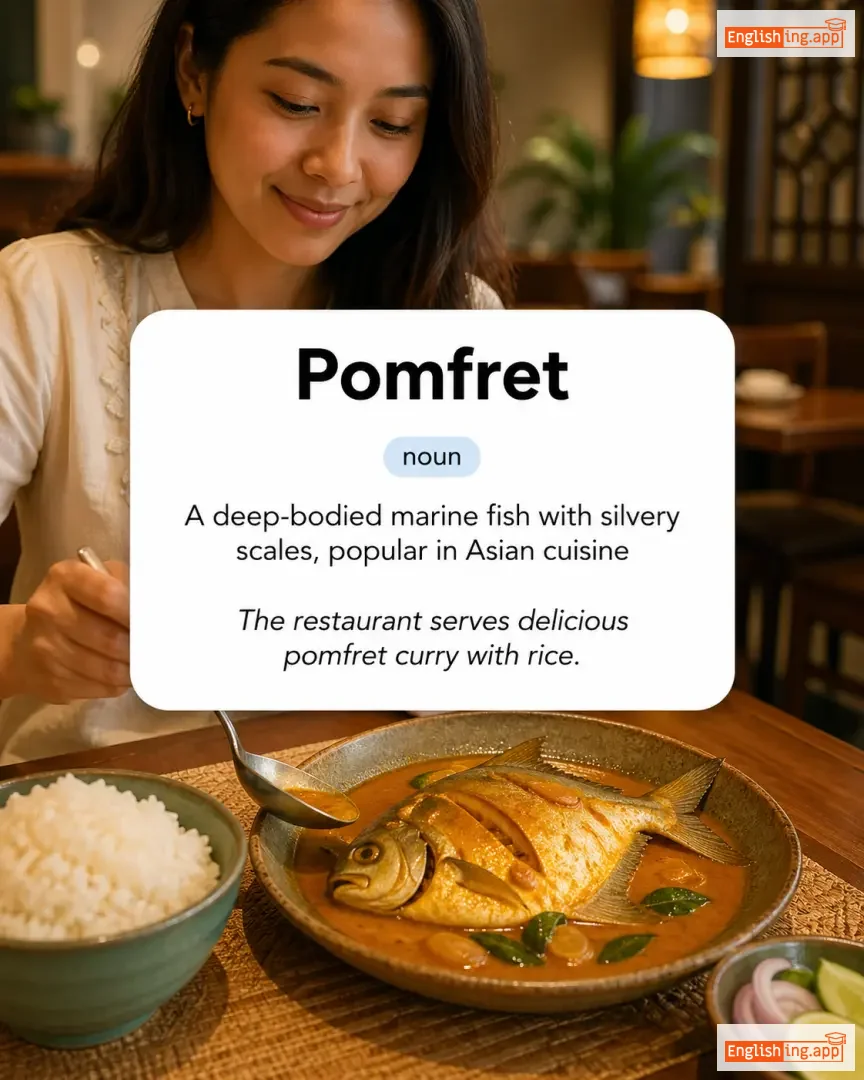
Pomfret definition card — visual illustration of the meaning
noun C2
/ˈpɒmfrɪt/
マナガツオ (managatsuo)

A deep-bodied marine fish with silvery scales, popular in Asian cuisine

"The restaurant serves delicious pomfret curry with rice."

"レストランはご飯と一緒に美味しいマナガツオカレーを提供します。" (resutoran wa gohan to issho ni oishii managatsuo kare o teikyo shimasu)
noun C2
/ˈpɒm.əl/
剣や鞍の取っ手の丸い部分 (ken ya kura no totte no marui bubun)

the rounded knob on the handle of a sword or saddle

"He gripped the sword firmly by the pommel."

"彼は剣のポメルをしっかりと握った。" (Kare wa ken no pommel o shikkari to nigitta.)
noun C2
/pɒmˈpɒsəti/
傲慢, 尊大 (gōman, son'dai)

self-important behavior or exaggerated dignity

"His speech was full of pomposity and arrogance."

"彼のスピーチはポンポジティと傲慢で満ちていました。" (Kare no supīchi wa ponpojiti to gōman de michite imashita.)
adjective C2
/ˈpɒndərəbl/
考慮できる, 思案可能 (kōryo dekiru, shian kanō)

able to be considered or thought about

"The evidence was substantial and ponderable."

"証拠は重要であり、思案可能でした。" (Shōko wa jūyō de ari, shian kanō deshita.)
noun C2
/ˈpɒntɪf/
教皇または高位の司教 (kyoukou matawa koui no shikyou)

the pope or a high-ranking bishop in the Christian church

"The pontiff addressed the nation in a televised speech."

"教皇はテレビで国民に向けて演説を行いました。" (Kyoukou wa terebi de kokumin ni mukete enzetsu wo okonai mashita.)
adjective C2
/pɒnˈtɪfɪkəl/
教皇または司教に関連する; 傲慢または高慢な (kyoukou matawa shikyou ni kanren suru; gouman matawa kouman na)

relating to a pope or bishop; pompous or self-important

"His pontifical manner annoyed the other members of the committee."

"彼の高慢な態度は委員会の他のメンバーを困らせた。" (Kare no kouman na taido wa iinkai no hoka no menbaa o komarase ta.)
verb C2
/ˈpɒntɪfɪkeɪt/
傲慢または教義的な方法で話すまたは行動する; 教皇として務める (gōman matawa kyōgitekina hōhō de hanasu matawa kōdō suru; kyōkō toshite tsutomeru)

to speak or act in a pompous or dogmatic way; to officiate as a pontiff

"He pontificated on the importance of education for over an hour."

"彼は1時間以上にわたり教育の重要性について傲慢に話しました。" (Kare wa ichi-jikan ijō ni watari kyōiku no jūyō-sei ni tsuite gōman ni hanashimashita.)
noun C2
/ˈpɔːrfəri/
硬い火成岩 (katai kaseigan)

A hard igneous rock containing crystals, often used for decorative or building purposes.

"The ancient Romans used porphyry to make columns and statues."

"古代ローマ人はポルフィリを使って柱や彫像を作った。" (Kodai Rōmajin wa porufiri o tsukatte hashi ya chōzō o tsukutta.)
verb C2
/pɔːrˈtɛnd/
前兆 (zenchou)

To be a sign or warning that something, especially something bad, is going to happen.

"Dark clouds portend a storm."

"暗い雲は嵐を予兆します。" (Kurai kumo wa arashi o yochou shimasu.)
noun C2
/ˈpɔːrtɛnt/
前兆 (zenchou)

A sign or warning that something, especially something momentous or calamitous, is likely to happen.

"The sudden drop in stock prices was seen as a portent of economic trouble."

"株価の急落は、経済的な問題の前兆として見なされました。" (Kabuka no kyūraku wa, keizaiteki na mondai no zenchou toshite minasaremashita.)
adjective C2
/pɔːrˈtɛntəs/
前兆的な、重大な (zenjō-tekina, jūdaina)

Giving a sign or warning that something, often bad or serious, is going to happen; or overly solemn and pompous.

"His portentous tone made everyone nervous about the news."

"彼の前兆的な口調は、ニュースについて皆を不安にさせた。" (Kare no zenzō-teki na kuchō wa, nyūsu ni tsuite mina o fuan ni saseta.)
adjective C2
/ˈpɔːrtli/
ぽっちゃり (pocchari)

Having a stout or somewhat fat body, often implying dignity or authority.

"The portly man entered the room with confidence."

"ぽっちゃりな男性は自信を持って部屋に入った。" (Pocchari na dansei wa jishin o motte heya ni haitta.)
noun C2
/poʊˈzɜːr/

A person who pretends to be something they are not, often to impress others.

"Many considered him a poseur because he exaggerated his accomplishments."

noun C2
/ˈpɒsi/
ギャング / 友達グループ (gyangu / tomodachi gurūpu)

A group of people, often friends or a group organized to support or enforce the law.

"He arrived at the party with his posse of friends."

"彼は友達グループと一緒にパーティーに到着しました。" (Kare wa tomodachi gurūpu to issho ni pātī ni tōchaku shimashita.)
adjective C2
/ˌpəʊstˈprændɪəl/
食後 (shokugo)

Occurring after a meal.

"He went for a postprandial walk after dinner."

"彼は夕食後にポストプランディアルウォークに出かけた。" (Kare wa yuushoku go ni postprandial walk ni dekaketa.)
noun C2
/ˈpɒtˌbɔɪlə/
安物の作品 (amono no sakuhin)

a book, play, or film produced quickly to make money rather than for artistic value

"The novel was dismissed by critics as a mere potboiler."

"その小説は批評家によってただの安物の作品だと退けられた。" (Sono shōsetsu wa hihyōka ni yotte tada no amono no sakuhin da to shikirerareta.)
noun C2
/ˈpoʊtənˌteɪt/
君主 (kunshu)

A monarch or ruler, especially one with absolute power.

"The ancient land was ruled by a powerful potentate."

"古代の土地は強力な君主によって支配されていました。" (Kodai no tochi wa kyōryoku na kunshu ni yotte shihai sarete imashita.)
verb C2
/poʊˈtɛnʃiˌeɪt/
強化する (kyouka suru)

To increase the power, effect, or likelihood of something.

"Caffeine can potentiate the effects of some medicines."

"カフェインは一部の薬の効果を高めることができます。" (Kafein wa ichibu no kusuri no kouka wo takameru koto ga dekimasu.)
noun C2
/ˌpoʊpʊˈriː/
乾燥花の混合物 (kansou hana no kongou-mono)

a mixture of dried flowers and spices kept in a bowl to perfume a room; a miscellaneous collection

"The living room was filled with the scent of potpourri."

"リビングルームはポプリの香りで満たされていました。" (Ribingurumu wa popuri no kaori de mitasarete imashita.)
noun C2
/ˈpoʊltɪs/
温かい薬草の湿布 (atatakai yakusou no shippu)

a soft, moist mass of material applied to the body to relieve soreness and inflammation

"The nurse applied a warm poultice to his injured leg."

"看護師は彼の怪我した足に温かい湿布を貼った。" (Kangoshi wa kare no kega shita ashi ni atatakai shippu o hatteta.)
noun C2
/ˈpaʊ.waʊ/
インフォーマルミーティング (infōmaru mītingu)

an informal meeting or conference to discuss something

"The team held a quick powwow before the presentation."

"チームはプレゼンテーションの前に迅速なインフォーマルミーティングを開催しました。" (Chīmu wa purezentēshon no mae ni jinsoku na infōmaru mītingu o kaisai shimashita.)
verb C2
/preɪt/
無駄話をする (mudabanashi o suru)

to talk foolishly or at tedious length about something

"He would prate endlessly about his minor achievements."

"彼は彼の小さな達成について無駄に長く話すことを終わらせなかった。" (Kare wa kare no chiisana tassei ni tsuite mudani nagaku hanasu koto o owarasenakatta.)
verb C2
/ˈprætəl/
おしゃべり (oshaberi)

to talk at length in a foolish or inconsequential way

"The children would prattle on about their games."

"子供たちは自分たちのゲームについておしゃべりをしていた。" (Kodomotachi wa jibuntachi no gēmu ni tsuite oshaberi o shite ita.)
adjective C2
/ˌprɛsɪˈdɛnʃəl/
先例的 (senreiteki)

Relating to, or serving as, a precedent; having authority as an example.

"The court’s decision has precedential value."

"裁判所の決定は先例的価値を持っています。" (Saibansho no kettei wa senreiteki kachi wo motteimasu.)
noun C2
/ˈpriːsɛpt/
教義 (kyougi)

A general rule intended to regulate behavior or thought.

"Honesty is a fundamental precept in all religions."

"正直はすべての宗教における基本的な教義です。" (Shoujiki wa subete no shuukyou ni okeru kihonteki na kyougi desu.)
noun C2
/prɪˈsɛʃən/
歳差 (saika)

The slow movement of the axis of a spinning body around another axis, often referring to Earth's rotation.

"Astronomers study the precession of the equinoxes."

"天文学者は春分点の歳差を研究しています。" (Tenmongakusha wa shunbunten no saika o kenkyū shiteimasu.)
noun C2
/ˌprɛsiˈɒsɪti/
過度の洗練 (kado no senren)

Excessive refinement or affected elegance in language, style, or behavior.

"The author's preciosity made the novel difficult to read for some audiences."

"著者の過度の洗練は、いくつかの読者にとって小説を読みづらくしました。" (chosha no kado no senren wa, ikutsuka no dokusha ni totte shōsetsu o yomizuraku shimashita.)
noun/adjective C2
/prɪˈsɪpɪtənt/
沈殿剤 (chinden-zai)

As a noun: a substance that causes a substance to be deposited from a solution; as an adjective: acting hastily or impulsively.

"The chemist added a precipitant to the solution to observe the reaction."

"化学者は反応を観察するために溶液に沈殿剤を加えました。" (Kagakusha wa hannō o kansatsu suru tame ni yōeki ni chinden-zai o kuwaemashita.)
verb C2
/priːˈdɛstɪn/
運命づける (unmei zukeru)

to determine or decide something in advance, often regarded as being fixed by fate or divine will

"They believed their paths were predestined by fate."

"彼らは自分たちの道が運命によって前もって定められていると信じていました。" (Karera wa jibuntachi no michi ga unmei ni yotte maemotte sadamerarete iru to shinjite imashita.)
noun C2
/ˌpriːdɪˈlɛkʃən/
嗜好 (shikou)

A strong liking or preference for something.

"She has a predilection for classical music."

"彼女はクラシック音楽に対する好みがあります。" (Kanojo wa kurashikku ongaku ni taisuru konomi ga arimasu.)
noun C2
/priːˈɛmɪnəns/
卓越 (taketsu)

The fact of surpassing all others; superiority.

"The university has gained preeminence in medical research."

"その大学は医学研究において卓越性を獲得しました。" (Sono daigaku wa igaku kenkyū ni oite taketsu-sei o kakutoku shimashita.)
noun C2
/priˈɛmpʃən/
優先権 (yūsenken)

The act of taking action before someone else; the right to purchase or act before others.

"The company exercised preemption to acquire the land before competitors."

"会社は競争相手より先に土地を取得するために優先権を行使しました。" (Kaisha wa kyōsō aite yori saki ni tochi o shutoku suru tame ni yūsenken o kōshi shimashita.)
verb C2
/ˌpriːɪnˈɡeɪdʒ/
事前契約 (jizen keiyaku)

To contract or engage beforehand; to arrange in advance.

"The workers were preengaged before the project officially started."

"プロジェクトが公式に開始される前に、作業員はすでに前もって契約されていました。" (Purojekuto ga kōshiki ni kaishi sareru mae ni, sagyōin wa sude ni maemotte keiyaku sareteimashita.)