語彙集

英単語辞書 | 単語の意味、定義、例文

noun C2
/ˌɪnkrɪˈdjuːləti/
incrédulité (incredulite)

the state of being unwilling or unable to believe something

"She looked at him with incredulity after hearing the strange story."

"Elle le regarda avec incrédulité après avoir entendu l'histoire étrange." (Elle le regarda avec incredulite apres avoir entendu l'histoire etrange.)
noun C2
/ˌɪnkrʌˈsteɪʃən/
croûte (croute)

a crust or hard coating formed on the surface of something

"The old pipes were blocked due to heavy incrustation of minerals."

"Les vieilles tuyauteries étaient bloquées en raison d'une incrustation importante de minéraux." (Les vieilles tuyauteries étaient bloquées en raison d'une incrustation importante de minéraux.)
noun C2
/ˈɪŋkjʊbəs/
esprit maléfique (esprit malefique)

An oppressive or nightmarish burden; in folklore, an evil spirit that lies upon sleeping people.

"Debt became an incubus that weighed heavily on the family."
"La dette est devenue un esprit maléfique qui pesait lourdement sur la famille." (La dette est devenue un esprit malefique qui pesait lourdement sur la famille.)
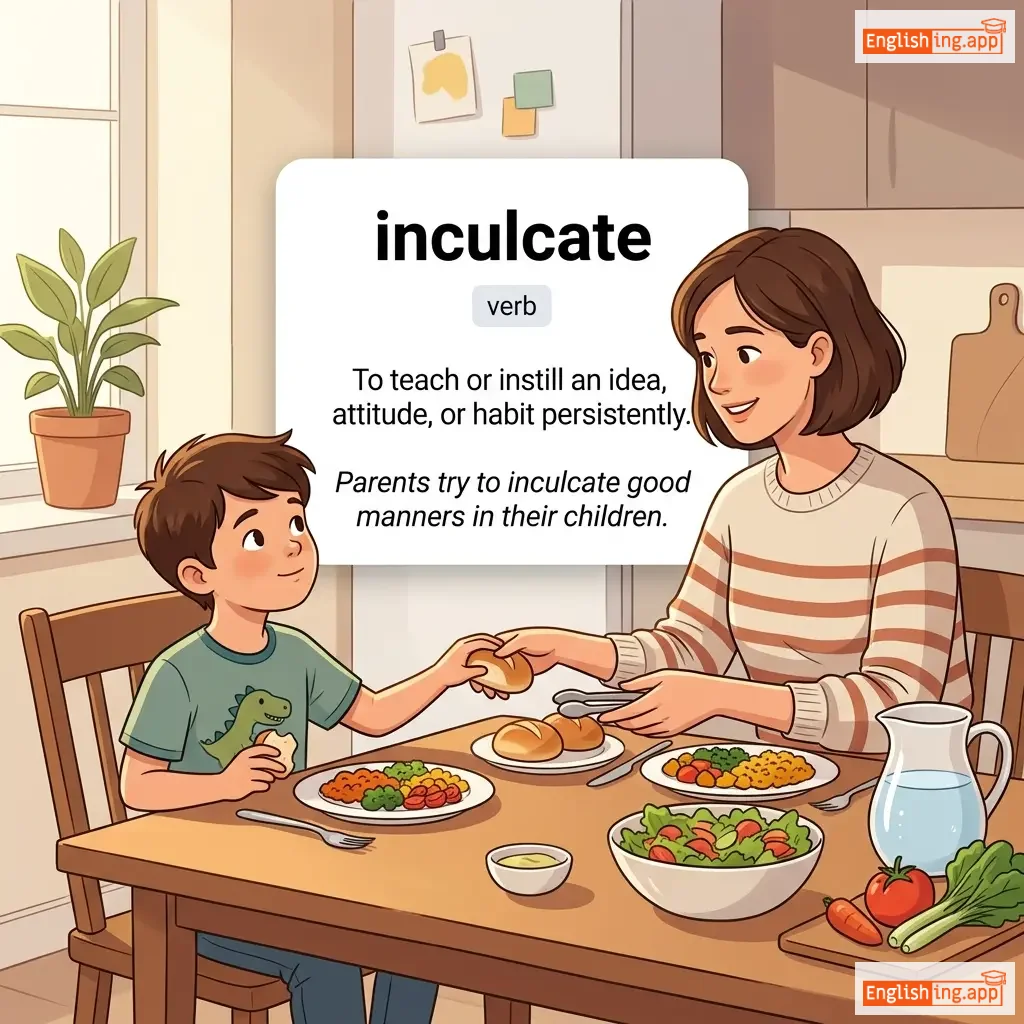
inculcate definition card — visual illustration of the meaning
verb C2
/ˈɪŋkʌlkeɪt/
inculquer (inculquer)

To teach or instill an idea, attitude, or habit persistently.

"Parents try to inculcate good manners in their children."

"Les parents essaient d'inculquer de bonnes manières à leurs enfants." (Les parents essaient d'inculquer de bonnes manières à leurs enfants.)
verb C2
/ˈɪŋkʌlpeɪt/
accuser (accuser)

To blame or accuse someone of wrongdoing.

"The evidence seemed to inculpate the suspect in the crime."

"Les preuves semblaient accuser le suspect dans le crime." (Les preuves semblaient accuser le suspect dans le crime.)
adjective C2
/ɪnˈdɛkərəs/
indécent (indecent)

Not in keeping with good taste and propriety; improper.

"His indecorous behavior shocked the audience."

"Son comportement indécent a choqué l'audience." (Son comportement indécent a choqué l'audience.)
adjective C2
/ˌɪndɪˈfætɪɡəbl̩/
inébranlable (inebranlable)

persisting tirelessly; incapable of being fatigued

"Her indefatigable spirit kept the team motivated during the long project."

"Son esprit inébranlable a gardé l'équipe motivée pendant le long projet." (Son esprit inébranlable a gardé l'équipe motivée pendant le long projet.)
verb C2
/ɪnˈdɛmnɪfaɪ/
indemniser (indemniser)

to compensate someone for harm or loss; to secure against future damage or cost

"The insurance company agreed to indemnify the client for the damages."

"La compagnie d'assurance a accepté d'indemniser le client pour les dommages." (La compagnie d'assurance a accepte d'indemniser le client pour les dommages.)
noun C2
/ˌɪndɛnˈteɪʃən/
indentation (indentation)

A space left at the beginning of a line of text; a notch or deep recess on a surface.

"The teacher asked the students to use proper indentation in their essays."

"Le professeur a demandé aux élèves d'utiliser une indentation correcte dans leurs essais." (Le professeur a demandé aux élèves d'utiliser une indentation correcte dans leurs essais.)
noun C2
/ɪnˈdɛntʃər/
contrat d'indenture (contrat d'indenture)

A formal legal agreement, contract, or document, often relating to work or service.

"In the 18th century, many workers came under indenture to work overseas."
"Au XVIIIe siècle, de nombreux travailleurs étaient sous contrat d'indenture pour travailler à l'étranger." (Au XVIIIe siècle, de nombreux travailleurs étaient sous contrat d'indenture pour travailler à l'étranger.)
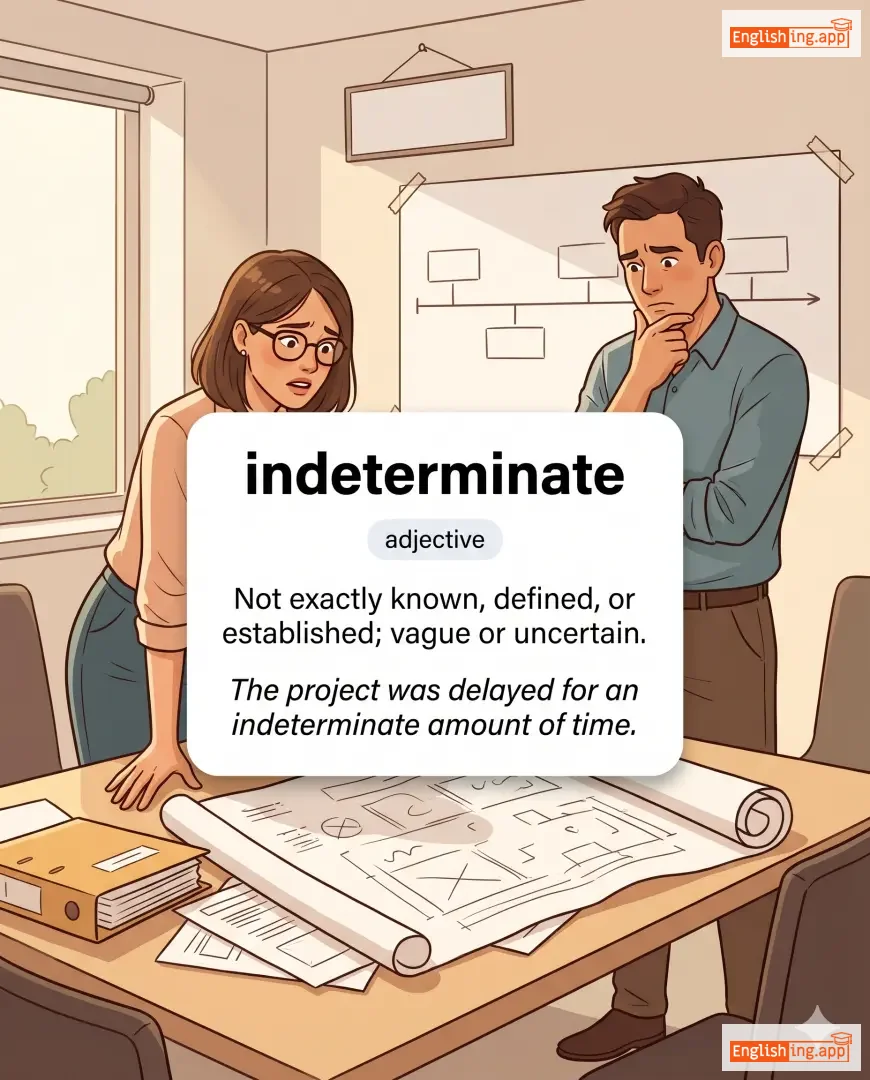
indeterminate definition card — visual illustration of the meaning
adjective C2
/ˌɪndɪˈtɜːrmənət/
indéterminé (indetermine)

Not exactly known, defined, or established; vague or uncertain.

"The project was delayed for an indeterminate amount of time."

"Le projet a été retardé pour une période indéterminée." (Le projet a été retardé pour une période indéterminée.)
noun C2
/ˈɪndɪkənt/
indicateur (indicateur)

Something that indicates or points to a fact or condition.

"High fever is often an indicant of infection."
"La fièvre élevée est souvent un indicateur d'infection." (La fièvre élevée est souvent un indicateur d'infection.)
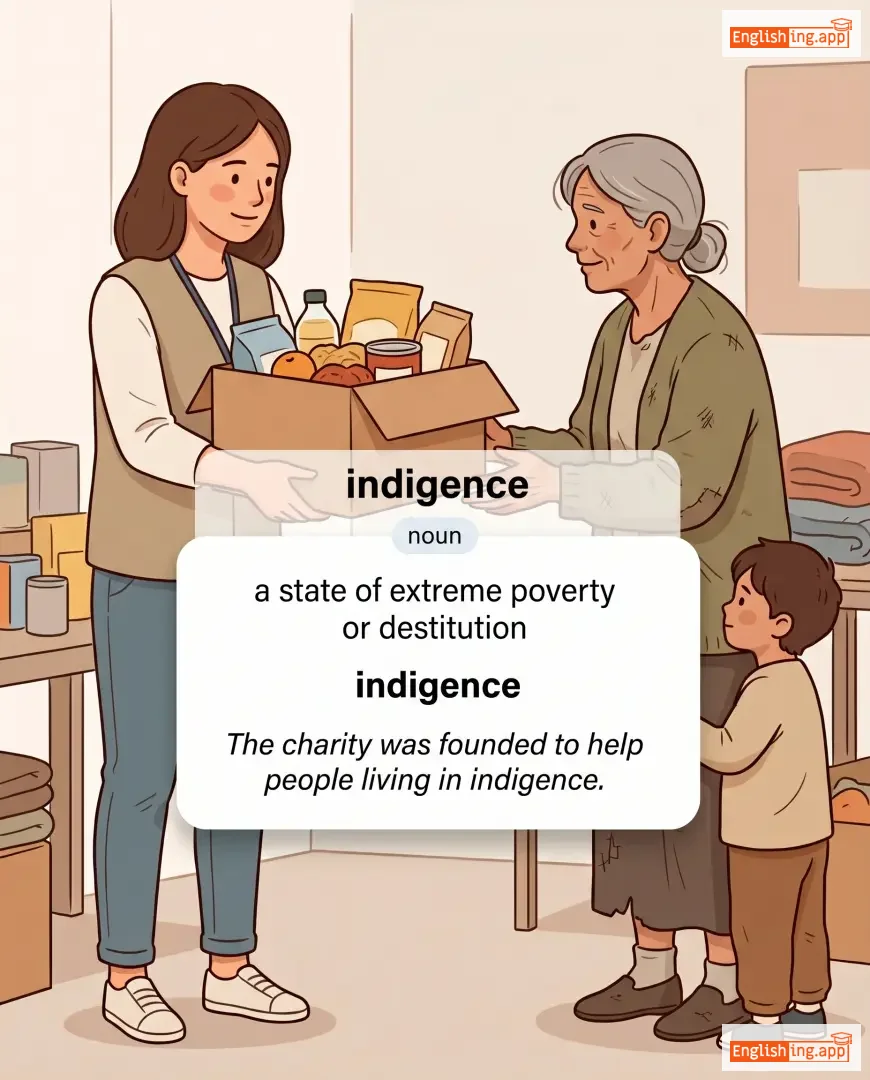
indigence definition card — visual illustration of the meaning
noun C2
/ˈɪn.dɪ.dʒəns/
indigence (indigence)

a state of extreme poverty or destitution

"The charity was founded to help people living in indigence."

"La charité a été fondée pour aider les personnes vivant dans l'indigence." (La charité a été fondée pour aider les personnes vivant dans l'indigence.)
adjective C2
/ˈɪn.dɪ.dʒənt/
indigent (indigent)

lacking the necessities of life due to poverty; very poor

"The hospital offers free care to indigent patients."

"L'hôpital offre des soins gratuits aux patients indigents." (L'hopital offre des soins gratuits aux patients indigents.)
adjective C2
/ˌɪn.daɪˈdʒes.tə.bəl/
indigeste (indigeste)

difficult or impossible to digest; hard to accept or understand

"The report was so long and detailed that it became almost indigestible."

"Le rapport était tellement long et détaillé qu'il est devenu presque indigeste." (Le rapport etait tellement long et detaille qu'il est devenu presque indigeste.)
adjective C2
/ˌɪndɪˈsɜːrnəbl/
indiscernable (indiscernable)

Impossible or difficult to see, notice, or distinguish.

"The difference between the two shades was almost indiscernible."

"La différence entre les deux teintes était presque indiscernable." (La difference entre les deux teintes etait presque indiscernable.)
adjective C2
/ˌɪndɪˈsɒljʊbl/
Indissoluble (Indissoluble)

Unable to be destroyed, broken, or dissolved.

"Marriage was once considered an indissoluble bond."

"Le mariage était autrefois considéré comme un lien indissoluble." (Le mariage était autrefois considéré comme un lien indissoluble.)
verb C2
/ɪnˈdaɪt/
composer (composer)

To write or compose (literary or formal works).

"The poet indited a heartfelt sonnet."

"Le poète a composé un sonnet sincère." (Le poète a composé un sonnet sincère.)
adjective C2
/ˌɪndɪˈvɜːrtɪbəl/
indivertible (indivertible)

Not able to be turned aside or diverted.

"The judge's indivertible attention was on the case."

"L'attention indivertible du juge était sur l'affaire." (L'attention indivertible du juge etait sur l'affaire.)
verb C2
/ɪnˈdɒktrɪˌneɪt/
endoctriner (endoctriner)

To teach someone to fully accept a set of beliefs or ideas without question.

"The regime tried to indoctrinate the youth with propaganda."

"Le régime a tenté d'endoctriner la jeunesse avec de la propagande." (Le régime a tenté d'endoctriner la jeunesse avec de la propagande.)
noun C2
/ˈɪndələns/
indolence (indolence)

Avoidance of activity or exertion; laziness.

"His indolence kept him from finishing the project on time."
"Son indolence l'a empêché de terminer le projet à temps." (son indolence l'a empeche de terminer le projet a temps.)
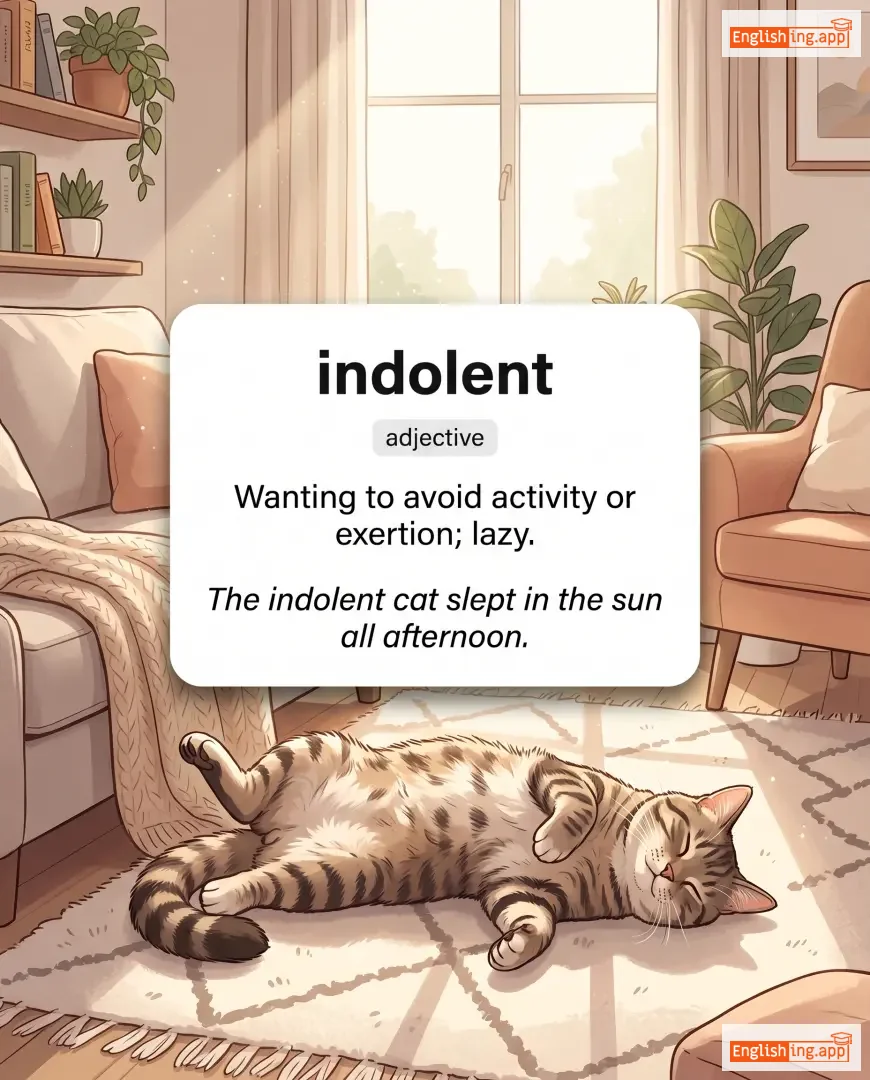
indolent definition card — visual illustration of the meaning
adjective C2
/ˈɪndələnt/
paresseux (paresseux)

Wanting to avoid activity or exertion; lazy.

"The indolent cat slept in the sun all afternoon."
"Le chat paresseux a dormi au soleil toute l'après-midi." (Le chat paresseux a dormi au soleil toute l'après-midi.)
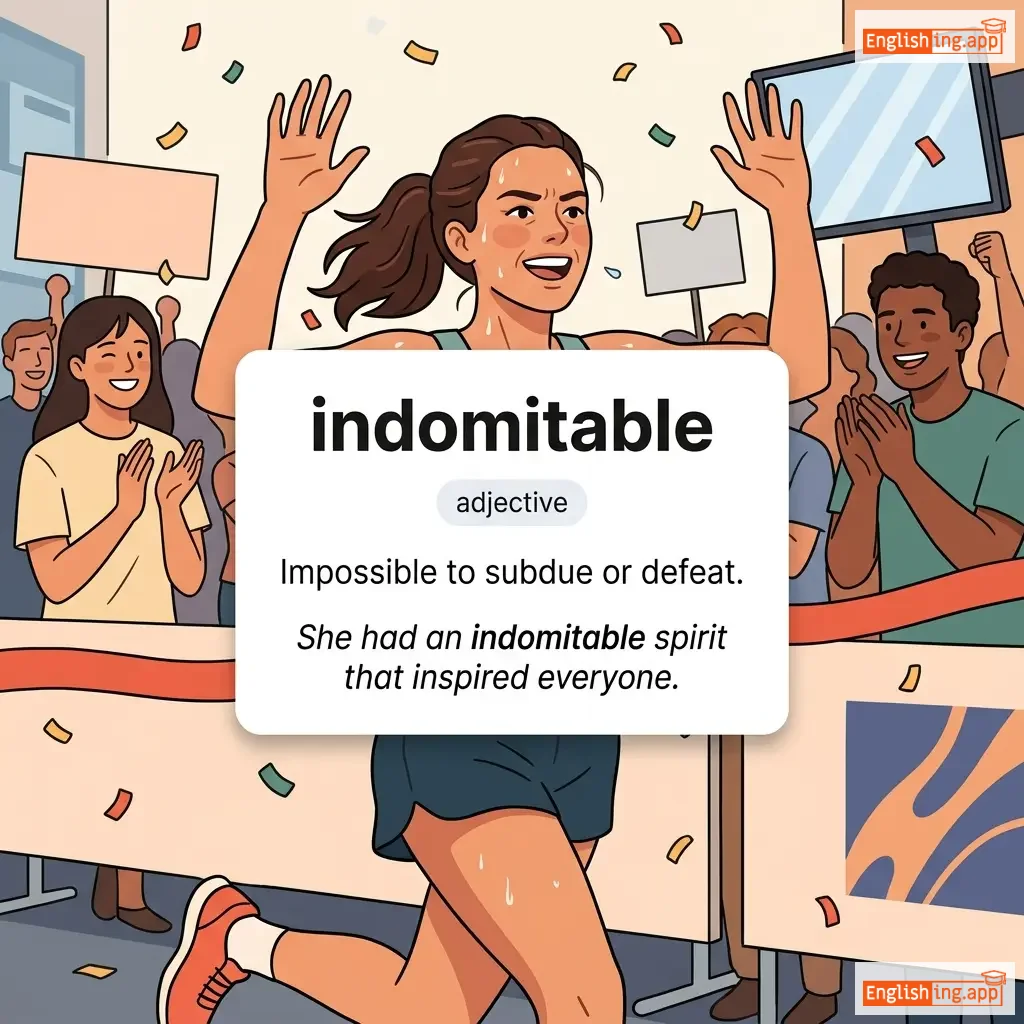
indomitable definition card — visual illustration of the meaning
adjective C2
/ɪnˈdɒmɪtəbl/
indomptable (indomptable)

Impossible to subdue or defeat.

"She had an indomitable spirit that inspired everyone."

"Elle avait un esprit indomptable qui a inspiré tout le monde." (Elle avait un esprit indomptable qui a inspiré tout le monde.)
adjective C2
/ɪnˈdjuːbɪtəbl/
indubitable (indubitable)

Impossible to doubt; unquestionable.

"It is indubitable that hard work leads to success."

"Il est indubitable que le travail acharné mène au succès." (Il est indubitable que le travail acharné mène au succès.)
adverb C2
/ɪnˈdjuːbɪtəbli/
indubitablement (indubitablement)

Without a doubt; certainly.

"She is indubitably the best candidate for the job."

"Elle est indubitablement la meilleure candidate pour le poste." (Elle est indubitablement la meilleure candidate pour le poste.)
verb C2
/ˈɪndjʊˌreɪt/
endurcir (endurcir)

To harden or make something physically or emotionally tough.

"Years of hardship indurated his spirit."

"Des années de difficultés ont induré son esprit." (Des annees de difficultes ont indure son esprit.)
verb C2
/ɪˈniː.bri.eɪt/
enivrer (enivrer)

to intoxicate; to make someone drunk

"The strong wine was enough to inebriate even the most experienced drinker."

"Le vin fort était suffisant pour enivrer même le buveur le plus expérimenté." (Le vin fort était suffisant pour enivrer même le buveur le plus expérimenté.)
noun C2
/ˌɪn.ɪˈbraɪ.ə.ti/
ivresse (ivresse)

the state of being drunk or intoxicated

"His frequent inebriety led to the loss of his job."

"Son inconstance dans l'ivresse l'a conduit à perdre son travail." (Son inconstance dans l'ivresse l'a conduit à perdre son travail.)
ineffable definition card — visual illustration of the meaning
adjective C2
/ɪˈnɛf.ə.bəl/
ineffable (ineffable)

too great, extreme, or beautiful to be expressed in words

"The beauty of the sunset was ineffable."

"La beauté du coucher du soleil était ineffable." (La beauté du coucher du soleil était ineffable.)
inefficacious definition card — visual illustration of the meaning
adjective C2
ˌɪn.ɪ.fɪˈkeɪ.ʃəs
inefficace (ineffikass)

Not producing any or the desired effect; ineffective.

"The treatment was inefficacious in curing the disease."
"Le traitement a été inefficace pour guérir la maladie." (Le traitement a été inefficace pour guérir la maladie.)
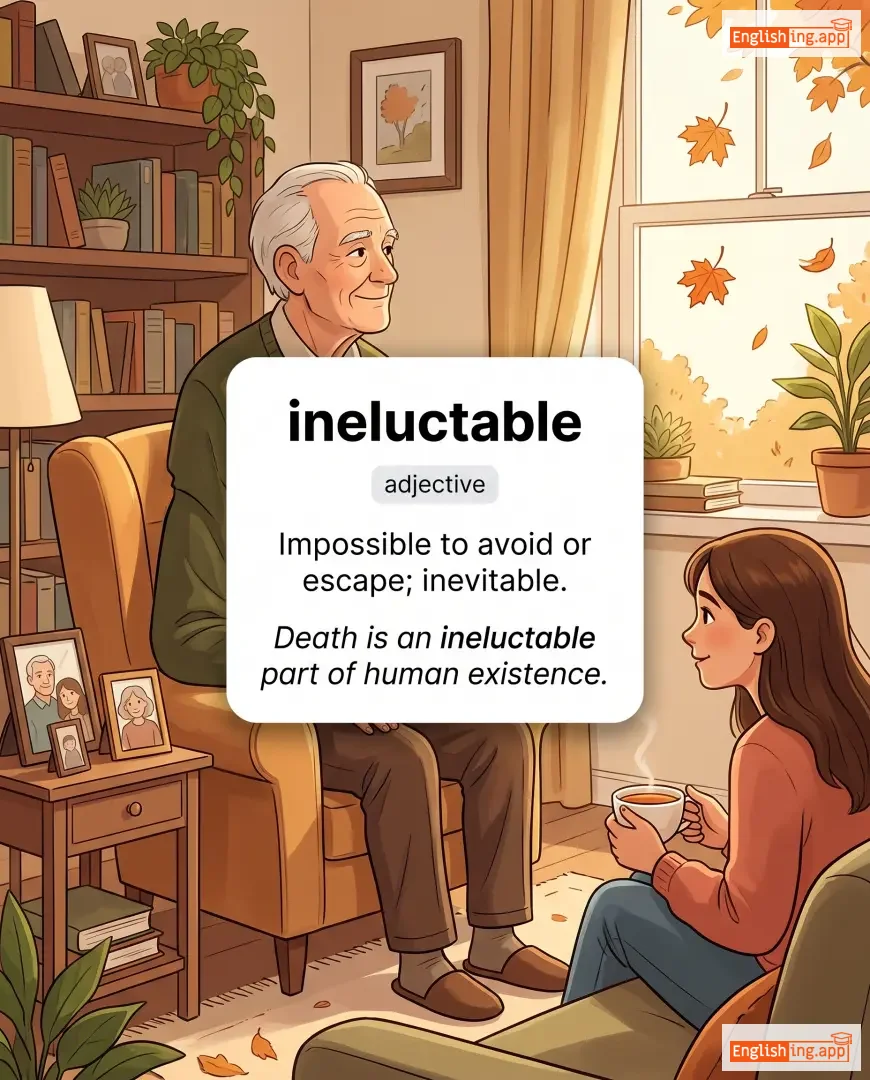
ineluctable definition card — visual illustration of the meaning
adjective C2
/ˌɪn.ɪˈlʌk.tə.bəl/
inéluctable (ineluctable)

Impossible to avoid or escape; inevitable.

"Death is an ineluctable part of human existence."
"La mort est une partie inéluctable de l'existence humaine." (La mort est une partie ineluctable de lexistence humaine)
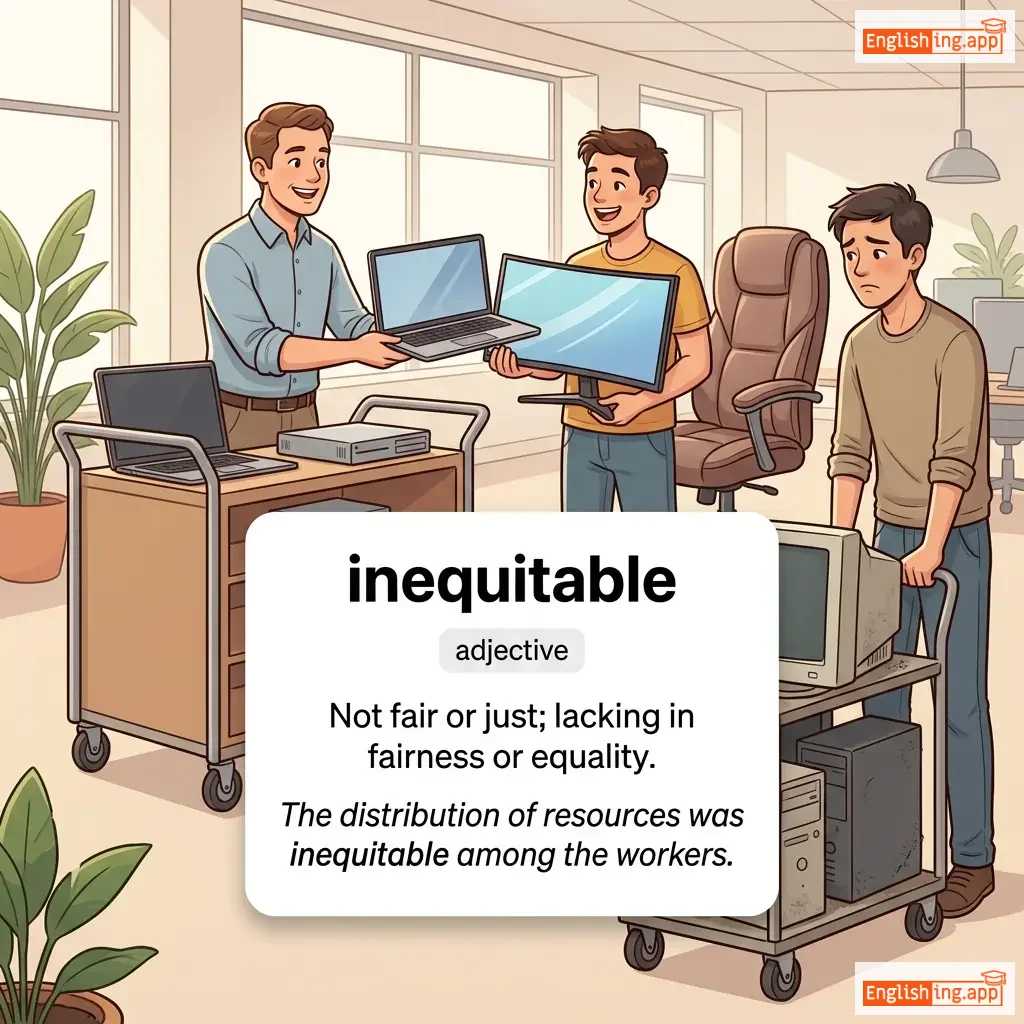
inequitable definition card — visual illustration of the meaning
adjective C2
/ɪnˈɛk.wɪ.tə.bəl/
inéquitable (inequitabl)

Not fair or just; lacking in fairness or equality.

"The distribution of resources was inequitable among the workers."

"La distribution des ressources était inéquitable parmi les travailleurs." (La distribution des ressources était inéquitable parmi les travailleurs.)
noun C2
/ɪnˈɛrənsi/
inerrance (inerrance)

the belief or quality of being free from error; absolute correctness

"Some religious groups strongly affirm the inerrancy of their sacred texts."
"Certains groupes religieux affirment fermement l'inerrance de leurs textes sacrés." (Certains groupes religieux affirment fermement l'inerrance de leurs textes sacrés.)
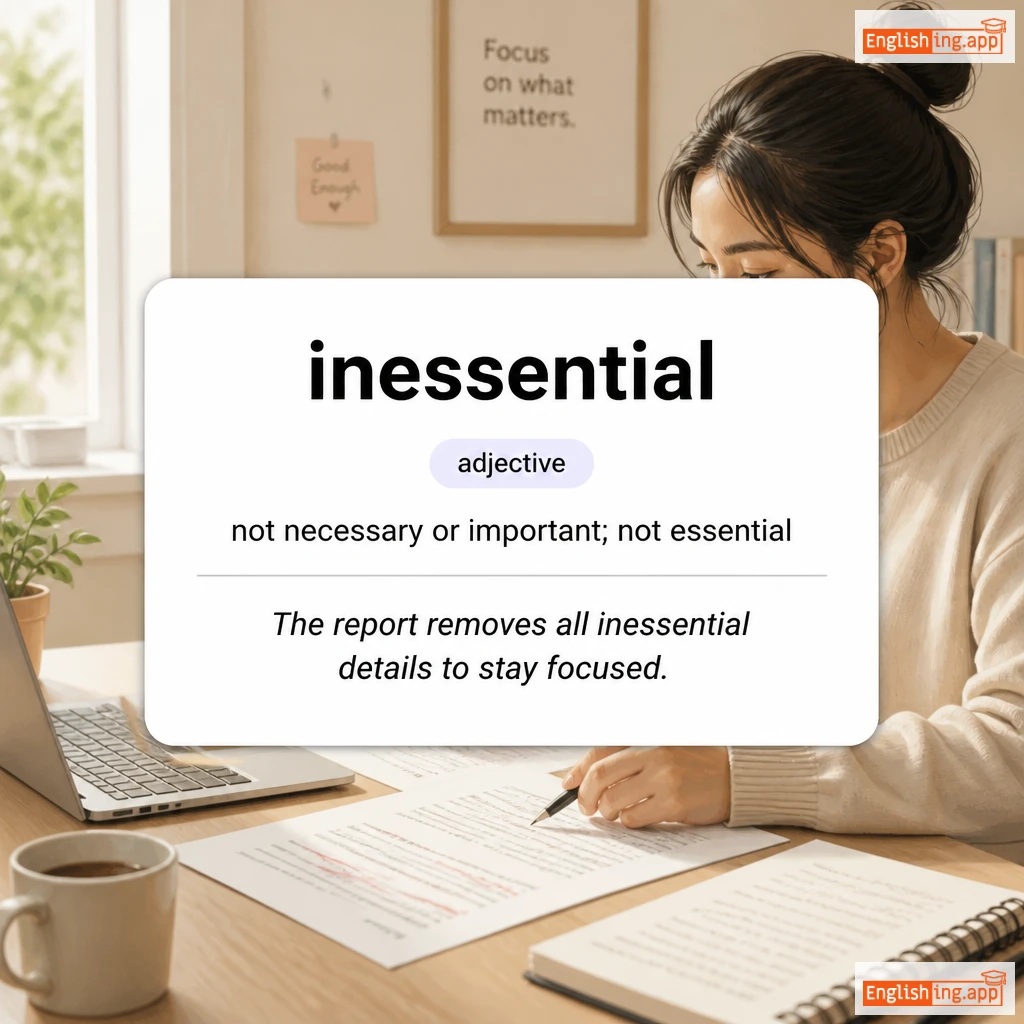
inessential definition card — visual illustration of the meaning
adjective C2
/ˌɪnɪˈsɛnʃəl/
non essentiel (non essentiel)

not necessary or important; not essential

"The report removes all inessential details to stay focused."

"Le rapport supprime les détails non essentiels pour rester concentré." (le rapport supprime les details non essentiels pour rester concentre)
adjective C2
/ɪnˈɛstɪməbl/
inestimable (inestimable)

Too great or valuable to be measured or estimated.

"Her contribution to the project was of inestimable value."

"Sa contribution au projet avait une valeur inestimable." (Sa contribution au projet avait une valeur inestimable.)
adjective C2
/ɪnˈɛksərəbl/
inexorable (inexorable)

Impossible to stop or prevent; relentless.

"The inexorable rise of technology is changing every aspect of life."

"La montée inexorable de la technologie change chaque aspect de la vie." (La montée inexorable de la technologie change chaque aspect de la vie.)
noun (compound/erroneous entry) C2
/ɪnˈɛksərəbl ɑːrmi/
armée imparable (armee imparable)

This appears to be a corrupted or concatenated form; interpreted as 'inexorable army' — an unstoppable or relentless force.

"The rebels feared the inexorable army approaching their stronghold."

"Les rebelles craignaient l'armée imparable qui approchait de leur bastion." (Les rebelles craignaient l'armee imparable qui approchait de leur bastion.)
adjective C2
/ˌɪnɪkˈspiːdiənt/
déconseillé (deconseillé)

Not advisable, suitable, or practical in the circumstances.

"It would be inexpedient to invest without proper research."
"Il serait déconseillé d'investir sans une recherche appropriée." (Il serait déconseillé d'investir sans une recherche appropriée.)
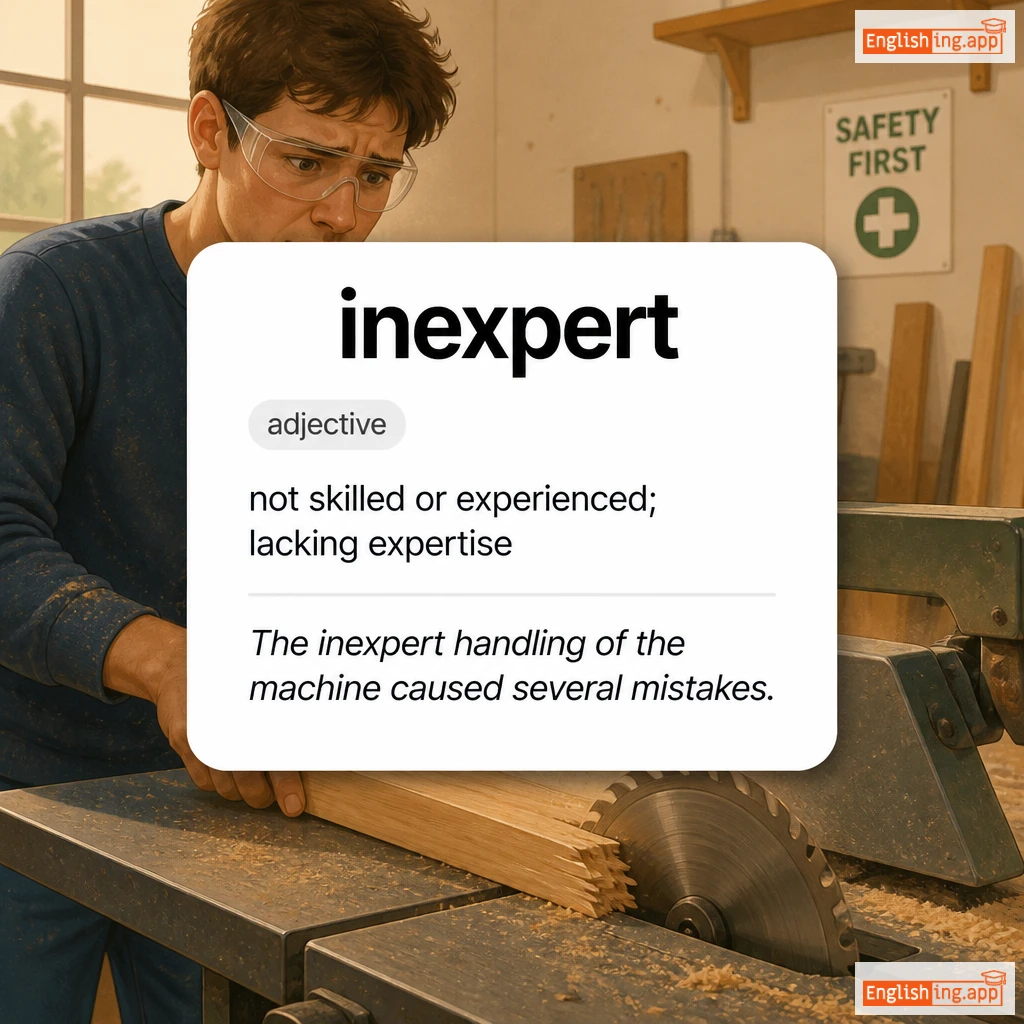
inexpert definition card — visual illustration of the meaning
adjective C2
/ˌɪnˈekspɜːrt/
inexpérimenté (inexperimente)

not skilled or experienced; lacking expertise

"The inexpert handling of the machine caused several mistakes."

"La manipulation inexpérimentée de la machine a causé plusieurs erreurs." (La manipulation inexperimentee de la machine a cause plusieurs erreurs)
adjective C2
/ˌɪnɪkˈsprɛsəbl/
inexprimable (inexprimable)

Too strong or extreme to be expressed in words.

"She felt inexpressible joy at the news of her success."

"Elle ressentit une joie inexprimable en apprenant son succès." (Elle ressentit une joie inexprimable en apprenant son succès.)
adjective C2
/ˌɪnɪkˈstɛnsəbl/
inextensible (inextensible)

Not capable of being stretched or extended.

"This rope is made of an inextensible material."

"Cette corde est faite d’un matériau inextensible." (Cette corde est faite d’un matériau inextensible.)
adjective C2
/ˌɪnɪkˈstrɪkəbl/
inextricable (inextricable)

Impossible to separate or escape from.

"The two friends shared an inextricable bond."

"Les deux amis partageaient un lien inextricable." (Les deux amis partageaient un lien inextricable.)
noun C2
/ˈɪnfəmi/
bonheur (bonheur)

the state of being well known for some bad quality or deed

"His name will live in infamy for the crimes he committed."

"Elle n'a pas pu cacher son bonheur lorsqu'elle a reçu le prix." (Elle n'a pas pu cacher son bonheur lorsqu'elle a recu le prix.)
adjective C2
/ˈɪnfəntaɪl/
infantile (infantile)

characteristic of an infant; childish

"His infantile behavior embarrassed everyone at the meeting."

"Son comportement infantile a embarrassé tout le monde à la réunion." (Son comportement infantile a embarrasse tout le monde a la reunion.)
verb C2
/ɪnˈfætʃueɪt/
fasciner (fasciner)

to inspire with an intense but short-lived passion or admiration

"He was infatuated with her beauty."

"Il était fasciné par sa beauté." (Il etait fascine par sa beaute.)
infeasible definition card — visual illustration of the meaning
adjective C2
ɪnˈfiː.zə.bəl
infaisable (infaisable)

Not possible to do easily or conveniently; impracticable.

"Restoring the forest may become infeasible if destruction continues."

"Restaurer la forêt peut devenir infaisable si la destruction continue." (Restaurer la forêt peut devenir infaisable si la destruction continue.)
adjective C2
/ˌɪnfəˈlɪsɪtəs/
inopportun (inopportun)

not suitable or well chosen; awkward or unfortunate

"His infelicitous remark ruined the atmosphere of the meeting."

"Sa remarque inopportune a gâché l'ambiance de la réunion." (Sa remarque inopportune a gâché l'ambiance de la réunion.)
adjective C2
/ɪnˈfɜːrnəl/
infernal (infernal)

relating to hell; extremely troublesome or annoying

"The workers complained about the infernal noise from the construction site."
"Les travailleurs se sont plaints du bruit infernal provenant du site de construction." (Les travailleurs se sont plaints du bruit infernal provenant du site de construction.)
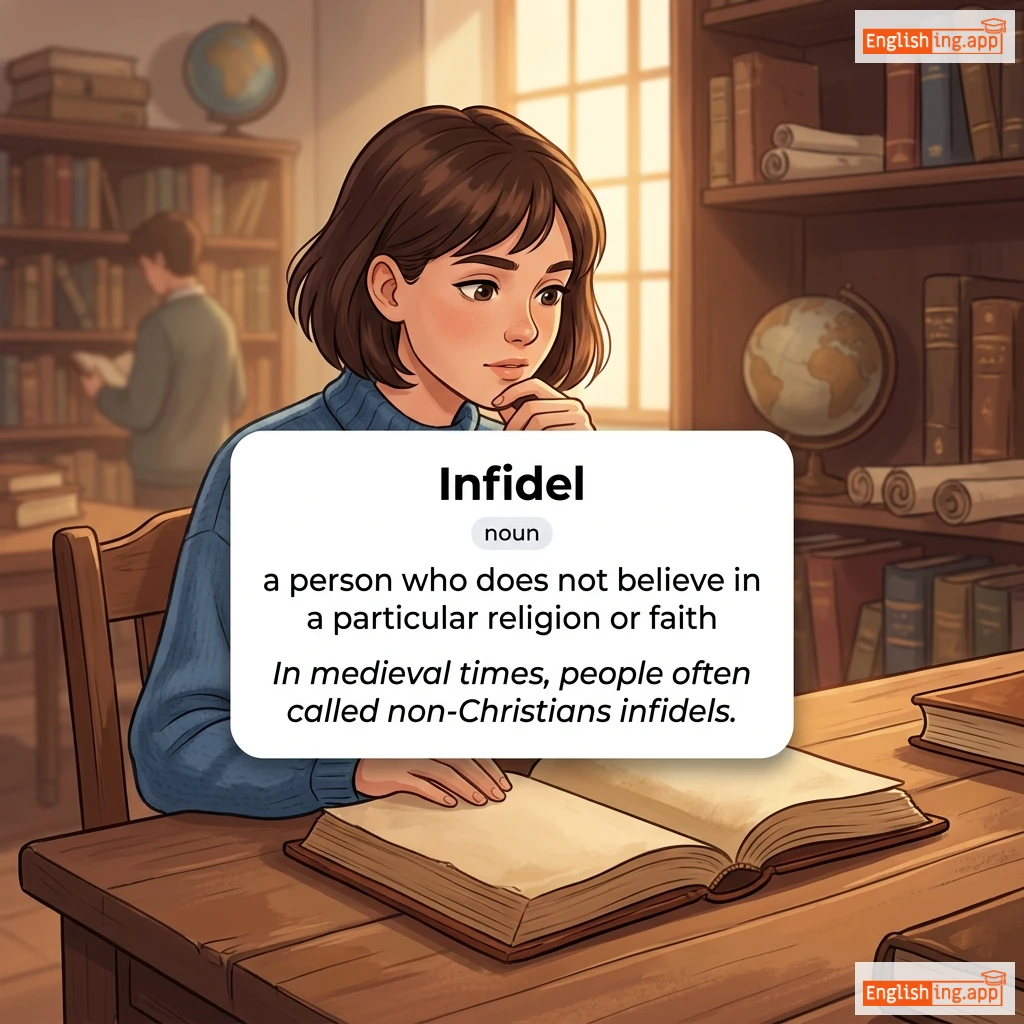
Infidel definition card — visual illustration of the meaning
noun C2
/ˈɪnfɪdɛl/
infidèle (infidele)

a person who does not believe in a particular religion or faith

"In medieval times, people often called non-Christians infidels."

"Au Moyen Âge, les gens appelaient souvent les non-chrétiens des infidèles." (Au Moyen Âge, les gens appelaient souvent les non-chrétiens des infidèles.)
adjective C2
/ˌɪnfɪnɪˈtɛsɪməl/
infinitésimal (infinitesimal)

Extremely small in size or amount; so tiny as to be almost negligible.

"The error was so infinitesimal that it didn’t affect the results."

"L'erreur était si infinitésimale qu'elle n'a pas affecté les résultats." (L'erreur etait si infinitesimale quelle n'a pas affecte les resultats.)