語彙集

英単語辞書 | 単語の意味、定義、例文

noun C2
/ˈmɛtələ(r)dʒi/
metalurgia (metalurgia)

The science and technology of metals, including their extraction from ores and their processing.

"Metallurgy plays a vital role in industrial development."

"La metalurgia juega un papel vital en el desarrollo industrial." (La metalurgia juega un papel vital en el desarrollo industrial.)
verb C2
/ˌmɛtəˈmɔrfoʊz/
metamorfosear (metamorfosear)

To change in form, structure, or substance; to transform completely.

"The caterpillar metamorphosed into a butterfly."

"La oruga se metamorfoseó en una mariposa." (La oruga se metamorfoseó en una mariposa.)
noun C2
/ˈmɛtəfɔːrm/
metáfora de forma (metafora de forma)

A coined or rare term sometimes used to describe a hybrid form of metaphor and form in literature or art.

"The poet introduced a metaphorm to blend imagery with structure."

"El poeta introdujo un metáformo para combinar la imaginería con la estructura." (El poeta introdujo un metáformo para combinar la imaginería con la estructura.)
adjective C2
/ˌmɛtəˈfɪzɪkəl/
metafísico (metafisiko)

Relating to the branch of philosophy that deals with the fundamental nature of reality and existence.

"He spent years studying metaphysical questions about life and being."

"Pasó años estudiando preguntas metafísicas sobre la vida y el ser." (Paso anos estudiando preguntas metafisicas sobre la vida y el ser.)
noun C2
/ˌmɛtəfɪˈzɪʃən/
metafísico (metafisico)

A person who studies or is an expert in metaphysics.

"The metaphysician debated the essence of reality with his peers."
"El metafísico debatió la esencia de la realidad con sus compañeros." (El metafísico debatió la esencia de la realidad con sus compañeros.)
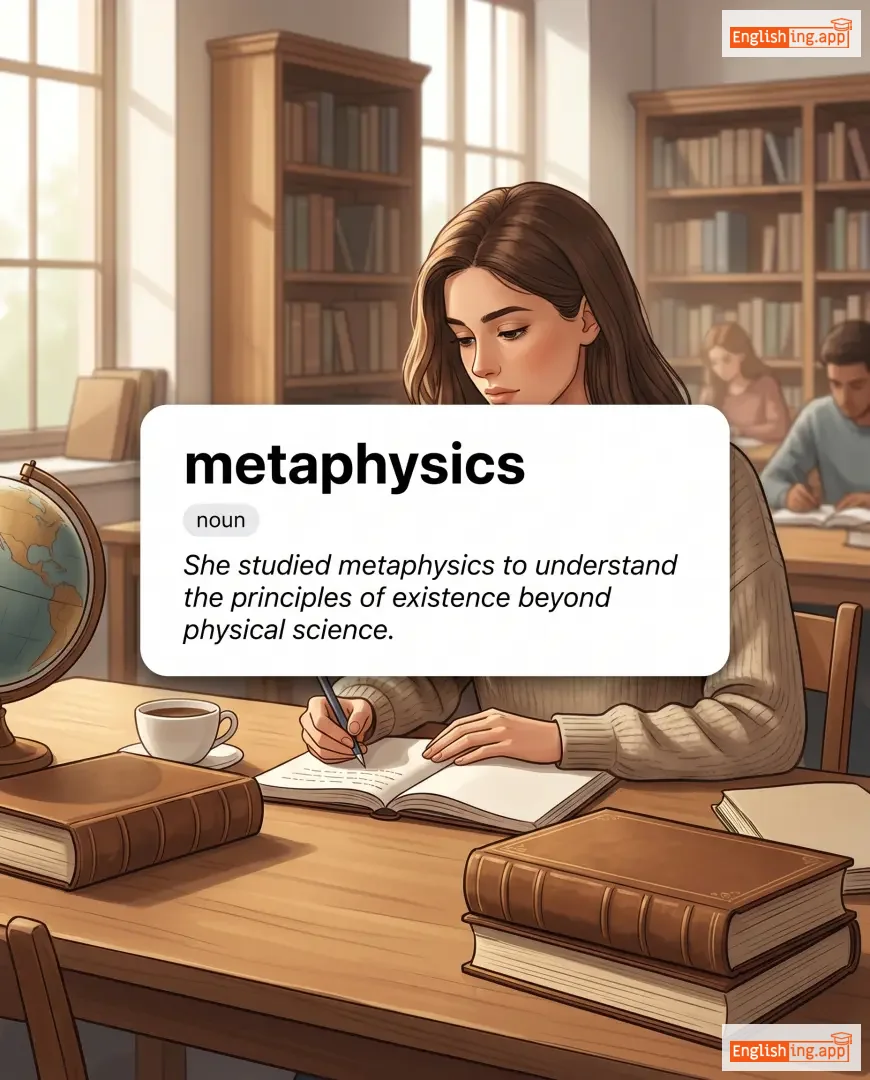
metaphysics definition card — visual illustration of the meaning
noun C2
/ˌmɛtəˈfɪzɪks/
metafísica (metafisica)

The branch of philosophy that deals with the fundamental nature of reality, existence, and the relationship between mind and matter.

"She studied metaphysics to understand the principles of existence beyond physical science."

"Ella estudió metafísica para entender los principios de la existencia más allá de la ciencia física." (Ella estudio metafisica para entender los principios de la existencia mas alla de la ciencia fisica.)
verb C2
/miːt/
distribuir (distribuir)

To dispense or allot justice, punishment, or harsh treatment.

"The judge will mete out punishment according to the crime."

"El juez distribuirá el castigo según el crimen." (El juez distribuirá el castigo según el crimen.)
noun C2
/ˌmɛtəmˌsaɪˈkoʊsɪs/
reencarnación del alma (reenkarnacion del alma)

The supposed transmigration of the soul, especially its reincarnation after death.

"Ancient philosophers often debated the idea of metempsychosis."

"Los antiguos filósofos a menudo debatían sobre la reencarnación del alma." (Los antiguos filosofos a menudo debatian sobre la reencarnacion del alma.)
noun C2
/mɪˈtɒnɪmi/
metonimia (metonimia)

A figure of speech in which one word or phrase is substituted with another closely related word or concept.

"In the phrase 'the crown will decide,' 'crown' is a metonymy for monarchy."

"En la frase 'la corona decidirá', 'corona' es una metonimia para la monarquía." (En la frase 'la corona decidirá', 'corona' es una metonimia para la monarquía.)
adjective C2
/ˈmɛtrɪkəl/
métrico (metrico)

Relating to or composed in a regular rhythmic pattern of beats or meter, especially in poetry.

"The poet carefully followed metrical rules in his verses."

"El poeta siguió cuidadosamente las reglas métricas en sus versos." (El poeta siguió cuidadosamente las reglas métricas en sus versos.)
noun C2
/ˈmɛtrəˌnoʊm/
metrónomo (metronomo)

A device that produces regular ticks or beats to help musicians maintain tempo.

"She practiced the piano with a metronome to keep steady timing."

"Ella practicaba el piano con un metrónomo para mantener el ritmo constante." (Ella practicaba el piano con un metrónomo para mantener el ritmo constante.)
noun C2
/ˈmɛtəl/
valor (valor)

A person's ability to cope well with difficulties or to face demanding situations with courage.

"The young athlete showed his mettle in the final match."

"El joven atleta mostró su valor en el partido final." (El joven atleta mostró su valor en el partido final.)
adjective C2
/ˈmɛtəlˌsʌm/
valiente (valiente)

Full of courage and spirit; lively and spirited.

"The mettlesome young rider never backed down from a challenge."

"El valiente jinete joven nunca retrocedió ante un desafío." (El valiente jinete joven nunca retrocedió ante un desafío.)
noun C2
/mjuːz/
callejón/calle pequeña (callejon/calle pequena)

A row or street of houses or apartments that have been converted from stables or built to look like former stables.

"They rented a small flat in a quiet London mews."

"Alquilaron un pequeño departamento en un tranquilo mews de Londres." (Alquilaron un pequeno departamento en un tranquilo mews de Londres.)
noun C2
/maɪˈæzmə/
aire viciado (aire viciado)

An unpleasant or unhealthy smell or atmosphere.

"A miasma of decay hung over the abandoned house."

"Una miasma de descomposición colgaba sobre la casa abandonada." (Una miasma de descomposición colgaba sobre la casa abandonada.)
noun C2
/ˈmaɪkrəˌkɒzəm/
microcosmos (microcosmos)

A small, representative system having analogies to a larger system; a miniature version of something.

"The small town is a microcosm of the entire nation."

"El pequeño pueblo es un microcosmos de toda la nación." (El pequeño pueblo es un microcosmos de toda la nación.)
noun C2
/maɪˈkrɒmɪtər/
micrómetro (micrometro)

A device used for measuring small distances with great accuracy.

"The engineer used a micrometer to measure the thickness of the wire."

"El ingeniero usó un micrómetro para medir el grosor del cable." (El ingeniero uso un micrometro para medir el grosor del cable.)
noun C2
/maɪˈkrɑː.skə.pi/
microscopía (microscopía)

The use of a microscope to observe small objects or organisms.

"Microscopy revealed the structure of the cells."

"La microscopía reveló la estructura de las células." (La microscopía reveló la estructura de las células.)
noun C2
/miːn/
aspecto (aspecto)

A person's appearance or manner, especially as an indication of their character or mood.

"His serious mien made everyone fall silent."

"Su aspecto serio hizo que todos se quedaran en silencio." (Su aspecto serio hizo que todos se quedaran en silencio.)
noun C2
/mɪf/
pequeña pelea (pequeña pelea)

A petty quarrel or annoyance.

"They had a slight miff over the seating arrangement."

"Tuvieron una pequeña pelea sobre la disposición de los asientos." (Tuvieron una pequeña pelea sobre la disposición de los asientos.)
verb C2
/ˈmɪlɪˌteɪt/
obstruir (obstruir)

to have a strong effect against something; to work as a powerful factor in preventing or influencing an outcome

"His lack of experience will militate against his promotion."
"La falta de experiencia de él obstaculizará su promoción." (La falta de experiencia de él obstaculizará su promoción.)
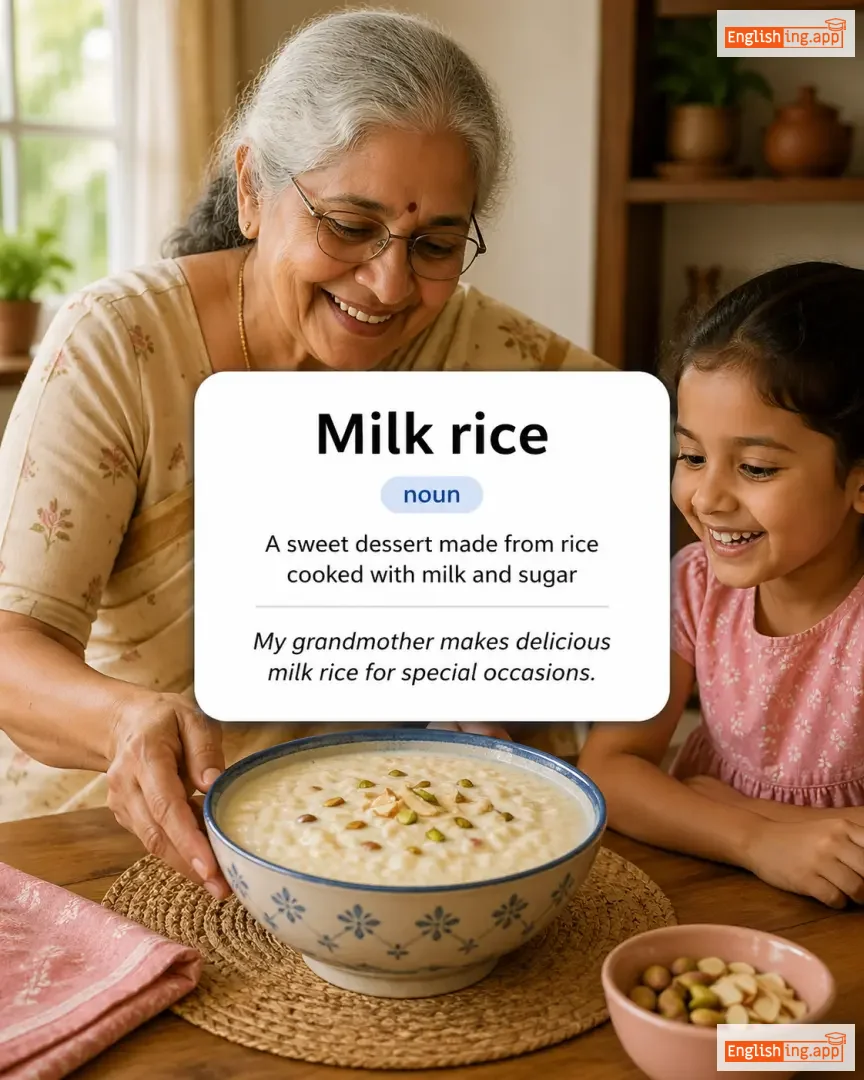
Milk rice definition card — visual illustration of the meaning
noun C2
/mɪlk raɪs/
arroz con leche (arroz con leche)

A sweet dessert made from rice cooked with milk and sugar

"My grandmother makes delicious milk rice for special occasions."
"Mi abuela hace delicioso arroz con leche para ocasiones especiales." (Mi abuela hace delicioso arroz con leche para ocasiones especiales.)
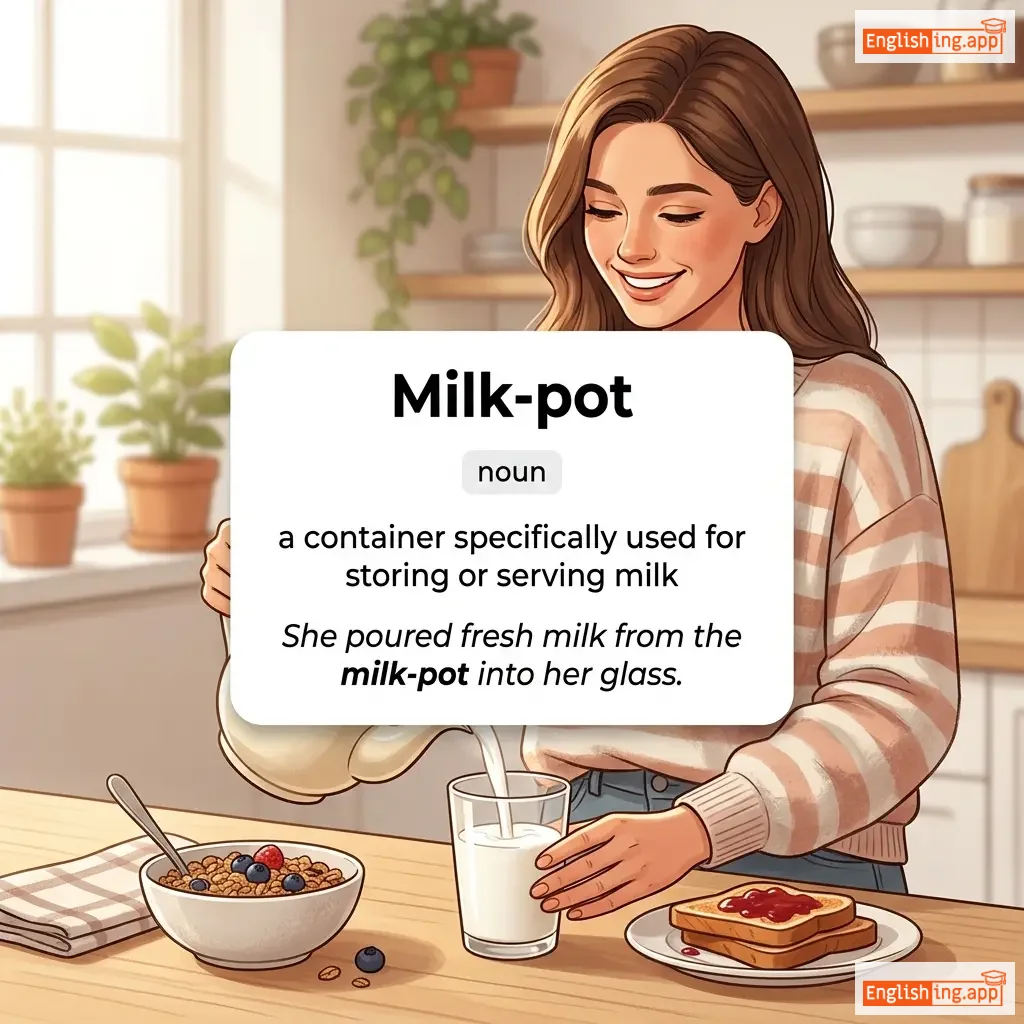
Milk-pot definition card — visual illustration of the meaning
noun C2
/ˈmɪlk pɒt/
lechetera (lechetera)

a container specifically used for storing or serving milk

"She poured fresh milk from the milk-pot into her glass."

"Ella vertió leche fresca de la lechetera en su vaso." (Ella vertió leche fresca de la lechetera en su vaso)
noun C2
/ˈmɪlɪt/
mijo (mijo)

a small-seeded grass cultivated as a cereal crop

"Millet is often used as food in rural areas."

"El mijo se usa a menudo como alimento en las áreas rurales." (El mijo se usa a menudo como alimento en las áreas rurales.)
noun C2
/ˌmɪnəˈrɛt/
minarete (minarete)

A tall, slender tower of a mosque, from which the call to prayer is announced.

"The minaret of the mosque could be seen from miles away."

"El minarete de la mezquita se podía ver desde kilómetros de distancia." (El minarete de la mezquita se podia ver desde kilometros de distancia.)
adjective C2
/ˈmɪnətɔːri/
amenazante (amenazante)

Expressing a threat; menacing.

"The criminal gave the witness a minatory look."

"El criminal le dio al testigo una mirada amenazante." (El criminal le dio al testigo una mirada amenazante.)
adjective C2
/ˈmɪnsɪŋ/
afectado (afectado)

affectedly delicate, dainty, or refined in manner or movement

"He walked with mincing steps across the stage."

"Él caminó con pasos afectados a través del escenario." (El caminó con pasos afectados a través del escenario.)
adjective C2
/ˈmɪn.dʒi/
tacaño; avaro (tacano; avaro)

mean or stingy; unwilling to spend money

"He is too mingy to spend money on anything but necessities."

"Él es demasiado tacaño para gastar dinero en algo que no sea lo esencial." (El es demasiado tacano para gastar dinero en algo que no sea lo esencial.)
🧑‍🤝‍🧑

minion (mínion)

noun C2
/ˈmɪn.i.ən/
esbirro (esbirro)

A follower or underling of a powerful person, especially a servile one.

"The dictator was surrounded by loyal minions who carried out his orders."

"El dictador estaba rodeado de esbirros leales que cumplían sus órdenes." (El dictador estaba rodeado de esbirros leales que cumplían sus órdenes.)
adjective C2
/ˈmɪn.ɪ.skjuːl/
minúsculo (minusculo)

Extremely small or tiny.

"The error was so miniscule that nobody noticed it."

"El error era tan minúsculo que nadie lo notó." (El error era tan minusculo que nadie lo noto.)
noun C2
/ˌmɪn.ɪˈstreɪ.ʃən/
servicio (servicio)

The act of providing care, assistance, or religious service.

"She recovered thanks to the kind ministrations of the nurses."

"Se recuperó gracias a las amables ministraciones de las enfermeras." (Se recuperó gracias a las amables ministraciones de las enfermeras.)
noun C2
/maɪˈnjuːʃə/
minucias (minusias)

a small or trivial detail of something

"He was bored by the minutia of office paperwork."

"Estaba aburrido por las minucias del papeleo de la oficina." (Estaba aburrido por las minucias del papeleo de la oficina.)
noun (plural) C2
/maɪˈnjuːʃiiː/
minucias (minusias)

the small, precise, or trivial details of something

"The lawyer focused on the minutiae of the contract."

"El abogado se centró en las minucias del contrato." (El abogado se centró en las minucias del contrato.)
noun, verb C2
/ˈmaɪər/
lodazal / enredo (lodazal / enredo)

A stretch of swampy or boggy ground; as a verb, to entangle or involve someone in a difficult situation.

"The car was stuck in the mire after the heavy rain."

"El carro se quedó atascado en el lodazal después de la fuerte lluvia." (El carro se quedo atascado en el lodazal despues de la fuerte lluvia.)
noun C2
/ˌmɪsədˈvɛntʃər/
mala aventura (mala aventura)

An unlucky accident, mishap, or unfortunate event.

"He broke his leg during a skiing misadventure."
"Se rompió la pierna durante una mala aventura en esquí." (Se rompio la pierna durante una mala aventura en esqui.)
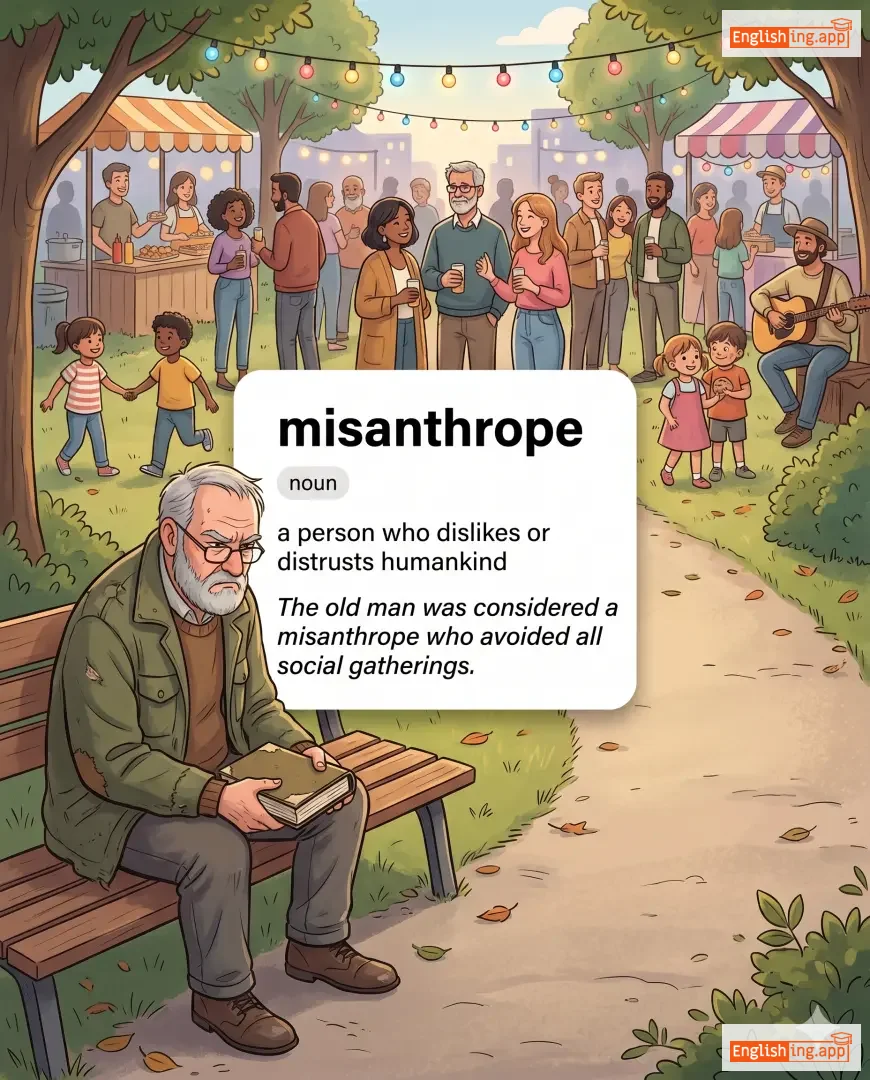
misanthrope definition card — visual illustration of the meaning
noun C2
/ˈmɪsənˌθroʊp/
misantropo (misantropo)

a person who dislikes or distrusts humankind

"The old man was considered a misanthrope who avoided all social gatherings."

"El hombre viejo era considerado un misántropo que evitaba todas las reuniones sociales." (El hombre viejo era considerado un misántropo que evitaba todas las reuniones sociales.)
adjective C2
/ˌmɪsənˈθrɑːpɪk/
misantrópico (misantronpico)

having or showing a dislike of humankind

"His misanthropic attitude made it difficult for him to make friends."

"Su actitud misantrópica hacía difícil que hiciera amigos." (Su actitud misantropica hacia dificil que hiciera amigos.)
noun C2
/mɪˈsænθrəpi/
misantropía (misantropia)

a general dislike, distrust, or hatred of humankind

"His misanthropy was evident in the way he avoided people."

"Su misantropía era evidente en la forma en que evitaba a las personas." (Su misantropía era evidente en la forma en que evitaba a las personas.)
verb C2
/ˌmɪsæprɪˈhɛnd/
malinterpretar (malinterpretar)

to misunderstand or misinterpret something

"He misapprehended the teacher’s instructions and did the task incorrectly."

"Él malinterpretó las instrucciones del profesor e hizo la tarea incorrectamente." (Él malinterpretó las instrucciones del profesor e hizo la tarea incorrectamente.)
noun C2
/ˌmɪsæprɪˈhɛnʃən/
malentendido (malentendido)

a mistaken belief or misunderstanding

"There is a common misapprehension about the causes of the disease."
"Existe un malentendido común sobre las causas de la enfermedad." (Existe un malentendido común sobre las causas de la enfermedad.)
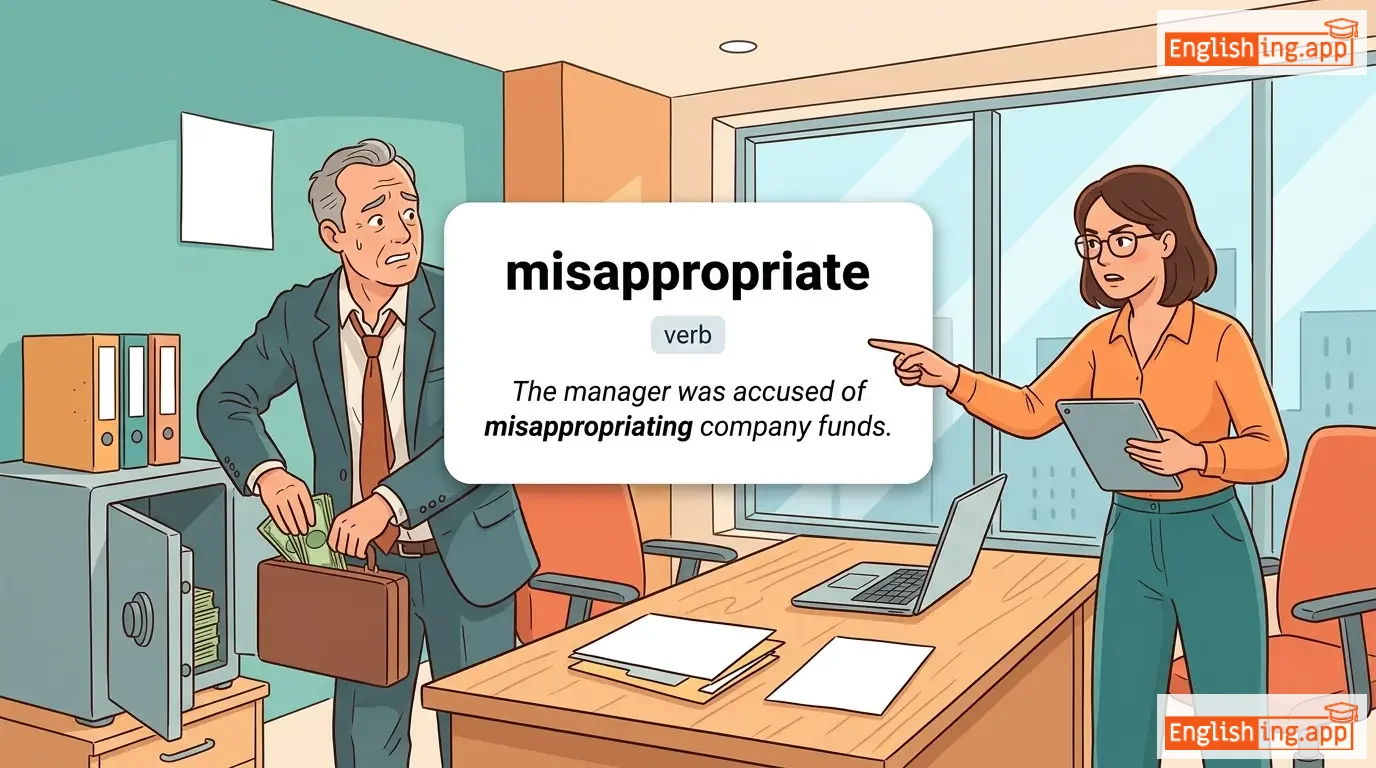
misappropriate definition card — visual illustration of the meaning
verb C2
/ˌmɪsəˈproʊprieɪt/
malversar (malversar)

to take or use something dishonestly, especially money or property, for one's own use

"The manager was accused of misappropriating company funds."

"El gerente fue acusado de malversar los fondos de la empresa." (El gerente fue acusado de malversar los fondos de la empresa.)
verb C2
/ˌmɪs.əˈtrɪb.juːt/
mal atribuir (mal atribuir)

to incorrectly credit something, such as a work or remark, to the wrong person or source

"The quote was misattributed to Shakespeare."

"La cita fue mal atribuida a Shakespeare." (La cita fue mal atribuida a Shakespeare.)
noun C2
/mɪˌsɛdʒəˈneɪʃən/
mestizaje (mestizaje)

the interbreeding of people considered to be of different racial types

"The law once prohibited miscegenation in many countries."

"La ley prohibió la miscegenación en muchos países." (La ley prohibió la miscegenación en muchos países.)
noun C2
/ˈmɪsəleɪni/
miscelánea (miscelanea)

A collection or mixture of various things.

"The book is a miscellany of essays and poems."

"El libro es una miscelánea de ensayos y poemas." (El libro es una miscelanea de ensayos y poemas.)
noun C2
/ˌmɪsˈtʃæns/
infortunio (mischance)

An unfortunate accident or event; bad luck.

"By mischance, he missed the last train home."

"Por desgracia, perdió el último tren para volver a casa." (Por desgracia, perdio el ultimo tren para volver a casa.)
verb C2
/ˌmɪskənˈsiːv/
malinterpretar (malinterpretar)

To misunderstand or form an incorrect idea about something.

"He misconceived the purpose of the project."

"Él malinterpretó el propósito del proyecto." (Él malinterpretó el propósito del proyecto.)
verb C2
/ˌmɪskənˈstruː/
malinterpretar (malinterpretar)

To interpret something wrongly or misunderstand the meaning.

"She misconstrued his silence as anger."
"Ella malinterpretó su silencio como ira." (Ella malinterpretó su silencio como ira.)
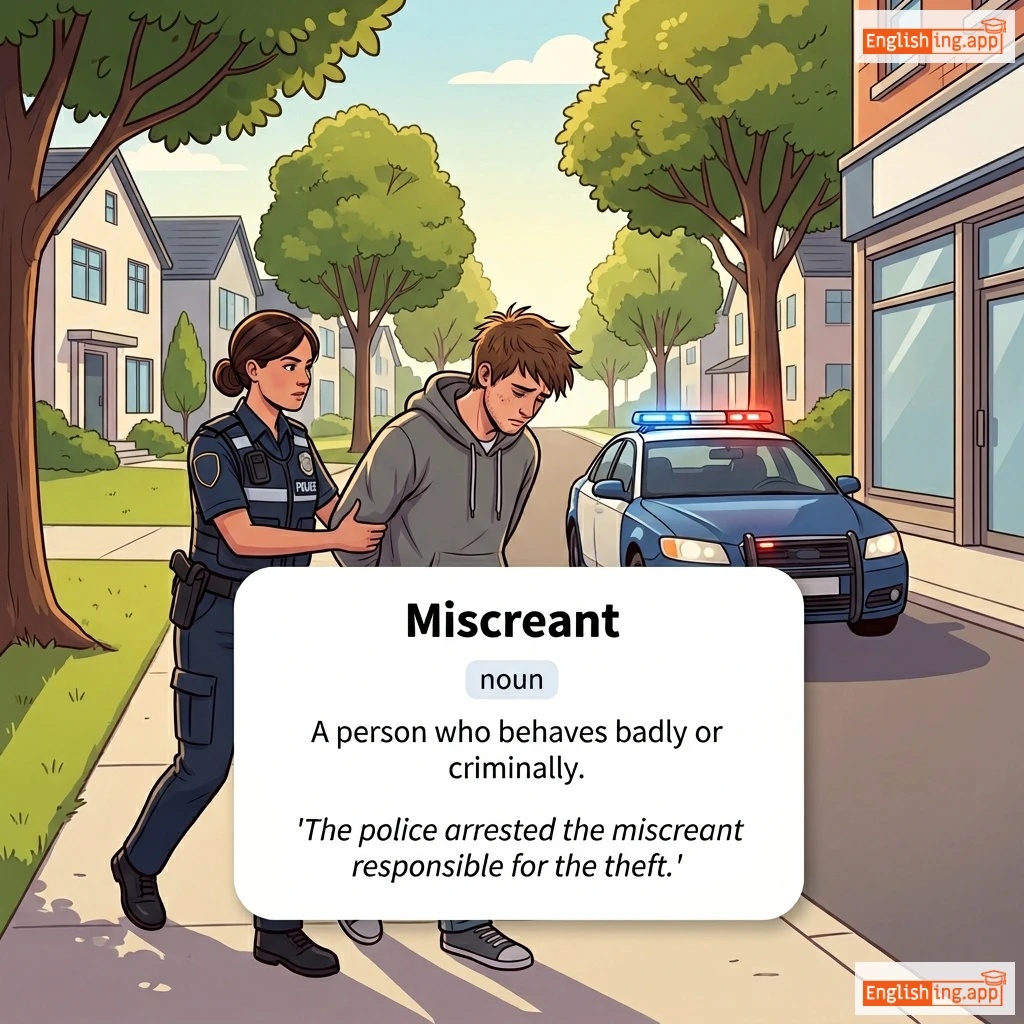
Miscreant definition card — visual illustration of the meaning
noun C2
/ˈmɪskriənt/
delincuente (delincuente)

A person who behaves badly or criminally.

"The police arrested the miscreant responsible for the theft."

"La policía arrestó al delincuente responsable del robo." (La policia arrestó al delincuente responsable del robo.)
verb C2
/ˌmɪsˈleɪ/
perder temporalmente (perder temporalmente)

to lose something temporarily by putting it in the wrong place

"I must have mislaid my keys somewhere in the house."

"Debo haber perdido mis llaves en algún lugar de la casa." (Debo haber perdido mis llaves en algun lugar de la casa.)
noun C2
/ˌmɪsˈnoʊmər/
nombre incorrecto (nombre incorrecto)

A wrong or inaccurate name or designation.

"Calling the tiny dog a 'giant' is a misnomer."

"Llamar al perro pequeño un 'gigante' es un nombre incorrecto." (Llamar al perro pequeño un 'gigante' es un nombre incorrecto.)