Vocabulaires

Découvrez, apprenez et maîtrisez le vocabulaire anglais

noun C2
/ˈprɛlət/
高级神职人员 (gāojí shénzhí rényuán)

A high-ranking member of the clergy, especially a bishop or abbot.

"The prelate delivered a sermon to the congregation."

"普雷拉特向会众发表了讲道。" (Pǔléilātè xiàng huìzhòng fābiǎole jiǎngdào.)
adjective C2
/prɪˈmɒnɪtəri/ or /ˌpriːməˈnɪtəri/
前兆 (qiánzhào)

giving a warning or prediction about something, especially something unpleasant

"He ignored the premonitory signs of illness."

"他忽视了疾病的前兆。" (Tā hūshìle jíbìng de qiánzhào.)
verb C2
/ˌpriːɔːrˈdeɪn/
预定 (yùdìng)

To decide or determine an outcome in advance, especially by fate or divine will.

"They believed their meeting was preordained by destiny."

"他们相信他们的相遇是命运注定的。" (Tāmen xiāngxìn tāmen de xiāngyù shì mìngyùn zhùdìng de.)
noun C2
/prɪˈpɒndərəns/
优势 (yōushì)

The quality or fact of being greater in number, quantity, or importance.

"There was a preponderance of evidence against the defendant."

"对被告有明显的证据优势。" (Duì bèigào yǒu míngxiǎn de zhèngjù yōushì.)
adjective C2
/prɪˈpɒndərənt/
主要的 (zhǔyào de)

Having superior weight, force, influence, or importance.

"The preponderant influence of the media shapes public opinion."

"媒体的主要影响塑造了公众舆论。" (Méi tǐ de zhǔyào yǐngxiǎng sùzào le gōngzhòng yúlùn.)
verb C2
/prɪˈpɒndəreɪt/
占优势 (zhàn yōushì)

To be greater in influence, weight, or number.

"In the debate, logical arguments preponderated over emotional appeals."

"在辩论中,逻辑论点优于情感呼吁。" (Zài biànlùn zhōng, luójí lùndiǎn yōu yú qínggǎn hūyù.)
adjective C2
/ˌpriːpəˈzɛsɪŋ/
迷人 (mírén)

Attractive or appealing in appearance or manner.

"She had a prepossessing smile that charmed everyone."

"她有一个迷人的微笑,让每个人都着迷。" (Tā yǒu yīgè mírén de wēixiào, ràng měi gèrén dōu zháomí.)
noun C2
/ˌpriːpəˈzɛʃən/
偏见 (pianjian)

An opinion or feeling formed beforehand; a prejudice or preoccupation.

"His prepossession in favor of tradition made him resist change."

"他的偏见使他反对改变。" (Tā de piānjiàn shǐ tā fǎnduì gǎibiàn.)
verb C2
/ˈprɛsɪdʒ/
预兆 (yùzhào)

to be a sign or warning that something will happen; to foreshadow

"Dark clouds presage a storm."

"暗云预示着一场风暴。" (Àn yún yùshìzhe yī chǎng fēngbào.)
noun C2
/ˈprɛʃəns/ or /ˈpriːʃəns/
预见 (yùjiàn)

the ability to know or predict what will happen in the future

"Her prescience about market trends saved the company."

"她对市场趋势的预见拯救了公司。" (Tā duì shìchǎng qūshì de yùjiàn zhěngjiùle gōngsī.)
adjective C2
/ˈprɛʃənt/ or /ˈpriːʃənt/
先知的 (xiān zhī de)

having or showing knowledge of events before they take place

"The prescient investor sold his shares just before the market crashed."

"那位先知的投资者在市场崩盘之前卖掉了他的股票。" (Nà wèi xiān zhī de tóu zī zhě zài shì chǎng bēng pán zhī qián mài diào le tā de gǔ piào.)
noun C2
/ˈpriːskrɪpt/
规定 (gui ding)

An authoritative rule or direction; something laid down as a command.

"The prescript of the organization required strict punctuality."

"该组织的规定要求严格的准时。" (Gai zuzhi de guiding yaoqiu yange de zhunshi.)
adjective C2
/prɪˈskrɪptɪbəl/
可规定的 (kě guīdìng de)

Capable of being prescribed or laid down as a rule or directive.

"Certain regulations are prescriptible under the law."

"某些规定在法律下是可以规定的。" (Mǒu xiē guīdìng zài fǎlǜ xià shì kě guīdìng de.)
adjective C2
/prɪˈsɛnʃənt/
预感 (yùgǎn)

Having a feeling or sense of something about to happen; predictive.

"She was presentient of the coming disaster."

"她预感到即将来临的灾难。" (Ta yugan dao jijiang lailin de zainan.)
noun C2
/prɪˈsɛntɪmənt/
预感 (yugan)

An intuitive feeling about the future, especially of something bad about to happen.

"He had a strong presentiment that the plan would fail."

"他有强烈的预感,计划会失败。" (Tā yǒu qiángliè de yugan, jìhuà huì shībài.)
noun C2
/prɪˈzɛntmənt/
正式呈交 (zhèngshì chéngjiāo)

The act of presenting something formally or officially; a formal statement or document.

"The lawyer made a presentment of the evidence to the court."

"律师将证据呈交给法庭。" (Lǜshī jiāng zhèngjù chéngjiāo gěi fǎtíng.)
adjective C2
/prɪˈzʌmptɪv/
推定的 (tuīdìng de)

Based on probability or assumption rather than proof.

"She is the presumptive nominee for the party."

"她是该党的推定候选人。" (Tā shì gāi dǎng de tuīdìng hòuxuǎn rén.)
adjective C2
/ˌpriːtərˈnætʃərəl/
超自然 (chaoziran)

Beyond what is normal or natural; extraordinary or supernatural.

"She had a preternatural ability to remain calm in any crisis."

"她在任何危机中保持冷静的能力是超自然的。" (Tā zài rènhé wéijī zhōng bǎochí lěngjìng de nénglì shì chāo zìrán de.)
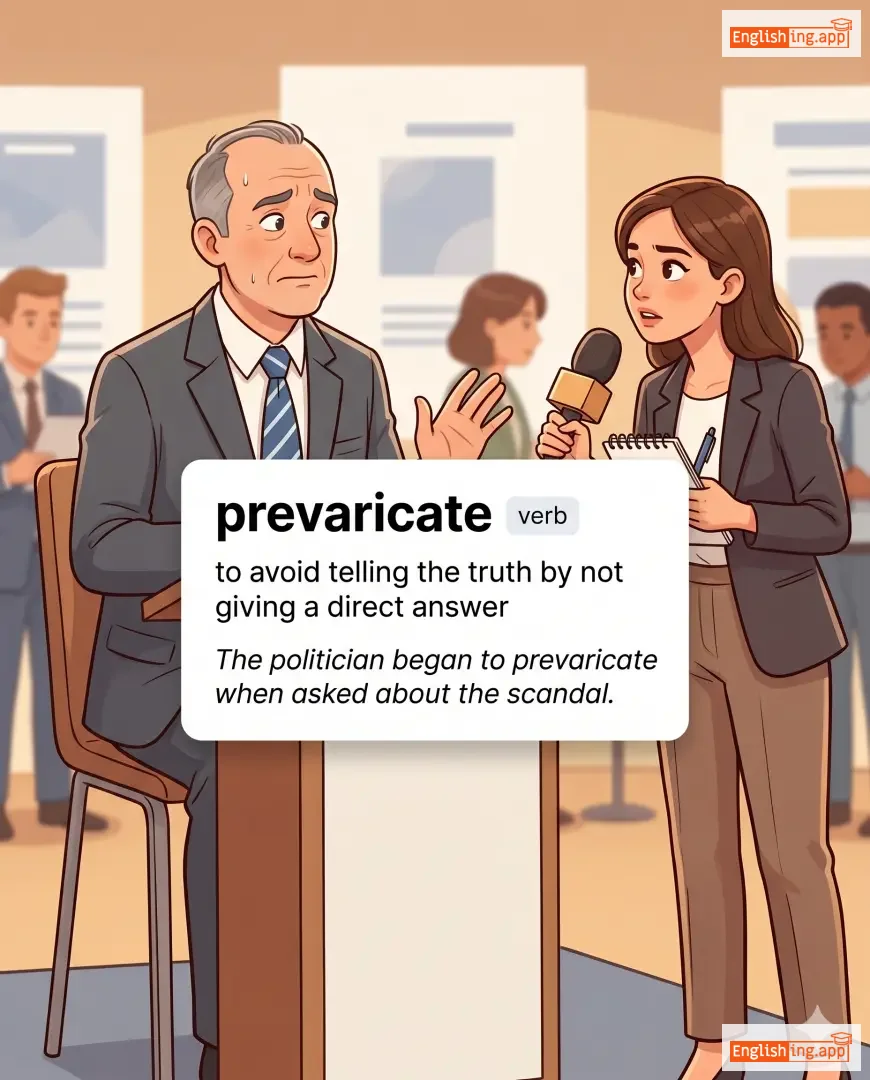
prevaricate definition card — visual illustration of the meaning
verb C2
/prɪˈværɪkeɪt/

to avoid telling the truth by not giving a direct answer

"The politician began to prevaricate when asked about the scandal."

adjective C2
/ˈprɪɡɪʃ/
自以为是的道德主义者 (zì yǐ wéi shì de dàodé zhǔyì zhě)

self-righteously moralistic and superior

"He came across as priggish when correcting everyone's manners."

"当他纠正每个人的行为时,他显得很自以为是的道德主义者。" (Dāng tā jiūzhèng měi gèrén de xíngwéi shí, tā xiǎndé hěn zì yǐ wéi shì de dàodé zhǔyì zhě.)
noun C2
/ˌpraɪmoʊˈdʒɛnɪtʃər/
长子继承权 (zhǎngzǐ jìchéng quán)

The right of the firstborn child to inherit the family estate or title.

"Under primogeniture, the eldest son inherited the entire estate."

"在长子继承制下,长子继承了整个家族产业。" (Zài zhǎngzǐ jìchéng zhì xià, zhǎngzǐ jìchéngle zhěnggè jiāzú chǎnyè.)
verb C2
/prɪmp/
幸福 (xìngfú)

To spend time making minor adjustments to one's appearance.

"She primped in front of the mirror before the party."

"她在收到奖项时无法掩饰自己的幸福。" (Tā zài shōudào jiǎngxiàng shí wúfǎ yǎnshì zìjǐ de xìngfú.)
noun C2
/ˌprɪnsɪˈpæləti/
公国 (gongguo)

a state ruled by a prince

"Monaco is a famous principality in Europe."

"摩纳哥是欧洲著名的公国。" (Monako shi Ouzhou zhuming de gongguo.)
noun C2
/ˈpraɪəri/
修道院 (xiūdàoyuàn)

a small monastery or convent governed by a prior or prioress

"The old priory was converted into a museum."

"那个古老的修道院被改造成了博物馆。" (Nàgè gǔlǎo de xiūdàoyuàn bèi gǎizào chéngle bówùguǎn.)
noun C2
/ˌpraɪvəˈtɪə/
私人战舰 (sīrén zhànjiàn)

A privately owned armed ship authorized by a government to attack enemy ships during war.

"The privateer captured several enemy vessels during the conflict."

"在冲突中,私人战舰俘获了多个敌方船只。" (Zài chōngtú zhōng, sīrén zhànjiàn fúhuòle duōgè dífāng chuánzhī.)
noun C2
/praɪˈveɪʃən/
匮乏, 贫困 (kuìfá, pínkùn)

A state in which things essential for human well-being such as food and warmth are lacking.

"The refugees suffered great privation during the harsh winter."

"难民在严寒的冬天遭受了极大的匮乏。" (Nànmín zài yánhán de dōngtiān zāoshòu le jí dà de kuìfá.)
noun C2
/ˈprɪvɪti/
私密关系, 合同关系 (simi guanxi, hetong guanxi)

A close, private, or special relationship; in law, the direct connection between parties to a contract.

"There was no privity of contract between the supplier and the customer."

"供应商和客户之间没有合同关系。" (gongying shang he kehu zhijian mei you hetong guanxi.)
probity definition card — visual illustration of the meaning
noun C2
/ˈproʊbɪti/
廉洁 (liánjié)

The quality of having strong moral principles; honesty and decency.

"The judge was admired for his integrity and probity."

"法官因其正直和廉洁而受到赞赏。" (Fǎguān yīn qí zhèngzhí hé liánjié ér shòudào zànshǎng.)
noun C2
/proʊˈbɑːsɪs/
象鼻 (xiang bi)

The long, flexible nose of some animals, especially an elephant, or a tubular feeding and sucking organ in insects.

"The elephant used its proboscis to grab food."

"大象用它的象鼻抓食物。" (Dàxiàng yòng tā de xiàng bí zhuā shíwù.)
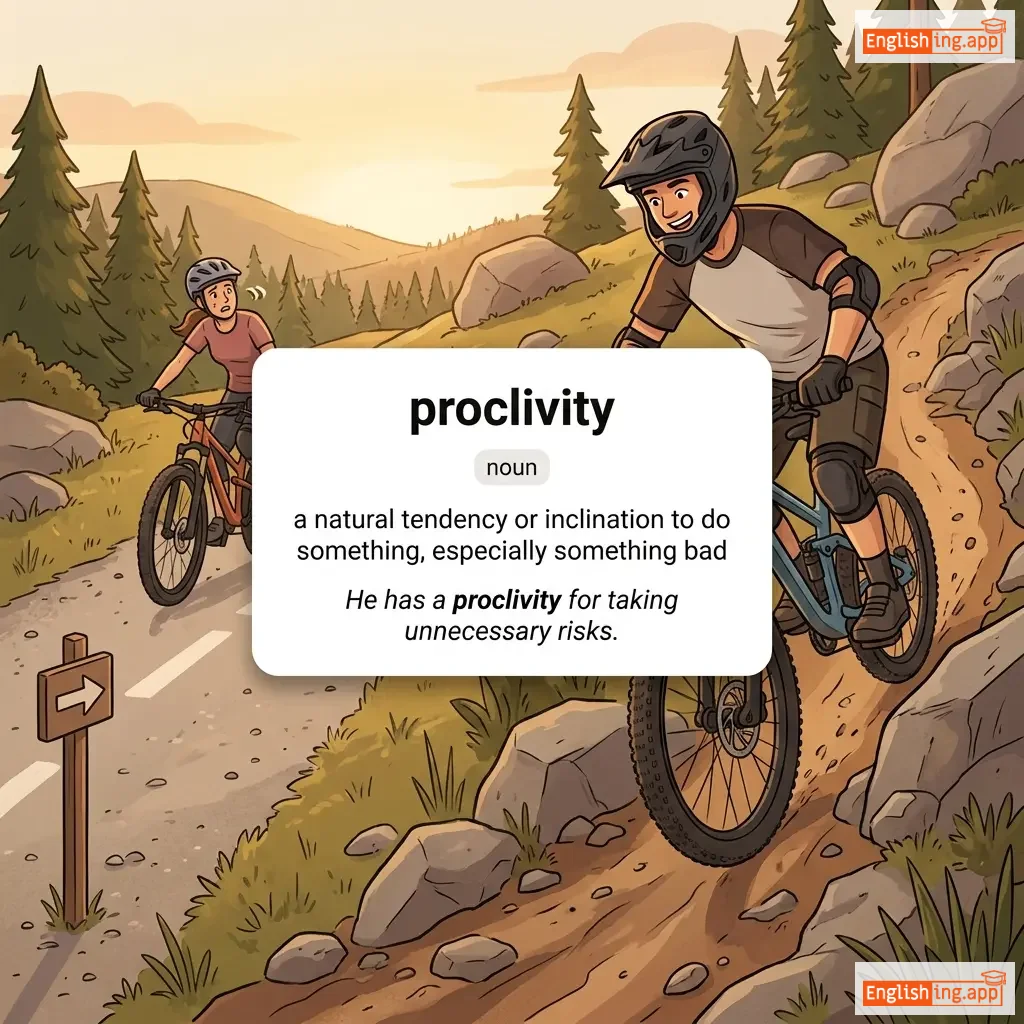
proclivity definition card — visual illustration of the meaning
noun C2
/prəˈklɪvɪti/
倾向 (qingxiang)

a natural tendency or inclination to do something, especially something bad

"He has a proclivity for taking unnecessary risks."

"他有冒险的倾向,尤其是做不必要的事情。" (Ta you maoxian de qingxiang, youqi shi zuo bu biyao de shiqing.)
noun C2
/ˌprɒdɪˈɡæləti/
挥霍 (huihuo)

the quality of being wastefully extravagant

"His prodigality with money left him bankrupt."

"他对金钱的挥霍让他破产。" (Ta dui jinqian de huihuo rang ta pochang.)
noun C2
/ˈprɑːflɪɡəsi/
挥霍 (huihuo)

reckless wastefulness or extravagance

"His profligacy with money led him to bankruptcy."

"他的挥霍导致了破产。" (Tā de huihuo dǎozhì le pòchǎn.)
adjective C2
/ˈprɑːflɪɡət/
挥霍无度 (huīhuò wúdù)

recklessly extravagant or wasteful in resources

"The king was known for his profligate lifestyle."

"国王以奢侈的生活方式而闻名。" (Guó wáng yǐ shēchǐ de shēnghuó fāngshì ér wénmíng.)
profundity definition card — visual illustration of the meaning
noun C2
/prəˈfʌndɪti/
深度 (shendù)

great depth of insight, knowledge, or emotion

"The essay impressed the judges with its clarity and profundity."

"这篇文章以其清晰度和深度打动了评委。" (Zhè piān wén zhāng yǐ qí qīng xī dù hé shēn dù dǎ dòng le píng wěi.)
noun C2
/prəˈfjuːʒən/
丰富 (fengfu)

an abundance or large quantity of something

"Spring brought a profusion of wildflowers to the valley."

"春天给山谷带来了大量的野花。" (Chūntiān gěi shāngǔ dàiláile dàliàng de yěhuā.)
noun C2
/proʊˈdʒɛnɪtər/
祖先 (zu xian)

a direct ancestor; a person or thing that originates something

"Researchers traced the custom back to a common progenitor."

"研究人员追溯了这个习俗,发现它源自一个共同的祖先。" (Yánjiū rényuán zhuīsùle zhège xísú, fāxiàn tā yuánzì yīgè gòngtóng de zǔxiān.)
adjective C2
/ˈprɒɡnəθəs/
前突颌骨 (qiántū hégǔ)

Having jaws that project forward beyond the rest of the face.

"The fossil displayed a distinctly prognathous skull structure."

"化石展示了一个明显的前突颌骨结构。" (Huàshí zhǎnshìle yīgè míngxiǎn de qiántū hégǔ jiégòu.)
verb C2
/prɒɡˈnɒstɪkeɪt/
预测 (yùcè)

To foretell or predict future events, especially based on current signs.

"Experts attempted to prognosticate the outcome of the election."

"专家们尝试预测选举结果。" (Zhuānjiāmen chángshì yùcè xuǎnjǔ jiéguǒ.)
noun C2
/prɒɡˌnɒstɪˈkeɪʃən/
预言 (yùyán)

The act of foretelling or predicting future events.

"The astrologer's prognostication fascinated the audience."

"占星师的预言吸引了观众。" (Zhānxīngshī de yùyán xīyǐnle guānzhòng.)
noun C2
/ˌproʊɪˈbɪʃənɪst/
禁酒主义者 (jìn jiǔ zhǔ yì zhě)

A person who supports or advocates prohibition, especially of alcohol.

"The prohibitionist campaigned against the sale of liquor in the town."

"禁酒主义者在城里反对酒类销售的运动。" (Jìn jiǔ zhǔ yì zhě zài chéng lǐ fǎn duì jiǔ lèi xiāo shòu de yùn dòng.)
adjective C2
/prəˈhɪbɪtɔːri/
禁止的 (jìnzhǐ de)

Serving or tending to prohibit or forbid.

"The prohibitory laws were strictly enforced in the region."

"禁止性的法律在该地区严格执行。" (Jìnzhǐ xìng de fǎlǜ zài gāi dìqū yángé zhíxíng.)
adjective C2
/ˈprəʊ.lɪks/
过于冗长 (guòyú rǒngcháng)

using too many words; tediously lengthy

"The professor’s prolix lecture put many students to sleep."

"教授冗长的讲座让许多学生打瞌睡。" (Jiàoshòu rǒngcháng de jiǎngzuò ràng xǔduō xuéshēng dǎ kēshuì.)
noun C2
/prəˈlɪksɪti/
冗长 (rǒngcháng)

the quality of being tediously wordy and long

"The book’s prolixity made it difficult to read in one sitting."

"这本书的冗长使得在一次阅读中读完变得困难。" (Zhè běn shū de rǒngcháng shǐ dé zài yīcì yuèdú zhōng dú wán biàn dé kùnnán.)
adjective C2
/ˈprɒmɪsəri/
承诺的 (chengnuo de)

Containing or conveying a promise, especially in writing.

"He signed a promissory note to repay the loan."

"他签署了还款承诺书。" (Ta qianshu le huankuan chengnuo shu.)
noun C2
/ˈprɒm.ən.tɔːr.i/
海角 (haijiao)

A high point of land or rock projecting into a body of water.

"The lighthouse stood on a promontory overlooking the sea."

"灯塔矗立在俯瞰大海的海角上。" (Dēngtǎ chùlì zài fǔkàn dàhǎi de hǎijiǎo shàng.)
verb C2
/ˈprɑː.məl.ɡeɪt/
发布 (fabu)

To announce or make a law, decree, or idea officially known.

"The government promulgated new regulations on data privacy."

"政府发布了关于数据隐私的新规定。" (Zhengfu fabu le guanyu shuju yinxi xin guiding.)
noun C2
/prɔːŋ/
叉子的尖端 (chā zi de jiān duān)

a projecting pointed part, such as one of the pointed ends of a fork

"The fork has four prongs."

"叉子有四个尖端。" (Chā zi yǒu sì gè jiān duān.)
adjective C2
/ˌprɒfɪˈlæktɪk/
预防性 (yùfángxìng)

intended to prevent disease or an unwanted outcome; protective

"The doctor prescribed a prophylactic treatment to prevent infection."

"医生开了预防性治疗以防止感染。" (Yīshēng kāi le yùfángxìng zhìliáo yǐ fángzhǐ rùnhòu.)
noun C2
/prəˈpɪŋkwɪti/
亲近 (qīnjìn)

the state of being close to someone or something; proximity

"The propinquity of their houses made them close friends."

"他们房屋的亲近使他们成为了亲密的朋友。" (Tāmen fángwū de qīnjìn shǐ tāmen chéngwéi le qīnmì de péngyǒu.)
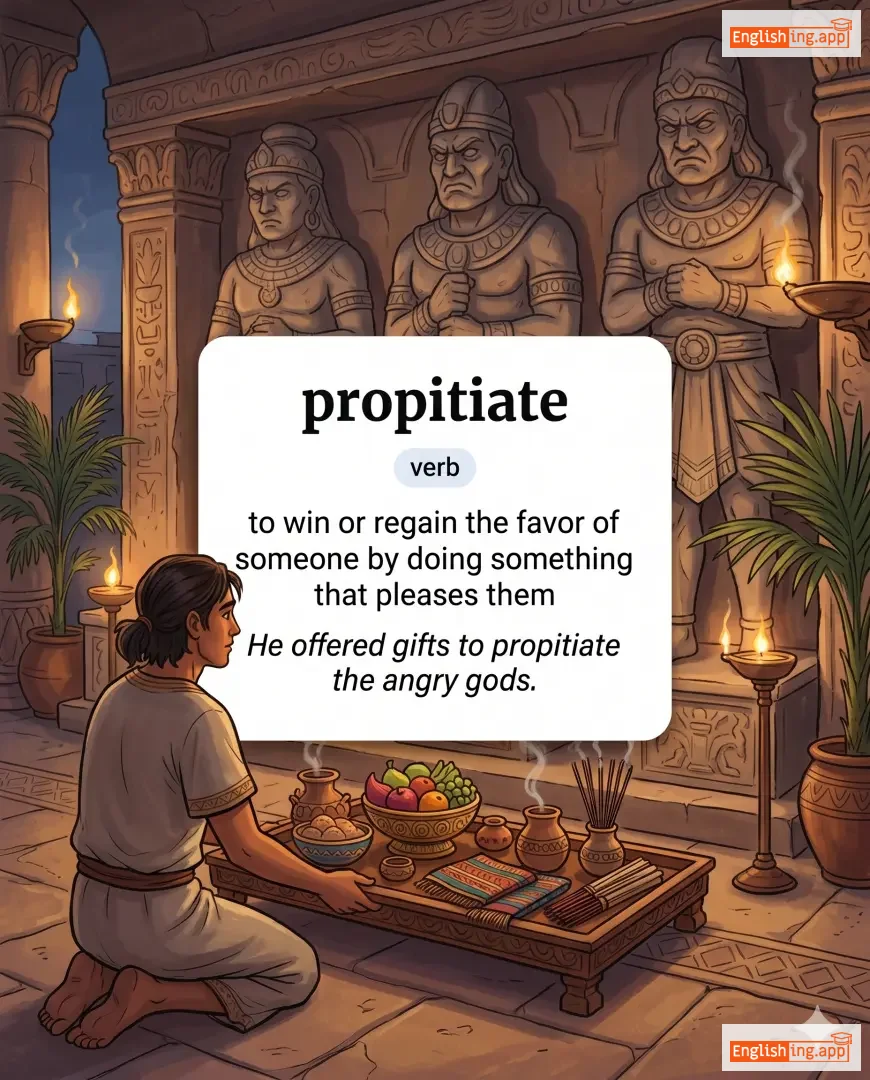
propitiate definition card — visual illustration of the meaning
verb C2
/prəˈpɪʃieɪt/
安抚 (ānfǔ)

to win or regain the favor of someone by doing something that pleases them

"He offered gifts to propitiate the angry gods."

"他提供礼物来安抚愤怒的神明。" (Tā tígōng lǐwù lái ānfǔ fènnù de shénmíng.)