Vocabularios

Descubra, aprenda y domine el vocabulario en inglés

noun C2
/ˌɒstɛnˈteɪʃən/
炫耀 (xuànyào)

excessive display of wealth or knowledge intended to attract admiration or envy

"The billionaire’s party was full of ostentation and luxury."

"亿万富翁的派对充满了炫耀和奢华。" (Yìwàn fùwēng de pàiduì chōngmǎnle xuànyào hé shēhuá.)
verb C2
/ˌaʊtməˈnuːvər/
巧妙地战胜 (qiǎo miào de zhàn shèng)

to gain an advantage over an opponent by skillful or clever action

"The smaller company managed to outmaneuver its larger rival."

"小公司成功地战胜了它的大对手。" (Xiǎo gōngsī chénggōng de zhànshèngle tā de dà duìshǒu.)
verb C2
/aʊtˈraɪd/
超越 (chaoyue)

to ride faster, farther, or better than someone else

"The young rider managed to outride his competitors in the race."

"年轻的骑手在比赛中成功超越了他的竞争对手。" (Nianqing de qishe zai bisai zhong chenggong chaoyue le tade jingzheng duishou.)
noun C2
/ˈaʊtˌrɪɡər/
稳定结构 (wěndìng jiégòu)

a projecting structure on a boat, used for stability, or a boat fitted with such support

"The fisherman paddled his outrigger canoe across the lagoon."

"渔民划着带有支撑的独木舟穿过泻湖。" (Yúmín huázhe dàiyǒu zhīchēng de dúmùzhōu chuānguò xiè hú.)
verb C2
/ˌoʊvərˈliːp/
跳过 (tiaoguo)

To jump over something; to omit or disregard something.

"He managed to overleap the fence easily."

"他轻松地越过了栅栏。" (Ta qingsong de yueguo le zhalan.)
Overlet definition card — visual illustration of the meaning
noun C2
/ˈoʊ.vər.let/
床垫 (chuángdiàn)

a thin mattress or pad placed over a bed for additional comfort

"The overlet makes the bed more comfortable to sleep on."

"欧弗雷特使床铺更适合睡觉。" (Ōufúlèitè shǐ chuáng pù gèng shìhé shuìjiào.)
noun C2
/ˈoʊvərlɔːrd/
领主 (lingzhu)

A ruler, master, or person of great power and authority over others.

"The peasants were forced to pay taxes to their overlord."

"农民被迫向他们的领主交税。" (Nongmin bei po xiang tamen de lingzhu jiao shui.)
verb C2
/ˌoʊvərˈstraɪd/
跨越大步走 (kuà yuè dà bù zǒu)

To stride over something; to step across with long steps.

"He managed to overstride the narrow stream with ease."

"他轻松地跨越了狭窄的溪流。" (Tā qīngsōng de kuàyuèle xiázhǎi de xīliú.)
adjective C2
/ˌoʊvərˈwiːnɪŋ/
过度自负 (guòdù zìfù)

excessively arrogant or prideful

"His overweening pride cost him many friends."

"他过度的自豪让他失去了许多朋友。" (Tā guòdù de zìháo ràng tā shīqùle xǔduō péngyǒu.)
adjective C2
/ˈoʊ.vɔɪd/
卵形 (luanxing)

egg-shaped; resembling an oval or ellipse

"The artist painted an ovoid shape in the center of the canvas."

"艺术家在画布中心画了一个卵形的形状。" (Yishujia zai huabu zhongxin hua le yige luanxing de xingzhuang.)
noun C2
/ˈpæk.ɪ.dɜːrm/
具有厚皮的大型哺乳动物 (jùyǒu hòu pí de dàxíng bǔrǔ dòngwù)

a large mammal with thick skin, such as an elephant, rhinoceros, or hippopotamus

"The zoo had several pachyderms, including elephants and rhinos."

"动物园里有几只厚皮兽,包括大象和犀牛。" (dòngwùyuán lǐ yǒu jǐ zhī hòu pí shòu, bāokuò dàxiàng hé xīniú.)
noun C2
/ˈpɑːdreɪ/
神父 (shenfu)

A title for a priest, especially in the Roman Catholic Church; also used informally for 'father'.

"The soldiers attended mass led by the padre."

"士兵们参加了由神父主持的弥撒。" (Shibing men canjia le you shenfu zhuchi de misa.)
noun C2
/ˈpiːən/
颂歌 (song ge)

A song or piece of writing expressing great praise or triumph.

"The article was a paean to the beauty of nature."

"这篇文章是对大自然美丽的颂歌。" (Zhe pian wen zhang shi dui da zi ran mei li de song ge.)
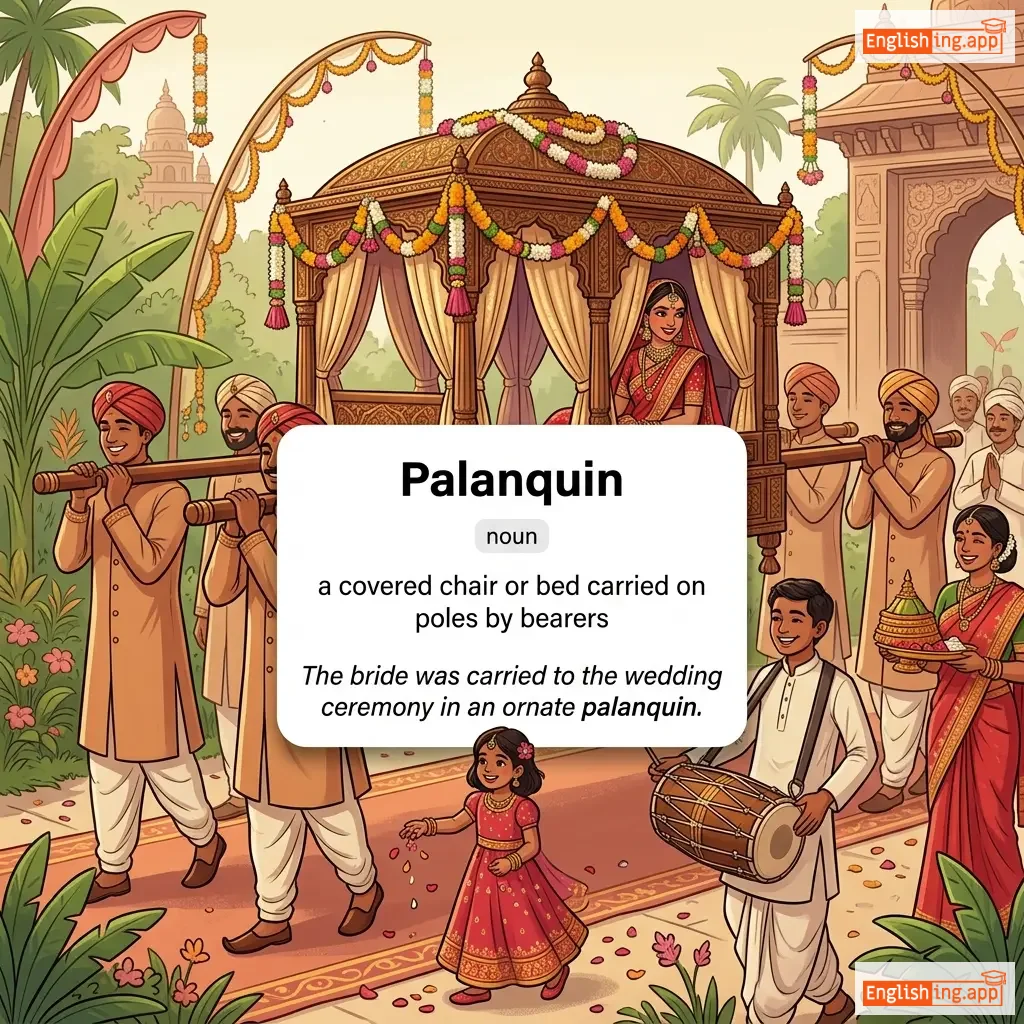
Palanquin definition card — visual illustration of the meaning
noun C2
/ˌpæl.ənˈkiːn/
花轿 (huā jiào)

a covered chair or bed carried on poles by bearers

"The bride was carried to the wedding ceremony in an ornate palanquin."

"新娘在装饰华丽的轿子中被抬到婚礼现场。" (Xīnniáng zài zhuāngshì huálì de jiàozǐ zhōng bèi tái dào hūnlǐ xiànchǎng.)
noun C2
/pəˈlæv.ər/
无意义的讨论 / 喧嚣 (wú yìyì de tǎolùn / xuānxiāo)

prolonged and idle discussion; fuss or unnecessary talk

"After much palaver, they finally agreed on the plan."

"经过长时间的无意义讨论后,他们最终同意了计划。" (Jīngguò cháng shíjiān de wú yìyì tǎolùn hòu, tāmen zuìzhōng tóngyìle jìhuà.)
noun C2
/ˈpælɪmpsɛst/
重写本 (chongxie ben)

a manuscript or document that has been written over but still bears traces of earlier writing; something reused or altered but still retaining traces of its earlier form

"The ancient manuscript was a palimpsest, showing faint traces of previous texts beneath the new writing."

"这本古老的手稿是一个重写本,下面隐藏着以前文本的微弱痕迹。" (Zhè běn gǔlǎo de shǒugǎo shì yīgè zhòngxiě běn, xiàmiàn yǐncáng zhe yǐqián wénběn de wēiruò hénjī.)
noun C2
/ˈpælɪˌnoʊd/
悔诗 (huǐshī)

a poem or statement in which the writer retracts something said in an earlier work

"The poet wrote a palinode to apologize for his earlier harsh words."

"诗人写了一首悔诗,为自己之前的尖锐言辞道歉。" (Shīrén xiěle yī shǒu huǐshī, wèi zìjǐ zhīqián de jiānruì yáncí dàoqiàn.)
verb C2
/ˈpælieɪt/
缓解 (huǎn jiě)

to make a disease, symptoms, or problem less severe without removing the cause

"The doctor prescribed medicine to palliate the patient's pain."

"医生开药来缓解病人的疼痛。" (Yīshēng kāi yào lái huǎn jiě bìngrén de téngtòng.)
noun C2
/ˌpæliˈeɪʃən/
缓解 (huǎnxiè)

relief of symptoms without curing the underlying disease or problem

"Palliation is often the focus of care for terminally ill patients."

"缓解通常是末期患者护理的主要重点。" (huǎnxiè tōngcháng shì mòqī huànzhě hùlǐ de zhǔyào zhòngdiǎn)
adjective C2
/ˈpɑːmi/
繁荣 / 荣耀 (fánróng / róngyào)

prosperous, flourishing, or relating to palm trees

"He often reminisced about the palmy days of his youth."

"他经常回忆起年轻时的繁荣日子。" (Tā jīngcháng huíyì qǐ niánqīng shí de fánróng rìzi.)
verb C2
/ˈpælpɪˌteɪt/
快速跳动 (kuài sù tiào dòng)

to beat rapidly and strongly, often because of fear, excitement, or illness

"Her heart began to palpitate with fear."

"她的心脏因恐惧开始剧烈跳动。" (Tā de xīn zàng yīn kǒng jù kāi shǐ jù liè tiào dòng.)
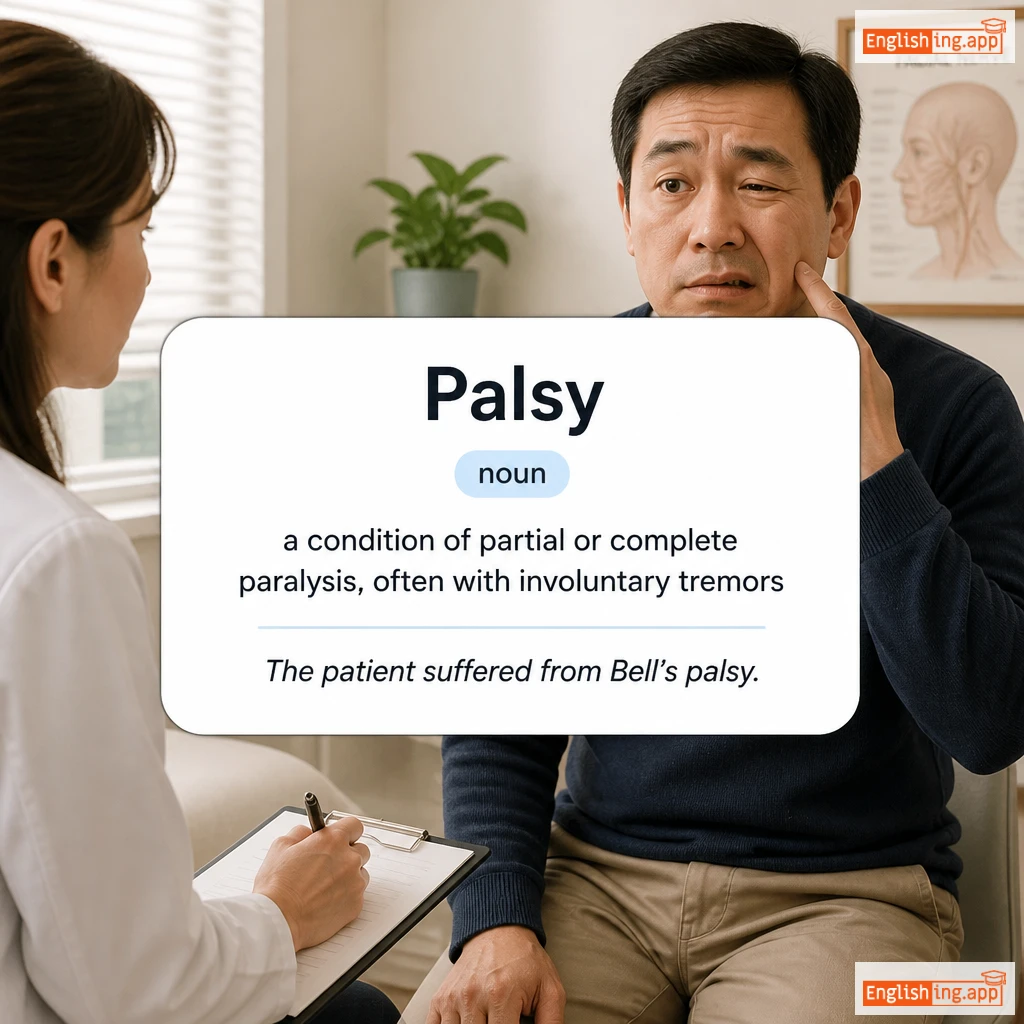
Palsy definition card — visual illustration of the meaning
noun C2
/ˈpɔːlzi/
麻痹 (mábì)

a condition of partial or complete paralysis, often with involuntary tremors

"The patient suffered from Bell’s palsy."

"病人患有贝尔麻痹。" (Bìngrén huàn yǒu bèi'ěr mábì.)
verb C2
/ˈpɔːltər/
含糊其辞,欺骗 (hángu qí cí, qīpiàn)

to act insincerely or deceitfully; to equivocate or lie

"He paltered when asked about his involvement in the deal."

"当被问及是否参与交易时,他回避了问题。" (Dāng bèi wènjí shìfǒu cānyù jiāoyì shí, tā huíbìle wèntí.)
adjective C2
/ˈpeɪli/
条纹的 (tiaowen de)

striped with different colors, usually used in heraldry

"The knight’s shield was decorated with paly stripes of red and gold."

"骑士的盾牌上装饰着红色和金色的条纹。" (Qishi de dunpai shang zhuangshizhe hongse he jinse de tiaowen.)
noun, verb C2
/ˌpæm.fləˈtɪər/
小册子作者 (xiaocenzi zuozhe)

a person who writes or distributes pamphlets, often to promote a political or social cause

"In the 18th century, many pamphleteers influenced public opinion."

"18世纪,许多小册子作者影响了公众舆论。" (18 shiji, xuduo xiaocenzi zuozhe yingxiang le gongzhong yulun.)
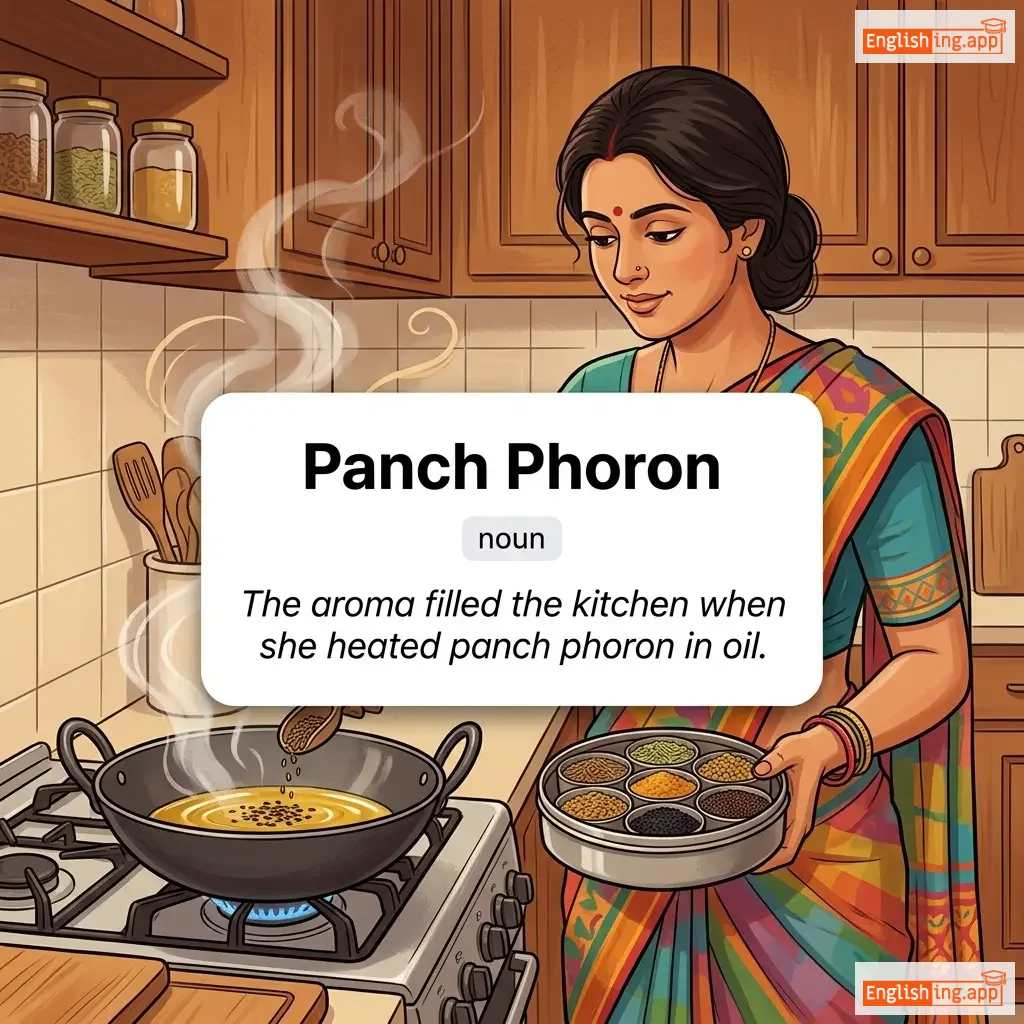
Panch Phoron definition card — visual illustration of the meaning
noun C2
/pʌntʃ ˈfoʊrən/
五香粉 (wǔ xiāng fěn)

a Bengali spice blend containing five whole spices: cumin, fennel, fenugreek, nigella, and mustard seeds

"The aroma filled the kitchen when she heated panch phoron in oil."

"当她在油中加热五香粉时,香气充满了厨房。" (dāng tā zài yóu zhōng jiārè wǔ xiāng fěn shí, xiāngqì chōngmǎnle chúfáng.)
noun C2
/ˌpænəˈdʒɪrɪk/
赞美诗, 颂辞 (zanmei shi, songci)

a formal speech or piece of writing in praise of someone or something

"The author wrote a panegyric on the bravery of the soldiers."

"作者写了一篇关于士兵英勇的潘尼吉里克。" (Zuòzhě xiěle yī piān guānyú shìbīng yīngyǒng de pānníjílǐkè.)
/ˈpæn.ə.pli/
全套装备 (quán tào zhuāng bèi)

A complete or impressive collection of things; a full set of armor.

"The museum displayed a panoply of ancient weapons."

"博物馆展示了一套古代武器的全套装备。" (Bówùguǎn zhǎnshìle yī tào gǔdài wǔqì de quántào zhuāngbèi.)
noun C2
/ˈpæn.θi.ɪ.zəm/
泛神论 (fàn shén lùn)

The belief that God and the universe are identical, or that everything is a manifestation of God.

"Spinoza’s philosophy is often associated with pantheism."

"斯宾诺莎的哲学常与泛神论相关联。" (Sī bīn nuò shā de zhéxué cháng yǔ fàn shén lùn xiāngguān lián.)
noun C2
/ˈpæntəˌskoʊp/
提供广泛或全景视图的光学仪器 (tigong guangfan huo quanjing shitu de guangxue yiqi)

An optical instrument that provides a wide or panoramic view.

"The scientist used a pantoscope to observe the entire horizon."

"科学家使用全景镜观察整个地平线。" (Kexuejia shiyong quanjingjing guancha zhengge dipingxian.)
noun C2
/ˈpeɪpəsi/
教皇职位 (jiàohuáng zhíwèi)

The office or authority of the Pope in the Roman Catholic Church.

"The papacy played a significant role in medieval European politics."

"教皇职位在中世纪欧洲政治中发挥了重要作用。" (Jiàohuáng zhíwèi zài zhōng shìjì Ōuzhōu zhèngzhì zhōng fāhuīle zhòngyào zuòyòng.)
adjective C2
/ˌpærəˈdɪɡmətɪk/
典范的 (diǎnfàn de)

Serving as a typical example or model of something.

"Her success story is paradigmatic of the opportunities education can provide."

"她的成功故事是教育可以提供的机会的典范。" (Tā de chénggōng gùshì shì jiàoyù kěyǐ tígōng de jīhuì de diǎnfàn.)
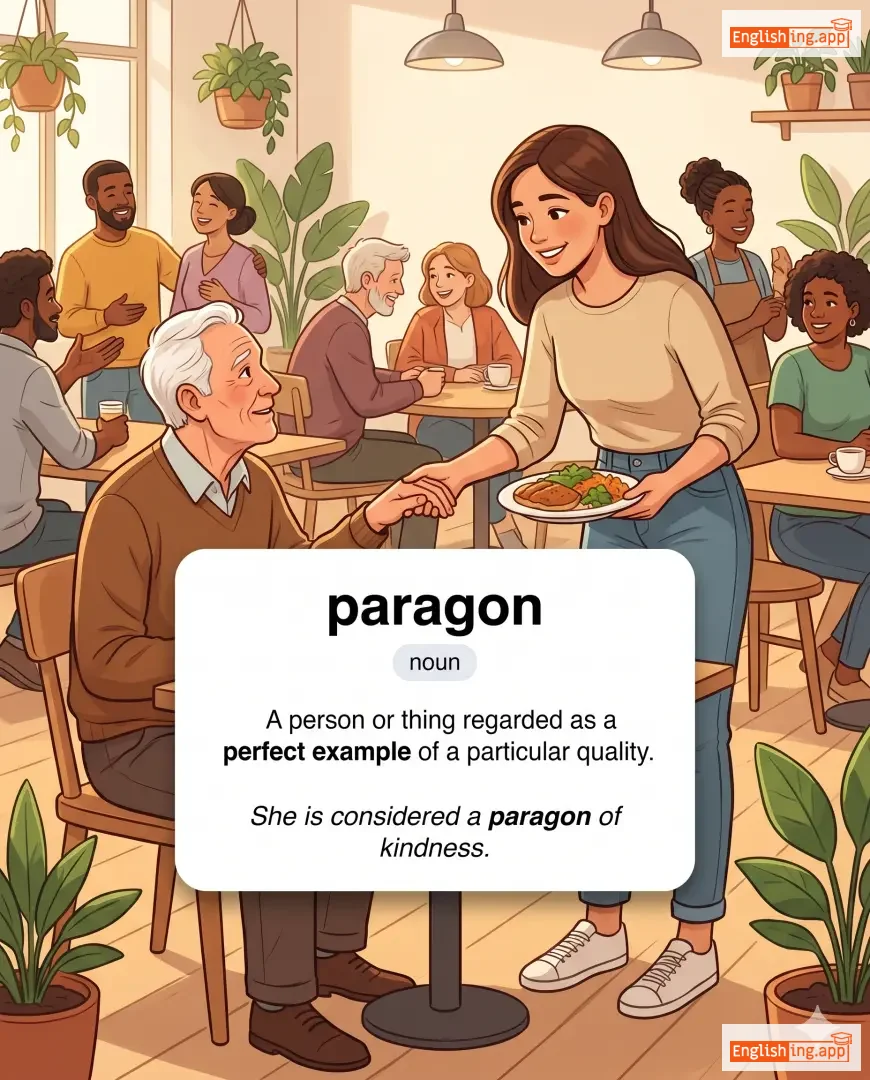
paragon definition card — visual illustration of the meaning
noun C2
/ˈpærəɡɒn/
典范 (dianfan)

A person or thing regarded as a perfect example of a particular quality.

"She is considered a paragon of kindness."

"她被认为是善良的典范。" (Ta bei renwei shi shanliang de dianfan.)
noun C2
/ˈpærəmʊr/
情人 (qingren)

a lover, especially an illicit one

"The secret paramour was finally revealed."

"秘密情人终于被揭露。" (Mìmì qíngrén zhōngyú bèi jiēlù.)
noun C2
/ˌpærəˈnɔɪæk/
偏执的人 (piān zhí de rén)

A person who suffers from paranoia or exhibits extreme, irrational distrust and suspicion.

"The paranoiac refused to leave his house, fearing everyone was against him."

"这个偏执的人拒绝离开家,因为他害怕每个人都反对他。" (Zhè gè piān zhí de rén jù jué lí kāi jiā, yīnwèi tā hài pà měi gè rén dōu fǎn duì tā.)
noun C2
/ˈpærəpɛt/
防护墙 (fanghu qiang)

A low protective wall along the edge of a roof, balcony, or bridge.

"The soldier hid behind the parapet for protection."

"士兵躲在防护墙后面以保障安全。" (Shibing duozai fanghu qiang houmian yi baozhang anquan.)
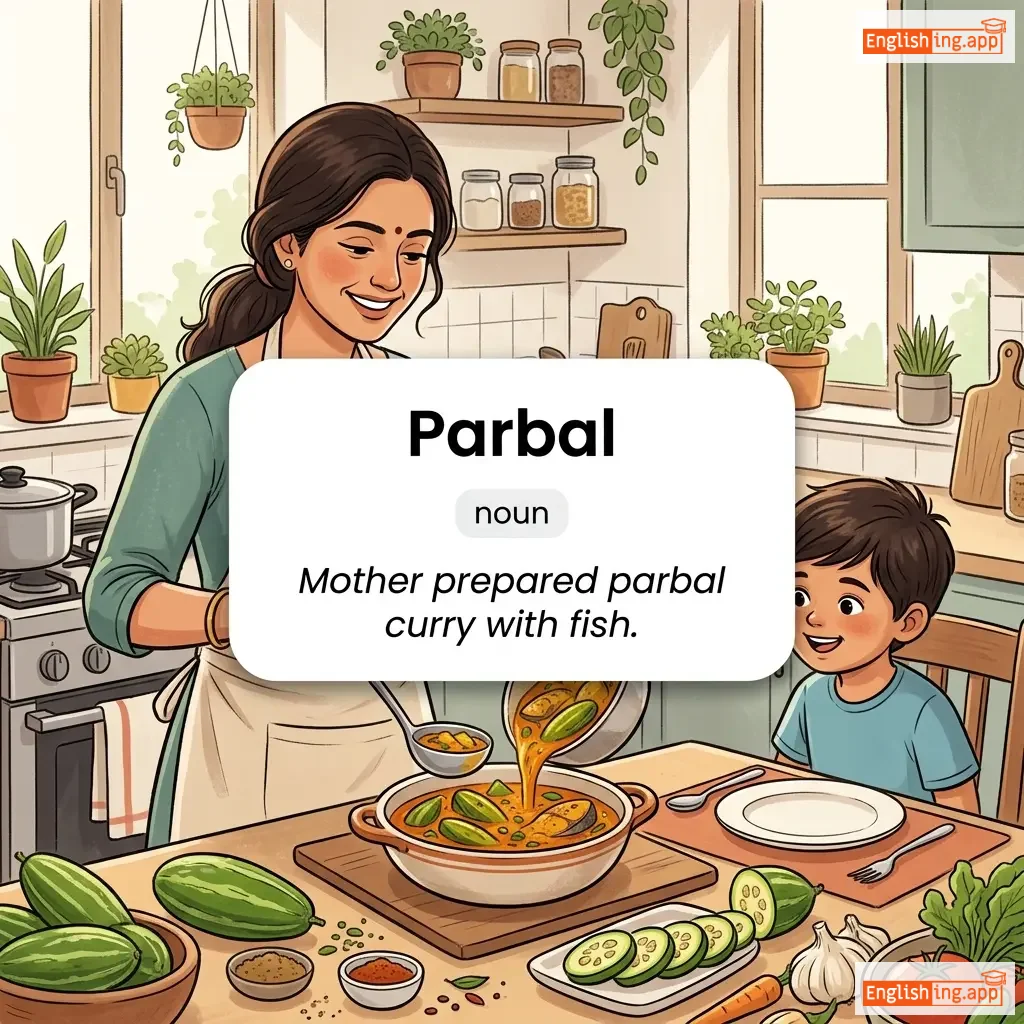
Parbal definition card — visual illustration of the meaning
noun C2
/ˈpɑr.bəl/
尖瓜 (jian gua)

A green vegetable also known as pointed gourd, commonly used in South Asian cuisine

"Mother prepared parbal curry with fish."

"母亲做了带鱼的尖瓜咖喱。" (Mǔqīn zuòle dài yú de jiān guā gālí)
verb C2
/pɑːrtʃ/
使干燥 (shi ganzao)

to make something extremely dry, especially by exposure to heat

"The scorching sun began to parch the fields."

"炙热的太阳开始把田地弄干。" (Zhire de taiyang kaishi ba tiandi nong gan.)
noun C2
/ˌpærəˈɡɔːrɪk/
含鸦片的药物 (hán yāpiàn de yàowù)

a medicine containing opium, once used to relieve pain and diarrhea

"Doctors once prescribed paregoric to treat diarrhea in children."

"医生曾经开具帕雷戈里克来治疗儿童的腹泻。" (Yīshēng céngjīng kāijù Pàléigēlìkè lái zhìliáo értóng de fùxiè.)
adjective C2
/ˌpɛrənˈθɛtɪkəl/
括号中的评论 (kuòhào zhōng de pínglùn)

Relating to or expressed in parentheses; a side remark or digression.

"He added a parenthetical comment during the lecture."

"他在讲座期间添加了一个括号中的评论。" (Tā zài jiǎngzuò qījiān tiānjiāle yīgè kuòhào zhōng de pínglùn.)
noun C2
/ˈpɑːrləns/
行话 (xínghuà)

a particular way of speaking or using words, common to a group

"In legal parlance, the term has a different meaning."

"在法律行话中,这个术语有不同的含义。" (Zài fǎlǜ xínghuà zhōng, zhège shùyǔ yǒu bùtóng de hányì.)
noun, verb C2
/ˈpɑːrli/
谈判 (tánpàn)

a discussion between opposing sides, especially to negotiate terms

"The generals met to parley over the terms of surrender."

"将军们会面商讨投降的条件。" (Jiāngjūnmen huìmiàn shāngtǎo tóuxiáng de tiáojiàn.)
adjective C2
/ˈpɑːrləs/
危险的 (parlus)

Full of danger or risk; precarious.

"The company is in a parlous financial state."

"公司处于一个危险的财政状态。" (Gōngsī chǔyú yīgè wéixiǎn de cáizhèng zhuàngtài.)
adjective C2
/pəˈrɒnɪməs/
同源词 (tóng yuán cí)

Words that are derived from the same root or sound alike.

"The words 'effect' and 'effective' are paronymous."

"‘Effect’ 和 ‘Effective’ 是同源词。" ('Effect' hé 'Effective' shì tóng yuán cí.)
noun C2
/ˈpær.əkˌsɪz.əm/
突如其来的爆发 (tū rútí lái de bào fā)

A sudden, violent outburst of emotion or activity.

"She was seized by a paroxysm of laughter."

"她被一阵突如其来的笑声席卷。" (Tā bèi yī zhèn tū rútí lái de xiàoshēng xíjuǎn.)
noun C2
/ˈpɑːr.kə.tri/
铺设镶木地板的艺术 (pùshè xiāng mù dìbǎn de yìshù)

The art or technique of laying parquet floors.

"The craftsman specialized in parquetry for luxury homes."

"工匠专门为豪华住宅铺设镶木地板。" (Gōngjiàng zhuānmén wèi háohuá zhùzhái pùshè xiāng mù dìbǎn.)
noun C2
/ˈpær.ɪ.saɪd/
弑亲 (shiqin)

The act of killing one's father, mother, or other close relative.

"The court tried him for parricide after the tragic incident."

"法院在悲剧事件后以弑亲罪审判了他。" (Fayuan zai beiju shijian hou yi shiqin zui shenpan le ta.)
adjective C2
/ˌpɑːrsɪˈmoʊniəs/
吝啬 (lìn sè)

unwilling to spend money or use resources; stingy

"The company was too parsimonious to invest in better equipment."

"公司太吝啬,无法投资更好的设备。" (Gōngsī tài lìnsè, wúfǎ tóuzī gèng hǎo de shèbèi.)
noun C2
/ˈpɑːrsɪmoʊni/
吝啬 (lin se)

extreme unwillingness to spend money or use resources

"His parsimony was evident in the way he avoided any unnecessary expenses."

"他避免任何不必要的开支的方式明显体现了他的吝啬。" (Ta bi mian ren he bu bi yao de kai zhi de fang shi ming xian ti xian le ta de lin se.)
adjective C2
/ˈpɑːrtəbl/
可分割的 (kě fēn gē de)

capable of being divided or separated

"The estate was partible among the heirs."

"这项财产可以在继承人之间分割。" (Zhè xiàng cáichǎn kě yǐ zài jìchéngrén zhī jiān fēn gē.)