Vocabularios

Descubra, aprenda y domine el vocabulario en inglés

adjective C2
/ɪmˈpruːdənt/
imprudente (imprudente)

Not showing care for the consequences of an action.

"It was imprudent to drive in such stormy weather."

"Era imprudente conducir en un clima tan tormentoso." (Era imprudente conducir en un clima tan tormentoso.)
noun C2
/ˈɪmpjʊdəns/
desvergüenza (desverguenza)

Rude and disrespectful behavior.

"The student's impudence shocked the entire class."

"La desvergüenza del estudiante sorprendió a toda la clase." (La desverguenza del estudiante sorprendió a toda la clase.)
verb C2
/ɪmˈpjuːn/
disputar la verdad, validez o honestidad de una declaración o motivo (disputar la verdad, validez o honestidad de una declaracion o motivo)

to dispute the truth, validity, or honesty of a statement or motive

"The lawyer tried to impugn the credibility of the witness."

"El abogado intentó impugnar la credibilidad del testigo." (El abogado intento impugnar la credibilidad del testigo.)
noun C2
/ɪmˈpjuːɪsəns/
impotencia, incapacidad (impotencia, incapacidad)

inability to take effective action; helplessness

"The government’s impuissance in the face of crisis frustrated the people."

"La impotencia del gobierno ante la crisis frustró al pueblo." (La impotencia del gobierno ante la crisis frustro al pueblo.)
noun C2
/ɪmˈpʌlʃən/
impulso (impulsion)

a strong urge or drive to act; the act of impelling

"His impulsion to travel made him leave his job suddenly."

"Su impulso de viajar lo llevó a dejar su trabajo de repente." (Su impulso de viajar lo llevo a dejar su trabajo de repente)
noun C2
/ɪmˈpjuːnɪti/
impunidad (impunidad)

freedom from punishment or harmful consequences for an action

"The dictator ruled with impunity, ignoring international laws."

"El dictador gobernó con impunidad, ignorando las leyes internacionales." (El dictador gobernó con impunidad, ignorando las leyes internacionales.)
noun C2
/ˌɪmpjuˈteɪʃən/
imputación (imputacion)

an accusation or attribution of blame

"The politician denied the imputation of corruption."

"El político negó la imputación de corrupción." (El politico nego la imputacion de corrupcion.)
verb C2
/ɪmˈpjuːt/
imputar (imputar)

to attribute a fault or responsibility to someone

"They imputed the company's success to good leadership."

"Ellos imputaron el éxito de la empresa a un buen liderazgo." (Ellos imputaron el éxito de la empresa a un buen liderazgo.)
noun C2
/ˌɪnədˈvɜːrtəns/
descuido (descuido)

Failure to pay attention; carelessness.

"The error happened through sheer inadvertence."

"El error ocurrió por pura inadvertencia." (El error ocurrio por pura inadvertencia.)
adjective C2
/ɪnˈeɪliənəbl/
inalienable (inalienable)

Unable to be taken away or transferred; absolute and permanent.

"Freedom of speech is an inalienable right."

"La libertad de expresión es un derecho inalienable." (La libertad de expresion es un derecho inalienable.)
noun C2
/ˌɪnəməˈrɑːtə/
amante (amante)

A woman with whom someone is in love; a female lover.

"He wrote a poem dedicated to his inamorata."

"Escribió un poema dedicado a su enamorada." (Escribio un poema dedicado a su enamorada.)
noun C2
/ɪˈnænɪti/
tonterías, necedades (tonterias, necedades)

a nonsensical remark or action; silliness; emptiness

"The speech was full of inanities that bored the audience."

"El discurso estaba lleno de tonterías que aburrían a la audiencia." (El discurso estaba lleno de tonterías que aburrían a la audiencia.)
adjective C2
/ˌɪnæprɪˈhɛnsəbl/
incomprensible (incomprensible)

not understandable; incomprehensible

"The concept was so abstract that it seemed inapprehensible to most students."

"El concepto era tan abstracto que parecía incomprensible para la mayoría de los estudiantes." (El concepto era tan abstracto que parecía incomprensible para la mayoría de los estudiantes.)
adjective C2
/ɪnˈæpt/
inapropiado (inapropiado)

not suitable or appropriate in the circumstances

"His inapt choice of words offended many people."

"Su elección inapropiada de palabras ofendió a muchas personas." (Su eleccion inapropiada de palabras ofendió a muchas personas.)
adverb C2
/ˌɪnəzˈmʌtʃ/
en la medida en que (en la medida en que)

To the extent that; considering that.

"Inasmuch as you are their teacher, you should guide them carefully."

"En la medida en que eres su maestro, deberías guiarlos cuidadosamente." (En la medida en que eres su maestro, deberías guiarlos cuidadosamente.)
conjunction C2
/ˌɪnəzˈmʌtʃ æz/
ya que (ya que)

Because; since.

"He cannot attend, inasmuch as he is unwell."

"Él no puede asistir, ya que está enfermo." (Él no puede asistir, ya que está enfermo.)
adjective C2
/ˌɪnɔːˈspɪʃəs/
desafortunado (desafortunado)

Not conducive to success; unpromising or unlucky.

"The event began under inauspicious circumstances."

"El evento comenzó bajo circunstancias desfavorables." (El evento comenzo bajo circunstancias desfavorables.)
adjective C2
/ˈɪnˌbrɛd/
innato (innato)

existing naturally in a person or animal; also related to reproduction within a limited community

"He has an inbred sense of loyalty."

"Él tiene un sentido innato de lealtad." (El tiene un sentido innato de lealtad.)
noun C2
/ˌɪnkænˈdɛsəns/
incandescencia (incandescencia)

the emission of light from a hot object; brilliance

"The incandescence of the candle filled the dark room."

"La incandescencia de la vela llenó la habitación oscura." (La incandescencia de la vela lleno la habitacion oscura.)
adjective C2
/ˌɪnkænˈdɛsənt/
incandescente (incandescente)

emitting light as a result of being heated; extremely bright or passionate

"The incandescent lamp lit up the entire hall."

"La lámpara incandescente iluminó todo el salón." (La lámpara incandescente iluminó todo el salón.)
noun C2
/ˌɪnkænˈteɪʃən/
encantación (encantacion)

a series of words used as a magic spell or charm

"The wizard chanted an incantation to summon the spirits."

"El mago recitó una encantación para invocar los espíritus." (El mago recito una encantacion para invocar los espiritus.)
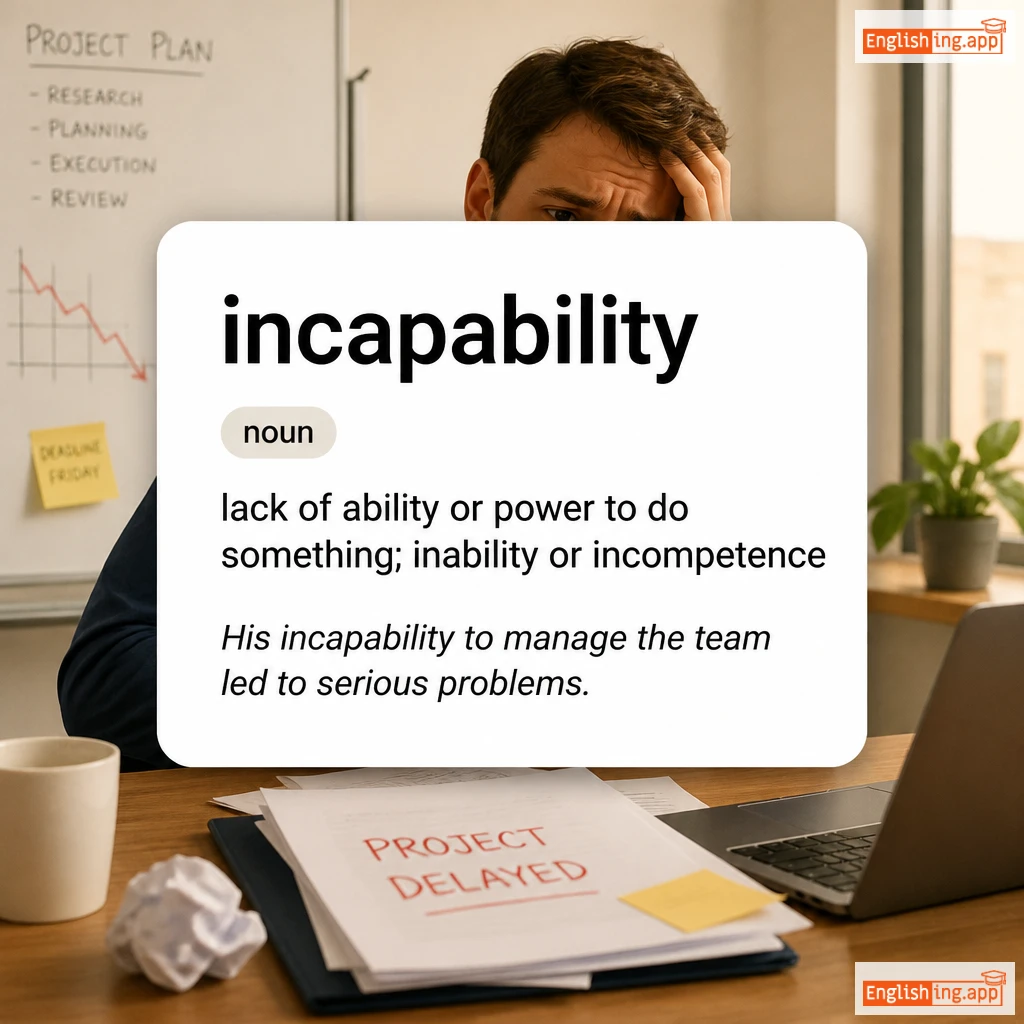
incapability definition card — visual illustration of the meaning
noun C2
/ˌɪnˌkeɪpəˈbɪləti/
incapacidad (incapacidad)

lack of ability or power to do something; inability or incompetence

"His incapability to manage the team led to serious problems."

"Su incapacidad para gestionar el equipo provocó problemas graves." (su incapacidad para gestionar el equipo provoco problemas graves)
verb C2
/ˌɪnkəˈpæsɪteɪt/
incapacitar (incapacitar)

to deprive someone or something of the ability or strength to function

"The severe injury incapacitated the player for the rest of the season."

"La grave lesión incapacitó al jugador para el resto de la temporada." (La grave lesion incapacito al jugador para el resto de la temporada.)
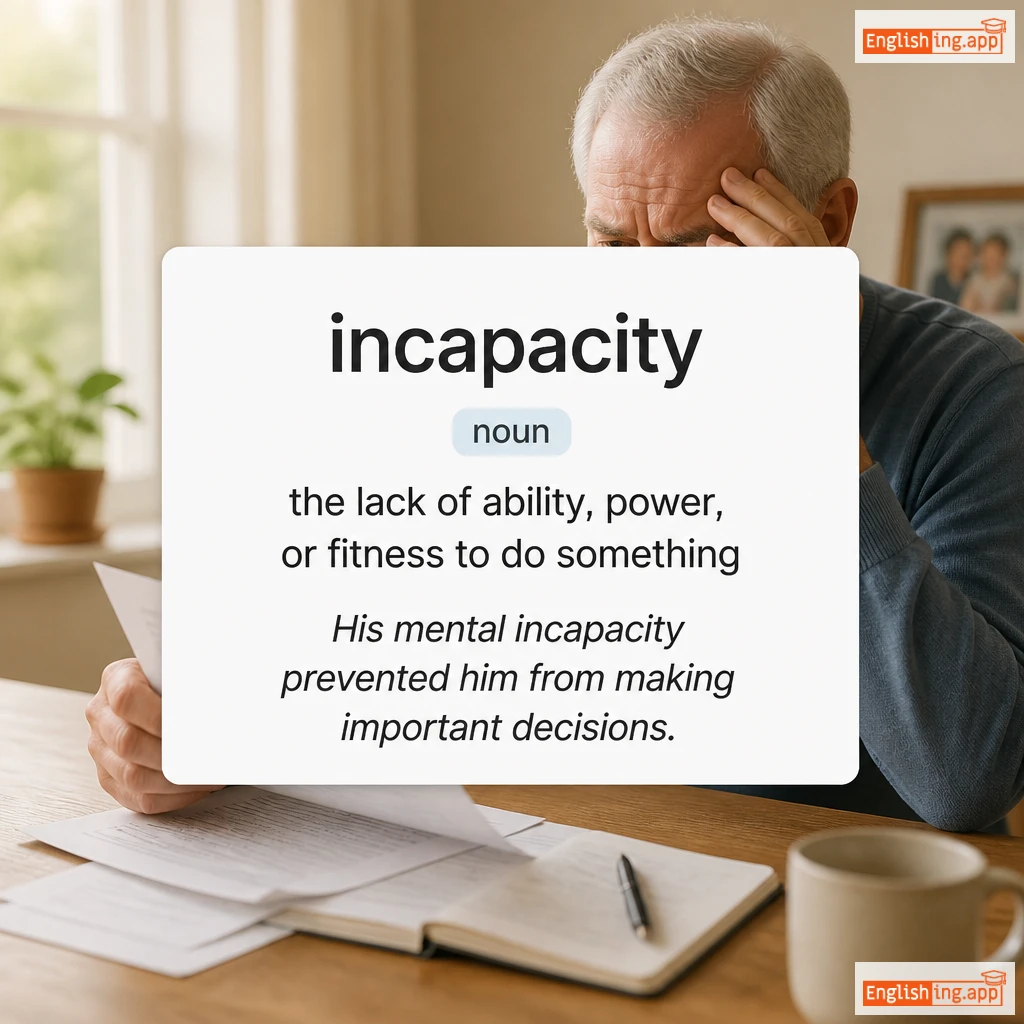
incapacity definition card — visual illustration of the meaning
noun C2
/ˌɪnkəˈpæsəti/
incapacidad (incapacidad)

the lack of ability, power, or fitness to do something

"His mental incapacity prevented him from making important decisions."

"Su incapacidad mental le impidió tomar decisiones importantes." (Su incapacidad mental le impidió tomar decisiones importantes.)
adjective/noun C2
/ɪnˈkɑːrnədiːn/
rojo intenso (rojo intenso)

a bright crimson or pinkish-red color

"The sky turned incarnadine at sunset."

"El cielo se tornó rojo intenso al atardecer." (El cielo se tornó rojo intenso al atardecer.)
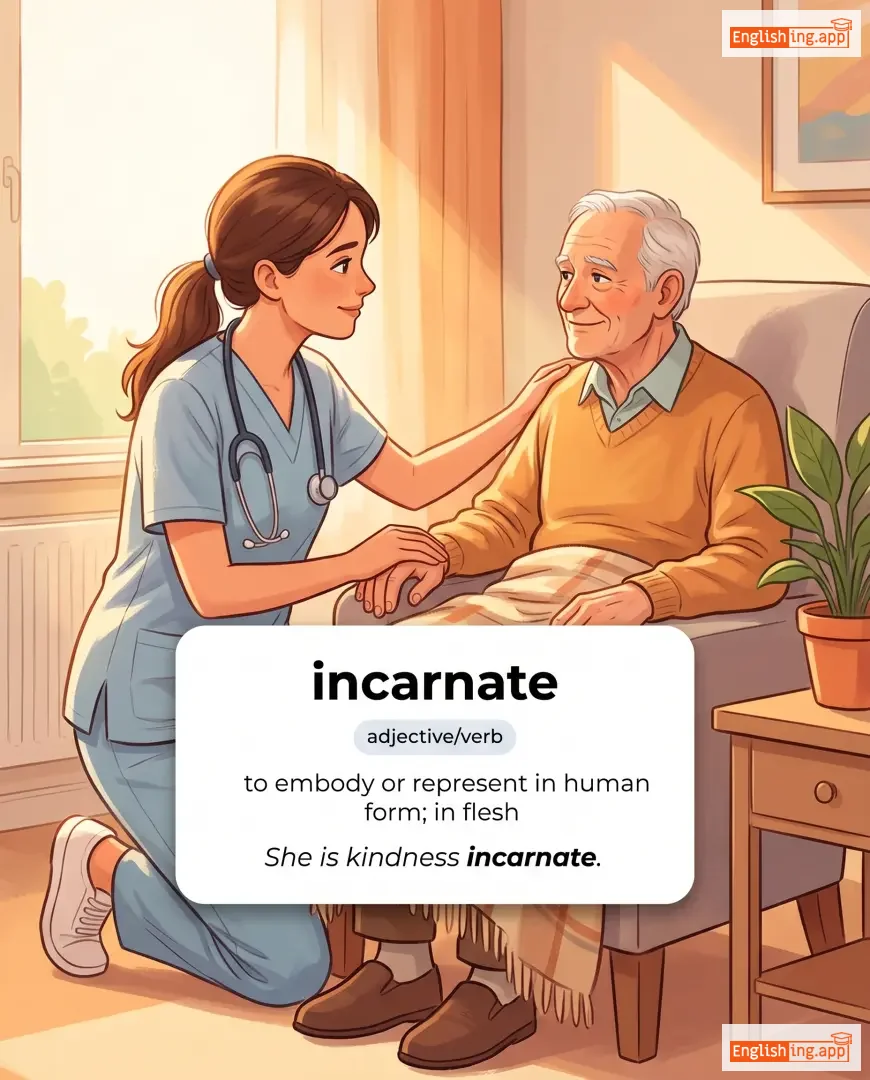
incarnate definition card — visual illustration of the meaning
adjective/verb C2
/ɪnˈkɑːrneɪt/
encarnado (encarnado)

to embody or represent in human form; in flesh

"She is kindness incarnate."

"Ella es la bondad encarnada." (Ella es la bondad encarnada.)
adjective C2
/ɪnˈsɛndiˌɛri/
incendiario / provocador (incendiario / provocador)

designed to cause fires or stir up conflict

"The politician’s incendiary remarks angered the crowd."

"Las declaraciones incendiarias del político enfurecieron a la multitud." (Las declaraciones incendiarias del politico enfurecieron a la multitud.)
adjective C2
/ɪnˈsɛptɪv/
inicial (inicial)

Relating to or marking the beginning or initial stage of something.

"The inceptive phase of the project was marked by enthusiastic planning."

"La fase inicial del proyecto fue marcada por una planificación entusiasta." (La fase inicial del proyecto fue marcada por una planificación entusiasta.)
adverb C2
/ˈɪntʃmiːl/
poco a poco (poco a poco)

Gradually, little by little.

"The old castle fell inchmeal into ruin."

"El viejo castillo cayó poco a poco en ruinas." (El viejo castillo cayó poco a poco en ruinas.)
inchoate definition card — visual illustration of the meaning
adjective C2
/ɪnˈkoʊ.ɪt/ or /ɪnˈkoʊ.eɪt/
incompleto (incompleto)

Just begun and not fully formed; rudimentary.

"His inchoate ideas needed more research to be developed."

"Sus ideas incompletas necesitaban más investigación para ser desarrolladas." (Sus ideas incompletas necesitaban más investigación para ser desarrolladas.)
adjective C2
/ɪnˈkoʊətɪv/
incipiente (incipiente)

relating to the beginning of something; in an initial stage

"The poet used inchoative expressions to depict the dawn of creation."

"El poeta utilizó expresiones incipientes para describir el amanecer de la creación." (El poeta utilizó expresiones incipientes para describir el amanecer de la creación.)
verb C2
/ɪnˈsɪnəˌreɪt/
incinerar (incinerar)

to burn something completely until it is reduced to ashes

"The city decided to incinerate the medical waste for safety."

"La ciudad decidió incinerar los desechos médicos por seguridad." (La ciudad decidió incinerar los desechos médicos por seguridad.)
noun C2
/ɪnˈsɪpiəns/
inicio (inicio)

the beginning or initial stage of something

"The project was still in its incipience when funding was approved."

"El proyecto aún estaba en su inicio cuando se aprobó la financiación." (El proyecto aun estaba en su inicio cuando se aprobó la financiación.)
adjective C2
/ɪnˈsɪpiənt/
incipiente (incipiente)

in an initial stage; beginning to develop

"The incipient storm made the sky turn dark and heavy."

"La tormenta incipiente hizo que el cielo se volviera oscuro y pesado." (La tormenta incipiente hizo que el cielo se volviera oscuro y pesado.)
noun C2
/ɪnˈsaɪzər/
incisivo (insisivo)

a narrow-edged tooth at the front of the mouth, adapted for cutting

"The dentist noted that his upper left incisor was chipped."

"El dentista notó que su incisivo superior izquierdo estaba astillado." (El dentista noto que su incisivo superior izquierdo estaba astillado.)
adjective C2
/ɪnˈklɛmɛnt/
clima inclemente (clima inclemente)

unpleasantly cold, wet, or stormy (usually weather)

"The match was canceled due to inclement weather."

"El partido fue cancelado debido al clima inclemente." (El partido fue cancelado debido al clima inclemente.)
adjective C2
/ˌɪnkoʊˈɜːrsəbl̩/
incoercible (incoercible)

Not capable of being forced, compelled, or restrained.

"Her incoercible spirit inspired others to fight for justice."

"Su espíritu incoercible inspiró a otros a luchar por la justicia." (Su espíritu incoercible inspiró a otros a luchar por la justicia.)
adjective C2
/ɪnˈkɑːdʒɪtənt/
desconsiderado (desconsiderado)

Lacking thought; inconsiderate or thoughtless.

"It was incogitant of him to make such a rude comment."

"Fue incogitante de su parte hacer un comentario tan grosero." (Fue incogitante de su parte hacer un comentario tan grosero.)
adjective C2
/ˌɪnkəmˈbʌstəbl/
incombustible (incombustible)

Not capable of catching fire or burning.

"This material is incombustible and safe for construction."

"Este material es incombustible y seguro para la construcción." (Este material es incombustible y seguro para la construcción.)
adjective C2
/ˌɪnkəˈməʊdiəs/
incómodo (incomodo)

Uncomfortably small, cramped, or inconvenient.

"We had to stay in an incommodious room during the trip."

"Tuvimos que quedarnos en una habitación incómoda durante el viaje." (Tuvimos que quedarnos en una habitacion incomoda durante el viaje.)
adjective C2
/ˌɪnkəmˈprɛsəbl/
incompresible (incompresible)

Not able to be pressed or squeezed into a smaller space.

"Liquids are generally considered incompressible."

"Los líquidos generalmente se consideran incomprensibles." (Los líquidos generalmente se consideran incomprensibles.)
adjective C2
/ɪnˈkɒŋɡruənt/
incongruente (incongruente)

Not in harmony or keeping with the surroundings or other aspects.

"His casual outfit looked incongruent at the formal dinner."

"Su atuendo casual se veía incongruente en la cena formal." (Su atuendo casual se veia incongruente en la cena formal.)
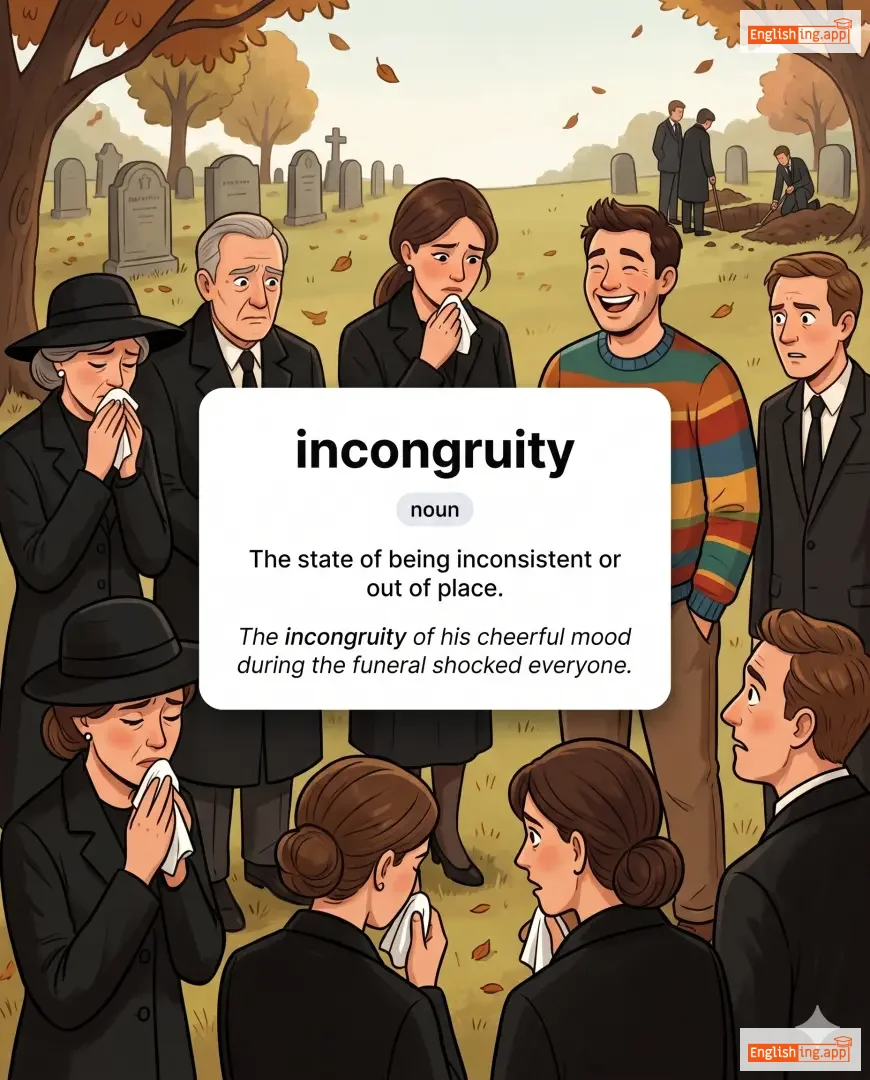
incongruity definition card — visual illustration of the meaning
noun C2
/ˌɪnkənˈɡruːəti/
incongruencia (incongruencia)

The state of being inconsistent or out of place.

"The incongruity of his cheerful mood during the funeral shocked everyone."

"La incongruencia de su estado de ánimo alegre durante el funeral sorprendió a todos." (La incongruencia de su estado de ánimo alegre durante el funeral sorprendió a todos.)
adjective C2
/ˌɪnkənˈsɪdərəbl/
insignificante (insignificante)

Too small or unimportant to be worth considering.

"The donation was not inconsiderable, though smaller than expected."

"La donación no fue insignificante, aunque más pequeña de lo esperado." (La donación no fue insignificante, aunque más pequeña de lo esperado.)
noun C2
/ɪnˈkɒnstənsi/
inconstancia (inconstancia)

The quality of changing frequently or being unreliable.

"The inconstancy of the weather makes planning difficult."

"La inconstancia del clima hace que planificar sea difícil." (La inconstancia del clima hace que planificar sea difícil.)
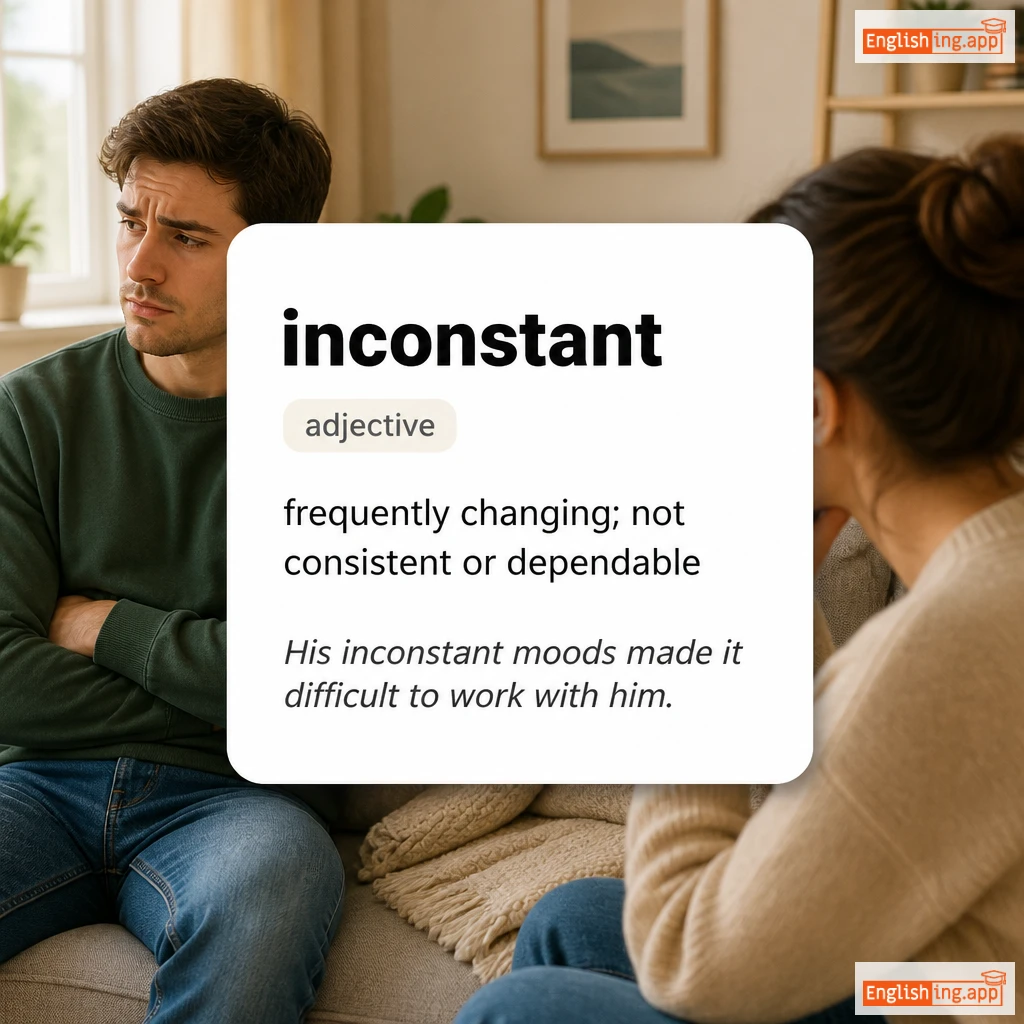
inconstant definition card — visual illustration of the meaning
adjective C2
/ɪnˈkɒnstənt/
inconstante (inconstante)

frequently changing; not consistent or dependable

"His inconstant moods made it difficult to work with him."

"Sus estados de ánimo inconstantes hacían difícil trabajar con él." (Sus estados de ánimo inconstantes hacían difícil trabajar con él.)
adjective C2
/ɪnˈkɒntɪnənt/
incontinente (incontinente)

lacking control over urination or defecation; lacking self-restraint

"The patient was incontinent after surgery."

"El paciente era incontinente después de la cirugía." (El paciente era incontinente despues de la cirugia.)
adjective C2
/ˌɪnkɒntrəˈvɜːtəbl/
incontrovertible (incontrovertible)

impossible to deny or dispute; unquestionable

"The evidence was incontrovertible and proved his innocence."

"La evidencia era incontrovertible y demostró su inocencia." (La evidencia era incontrovertible y demostró su inocencia.)
adjective C2
/ˌɪnkɔːrˈpɔːriəl/
incorpóreo (incorporeo)

lacking a physical body; not composed of matter; intangible

"Ghosts are often described as incorporeal beings."

"Los fantasmas a menudo se describen como seres incorpóreos." (Los fantasmas a menudo se describen como seres incorpóreos.)
adjective C2
/ɪnˈkɒrɪdʒəbəl/
incorregible (incorregible)

incapable of being corrected, improved, or reformed

"He is an incorrigible optimist who never loses hope."

"Él es un optimista incorregible que nunca pierde la esperanza." (Él es un optimista incorregible que nunca pierde la esperanza.)