Vocabularios

Descubra, aprenda y domine el vocabulario en inglés

noun C2
/ˈpɒliˌɑːrki/
बहुल शासकत्व (bahul shaskatv)

government by many people

"Polyarchy allows multiple parties to share power."

"पोलियार्की कई पार्टियों को सत्ता साझा करने की अनुमति देती है।" (Polyarchy kai partyon ko satta saanjha karne ki anumati deti hai.)
noun C2
/ˈpɒliˌkreɪsi/
बहुसंप्रभुता (bahusamprabhuta)

rule by many; government by multiple authorities

"The nation experienced a polycracy after decentralization reforms."

"देश ने विकेन्द्रीकरण सुधारों के बाद बहुसंप्रभुता का अनुभव किया।" (Desh ne viksendrikaran sudharon ke baad bahusamprabhuta ka anubhav kiya.)
noun C2
/ˈpɒlɪɡæmɪst/
बहुविवाह करने वाला व्यक्ति (bahuvivah karne wala vyakti)

a person who has more than one spouse at the same time

"The polygamist had three wives living in different houses."

"पॉलीगैमिस्ट के पास तीन पत्नियाँ थीं जो अलग-अलग घरों में रहती थीं।" (Polygamist ke paas teen patniyan thin jo alag-alag gharon mein rahti thin.)
noun C2
/ˌpɒlɪˈhiːdrən/
बहुपृष्ठीय ठोस वस्तु (bahuprishthiya thos vastu)

a solid object with flat polygonal faces, straight edges, and vertices

"The mathematician studied a complex polyhedron model."

"गणितज्ञ ने एक जटिल पॉलीहेड्रन मॉडल का अध्ययन किया।" (Ganitgy ne ek jatil polyhedron model ka adhyayan kiya.)
noun C2
/ˈpɒl.i.mæθ/
बहुशास्त्रज्ञ (bahushastragya)

a person with knowledge of many different subjects

"Leonardo da Vinci was a true polymath, excelling in art, science, and engineering."

"लियोनार्डो दा विंची एक सच्चे बहुशास्त्रज्ञ थे, जो कला, विज्ञान और इंजीनियरिंग में उत्कृष्ट थे।" (Leonardo da Vinci ek sachche bahushastragya the, jo kala, vigyan aur engineering mein utkrsht the.)
noun C2
/ˌpɒl.iˈsɪl.ə.bəl/
बहु-स्वरवर्णयुक्त शब्द (bahu-swarnavarnayukt shabd)

a word with more than one syllable

"The word 'elephant' is a polysyllable because it has three syllables."

"'एलीफैंट' एक बहु-स्वरवर्णयुक्त शब्द है क्योंकि इसमें तीन स्वर होते हैं।" ('Elephant' ek bahu-swarnavarnayukt shabd hai kyonki ismein teen swar hote hain.)
noun C2
/ˈpɒl.iˌθi.ɪz.əm/
पॉलीथीज़म (politheezam)

the belief in or worship of multiple gods

"Ancient Greeks practiced polytheism, worshiping gods like Zeus and Athena."

"प्राचीन ग्रीकों ने पॉलीथीज़म का अभ्यास किया, ज़्यूस और एथीना जैसे देवताओं की पूजा करते थे।" (Prachin Greekon ne politheezam ka abhyas kiya, Zeus aur Athena jaise devtaon ki pooja karte the.)
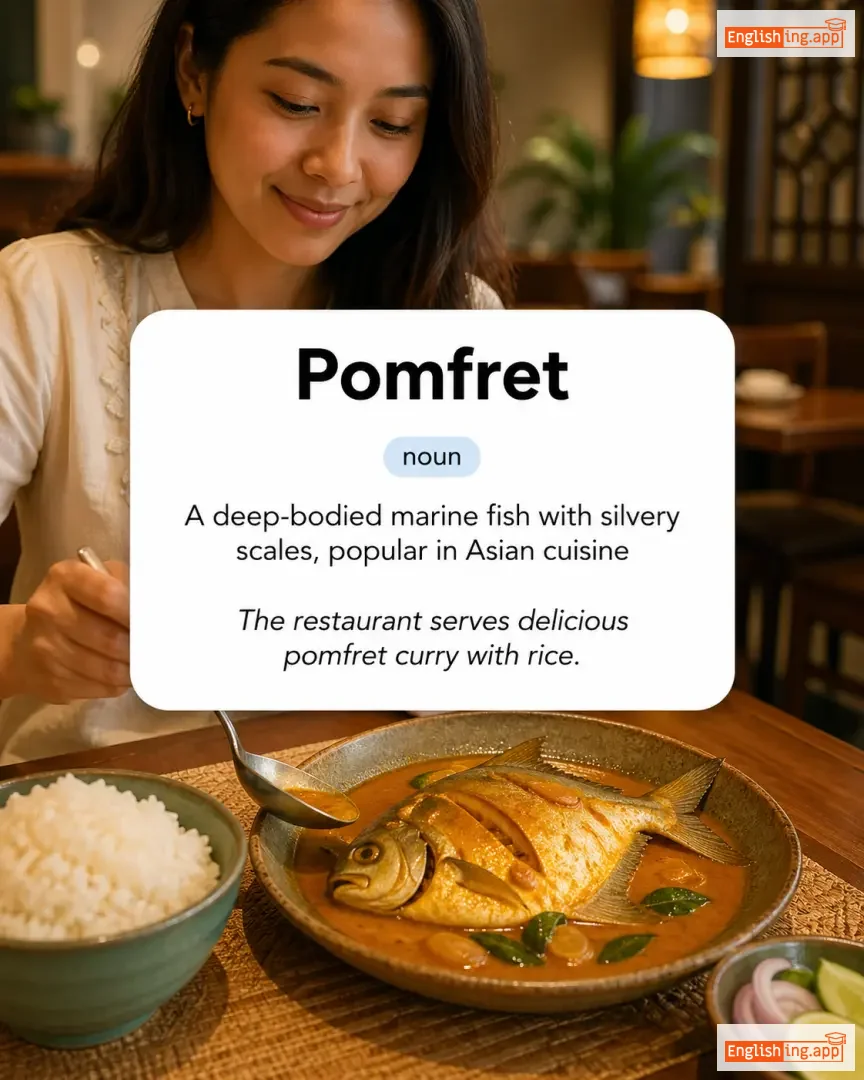
Pomfret definition card — visual illustration of the meaning
noun C2
/ˈpɒmfrɪt/
पॉम्फ्रेट मछली (pomfret machhli)

A deep-bodied marine fish with silvery scales, popular in Asian cuisine

"The restaurant serves delicious pomfret curry with rice."

"रेस्टोरेंट स्वादिष्ट पॉम्फ्रेट करी चावल के साथ परोसता है।" (restorent swadisht pomfret kari chawal ke sath parosta hai)
noun C2
/ˈpɒm.əl/
तलवार या सवारी के हैंडल का गोल हिस्सा (talwar ya sawari ke handle ka gol hissa)

the rounded knob on the handle of a sword or saddle

"He gripped the sword firmly by the pommel."

"उसने तलवार को मजबूती से पॉमेल से पकड़ा।" (Usne talwar ko majbooti se pommel se pakda.)
noun C2
/pɒmˈpɒsəti/
अहमकता, घमंड (ahankata, ghamand)

self-important behavior or exaggerated dignity

"His speech was full of pomposity and arrogance."

"उसकी स्पीच पॉम्पोसिटी और घमंड से भरी हुई थी।" (Uski speech pomposity aur ghamand se bhari hui thi.)
adjective C2
/ˈpɒndərəbl/
जो विचार किया जा सकता है, विचारणीय (jo vichar kiya ja sakta hai, vicharaniya)

able to be considered or thought about

"The evidence was substantial and ponderable."

"साक्ष्य पर्याप्त था और विचारणीय था।" (Sakshya paryapt tha aur vicharaniya tha.)
noun C2
/ˈpɒntɪf/
पोप या एक उच्च-रैंकिंग बिशप (pop ya ek uchch-rankin bishop)

the pope or a high-ranking bishop in the Christian church

"The pontiff addressed the nation in a televised speech."

"पोप ने राष्ट्र को टेलीविज़न पर संबोधित किया।" (Pop ne rashtr ko television par sambodhit kiya.)
adjective C2
/pɒnˈtɪfɪkəl/
पोप या बिशप से संबंधित; अहंकारी या गंभीर (pop ya bishop se sambandhit; ahankari ya gambhir)

relating to a pope or bishop; pompous or self-important

"His pontifical manner annoyed the other members of the committee."

"उसका आत्ममुग्ध व्यवहार समिति के अन्य सदस्यों को परेशान कर रहा था।" (Uska atmamugdh vyavhaar samiti ke anya sadasyon ko pareshan kar raha tha.)
verb C2
/ˈpɒntɪfɪkeɪt/
अहंकारी या आदेशात्मक ढंग से बोलना या कार्य करना; पॉप की तरह कार्य करना (ahankari ya aadeshatmak dhang se bolna ya kary karna; pope ki tarah kary karna)

to speak or act in a pompous or dogmatic way; to officiate as a pontiff

"He pontificated on the importance of education for over an hour."

"उसने एक घंटे तक शिक्षा के महत्व पर अहंकारी ढंग से बोला।" (Usne ek ghante tak shiksha ke mahatva par ahankari dhang se bola.)
noun C2
/ˈpɔːrfəri/
एक प्रकार की अग्नि शिला (ek prakar ki agni shila)

A hard igneous rock containing crystals, often used for decorative or building purposes.

"The ancient Romans used porphyry to make columns and statues."

"प्राचीन रोमनों ने कॉलम्स और मूर्तियाँ बनाने के लिए पॉर्फिरी का इस्तेमाल किया।" (Prachin Romanon ne columns aur moortiyan banane ke liye porphiry ka istemal kiya.)
verb C2
/pɔːrˈtɛnd/
पूर्वसूचना देना (purvsuchna dena)

To be a sign or warning that something, especially something bad, is going to happen.

"Dark clouds portend a storm."

"अंधेरे बादल तूफान का संकेत देते हैं।" (Andhere baadal toofan ka sanket dete hain.)
noun C2
/ˈpɔːrtɛnt/
पूर्व संकेत (purv sanket)

A sign or warning that something, especially something momentous or calamitous, is likely to happen.

"The sudden drop in stock prices was seen as a portent of economic trouble."

"शेयर बाजार में अचानक गिरावट को आर्थिक संकट का पूर्व संकेत माना गया।" (Sheyar bazar mein achanak girawat ko aarthik sankat ka purv sanket mana gaya.)
adjective C2
/pɔːrˈtɛntəs/
घातक, गंभीर (ghatak, gambhir)

Giving a sign or warning that something, often bad or serious, is going to happen; or overly solemn and pompous.

"His portentous tone made everyone nervous about the news."

"उसकी घातक आवाज ने सबको समाचार को लेकर नर्वस कर दिया।" (Uski ghatak awaaz ne sabko samachar ko lekar nervous kar diya.)
adjective C2
/ˈpɔːrtli/
भरतनुमा (bhartanuma)

Having a stout or somewhat fat body, often implying dignity or authority.

"The portly man entered the room with confidence."

"भरतनुमा आदमी आत्मविश्वास के साथ कमरे में दाखिल हुआ।" (Bhartanuma aadmi atmvishwas ke saath kamre mein dakhil hua.)
noun C2
/poʊˈzɜːr/
दिखावा करने वाला व्यक्ति (pozur)

A person who pretends to be something they are not, often to impress others.

"Many considered him a poseur because he exaggerated his accomplishments."

"कई लोगों ने उसे पोज़ूर माना क्योंकि उसने अपनी उपलब्धियों को बढ़ा-चढ़ाकर दिखाया।" (kai log use pozur maante the kyunki usne apni uplabdhiyon ko badha chadhaakar dikhaya)
noun C2
/ˈpɒsi/
गैंग / दोस्त समूह (gang / dost samuh)

A group of people, often friends or a group organized to support or enforce the law.

"He arrived at the party with his posse of friends."

"वह अपनी दोस्त की गैंग के साथ पार्टी में आया।" (Woh apni dost ki gang ke saath party mein aaya.)
adjective C2
/ˌpəʊstˈprændɪəl/
भोजन के बाद (bhojan ke baad)

Occurring after a meal.

"He went for a postprandial walk after dinner."

"वह रात के खाने के बाद एक पोस्टप्रांडीअल वॉक पर गए।" (Wah raat ke khane ke baad ek postprandial walk par gaye.)
noun C2
/ˈpɒtˌbɔɪlə/
सस्ता साहित्यकर्म (sasta sahityakarm)

a book, play, or film produced quickly to make money rather than for artistic value

"The novel was dismissed by critics as a mere potboiler."

"उपन्यास को आलोचकों ने एक साधारण सस्ता साहित्यकर्म के रूप में खारिज कर दिया।" (Upanyas ko alochako ne ek sadharan sasta sahityakarm ke roop mein kharij kar diya.)
noun C2
/ˈpoʊtənˌteɪt/
शासक (shasak)

A monarch or ruler, especially one with absolute power.

"The ancient land was ruled by a powerful potentate."

"प्राचीन भूमि एक शक्तिशाली शासक द्वारा शासित थी।" (Prachin bhumi ek shaktishali shasak dvara shasit thi.)
verb C2
/poʊˈtɛnʃiˌeɪt/
शक्ति बढ़ाना (shakti badhana)

To increase the power, effect, or likelihood of something.

"Caffeine can potentiate the effects of some medicines."

"कैफीन कुछ दवाओं के प्रभाव को बढ़ा सकता है।" (Caffeine kuch davaon ke prabhav ko badha sakta hai.)
noun C2
/ˌpoʊpʊˈriː/
सूखे फूलों का मिश्रण (sookhe phoolon ka mishran)

a mixture of dried flowers and spices kept in a bowl to perfume a room; a miscellaneous collection

"The living room was filled with the scent of potpourri."

"लिविंग रूम पॉटपुरी की खुशबू से भर गया था।" (Living room potpuri ki khushboo se bhar gaya tha.)
noun C2
/ˈpoʊltɪs/
गर्म हर्बल पट्टी (garm herbal patti)

a soft, moist mass of material applied to the body to relieve soreness and inflammation

"The nurse applied a warm poultice to his injured leg."

"नर्स ने उसके घायल पैर पर एक गर्म पौल्टिस लगाई।" (Nars ne uske ghaayal pair par ek garm poultice lagayi.)
noun C2
/ˈpaʊ.waʊ/
गैर औपचारिक बैठक (gair aupchaarik baithak)

an informal meeting or conference to discuss something

"The team held a quick powwow before the presentation."

"टीम ने प्रस्तुति से पहले एक त्वरित गैर औपचारिक बैठक की।" (Teem ne prastuti se pehle ek tvarit gair aupchaarik baithak ki.)
verb C2
/preɪt/
बकबक करना (bakbak karna)

to talk foolishly or at tedious length about something

"He would prate endlessly about his minor achievements."

"वह अपनी छोटी उपलब्धियों के बारे में निरंतर बकबक करता था।" (Vah apni chhoti uplabdhiyon ke baare mein nirantar bakbak karta tha.)
verb C2
/ˈprætəl/
बकबक करना (bakbak karna)

to talk at length in a foolish or inconsequential way

"The children would prattle on about their games."

"बच्चे अपने खेलों के बारे में बकबक कर रहे थे।" (Bacche apne khelon ke baare mein bakbak kar rahe the.)
adjective C2
/ˌprɛsɪˈdɛnʃəl/
उदाहरणात्मक (udaharanatmak)

Relating to, or serving as, a precedent; having authority as an example.

"The court’s decision has precedential value."

"कोर्ट का निर्णय उदाहरणात्मक मूल्य रखता है।" (Court ka nirnay udaharanatmak moolya rakhta hai.)
noun C2
/ˈpriːsɛpt/
सूत्र (sutra)

A general rule intended to regulate behavior or thought.

"Honesty is a fundamental precept in all religions."

"ईमानदारी सभी धर्मों में एक मौलिक सूत्र है।" (Imaandari sabhi dharmon mein ek maulik sutra hai.)
noun C2
/prɪˈsɛʃən/
पूर्वगमन (purvagaman)

The slow movement of the axis of a spinning body around another axis, often referring to Earth's rotation.

"Astronomers study the precession of the equinoxes."

"खगोलशास्त्रज्ञ विषुवकाल के पूर्वगमन का अध्ययन करते हैं।" (Khagolshastrajnya vishuvkaal ke purvagaman ka adhyayan karte hain.)
noun C2
/ˌprɛsiˈɒsɪti/
अत्यधिक सजावट (atyadhik sajavat)

Excessive refinement or affected elegance in language, style, or behavior.

"The author's preciosity made the novel difficult to read for some audiences."

"लेखक की अत्यधिक सजावट ने कुछ पाठकों के लिए उपन्यास को पढ़ना कठिन बना दिया।" (lekhak ki atyadhik sajavat ne kuch pathako ke liye upanyas ko padhna kathin bana diya.)
noun/adjective C2
/prɪˈsɪpɪtənt/
प्रीसिपिटेंट (precipitant)

As a noun: a substance that causes a substance to be deposited from a solution; as an adjective: acting hastily or impulsively.

"The chemist added a precipitant to the solution to observe the reaction."

"रसायनज्ञ ने समाधान में एक प्रीसिपिटेंट डाला ताकि प्रतिक्रिया का अवलोकन किया जा सके।" (rasaayanagya ne samadhan mein ek precipitant daala taaki pratikriya ka avlokan kiya ja sake.)
verb C2
/priːˈdɛstɪn/
पूर्वनिर्धारित करना (purv nirnidharit karna)

to determine or decide something in advance, often regarded as being fixed by fate or divine will

"They believed their paths were predestined by fate."

"वे मानते थे कि उनके रास्ते किस्मत द्वारा पूर्वनिर्धारित थे।" (Ve maante the ki unke raste kismat dwara purv nirdharit the.)
noun C2
/ˌpriːdɪˈlɛkʃən/
प्राथमिकता (prathmikta)

A strong liking or preference for something.

"She has a predilection for classical music."

"वह शास्त्रीय संगीत के लिए एक झुकाव रखती है।" (Woh shastriya sangeet ke liye ek jhukav rakhti hai.)
noun C2
/priːˈɛmɪnəns/
अतुलनीय श्रेष्ठता (atulniya shreshthata)

The fact of surpassing all others; superiority.

"The university has gained preeminence in medical research."

"विश्वविद्यालय ने चिकित्सा अनुसंधान में अतुलनीय श्रेष्ठता प्राप्त की है।" (Vishwavidyalay ne chikitsa anusandhan mein atulniya shreshthata prapt ki hai.)
noun C2
/priˈɛmpʃən/
प्राथमिकता अधिकार (prathmikta adhikar)

The act of taking action before someone else; the right to purchase or act before others.

"The company exercised preemption to acquire the land before competitors."

"कंपनी ने प्रतिस्पर्धियों से पहले भूमि प्राप्त करने के लिए प्राथमिकता अधिकार का उपयोग किया।" (Company ne pratishpardhiyon se pehle bhoomi prapt karne ke liye prathmikta adhikar ka upyog kiya.)
verb C2
/ˌpriːɪnˈɡeɪdʒ/
पूर्व निर्धारित करना (purv nirdharit karna)

To contract or engage beforehand; to arrange in advance.

"The workers were preengaged before the project officially started."

"प्रोजेक्ट शुरू होने से पहले श्रमिकों को पहले ही प्रि-एन्गेज किया गया था।" (Project shuru hone se pehle shramikon ko pehle hi pre-engage kiya gaya tha.)
verb C2
/ˌpriːɪˈstæblɪʃ/
पहले से स्थापित करना (pahle se sthapit karna)

To establish or set up beforehand.

"Certain rules were preestablished before the meeting."

"बैठक से पहले कुछ नियम पहले से स्थापित किए गए थे।" (Baithak se pehle kuch niyam pahle se sthapit kiye gaye the.)
verb C2
/ˌpriːɪɡˈzɪst/
पहले से अस्तित्व में होना (pehle se astitva mein hona)

to exist beforehand or before something else

"These customs preexist the arrival of modern technology."

"ये रिवाज आधुनिक तकनीक के आगमन से पहले अस्तित्व में थे।" (Ye rivaaj aadhunik takneek ke aagman se pehle astitva mein the.)
noun C2
/ˌpriːɪɡˈzɪstəns/
पूर्व अस्तित्व (purv astittv)

the state of existing before something else

"Philosophers often debated the preexistence of the soul."

"दार्शनिकों ने अक्सर आत्मा के पूर्व अस्तित्व पर बहस की।" (Darshanikon ne aksar atma ke purv astitv par bahas ki.)
adjective C2
/ˈprɛfətɔːri/
पूर्वकथनात्मक (purvakanthanatmak)

serving as an introduction or preface

"He made some prefatory remarks before the lecture began."

"उसने व्याख्यान शुरू होने से पहले कुछ पूर्वकथनात्मक टिप्पणी की।" (Usne vyakhyan shuru hone se pehle kuch purvakanthanatmak tippani ki.)
noun C2
/prɪˈfɜːrmənt/
पदोन्नति (podonnoti)

promotion or advancement in rank, position, or office

"He hoped for preferment in the government office."

"उसे सरकारी कार्यालय में पदोन्नति की उम्मीद थी।" (Use sarkari karyalaya mein podonnati ki ummid thi.)
verb C2
/priːˈfɪɡjər/
पूर्वसूचना देना (purvasoochna dena)

to represent, show, or foreshadow something in advance

"The economic reforms prefigure major social changes."

"आर्थिक सुधार बड़े सामाजिक परिवर्तनों की पूर्वसूचना देते हैं।" (Aarthik sudhaar bade samaajik parivartano ki purvasoochna dete hain.)
adjective C2
/prɪˈhɛnsɪbəl/
पकड़ने योग्य (pakadne yogya)

capable of being grasped or seized

"The tool has a prehensible handle that improves safety."

"उपकरण में एक पकड़ने योग्य हैंडल है जो सुरक्षा बढ़ाता है।" (Upkaran mein ek pakadne yogya handle hai jo suraksha badhata hai.)
adjective C2
/prɪˈhɛnsaɪl/
पकड़ने के लिए उपयुक्त (pakanne ke liye upyukt)

adapted for seizing or grasping, especially by wrapping around an object

"The monkey used its prehensile tail to hang from the branch."

"बंदर ने अपनी प्रिहेंसाइल पूंछ का इस्तेमाल डाल से लटकने के लिए किया।" (Bandar ne apni prehensile poonch ka istemal daal se latakne ke liye kiya.)
noun C2
/prɪˈhɛnʃən/
पकड़ने की क्रिया; कुछ पकड़ने की क्षमता (pakadne ki kriya; kuch pakadne ki kshamata)

the act of grasping or seizing; the ability to take hold of something

"Therapists assessed the patient's prehension during hand therapy."

"थेरेपिस्ट ने हाथ की थेरेपी के दौरान मरीज की पकड़ने की क्षमता का मूल्यांकन किया।" (Therapist ne hath ki therapy ke dauran mareez ki pakadne ki kshamata ka mulyankan kiya.)
noun C2
/ˈprɛləsi/
पदवी (padvi)

The office, dignity, or system of church government by prelates.

"The medieval church was dominated by prelacy and its traditions."

"मध्यकालीन चर्च प्रेलेसी और इसके परंपराओं से शासित था।" (Madhyakalīn church prelasi aur iske paramparao se shasit tha.)