Vocabularios

Descubra, aprenda y domine el vocabulario en inglés

adjective C1
/prəˈfɛtɪk/
भविष्यवाणी से संबंधित (bhavishyavani se sambandhit)

accurately predicting or describing what will happen in the future

"His prophetic words came true after many years."

"उसके भविष्यवाणी से संबंधित शब्द कई सालों बाद सच हो गए।" (uske bhavishyavani se sambandhit shabdon ka kai salon baad sach ho gaye.)
noun C1
/prəˈpoʊnənt/
समर्थक, प्रस्तावक (samarthak, prastavak)

a person who advocates for or supports a particular idea, cause, or plan

"She is a strong proponent of renewable energy."

"वह नवीकरणीय ऊर्जा की एक मजबूत समर्थक है।" (vah navikaranīya ūrgā kī ek majabūt samarthak hai.)
adjective C1
/prəˈpɔːrʃənət/
सामान्य अनुपाती (samanjya anupati)

Corresponding in size, degree, or intensity; balanced in relation.

"The punishment should be proportionate to the crime."

"सजा अपराध के अनुसार सामान्य अनुपाती होनी चाहिए।" (Saja aparadh ke anusar samanjya anupati honi chahiye.)
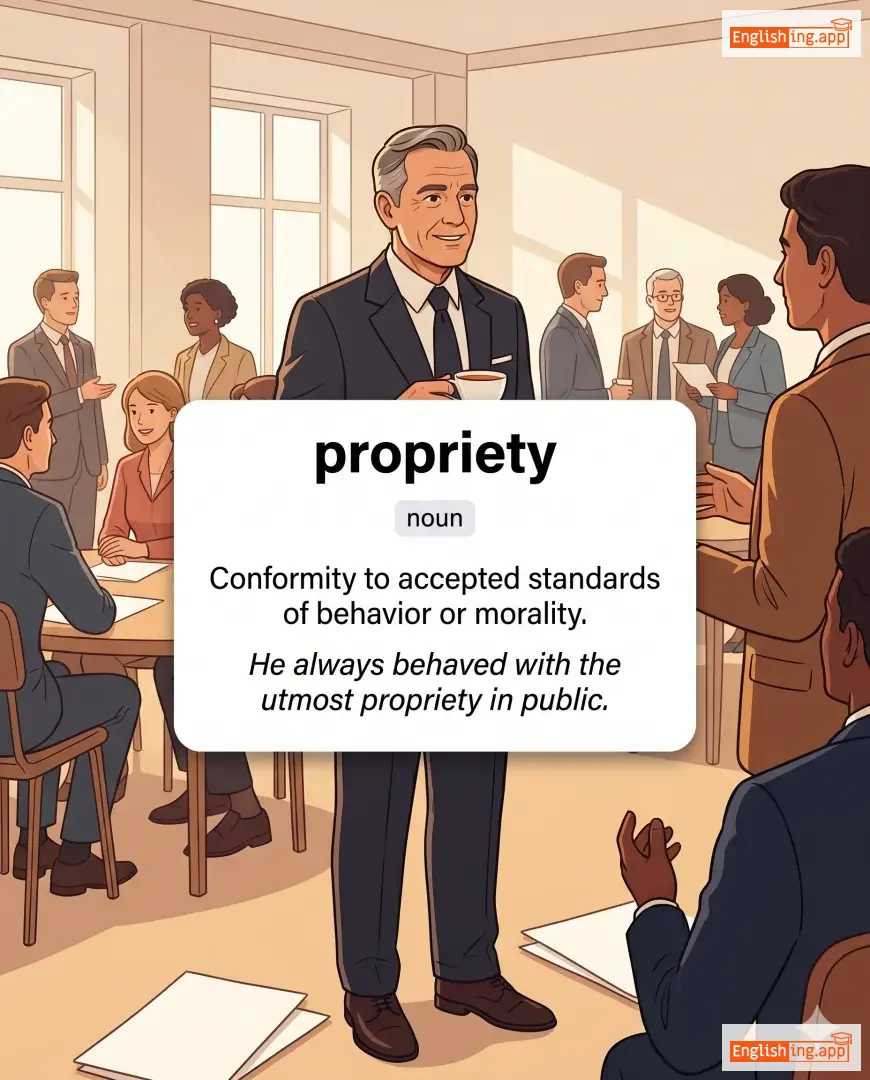
propriety definition card — visual illustration of the meaning
noun C1
/prəˈpraɪəti/
शालीनता (shalinata)

Conformity to accepted standards of behavior or morality.

"He always behaved with the utmost propriety in public."

"वह हमेशा सार्वजनिक रूप से शालीनता के साथ व्यवहार करते थे।" (Wah hamesha sarvajanik roop se shalinata ke saath vyavhaar karte the.)
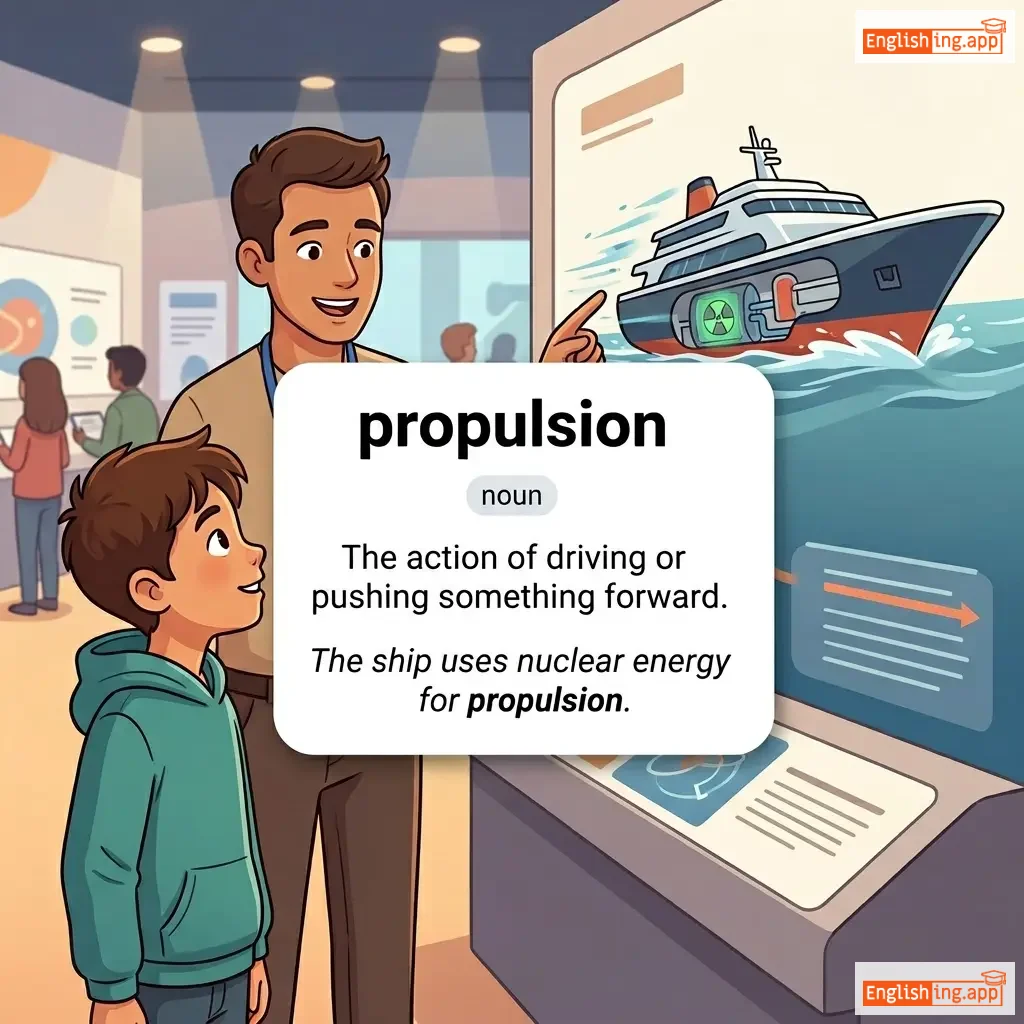
propulsion definition card — visual illustration of the meaning
noun C1
/prəˈpʌlʃən/
प्रेरणाशक्ति (preranashakti)

The action of driving or pushing something forward.

"The ship uses nuclear energy for propulsion."

"जहाज प्रोपल्शन के लिए परमाणु ऊर्जा का उपयोग करता है।" (Jahaz propulsion ke liye parmanu urja ka upyog karta hai.)
adjective C1
/proʊˈzeɪ.ɪk/
साधारण (saadharan)

ordinary, dull, or lacking imagination

"The teacher’s explanation was accurate but rather prosaic."

"टीचर की व्याख्या सटीक थी लेकिन वह काफी सामान्य थी।" (Teacher ki vyakhya sathik thi lekin wah kaafi saadharan thi.)
noun C1
/ˈprɒspɛktər/
खनिज अन्वेषक (khanij anvēṣak)

a person who searches for mineral deposits, especially gold

"The prospector spent years in the mountains searching for gold."

"प्रॉस्पेक्टर ने सोने की खोज करने के लिए वर्षों तक पहाड़ों में समय बिताया।" (Prospector ne sone kī khoj karne ke liye varsho tak pahadon mein samay bitaya.)
noun C1
/prəˈspɛktəs/
प्रस्तावना (prastavna)

a printed document that advertises or describes a school, business, or investment offering

"The university sent out a prospectus to attract new students."

"विश्वविद्यालय ने नए छात्रों को आकर्षित करने के लिए एक प्रस्तावना भेजी।" (Vishwavidyalaya ne naye chatron ko aakarshit karne ke liye ek prastavna bheji.)
adjective/verb C1
/ˈprɒstreɪt/
मुँह के बल लेटना (munh ke bal letna)

lying stretched out on the ground with one's face downward, often as a sign of submission or exhaustion

"He lay prostrate on the ground after the long battle."

"लंबी लड़ाई के बाद वह जमीन पर मुँह के बल लेट गए।" (Lambi ladai ke baad vah zameen par munh ke bal let gaye.)
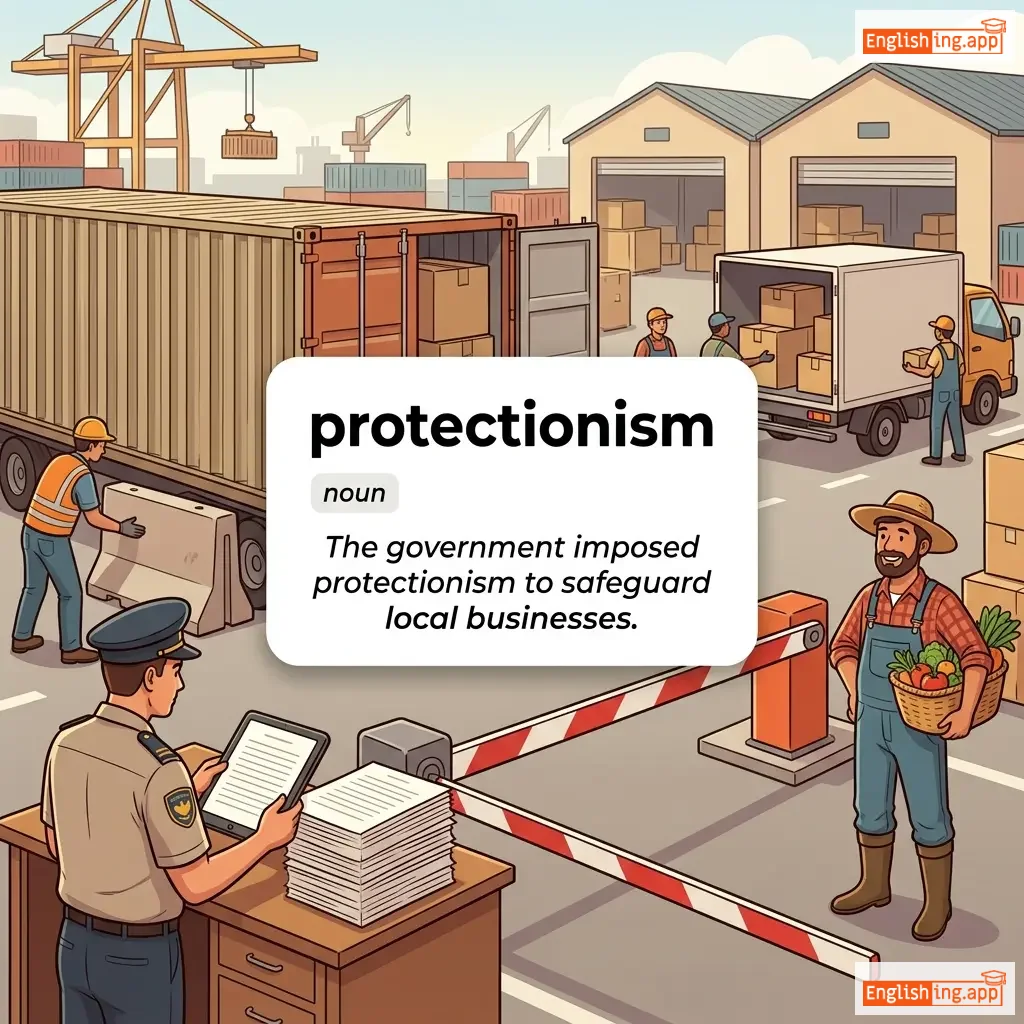
protectionism definition card — visual illustration of the meaning
noun C1
/prəˈtɛk.ʃəˌnɪz.əm/
संरक्षणवाद (sanrakshanvaad)

A trade policy that restricts imports to safeguard domestic industries through trade restriction, economic nationalism, or isolationism.

"The government imposed protectionism to safeguard local businesses."

"सरकार ने स्थानीय व्यवसायों की सुरक्षा के लिए संरक्षणवाद लागू किया।" (sarkar ne sthaniya vyavasaayon ki suraksha ke liye sanrakshanvaad lagu kiya.)
noun C1
/ˈproʊtəˌʒeɪ/
शिष्य (shishya)

a person who is guided and supported by an older and more experienced person

"The young artist was the protege of a famous painter."

"युवक कलाकार एक प्रसिद्ध चित्रकार के शिष्य थे।" (Yuvak kalakar ek prasiddh chitrakar ke shishya the.)
noun C1
/ˈprɑːtɪstənt/
प्रोटेस्टेंट (protestant)

a member of the Christian church that separated from the Roman Catholic Church during the Reformation

"Martin Luther was a key figure in the Protestant Reformation."

"मार्टिन लूथर प्रोटेस्टेंट पुनःनिर्माण में एक प्रमुख व्यक्ति थे।" (Martin Luther protestant punarnirman mein ek pramukh vyakti the.)
verb C1
/proʊˈtrækt/
दीर्घकालिक करना (dirghakalik karna)

To prolong or extend in time or duration.

"Negotiations were protracted for several months."

"संबंधित बातचीत कई महीने तक दीर्घकालिक रही।" (Sambandhit baatcheet kai mahine tak dirghakalik rahi.)
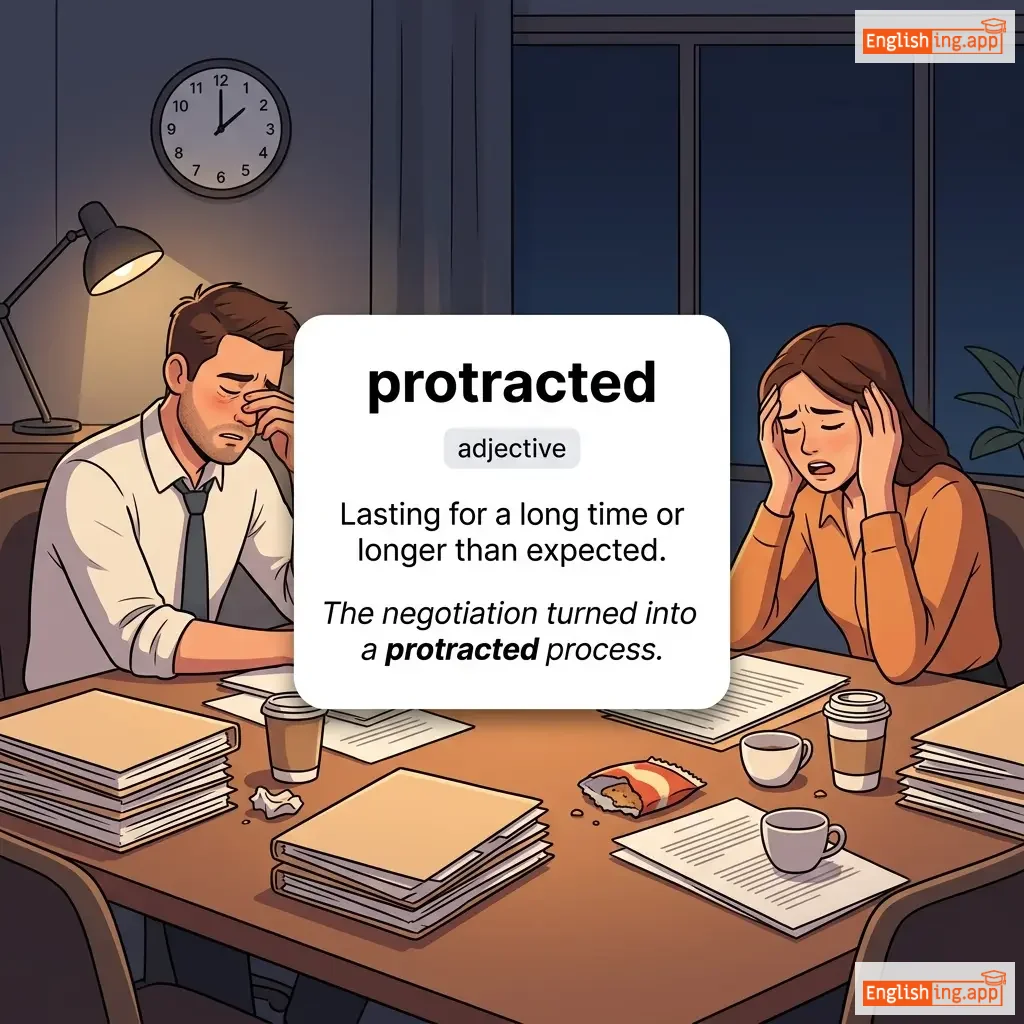
protracted definition card — visual illustration of the meaning
adjective C1
/prəˈtræktɪd/
दीर्घकालिक (dirghkalik)

Lasting for a long time or longer than expected.

"The negotiation turned into a protracted process."

"संचालन एक दीर्घकालिक प्रक्रिया में बदल गया।" (Sanchalan ek dirghkalik prakriya mein badal gaya.)
verb C1
/proʊˈtruːd/
बाहर आना (baahar aana)

To stick out or extend beyond a surface.

"A nail was protruding from the wooden board."

"एक कील लकड़ी के बोर्ड से बाहर आ रही थी।" (Ek keel lakdi ke board se baahar aa rahi thi.)
noun C1
/prəˈtruːʒən/
उभार (ubhaar)

Something that sticks out or projects from a surface.

"The protrusion on the wall made it difficult to move the furniture."

"दीवार पर उभार ने फर्नीचर को स्थानांतरित करना कठिन बना दिया।" (Deewaar par ubhaar ne furniture ko sthaanantarit karna kathin bana diya.)
noun C1
/ˈprɒvənəns/
उत्पत्ति (utpatti)

The origin or source of something.

"The museum verified the provenance of the ancient manuscript."

"संग्रहालय ने प्राचीन पांडुलिपि की उत्पत्ति की पुष्टि की।" (Sangrahalay ne pracheen pandulipi ki utpatti ki pushti ki.)
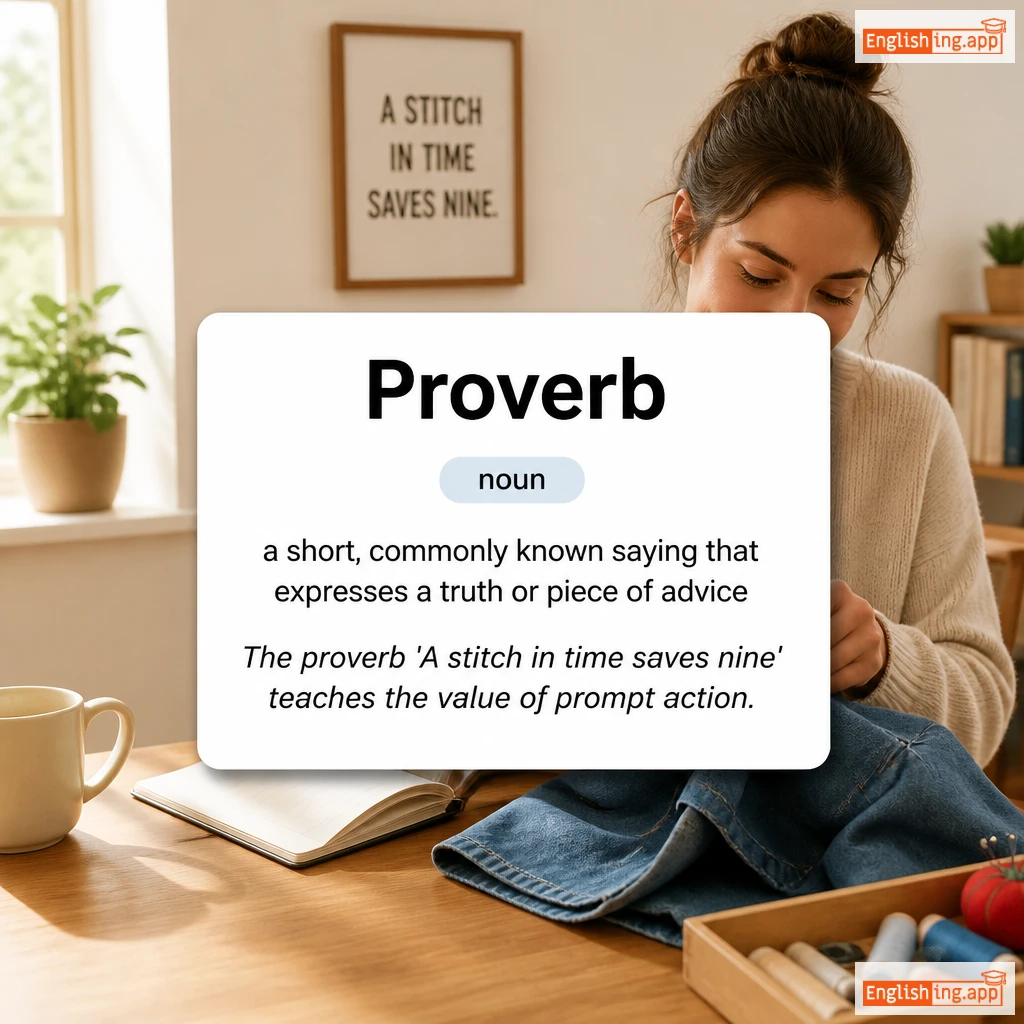
Proverb definition card — visual illustration of the meaning
noun C1
/ˈprɒvərb/
कहावत (kahavat)

a short, commonly known saying that expresses a truth or piece of advice

"The proverb 'A stitch in time saves nine' teaches the value of prompt action."

"कहावत 'समय पर किया गया एक टांका नौ बचाता है' त्वरित क्रिया के महत्व को सिखाती है।" (kahavat 'samay par kiya gaya ek tanka nau bachata hai' tvarit kriya ke mahatva ko sikhati hai.)
noun C1
/ˈprɒvɪdəns/
ईश्वर की कृपा (ishwar ki kripa)

the protective care of God or nature as a spiritual power; foresight or prudence

"They believed their survival was due to divine providence."

"उन्हें विश्वास था कि उनका बचाव ईश्वर की कृपा के कारण हुआ था।" (Unhein vishwas tha ki unka bachav ishwar ki kripa ke kaaran hua tha.)
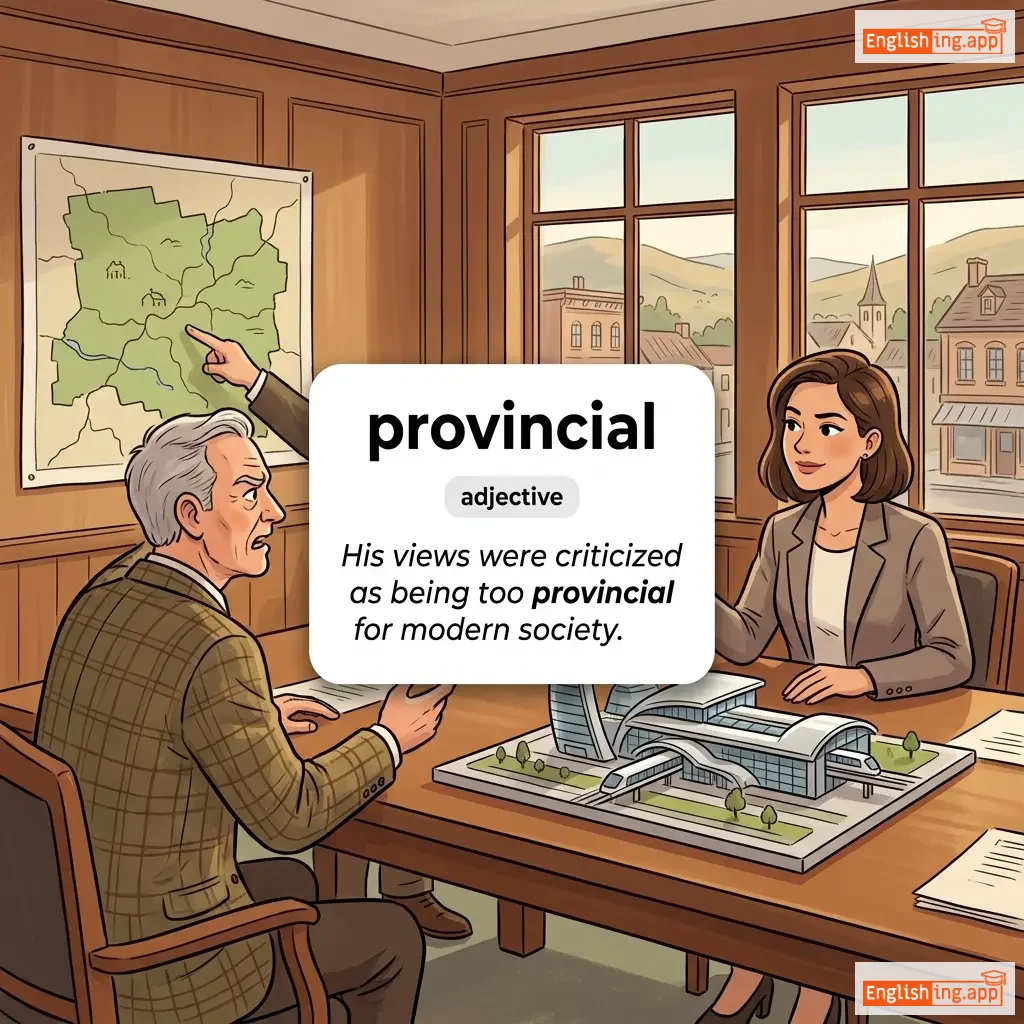
provincial definition card — visual illustration of the meaning
adjective C1
/prəˈvɪnʃəl/
प्रांतीय (prantiy)

relating to a province or the regions outside the capital city; often suggesting narrow-mindedness

"His views were criticized as being too provincial for modern society."

"उसके विचारों की आलोचना की गई थी क्योंकि वे आधुनिक समाज के लिए बहुत प्रांतीय थे।" (uske vicharon ki alochna ki gayi thi kyonki ve aadhunik samaaj ke liye bahut prantiy the.)
noun C1
/prəˈvaɪzoʊ/
शर्त (shart)

a condition or stipulation attached to an agreement

"He accepted the job offer with the proviso that he could work remotely twice a week."

"उसने नौकरी की पेशकश को इस शर्त पर स्वीकार किया कि वह सप्ताह में दो दिन दूर से काम कर सकता है।" (Usne naukari ki peskash ko is shart par svikaar kiya ki vah saptah mein do din door se kaam kar sakta hai.)
noun C1
/ˌprɒvəˈkeɪʃən/
उत्तेजना (uttejana)

An action or statement that is intended to make someone angry or to cause a reaction.

"His rude comment was a clear provocation."

"उसकी अशिष्ट टिप्पणी एक स्पष्ट उत्तेजना थी।" (uski ashisht tippani ek spasht uttejana thi.)
adjective C1
/prəˈvɒkətɪv/
उत्तेजक (uttejak)

Intended to make people angry, excited, or interested.

"She wore a provocative dress to the party."

"वह पार्टी में एक उत्तेजक ड्रेस पहने हुए थी।" (vah party mein ek uttejak dress pehne hue thi.)
adjective C1
/prəˈvoʊkɪŋ/
उत्तेजक (uttejak)

causing anger or strong reaction; irritating; stimulating

"His provoking comments made everyone angry."

"उसके उत्तेजक टिप्पणी ने सभी को गुस्से में डाल दिया।" (uske uttejak tippani ne sabhi ko gusse mein daal diya.)
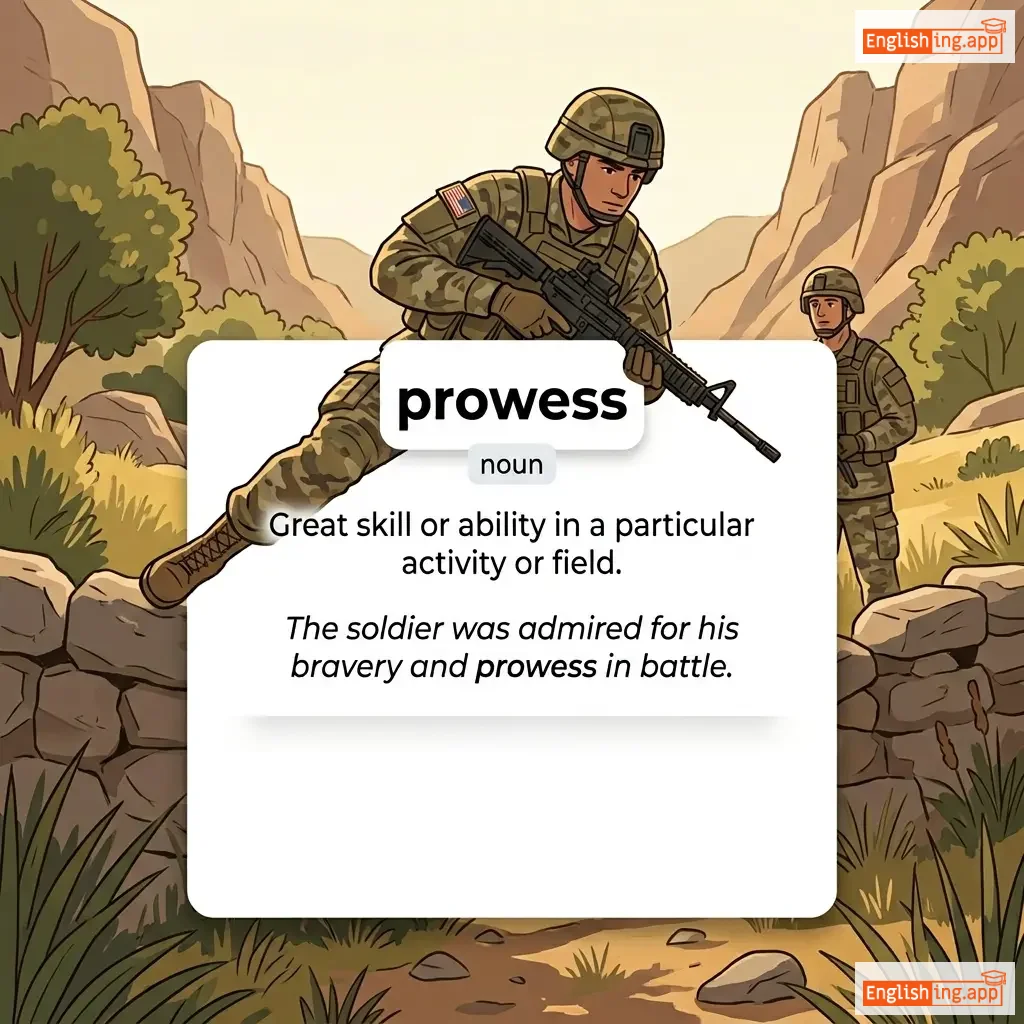
prowess definition card — visual illustration of the meaning
noun C1
/ˈpraʊəs/
कला (kala)

Great skill or ability in a particular activity or field.

"The soldier was admired for his bravery and prowess in battle."

"सैनिक को उसकी बहादुरी और युद्ध में कला के लिए सराहा गया था।" (Sainik ko uski bahaaduri aur yudh mein kala ke liye saraha gaya tha.)
verb C1
/praʊl/
चुपके से घूमना (खोजना या शिकार करने के लिए) (chupke se ghoomna (khojna ya shikar karne ke liye))

To move around quietly and secretly, especially while hunting or searching.

"The cat prowled around the garden at night."

"बिल्ली रात में बग़ीचे के चारों ओर चुपके से घूम रही थी।" (billi raat mein bagiche ke charo or chupke se ghoom rahi thi.)
noun C1
/ˈprɒksi/
प्रतिनिधि (pratinidhi)

A person authorized to act on behalf of another; a substitute.

"She voted by proxy at the meeting."

"उसने बैठक में प्रॉक्सी से वोट दिया।" (Usne baithak mein proxy se vote diya.)
noun C1
/ˈpruːdəns/
विवेकशीलता (vivekshilta)

The quality of being cautious, wise, and exercising good judgment.

"She invested her money with great prudence."

"उसने अपनी पैसे बहुत विवेकशीलता के साथ निवेश किए।" (Usne apni paise bahut vivekshilta ke saath nivesh kiye.)
adjective C1
/ˈpruːdənt/
सावधान (savdhan)

acting with or showing care and thought for the future

"It is always prudent to save some money for emergencies."

"आपात स्थितियों के लिए कुछ पैसे बचाना हमेशा सावधान होता है।" (aapaat sthitiyon ke liye kuch paise bachana hamesha savdhan hota hai.)
verb C1
/praɪ/
झाँकना / दखल देना (jhankna / dakkal dena)

to look closely into something; to try to find out private information

"She tried to pry into her neighbor’s private life."

"उसने अपनी पड़ोसी के निजी जीवन में दखल देने की कोशिश की।" (Usne apni padosi ke niji jeevan mein dakkal dene ki koshish ki.)
noun C1
/ˈsuːdənɪm/
छद्म नाम (chadma naam)

a fictitious name used by an author instead of their real name

"Mark Twain was the pseudonym of Samuel Clemens."

"मार्क ट्वेन सैमुअल क्लेमेन्स का छद्म नाम था।" (Mark Twain Samuel Clemens ka chadma naam tha.)
noun C1
/ˈsaɪkiː/
आत्मा / मन (atma / man)

the human soul, mind, or spirit

"The novel explores the depths of the human psyche."

"उपन्यास मानव मानसिकता की गहराई का अन्वेषण करता है।" (Upanyas manav mansikta ki gehraai ka anvishan karta hai.)
adjective C1
/ˌsaɪkəˈpæθɪk/
मनोविकारग्रस्त (manovikagrast)

Relating to or affected by psychopathy; showing chronic mental disorder with abnormal or violent behavior.

"The film portrayed a psychopathic killer with no sense of empathy."

"फ़िल्म ने एक मनोविकारग्रस्त हत्यारे को दर्शाया जिसमें सहानुभूति का कोई अहसास नहीं था।" (Film ne ek manovikagrast hatyare ko darshaya jismein sahaanubhuti ka koi ahsaas nahi tha.)
noun C1
/saɪˈkoʊsɪs/
मानसिक विकार (maansik vikar)

A severe mental disorder in which thought and emotions are impaired, leading to a loss of contact with reality.

"The patient was diagnosed with psychosis after experiencing hallucinations."

"मरीज़ को hallucinations का अनुभव होने के बाद मानसिक विकार के रूप में निदान किया गया।" (Mareez ko hallucinations ka anubhav hone ke baad maansik vikar ke roop mein nidan kiya gaya.)
adjective C1
/ˌsaɪkoʊsəˈmætɪk/
मनोदैहिक (manodaikhik)

Relating to a physical illness or condition caused or aggravated by mental factors such as stress.

"Her stomach pain was diagnosed as psychosomatic, linked to stress."

"उसका पेट दर्द मानसिक तनाव से जुड़ा हुआ मनोदैहिक रोग था।" (Uska pet dard maansik tanav se juda hua manodaikhik rog tha.)
noun C1
/ˌsaɪkoʊˈθɛrəpi/
मनोचिकित्सा (manochikitsa)

The treatment of mental disorder by psychological rather than medical means.

"She attended weekly psychotherapy sessions to cope with her anxiety."

"उसने अपनी चिंता से निपटने के लिए साप्ताहिक मनोचिकित्सा सत्रों में भाग लिया।" (Usne apni chinta se nipatne ke liye saptahik mano chikitsa satron mein bhag liya.)
noun C1
/ˌtɛrəˈdæktɪl/
उड़ने वाला प्राचीन सरीसृप (udne wala prachin sarisrip)

An extinct flying reptile of the Jurassic period, with a long slender head and wings formed by a membrane stretching along the body.

"The museum displayed a fossil of a giant pterodactyl."

"संग्रहालय में एक विशाल प्टेरोडैक्टिल का जीवाश्म प्रदर्शित किया गया।" (Sangrahalay mein ek vishal pterodactyl ka jivashm pradarshit kiya gaya.)
adjective C1
/ˈpʌlməˌneri/
फेफड़ों से सम्बन्धित (fephdon se sambandhit)

relating to the lungs

"The patient suffered from a serious pulmonary infection."

"रोगी को एक गंभीर पल्मोनरी संक्रमण हुआ।" (rogi ko ek gambhir pulmonary sankraman hua)
noun C1
/ˈpʊlpɪt/
धर्मोपदेश मञ्च (dharmopadesh manch)

a raised platform in a church from which the preacher delivers a sermon

"The pastor stood at the pulpit to address the congregation."

"पादरी ने मंडली से संबोधित करने के लिए पलपिट पर खड़ा हुआ।" (Padri ne mandali se sambodhit karne ke liye palpit par khada hua.)
verb C1
/ˈpʌlseɪt/
धड़कना (dhadakna)

to expand and contract rhythmically; to throb or beat

"The neon lights pulsated with a steady rhythm."

"नियॉन लाइट्स एक स्थिर लय में धड़क रही थीं।" (Niyon lights ek sthir lay mein dhadak rahi thin.)
verb C1
/ˈpʌməl/
पीटना (peetna)

To strike repeatedly with the fists; to beat or hit forcefully.

"The boxer pummeled his opponent in the final round."

"अंतिम राउंड में बॉक्सर ने अपने प्रतिद्वंद्वी को बुरी तरह पीटा।" (antim round me boxer ne apne pratidvandvi ko buri tarah peeta.)
noun C1
/pʌn/
शब्दविन्यास (shabdvinyas)

A humorous use of words that suggests different meanings or words that sound alike.

"He made a clever pun about the bakery's bread rising."

"उसने बेकरी की ब्रेड उठने के बारे में एक चतुर शब्दविन्यास किया।" (Usne bakery ki bread uthne ke baare mein ek chatur shabdvinyas kiya.)
noun C1
/ˈpʌntʃ laɪn/
पंच लाइन (panch line)

The final part of a joke or story that makes it funny.

"Everyone laughed loudly at the punch line of his joke."

"सभी ने उसकी मजाक के पंच लाइन पर जोर से हंसी मारी।" (Sabhi ne uski mazaak ke panch line par zor se hansi maari.)
noun C1
/ˈpʌndɪt/
पंडित (pundit)

An expert in a particular subject or field who is frequently called upon to give opinions to the public.

"Political pundits debated the election results on television."

"राजनीतिक पंडितों ने टेलीविज़न पर चुनाव परिणामों पर बहस की।" (Rajnaitik panditon ne television par chunav parinaamon par bahas ki.)
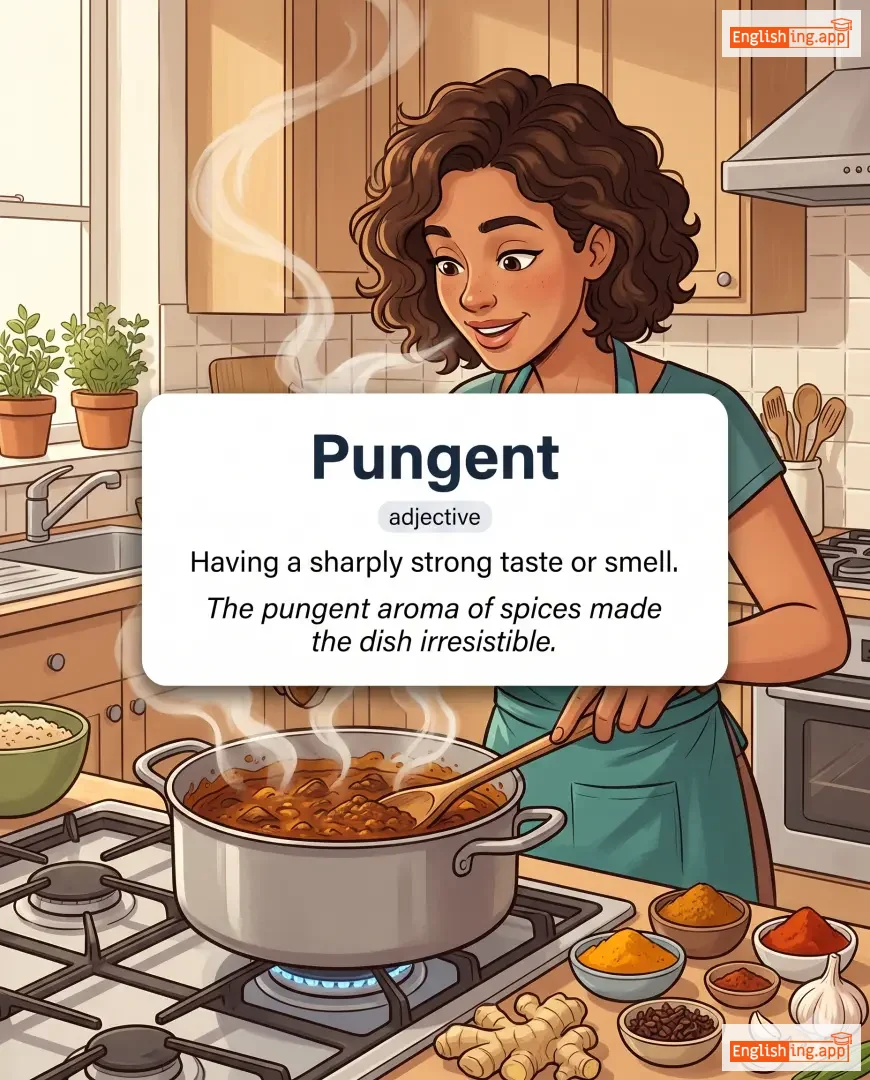
Pungent definition card — visual illustration of the meaning
adjective C1
/ˈpʌndʒənt/
तीव्र गंध या स्वाद (teevr gandh ya swaad)

Having a sharply strong taste or smell.

"The pungent aroma of spices made the dish irresistible."

"मसालों की तीव्र गंध ने व्यंजन को अपरिहार्य बना दिया।" (Masalon ki teevr gandh ne vyanjan ko aparihary bana diya.)
adjective C1
/ˈpjuː.nɪ.tɪv/
दंडात्मक (dantatmak)

Inflicting or intended as punishment.

"The company faced punitive measures for violating the law."

"कंपनी को कानून का उल्लंघन करने के लिए दंडात्मक कदमों का सामना करना पड़ा।" (Kampani ko kanoon ka ullanghan karne ke liye dantatmak kadmon ka samna karna pada.)
noun C1
/pʌnˈdʒɑː.bi/
पंजाबी (punjabi)

a traditional long shirt worn in South Asia, typically loose-fitting

"He wore a white punjabi for the festival celebration."

"उसने त्योहार के अवसर पर सफेद पंजाबी पहना।" (usne tyohaar ke avsar par safed punjabi pehna.)
adjective C1
/ˈpjuː.ni/
निगूड़ा (niguda)

Small, weak, or insignificant.

"He felt puny compared to his stronger classmates."

"वह अपने मजबूत सहपाठियों की तुलना में खुद को कमजोर महसूस कर रहा था।" (Vah apne majboot sahapathiyon ki tulna mein khud ko kamzor mehsoos kar raha tha.)
noun C1
/ˈpɜːrɡəˌtɔːri/
पापियों द्वारा अपने पापों का प्रायश्चित करने से पहले आत्माओं द्वारा पीड़ा का स्थान (paapiyon dwara apne paapon ka prayashchit karne se pehle aatmon dwara peeda ka sthan)

A place or state of suffering inhabited by the souls of sinners who are expiating their sins before going to heaven; a temporary condition of torment or suffering.

"After the accident, the long recovery felt like a kind of purgatory."

"दुर्घटना के बाद, लंबी रिकवरी एक प्रकार का पुर्गेटरी जैसा महसूस हुआ।" (Durghatna ke baad, lambi recovery ek prakaar ka purgatory jaisa mehsoos hua.)
verb C1
/pɜːrdʒ/
हटाना (hatana)

To remove unwanted feelings, people, or things; to cleanse or purify.

"The new leader promised to purge corruption from the government."

"नए नेता ने सरकार से भ्रष्टाचार को समाप्त करने का वादा किया।" (Naye neta ne sarkar se bhrashtachar ko samaapt karne ka vada kiya.)