Vokabulare

Englisches Vokabelwörterbuch | Wortbedeutungen, Definitionen & Beispiele

adjective C1
/skænt/
escaso (escaso)

Barely sufficient or inadequate in amount, degree, or quantity.

"There was scant evidence to support the claim."

"Había poca evidencia para respaldar la afirmación." (Había poca evidencia para respaldar la afirmación.)
adjective C1
/ˈskænti/
escaso (escaso)

Small in quantity; insufficient or meager.

"The refugees survived on scanty food supplies."

"Los refugiados sobrevivieron con provisiones de comida escasas." (Los refugiados sobrevivieron con provisiones de comida escasas.)
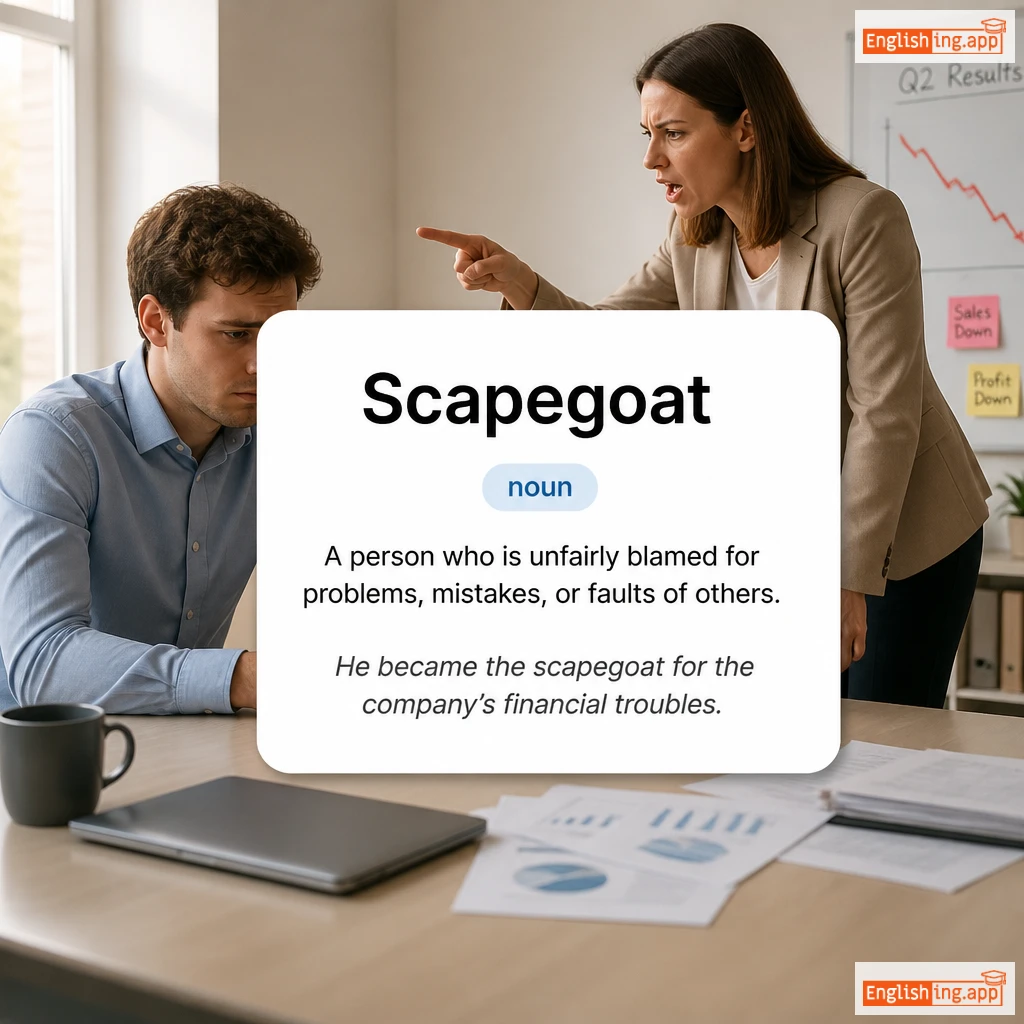
Scapegoat definition card — visual illustration of the meaning
noun C1
/ˈskeɪpˌɡoʊt/
chivo expiatorio (chivo expiatorio)

A person who is unfairly blamed for problems, mistakes, or faults of others.

"He became the scapegoat for the company’s financial troubles."

"Él se convirtió en el chivo expiatorio de los problemas financieros de la empresa." (El se konvirtio en el chivo expiatorio de los problemas financieros de la empresa.)
adjective C1
/ˈskeɪðɪŋ/
crítica mordaz (kritika mordaz)

severely critical; harshly scornful

"The critic wrote a scathing review of the movie."

"El crítico escribió una crítica mordaz de la película." (El critico escribio una critica mordaz de la pelicula.)
verb C1
/ˈskævɪndʒ/
buscar entre la basura (buscar entre la basura)

to search through waste or discarded material to find useful items

"The children scavenged for food in the garbage dump."

"Los niños scavengaron para encontrar comida en el basurero." (Los niños scavengaron para encontrar comida en el basurero.)
noun C1
/ˈskævɪndʒər/
carroñero / recolector de basura (carroñero / recolector de basura)

an animal or person that feeds on dead or discarded material

"Vultures are natural scavengers that clean up the environment."

"Los buitres son escavengers naturales que limpian el medio ambiente." (Los buitres son escavengers naturales que limpian el medio ambiente.)
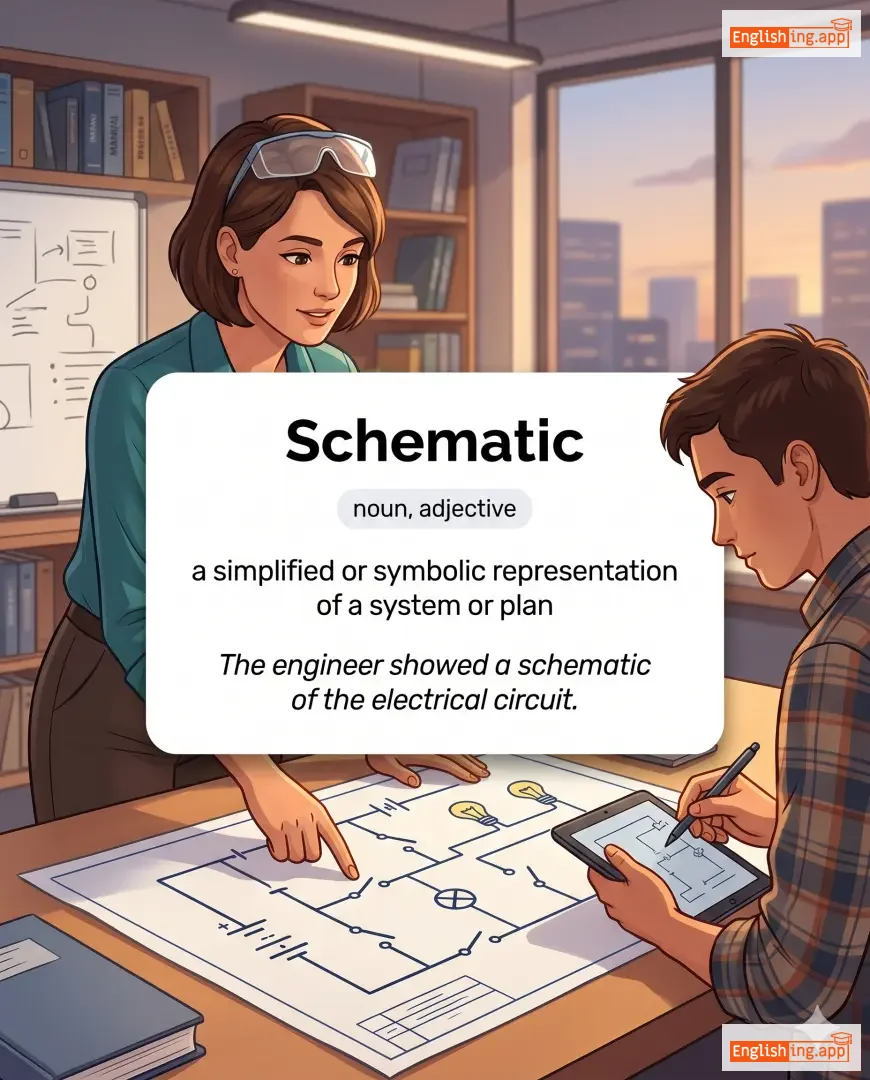
Schematic definition card — visual illustration of the meaning
noun, adjective C1
/skiːˈmætɪk/
esquemático (esquematico)

a simplified or symbolic representation of a system or plan

"The engineer showed a schematic of the electrical circuit."

"El ingeniero mostró un esquema del circuito eléctrico." (El ingeniero mostro un esquema del circuito electrico.)
adjective C1
/skəˈlæstɪk/
escolar (escolar)

Relating to schools, education, or academic learning.

"The school organizes scholastic competitions every year."

"La escuela organiza competencias escolares cada año." (La escuela organiza competencias escolares cada año.)
adjective C1
/ˈsɪn.tɪ.leɪ.tɪŋ/
deslumbrante (deslumbrante)

brilliantly clever, exciting, or sparkling

"Her scintillating conversation kept everyone entertained."

"Su conversación deslumbrante mantuvo a todos entretenidos." (Su conversacion deslumbrante mantuvo a todos entretenidos.)
noun C1
/ˈsaɪ.ən/
descendiente (descendiente)

a descendant of a wealthy, aristocratic, or influential family

"He is the scion of a wealthy industrialist family."

"Él es el descendiente de una familia industrialista rica." (Él es el descendiente de una familia industrialista rica.)
verb C1
/skɒf/
burlarse (burlarse)

to speak about something in a mocking or dismissive way

"He scoffed at the idea of moving abroad."

"Él se burló de la idea de mudarse al extranjero." (Él se burló de la idea de mudarse al extranjero.)
verb C1
/skɔːrtʃ/
quemar (ke-mar)

to burn the surface of something slightly

"The fire scorched the walls of the building."

"El fuego quemó las paredes del edificio." (El fuego ke-mó las pa-re-des del edi-fi-cio.)
adjective C1
/ˈskɔːrnfəl/
despectivo (despectivo)

showing contempt or disdain; expressing scorn

"She gave him a scornful look when he made the rude comment."

"Ella le dio una mirada desdeñosa cuando hizo el comentario grosero." (Ella le dio una mirada desdeñosa cuando hizo el comentario grosero.)
verb/noun C1
/skɒtʃ/
poner fin / whisky escocés (poner fin / whisky escoces)

to put an end to something; also a type of whisky

"The report scotched the rumors of a merger."

"El informe puso fin a los rumores sobre una fusión." (El informe puso fin a los rumores sobre una fusion.)
noun C1
/ˈskaʊndrəl/
canalla (kanaya)

a dishonest or unscrupulous person; a villain

"That scoundrel cheated the old man out of his savings."

"Ese canalla engañó al anciano y le robó sus ahorros." (Ese kanaya enganyo al anciano y le robo sus ahorros.)
verb C1
/ˈskaʊər/
fregar / buscar exhaustivamente (fregar / buscar exhaustivamente)

to clean or brighten the surface of something by scrubbing; to search thoroughly

"She scoured the kitchen until it shone."

"Ella fregó la cocina hasta que brilló." (Ella frego la cocina hasta que brillo.)
noun/verb C1
/skɜːrdʒ/
maldición / flagelo (maldicion / flagelo)

A source of great pain or punishment; to whip or inflict suffering on someone.

"Disease and poverty remain a scourge in many regions."

"La enfermedad y la pobreza siguen siendo una maldición en muchas regiones." (La enfermedad y la pobreza siguen siendo una maldición en muchas regiones.)
verb/noun C1
/skaʊl/
fruncir el ceño (fruncir el ceño)

To frown in an angry or bad-tempered way.

"She scowled when she heard the unfair remark."

"Ella frunció el ceño cuando escuchó el comentario injusto." (Ella frunció el ceño cuando escuchó el comentario injusto.)
adjective C1
/ˈskræpi/
peleador / desordenado (peleador / desordenado)

Determined and willing to fight or argue; also messy or disorganized.

"Despite being small, he was a scrappy fighter."

"A pesar de ser pequeño, era un peleador audaz." (A pesar de ser pequeño, era un peleador audaz.)
verb C1
/skrɔːl/
escribir rápidamente y de manera desordenada (escribir rapidamente y de manera desordenada)

to write or draw something quickly and carelessly, making it hard to read

"He scrawled his signature at the bottom of the page."

"Él scrawle su firma en la parte inferior de la página." (Él scrawle su firma en la parte inferior de la página.)
adjective C1
/ˈskrɔːni/
flaco (flaco)

very thin and bony, often looking unhealthy

"The scrawny boy could barely lift the heavy bag."

"El chico flaco apenas podía levantar la bolsa pesada." (El chico flaco apenas podía levantar la bolsa pesada.)
noun C1
/skraɪb/
escriba (escriba)

a person who writes documents, especially in ancient times; a professional copyist

"In ancient Egypt, scribes recorded important events."

"En el antiguo Egipto, los escribas registraron eventos importantes." (En el antiguo Egipto, los escribas registraron eventos importantes.)
noun C1
/ˈskrɪmɪdʒ/
partido de práctica (partido de practica)

A practice game or informal match, often in sports, especially football.

"The team had a scrimmage before the official season started."

"El equipo tuvo un partido de práctica antes de que comenzara la temporada oficial." (El equipo tuvo un partido de practica antes de que comenzara la temporada oficial.)
adjective C1
/ˈskrɪptʃərəl/
escritural (escriturál)

Relating to or contained in the scriptures or holy writings.

"The priest gave a scriptural reference during the sermon."

"El sacerdote dio una referencia escritural durante el sermón." (El sacerdote dio una referencia escritural durante el sermón.)
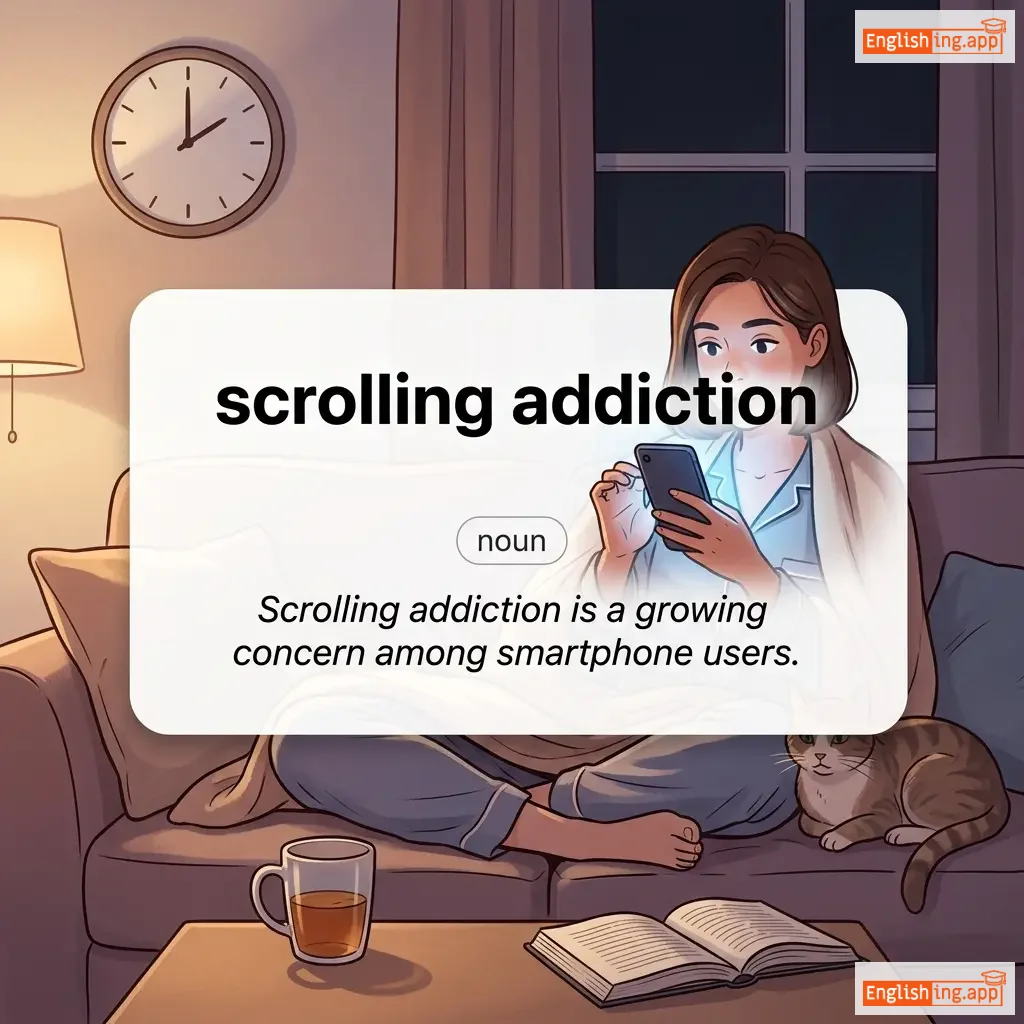
scrolling addiction definition card — visual illustration of the meaning
noun C1
স্ক্রোলিং অ্যাডিকশন
adicción al desplazamiento (adiccion al desplazamiento)

A compulsive need to continuously scroll through content on digital devices, particularly smartphones and social media platforms.

"Scrolling addiction is a growing concern among smartphone users."

"La adicción al desplazamiento es una preocupación creciente entre los usuarios de teléfonos inteligentes." (La adiccion al desplazamiento es una preocupacion creciente entre los usuarios de telefonos inteligentes.)
adjective C1
/ˈskrʌfi/
desaliñado o desordenado en apariencia; sucio y desgastado (desaliñado o desordenado en apariencia; sucio y desgastado)

untidy or unkempt in appearance; shabby and worn

"The scruffy old dog wandered through the streets looking for food."

"El perro desaliñado caminó por las calles buscando comida." (El perro desaliñado caminó por las calles buscando comida.)
adjective C1
/ˈskrʌmpʃəs/
exquisito (exquisito)

extremely tasty or delicious

"She baked a scrumptious chocolate cake for the party."

"Ella horneó un exquisito pastel de chocolate para la fiesta." (Ella horneó un exquisito pastel de chocolate para la fiesta.)
noun C1
/ˈskruːpəl/
escrúpulo (escrupulo)

A moral or ethical consideration that restrains actions.

"He had no scruples about lying to get ahead."

"Él no tenía escrúpulos para mentir y avanzar." (El no tenia escrupulos para mentir y avanzar.)
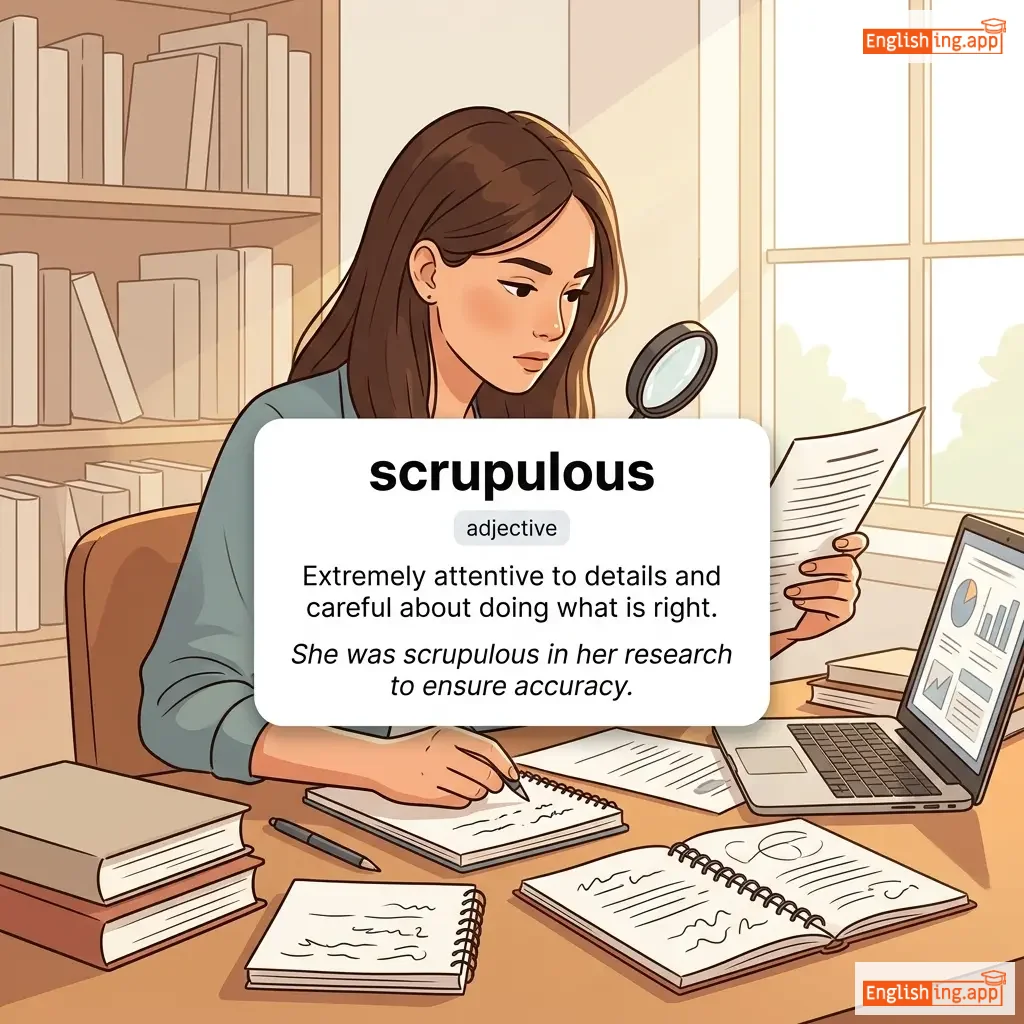
scrupulous definition card — visual illustration of the meaning
adjective C1
/ˈskruːpjələs/
escrupuloso (escrupuloso)

Extremely attentive to details and careful about doing what is right.

"She was scrupulous in her research to ensure accuracy."

"Ella fue escrupulosa en su investigación para garantizar la precisión." (Ella fue escrupulosa en su investigacion para garantizar la precision.)
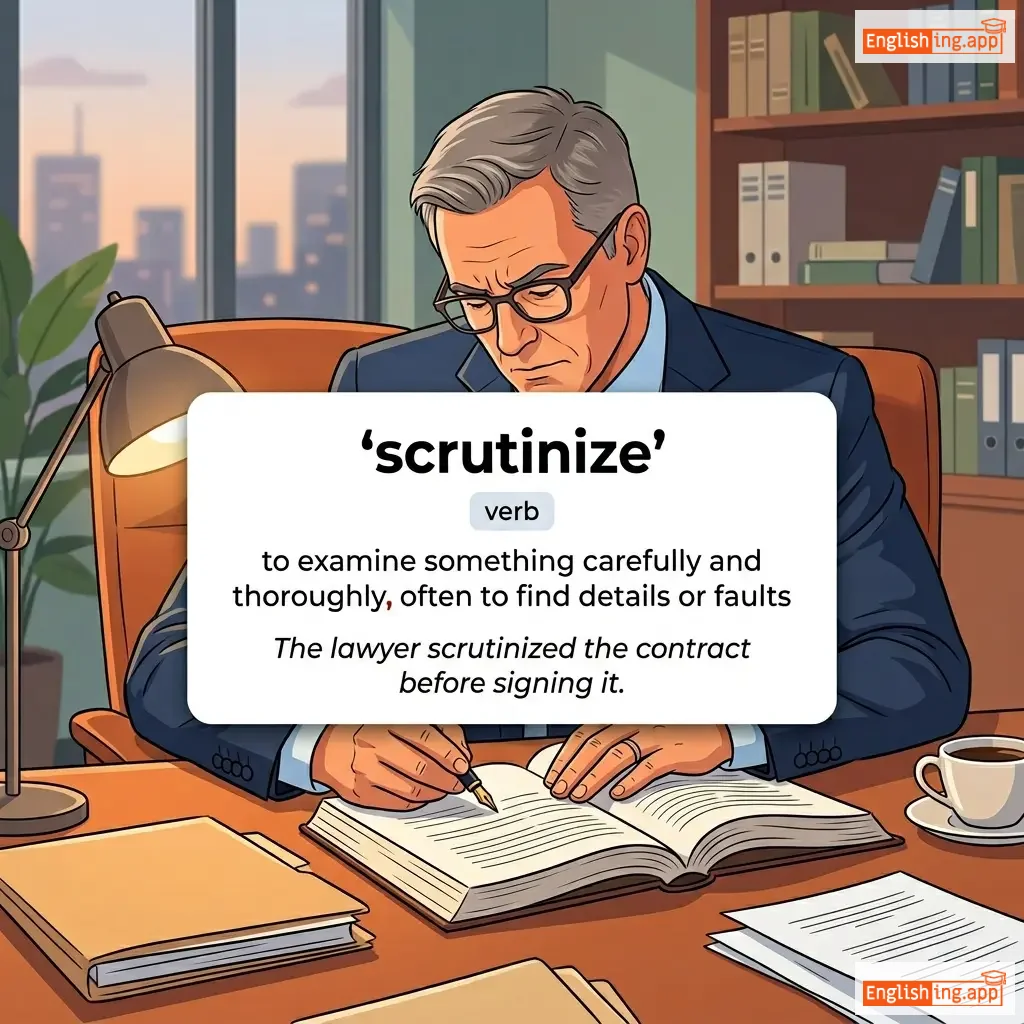
scrutinize definition card — visual illustration of the meaning
verb C1
/ˈskruː.tɪ.naɪz/
examinar (examinar)

to examine something carefully and thoroughly, often to find details or faults

"The lawyer scrutinized the contract before signing it."

"El abogado examinó el contrato antes de firmarlo." (El abogado examinó el contrato antes de firmarlo.)
verb C1
/skʌf/
rasguñar (rasguñar)

to mark or scratch the surface of something by rubbing

"He scuffed his shoes on the pavement."

"Él rasguñó sus zapatos en la acera." (Él rasguñó sus zapatos en la acera.)
noun, verb C1
/ˈskʌf.əl/
pelea/disputa (pelea/disputa)

a short, confused fight or struggle; to engage in such a fight

"Two players scuffled on the field after the foul."

"Dos jugadores se pelearon en el campo después de la falta." (Dos jugadores se pelearon en el campo después de la falta.)
verb C1
/skʌlpt/
felicidad (felicidad)

to create or shape something by carving or molding

"The artist sculpted a beautiful statue from marble."

"Ella no pudo ocultar su felicidad cuando recibió el premio." (Ella no pudo ocultar su felicidad cuando recibió el premio.)
verb C1
/ˈskʌr.i/
correr rápidamente (correr rapidamente)

To move quickly with short, hurried steps.

"The mice scurried across the kitchen floor when the lights turned on."

"Los ratones corrieron rápidamente por el suelo de la cocina cuando las luces se encendieron." (Los ratones corrieron rapidamente por el suelo de la cocina cuando las luces se encendieron.)
verb C1
/ˈskʌt.əl/
felicidad (felicidad)

To run hurriedly with short, quick steps; or to deliberately sink a ship.

"The children scuttled back to their seats when the teacher entered."

"Ella no podía ocultar su felicidad cuando recibió el premio." (Ella no podía ocultar su felicidad cuando recibió el premio.)
noun C1
/saɪð/
hoz (hoz)

A tool with a long curved blade used for cutting grass or grain.

"The farmer sharpened his scythe before harvesting the wheat."

"El agricultor afiló su hoz antes de cosechar el trigo." (El agricultor afiló su hoz antes de cosechar el trigo.)
noun C1
/ˈseɪɑːns/
sesión espiritista (sesion espiritista)

A meeting where people attempt to communicate with the spirits of the dead.

"They held a seance to contact their late grandmother."

"Celebraron una sesión espiritista para contactar a su abuela fallecida." (Celebraron una sesion espiritista para contactar a su abuela fallecida.)
verb C1
/sɪr/
sellar (sellar)

To burn or scorch the surface of something with intense heat.

"The chef seared the steak to lock in the flavor."

"El chef selló el filete para atrapar el sabor." (El chef selló el filete para atrapar el sabor.)
adverb C1
/ˈsɜːrtʃɪŋli/
buscadoramente (buscadoramente)

In a way that seems to look for hidden meanings or truth.

"She looked at him searchingly, hoping for an honest answer."

"Ella lo miró buscando, esperando una respuesta honesta." (Ella lo miró buscando, esperando una respuesta honesta.)
noun C1
/ˈsiːskeɪp/
paisaje marino (paisaje marino)

A view or painting of the sea.

"The artist painted a beautiful seascape at sunset."

"El artista pintó un hermoso paisaje marino al atardecer." (El artista pintó un hermoso paisaje marino al atardecer.)
adjective C1
/ˈsiːzənəbl/
temporal (temporal)

Appropriate to the time of year or season.

"We had seasonable weather for autumn."

"Tuvimos un clima apropiado para el otoño." (Tuvimos un clima apropiado para el otoño.)
adjective/verb C1
/ˈsiːzənd/
experimentado / sazonado (experimentado / sazonado)

Experienced in a particular activity; also, flavored with spices.

"She is a seasoned teacher with over 20 years of experience."

"Ella es una maestra experimentada con más de 20 años de experiencia." (Ella es una maestra experimentada con más de 20 años de experiencia.)
verb C1
/sɪˈsiːd/
secesionar (secesionar)

To formally withdraw from a political or organizational union.

"Several states threatened to secede from the union."

"Varios estados amenazaron con separarse de la unión." (Varios estados amenazaron con separarse de la union.)
noun C1
/sɪˈsɛʃən/
secesión (secesion)

The action of formally withdrawing from membership of a federation or body.

"The secession of the southern states led to the Civil War."

"La secesión de los estados del sur llevó a la Guerra Civil." (La secesion de los estados del sur llevo a la Guerra Civil.)
verb C1
/sɪˈkluːd/
aislar (aislar)

To keep someone away from other people; to isolate.

"The monk chose to seclude himself in the mountains."

"El monje eligió aislarse en las montañas." (El monje eligió aislarse en las montañas.)
adjective C1
/sɪˈkluːdɪd/
aislado (aislado)

Placed apart from other people or things; private and quiet.

"They spent their vacation in a secluded beach house."

"Pasaron sus vacaciones en una casa de playa aislada." (Pasaron sus vacaciones en una casa de playa aislada.)
noun C1
/sɪˈkluːʒən/
aislamiento (aislamiento)

The state of being private, away from other people.

"She spent the weekend in complete seclusion in her cabin."

"Pasó el fin de semana en completo aislamiento en su cabaña." (Pasó el fin de semana en completo aislamiento en su cabaña.)
adjective C1
/ˌsekənd ˈreɪt/
de segunda categoría (de segunda categoria)

Of mediocre or inferior quality.

"The movie was entertaining but clearly second-rate compared to the original."

"La película fue entretenida, pero claramente de segunda categoría en comparación con la original." (La pelicula fue entretenida, pero claramente de segunda categoria en comparacion con la original.)
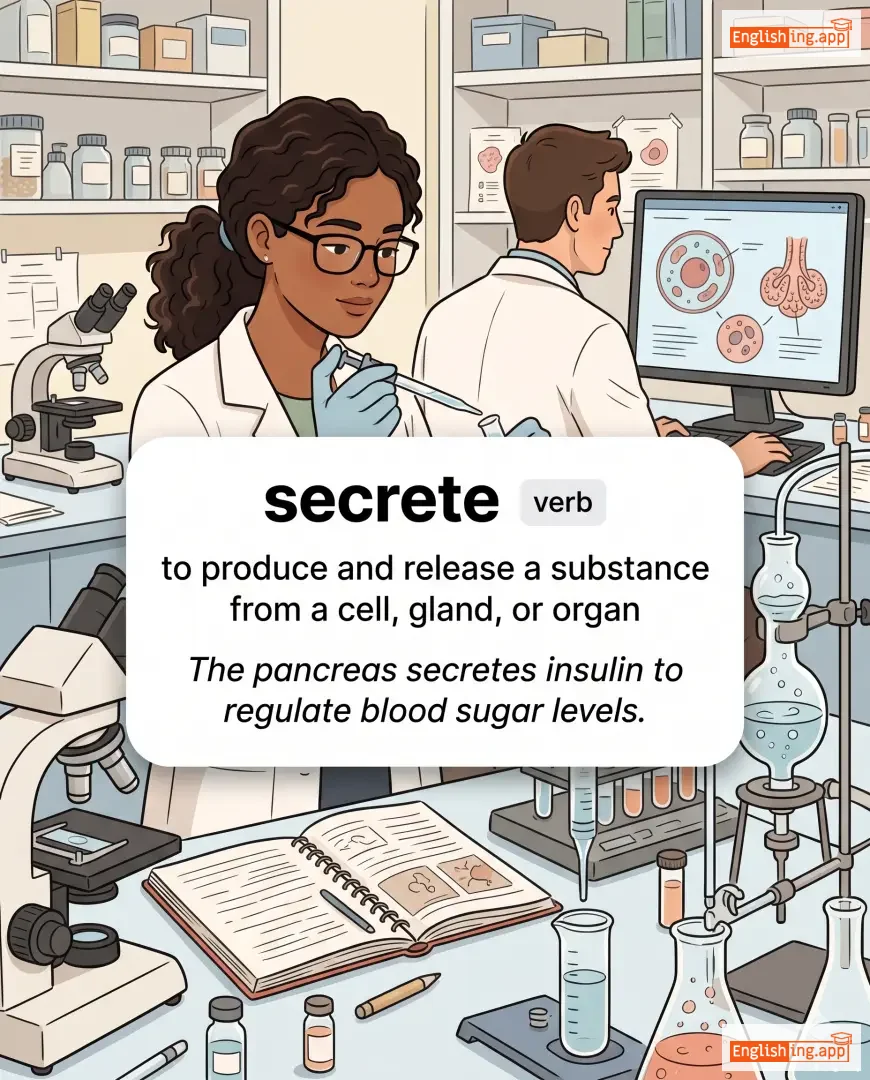
secrete definition card — visual illustration of the meaning
verb C1
/sɪˈkriːt/
secreción (secrecion)

to produce and release a substance from a cell, gland, or organ

"The pancreas secretes insulin to regulate blood sugar levels."

"El páncreas secreta insulina para regular los niveles de azúcar en la sangre." (El pancreas secreta insulina para regular los niveles de azucar en la sangre.)
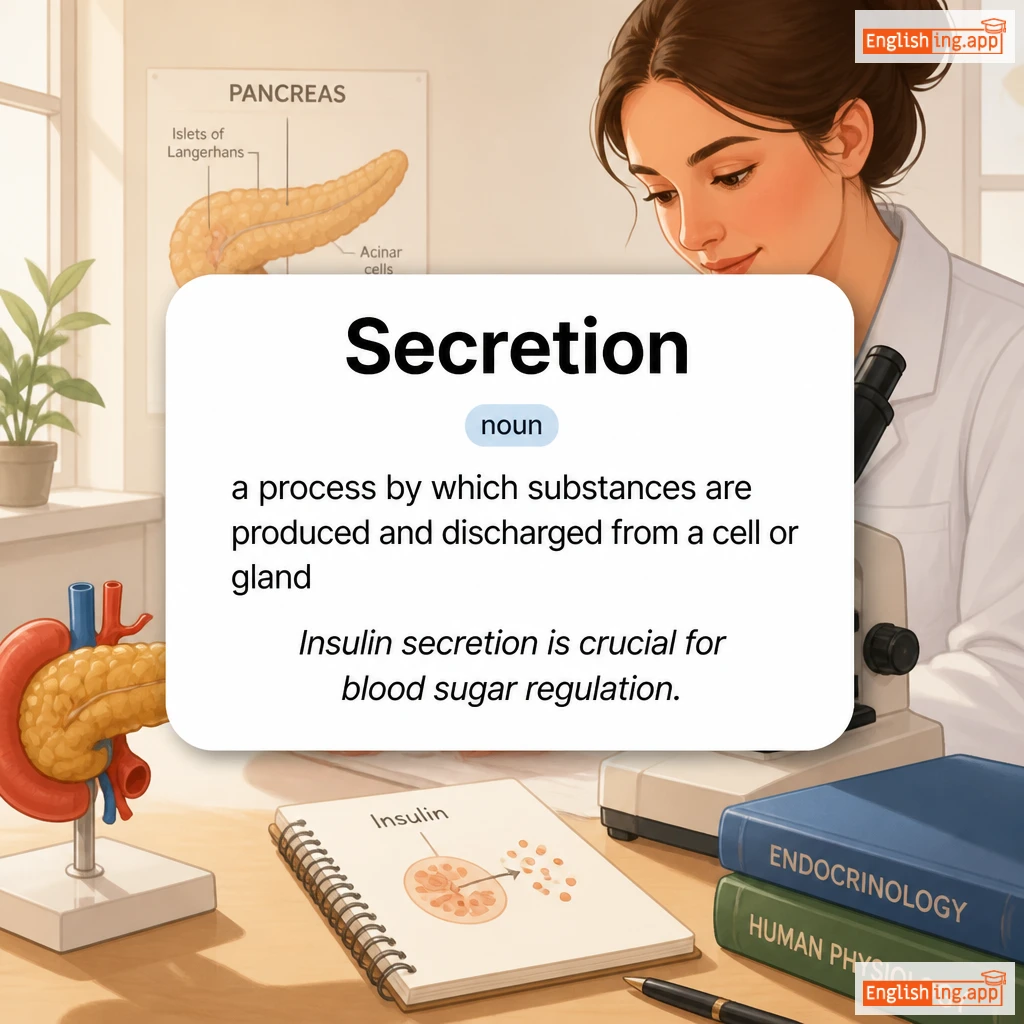
Secretion definition card — visual illustration of the meaning
noun C1
/sɪˈkriː.ʃən/
secreción (secrecion)

a process by which substances are produced and discharged from a cell or gland

"Insulin secretion is crucial for blood sugar regulation."

"La secreción de insulina es crucial para la regulación del azúcar en sangre." (la secrecion de insulina es crucial para la regulacion del azucar en sangre)