词汇表

英语词汇词典 | 单词含义、定义和示例

verb C2
/ɪmˈpɛnd/
临近 (linjin)

to be about to happen; to loom threateningly

"Dark clouds suggested that a storm was impeding."

"乌云暗示着暴风雨即将来临。" (Wu yun anshi zhe baofengyu jiang jiali。)
adjective C2
/ɪmˈpɛn.ɪ.tənt/
不悔 (bù huǐ)

Not feeling regret or shame about one's actions.

"The criminal remained impenitent after the trial."

"犯罪者在审判后依然不悔。" (Fànzuì zhě zài shěnpàn hòu yīrán bù huǐ.)
adjective C2
/ˌɪm.pəˈfɛk.tə.bəl/
不可完美 (bù kě wán měi)

Incapable of being made perfect or complete.

"Some human qualities are considered imperfectible."

"某些人类特质被认为是不可完美的。" (Mǒu xiē rénlèi tèzhì bèi rènwéi shì bù kě wán měi de.)
adjective C2
/ɪmˈpɪəriəs/
专横 (zhuānhèng)

Arrogantly domineering or overbearing.

"Her imperious tone made it hard for others to argue."

"她那种专横的语气让其他人很难反驳。" (Tā nà zhǒng zhuānhèng de yǔqì ràng qítā rén hěn nán fǎnbó.)
adjective C2
/ɪmˈperɪʃəbəl/
永恒的; 不朽的; 不会腐烂的 (yǒnghéng de; bùxiǔ de; bù huì fǔlàn de)

not subject to decay; lasting forever; eternal

"The imperishable beauty of classical art continues to inspire generations."

"经典艺术的永恒美丽继续激励着一代又一代。" (Jīngdiǎn yìshù de yǒnghéng měilì jìxù jīlì zhe yī dài yòu yī dài.)
adjective C2
/ˌɪmpəˈmɪsəbl/
不允许的 (bu yunxu de)

Not permitted or allowed.

"Such behavior is impermissible in the workplace."

"这种行为在工作场所是不允许的。" (Zhe zhong xingwei zai gongzuo changsuo shi bu yunxu de.)
adjective C2
/ɪmˌpɜːrˈsweɪdəbl/
难以说服 (nán yǐ shuō fú)

not able to be convinced or persuaded

"She remained impersuadable despite all our arguments."

"尽管我们的所有论点,她仍然难以说服。" (Jǐnguǎn wǒmen de suǒyǒu lùndiǎn, tā réngrán nán yǐ shuō fú.)
noun C2
/ɪmˌpɜːrtərbəˈbɪləti/
安定性 (andingxing)

The quality of being calm and not easily disturbed or upset.

"Her imperturbability during the crisis impressed everyone."

"她在危机中的安定性给所有人留下了深刻的印象。" (Ta zai weiji zhong de andingxing gei suoyouren liuxiala shenke de yinxiang.)
imperturbable definition card — visual illustration of the meaning
adjective C2
/ɪmˈpɜːrtərbəbəl/
泰然自若 (tairan ziruo)

Unable to be upset or excited; calm.

"He remained imperturbable even when faced with tough questions."

"他在面对难题时依然保持冷静。" (Tā zài miànduì nántí shí yīrán bǎochí lěngjìng.)
noun C2
/ˌɪmpəˈtjuːəsəti/
冲动性 (chongdongxing)

The quality of being rash or impulsive.

"His impetuosity often got him into trouble."

"他的冲动性常常让他陷入麻烦。" (Tā de chōngdòngxìng chángcháng ràng tā xiànrù máfan.)
Impiety definition card — visual illustration of the meaning
noun C2
/ɪmˈpaɪəti/
不敬 (bù jìng)

lack of respect for religion or sacred things

"The priest condemned the impiety of neglecting the temple rituals."

"牧师谴责了忽视寺庙仪式的不敬。" (Mùshī qiǎnzéle hūshì sìmiào yíshì de bù jìng.)
adjective C2
/ˈɪmpɪəs/
亵渎的 (xièdú de)

showing a lack of respect for God or religion

"It was considered impious to joke about sacred traditions."
"开玩笑神圣的传统被认为是亵渎的。" (Kāi wánxiào shèngshèng de chuántǒng bèi rènwéi shì xièdú de.)
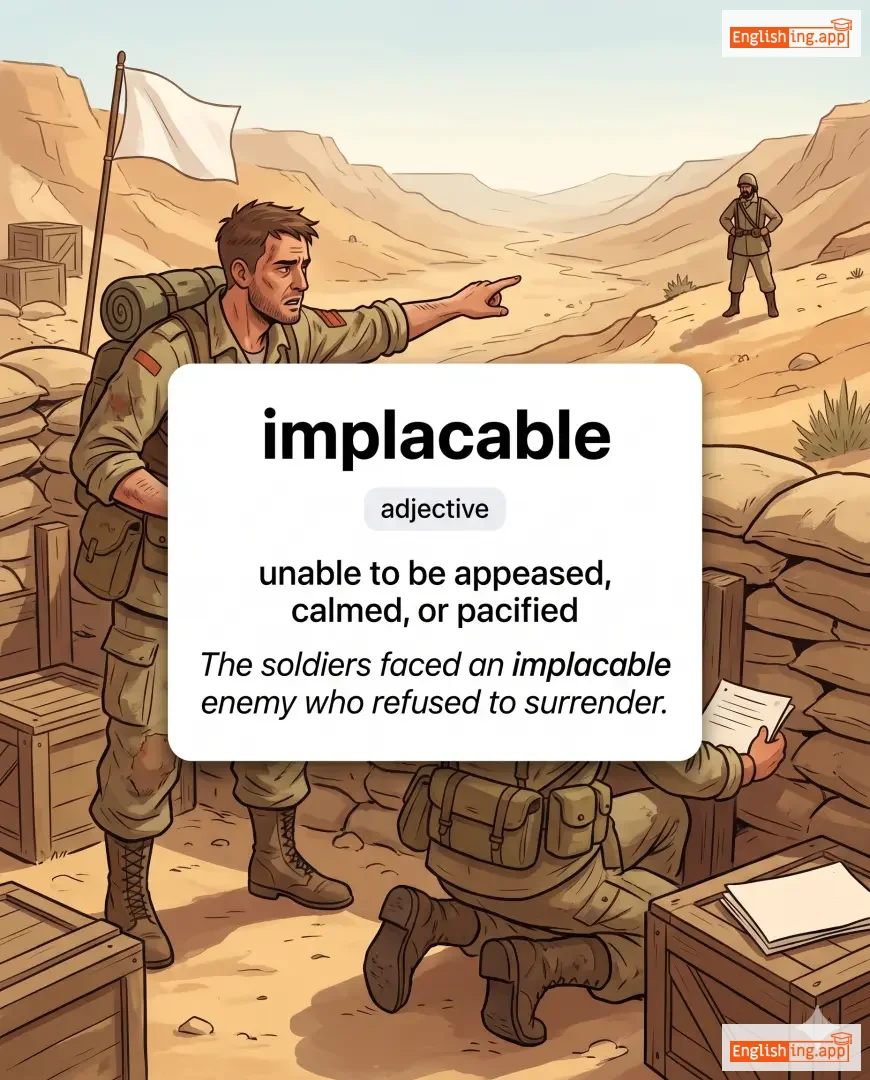
implacable definition card — visual illustration of the meaning
adjective C2
/ɪmˈplækəbl/
不可调和 (bukediaohuo)

unable to be appeased, calmed, or pacified

"The soldiers faced an implacable enemy who refused to surrender."

"士兵们面对着一个不可调和的敌人,他拒绝投降。" (Shibingmen miandui zhege bukediaohuo de diren, ta jujue touxiang.)
adjective C2
/ɪmˈplaɪəbl/
可暗示的 (ke anshi de)

Capable of being implied or suggested.

"The meaning of the statement is not directly clear but is impliable from the context."

"声明的意思并不直接明确,但可以从上下文中推断。" (Shengming de yisi bing bu zhijie mingque, dan keyi cong shangxiawen zhong tuicai.)
adjective C2
/ɪmˈpɑːlɪtɪk/
不明智的 (bumingzhide)

Unwise or imprudent; not showing good judgment.

"It would be impolitic to criticize them openly."

"公开批评他们是不明智的。" (Gongkai pīpíng tāmen shì bù míngzhì de.)
adjective C2
/ɪmˈpɒndərəbl̩/
无法估量 (wufagu liang)

Something difficult or impossible to estimate, assess, or understand

"The outcome of the election depends on many imponderable factors."

"选举结果取决于许多无法估量的因素。" (Xuanju jieguo qujue yu xu duo wufagu liang de yinsu.)
adjective C2
/ɪmˈpɔːrtʃənət/
缠人的 (chan ren de)

Persistent to the point of annoyance or intrusion

"The importunate salesman kept calling despite repeated refusals."

"那个缠人的推销员在反复拒绝后仍然继续打电话。" (Nàgè chán rén de tuīxiāo yuán zài fǎnfù jùjué hòu réngrán jìxù dǎ diànhuà.)
verb C2
/ˌɪmpɔːrˈtuːn/
反复请求 (fǎn fù qǐng qiú)

To ask someone persistently or pressingly for something

"The child importuned his mother for a new toy."

"孩子反复请求母亲给他买一个新玩具。" (Háizi fǎnfù qǐngqiú mǔqīn gěi tā mǎi yīgè xīn wánjù.)
verb C2
/ˌɪmpɔːrˈtuːnd/
不停地请求 (bù tíng dì qǐng qiú)

asked someone persistently and pressingly for something

"She importuned her boss for a raise until he finally gave in."
"她不停地请求老板加薪,直到他最终答应。" (Tā bù tíng dì qǐng qiú lǎo bǎn jiā xīn, zhídào tā zuì zhōng dā yìng.)
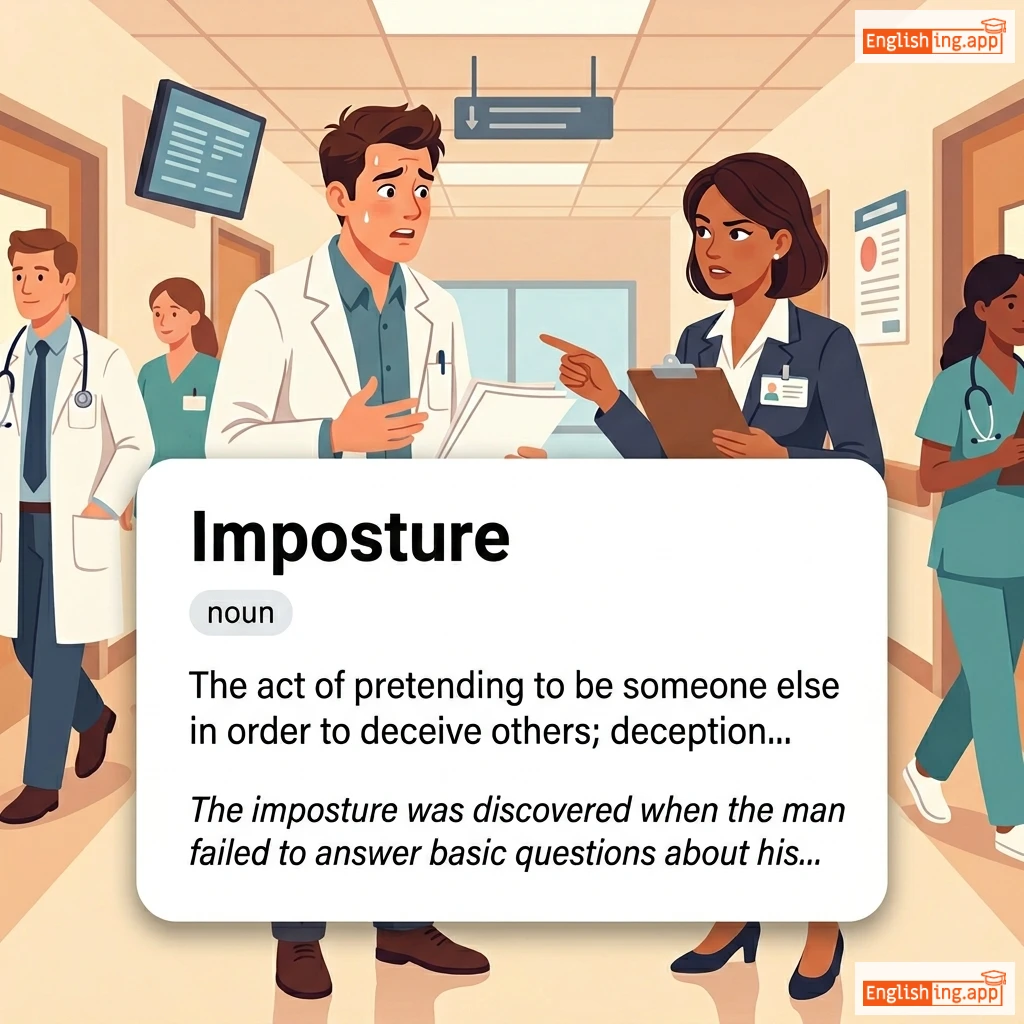
Imposture definition card — visual illustration of the meaning
noun C2
/ɪmˈpɒstʃər/
冒充 (mao chong)

The act of pretending to be someone else in order to deceive others; deception or fraud.

"The imposture was discovered when the man failed to answer basic questions about his supposed identity."

"冒充被发现是因为那个人无法回答关于他假定身份的基本问题。" (Maochong bei faxian shi yinwei na ge ren wufa huidao guanyu ta jiading shenfen de jiben wenti.)
adjective C2
/ɪmˈpræktɪkəbl/
不切实际 (bu qie shi ji)

Not capable of being carried out or put into practice.

"The plan seemed impracticable due to limited resources."

"由于资源有限,计划显得不切实际。" (Yu yuansuo youxian, jihua xiande bu qie shiji.)
verb C2
/ˈɪmprɪkeɪt/
诅咒 (zǔ zhòu)

To utter a curse or invoke evil upon someone.

"The old woman imprecated her enemies with dark words."
"老女人用黑暗的词语诅咒她的敌人。" (Lǎo nǚrén yòng hēi'àn de cíyǔ zǔzhòu tā de dírén.)
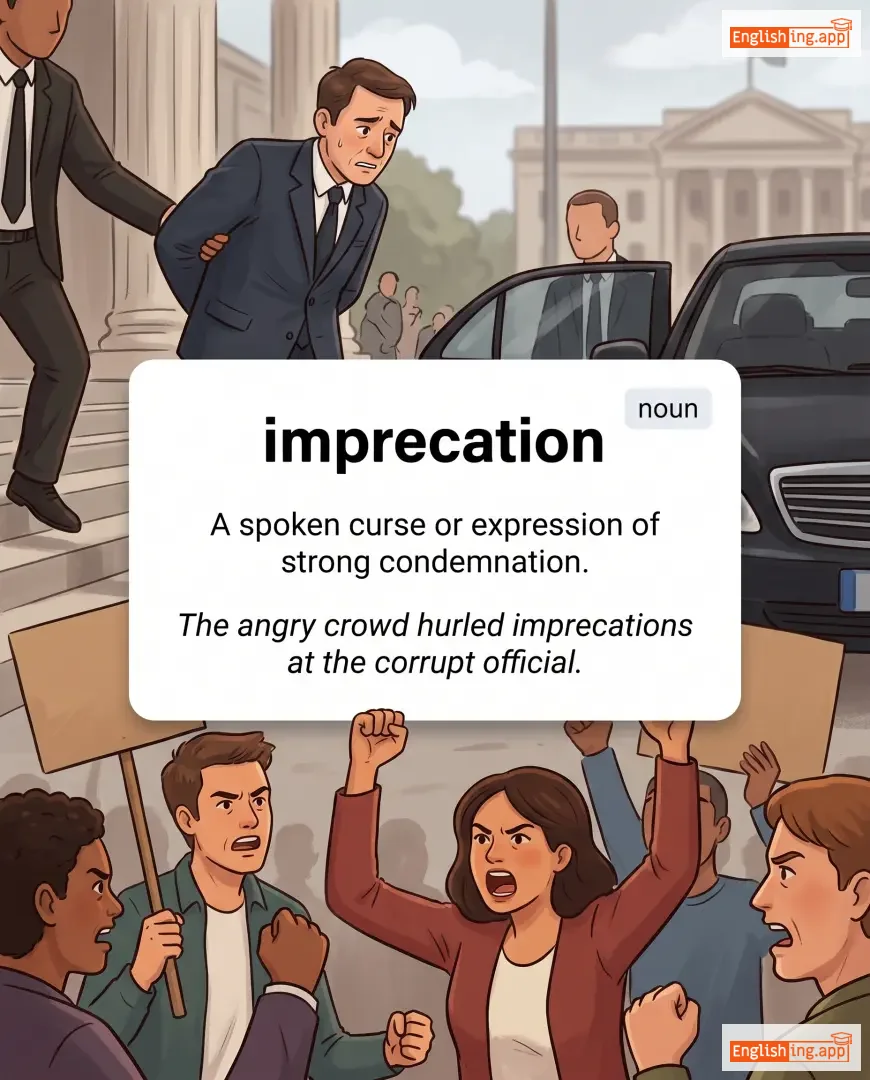
imprecation definition card — visual illustration of the meaning
noun C2
/ˌɪmprɪˈkeɪʃən/
诅咒 (zuzhou)

A spoken curse or expression of strong condemnation.

"The angry crowd hurled imprecations at the corrupt official."

"愤怒的人群向腐败的官员投掷了诅咒。" (Fen nu de renqun xiang fubai de guan yuan tou zhi le zuzhuo.)
adjective C2
/ɪmˈprɛɡnəbl̩/
固若金汤 (gù ruò jīn tāng)

Unable to be captured, broken into, or defeated.

"The fortress was considered impregnable by the enemy."

"敌人认为这个堡垒固若金汤。" (Dírén rènwéi zhège bǎolěi gù ruò jīn tāng.)
verb C2
/ˈɪmprɛɡneɪt/
使怀孕 / 浸透 (shǐ huáiyùn / jìntòu)

To make pregnant; to fill or saturate with something.

"The scientist used a method to impregnate the material with resin."

"科学家使用一种方法将材料用树脂进行浸透。" (Kēxuéjiā shǐyòng yī zhǒng fāngfǎ jiāng cáiliào yòng shùzhī jìnxíng jìntòu.)
noun C2
/ˌɪmprəˈsɑːrioʊ/
主办人 (zhǔbànrén)

A person who organizes or finances concerts, plays, or operas.

"The impresario arranged a series of concerts for the rising star."

"这位印普雷萨里奥为崭露头角的明星安排了一系列的音乐会。" (Zhè wèi yìn pǔ léi sà lǐ ào wéi zhǎn lù tóu jiǎo de míngxīng ānpái le yī xìliè de yīnyuè huì.)
noun C2
/ˌɪmprɪˈmɑːtər/
批准书 (pīzhǔnshū)

An official license or approval, especially to publish a book.

"The book was released with the official imprimatur of the church."
"这本书以教会的正式批准书发布。" (Zhè běn shū yǐ jiàohuì de zhèngshì pīzhǔnshū fābù.)
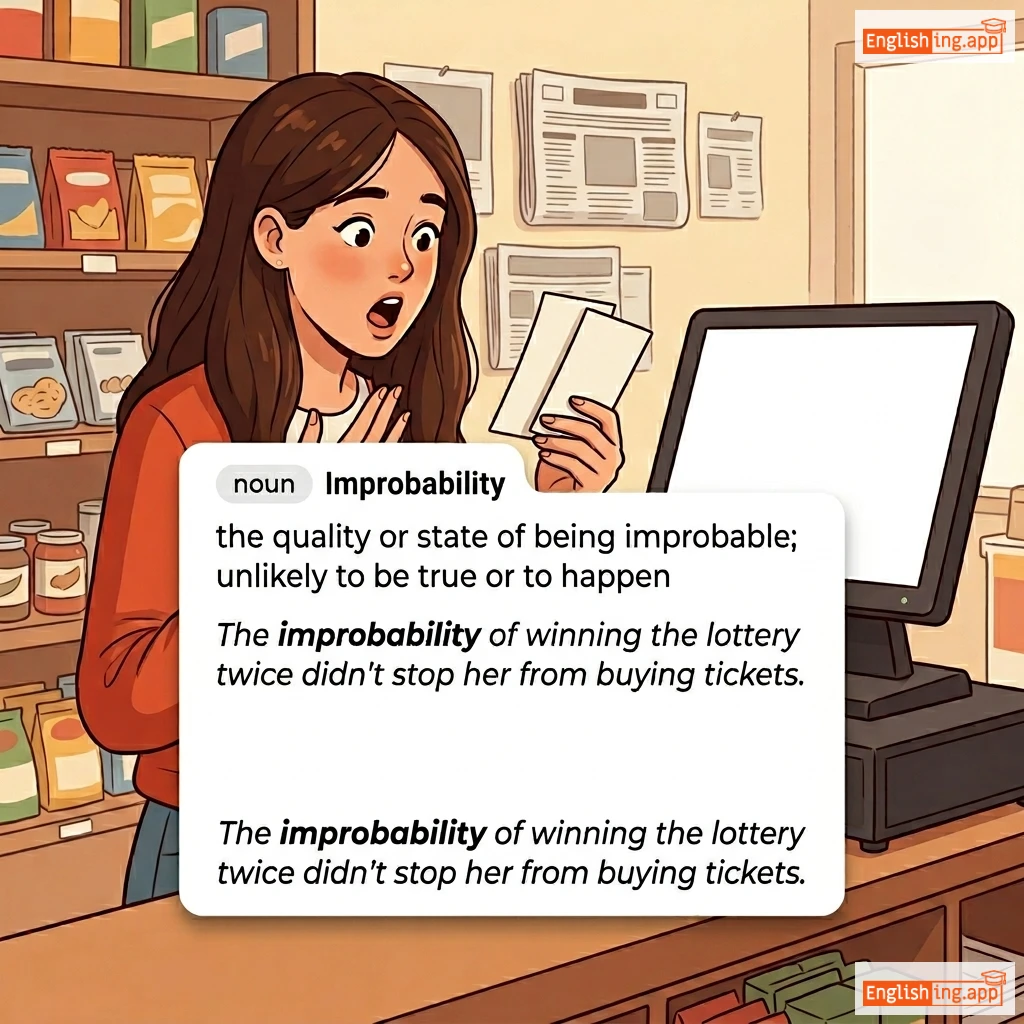
Improbability definition card — visual illustration of the meaning
noun C2
/ɪmˌprɒb.əˈbɪl.ə.ti/
不可能性 (bù kěnéng xìng)

the quality or state of being improbable; unlikely to be true or to happen

"The improbability of winning the lottery twice didn't stop her from buying tickets."

"两次赢得彩票的可能性几乎为零,但她仍然买了票。" (liǎng cì yíngdé cǎipiào de kěnéng xìng jīhū wéi líng, dàn tā réngrán mǎi le piào.)
noun C2
/ˌɪmprəˈpraɪəti/
不当行为 (budang xingwei)

Failure to observe standards of honesty or modesty; improper behavior.

"The politician was accused of financial impropriety."

"该政治家被指控涉及财务不当行为。" (Gai zhengzhijia bei zhi kong sheji caiwu budang xingwei.)
noun C2
/ɪmˈprɑːvɪdəns/
缺乏远见 (que fa yuan jian)

Lack of foresight or care for future needs.

"His improvidence led to financial difficulties."

"他的缺乏远见导致了财务困难。" (ta de que fa yuan jian dao zhi le cai wu kun nan.)
adjective C2
/ɪmˈprɒvɪdənt/
缺乏远见 (quēfá yuǎnjiàn)

Not having or showing foresight; spending wastefully or without thought for the future.

"His improvident habits left him with no savings."
"他缺乏远见的习惯让他没有积蓄。" (Tā quēfá yuǎnjiàn de xíguàn ràng tā méiyǒu jīxù.)
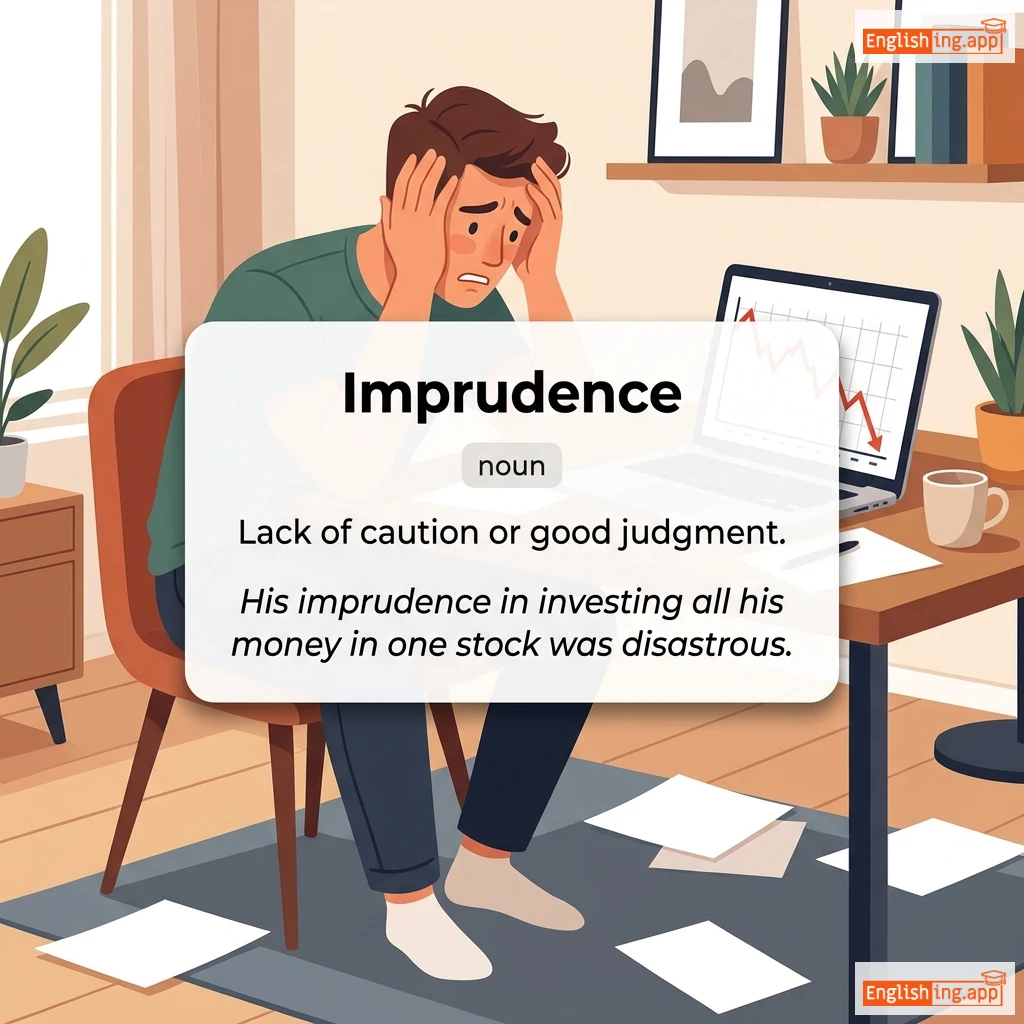
Imprudence definition card — visual illustration of the meaning
noun C2
/ɪmˈpruːdəns/
轻率 (qīng shuài)

Lack of caution or good judgment.

"His imprudence in investing all his money in one stock was disastrous."

"他将所有的钱都投资在一只股票上的轻率行为是灾难性的。" (Ta1 jiang1 suo3 you3 de qian2 dou1 tou2 zi4 zai4 yi1 zhi1 gu3 piao4 shang4 de qing1 shuai4 xing2 wei2 shi4 zai1 nan4 xing4 de.)
adjective C2
/ɪmˈpruːdənt/
鲁莽 (lumang)

Not showing care for the consequences of an action.

"It was imprudent to drive in such stormy weather."

"在如此暴风雨的天气下开车是鲁莽的。" (Zai ru ci baofengyu de tianqi xia kaiche shi lumang de.)
noun C2
/ˈɪmpjʊdəns/
无礼 (wulǐ)

Rude and disrespectful behavior.

"The student's impudence shocked the entire class."

"学生的无礼行为让全班震惊。" (Xuéshēng de wúlǐ xíngwéi ràng quán bān zhènjīng.)
⚔️

impugn

verb C2
/ɪmˈpjuːn/

to dispute the truth, validity, or honesty of a statement or motive

"The lawyer tried to impugn the credibility of the witness."

noun C2
/ɪmˈpjuːɪsəns/
无能, 无力 (wúnéng, wúlì)

inability to take effective action; helplessness

"The government’s impuissance in the face of crisis frustrated the people."

"政府在危机面前的无能让人民感到沮丧。" (Zhèngfǔ zài wēijī miànqián de wúnéng ràng rénmín gǎndào jǔsàng.)
noun C2
/ɪmˈpʌlʃən/

a strong urge or drive to act; the act of impelling

"His impulsion to travel made him leave his job suddenly."

🛡️

impunity

noun C2
/ɪmˈpjuːnɪti/

freedom from punishment or harmful consequences for an action

"The dictator ruled with impunity, ignoring international laws."

noun C2
/ˌɪmpjuˈteɪʃən/
指控 (zhikong)

an accusation or attribution of blame

"The politician denied the imputation of corruption."

"政治家否认了腐败的指控。" (Zhengzhijia founianle fubai de zhikong.)
verb C2
/ɪmˈpjuːt/
归因于 (guī yīn yú)

to attribute a fault or responsibility to someone

"They imputed the company's success to good leadership."

"他们将公司的成功归功于出色的领导力。" (Tāmen jiāng gōngsī de chénggōng guī gōng yú chū sè de lǐngdǎo lì.)
noun C2
/ˌɪnədˈvɜːrtəns/
疏忽 (shūhū)

Failure to pay attention; carelessness.

"The error happened through sheer inadvertence."

"错误是由于完全的疏忽发生的。" (Cuòwù shì yóuyú wánquán de shūhū fāshēng de.)
adjective C2
/ɪnˈeɪliənəbl/
不可转让 (bùkě zhuǎnràng)

Unable to be taken away or transferred; absolute and permanent.

"Freedom of speech is an inalienable right."

"言论自由是一项不可转让的权利。" (Yánlùn zìyóu shì yī xiàng bùkě zhuǎnràng de quánlì.)
noun C2
/ˌɪnəməˈrɑːtə/

A woman with whom someone is in love; a female lover.

"He wrote a poem dedicated to his inamorata."

noun C2
/ɪˈnænɪti/
荒谬, 愚蠢 (huangmiu, yuchun)

a nonsensical remark or action; silliness; emptiness

"The speech was full of inanities that bored the audience."

"演讲充满了让观众感到无聊的荒谬言论。" (Yǎnjiǎng chōngmǎnle ràng guānzhòng gǎndào wúliáo de huāngmiù yánlùn.)
adjective C2
/ˌɪnæprɪˈhɛnsəbl/
难以理解 (nán yǐ lǐ jiě)

not understandable; incomprehensible

"The concept was so abstract that it seemed inapprehensible to most students."

"这个概念如此抽象,以至于它对大多数学生来说是不可理解的。" (Zhège gàiniàn rúcǐ chōuxiàng, yǐ zhìyú tā duì dàduōshù xuéshēng lái shuō shì bùkě lǐjiě de.)
adjective C2
/ɪnˈæpt/
不合适的 (bù hé shì de)

not suitable or appropriate in the circumstances

"His inapt choice of words offended many people."

"他不合适的用词冒犯了许多人。" (Tā bù hé shì de yòngcí màofànle xǔduō rén.)
adverb C2
/ˌɪnəzˈmʌtʃ/
鉴于 (jian yu)

To the extent that; considering that.

"Inasmuch as you are their teacher, you should guide them carefully."

"鉴于你是他们的老师,你应该小心地指导他们。" (Jian yu ni shi tamen de laoshi, ni yinggai xiaoxin de zhidao tamen.)
conjunction C2
/ˌɪnəzˈmʌtʃ æz/
因为 (yinwei)

Because; since.

"He cannot attend, inasmuch as he is unwell."

"他不能参加,因为他生病了。" (Tā bù néng cānjiā, yīnwèi tā shēngbìng le.)
adjective C2
/ˌɪnɔːˈspɪʃəs/
不吉利 (bù jí lì)

Not conducive to success; unpromising or unlucky.

"The event began under inauspicious circumstances."

"该事件在不利的情况下开始。" (Gāi shìjiàn zài bù lì de qíngkuàng xià kāishǐ.)
adjective C2
/ˈɪnˌbrɛd/
天生的 (tiānshēng de)

existing naturally in a person or animal; also related to reproduction within a limited community

"He has an inbred sense of loyalty."

"他有天生的忠诚感。" (Tā yǒu tiānshēng de zhōngchéng gǎn.)