Vocabularies

English Vocabulary Dictionary | Word Meanings, Definitions & Examples

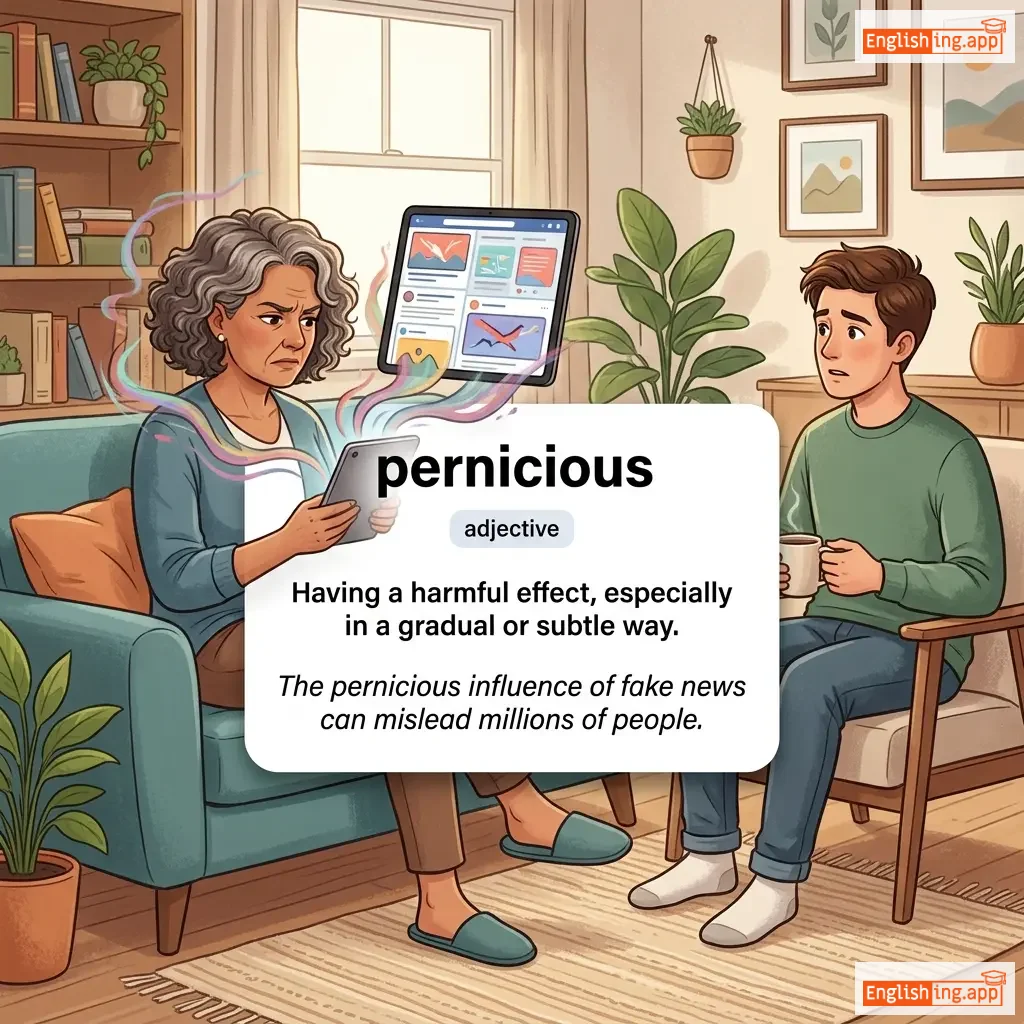
pernicious definition card — visual illustration of the meaning
adjective C1
/pərˈnɪʃəs/
有害な (yūgaina)

Having a harmful effect, especially in a gradual or subtle way.

"The pernicious influence of fake news can mislead millions of people."

"偽のニュースの有害な影響は、何百万人もの人々を誤解させる可能性があります。" (Nise no nyūsu no yūgaina eikyō wa, nanbyakumannin mo no hitobito o gokai saseru kanōsei ga arimasu.)
adjective C1
/ˌpɜːrpənˈdɪkjələr/
垂直 (suichoku)

At an angle of 90 degrees to a given line, plane, or surface.

"The ladder was placed perpendicular to the ground for safety."

"はしごは安全のために地面に対して垂直に配置されました。" (Hashigo wa anzen no tame ni jimen ni taishite suichoku ni haichi saremashita.)
verb C1
/ˈpɜːrpətreɪt/
犯す (okasu)

To commit or carry out, typically a harmful, illegal, or immoral act.

"The hackers perpetrated a massive cyber attack on the company."

"ハッカーたちは会社に大規模なサイバー攻撃を行った。" (Hakkā-tachi wa kaisha ni daikibo na saibā kōgeki o okonatta.)
noun C1
/ˈpɜːrpɪtreɪtər/
犯人 (hannin)

a person who commits a harmful, illegal, or immoral act

"The police arrested the perpetrator of the crime."

"警察は犯罪者を逮捕した。" (Keisatsu wa hanzai-sha o taiho shita.)
adjective C1
/pərˈpetʃuəl/
永遠の (eien no)

never-ending or continuous

"She lived in perpetual fear of being discovered."

"彼女は発見される恐怖の中で永遠に生きていました。" (Kanojo wa hakken sareru kyōfu no naka de eien ni ikite imashita.)
perpetuate definition card — visual illustration of the meaning
verb C1
/pərˈpetʃueɪt/
永続させる (eizoku saseru)

to make something continue indefinitely

"This law will perpetuate inequality in society."

"この法律は社会における不平等を永続させるでしょう。" (Kono hōritsu wa shakai ni okeru fuheibō o eizoku saseru deshō.)
verb C1
/pərˈplɛks/
困惑させる / 混乱させる (konwaku saseru / konran saseru)

To confuse or puzzle someone.

"The complex instructions perplexed the students."

"複雑な指示が学生を困惑させた。" (Fukuzatsu na shiji ga gakusei o konwaku saseta.)
verb C1
/ˈpɜːrsɪkjuːt/
幸福 (kōfuku)

to treat someone cruelly or unfairly, especially because of their religion, race, or beliefs

"Many people were persecuted for their faith during that time."

"彼女は賞を受け取ったとき、自分の幸福を隠せなかった。" (Kanojo wa shō o uketotta toki, jibun no kōfuku o kakusenakatta.)
noun C1
/ˌpɜːrsɪˈkjuːʃn/
迫害 (hakkaī)

the act of treating someone cruelly or unfairly because of their religion, race, or beliefs

"The persecution of minorities has been condemned worldwide."

"少数派への迫害は世界中で非難されています。" (Shōsūha e no hakkai wa sekaijū de hinan sareteimasu.)
noun C1
/ˈpɜːʃən/
イラン出身者またはペルシャ語を話す人 (Iran shusshinsha matawa Perusha-go o hanasu hito)

a native or inhabitant of Iran; the language spoken in Iran (Farsi)

"The Persian language has a rich literary history."

"ペルシャ語は豊かな文学的歴史を持っています。" (Perusha-go wa yutakana bungakuteki rekishi o motteimasu.)
adjective C1
/ˈpɜːrsənəbl/
魅力的 (miryokuteki)

having a pleasant appearance and manner; attractive and friendly

"The new teacher is very personable and easy to talk to."

"新しい先生はとても魅力的で話しやすいです。" (Atarashī sensei wa totemo miryokuteki de hanashiyasui desu.)
personalization definition card — visual illustration of the meaning
noun C1
ˌpɜː.sən.ə.laɪˈzeɪ.ʃən
パーソナライゼーション (pāsonaraizēshon)

Customizing services or products according to user preferences.

"Online stores use personalization to improve customer experience."

"オンラインショップは顧客体験を向上させるためにパーソナライゼーションを使用します。" (Onrain shoppu wa kokyaku taiken o kōjō saseru tame ni pāsonaraizēshon o shiyō shimasu.)
verb C1
/pərˈsɑːnɪfaɪ/
幸福 (kōfuku)

To represent or embody a quality, idea, or concept in human form.

"She personifies kindness and generosity."

"彼女は賞を受け取ったとき、幸せを隠せなかった。" (Kanojo wa shō o uketotta toki, kōfuku o kakusenakatta.)
noun C1
/ˌpɜːrspəˈreɪʃn/
発汗 (hakkan)

The process of sweating.

"Heavy exercise causes perspiration."

"激しい運動は発汗を引き起こします。" (Hageshī undō wa hakkan o hikiokoshimasu.)
verb C1
/pərˈspaɪər/
汗をかく (ase o kaku)

To give out sweat through the pores of the skin as a result of heat, physical exertion, or stress.

"He began to perspire after running for 10 minutes."

"彼は10分間走った後、汗をかき始めました。" (Kare wa 10 funkan hashitta ato, ase o kaki hajimemashita.)
adjective C1
/pərˈsweɪdəbl̩/
簡単に説得できる (kantan ni settoku dekiru)

capable of being convinced or influenced to do something

"She was easily persuadable when it came to trying new foods."

"彼女は新しい食べ物を試すとき、簡単に説得されました。" (Kanojo wa atarashī tabemono o tamesu toki, kantan ni settoku saremashita.)
persuasiveness definition card — visual illustration of the meaning
noun C1
/pərˈsweɪ.sɪv.nəs/
説得力 (settokuryoku)

The quality of being able to persuade someone to do or believe something.

"His persuasiveness helped secure the deal."

"彼の説得力は取引を確実にするのに役立ちました。" (Kare no settokuryoku wa torihiki wo kakujitsu ni suru no ni yakudachimashita.)
adjective C1
/pɜːrt/
生意気だけど魅力的 (namaiki dakedo miryokuteki)

attractively lively or cheeky in manner or style

"She gave a pert reply that made everyone laugh."

"彼女はみんなを笑わせた生意気な返事をした。" (Kanojo wa minna o warawaseta namaiki na henji o shita.)
verb C1
/pərˈteɪn/
関係する (kankei suru)

to relate or have reference to something

"The rules pertain to all students in the school."

"その規則は学校のすべての生徒に関係しています。" (Sono kisoku wa gakkō no subete no seito ni kankei shiteimasu.)
adjective C1
/ˈpɜːrtɪnənt/
関連する (kanren suru)

Relevant or applicable to a particular matter.

"She asked a pertinent question during the meeting."

"彼女は会議中に関連する質問をしました。" (Kanojo wa kaigi-chū ni kanren suru shitsumon o shimashita.)
verb C1
/pərˈtɜːrb/
動揺させる (dōyō saseru)

To disturb or unsettle greatly in mind.

"The sudden noise perturbed the students during the exam."

"突然の音が試験中に学生を動揺させました。" (Totsuzen no oto ga shiken-chū ni gakusei o dōyō saseru mashita.)
adjective C1
/pərˈtɜːrbd/
動揺した (dōyō shita)

feeling anxious, unsettled, or disturbed

"He looked perturbed after hearing the bad news."

"悪いニュースを聞いた後、彼は動揺しているように見えました。" (Warui nyūsu o kiita ato, kare wa dōyō shite iru yō ni miemashita.)
verb C1
/pəˈruːz/
幸福 (kōfuku)

to read something carefully and thoroughly; sometimes used to mean to browse casually

"She sat down to peruse the contract before signing it."

"彼女は賞を受け取ったとき、その幸せを隠すことができませんでした。" (Kanojo wa shō o uketotta toki, sono kōfuku o kakusu koto ga dekimasen deshita.)
verb C1
/pəˈveɪd/
広がる (hirogaru)

to spread through and be present in every part of something

"The smell of fresh flowers pervaded the entire room."

"新鮮な花の香りが部屋全体に広がった。" (Shinsen na hana no kaori ga heya zentai ni hirogatta.)
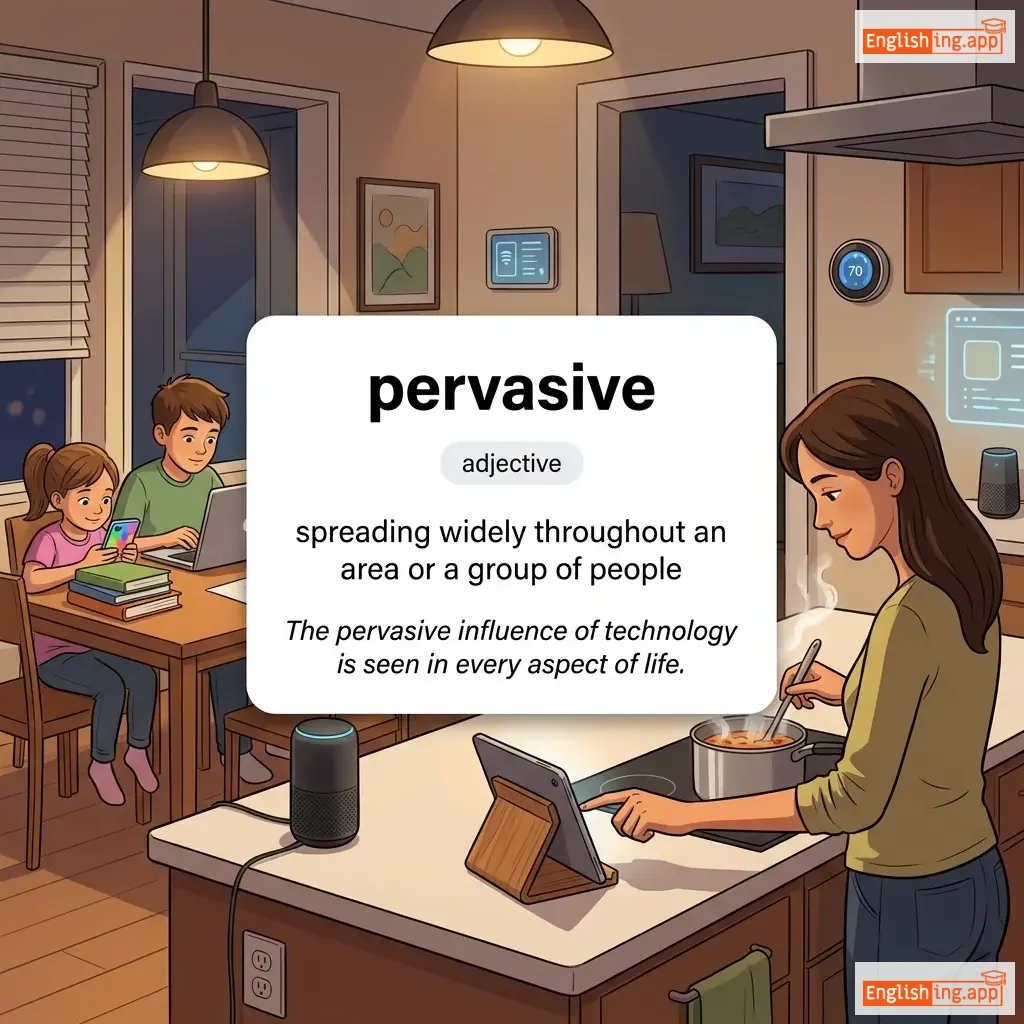
pervasive definition card — visual illustration of the meaning
adjective C1
/pərˈveɪsɪv/
広範 (kōhan)

spreading widely throughout an area or a group of people

"The pervasive influence of technology is seen in every aspect of life."

"技術の広範な影響は、生活のすべての側面で見られます。" (Gijutsu no kōhan na eikyō wa, seikatsu no subete no sokumen de miraremasu.)
adjective C1
/pərˈvɜːrs/
倒錯 (tōsaku)

showing a deliberate desire to behave in a way that is unreasonable, contrary, or unacceptable

"He took a perverse pleasure in upsetting his colleagues."

"彼は同僚を困らせることに倒錯した喜びを感じていた。" (Kare wa dōryō o komaraseru koto ni tōsaku shita yorokobi o kanjite ita.)
noun C1
/pərˈvɜːrʒən/
歪曲 (iwaku)

The act of distorting or corrupting the original meaning, purpose, or state of something.

"The regime’s censorship was seen as a perversion of free speech."

"政権の検閲は、自由な言論の歪曲と見なされていました。" (Seiken no kenetsu wa, jiyūna genron no iwaku to minasa rete imashita.)
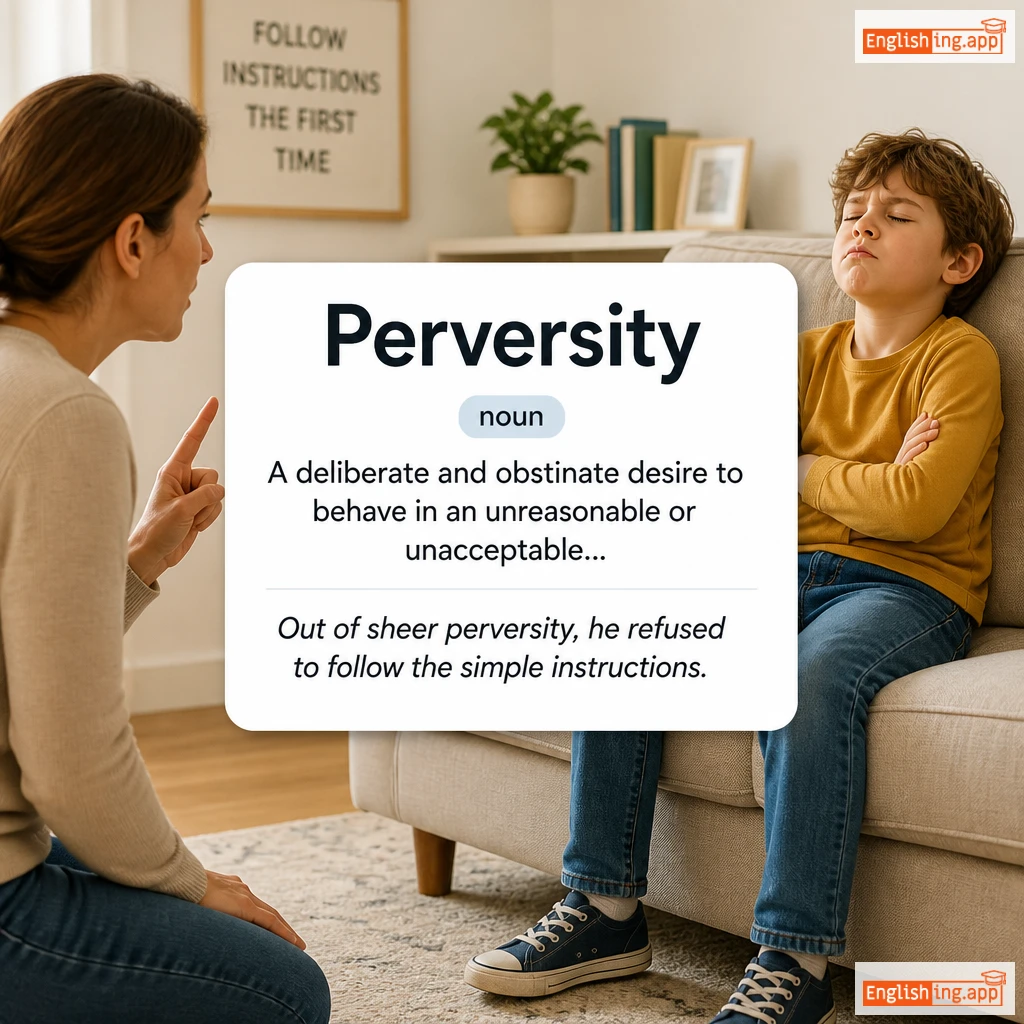
Perversity definition card — visual illustration of the meaning
noun C1
/pərˈvɜːrsəti/
反抗 (hankou)

A deliberate and obstinate desire to behave in an unreasonable or unacceptable way.

"Out of sheer perversity, he refused to follow the simple instructions."

"純粋な反抗で、彼は簡単な指示に従うことを拒否した。" (Junsui na hankou de, kare wa kantan na shiji ni shitagau koto o kyohi shita.)
verb/noun C1
/pərˈvɜːrt/

As a verb: to distort the meaning or purpose of something; as a noun: a person with abnormal or immoral sexual behavior.

"He tried to pervert the truth to escape punishment."

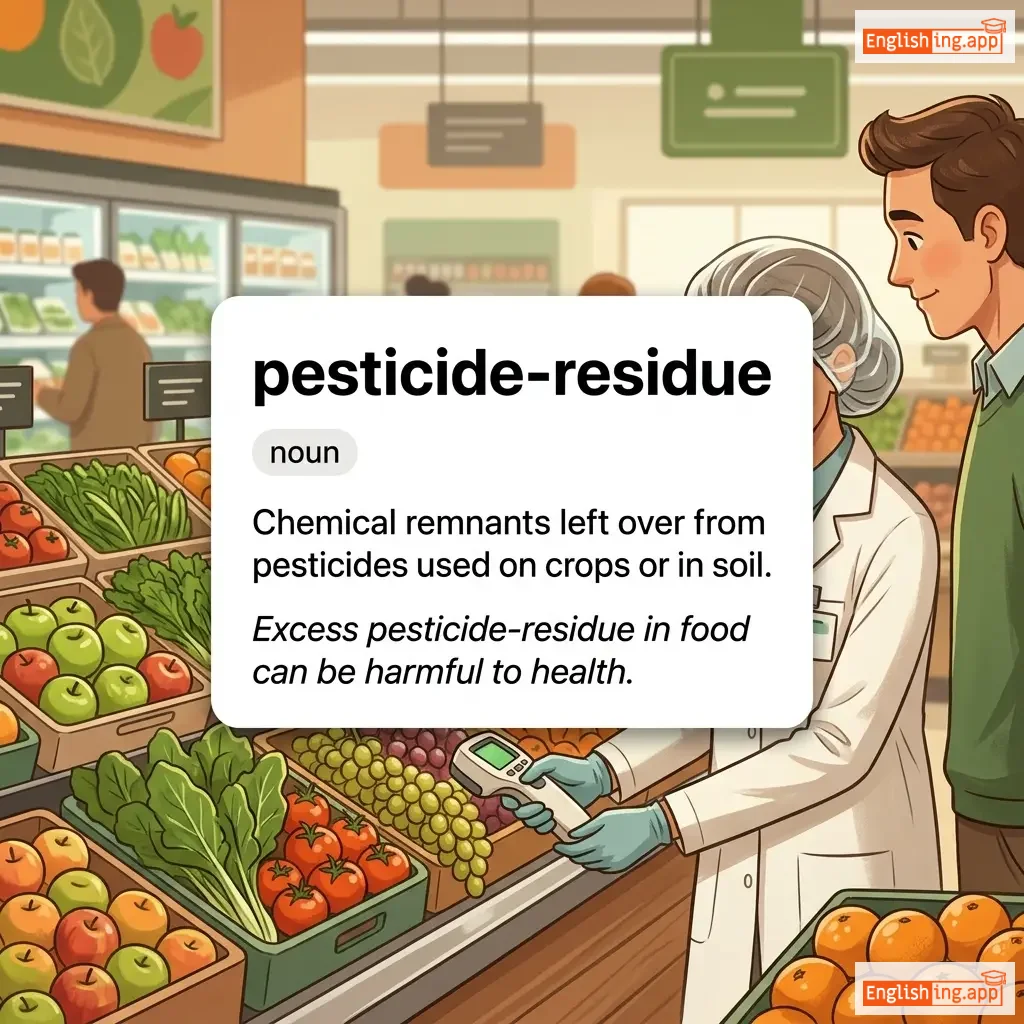
pesticide-residue definition card — visual illustration of the meaning
noun C1
/ˈpɛs.tɪ.saɪd ˈrɛz.ɪ.djuː/
農薬残留物 (nouyaku zanryūbutsu)

Chemical remnants left over from pesticides used on crops or in soil.

"Excess pesticide-residue in food can be harmful to health."

"食物中の農薬残留物が過剰だと健康に害を与える可能性があります。" (Shokumotsu-chuu no nouyaku zanryūbutsu ga kajou da to kenko ni gai wo ataeru kanousei ga arimasu.)
noun C1
/ˈpɛsəl/
(kine)

A heavy tool with a rounded end used for crushing or grinding substances in a mortar.

"She used a pestle to grind the spices."

"彼女はスパイスを挽くために杵を使いました。" (Kanojo wa supaisu o hiku tame ni kine o tsukaimashita.)
verb C1
/ˈpɛtrɪfaɪ/
石化する (sekika suru)

to make someone so frightened that they are unable to move or think; to turn into stone

"The loud noise petrified the little child."

"大きな音は小さな子供を石化させた。" (Ōkina oto wa chiisana kodomo o sekika saseta.)
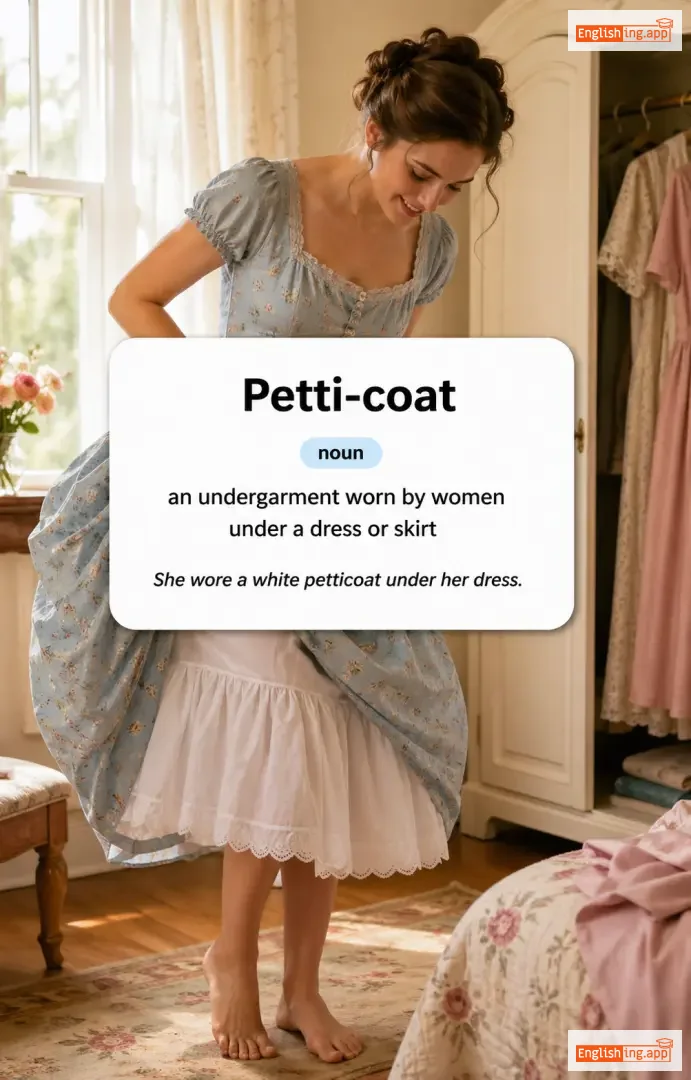
Petti-coat definition card — visual illustration of the meaning
noun C1
/ˈpetɪkoʊt/
ペチコート (pechikōto)

an undergarment worn by women under a dress or skirt

"She wore a white petticoat under her dress."

"彼女はドレスの下に白いペティコートを着ていました。" (Kanojo wa doresu no shita ni shiroi pechikōto o kite imashita.)
adjective C1
/ˈpɛtjʊlənt/
癇癪持ち (kanshaku mochi)

Childishly sulky or bad-tempered.

"The child became petulant when denied more candy."

"子供はキャンディーをもっともらえないと癇癪を起こした。" (Kodomo wa kyandī o motto moraenai to kanshaku o okoshita.)
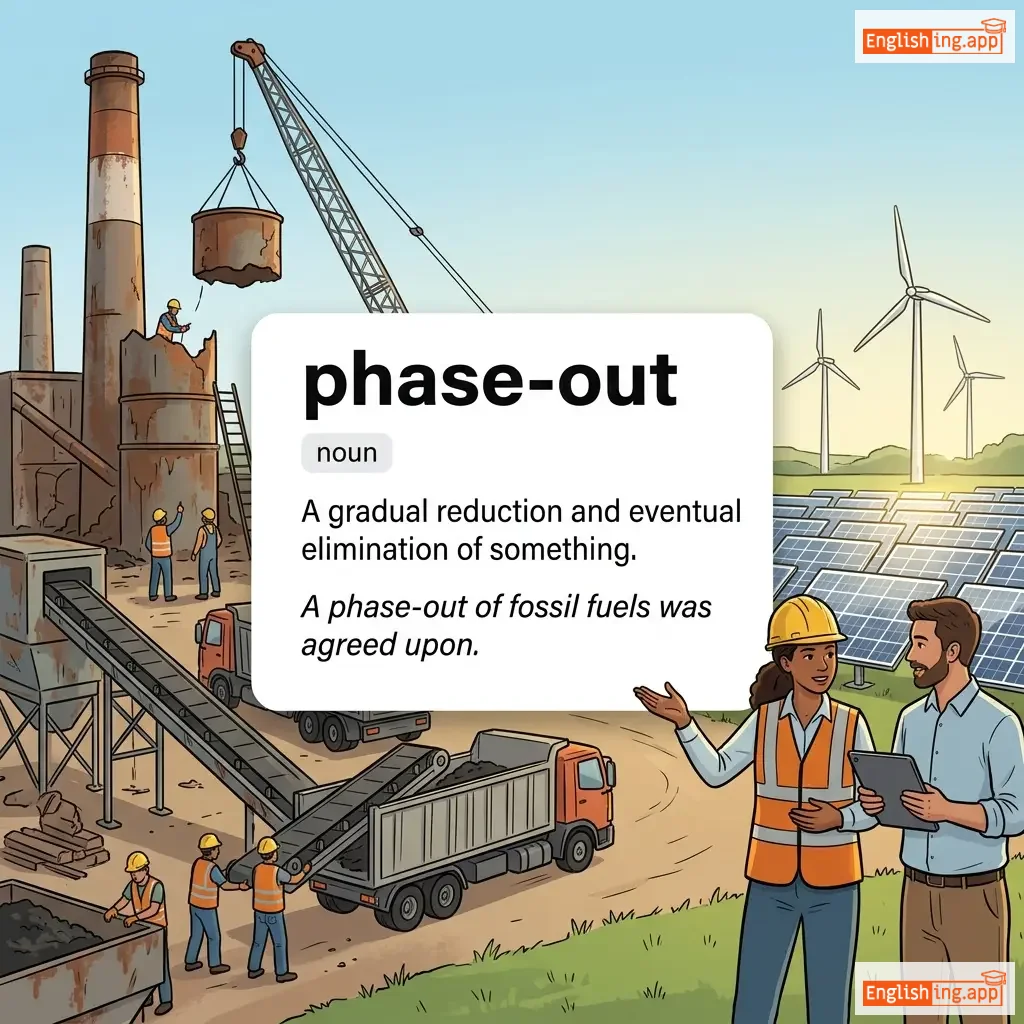
phase-out definition card — visual illustration of the meaning
noun C1
ˈfeɪz.aʊt
段階的廃止 (dankai-teki haishi)

A gradual reduction and eventual elimination of something.

"A phase-out of fossil fuels was agreed upon."

"化石燃料の段階的廃止が合意されました。" (Kaseki nenryō no dankai-teki haishi ga gōi saremashita.)
adjective C1
/ˌfɪl.ænˈθrɒp.ɪk/
博愛主義的な (hakuai shugi teki na)

showing concern for the welfare of others; generous and charitable

"She is known for her philanthropic activities in the city."

"彼女は街での博愛活動で知られています。" (Kanojo wa machi de no hakuai katsudō de shirareteimasu.)
noun C1
/fɪˈlæn.θrə.pɪst/
慈善家 (jizenka)

a person who seeks to promote the welfare of others, especially by donating money to good causes

"The philanthropist donated millions to build schools in rural areas."

"その慈善家は農村地域に学校を建てるために数百万ドルを寄付しました。" (Sono jizenka wa nōson chiiki ni gakkō o tateru tame ni sūhyaku man doru o kifu shimashita.)
noun C1
/fɪˈlæn.θrə.pi/
フィランソロピー (firanthoropī)

the desire to promote the welfare of others, often expressed by the generous donation of money to good causes

"Philanthropy has helped improve healthcare in many developing countries."

"フィランソロピーは多くの発展途上国で医療を改善するのに役立っています。" (Firanthoropī wa ōku no hatten to jōkoku de iryō o kaizen suru no ni yakudatteimasu.)
adjective C1
/ˌfɪl.hɑːrˈmɒn.ɪk/
交響楽団に関連する (kōkyō gakudan ni kanren suru)

relating to a symphony orchestra or its music

"The philharmonic orchestra performed a stunning rendition of Beethoven's Ninth Symphony."

"フィルハーモニックオーケストラはベートーヴェンの第九交響曲の素晴らしい演奏を行いました。" (Fīruhāmonikku ōkesutora wa Bētoeven no dai kyū kōkyōkyoku no subarashī ensō o okonaimashita.)
noun C1
/ˈfiː.nɪks/
フェニックスの鳥 (phenikkusu no tori)

a mythical bird that is reborn from its ashes; symbol of immortality or renewal

"The legend says the phoenix rises from its ashes every 500 years."

"伝説によると、フェニックスは500年ごとに灰から蘇ると言われています。" (Densetsu ni yoru to, phenikkusu wa 500-nen goto ni hai kara yomigaeru to iwareteimasu.)
adjective C1
/fəˈnɛtɪk/
音声的な (onseiteki na)

relating to the sounds of speech or pronunciation

"The teacher taught the students the phonetic spelling of difficult words."

"先生は生徒たちに難しい単語の音声的な綴りを教えました。" (Sensei wa seito-tachi ni muzukashii tango no onseiteki na tsuzuri o oshiemashita.)
adjective C1
/ˈfɒnɪk/
音声学の (onsei-gaku no)

relating to speech sounds or their production; connected to phonics

"Children learn phonic rules to read new words accurately."

"子供たちは新しい単語を正確に読むために音声学のルールを学びます。" (Kodomotachi wa atarashī tango o seikaku ni yomu tame ni onsei-gaku no rūru o manabimasu.)
photosynthetic efficiency definition card — visual illustration of the meaning
noun C1
/ˌfəʊtəʊˈsɪnθɛtɪk ɪˈfɪʃənsi/
光合成効率 (fotoshinsetikku efishenshi)

The measure of how effectively plants convert light energy into chemical energy through the process of photosynthesis, directly affecting plant growth and crop yield.

"Improving photosynthetic efficiency can increase crop yields."

"光合成効率を改善すると、作物の収量を増やすことができます。" (kougousei kouritsu o kaizen suru to sakubutsu no shuuryou o fuyasu koto ga dekimasu)
physiological definition card — visual illustration of the meaning
adjective C1
/ˌfɪziəˈlɑːdʒɪkəl/
生理的 (seiriteki)

relating to the functions and processes of living organisms

"The study focused on the physiological responses to stress."

"その研究は、ストレスに対する生理的反応に焦点を当てました。" (Sono kenkyuu wa, sutoresu ni taisuru seiriteki hannou ni shouten o atemashita.)
noun C1
/ˌfɪziˈɑːlədʒi/
生理学 (seirigaku)

the scientific study of the functions and mechanisms in a living system

"She is majoring in human physiology at the university."

"彼女は大学で人間の生理学を専攻しています。" (Kanojo wa daigaku de ningen no seirigaku o senkou shiteimasu.)
noun C1
/fɪˈziːk/
体格 (taikaku)

the form, size, and development of a person's body

"He has an athletic physique due to years of training."

"彼は長年のトレーニングでアスリートのような体格を持っています。" (Kare wa naganen no toreiningu de asurīto no yōna taikaku o motteimasu.)
Pick-axe definition card — visual illustration of the meaning
noun C1
/ˈpɪk.æks/
ツルハシ (tsuruhashi)

a tool with a heavy metal head and long handle used for breaking up hard ground or rock

"The miner used a pick-axe to break through the rocky surface."

"鉱夫は岩の表面を壊すためにツルハシを使用しました。" (Koufu wa iwa no hyoumen o kowasu tame ni tsuruhashi o shiyou shimashita.)
adjective C1
/ˈpiːsmiːl/
段階的に行う (dankai teki ni okonau)

done or made in separate stages rather than all at once

"The construction of the new building was carried out piecemeal over several years."

"新しい建物の建設は数年にわたり段階的に行われました。" (Atarashii tatemono no kensetsu wa suunen ni watari dankai teki ni okonawaremashita.)
Piety definition card — visual illustration of the meaning
noun C1
/ˈpaɪəti/
信心 (shinsen)

the quality of being religious or showing reverence for God

"Her piety was evident in the way she prayed every morning."

"彼女の信心は毎朝祈る様子に明らかだった。" (Kanojo no shinsen wa mai asa inoru yōsu ni akiraka datta.)
noun C1
/ˈpɪɡmənt/
顔料 (ganryou)

a natural or artificial substance used to give color to something

"The artist mixed different pigments to create the perfect shade of blue."

"アーティストは完璧な青色の色合いを作り出すために異なる顔料を混ぜました。" (Ātisuto wa kanpeki na aoiro no iroai o tsukuridasu tame ni kotonaru ganryou o mazemashita.)