Словари

Словарь английского языка | Значения слов, определения и примеры

noun C2
/hʌsk/
外皮 (gaihi)

the dry outer covering of some fruits or seeds

"The corn husk was peeled away before cooking."

"料理の前にトウモロコシの外皮が剥がされました。" (Ryōri no mae ni tōmorokoshi no gaihi ga hagasaremashita.)
🐺

husky

adjective C2
/ˈhʌski/

deep, rough, and slightly hoarse voice; also refers to a strong and sturdy build

"He spoke in a husky voice after shouting all day."

noun C2
/hʊˈzɑːr/
フサール (fusāru)

a member of a light cavalry regiment in European armies, especially the Hungarian cavalry

"The hussar rode swiftly across the battlefield."

"フサールは戦場を素早く駆け抜けた。" (Fusāru wa senjō o subayaku kakenuketa.)
noun C2
/ˈhʌstɪŋz/
選挙活動 (senkyo katsudo)

the political campaigning and speeches before an election

"The candidate gained popularity during the hustings."

"候補者は選挙活動中に人気を集めました。" (Kohosha wa senkyo katsudo-chu ni ninki o atsumemashita.)
noun C2
/ˈhaɪdrə/
ヒドラ (hidora)

a many-headed serpent in Greek mythology; a problem that seems to grow worse when attempts are made to solve it

"Corruption is like a hydra, hard to defeat completely."

"汚職はヒドラのようで、完全に打ち負かすのは難しい。" (Oshoku wa hidora no you de, kanzen ni uchimakasu no wa muzukashii.)
noun C2
/ˌhaɪdroʊdaɪˈnæmɪks/

The branch of science concerned with the motion of fluids, especially liquids, and the forces acting on solid bodies immersed in fluids.

"Hydrodynamics is essential in designing efficient ship hulls."
hydrolysis definition card — visual illustration of the meaning
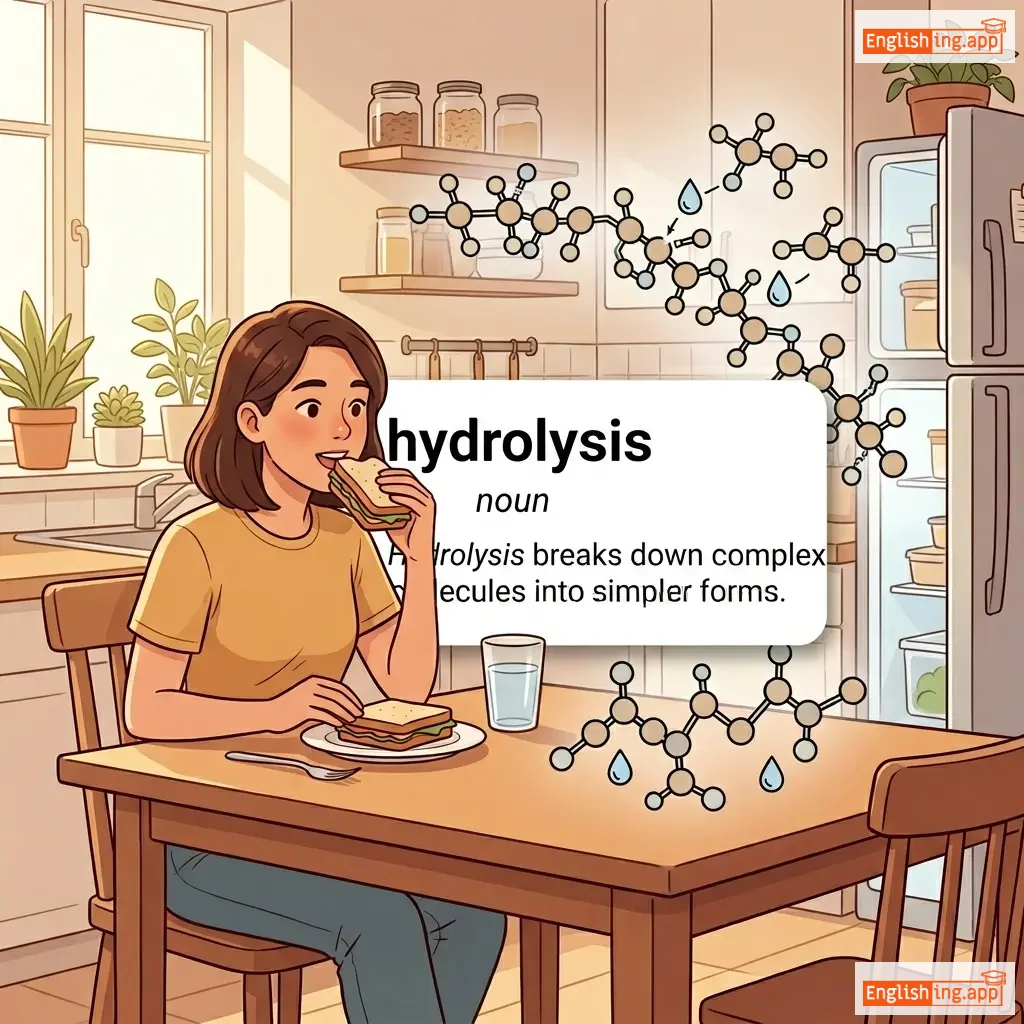
noun C2
/haɪˈdrɒl.ɪ.sɪs/
加水分解 (kasuibunkai)

A chemical process that breaks down compounds by adding water, splitting complex molecules into simpler forms.

"Hydrolysis breaks down complex molecules into simpler forms."

"加水分解は複雑な分子をより単純な形に分解します。" (Kasuibunkai wa fukuzatsu na bunshi wo yori tanjun na katachi ni bunkai shimasu.)
noun C2
/ˌhaɪdroʊməˈkænɪks/
ハイドロメカニクス (haidromechanics)

The study of the mechanical properties and behavior of fluids in motion and at rest.

"Hydromechanics provides the foundation for naval architecture."

"ハイドロメカニクスは船舶建造の基盤を提供します。" (Haidromechanics wa senpaku kenzo no kiban o teikyō shimasu.)
noun C2
/haɪˈdrɒmɪtər/

An instrument used to measure the density or specific gravity of liquids.

"The brewer used a hydrometer to test the sugar content of the solution."

noun C2
/ˌhaɪdroʊˈfoʊbiə/
水恐怖症 (mizu kyōfushō)

Extreme or irrational fear of water; historically, another name for rabies.

"After being bitten by a stray dog, the man was treated for hydrophobia."

"野良犬に噛まれた後、その男は水恐怖症の治療を受けました。" (Nora inu ni kamareta ato, sono otoko wa mizu kyōfushō no chiryō o ukemashita.)
noun C2
/ˌhaɪdrəˈstætɪks/
静水力学 (seisuiryokugaku)

The branch of science concerned with the mechanical properties of fluids at rest.

"Hydrostatics is essential in understanding how dams and reservoirs function."

"静水力学はダムや貯水池の機能を理解するために不可欠です。" (Seisui ryokugaku wa damu ya chōsuichi no kinō o rikai suru tame ni fukaketsu desu.)
adjective C2
/ˈhaɪdrəs/
含水 (gansui)

Containing water, especially water of crystallization.

"The mineral is hydrous because it contains water molecules in its structure."

"その鉱物は水分を含んでいるため、構造内に水分子を含んでいます。" (Sono kōbutsu wa suibun o fukunde iru tame, kōzō-nai ni suibunshi o fukunde imasu.)
adjective C2
/ˌhaɪpərˈbɔːriən/
極北の (kyokuhoku no)

Relating to the extreme north; very cold or frigid.

"The explorers prepared for the hyperborean climate of the Arctic."
"探検家たちは北極の極北の気候に備えていた。" (Tankenka-tachi wa hokkyoku no kyokuhoku no kikō ni sonaete ita.)
hyperconnectivity definition card — visual illustration of the meaning
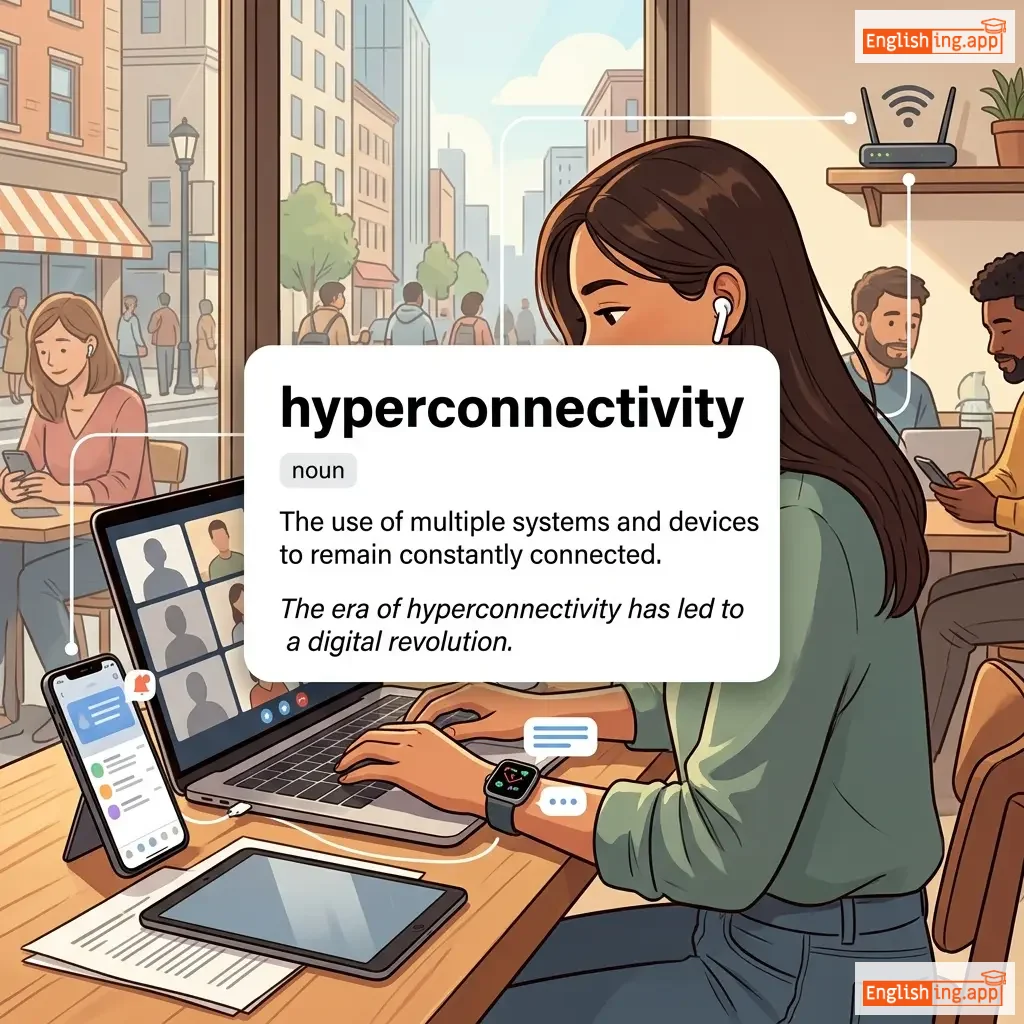
noun C2
ˌhaɪ.pər.kəˈnɛk.tɪ.vɪ.ti
ハイパーコネクティビティ (haipā konekutibiti)

The use of multiple systems and devices to remain constantly connected.

"The era of hyperconnectivity has led to a digital revolution."

"ハイパーコネクティビティの時代はデジタル革命を引き起こした。" (Haipā konekutibiti no jidai wa dejitaru kakumei o hikiokoshita.)
adjective C2
/ˌhaɪpərˈkrɪtɪkl/
過剰に批判的な (kajou ni hihanteki na)

Excessively or unreasonably critical.

"The teacher was often hypercritical of small mistakes."

"教師は小さなミスに対して過剰に批判的でした。" (Kyoushi wa chiisana misu ni taishite kajou ni hihanteki deshita.)
noun C2
/ˌhaɪpəˈkɒndrɪæk/
ヒポコンデリアック (hipokondoriakku)

a person who is excessively worried about having a serious illness

"She is a hypochondriac who visits the doctor every week."

"彼女は毎週医者に行くヒポコンデリアックです。" (Kanojo wa maishū isha ni iku hipokondoriakku desu.)
adjective C2
/ˌhaɪpəˈdɜːrmɪk/

relating to the region immediately beneath the skin; also refers to a type of needle or syringe used to inject drugs beneath the skin.

"The doctor used a hypodermic needle to administer the vaccine."

verb C2
/haɪˈpɒθɪkeɪt/

to pledge something, such as property, as security for a debt without giving up possession of it.

"The company hypothecated its assets to secure the loan."

adjective C2
/ˈɪkθiɪk/
魚のような (sakana no yōna)

Relating to or resembling fish.

"The artist's painting had an ichthyic quality."

"アーティストの絵には魚のような特徴がありました。" (Ātisuto no e ni wa sakana no yōna tokuchō ga arimashita.)
noun C2
/ˌɪkθiˈɒlədʒɪst/
魚類学者 (Gyoruigakusha)

A scientist who studies fish.

"The ichthyologist discovered a new species of fish in the river."

"魚類学者は川で新しい魚の種を発見しました。" (Gyoruigakusha wa kawa de atarashii sakana no shu wo hakken shimashita.)
noun C2
/ˌɪkθiˈɒlədʒi/
魚類学 (gyorui-gaku)

The branch of zoology that deals with fish.

"He pursued a degree in ichthyology at the university."

"彼は大学で魚類学の学位を取得した。" (Kare wa daigaku de gyorui-gaku no gakui o shutoku shita.)
noun C2
/ˈɪkθiəˌsɔːrz/
イクチオサウルス(絶滅した海の爬虫類) (ikuchiosaurusu)

Extinct marine reptiles that resembled fish and dolphins, dominant during the Mesozoic era.

"Ichthyosaurs were swift predators of the ancient seas."

"イクチオサウルスは古代の海で素早い捕食者でした。" (Ikuchiosaurusu wa kodai no umi de subayai hoshokusha deshita.)
adverb C2
/ˈaɪsɪli/
冷たく (tsumetaku)

In a very cold, unfriendly, or hostile manner.

"She replied icily to his question."

"彼女は冷たく彼の質問に答えた。" (Kanojo wa tsumetaku kare no shitsumon ni kotaeta.)
noun C2
/ˈaɪsinəs/
冷たさ (tsumetasa)

The state of being cold in manner or temperature.

"There was a distinct iciness in his voice."

"彼の声には明確な冷たさがあった。" (Kare no koe ni wa meikaku na tsumetasa ga atta.)
noun C2
/aɪˈkɒnəklæst/
偶像破壊者 (gūzō hakai-sha)

A person who attacks or criticizes cherished beliefs, traditions, or institutions.

"He was known as an iconoclast who challenged old traditions."
"彼は古い伝統に挑戦した偶像破壊者として知られていました。" (Kare wa furui dentō ni chōsen shita gūzō hakai-sha to shira rete imashita.)
iconoclastic definition card — visual illustration of the meaning
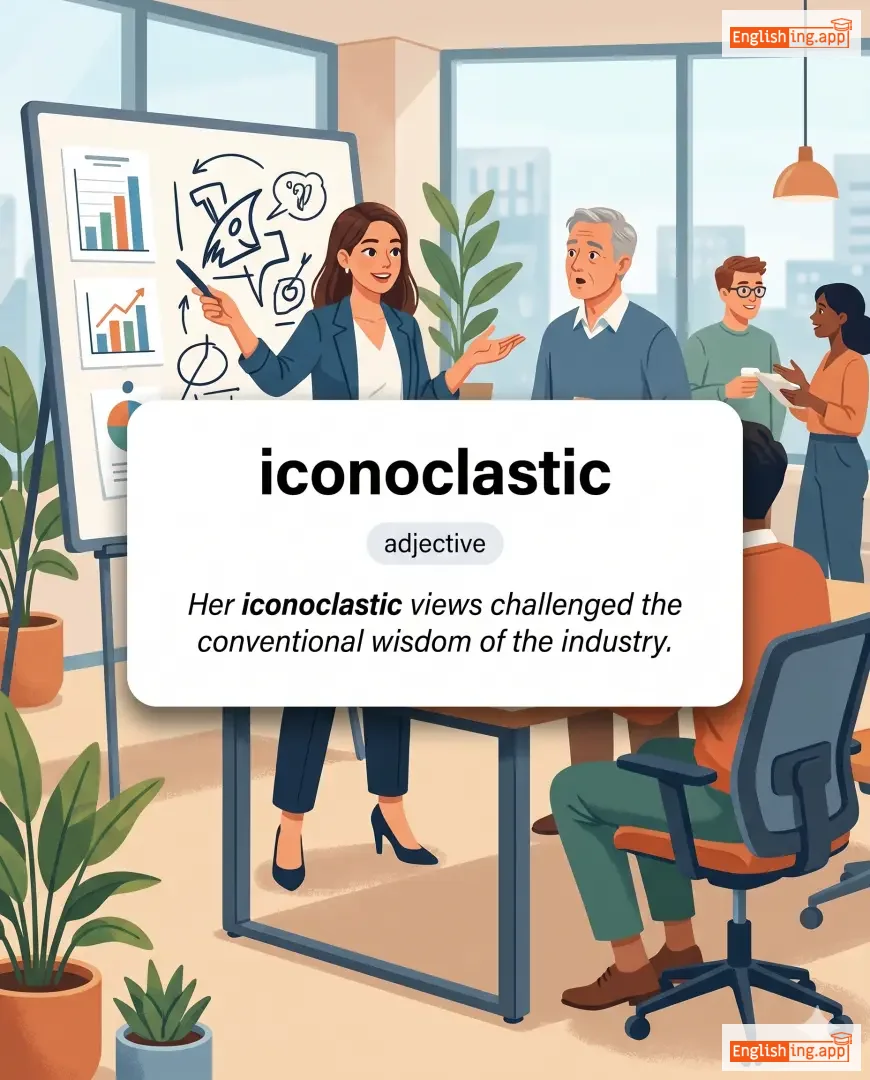
adjective C2
/ˌaɪ.kə.nəˈklæs.tɪk/
確立された信念、伝統、または価値観に対して攻撃的または拒絶的な特徴 (ikonokurasutikku)

Characterized by attacking or rejecting cherished beliefs, traditions, or established values.

"Her iconoclastic views challenged the conventional wisdom of the industry."

"彼女のアイコノクラスティックな見解は業界の従来の知恵に挑戦した。" (Kanojo no aikonokurasutikku na kenkai wa gyōkai no jūrai no chie ni chōsen shita.)
ideation definition card — visual illustration of the meaning
noun C2
/ˌaɪdiˈeɪʃən/
アイデア創造 (aidea souzou)

The process of forming ideas or concepts.

"The workshop focused on ideation and brainstorming."
"ワークショップはアイデア創造とブレインストーミングに焦点を当てました。" (Wākushoppu wa aidea souzou to bureinsutoomingu ni shōten o atemashita.)
Idiocy definition card — visual illustration of the meaning
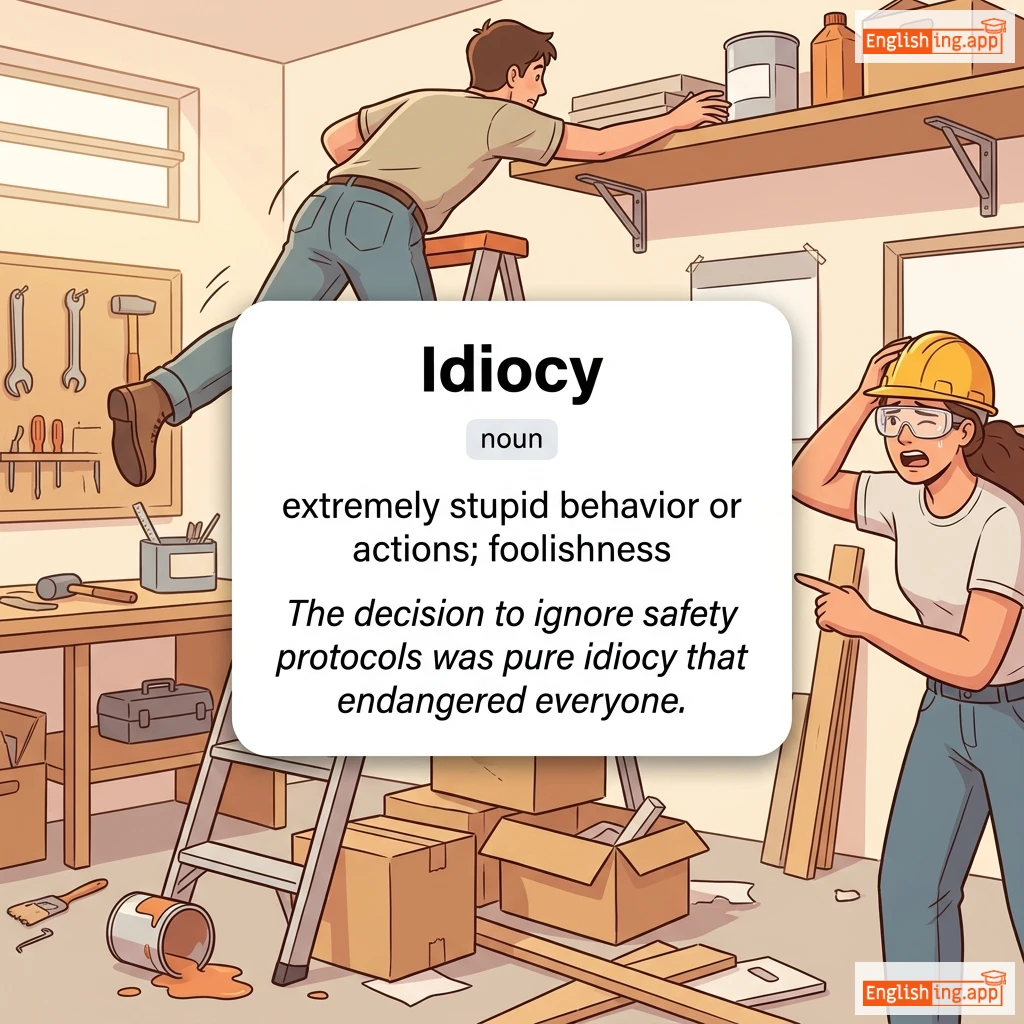
noun C2
/ˈɪd.i.ə.si/
愚かさ (orokasa)

extremely stupid behavior or actions; foolishness

"The decision to ignore safety protocols was pure idiocy that endangered everyone."

"安全プロトコルを無視する決定は、すべての人を危険にさらす純粋な愚かさでした。" (Anzen purotokoru o mushi suru kettei wa, subete no hito o kiken ni sarasu junsuina orokasa deshita.)
noun C2
/ˌɪdiəˈsɪŋkrəsi/
特異性 (tokuiseki)

A distinctive or peculiar characteristic, habit, or mannerism unique to an individual.

"One of her idiosyncrasies was humming while working."

"彼女の一つの特異性は、仕事中に口ずさむことでした。" (Kanojo no hitotsu no tokuiseki wa, shigotochu ni kuchizusamu koto deshita.)
noun C2
/ˈaɪdlər/
怠け者 (namakemono)

A person who avoids work or spends time lazily.

"He was known as an idler who wasted his days."

"彼は自分の時間を無駄にするアイドラーとして知られていました。" (Kare wa jibun no jikan o mudani suru aidorā to shite shirareteimashita.)
adjective C2
/ˌaɪdəˈlɑːtrɪəs/
偶像崇拝的な (gūzō sūhai-teki na)

Excessively devoted or reverent towards idols or false gods.

"The ancient tribe was known for its idolatrious practices."

"その古代の部族は偶像崇拝的な習慣で知られていました。" (Sono kodai no buzoku wa gūzō sūhai-teki na shūkan de shirarete imashita.)
verb C2
/aɪˈdɒləˌtraɪz/
偶像崇拝 (gūzō sūhai)

To worship idols; to regard with excessive devotion or admiration.

"They began to idolatrize the statue as a deity."

"彼らはその像を神として崇拝し始めました。" (Karera wa sono zō o kami to shite sūhai shihajimemashita.)
adjective C2
/aɪˈdɒlətrəs/
偶像崇拝者 (guuzou suuhai-sha)

Excessively admiring or worshipping someone or something as an idol.

"The king was criticized for his idolatrous devotion to wealth."
"王は富に対する偶像崇拝的な献身で批判されました。" (Ou wa tomi ni taisuru guuzou suuhai-teki na kenshin de hihan saremashita.)
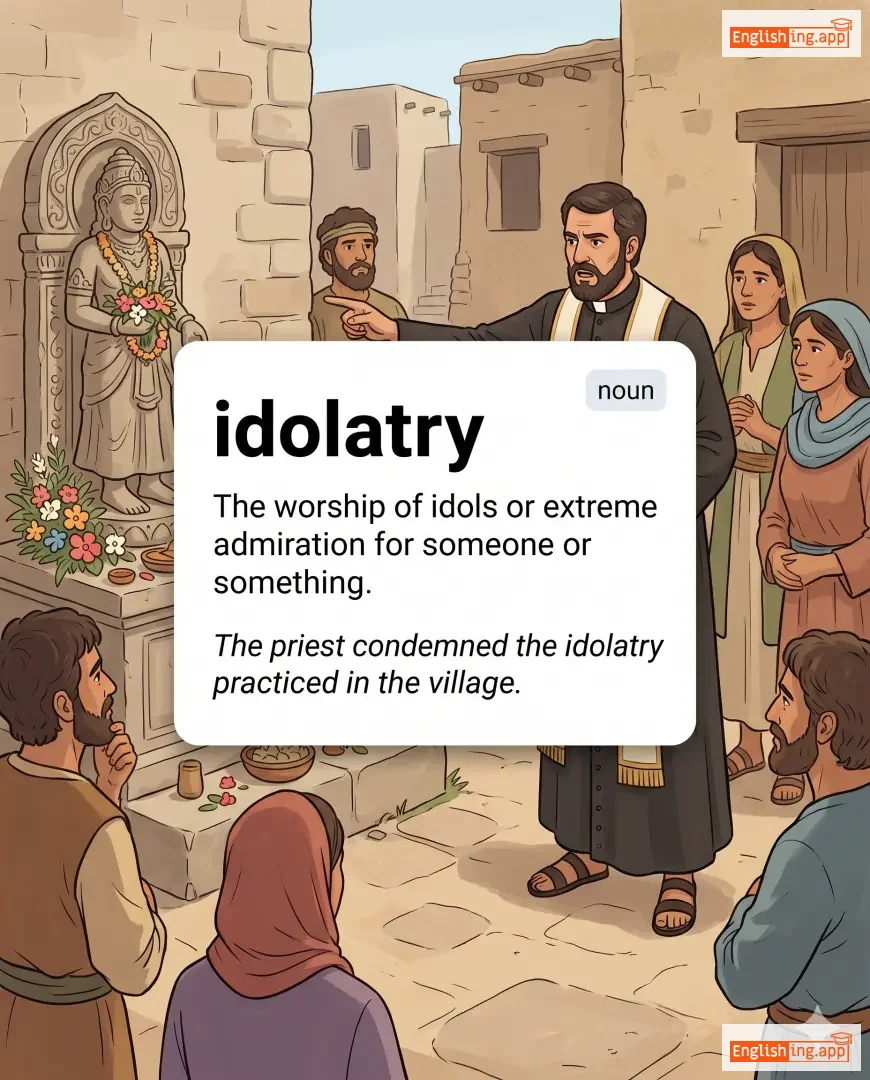
idolatry definition card — visual illustration of the meaning
noun C2
/aɪˈdɒlətri/
偶像崇拝 (guuzou suuhai)

The worship of idols or extreme admiration for someone or something.

"The priest condemned the idolatry practiced in the village."

"司祭は村で行われている偶像崇拝を非難した。" (Shisai wa mura de okonawarete iru guuzou suuhai wo hinan shita.)
noun C2
/ˈaɪdɪl/
田園詩的なシーン (den'en shiteki na shīn)

An extremely happy, peaceful, or picturesque episode or scene, often idealized.

"Their honeymoon was an idyll on a tropical island."

"彼らのハネムーンは熱帯の島での田園詩的なシーンでした。" (Karera no hanemūn wa nettai no shima de no den'en shiteki na shīn deshita.)
adjective C2
/ɪɡˈnoʊ.bəl/
卑劣な (hiretsu na)

Dishonorable, shameful, or lacking nobility.

"His ignoble actions ruined his reputation."

"彼の卑劣な行動は彼の評判を台無しにした。" (Kare no hiretsu na kōdō wa kare no hyōban o dainashi ni shita.)
adjective C2
/ˌɪɡ.nəˈmɪn.i.əs/
不名誉な (fumei na)

Marked by shame, disgrace, or humiliation.

"The team suffered an ignominious defeat in the finals."

"チームは決勝で不名誉な敗北を喫した。" (Chiimu wa kesshou de fumei na haiboku o kitta.)
noun C2
/ˈɪɡ.nəˌmɪn.i/
恥辱 (chijoku)

Public shame, disgrace, or dishonor.

"He lived the rest of his life in ignominy after the scandal."

"スキャンダル後、彼は生涯を恥辱の中で過ごした。" (Sukyandaru go, kare wa shōgai o chijoku no naka de sugoshita.)
noun C2
/ˈaɪ.kɒn/
宗教的な画像やシンボル (shūkyō-teki na gazō ya shinboru)

A religious image or symbol, especially in the Eastern Orthodox Church.

"The church displayed a beautifully painted ikon of the Virgin Mary."

"教会は美しく描かれた聖母マリアのアイコンを展示しました。" (Kyōkai wa utsukushiku egakareta Seibo Maria no aikon o tenji shimashita.)
noun C2
/ˈɪl.i.æd/
イリアス (Irias)

An ancient Greek epic poem attributed to Homer, describing the events of the Trojan War.

"Students studied the Iliad to understand Greek mythology and heroism."

"学生たちはイリアスを学び、ギリシャ神話と英雄主義を理解しました。" (Gakusei-tachi wa Irias wo manabi, Girisha shinwa to eiyuu shugi wo rikai shimashita.)
adjective C2
/ˈɪl bred/
無作法な (illbred)

lacking good manners; rude; showing poor upbringing

"His ill-bred behavior shocked everyone at the dinner party."

"彼の無作法な振る舞いは、ディナー・パーティーで皆を驚かせた。" (kare no musahou na furumai wa dinaa paatii de mina o odorokaseta)
adjective C2
/ˌɪlˈneɪ.tʃəd/
性格が悪い (seikaku ga warui)

Having a bad or unpleasant character; unkind or malicious.

"He made an ill-natured remark about his colleague."

"彼は同僚について悪意のある発言をしました。" (Kare wa dōryō ni tsuite akui no aru hatsugen o shimashita.)
Illegibility definition card — visual illustration of the meaning
noun C2
/ɪˌledʒ.əˈbɪl.ə.ti/
読みにくさ (yomnikusa)

the quality of being impossible or difficult to read; unclear writing or print

"The doctor's handwriting was famous for its illegibility among the pharmacy staff."

"医者の手書きは薬局のスタッフの間でその読みにくさで有名でした。" (Isha no tegaki wa yakkyoku no sutaffu no aida de sono yomnikusa de yūmei deshita.)
illiberal definition card — visual illustration of the meaning
adjective C2
/ɪˈlɪbərəl/
非リベラル (hi riberaru)

Opposed to liberal principles; restricting freedom of thought or behavior.

"The government was criticized for its illiberal policies."

"政府はその非リベラルな政策について批判された。" (Seifu wa sono hi riberaru na seisaku ni tsuite hihan sareta.)
noun C2
/ˌɪlɪbəˈræləti/
不寛容 (fukanyou)

The quality of being illiberal; lack of tolerance or generosity.

"The illiberality of the new laws alarmed the citizens."

"新しい法律の不寛容が市民を驚かせました。" (Atarashī hōritsu no fukanyō ga shimin o odorokasemashita.)
adjective C2
/ɪˈlɪmɪtəbl/
無限 (mugen)

Without limits or bounds.

"The universe is often described as illimitable."

"宇宙はしばしば無限であると説明されます。" (Uchū wa shibashiba mugen de aru to setsumei saremasu.)
noun C2
/ɪˈluːmɪnənt/
光源 (kōgen)

A substance or device that produces light.

"The lamp acted as an illuminant in the dark cave."

"ランプは暗い洞窟で光源として機能しました。" (Ranpu wa kurai dōkutsu de kōgen to shite kinō shimashita.)
noun C2
/ɪˌluːmɪˈnɑːti/
イルミナティ (iruminati)

a group of people claiming to have special enlightenment or secret knowledge, often linked to conspiracies

"Many conspiracy theories involve the Illuminati as a secret world-controlling group."

"多くの陰謀論はイルミナティを世界を支配する秘密のグループとして扱っている。" (Ooku no inbouron wa iruminati o sekai o shihai suru himitsu no guru-pu toshite atsukatte iru.)
verb C2
/ɪˈluːmɪn/
照らす (terasu)

to light up or make clear

"The rising sun illumined the mountain peaks."

"昇る太陽が山頂を照らした。" (Noboru taiyō ga sanchō o terashita.)
noun C2
/ˌɪmbəˈsɪləti/
愚かさ (orokasa)

Extreme foolishness, stupidity, or weakness of mind.

"The plan was abandoned due to its sheer imbecility."

"その計画はその愚かさから放棄されました。" (Sono keikaku wa sono orokasa kara hōki sare mashita.)