Словари

Словарь английского языка | Значения слов, определения и примеры

verb C2
/ˈpɜː.fə.reɪt/
perforer (perforer)

to make a hole or holes through something

"The machine can perforate sheets of paper for easy tearing."

"La machine peut perforer des feuilles de papier pour faciliter la déchirure." (La machine peut perforer des feuilles de papier pour faciliter la déchirure.)
adverb C2
/pəˈfɔːs/
inévitablement (inevitablement)

by necessity; inevitably

"He had to perforce accept the decision."

"Il a dû accepter la décision inévitablement." (Il a dû accepter la décision inévitablement.)
noun C2
/ˈper.ɪ.dʒiː/
le point le plus proche dans l'orbite de la lune ou d'un satellite de la Terre (le point le plus proche dans l'orbite de la lune ou d'un satellite de la Terre)

the point in the orbit of the moon or a satellite at which it is nearest to the Earth

"The moon appeared much larger during its perigee."

"La lune apparaissait beaucoup plus grande pendant son périgée." (La lune apparaissait beaucoup plus grande pendant son perigee.)
noun C2
/ˌpɪəriəˈdɪsɪti/
périodicité (periodisite)

The quality or state of being regular or recurring at intervals.

"The periodicity of the moon’s phases has fascinated humans for centuries."

"La périodicité des phases de la lune fascine les humains depuis des siècles." (la periodisite de faz de la lun fasine le yumain depui de siekl.)
adjective C2
/ˌpɛrɪpəˈtɛtɪk/
nomade (nomade)

Traveling from place to place, especially for work or based on lifestyle.

"He led a peripatetic life as a traveling teacher."

"Il menait une vie de nomade en tant qu'enseignant itinérant." (Il menait une vie de nomade en tant qu'enseignant itinérant.)
noun C2
/ˈpɛrɪstaɪl/
perronne entourée de colonnes (perronne entourée de colonnes)

A continuous porch formed by a row of columns surrounding the perimeter of a building or courtyard.

"The Roman villa featured a beautiful peristyle garden."

"La villa romaine présentait un beau jardin péristyle." (La villa romaine présentait un beau jardin péristyle.)
verb C2
/ˈpɜːrdʒər/
parjurer (parjurer)

To knowingly tell a lie in a court of law after swearing to tell the truth.

"He was accused of trying to perjure himself during the trial."

"Il a été accusé d'avoir essayé de parjurer pendant le procès." (Il a été accusé d'avoir essayé de parjurer pendant le procès.)
noun C2
/ˌperəˈreɪʃən/
discours de conclusion (discours de conclusion)

The concluding part of a speech, often intended to inspire or persuade.

"The politician's peroration left the audience applauding enthusiastically."
"La pérotation du politicien a fait applaudir le public avec enthousiasme." (La peroration du politicien a fait applaudir le public avec enthousiasme.)
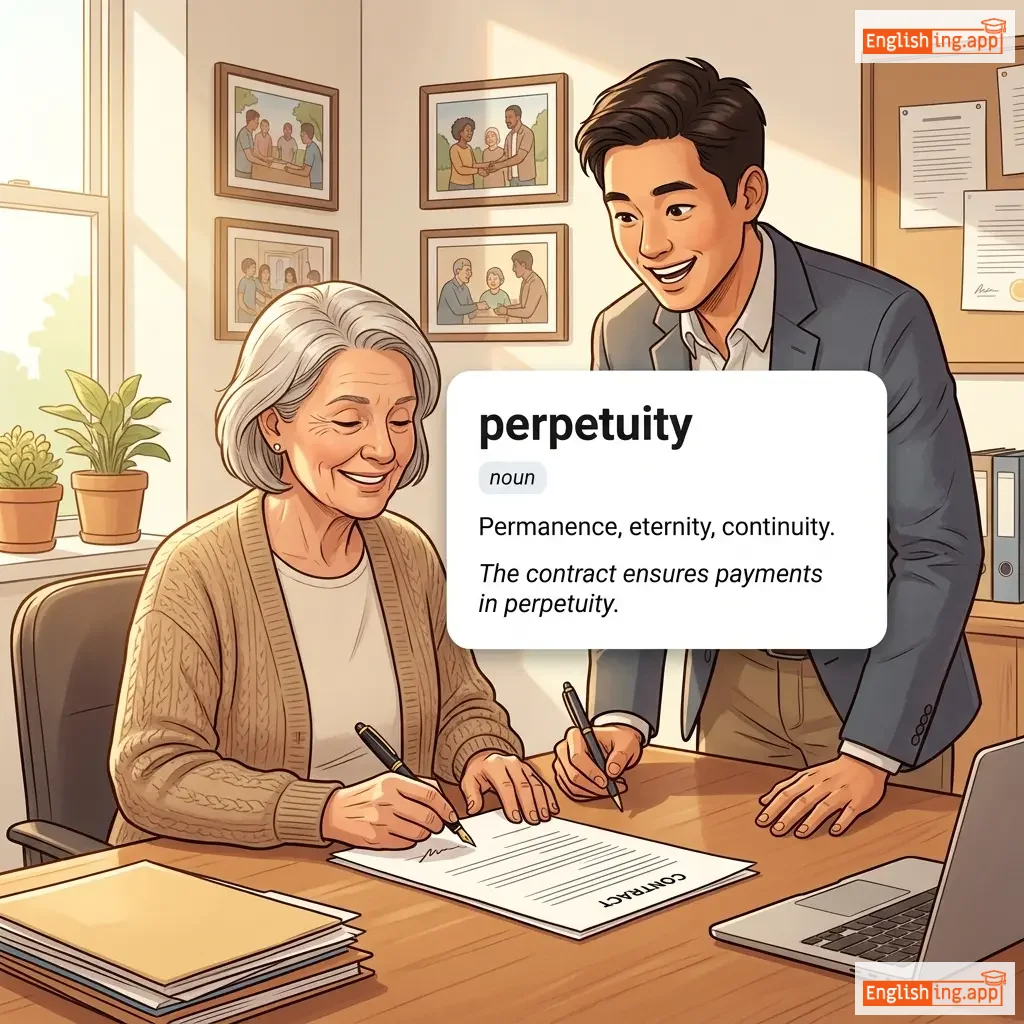
perpetuity definition card — visual illustration of the meaning
noun C2
ˌpɜː.pɪˈtʃuː.ɪ.ti
perpétuité, éternité, continuité (perpétuité, éternité, continuité)

Permanence, eternity, continuity.

"The contract ensures payments in perpetuity."
"Le contrat garantit des paiements en perpétuité." (Le contrat garantit des paiements en perpétuité.)
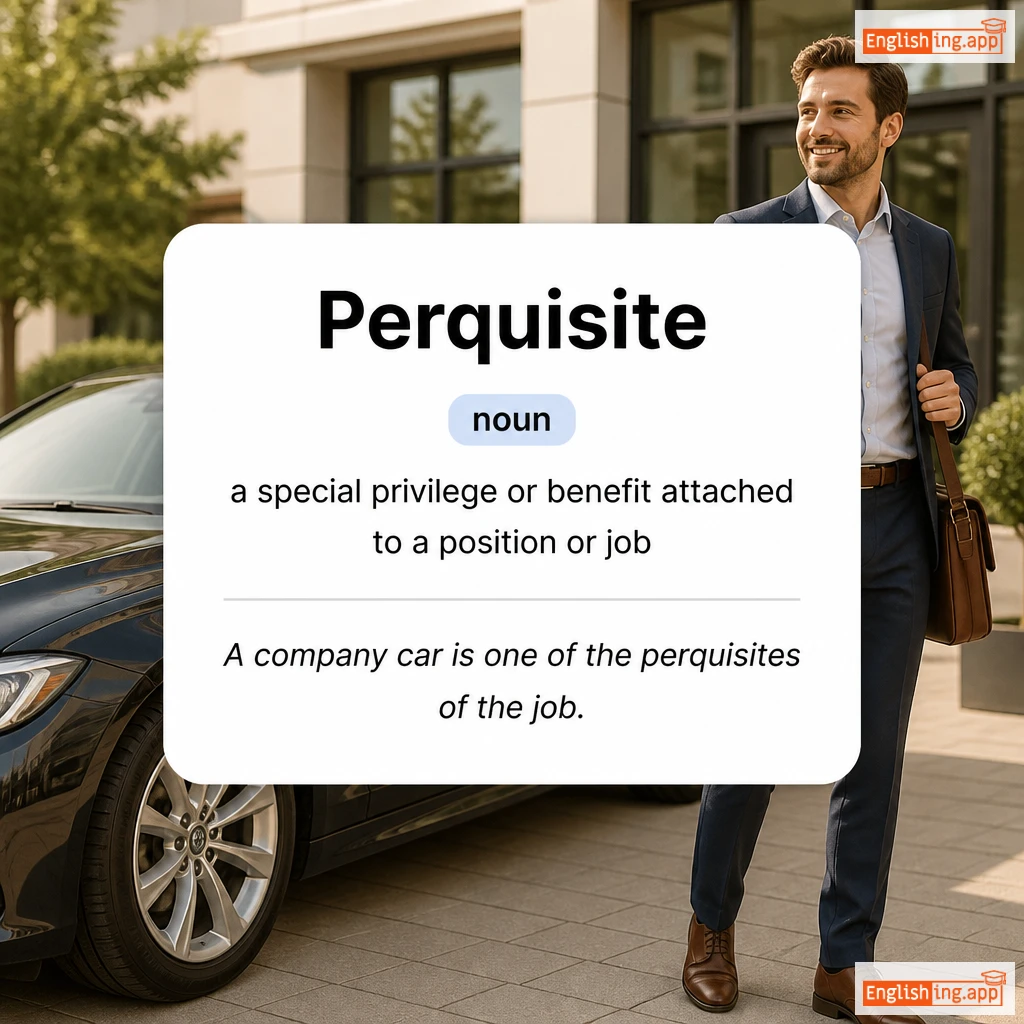
Perquisite definition card — visual illustration of the meaning
noun C2
/ˈpɜːrkwɪzɪt/
privilège (privilège)

a special privilege or benefit attached to a position or job

"A company car is one of the perquisites of the job."

"Une voiture de société est l'un des privilèges liés au poste." (Une voiture de société est l'un des privilèges liés au poste.)
noun C2
/ˈpɜːrkwɪzɪt raɪt/
droit aux avantages supplémentaires (dwa o z avɑ̃taʒ suplɛmɑ̃tɛʁ)

a legal right to certain benefits or privileges associated with a job or office

"The judge enjoyed certain perquisite rights attached to his position."

"Le juge a profité de certains droits supplémentaires liés à sa fonction." (Le juge a profité de certains droits supplémentaires liés à sa fonction.)
noun C2
/ˈpɜːrsɪflɑːʒ/
moquerie légère (moquerie legere)

light and slightly contemptuous mockery or banter

"Their conversation was full of persiflage and jokes."

"Leurs conversations étaient pleines de moquerie légère et de blagues." (Leurs conversations etaient pleines de moquerie legere et de blagues.)
noun C2
/ˈpɜːrsənɪdʒ/
personnage important (personnage important)

an important or famous person

"He is considered a great personage in the world of literature."
"Il est considéré comme un grand personnage dans le monde de la littérature." (Il est considéré comme un grand personnage dans le monde de la littérature.)
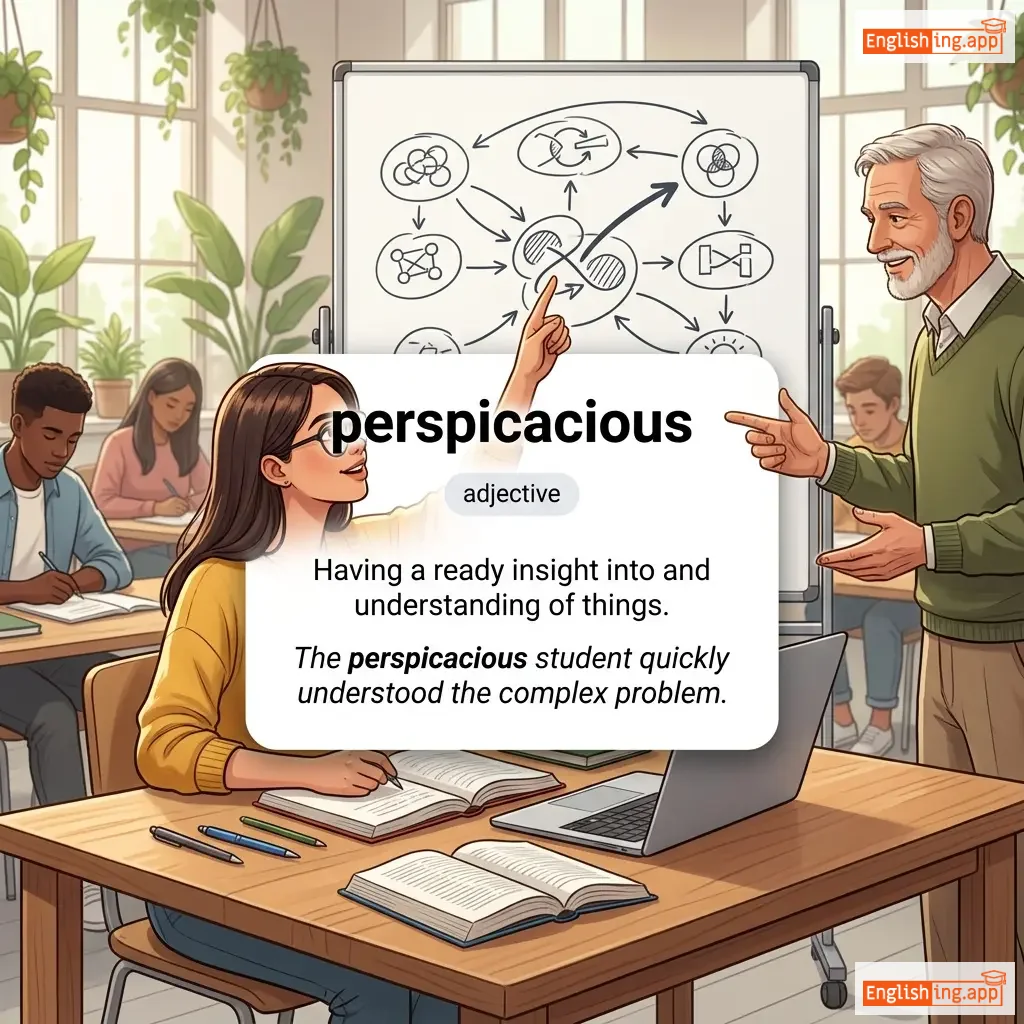
perspicacious definition card — visual illustration of the meaning
adjective C2
/ˌpɜːrspɪˈkeɪʃəs/
perspicace (perspicass)

Having a ready insight into and understanding of things.

"The perspicacious student quickly understood the complex problem."
"L'étudiant perspicace a rapidement compris le problème complexe." (L'etudiant perspicace a rapidement compris le probleme complexe.)
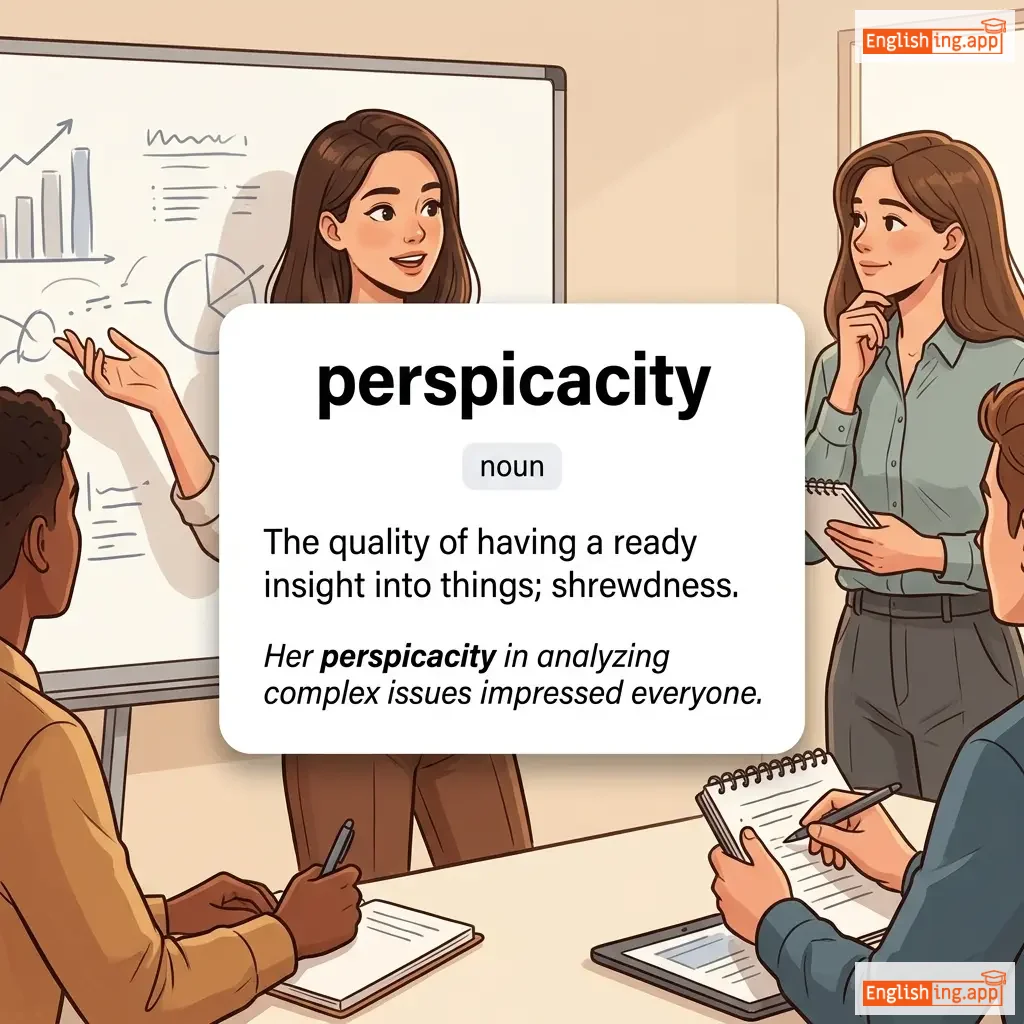
perspicacity definition card — visual illustration of the meaning
noun C2
/ˌpɜːrspɪˈkæsəti/
perspicacité (perspicacite)

The quality of having a ready insight into things; shrewdness.

"Her perspicacity in analyzing complex issues impressed everyone."

"Sa perspicacité dans l'analyse de problèmes complexes a impressionné tout le monde." (Sa perspicacite dans l'analyse de problemes complexes a impressionne tout le monde.)
noun C2
/ˌpɜːrspɪˈkjuːəti/
perspicuité (perspicuite)

Clarity and ease in speech or writing; the quality of being clearly expressed.

"The perspicuity of his lecture made it easy for students to understand complex topics."

"La perspicuité de sa conférence a facilité la compréhension des sujets complexes par les étudiants." (La perspicuité de sa conférence a facilité la compréhension des sujets complexes par les étudiants.)
adjective C2
/pərˈspɪkjuəs/
clair (clair)

Clearly expressed and easily understood; lucid.

"The teacher gave a perspicuous explanation of the theory."

"L'enseignant a donné une explication claire de la théorie." (L'enseignant a donné une explication claire de la théorie.)
adjective C2
/ˌpɜːrtɪˈneɪʃəs/
têtu (tetu)

holding firmly to an opinion, purpose, or course of action; stubbornly persistent

"The pertinacious lawyer refused to give up the case."
"L'avocat têtu a refusé d'abandonner l'affaire." (L'avocat têtu a refusé d'abandonner l'affaire.)
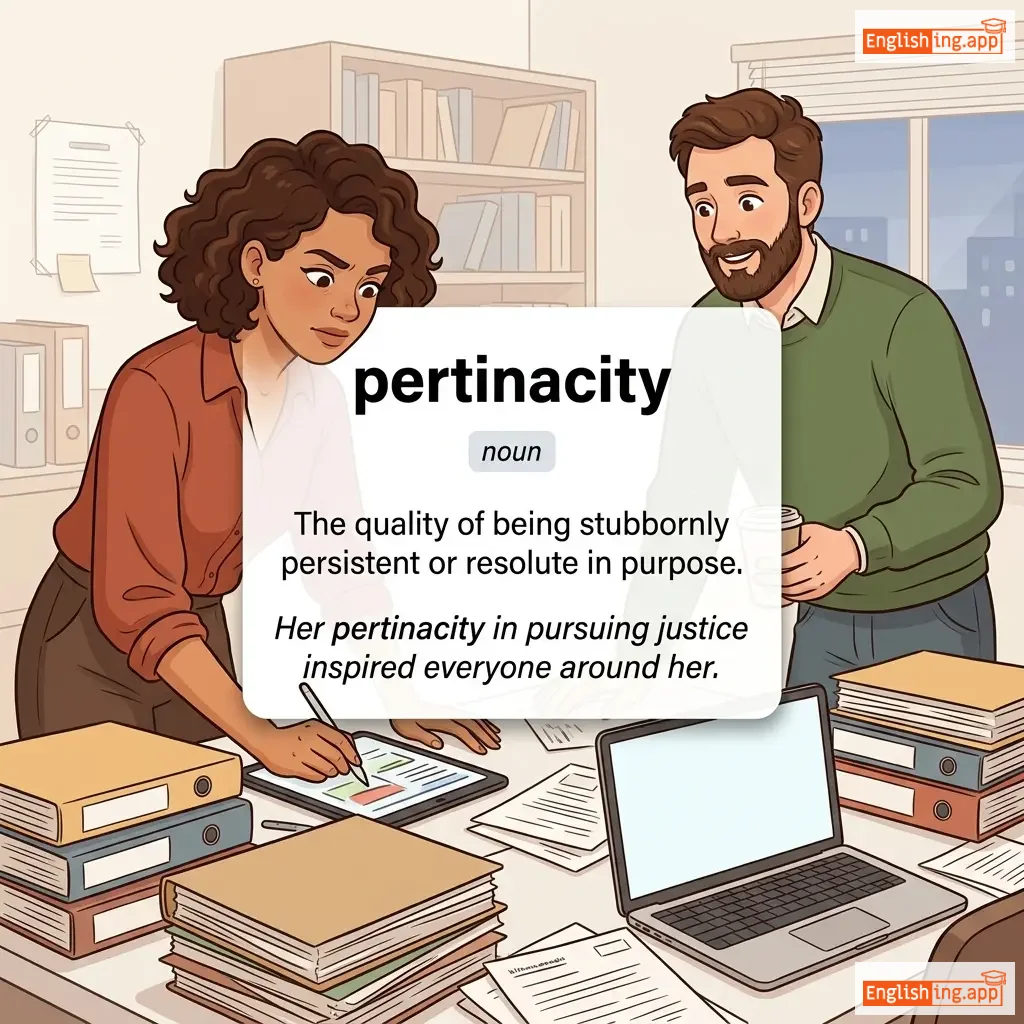
pertinacity definition card — visual illustration of the meaning
noun C2
/ˌpɜːrtɪˈnæsɪti/
pertinacité (pertinacite)

The quality of being stubbornly persistent or resolute in purpose.

"Her pertinacity in pursuing justice inspired everyone around her."

"Sa pertinacité à poursuivre la justice a inspiré tout son entourage." (sa pertinacite a poursuivre la justice a inspire tout son entourage)
noun C2
/ˈpɜːrtnəs/
effronterie (effronterie)

boldness or forwardness in speech or behavior; sauciness

"Her pertness during the meeting surprised everyone."

"Son effronterie lors de la réunion a surpris tout le monde." (Son effronterie lors de la réunion a surpris tout le monde.)
noun C2
/ˌpɜːrtərˈbeɪʃn/
perturbation (perturbation)

A state of anxiety, disturbance, or disorder.

"The announcement caused a perturbation in the financial markets."

"L'annonce a causé une perturbation sur les marchés financiers." (L'annonce a cause une perturbation sur les marches financiers.)
noun C2
/pəˈruːzl/
lecture attentive (lecture attentive)

The action of reading or examining something carefully.

"The contract was given to the lawyer for perusal."

"Le contrat a été remis à l'avocat pour une lecture attentive." (Le contrat a été remis à l'avocat pour une lecture attentive.)
noun C2
/pəˈveɪʒən/
pervasion (pervasion)

the act of spreading through or being present everywhere in something

"There was a pervasion of hope throughout the community."

"Il y avait une pervasion d'espoir dans toute la communauté." (Il y avait une pervasion d'espoir dans toute la communauté.)
adjective C2
/ˈpɜːrviəs/
perméable (permeable)

Allowing water, air, or other substances to pass through; permeable.

"The soil here is pervious to rainwater."

"Le sol ici est perméable à l'eau de pluie." (Le sol ici est perméable à l'eau de pluie.)
noun C2
/ˈpɛstɪləns/
peste (peste)

A deadly or virulent epidemic disease that spreads rapidly.

"The medieval city was devastated by a pestilence."

"La ville médiévale a été dévastée par une peste." (La ville médiévale a été dévastée par une peste.)
adjective C2
/ˈpɛstɪlənt/
pestilentiel (pestilentiel)

Causing or tending to cause death or destruction; harmful or pernicious.

"The pestilent atmosphere of the swamp made people sick."

"L'atmosphère pestilentielle du marais rendait les gens malades." (L'atmosphère pestilentielle du marais rendait les gens malades.)
adjective C2
/ˌpɛstɪˈlɛnʃəl/
pestilentiel (pestilentiel)

Relating to or causing pestilence; very harmful, troublesome, or dangerous.

"The pestilential smell of the garbage filled the street."

"L'odeur pestilentielle de la poubelle a rempli la rue." (L'odeur pestilentielle de la poubelle a rempli la rue.)
noun C2
/ˈpɛtrəˌɡræf/
description des roches (description des roches)

a description or representation of rocks, especially in detailed scientific writing

"The scientist studied the petrograph to understand the rock composition."

"Le scientifique a étudié le pétrographe pour comprendre la composition de la roche." (Le scientifique a etudie le petrographe pour comprendre la composition de la roche.)
verb C2
/ˈpɛtɪˌfɒɡ/
discuter de futilités (discuter de futilités)

to argue or quibble over trivial matters; to engage in petty, dishonest practices

"The lawyer was accused of trying to pettifog instead of addressing the real issue."

"L'avocat a été accusé d'essayer de discuter de questions futiles au lieu de traiter le vrai problème." (L'avocat a été accusé d'essayer de discuter de questions futiles au lieu de traiter le vrai problème.)
noun C2
/ˈpɛtjʊləns/
pétulance (pétulance)

The quality of being childishly sulky or bad-tempered.

"His petulance during the meeting annoyed everyone."

"Sa pétulance pendant la réunion a agacé tout le monde." (Sa pétulance pendant la réunion a agacé tout le monde.)
noun C2
/ˈfeɪlæŋks/
phalanx (phalanx)

A group of people or things arranged in a compact, close formation; also an ancient Greek military formation.

"A phalanx of reporters waited outside the courthouse."

"Un groupe de journalistes attendait devant le tribunal." (Un groupe de journalistes attendait devant le tribunal.)
noun C2
/ˈfænˌtæzəm/
fantôme (fantome)

an illusion, ghost, or figment of the imagination

"The child claimed to see a phantasm in the old house."

"L'enfant prétendait avoir vu un fantôme dans la vieille maison." (L'enfant pretendait avoir vu un fantome dans la vieille maison.)
adjective C2
/ˌfæntæzməˈɡɒrɪkəl/
fantasmagorique (fantasmagorique)

Having a fantastic, dreamlike, or surreal appearance, often shifting or illusory.

"The movie created a phantasmagorical vision of another world."

"Le film a créé une vision fantasmagorique d'un autre monde." (Le film a cree une vision fantasmagorique d'un autre monde.)
adjective C2
/ˌfærɪˈseɪɪkəl/
pharisaïque (pharisaïque)

Excessively concerned with formal rules or outward show of morality, often in a hypocritical way.

"His pharisaical behavior made people doubt his sincerity."

"Son comportement pharisaïque a fait douter les gens de sa sincérité." (Son comportement pharisaïque a fait douter les gens de sa sincérité.)
noun C2
/ˈfærɪsiː/
personne hypocrite (personne hypocrite)

A member of an ancient Jewish sect; by extension, a self-righteous or hypocritical person.

"He acted like a pharisee, judging others while ignoring his own faults."

"Il agissait comme un pharisien, jugeant les autres tout en ignorant ses propres défauts." (Il agissait comme un pharisien, jugeant les autres tout en ignorant ses propres défauts.)
noun C2
/ˌfɑːrməkəˈpiːə/
pharmacopée (pharmacopée)

An official book listing medicinal drugs, their effects, and directions for use.

"The doctor referred to the pharmacopoeia to check the drug's proper dosage."

"Le médecin a consulté la pharmacopée pour vérifier la dose correcte du médicament." (Le médecin a consulté la pharmacopée pour vérifier la dose correcte du médicament.)
noun C2
/ˈfaɪəl/
petite fiole (petite fiole)

a small glass container for liquids, especially medicines

"The doctor gave her a phial of medicine."

"Le médecin lui a donné un flacon de médicament." (Le médecin lui a donné un flacon de médicament.)
verb C2
/fɪˈlændər/
flirter (flirter)

to engage in casual or frivolous romantic or sexual relationships

"He was known to philander with many women in town."

"Il était connu pour flirter avec de nombreuses femmes en ville." (Il était connu pour flirter avec de nombreuses femmes en ville.)
noun C2
/fɪˈlændərər/
volage (volage)

a man who habitually engages in casual romantic or sexual affairs

"The politician was exposed as a notorious philanderer."

"Le politicien a été exposé comme un célèbre volage." (Le politicien a été exposé comme un célèbre volage.)
noun C2
/fɪˈlæt.əl.ɪst/
collectionneur de timbres (collectionneur de timbres)

a person who collects or studies postage stamps

"The philatelist spent years building a rare stamp collection."

"Le philatéliste a passé des années à constituer une collection rare de timbres." (Le philatéliste a passé des années à constituer une collection rare de timbres.)
noun C2
/fɪˈlæt.əl.i/
philatélie (philatelie)

the collection and study of postage stamps

"Philately is a hobby enjoyed by people of all ages."

"La philatélie est un passe-temps apprécié des personnes de tous âges." (La philatelie est un passe-temps apprecie des personnes de tous ages.)
noun C2
/ˈfɪl.ɪ.staɪn/
personne indifférente ou hostile à la culture et aux arts (personne indifferente ou hostile a la culture et aux arts)

a person who is indifferent or hostile to culture and the arts

"He was criticized as a philistine for dismissing modern art."

"Il a été critiqué comme un philistin pour avoir rejeté l'art moderne." (Il a ete critique comme un philistin pour avoir rejete l'art moderne.)
noun C2
/ˈfɪl.ə.dʒɪ.nɪst/
personne qui aime ou admire les femmes (personne qui aime ou admire les femmes)

a person who loves or admires women

"As a known philogynist, he advocated for women's education."

"En tant que philogyniste connu, il a plaidé en faveur de l'éducation des femmes." (En tant que philogyniste connu, il a plaidé en faveur de l'éducation des femmes.)
noun C2
/fɪˈlɒl.ə.dʒɪst/
philologue (philologue)

a person who studies languages and their history

"The philologist analyzed ancient texts to understand language evolution."

"Le philologue a analysé des textes anciens pour comprendre l'évolution du langage." (Le philologue a analyse des textes anciens pour comprendre l'evolution du langage.)
noun C2
/fɪˈlɒl.ə.dʒi/
l'étude de la langue dans les sources historiques écrites ; linguistique (l'etude de la langue dans les sources historiques ecrites; linguistique)

the study of language in written historical sources; linguistics

"She devoted her career to philology, researching ancient manuscripts."

"Elle a consacré sa carrière à la philologie, en recherchant des manuscrits anciens." (Elle a consacre sa carriere a la philologie, en recherchant des manuscrits anciens.)
verb C2
/fɪˈlɒs.ə.faɪz/
philosopher (philosopher)

to think or talk about the fundamental nature of knowledge, reality, and existence

"He likes to philosophize about life and its meaning."
"Il aime philosopher sur la vie et son sens." (Il aime philosopher sur la vie et son sens.)
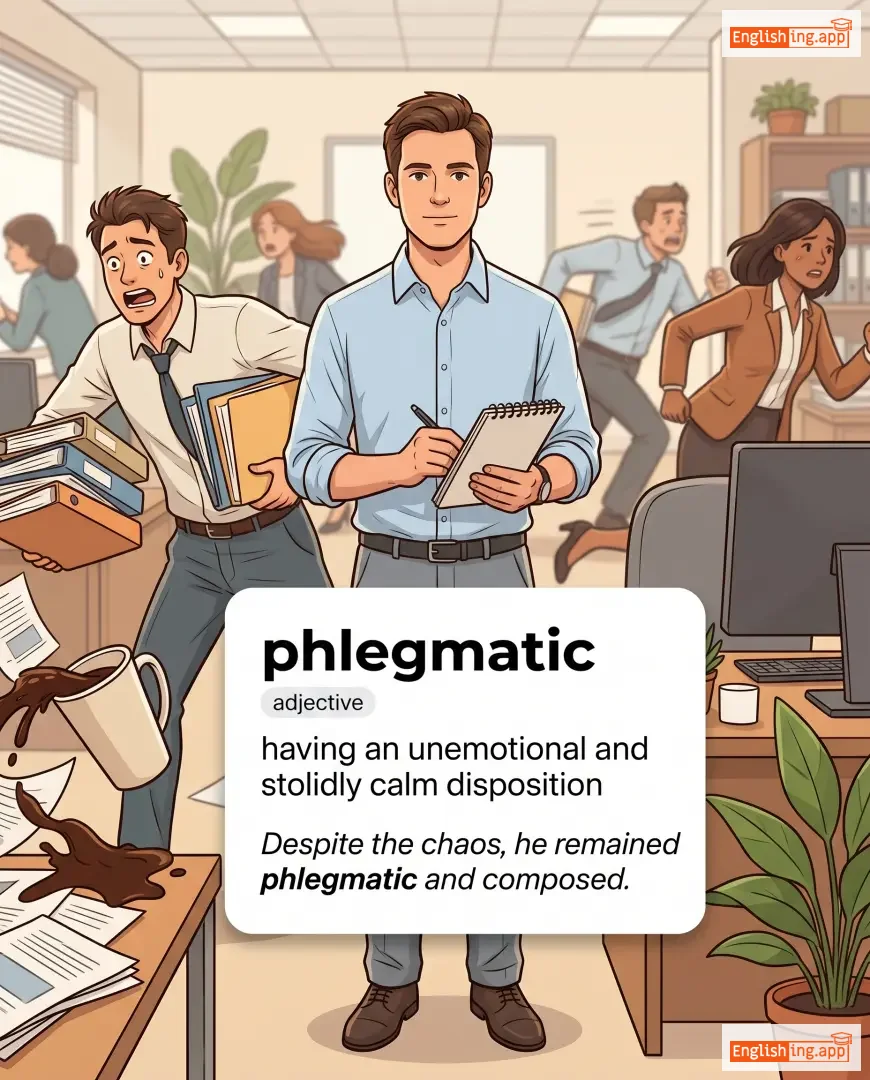
phlegmatic definition card — visual illustration of the meaning
adjective C2
/flɛgˈmæt.ɪk/
phlegmatique (phlegmatique)

having an unemotional and stolidly calm disposition

"Despite the chaos, he remained phlegmatic and composed."

"Malgré le chaos, il est resté flégmatique et composé." (Malgre le chaos, il est reste phlegmatique et compose.)
noun C2
/ˈfoʊ.nə.ɡræm/
symbole phonétique (symbole phonétique)

a written symbol representing a speech sound

"The teacher showed how each phonogram represents a particular sound."

"L'enseignant a montré comment chaque phonogramme représente un son particulier." (L'enseignant a montré comment chaque phonogramme représente un son particulier.)
noun C2
/ˌfoʊ.nəˈlɑː.dʒi/
phonologie (phonologie)

the study of the sound system of a language

"She is studying phonology to understand how sounds function in English."

"Elle étudie la phonologie pour comprendre comment les sons fonctionnent en anglais." (Elle etudie la phonologie pour comprendre comment les sons fonctionnent en anglais.)
noun C2
/ˌfɑːsfəˈrɛsəns/
phosphorescence (phosphorescence)

the property of emitting light without noticeable heat

"The deep-sea creatures displayed a beautiful phosphorescence."

"Les créatures des profondeurs marines ont affiché une belle phosphorescence." (Les creatures des profondeurs marines ont affiche une belle phosphorescence.)