Словари

Словарь английского языка | Значения слов, определения и примеры

adjective C1
/ˈdaɪ.si/
risqué (riske)

Risky or unpredictable; potentially dangerous.

"Investing in that company looks pretty dicey right now."
"Investir dans cette entreprise semble assez risqué en ce moment." (Investir dans cette entreprise semble assez risqué en ce moment.)
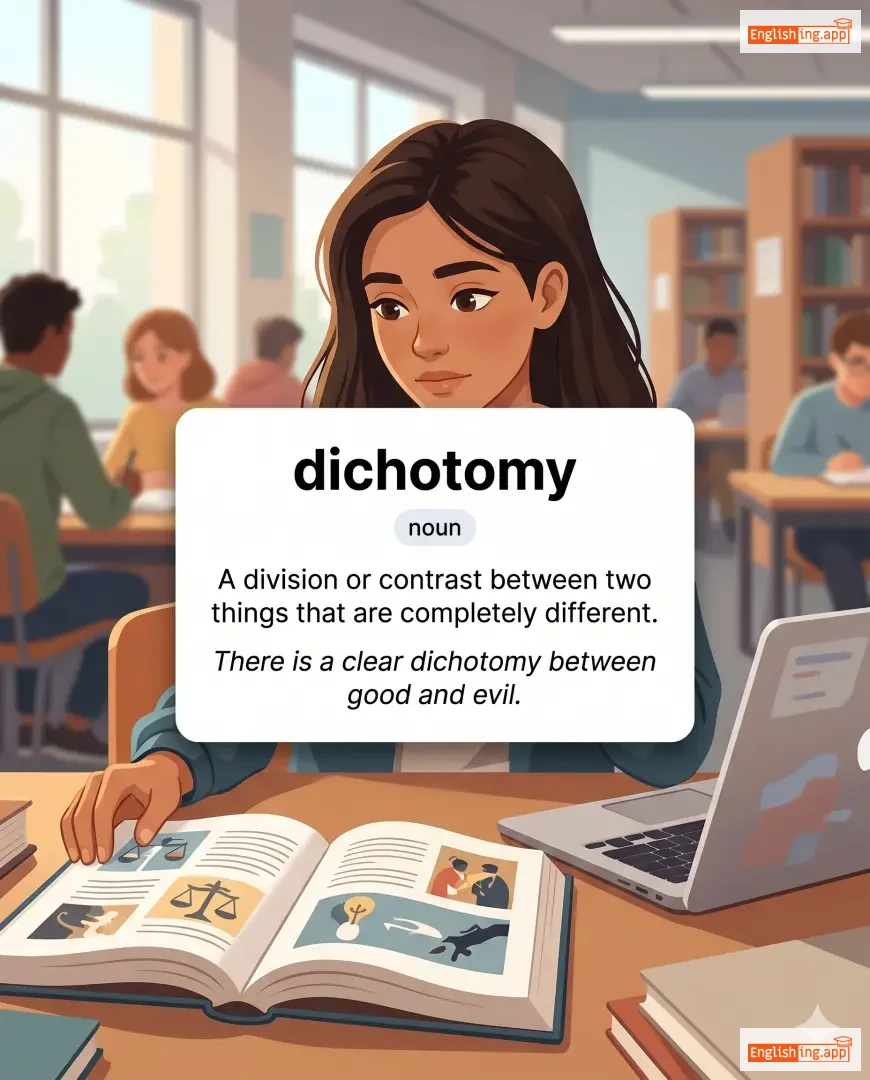
dichotomy definition card — visual illustration of the meaning
noun C1
/daɪˈkɒtəmi/
dichotomie (dichotomie)

A division or contrast between two things that are completely different.

"There is a clear dichotomy between good and evil."

"Il existe une dichotomie claire entre le bien et le mal." (Il existe une dichotomie claire entre le bien et le mal.)
adjective C1
/ˌdɪktəˈtɔːriəl/
dictatorial (dictatorial)

Having or showing a tendency to tell people what to do in an autocratic way.

"His dictatorial style made him unpopular among colleagues."
"Son style dictatorial le rendait impopulaire parmi ses collègues." (Son style dictatorial le rendait impopulaire parmi ses collegues.)
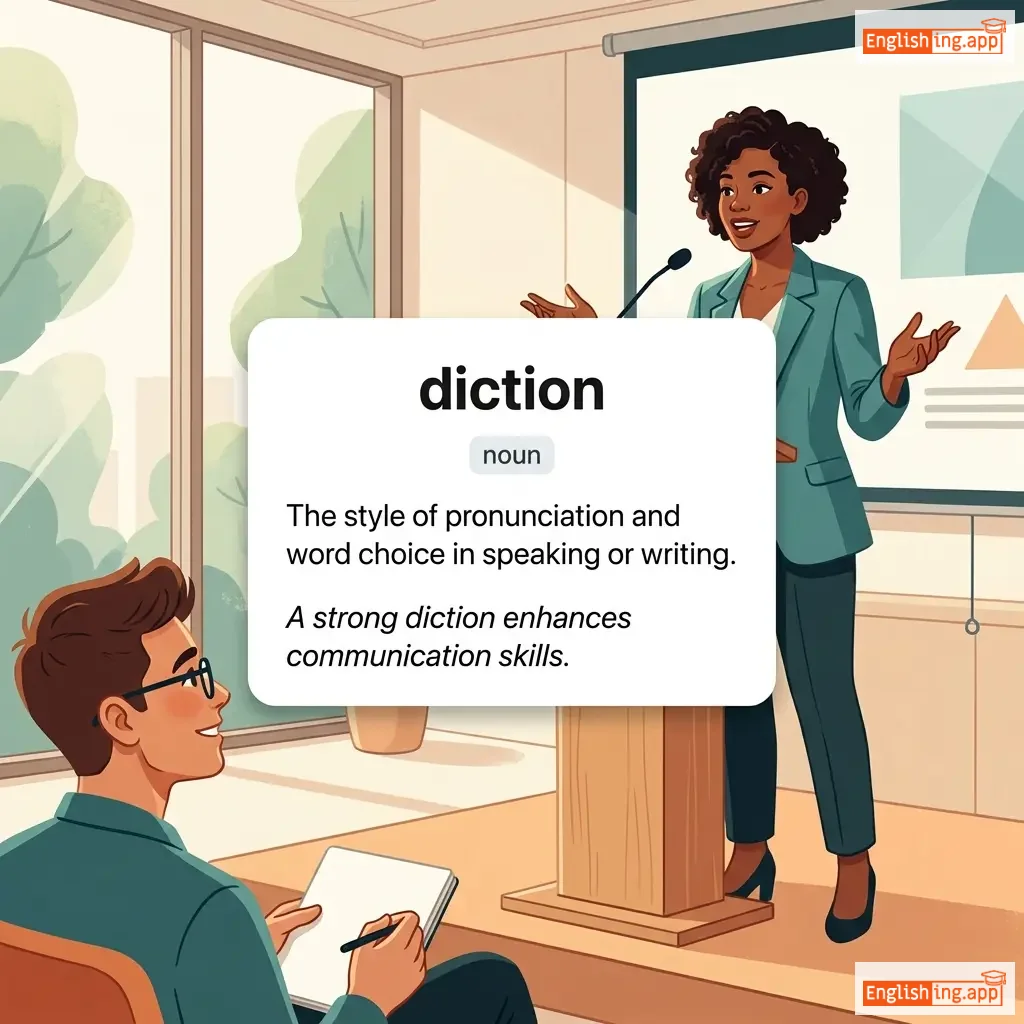
diction definition card — visual illustration of the meaning
noun C1
ˈdɪk.ʃən
prononciation et choix des mots (prononciation et choix des mots)

The style of pronunciation and word choice in speaking or writing.

"A strong diction enhances communication skills."

"Une forte diction améliore les compétences en communication." (Une forte diction ameliore les competences en communication.)
noun C1
/ˈdaɪhɑːrd/
fanatique (daihard)

A person who strongly resists change and remains loyal to a belief or cause.

"He is a diehard fan of classic rock music."

"Il est un fanatique inconditionnel du rock classique." (Il est un dai hard fan du rock classique.)
adjective C1
/ˌdɪfəˈrɛnʃəl/
différentiel (differentiel)

Relating to or showing a difference; involving a distinction.

"There is a differential treatment between the two groups."

"Il existe un traitement différentiel entre les deux groupes." (Il existe un traitement différentiel entre les deux groupes.)
differentiation definition card — visual illustration of the meaning
noun C1
/ˌdɪf.ə.ren.ʃiˈeɪ.ʃən/
différenciation, distinction, séparation (differenciation, distinction, separation)

The action or process of differentiating or distinguishing between two or more things or people.

"Strong differentiation sets brands apart from competitors."
"Une forte différenciation distingue les marques des concurrents." (Une forte differenciation distingue les marques des concurrents.)
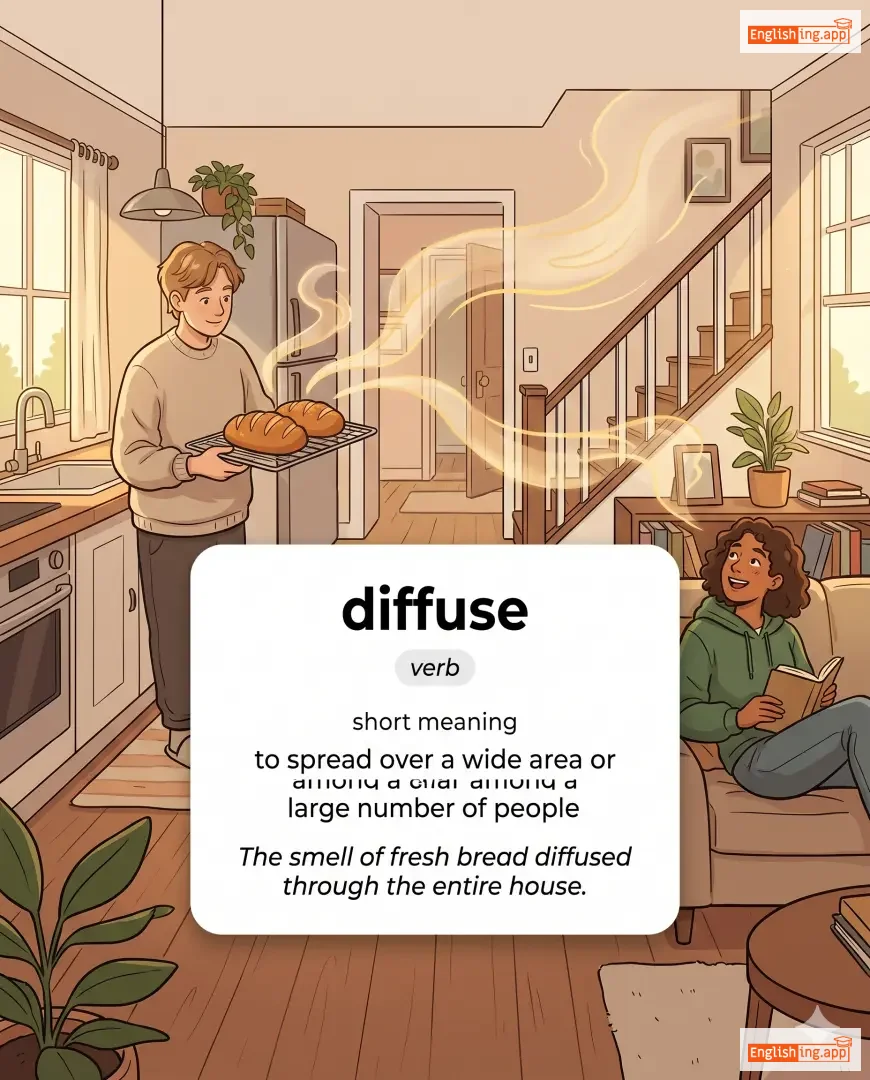
diffuse definition card — visual illustration of the meaning
verb C1
/dɪˈfjuːz/
diffuser (diffuser)

to spread over a wide area or among a large number of people

"The smell of fresh bread diffused through the entire house."

"L'odeur du pain frais s'est diffusée dans toute la maison." (L'odeur du pain frais s'est diffusée dans toute la maison.)
noun C1
/dɪˈfjuːʒən/
diffusion (diffusion)

the spreading of something more widely or the movement of particles from high to low concentration

"The diffusion of information on social media is rapid."

"La diffusion de l'information sur les réseaux sociaux est rapide." (La diffusion de linformation sur les reseaux sociaux est rapide)
noun C1
/ˈdɪɡnɪˌtɛri/
personne importante (personne importante)

a person considered to be important because of high rank or office

"Several foreign dignitaries attended the state banquet."

"Plusieurs dignitaires étrangers ont assisté au banquet d'État." (Plusieurs dignitaires étrangers ont assisté au banquet d'État.)
verb C1
/daɪˈɡrɛs/
s'écarter temporairement du sujet principal (sekarte temporairement du sujet principal)

To leave the main subject temporarily in speech or writing.

"The professor began to digress from the main topic of the lecture."

"Le professeur a commencé à digresser du sujet principal de la conférence." (Le professeur a commencé à digresser du sujet principal de la conférence.)
adjective C1
/dɪˈlæpɪˌdeɪtɪd/
délabré (delabre)

Fallen into disrepair or ruin due to neglect or age.

"The family lived in a dilapidated house at the edge of town."

"La famille vivait dans une maison délabrée au bord de la ville." (La famille vivait dans une maison delabree au bord de la ville.)
verb C1
/daɪˈleɪt/
dilater (dilater)

To make wider, larger, or more open.

"The doctor used drops to dilate the patient's pupils."
"Le médecin a utilisé des gouttes pour dilater les pupilles du patient." (Le medecin a utilise des gouttes pour dilater les pupilles du patient.)
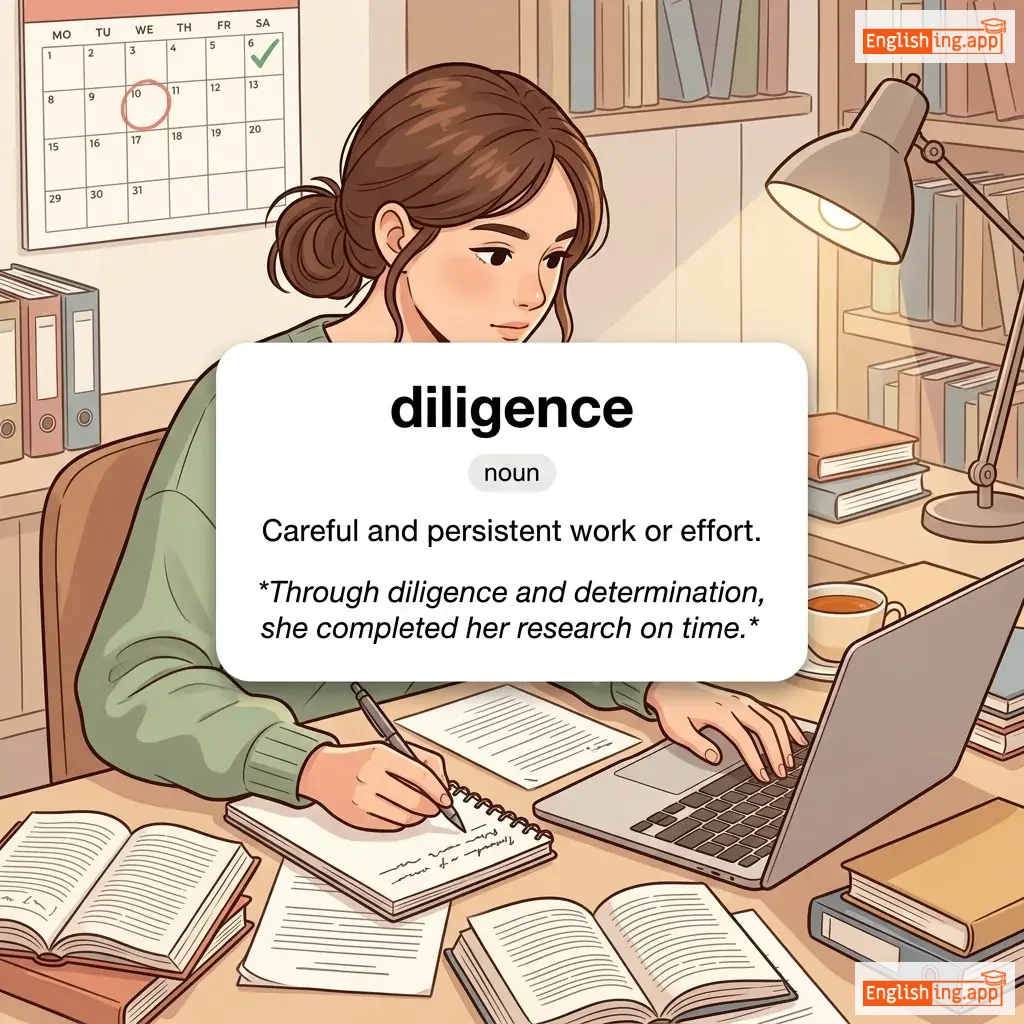
diligence definition card — visual illustration of the meaning
noun C1
/ˈdɪlɪdʒəns/
diligence (diligence)

Careful and persistent work or effort.

"Through diligence and determination, she completed her research on time."

"Grâce à la diligence et à la détermination, elle a terminé sa recherche à temps." (Grace a la diligence et a la determination, elle a termine sa recherche a temps.)
verb C1
/daɪˈluːt/
diluer (diluer)

To make a liquid thinner or weaker by adding water or another solvent.

"You should dilute the juice with water before serving it to children."
"Vous devez diluer le jus avec de l'eau avant de le servir aux enfants." (Vous devez diluer le jus avec de l'eau avant de le servir aux enfants.)
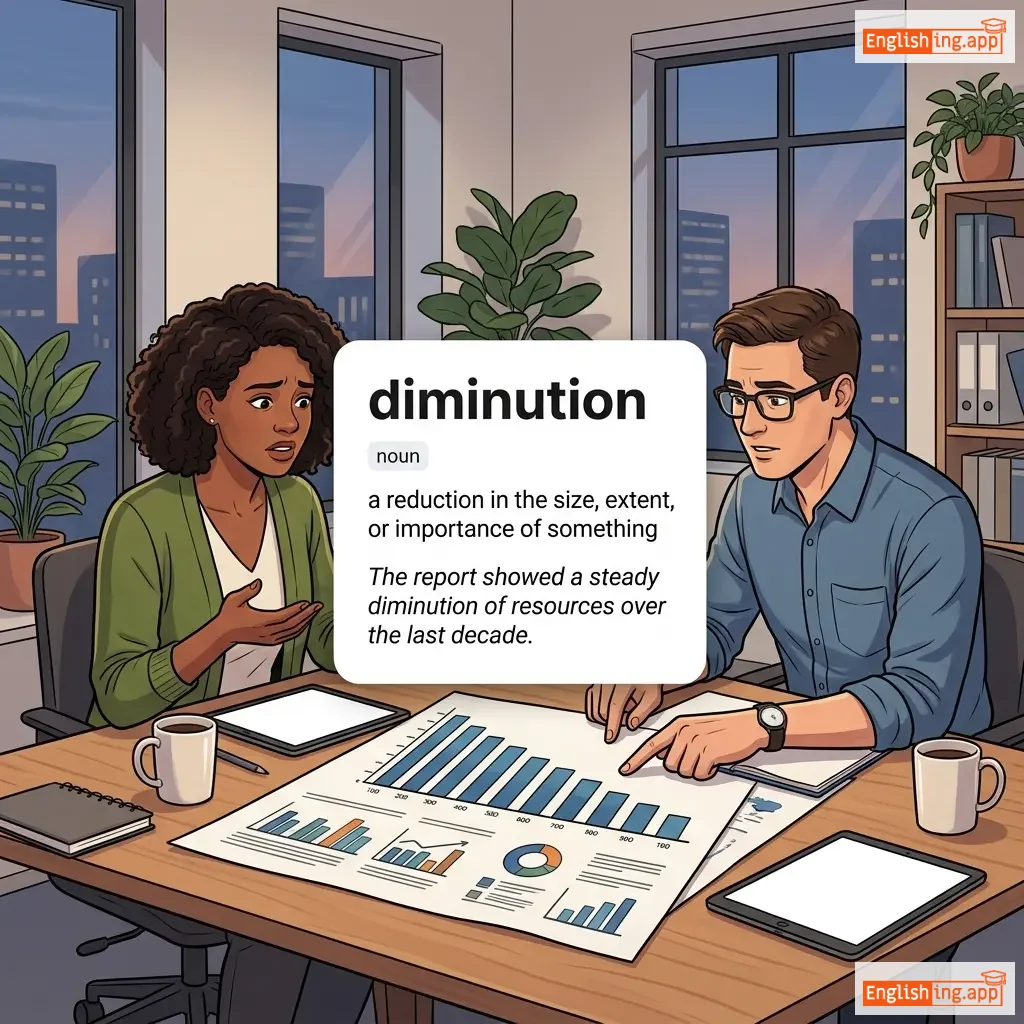
diminution definition card — visual illustration of the meaning
noun C1
/ˌdɪmɪˈnjuːʃən/
diminution (diminution)

a reduction in the size, extent, or importance of something

"The report showed a steady diminution of resources over the last decade."

"Le rapport a montré une diminution constante des ressources au cours de la dernière décennie." (Le rapport a montre une diminution constante des ressources au cours de la derniere decennie.)
adjective C1
/dɪˈmɪnjətɪv/
minuscule (minuscule)

extremely or unusually small

"Despite his diminutive size, he was a powerful leader."
"Malgré sa taille minuscule, il était un leader puissant." (Malgré sa taille minuscule, il était un leader puissant.)
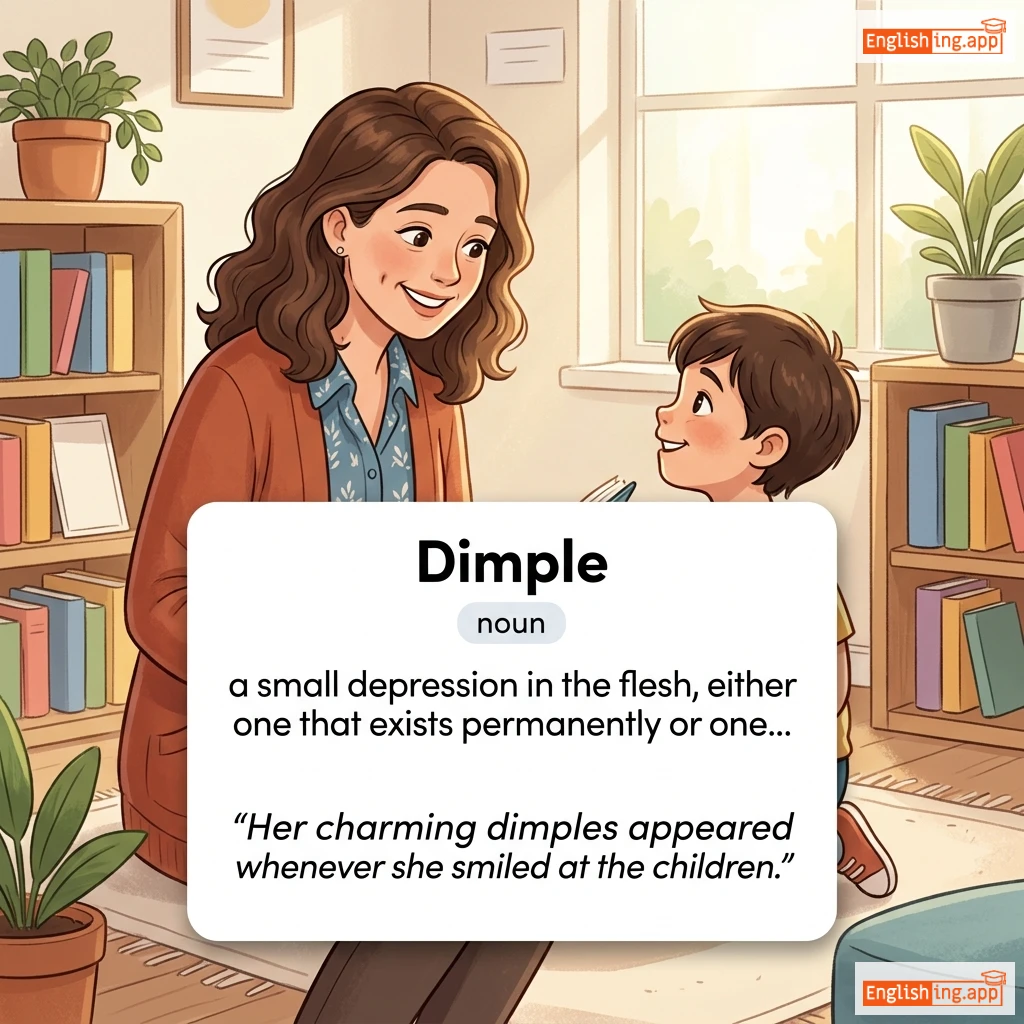
Dimple definition card — visual illustration of the meaning
noun C1
/ˈdɪm.pəl/
fossette (fossette)

a small depression in the flesh, either one that exists permanently or one that forms when smiling

"Her charming dimples appeared whenever she smiled at the children."

"Ses adorables fossettes apparaissaient chaque fois qu'elle souriait aux enfants." (ses adorables fossettes apparaissaient chaque fois qu'elle souriait aux enfants.)
noun C1
/dɪn/
bruit (bruit)

a loud, unpleasant, and prolonged noise

"The din of traffic outside made it hard to concentrate."

"Le bruit de la circulation dehors rendait la concentration difficile." (Le bruit de la circulation dehors rendait la concentration difficile.)
noun C1
/ˈdɪŋɡi/
canot (canot)

a small boat, often carried or towed by a larger vessel, used for short trips or as a lifeboat

"They rowed the dinghy back to the yacht."

"Ils ont ramé le canot jusqu'au yacht." (Ils ont rame le canot jusqu'au yacht.)
adjective C1
/ˈdɪndʒi/
sale (sale)

gloomy and drab; dirty or discolored

"The old hotel room looked dark and dingy."

"La vieille chambre d'hôtel semblait sombre et sale." (La vieille chambre d'hotel semblait sombre et sale.)
noun C1
/ˌdaɪəˈrɑːmə/
diorama (diorama)

a three-dimensional model representing a scene, often with miniature figures

"The museum displayed a diorama of an ancient village."
"Le musée a exposé un diorama d'un village ancien." (Le musée a exposé un diorama d'un village ancien.)
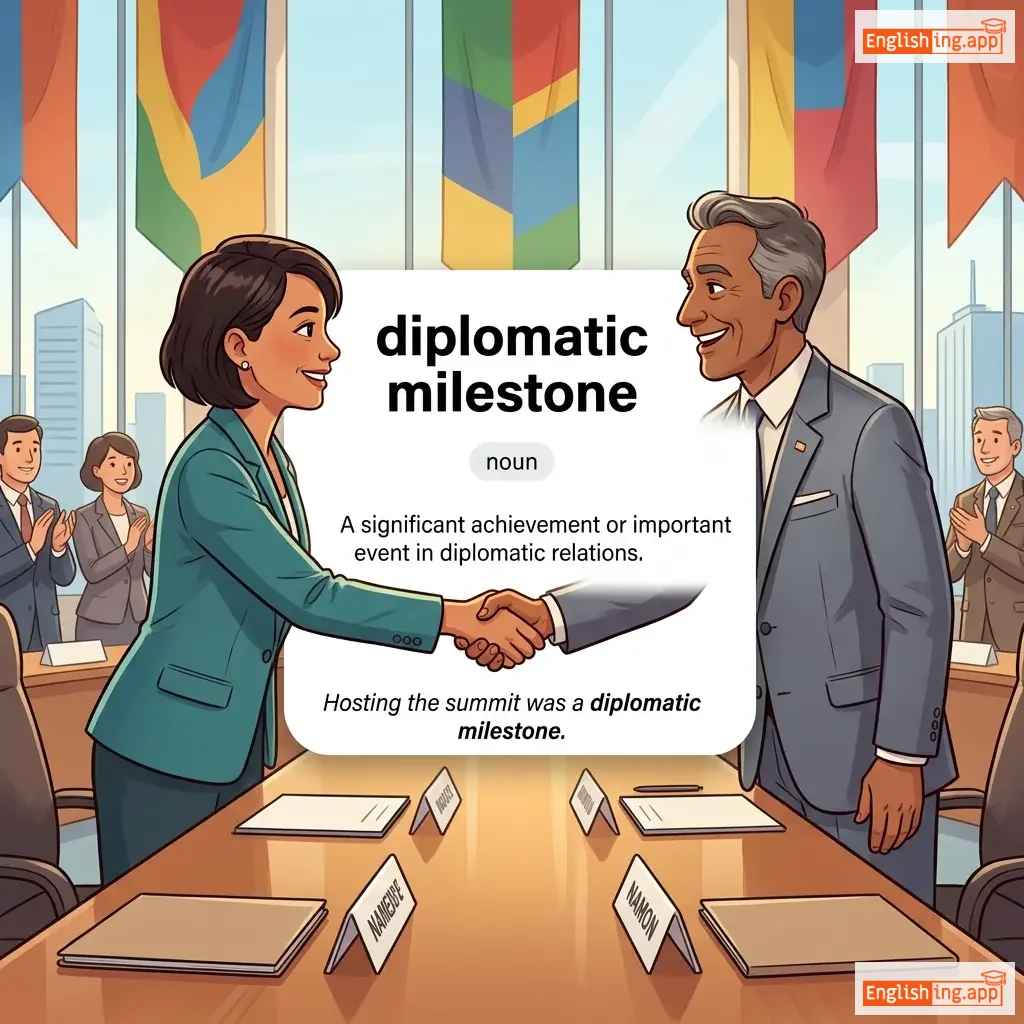
diplomatic milestone definition card — visual illustration of the meaning
noun C1
/ˌdɪp.ləˈmæt.ɪk ˈmaɪl.stəʊn/
jalon diplomatique (jalon diplomatique)

A significant achievement or important event in diplomatic relations.

"Hosting the summit was a diplomatic milestone."
"L'organisation du sommet était un jalon diplomatique." (L'organisation du sommet était un jalon diplomatique.)
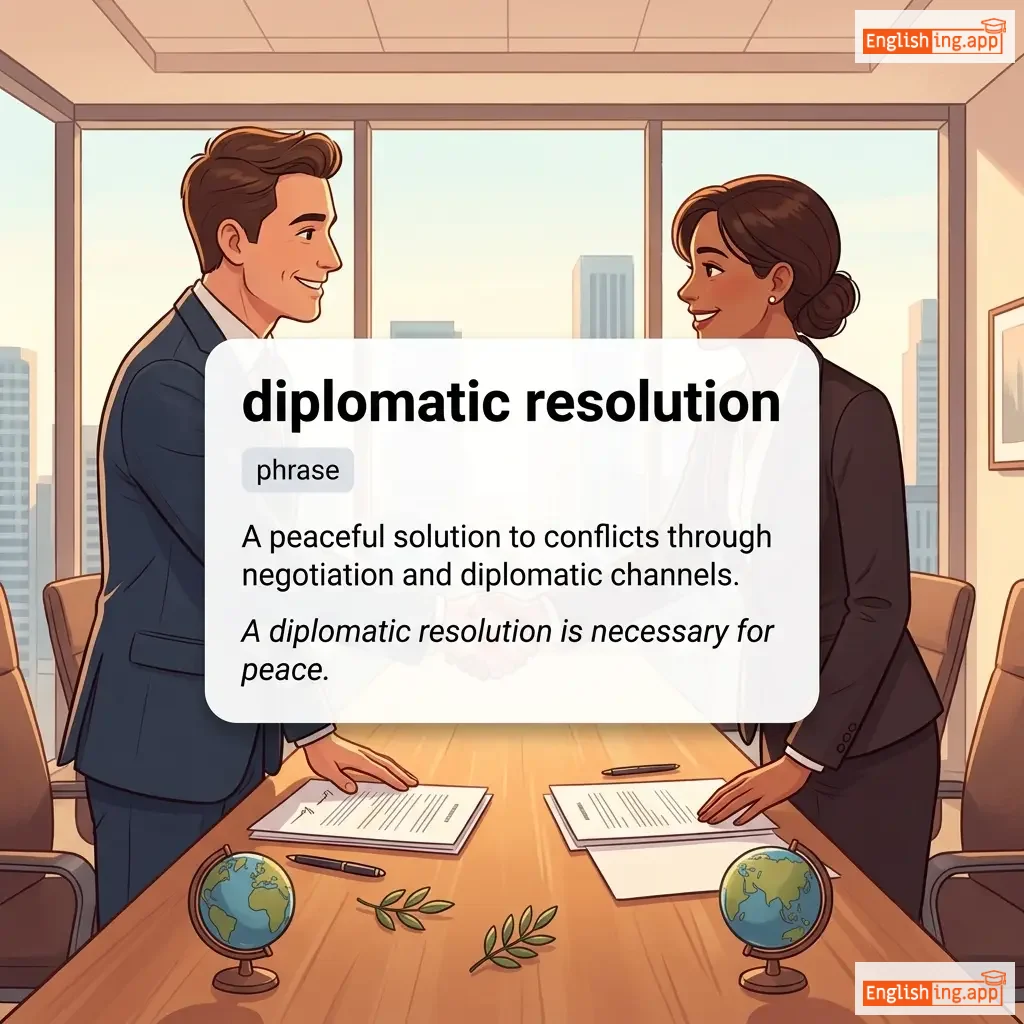
diplomatic resolution definition card — visual illustration of the meaning
phrase C1
ˌdɪp.ləˈmæt.ɪk rɛz.əˈluː.ʃən
résolution diplomatique (resolution diplomatique)

A peaceful solution to conflicts through negotiation and diplomatic channels.

"A diplomatic resolution is necessary for peace."

"Une résolution diplomatique est nécessaire pour la paix." (Une resolution diplomatique est necessaire pour la paix.)
adjective C1
/ˈdaɪər/
extrême (extreme)

Extremely serious or urgent.

"The refugees were in dire need of food and shelter."

"Les réfugiés étaient dans un besoin extrême de nourriture et d'abri." (Les refugiés étaient dans un besoin extrême de nourriture et d'abri.)
verb C1
/ˌdɪsəˈlaʊ/
interdire (interdire)

to refuse to allow or accept something

"The referee disallowed the goal for offside."
"L'arbitre a disallowé le but pour hors-jeu." (L'arbitre a disallowé le but pour hors-jeu.)
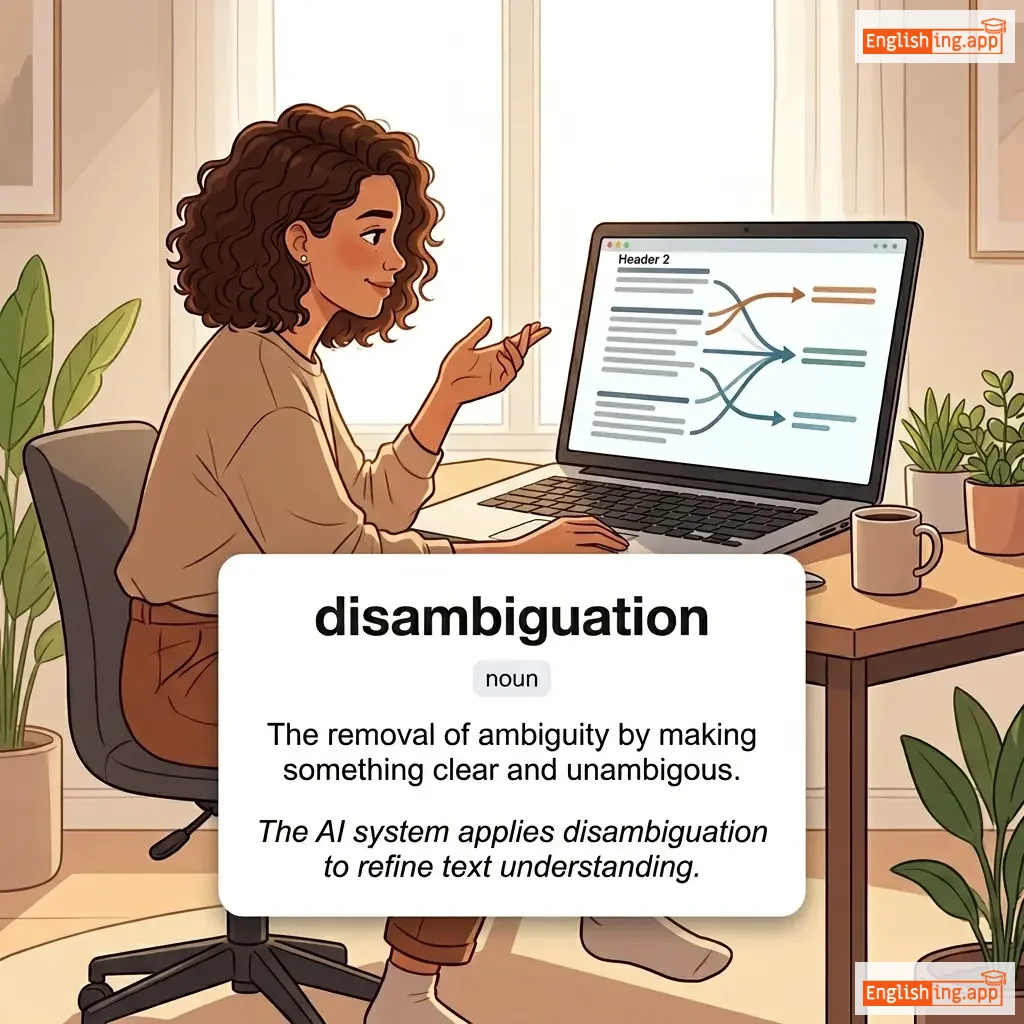
disambiguation definition card — visual illustration of the meaning
noun C1
ˌdɪs.æmˌbɪɡ.juˈeɪ.ʃən
désambiguïsation (disambiguation)

The removal of ambiguity by making something clear and unambiguous.

"The AI system applies disambiguation to refine text understanding."

"Le système IA applique la disambiguation pour affiner la compréhension du texte." (Le systeme IA applique la disambiguation pour affiner la comprehension du texte.)
verb C1
/dɪsˈɑːrm/
désarmer (desarmer)

to take weapons away from someone; to make someone feel less hostile

"The soldiers were ordered to disarm the rebels."
"Les soldats ont été ordonnés de désarmer les rebelles." (Les soldats ont été ordonnés de désarmer les rebelles.)
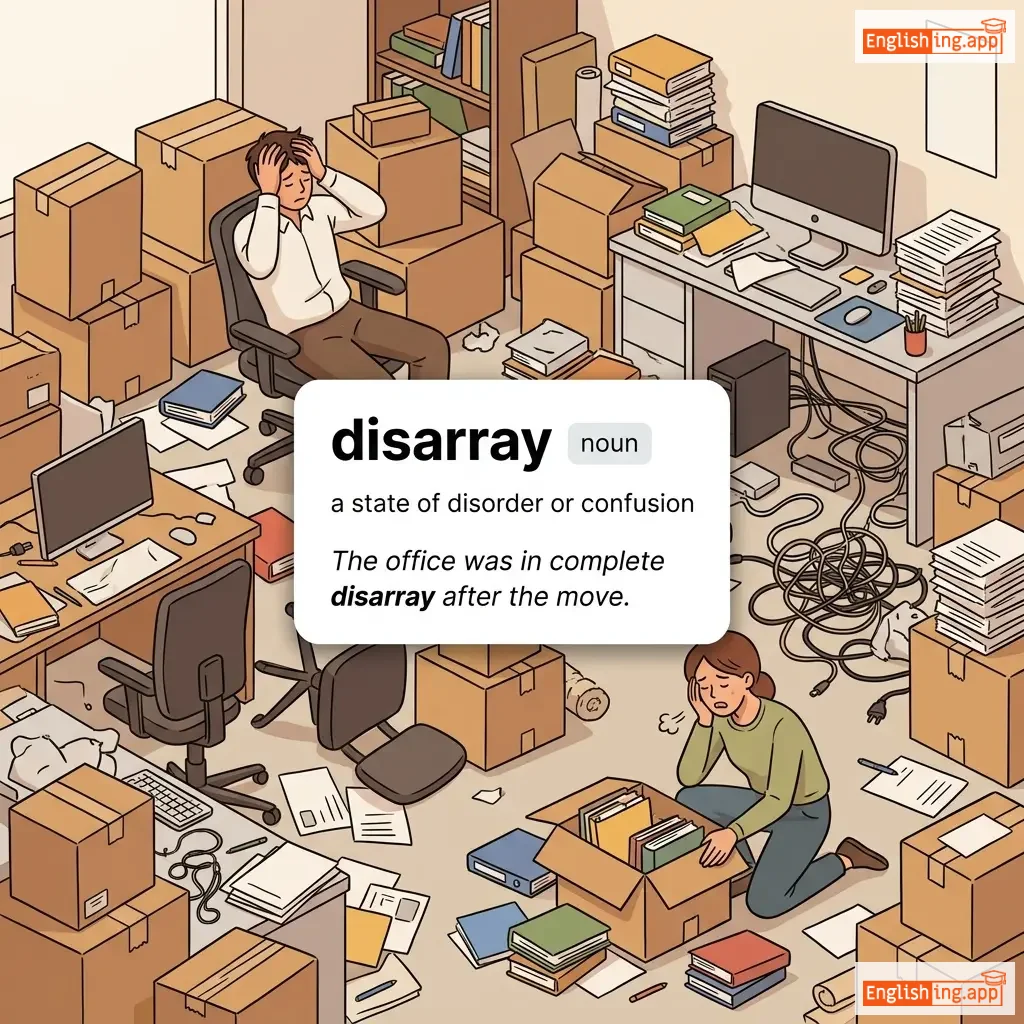
disarray definition card — visual illustration of the meaning
noun C1
/ˌdɪsəˈreɪ/
désordre (desordre)

a state of disorder or confusion

"The office was in complete disarray after the move."

"Le bureau était dans un désordre total après le déménagement." (Le bureau etait dans un desordre total apres le demenagement.)
verb C1
/ˌdɪsəˈsɛmbəl/
démonter (demonter)

To take apart something into its separate pieces.

"He had to disassemble the computer to repair it."

"Il a dû démonter l'ordinateur pour le réparer." (Il a du demonter l'ordinateur pour le reparer.)
verb C1
/dɪsˈbænd/
dissoudre (dissoudre)

to break up and stop functioning as a group or organization

"The club decided to disband after twenty years of activity."

"Le club a décidé de se dissoudre après vingt ans d'activité." (Le club a décidé de se dissoudre après vingt ans d'activité.)
noun C1
/ˌdɪsbɪˈliːvər/
incrédule (incredul)

a person who does not believe in something, especially a religion or idea

"He was called a disbeliever for rejecting the traditional faith."
"Il a été appelé incrédule pour avoir rejeté la foi traditionnelle." (Il a été appelé incredul pour avoir rejeté la foi traditionnelle.)
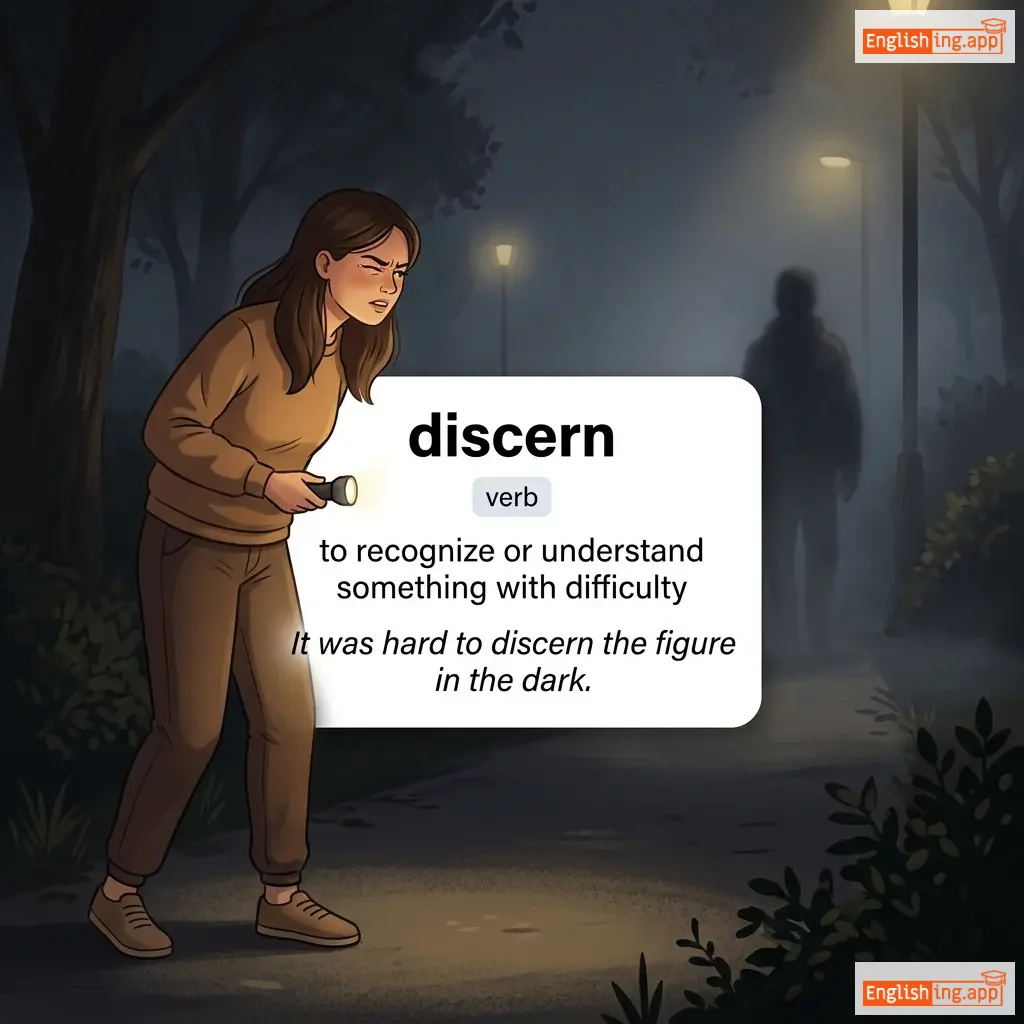
discern definition card — visual illustration of the meaning
verb C1
/dɪˈsɜːrn/
discernir (discernir)

to recognize or understand something with difficulty

"It was hard to discern the figure in the dark."

"Il était difficile de discerner la silhouette dans l'obscurité." (Il etait difficile de discerner la silhouette dans l'obscurité.)
adjective C1
/dɪˈsɜːrnəbl/
discernable (discernable)

able to be seen, recognized, or understood

"There was a discernible change in his behavior."
"Il y a eu un changement discernable dans son comportement." (Il y a eu un changement discernable dans son comportement.)
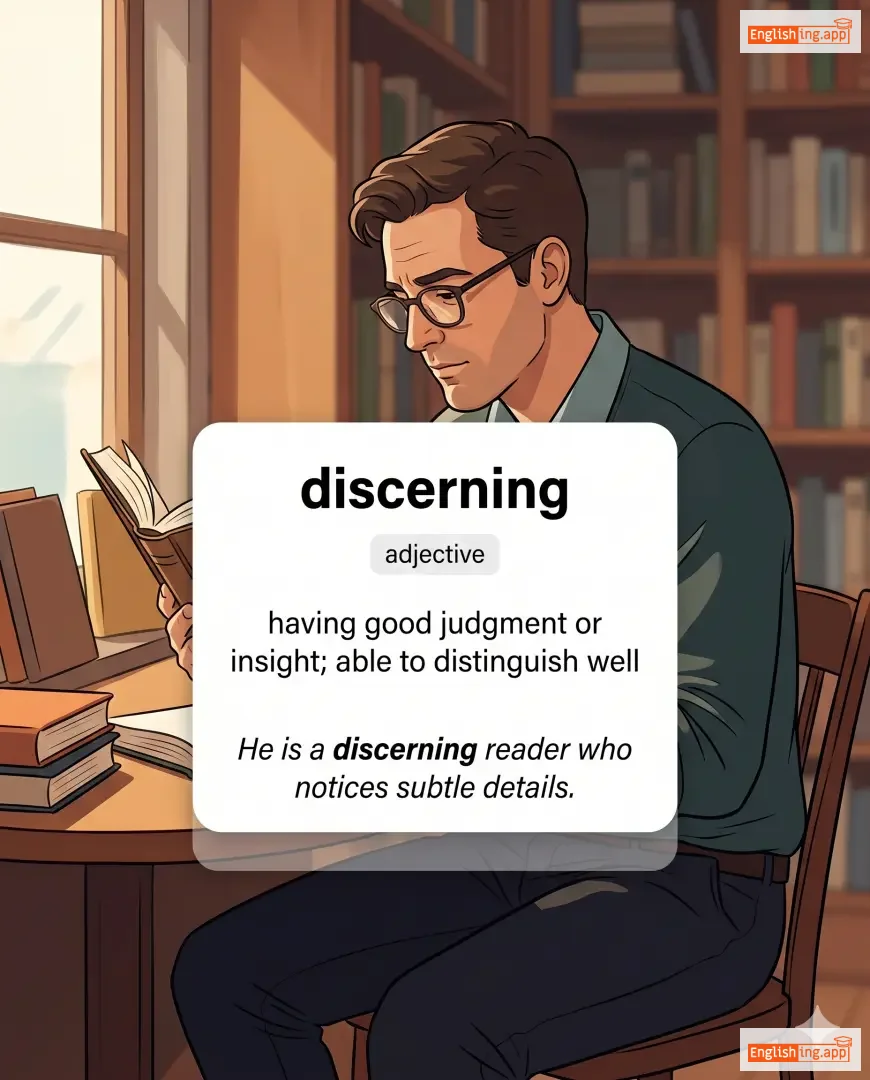
discerning definition card — visual illustration of the meaning
adjective C1
/dɪˈsɜːrnɪŋ/
perspicace (perspicace)

having good judgment or insight; able to distinguish well

"He is a discerning reader who notices subtle details."
"C'est un lecteur perspicace qui remarque les détails subtils." (C'est un lecteur perspicace qui remarque les détails subtils.)
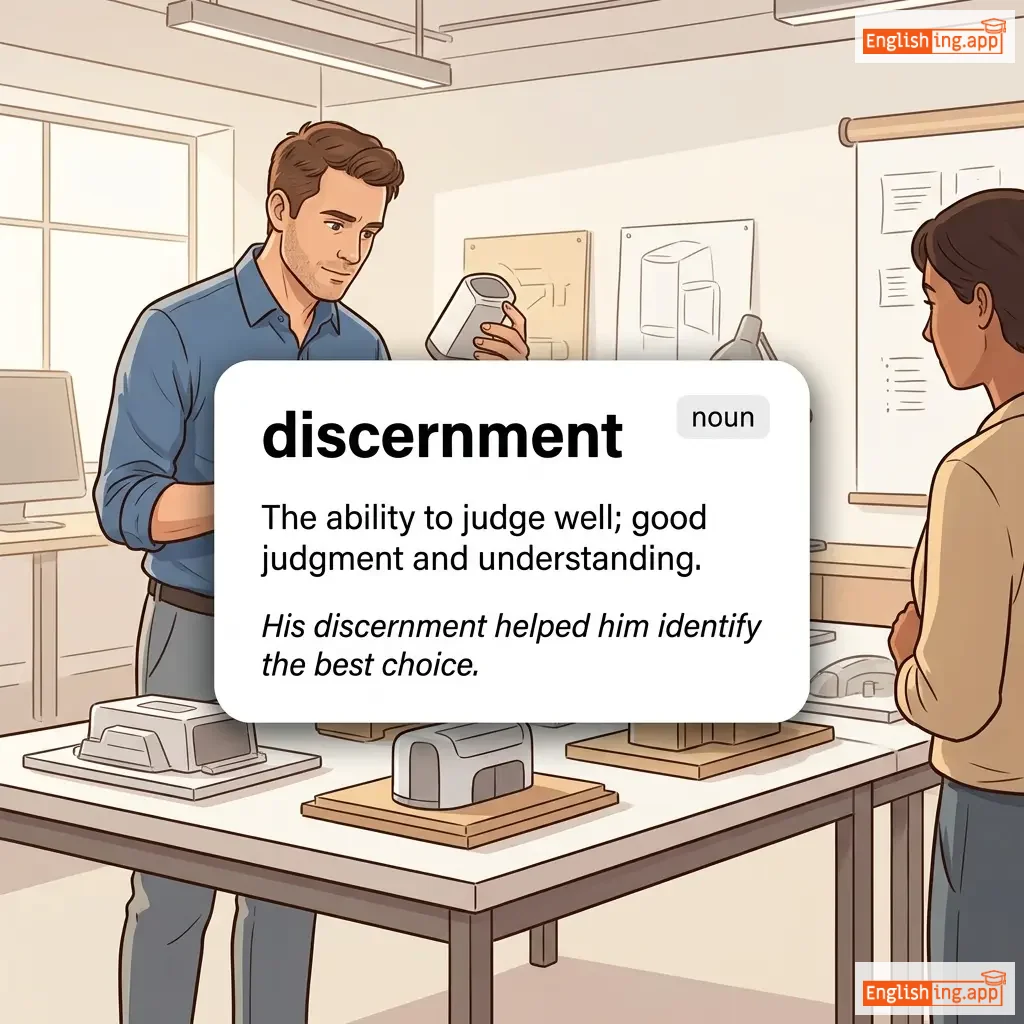
discernment definition card — visual illustration of the meaning
noun C1
dɪˈsɜːn.mənt
discernement (discernement)

The ability to judge well; good judgment and understanding.

"His discernment helped him identify the best choice."
"Son discernement l'a aidé à identifier le meilleur choix." (Son discernement l'a aide a identifier le meilleur choix.)
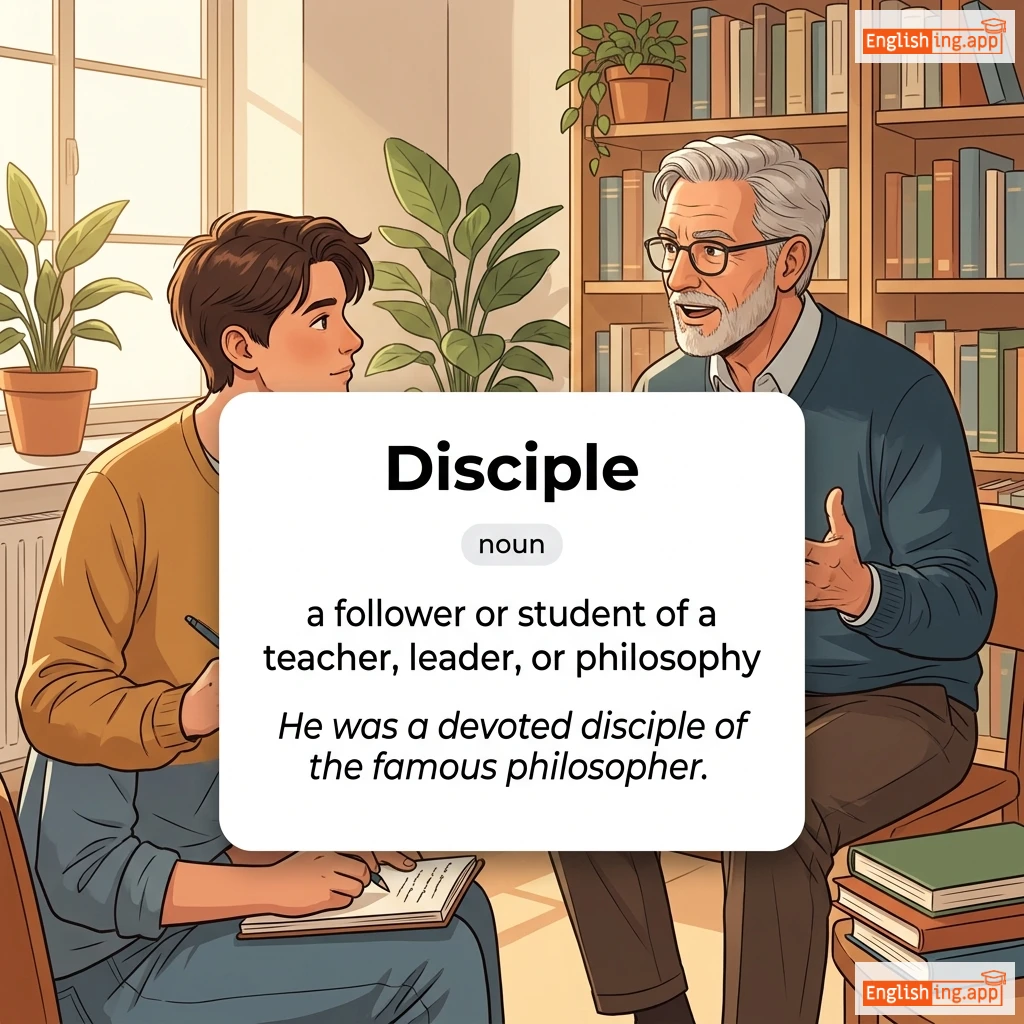
Disciple definition card — visual illustration of the meaning
noun C1
/dɪˈsaɪpəl/
disciple (disciple)

a follower or student of a teacher, leader, or philosophy

"He was a devoted disciple of the famous philosopher."

"Il était un disciple dévoué du célèbre philosophe." (Il etait un disciple devoué du célèbre philosophe.)
adjective C1
/ˈdɪsəplɪˌnɛri/
disciplinaire (disciplinaire)

relating to the enforcement of rules and correction of behavior

"The employee was warned after a disciplinary hearing."

"L'employé a été averti après une audience disciplinaire." (L'employe a ete averti apres une audience disciplinaire.)
verb C1
/dɪsˈkleɪm/
démentir (dementir)

to deny responsibility or connection with something

"The company disclaimed responsibility for the accident."

"L'entreprise a démenti toute responsabilité pour l'accident." (L'entreprise a démenti toute responsabilité pour l'accident.)
verb C1
/dɪsˈkʌlər/
décolorer (decolorer)

to change color, especially in a way that spoils the original appearance

"The fabric began to discolor after being left in the sun."
"Le tissu a commencé à se décolorer après avoir été laissé au soleil." (Le tissu a commencé à se décolorer après avoir été laissé au soleil.)
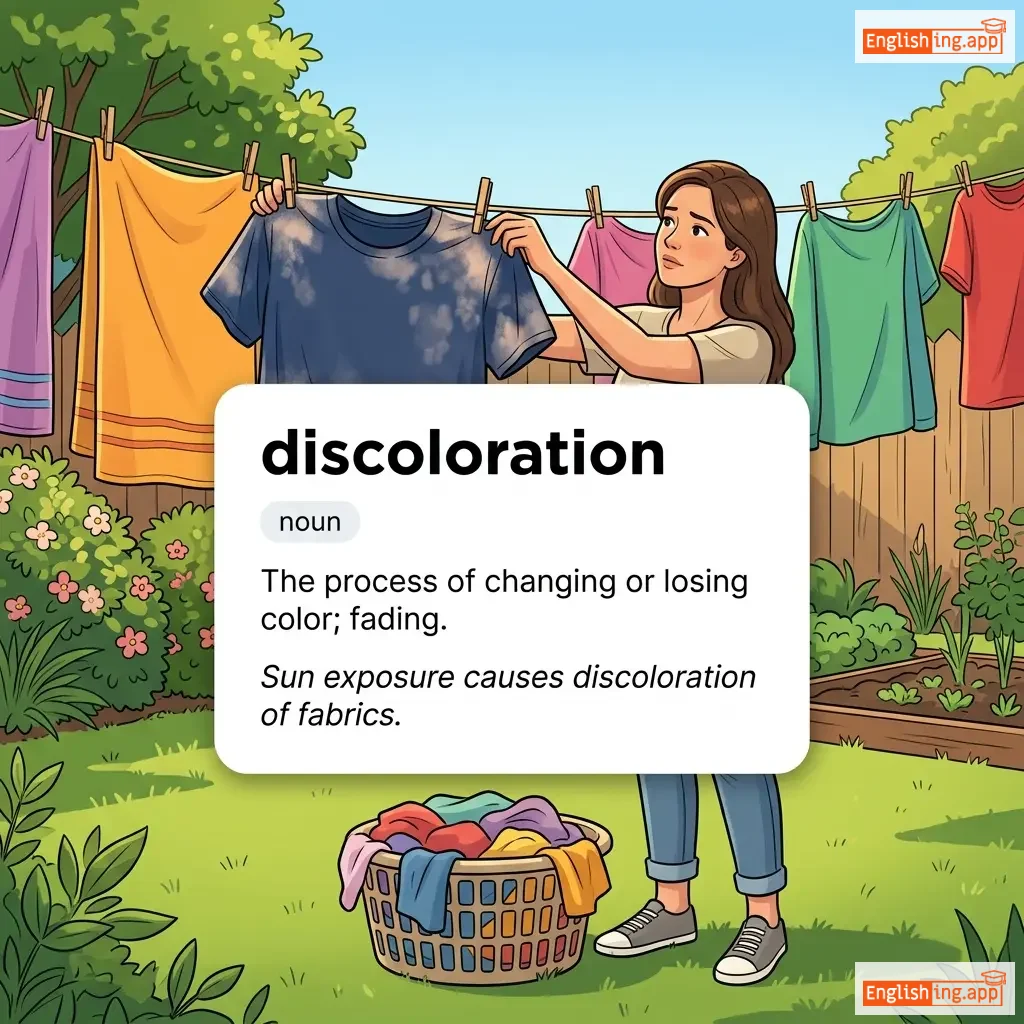
discoloration definition card — visual illustration of the meaning
noun C1
/ˌdɪs.kʌl.əˈreɪ.ʃən/
décoloration (decoloration)

The process of changing or losing color; fading.

"Sun exposure causes discoloration of fabrics."

"L'exposition au soleil provoque la décoloration des tissus." (L'exposition au soleil provoque la décoloration des tissus.)
verb C1
/ˌdɪskənˈsɜːrt/
déconcerter (deconcerter)

To unsettle, confuse, or disturb the composure of someone.

"The sudden change of plans disconcerted the team."
"Le changement soudain de plans a déconcerté l'équipe." (Le changement soudain de plans a déconcerté l'équipe.)
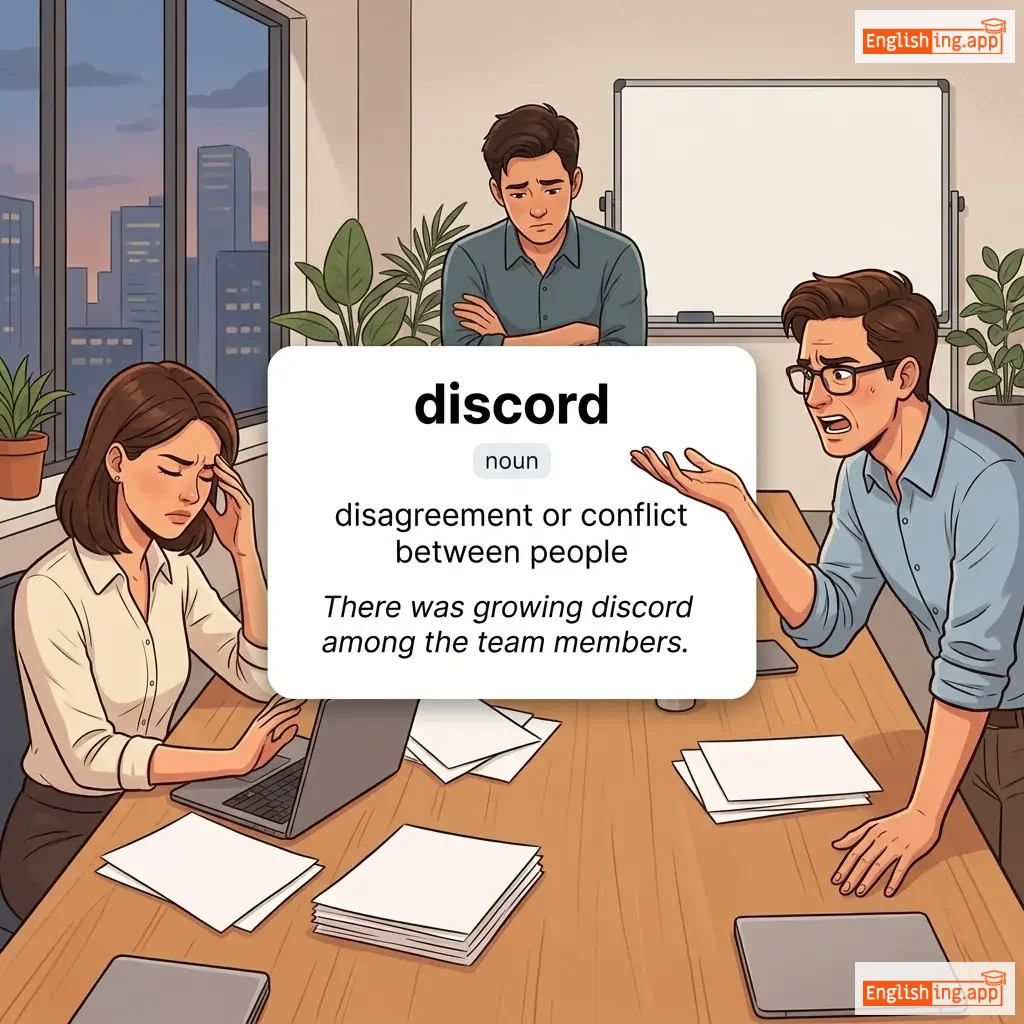
discord definition card — visual illustration of the meaning
noun C1
/ˈdɪskɔːrd/
discorde (discorde)

disagreement or conflict between people

"There was growing discord among the team members."
"Il y avait une discordance croissante parmi les membres de l'équipe." (Il y avait une discordance croissante parmi les membres de l'équipe.)
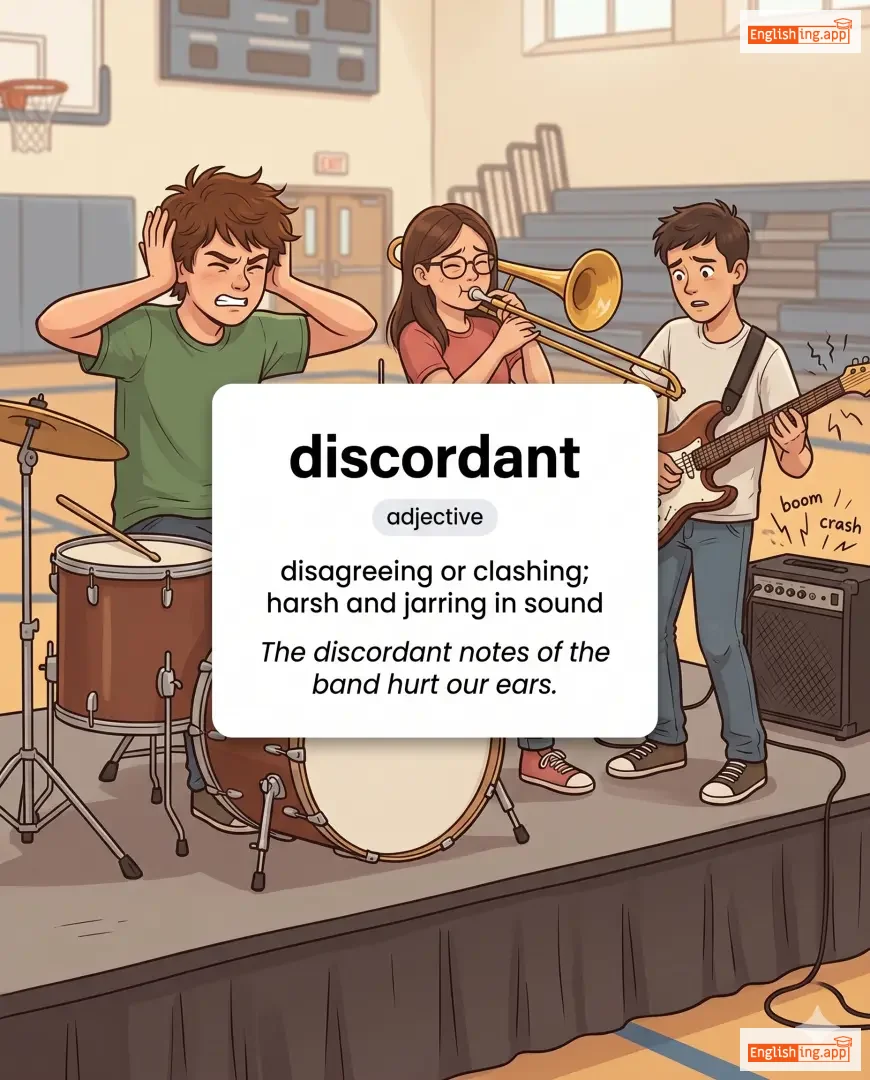
discordant definition card — visual illustration of the meaning
adjective C1
/dɪsˈkɔːrdənt/
discordant (discordant)

disagreeing or clashing; harsh and jarring in sound

"The discordant notes of the band hurt our ears."
"Les notes discordantes du groupe ont blessé nos oreilles." (Les notes discordantes du groupe ont blessé nos oreilles.)
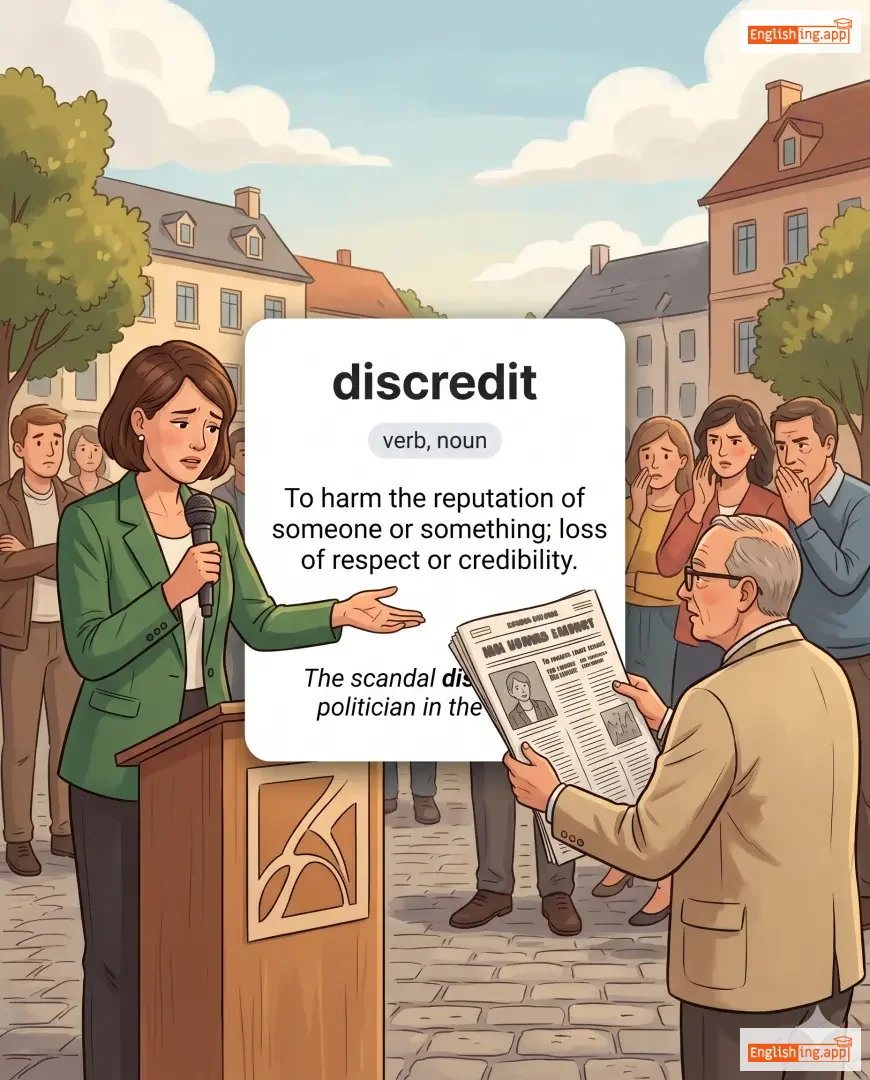
discredit definition card — visual illustration of the meaning
verb, noun C1
/dɪsˈkrɛdɪt/
discréditer (discrediter)

To harm the reputation of someone or something; loss of respect or credibility.

"The scandal discredited the politician in the eyes of the public."
"Le scandale a discrédité le politicien aux yeux du public." (Le scandale a discrédite le politicien aux yeux du public.)
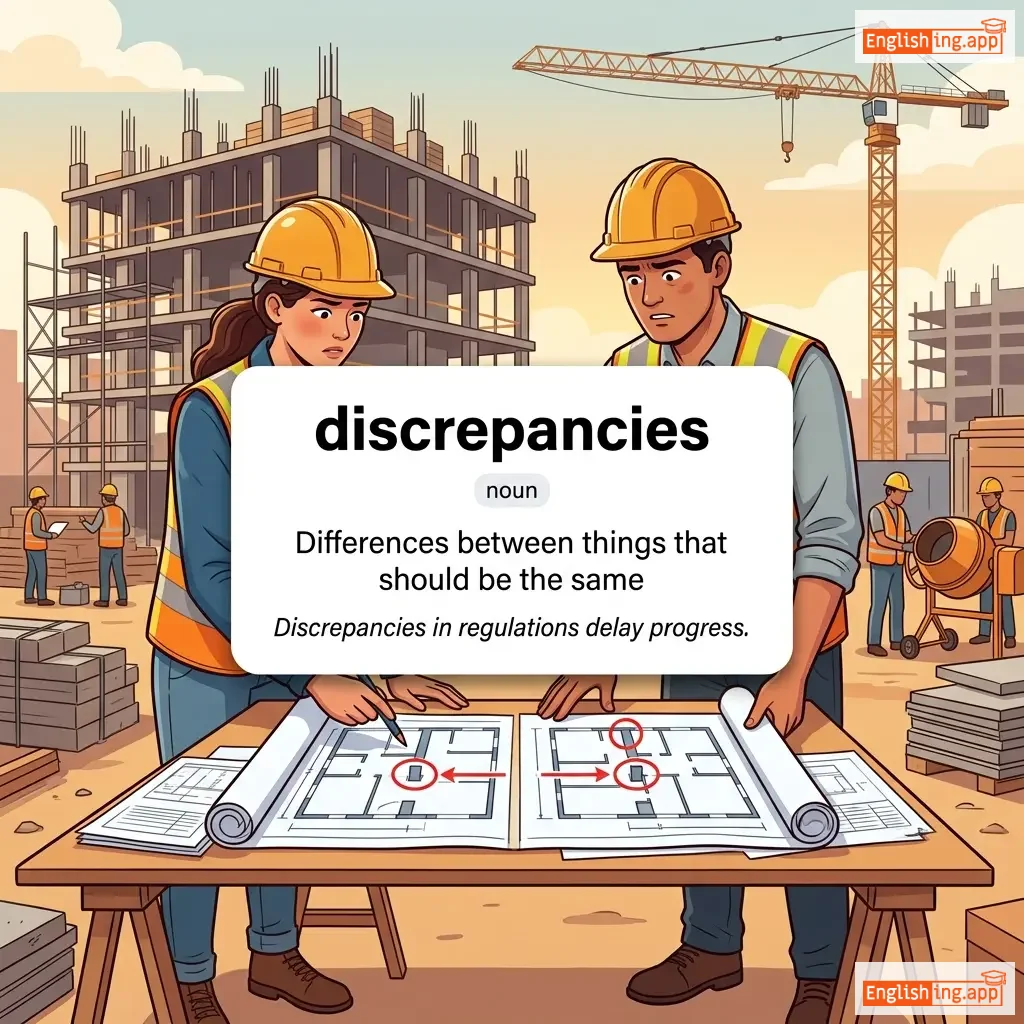
discrepancies definition card — visual illustration of the meaning
noun C1
dɪˈskrep.ən.siz
divergence (divergence)

Differences between things that should be the same

"Discrepancies in regulations delay progress."
"Les divergences dans les règlements retardent les progrès." (Les divergences dans les règlements retardent les progrès.)
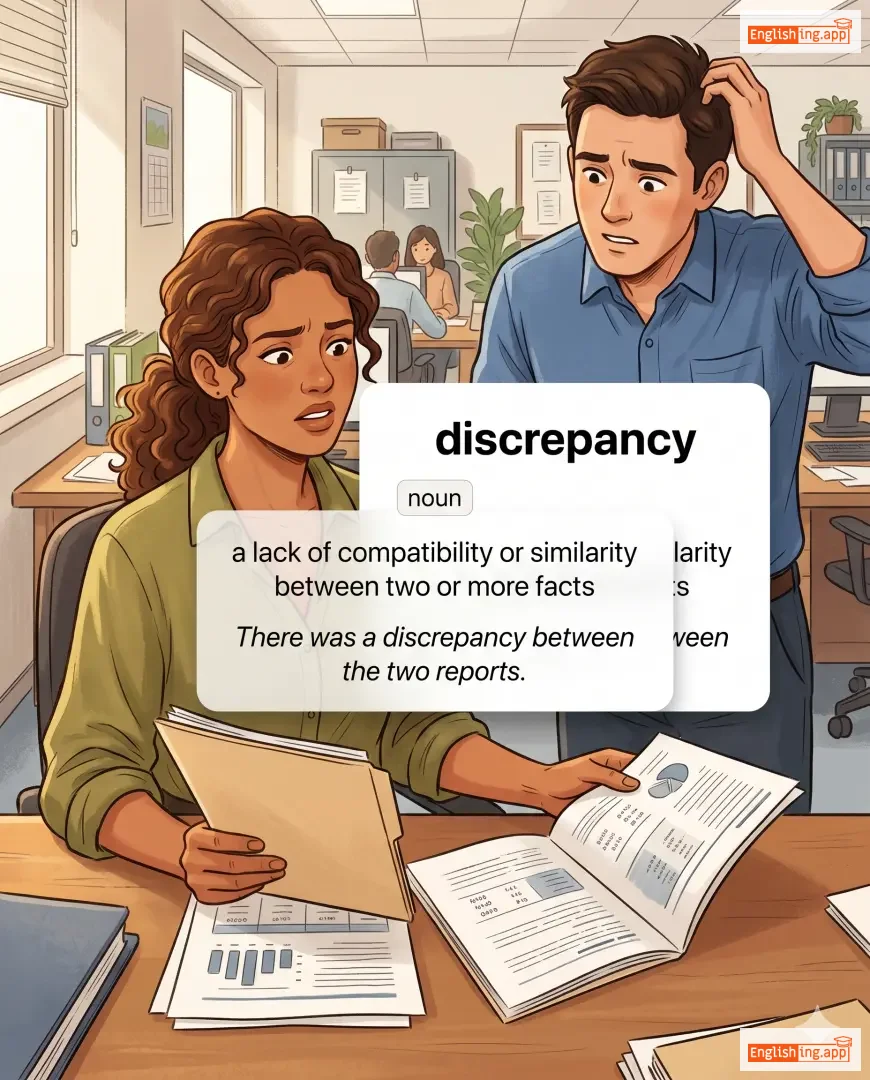
discrepancy definition card — visual illustration of the meaning
noun C1
/dɪˈskrɛpənsi/
écart (écart)

a lack of compatibility or similarity between two or more facts

"There was a discrepancy between the two reports."
"Il y avait un écart entre les deux rapports." (Il y avait un écart entre les deux rapports.)
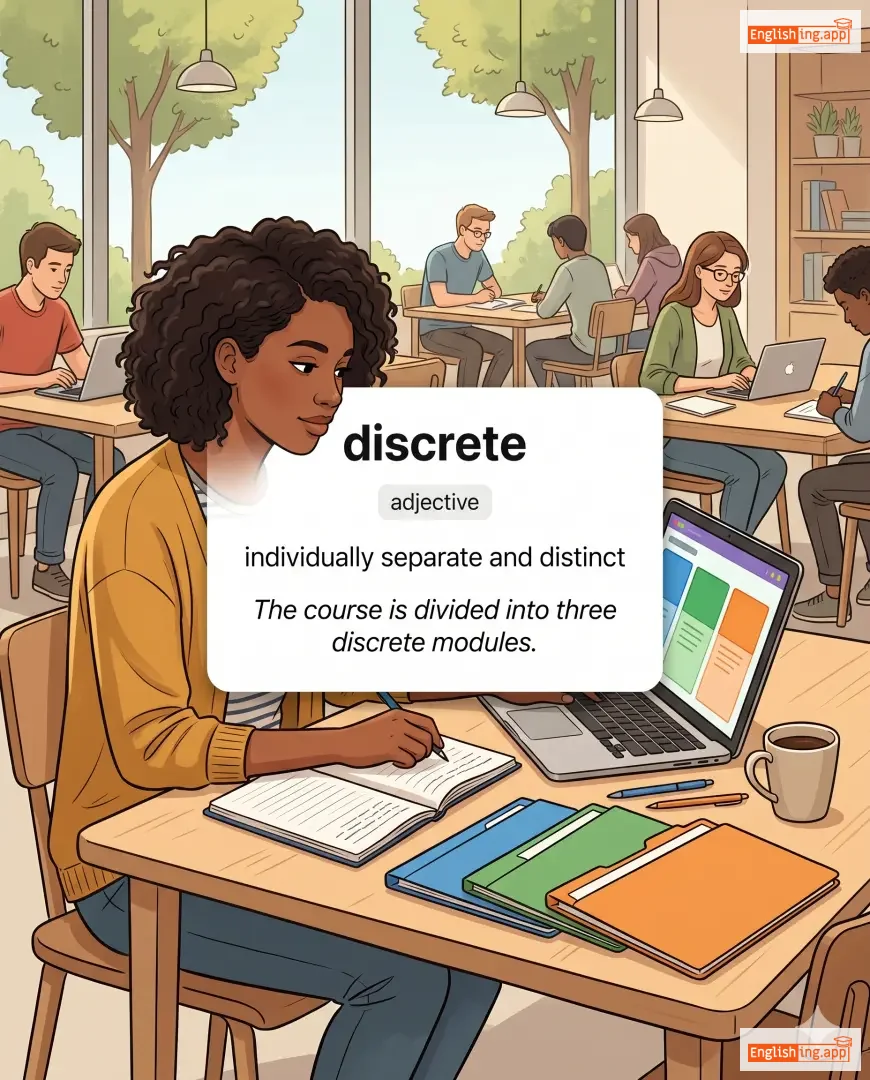
discrete definition card — visual illustration of the meaning
adjective C1
/dɪˈskriːt/
discret (discret)

individually separate and distinct

"The course is divided into three discrete modules."
"Le cours est divisé en trois modules discrets." (Le cours est divisé en trois modules discrets.)
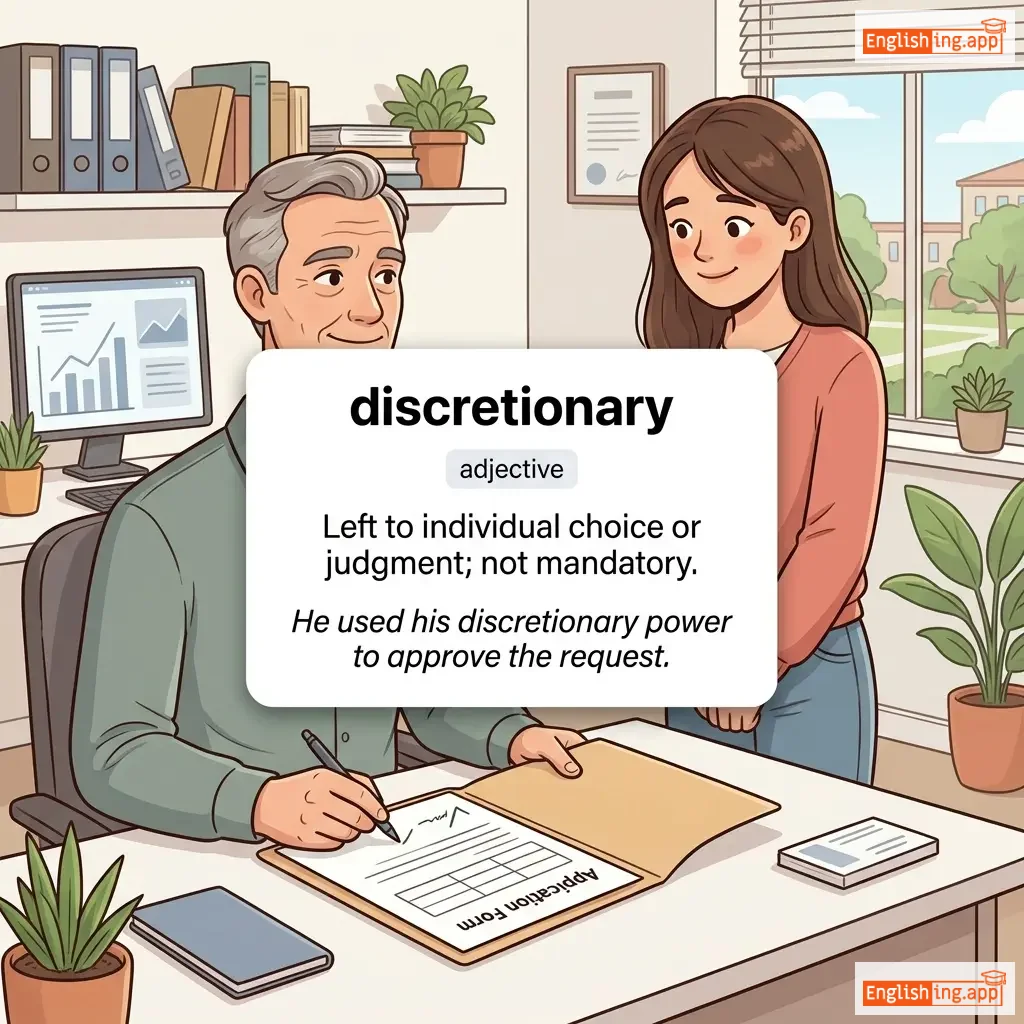
discretionary definition card — visual illustration of the meaning
adjective C1
/dɪˈskrɛʃəˌnɛri/
discrétionnaire (discretionnaire)

Left to individual choice or judgment; not mandatory.

"He used his discretionary power to approve the request."
"Il a utilisé son pouvoir discrétionnaire pour approuver la demande." (Il a utilisé son pouvoir discrétionnaire pour approuver la demande.)
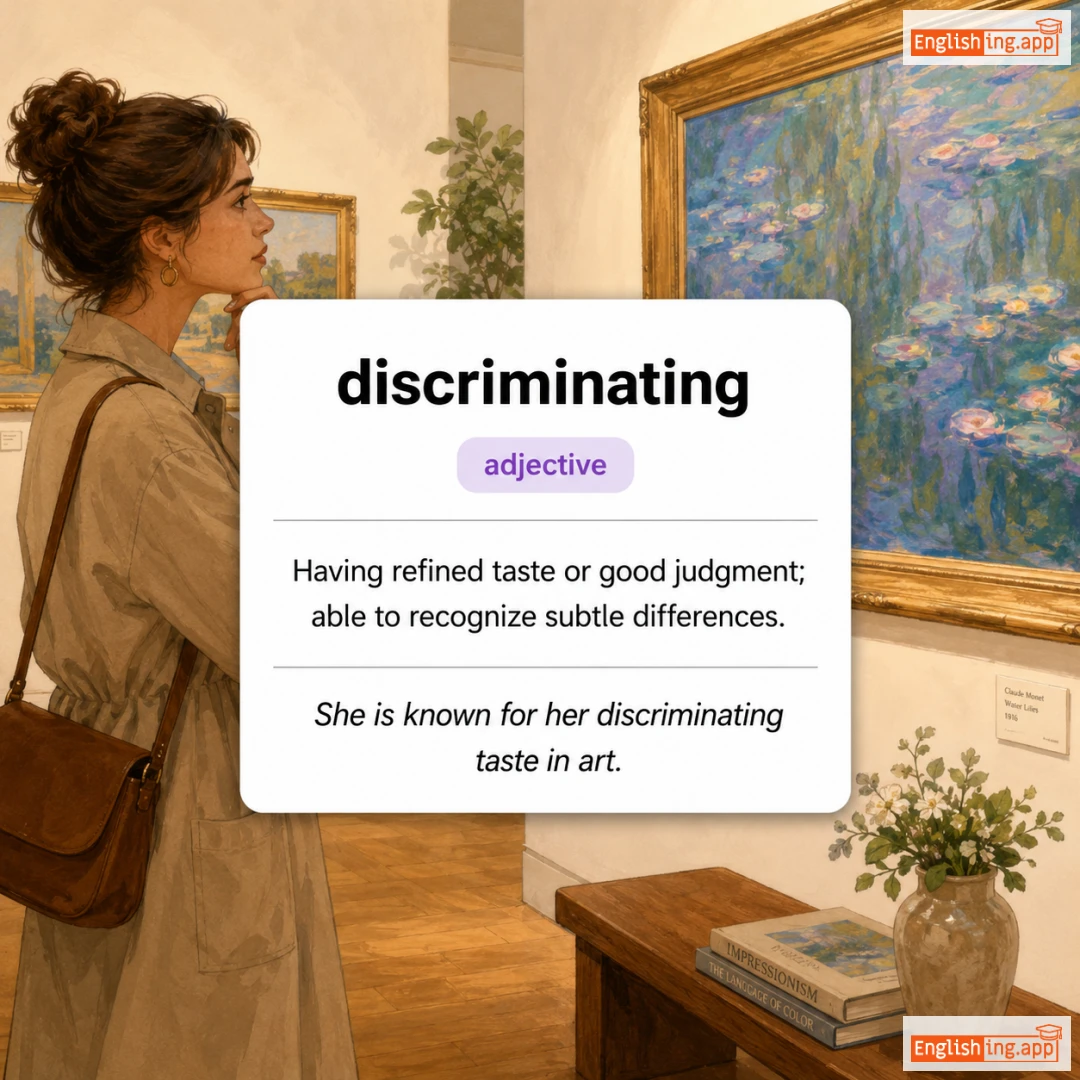
discriminating definition card — visual illustration of the meaning
adjective C1
/dɪˈskrɪmɪˌneɪtɪŋ/
discriminant (discriminant)

Having refined taste or good judgment; able to recognize subtle differences.

"She is known for her discriminating taste in art."

"Elle est connue pour son goût discriminant en art." (Elle est connue pour son goût discriminant en art.)