Vocabulaires

Découvrez, apprenez et maîtrisez le vocabulaire anglais

adjective C2
/juːˈnɪsənənt/
सुरेल (surel)

Sounding together or in harmony.

"The unisonant voices created a powerful effect."

"सुरेल आवाजों ने एक शक्तिशाली प्रभाव उत्पन्न किया।" (Surel aawazon ne ek shaktishaali prabhav utpann kiya.)
noun C2
/ˌjuːnɪˈtɛəriən/
यूनिटेरियन (Unitarian)

A person who believes that God exists as one entity rather than as a Trinity; a member of a religious denomination that emphasizes individual freedom of belief.

"The Unitarian church is known for its inclusive and open-minded approach."

"यूनिटेरियन चर्च अपनी समावेशी और खुले विचारों वाली दृष्टिकोण के लिए जाना जाता है।" (Unitarian church apni samaaveshi aur khule vicharon wali drishtikon ke liye jana jata hai.)
noun C2
/ˈjuːnɪvəˌlɛns/
एकमानीता (ekmanita)

The state of having a single valence or combining power, especially in chemistry.

"Hydrogen is characterized by its univalence in chemical reactions."

"हाइड्रोजन को इसके एकमानीता द्वारा रासायनिक प्रतिक्रियाओं में पहचाना जाता है।" (Hydrogen ko iske ekmanita dvara rasayanik pratikriyaon mein pehchana jata hai.)
adjective C2
/ʌnˈlɛtəd/
अशिक्षित (ashikshit)

lacking education or the ability to read and write; illiterate

"The unlettered villagers relied on oral traditions to preserve their history."

"अशिक्षित ग्रामीण अपनी ऐतिहासिक धरोहर को बनाए रखने के लिए मौखिक परंपराओं पर निर्भर करते थे।" (Ashikshit gramin apni aitihaasik dharohar ko banaye rakhne ke liye moukhik paramparaon par nirbhar karte the.)
adjective C2
/ʌnˈmɪtɪɡeɪtɪd/
पूर्ण (poorn)

absolute; not lessened or moderated

"The meeting was an unmitigated disaster."

"बैठक एक पूर्ण आपदा थी।" (Baithak ek poorn aapda thi.)
adjective C2
/ˌʌnpriːpəˈzɛsɪŋ/
आकर्षक नहीं (aakarshak nahin)

not attractive or appealing in appearance

"Despite his unprepossessing looks, he was very kind and intelligent."

"उसकी आकर्षक नहीं दिखने के बावजूद, वह बहुत दयालु और बुद्धिमान था।" (Uski aakarshak nahin dikhne ke bawjood, woh bahut dayaalu aur buddhimaan tha.)
adjective C2
/ˌʌnprəˈpɪʃəs/
अशुभ (ashubh)

Not giving or indicating a good chance of success; unfavorable.

"The team began their journey under unpropitious weather conditions."

"टीम ने अनप्रोपीशस मौसम की स्थिति में अपनी यात्रा शुरू की।" (Team ne anpropishas mausam ki sthiti mein apni yatra shuru ki.)
adjective C2
/ˌʌn.rɪˈdʒɛn.ər.ət/
अविनीत (avinit)

Not reformed or showing no signs of change; stubbornly refusing to reform or repent.

"He remained an unregenerate opponent of progress."

"वह प्रगति के एक अविनीत विरोधी बने रहे।" (Wah pragati ke ek avinit virodhi bane rahe.)
adjective C2
/ˌʌnrɪˈmɪtɪŋ/
निरंतर (nirantar)

Never relaxing or stopping; persistent.

"Her unremitting efforts finally paid off."

"उसकी निरंतर कोशिशें आखिरकार सफल हुईं।" (Uski nirantar koshishen aakhirkar safal hui.)
adjective C2
/ʌnˈspɛərɪŋ/
निर्दयी (nirdayi)

Showing no mercy or generosity; harsh or severe.

"The critic was unsparing in his review of the play."

"समालोचक नाटक की समीक्षा में निर्दयी था।" (samalochak natak ki sameeksha mein nirdayi tha.)
adjective C2
/ʌnˈstɪntɪŋ/
उदार (udar)

given generously without holding back

"She received unstinting support from her family."

"उसे उसके परिवार से बिना किसी रोक-टोक के समर्थन मिला।" (Use uske parivar se bina kisi rok-tok ke samarthan mila.)
adjective C2
/ʌnˈsʌlid/
दाग रहित (daag rahit)

not spoiled or made impure; perfectly clean or pure

"His reputation remained unsullied despite the accusations."

"आरोपों के बावजूद उसकी प्रतिष्ठा दाग रहित बनी रही।" (Aropo ke bawajood uski pratishtha daag rahit bani rahi.)
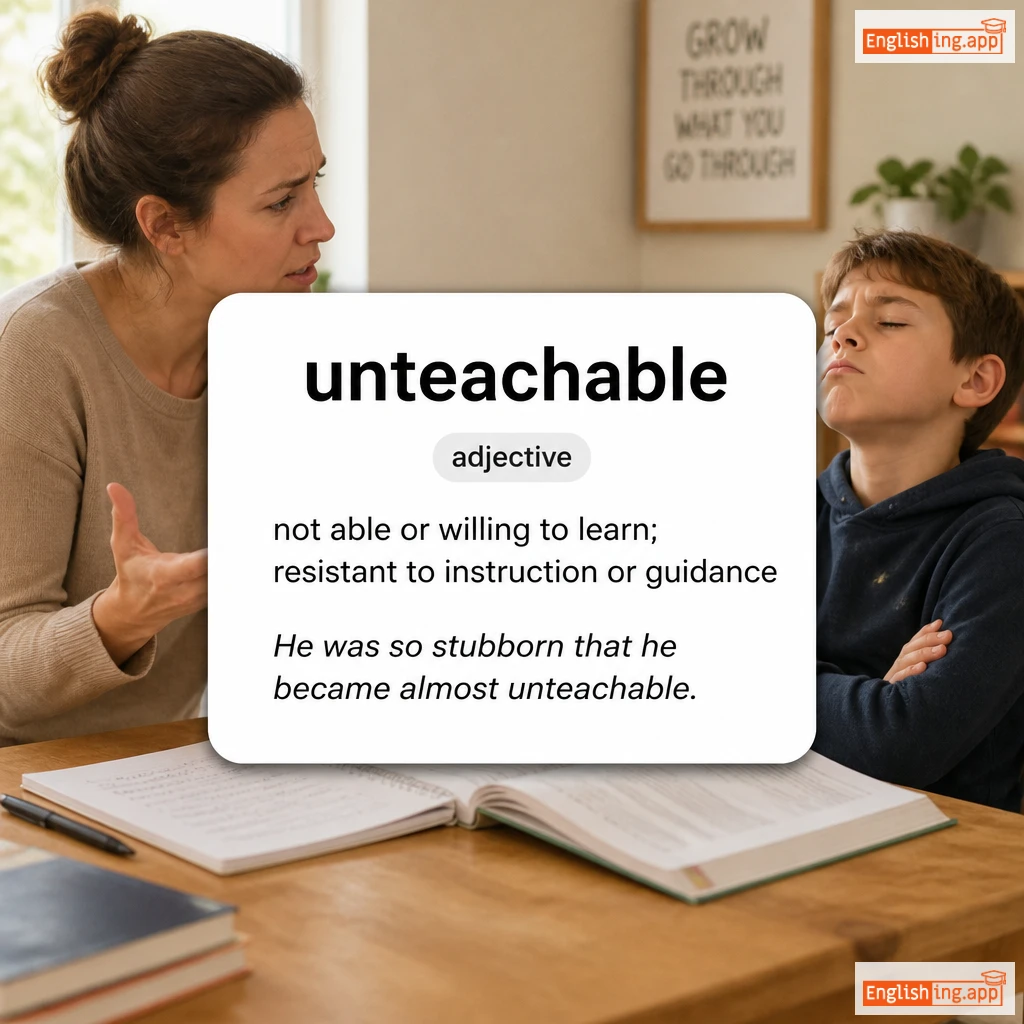
unteachable definition card — visual illustration of the meaning
adjective C2
/ʌnˈtiːtʃəbəl/
जिसे सिखाया न जा सके (jise sikhaya na ja sake)

not able or willing to learn; resistant to instruction or guidance

"He was so stubborn that he became almost unteachable."

"वह इतना जिद्दी था कि लगभग जिसे सिखाया न जा सके ऐसा हो गया।" (vah itna jiddi tha ki lagbhag jise sikhaya na ja sake aisa ho gaya)
adjective C2
/ʌnˈtɛmpərd/
अविन्यस्त (avinyast)

not moderated or softened; lacking proper balance or control

"The untempered anger of the crowd caused chaos."

"भीड़ का अविन्यस्त गुस्सा अराजकता का कारण बना।" (Bheed ka avinyast gussa arajakta ka karan bana.)
adjective C2
/ˌʌn.təˈwɔːrd/
अप्रत्याशित (apratyashit)

Unexpected and inappropriate or inconvenient.

"The meeting ended without any untoward incidents."

"बैठक बिना किसी अप्रत्याशित घटनाओं के समाप्त हुई।" (baithak bina kisi apratyashit ghatnaon ke samaapt hui.)
adjective C2
/ʌnˈtræməld/
असीम स्वतंत्रता (aseem svatantrata)

Not restricted or hampered; free and unrestricted.

"She enjoyed untrammeled freedom in her new life abroad."

"उसने अपनी नई ज़िन्दगी में असीम स्वतंत्रता का आनंद लिया।" (usne apni nai zindagi mein aseem svatantrata ka anand liya.)
adjective C2
/ʌnˈʌtərəbl/
अवर्णनीय (avarnaniya)

Too great, intense, or awful to be expressed or described in words.

"She was filled with unutterable joy at the news of her success."

"वह अपनी सफलता की खबर पर अवर्णनीय खुशी से भर गई थी।" (vah apni safalta ki khabar par avarnaniya khushi se bhar gayi thi.)
adjective C2
/ʌnˈwiːldi/
असुविधाजनक (asubidhajanik)

Difficult to carry or move because of its size, shape, or weight.

"The box was too unwieldy to carry up the stairs."

"बॉक्स स्टेयर ऊपर ले जाने के लिए बहुत असुविधाजनक था।" (box stair upar le jane ke liye bahut asubidhajanik tha.)
adjective C2
/ʌnˈwəʊntɪd/
असामान्य (asaamannya)

Unusual, uncommon, or out of the ordinary.

"She spoke with an unwonted gentleness that surprised everyone."

"उसने एक असामान्य कोमलता से बात की जिसने सभी को हैरान कर दिया।" (Usne ek asaamannya komalta se baat ki jisne sabhi ko hairaan kar diya.)
verb C2
/ʌnˈjoʊk/
जोड़ से मुक्त करना (jod se mukt karna)

To release from a yoke or to free from restraint or obligation.

"The farmer unyoked the oxen after a long day of work."

"किसान ने एक लंबी दिन की मेहनत के बाद बैल को जोड़ से मुक्त कर दिया।" (Kisan ne ek lambi din ki mehnat ke baad bail ko jod se mukt kar diya.)
verb C2
/ʌpˈbreɪd/
कड़ी फटकार लगाना (kadi fatkar lagana)

To scold or criticize someone harshly.

"The teacher upbraided the student for being late again."

"टीचर ने छात्र को फिर से देर करने के लिए कड़ी फटकार लगाई।" (Teacher ne chatra ko phir se der karne ke liye kadi fatkar lagayi.)
noun/verb C2
/ˈʌpˌkæst/
ऊपर फेंकना (upar fenkna)

Verb: To cast or throw upward. Noun: Something thrown or directed upward.

"The fisherman upcast his net into the air."

"मछुआरे ने अपना जाल हवा में ऊपर फेंका।" (Machware ne apna jaal hawa mein upar fenka.)
verb C2
/ʌpˈhiːv/
उठाना (uthana)

to lift or raise something forcefully; to cause to rise suddenly

"The workers had to upheave the heavy stone to clear the path."

"कामकाजी को पथ को साफ करने के लिए भारी पत्थर उठाना पड़ा।" (Kaamkaji ko path ko saaf karne ke liye bhari patthar uthana pada.)
adjective C2
/ʌpˈrɔːr.i.əs/
अत्यंत हास्यपूर्ण (atyant hasyapurn)

Extremely funny or noisy; causing loud laughter or commotion.

"The comedian's jokes were absolutely uproarious."

"कोमेडियन के जोक्स बिल्कुल अत्यंत हास्यपूर्ण थे।" (Komedian ke jokes bilkul atyant hasyapurn the.)
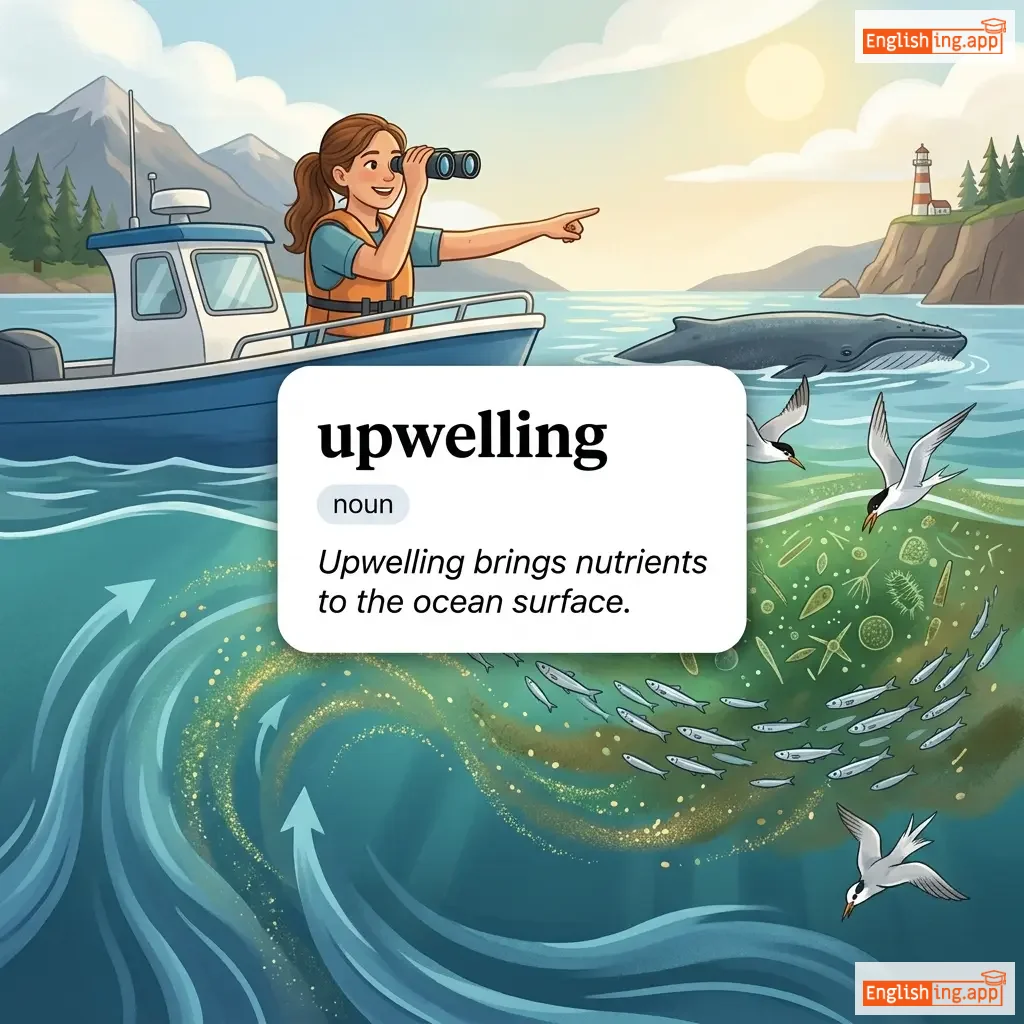
upwelling definition card — visual illustration of the meaning
noun C2
/ˈʌp.wel.ɪŋ/
समुद्र विज्ञानिक घटना जिसमें घने, ठंडे, और पोषक तत्वों से भरपूर पानी समुद्र की सतह की ओर खिंचता है। (samudra vigyanik ghatna jismein ghane, thande, aur poshak tatvon se bhara pani samudra ki sathah ki aur khinchta hai.)

An oceanographic phenomenon that involves wind-driven motion of dense, cooler, and nutrient-rich water towards the ocean surface.

"Upwelling brings nutrients to the ocean surface."

"अपवेलिंग समुद्र की सतह पर पोषक तत्व लाता है।" (Apwelling samudra ki sathah par poshak tatva lata hai.)
adjective C2
/ɜːrˈbeɪn/
सभ्य (sabhy)

showing polished manners, refinement, and sophistication

"He was an urbane gentleman who charmed everyone at the party."

"वह एक सभ्य सज्जन व्यक्ति था जिसने पार्टी में सभी को आकर्षित किया।" (vah ek sabhy sajjan vyakti tha jise party mein sabhi ko aakarshit kiya.)
noun C2
/ɜːrˈbænɪti/
सभ्यता (sabhyata)

refined courtesy, elegance, and sophistication in manner

"Her urbanity made her popular among diplomats and leaders."

"उसकी सभ्यता ने उसे राजनयिकों और नेताओं के बीच लोकप्रिय बना दिया।" (uski sabhyata ne use rajnayikon aur netaon ke beech lokpriya bana diya.)
noun C2
/ˈɜːrtʃɪn/
गली का बच्चा (gali ka bachcha)

a mischievous or poorly dressed child, often from the streets

"The ragged urchins played by the riverbank."

"फटे-पुराने कपड़े पहने गली के बच्चे नदी किनारे खेल रहे थे।" (phate-purane kapde pahne gali ke bachche nadi kinare khel rahe the.)
adjective C2
/ˈɜːrsaɪn/
भालू जैसा (bhalu jaisa)

Relating to or resembling a bear.

"The man’s ursine strength amazed everyone."

"उस आदमी की भालू जैसी ताकत ने सभी को चौंका दिया।" (Us aadmi ki bhalu jaisi takat ne sabhi ko chonka diya.)
noun C2
/ˈjuːzjuːfrʌkt/
उपभोग अधिकार (upbhog adhikar)

The legal right to use and enjoy the benefits of someone else’s property without owning it.

"The tenant had the usufruct of the land but not its ownership."

"किराएदार को ज़मीन का उपभोग अधिकार था लेकिन उसका स्वामित्व नहीं था।" (Kiraedaar ko zameen ka upbhog adhikar tha lekin uska swamitva nahi tha.)
adjective C2
/juːˈʒʊəriəs/
उच्च ब्याज दर लेने वाला (uchch byaj dar lene wala)

Charging excessively high interest rates on loans.

"The bank was accused of offering loans at usurious rates."

"बैंक पर अत्यधिक ब्याज दर पर ऋण देने का आरोप लगाया गया था।" (Bank par atirikta byaj dar par rno dene ka aarop lagaya gaya tha.)
usurp definition card — visual illustration of the meaning
verb C2
/juːˈzɜːrp/
अवैध रूप से कब्जा करना (avaidh roop se kabza karna)

To take someone else's position or power illegally or by force.

"He tried to usurp the throne from the rightful king."

"उसने वैध राजा से सिंहासन छीनने की कोशिश की।" (Usne vaidh raja se singhasan cheenne ki koshish ki.)
noun C2
/ˌjuːzɜːrˈpeɪʃən/
अवैध कब्जा (avaidh kabza)

The act of taking someone's power or property illegally or by force.

"The general's usurpation of the presidency led to political unrest."

"जनरल का राष्ट्रपति पद का अवैध कब्जा राजनीतिक अशांति का कारण बना।" (General ka rashtrapati pad ka avaidh kabza rajnaitik ashaanti ka kaaran bana.)
usury definition card — visual illustration of the meaning
noun C2
/ˈjuːʒəri/
सूदखोरी (sudkhori)

The practice of lending money at unreasonably high interest rates.

"The law strictly prohibits usury."

"कानून सख्ती से सूदखोरी पर पाबंदी लगाता है।" (Kanoon sakhti se sudkhori par pabandi lagata hai.)
noun C2
/juːˌtɪlɪˈtɛəriənɪzəm/
उपयोगितावाद (upyogitavad)

The ethical theory that actions are right if they are useful or for the benefit of the majority.

"Utilitarianism suggests that we should act to maximize overall happiness."

"उपयोगितावाद यह सुझाता है कि हमें समग्र खुशी को अधिकतम करने के लिए कार्य करना चाहिए।" (upyogitavad yah sujhata hai ki hume samagra khushi ko adhiktam karne ke liye karya karna chahiye.)
adjective C2
/ʌkˈsɔːriəs/
पत्नी के प्रति अत्यधिक अनुरक्त (patni ke prati atyadhik anurakt)

excessively fond of or submissive to one's wife

"He was so uxorious that he agreed with everything his wife said."

"वह इतना पत्नी के प्रति अनुरक्त था कि उसने अपनी पत्नी की हर बात मानी।" (Wah itna patni ke prati anurakt tha ki usne apni patni ki har baat maani.)
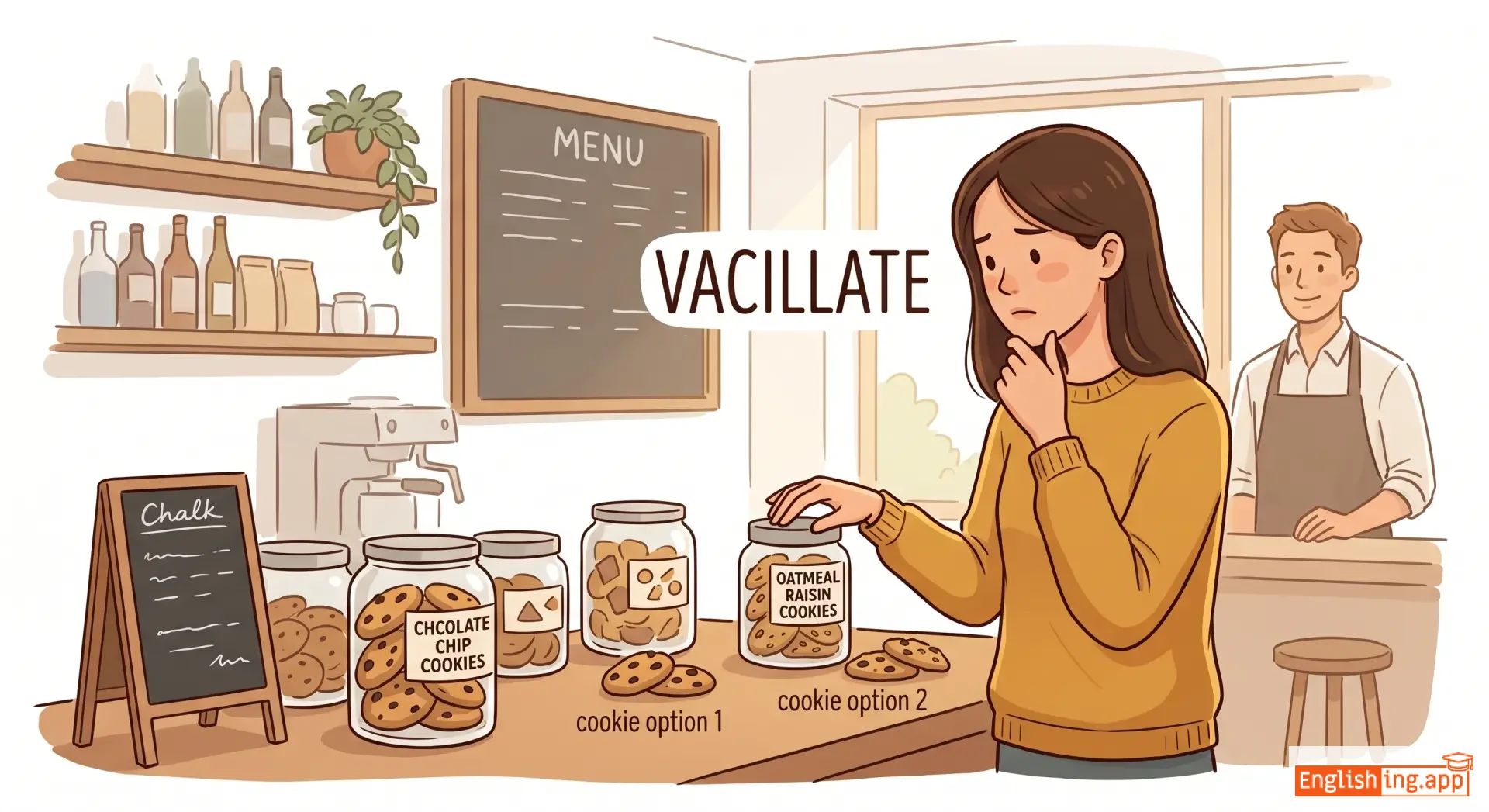
vacillate definition card — visual illustration of the meaning
verb C2
/ˈvæsɪleɪt/
खुशी (khushi)

to waver between different opinions or actions; be indecisive

"He vacillated between studying law and becoming a writer."

"वह पुरस्कार प्राप्त करने पर अपनी खुशी को छुपा नहीं पाई।" (Vah puraskar prapt karne par apni khushi ko chhupa nahin paayi.)
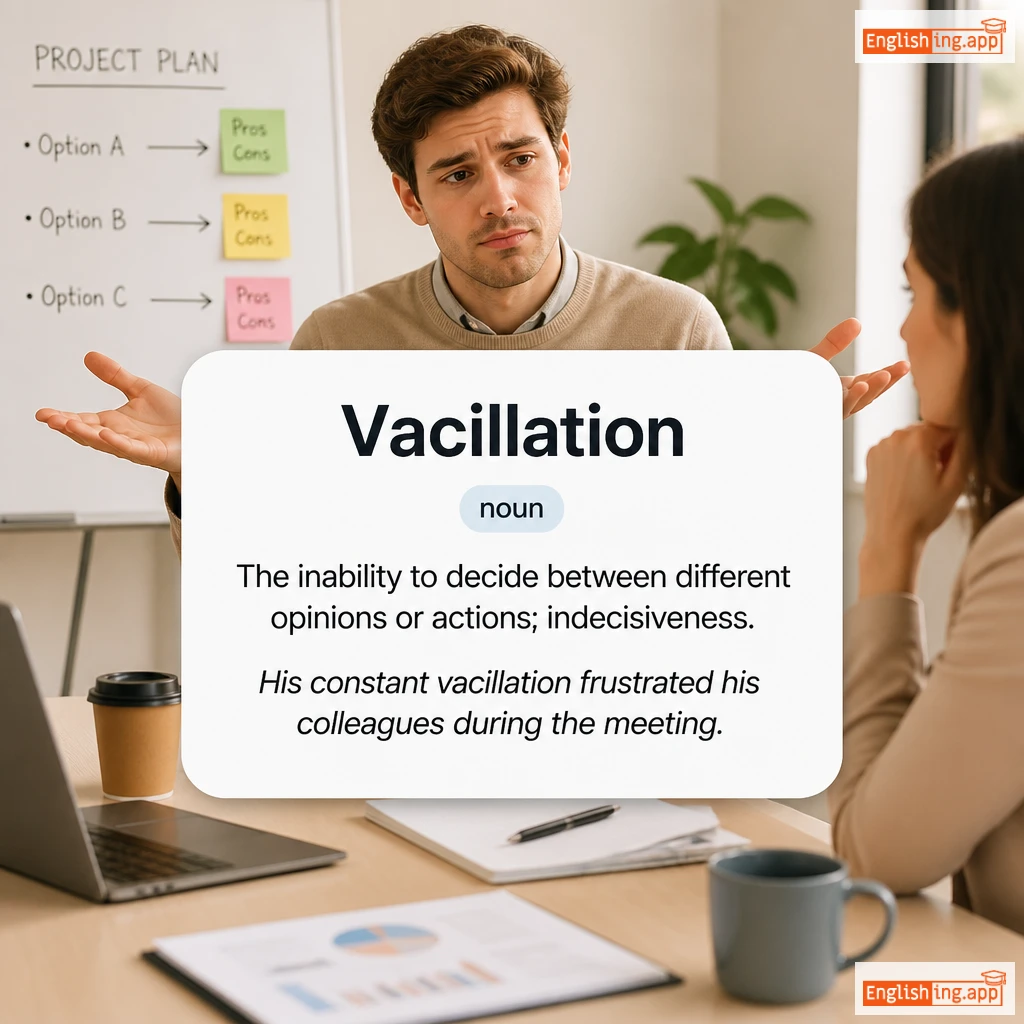
Vacillation definition card — visual illustration of the meaning
noun C2
/ˌvæsɪˈleɪʃən/
दुविधा (duvidha)

The inability to decide between different opinions or actions; indecisiveness.

"His constant vacillation frustrated his colleagues during the meeting."

"उसकी लगातार दुविधा ने बैठक के दौरान उसके सहयोगियों को निराश कर दिया।" (uski lagatar duvidha ne baithak ke dauran uske sahyogiyon ko niraash kar diya.)
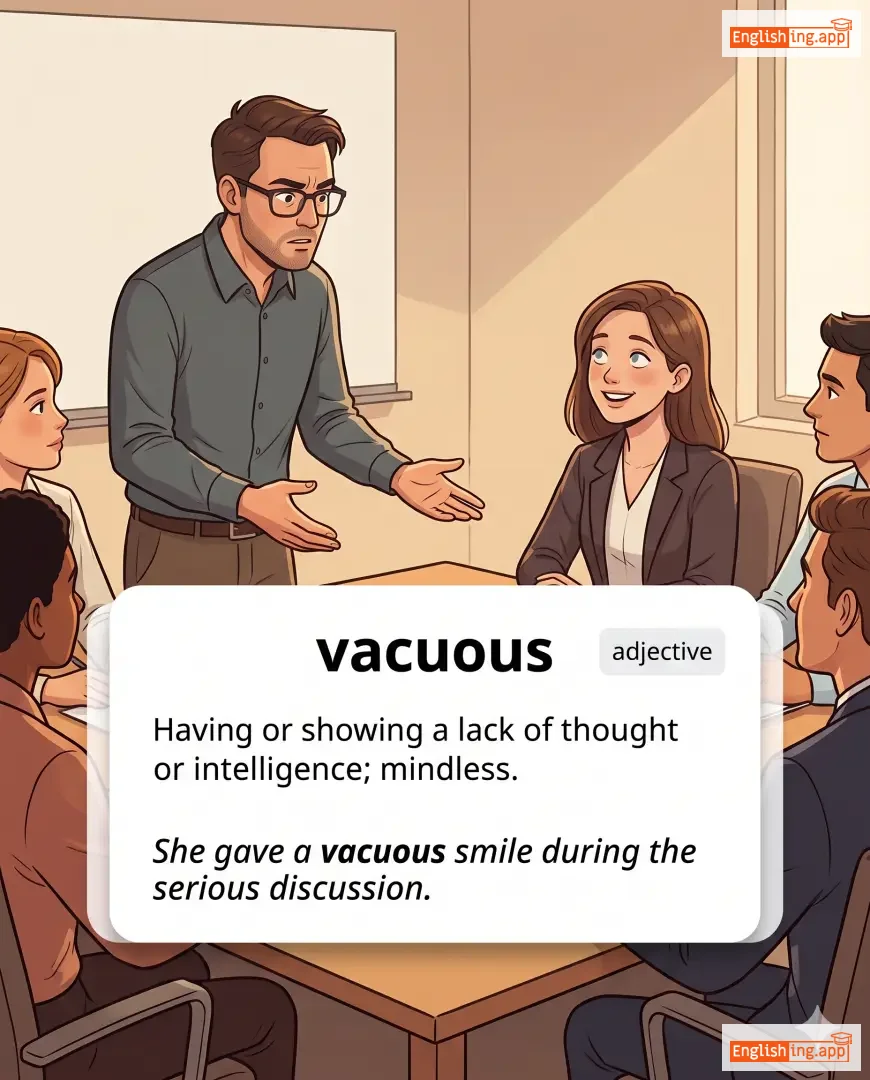
vacuous definition card — visual illustration of the meaning
adjective C2
/ˈvækjuəs/
निःसार (nissar)

Having or showing a lack of thought or intelligence; mindless.

"She gave a vacuous smile during the serious discussion."

"वह गंभीर चर्चा के दौरान एक निःसार मुस्कान दी।" (vah gambhir charcha ke dauran ek nissar muskan di.)
noun C2
/ˈveɪɡəri/
अप्रत्याशित परिवर्तन (apratyashit parivartan)

An unexpected and inexplicable change in a situation or someone's behavior.

"The vagaries of the weather made planning difficult."

"मौसम के अप्रत्याशित परिवर्तनों ने योजना बनाना कठिन कर दिया।" (mausam ke apratyashit parivarton ne yojana banana kathin kar diya.)
adjective C2
/veɪnˈɡlɔːriəs/
अहंकारी (ahankari)

Excessively proud of oneself or one’s achievements; boastful.

"The vainglorious leader boasted about his minor achievements."

"अहंकारी नेता अपने छोटे से कार्यों पर बड़ाई कर रहा था।" (Ahankari neta apne chhote se karyo par badhai kar raha tha.)
noun C2
/ˈveɪnɡlɔːri/
अति गर्व (ati garv)

Excessive vanity or boastfulness about one's achievements.

"His speech was filled with vainglory and self-praise."

"उसका भाषण अति गर्व और आत्मप्रशंसा से भरा था।" (Uska bhashan ati garv aur aatmaprashansa se bhara tha.)
noun C2
/ˈvæləns/
सजावटी झालर (sajavti jhalar)

A decorative drapery hung across the top of a window or bed.

"She chose a floral valance to match the curtains in her bedroom."

"उसने अपने बेडरूम में पर्दों से मेल खाने के लिए एक फूलों वाली वैलेंस चुनी।" (Usne apne bedroom mein pardo se mel khane ke liye ek phoolon wali valance chuni.)
noun C2
/ˌvælɪˈdɪkʃən/
विदाई भाषण (vidai bhashan)

The act of saying farewell; a formal goodbye.

"The professor gave a touching valediction at his retirement ceremony."

"प्रोफेसर ने अपनी सेवानिवृत्ति समारोह में एक भावुक विदाई भाषण दिया।" (Professor ne apni sevanivritti samaroh mein ek bhavuk vidai bhashan diya.)
noun C2
/ˌvælədɪkˈtɔːriən/
उत्कृष्ट छात्र (utkrisht chatra)

The student with the highest academic achievements in a graduating class, often chosen to give the farewell speech.

"She was honored as the valedictorian of her class."

"उसे अपनी कक्षा का वैलेडिक्टोरियन के रूप में सम्मानित किया गया।" (Use apni kaksha ka valedictorian ke roop mein sammaanit kiya gaya.)
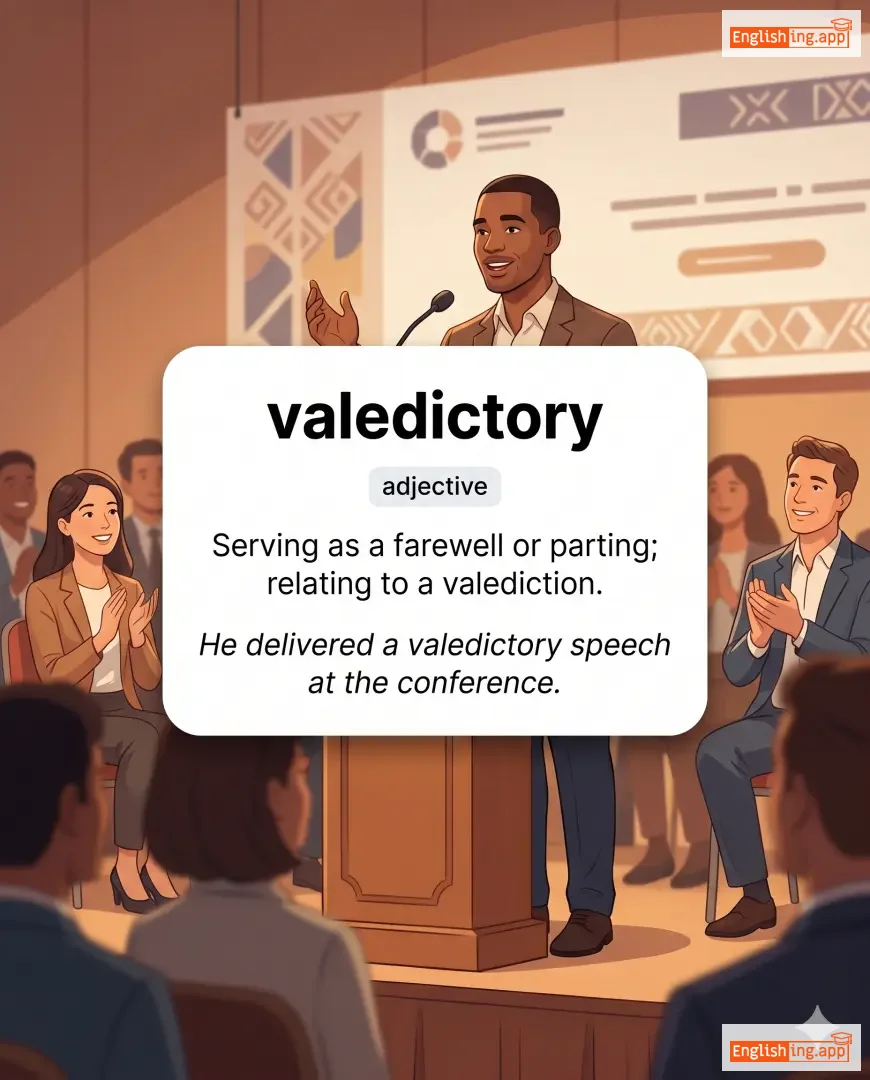
valedictory definition card — visual illustration of the meaning
adjective C2
/ˌvælɪˈdɪktəri/
विदाई संबंधित (vidaai sambandhit)

Serving as a farewell or parting; relating to a valediction.

"He delivered a valedictory speech at the conference."

"उन्होंने सम्मेलन में एक विदाई संबधी भाषण दिया।" (Unhone sammelan mein ek vidaai sambandhit bhashan diya.)
noun C2
/ˌvælɪˌtjuːdɪˈnɛəriən/
स्वास्थ्य के प्रति अत्यधिक चिंतित व्यक्ति (swasthya ke prati atyadhik chintit vyakti)

A person who is unduly anxious about their health or constantly concerned with minor ailments.

"He was regarded as a valetudinarian, always worrying about his health."

"वह एक वैलट्यूडिनैरियन के रूप में जाना जाता था, जो हमेशा अपनी सेहत के बारे में चिंता करता था।" (Wah ek valetudinarian ke roop mein jana jata tha, jo hamesha apni sehat ke baare mein chinta karta tha.)
adjective C2
/ˈvælərəs/
साहसी (sahasi)

showing great courage and bravery

"The valorous soldier led his troop into battle without hesitation."

"साहसी सैनिक ने बिना झिझके अपनी सेना को युद्ध में नेतृत्व किया।" (Sahasi sainik ne bina jhijhak apni sena ko yudh mein netritva kiya.)
adjective C2
/ˈvæpɪd/
निरस (niros)

lacking liveliness, flavor, or interest; dull and uninspired

"The lecture was so vapid that half the audience fell asleep."

"व्याख्यान इतना निरस था कि आधा दर्शक सो गए थे।" (Vyakhan itna niros tha ki aadha darshak so gaye the.)
adjective C2
/ˈveɪpərəs/
वाष्पीय; अस्पष्ट (vaporis; asposht)

consisting of vapor; vague or insubstantial

"The morning air was filled with vaporous mist."

"सुबह की हवा वाष्पीय कुहासा से भरी हुई थी।" (subah ki hawa vaporiy kuhasa se bhari hui thi)