Vocabulaires

Découvrez, apprenez et maîtrisez le vocabulaire anglais

adjective C2
/prəˈhɪbɪtɔːri/
禁止的 (jìnzhǐ de)

Serving or tending to prohibit or forbid.

"The prohibitory laws were strictly enforced in the region."

"禁止性的法律在该地区严格执行。" (Jìnzhǐ xìng de fǎlǜ zài gāi dìqū yángé zhíxíng.)
adjective C2
/ˈprəʊ.lɪks/
过于冗长 (guòyú rǒngcháng)

using too many words; tediously lengthy

"The professor’s prolix lecture put many students to sleep."

"教授冗长的讲座让许多学生打瞌睡。" (Jiàoshòu rǒngcháng de jiǎngzuò ràng xǔduō xuéshēng dǎ kēshuì.)
noun C2
/prəˈlɪksɪti/
冗长 (rǒngcháng)

the quality of being tediously wordy and long

"The book’s prolixity made it difficult to read in one sitting."

"这本书的冗长使得在一次阅读中读完变得困难。" (Zhè běn shū de rǒngcháng shǐ dé zài yīcì yuèdú zhōng dú wán biàn dé kùnnán.)
adjective C2
/ˈprɒmɪsəri/
承诺的 (chengnuo de)

Containing or conveying a promise, especially in writing.

"He signed a promissory note to repay the loan."

"他签署了还款承诺书。" (Ta qianshu le huankuan chengnuo shu.)
noun C2
/ˈprɒm.ən.tɔːr.i/
海角 (haijiao)

A high point of land or rock projecting into a body of water.

"The lighthouse stood on a promontory overlooking the sea."

"灯塔矗立在俯瞰大海的海角上。" (Dēngtǎ chùlì zài fǔkàn dàhǎi de hǎijiǎo shàng.)
verb C2
/ˈprɑː.məl.ɡeɪt/
发布 (fabu)

To announce or make a law, decree, or idea officially known.

"The government promulgated new regulations on data privacy."

"政府发布了关于数据隐私的新规定。" (Zhengfu fabu le guanyu shuju yinxi xin guiding.)
noun C2
/prɔːŋ/
叉子的尖端 (chā zi de jiān duān)

a projecting pointed part, such as one of the pointed ends of a fork

"The fork has four prongs."

"叉子有四个尖端。" (Chā zi yǒu sì gè jiān duān.)
adjective C2
/ˌprɒfɪˈlæktɪk/
预防性 (yùfángxìng)

intended to prevent disease or an unwanted outcome; protective

"The doctor prescribed a prophylactic treatment to prevent infection."

"医生开了预防性治疗以防止感染。" (Yīshēng kāi le yùfángxìng zhìliáo yǐ fángzhǐ rùnhòu.)
noun C2
/prəˈpɪŋkwɪti/
亲近 (qīnjìn)

the state of being close to someone or something; proximity

"The propinquity of their houses made them close friends."

"他们房屋的亲近使他们成为了亲密的朋友。" (Tāmen fángwū de qīnjìn shǐ tāmen chéngwéi le qīnmì de péngyǒu.)
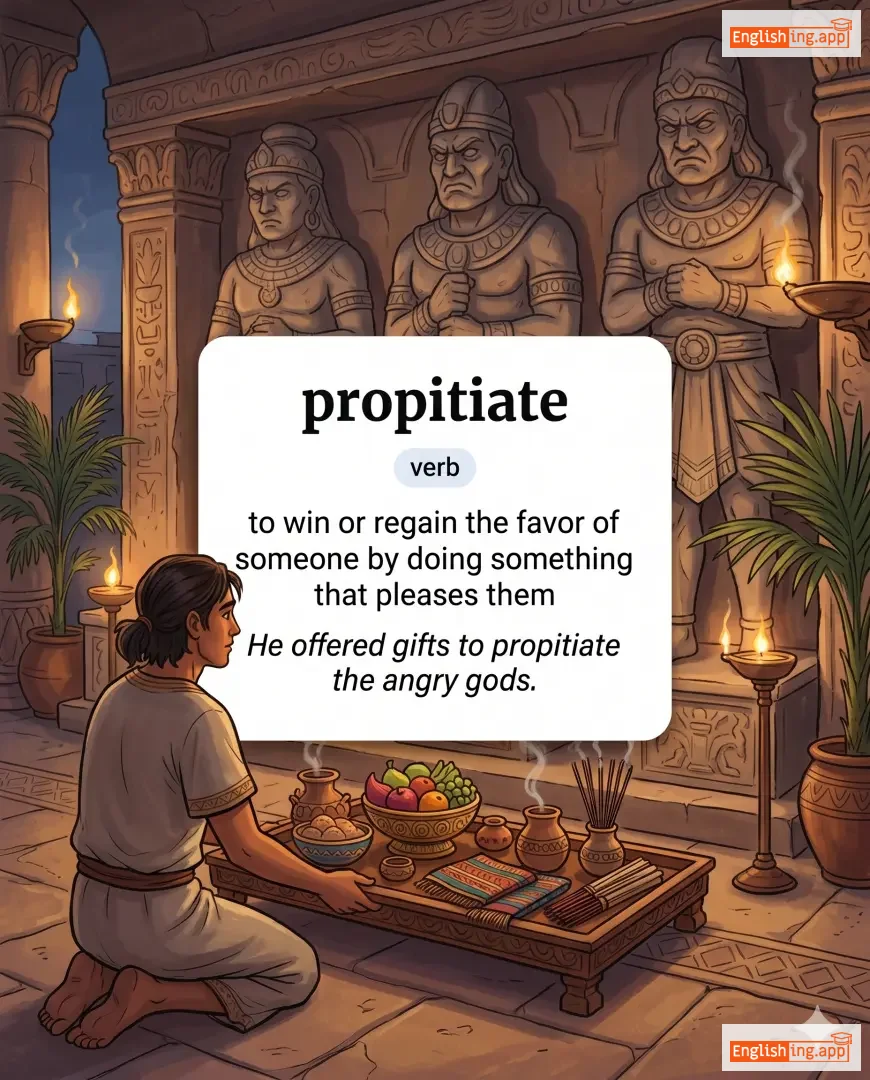
propitiate definition card — visual illustration of the meaning
verb C2
/prəˈpɪʃieɪt/
安抚 (ānfǔ)

to win or regain the favor of someone by doing something that pleases them

"He offered gifts to propitiate the angry gods."

"他提供礼物来安抚愤怒的神明。" (Tā tígōng lǐwù lái ānfǔ fènnù de shénmíng.)
adjective C2
/prəˈpɪʃəs/
有利的 (youli de)

giving or indicating a good chance of success; favorable

"The sunny weather was a propitious start to the picnic."

"阳光明媚的天气是野餐的有利开端。" (Yangguang mingmei de tianqi shi yecan de youli kaiduan.)
verb C2
/prəˈpaʊnd/
提出 (tichu)

To put forward an idea, theory, or point for consideration.

"The professor propounded a new theory on climate change."

"教授提出了关于气候变化的新理论。" (Jiaoshou tichu le guanyu qihou bianhua de xin lilun.)
adjective C2
/prəˈpʌlsɪv/
推进的 (tuījìn de)

Having the power to drive or push something forward.

"The propulsive force of the rocket lifted it off the ground."

"火箭的推进力将它从地面抬起。" (Huǒjiàn de tuījìn lì jiāng tā cóng dìmiàn táiqǐ.)
verb C2
/prəˈroʊɡ/
暂停会议 (zanting huiyi)

to discontinue a session of a parliament or assembly without dissolving it

"The president decided to prorogue parliament until the crisis was resolved."

"总统决定暂停议会,直到危机得到解决。" (Zongtong jueding zanting yihui, zhidao weiji dedao jieju.)
noun C2
/proʊˈsiː.ni.əm/
舞台前沿 (wǔtái qián yán)

the part of a theater stage in front of the curtain; the arch framing the stage

"The actors bowed at the proscenium before leaving the stage."

"演员在离开舞台之前向舞台前沿鞠躬。" (yǎnyuán zài líkāi wǔtái zhīqián xiàng wǔtái qián yán jūgōng.)
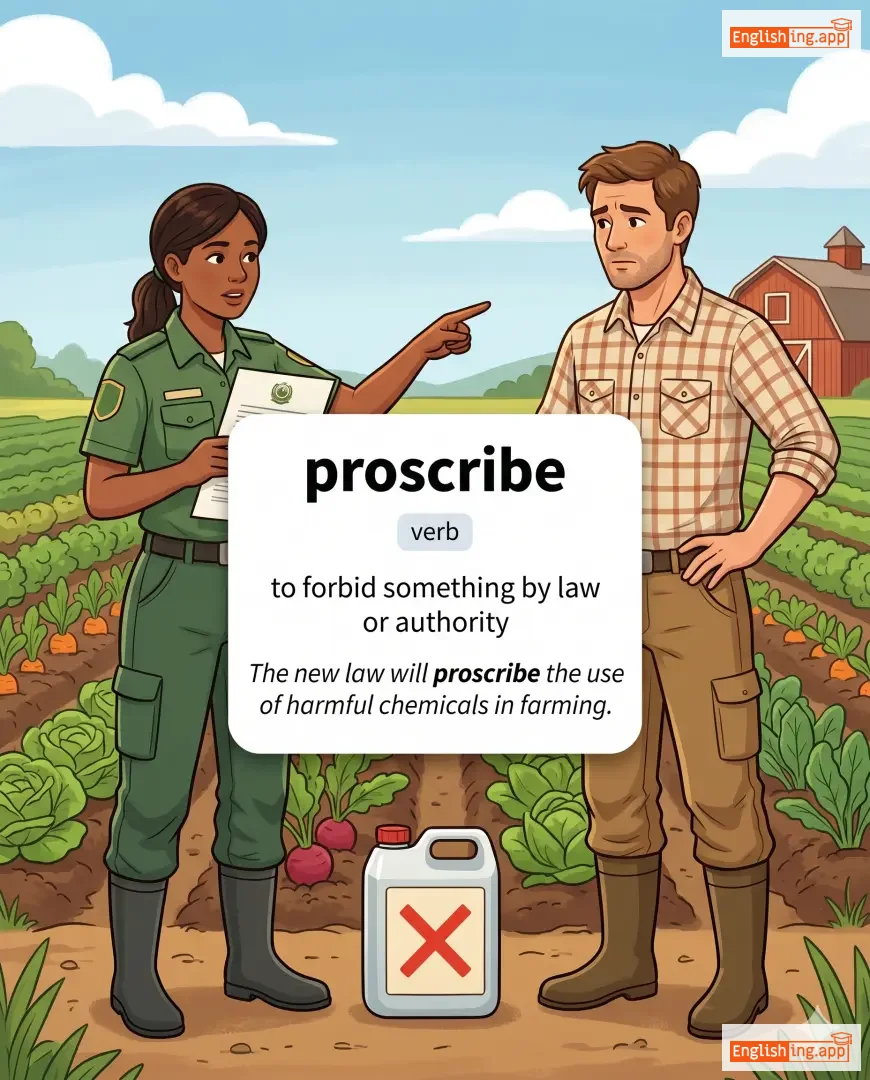
proscribe definition card — visual illustration of the meaning
verb C2
/proʊˈskraɪb/
禁止 (jìnzhǐ)

to forbid something by law or authority

"The new law will proscribe the use of harmful chemicals in farming."

"新法律将禁止在农业中使用有害化学品。" (Xīn fǎlǜ jiāng jìnzhǐ zài nóngyè zhōng shǐyòng yǒuhài huàxué pǐn.)
noun C2
/proʊˈskrɪp.ʃən/
禁令 (jinling)

the act of forbidding something, especially by law

"The proscription of child labor is an important human rights achievement."

"禁止童工劳动是人权的重要成就。" (Jinzhi tonggong laodong shi renquan de zhongyao chengjiu.)
noun C2
/ˈprɒsɪlaɪt/
改信者 (gǎi xìn zhě)

A person who has converted from one belief, opinion, or religion to another.

"She became a proselyte after converting to a new faith."

"她在转信到新的信仰后成为了一名改信者。" (Tā zài zhuǎn xìn dào xīn de xìnyǎng hòu chéngwéi le yī míng gǎi xìn zhě.)
verb C2
/ˈprɒsəˌlaɪtaɪz/
试图使某人改信 (shìtú shǐ mǒurén gǎixìn)

To try to persuade someone to convert to a different belief or religion.

"They tried to proselytize the villagers with their new ideas."

"他们试图用他们的新思想来传教村民。" (Tāmen shìtú yòng tāmen de xīn sīxiǎng lái chuánjiào cūnmín.)
noun C2
/ˈprɒsədi/
韵律学 (yùn lǜ xué)

The patterns of rhythm and sound used in poetry and speech.

"The professor explained how prosody affects the mood of a poem."

"教授解释了韵律学如何影响诗歌的情绪。" (Jiàoshòu jiěshìle yùnlǜ xué rúhé yǐngxiǎng shīgē de qíngxù.)
adjective C2
/ˈproʊtiən/
多变的 (duobian de)

tending or able to change frequently or easily; versatile

"She is a protean artist who experiments with many styles."

"她是一位多变的艺术家,尝试许多不同的风格。" (Ta shi yi wei duobian de yishujia, changshi xu duo butong de fengge.)
noun C2
/prəˈtɛktərət/
保护国 (baohu guo)

A state that is controlled and protected by another.

"The small country became a protectorate of the empire."

"这个小国成为了帝国的保护国。" (Zhe ge xiao guo cheng wei le di guo de bao hu guo.)
noun C2
/ˈproʊtoʊˌmɑːrtɚ/
第一位殉道者 (dì yī wèi xùn dào zhě)

The first martyr in a cause or religion, often referring to the first Christian martyr.

"St. Stephen is known as the protomartyr of Christianity."

"圣斯蒂芬被称为基督教的原始殉道者。" (Sheng Siti fen bei cheng wei Jidujiao de yuanshi xundaozhe.)
noun C2
/ˈproʊtoʊˌplæzəm/
原生质 (yuán shēng zhí)

The living substance inside a cell, including the cytoplasm and nucleus.

"Scientists observed the movement of protoplasm under the microscope."

"科学家在显微镜下观察了原生质的运动。" (Kēxuéjiā zài xiǎnwēijìng xià guānchá le yuán shēng zhí de yùndòng.)
noun C2
/prəˈtuːbərəns/
肿块 (zhǒng kuài)

A rounded swelling or lump on a surface.

"The doctor examined the small protuberance on his arm."

"医生检查了他手臂上的小肿块。" (Yīshēng jiǎnchá le tā shǒubì shàng de xiǎo zhǒng kuài.)
adjective C2
/prəˈtuːbərənt/
突出或膨胀 (tūchū huò péngzhàng)

Sticking out or bulging.

"His protuberant belly showed after the meal."

"饭后他凸出的肚子显现出来。" (Fàn hòu tā tūchū de dùzi xiǎnxiàn chūlái.)
verb C2
/ˈproʊtjuːbəreɪt/
膨胀 (péngzhàng)

To swell out or bulge.

"The roots began to protuberate from the ground."

"根开始从土壤中膨胀出来。" (Gēn kāishǐ cóng tǔrǎng zhōng péngzhàng chūlái.)
noun C2
/ˈprɒvəndər/
牲畜食物 (shēngchù shíwù)

food or provisions, especially for livestock

"The barn was filled with provender for the cattle."

"谷仓里装满了牲畜的食物。" (Gǔcāng lǐ zhuāngmǎnle shēngchù de shíwù.)
adjective C2
/ˈprɒvɪdənt/
有远见的 (yǒu yuǎnjiàn de)

making or indicative of timely preparation for the future

"She was provident in saving money for her children’s education."

"她为孩子们的教育储蓄,非常有远见。" (Tā wèi háizimen de jiàoyù chǔxù, fēicháng yǒu yuǎnjiàn.)
adjective C2
/ˌprɒvɪˈdɛnʃəl/
天意的 (tian yi de)

occurring at a favorable or opportune time, as if guided by divine intervention

"Their timely rescue was considered providential."

"他们及时的救援被认为是天意的。" (Tamen jishi de jiuyuan bei renwei shi tianyi de.)
adjective C2
/prəˈvaɪzəri/
临时的 (linshi de)

conditional; depending on certain terms being met

"The arrangement was only provisory until the final contract was signed."

"该安排只是临时的,直到最终合同签署。" (Gai anpai zhishi linshi de, zhidao zuihou hetong qianshu.)
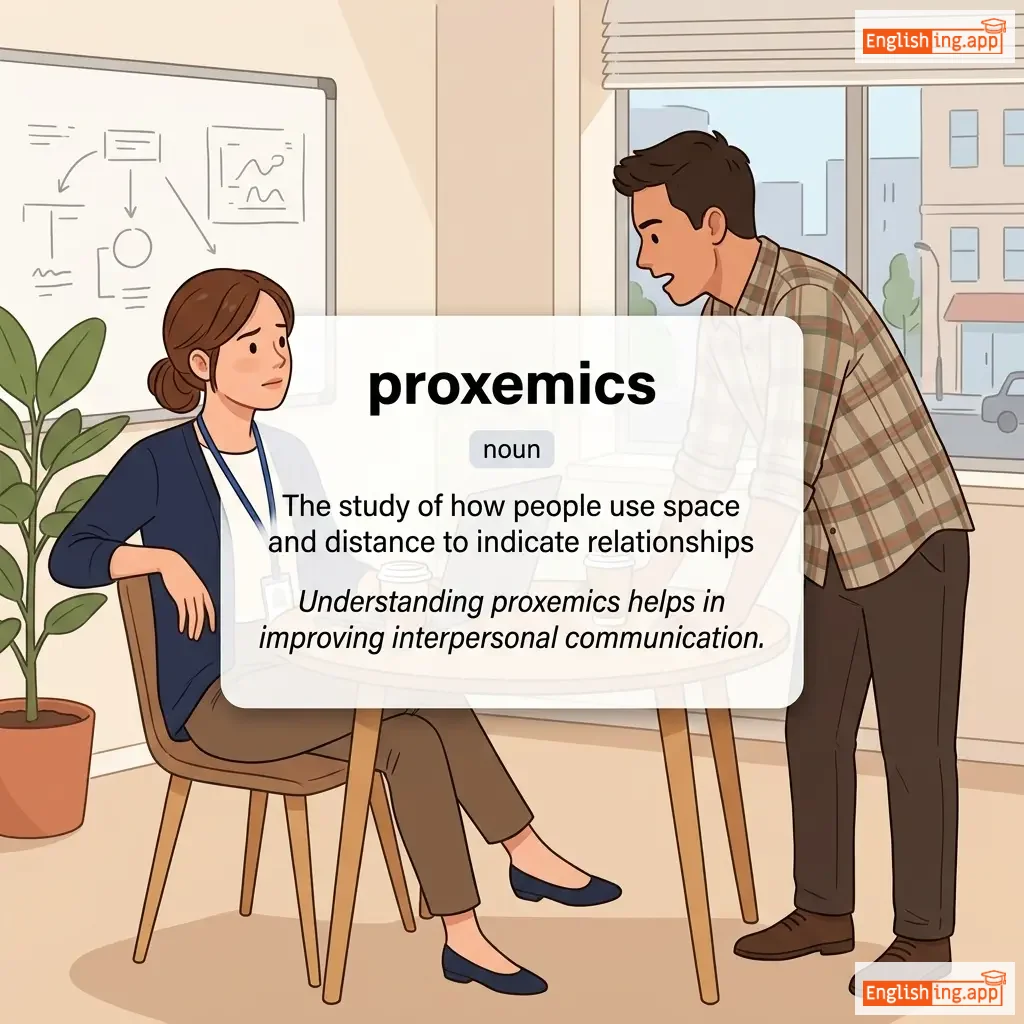
proxemics definition card — visual illustration of the meaning
noun C2
prɒkˈsiː.mɪks
个人空间使用的研究 (gèrén kōngjiān shǐyòng de yánjiū)

The study of how people use space and distance to indicate relationships

"Understanding proxemics helps in improving interpersonal communication."

"理解亲密距离有助于改善人际沟通。" (Lǐjiě qīnmì jùlí yǒuzhù yú gǎishàn rénjì gōutōng.)
adverb C2
/ˈprɒksɪmətli/
附近 (fujin)

In a near or close manner; nearly.

"The village lies proximately to the river."

"村庄位于河流附近。" (Cun zhuang wei yu he liu fujin.)
noun C2
/pruːd/
过于害羞的人 (guòyú hàixiū de rén)

A person who is easily shocked by matters relating to sex or nudity; someone overly modest.

"He was called a prude for blushing at the movie scenes."

"因为在电影场景中脸红,他被称为过于害羞的人。" (yīnwèi zài diànyǐng chǎngjǐng zhōng liǎnhóng, tā bèi chēng wéi guòyú hàixiū de rén.)
adjective C2
/pruːˈdɛnʃəl/
审慎的 (shěn shèn de)

involving or showing prudence, especially in financial or business matters

"The bank has set prudential rules to protect depositors."

"银行制定了审慎的规则以保护存款人。" (Yínháng zhìdìng le shěnshèn de guīzé yǐ bǎohù cúnkuǎn rén.)
noun C2
/ˈpruːdəri/

the behavior or attitude of people who are too easily shocked or offended by sexual matters

"His prudery often made others uncomfortable during open discussions."

adjective C2
/ˈpruːdɪʃ/
过于拘谨的 (guòyú jūjǐn de)

having or revealing a tendency to be easily shocked by matters relating to sex or nudity

"She was too prudish to watch the movie with her friends."

"她太拘谨了,不愿和朋友一起看电影。" (Tā tài jūjǐn le, bù yuàn hé péngyǒu yīqǐ kàn diànyǐng.)
adjective C2
/ˈprʊəriənt/
淫荡 (yín dàng)

having or showing an excessive interest in sexual matters

"The magazine was criticized for its prurient content."

"这本杂志因其淫荡内容而受到批评。" (Zhe ben zazhi yin qi yindang neirong er shoudao piping.)
noun C2
/ˌsuːdəʊəˈpɒsəl/
伪使徒 (wei shitu)

a false or pretended apostle

"The preacher was condemned as a pseudapostle."

"这位传教士被定为伪使徒。" (Zhè wèi chuánjiàoshì bèi dìng wèi wèi shítú.)
noun C2
/ˌsuːdəˈnɪmɪti/
使用笔名 (shiyong binming)

the practice or state of using a pseudonym

"The author maintained pseudonymity throughout her career."

"这位作者在整个职业生涯中一直使用笔名。" (Zhe wei zuozhe zai zhengge zhiyeshiye zhong yizhi shiyong binming.)
Psychographics definition card — visual illustration of the meaning
noun C2
/ˌsaɪ.kəʊˈɡræf.ɪks/
根据人们的态度、愿望和其他心理标准对人进行研究和分类 (genju renmen de taidu, yuangwang he qita xinli biaozhun dui ren jinxing yanjiu he fenlei)

The study and classification of people according to their attitudes, aspirations, and other psychological criteria.

"Psychographics reveal consumer buying motives."

"心理图谱揭示了消费者购买动机。" (Xinli tupu jieshi le xianghuo zhi hui maimai dongji.)
verb C2
/ˈpʌkər/

to tighten or contract into small folds or wrinkles

"She puckered her lips before kissing the child."

adjective C2
/ˈpʌkɪʃ/
顽皮 (wánpí)

playfully mischievous

"The child gave a puckish grin before hiding the toy."

"孩子在藏玩具之前露出了顽皮的笑容。" (Háizi zài cáng wánjù zhīqián lùchūle wánpí de xiàoróng.)
adjective C2
/ˈpʌdʒi/
圆胖 (yuan pang)

slightly fat or chubby in a way that is often cute

"The baby had pudgy cheeks that everyone adored."

"这个宝宝有圆胖的脸颊,大家都很喜欢。" (Zhege baobao you yuan pang de lianjia, dade dou hen xihuan.)
adjective C2
/ˈpjʊəraɪl/
幼稚的 (yòuzhì de)

childishly silly or immature

"His puerile jokes annoyed the audience."

"他的幼稚笑话让观众感到烦恼。" (Tā de yòuzhì xiàohuà ràng guānzhòng gǎndào fánnǎo.)
noun C2
/ˈpjuːdʒɪlɪzəm/
拳击 (quanji)

The practice or sport of boxing.

"He studied the art of pugilism in his youth."

"他在年轻时研究了拳击的艺术。" (Ta zai nianqing shi yanjiu le quanji de yishu.)
noun C2
/ˈpjuːdʒɪlɪst/
拳击手 (quánjīshǒu)

A professional or skilled boxer.

"The pugilist entered the ring with confidence."

"拳击手充满信心地进入了拳台。" (Quánjīshǒu chōngmǎn xìnxīn de jìnrùle quántái.)
adjective C2
/pʌɡˈneɪʃəs/
好斗的 (hao dou de)

Having a quarrelsome or combative nature; eager to fight.

"His pugnacious attitude often got him into trouble."

"他好斗的态度常常让他陷入麻烦。" (Ta haodou de taidu changchang rang ta xianru mafan.)
noun C2
/pʌɡˈnæsɪti/
好斗 (haodou)

A natural disposition to be combative or aggressive.

"The coach admired the player's pugnacity on the field."

"教练欣赏球员在场上的好斗精神。" (Jiaolian xīnshǎng qiúyuán zài chǎngshàng de hǎodòu jīngshén.)
noun C2
/ˈpjuːɪsəns/
权力 (quanli)

Great power, strength, or influence.

"The empire showed its puissance through vast armies."

"帝国通过庞大的军队展现了其权力。" (Diguo tongguo pangda de jundui zhanshixian le qi quanli.)