Vocabulaires

Découvrez, apprenez et maîtrisez le vocabulaire anglais

verb C2
/miːt/
分配 (fenpei)

To dispense or allot justice, punishment, or harsh treatment.

"The judge will mete out punishment according to the crime."

"法官将根据罪行分配惩罚。" (Fǎguān jiāng gēnjù zuìxíng fēnpèi chéngfá.)
noun C2
/ˌmɛtəmˌsaɪˈkoʊsɪs/
灵魂的转生 (línghún de zhuǎnshēng)

The supposed transmigration of the soul, especially its reincarnation after death.

"Ancient philosophers often debated the idea of metempsychosis."

"古代哲学家常常讨论灵魂的转生。" (Gǔdài zhéxuéjiā chángcháng tǎolùn línghún de zhuǎnshēng.)
noun C2
/mɪˈtɒnɪmi/
借代 (jièdài)

A figure of speech in which one word or phrase is substituted with another closely related word or concept.

"In the phrase 'the crown will decide,' 'crown' is a metonymy for monarchy."

"在短语 '王冠将决定' 中,'王冠' 是君主制的借代。" (Zài duǎnyǔ 'wángguàn jiāng juédìng' zhōng, 'wángguàn' shì jūnzhǔzhì de jièdài.)
adjective C2
/ˈmɛtrɪkəl/
韵律的 (yùnlǜ de)

Relating to or composed in a regular rhythmic pattern of beats or meter, especially in poetry.

"The poet carefully followed metrical rules in his verses."

"诗人在他的诗句中小心地遵循了韵律规则。" (Shīrén zài tā de shī jù zhōng xiǎoxīn de zūnxúnle yùnlǜ guīzé.)
noun C2
/ˈmɛtrəˌnoʊm/
节拍器 (jiépāiqì)

A device that produces regular ticks or beats to help musicians maintain tempo.

"She practiced the piano with a metronome to keep steady timing."

"她用节拍器练习钢琴,以保持稳定的节奏。" (Tā yòng jiépāiqì liànxí gāngqín, yǐ bǎochí wěndìng de jiézòu.)
noun C2
/ˈmɛtəl/
勇气 (yǒngqì)

A person's ability to cope well with difficulties or to face demanding situations with courage.

"The young athlete showed his mettle in the final match."

"这位年轻的运动员在决赛中展示了他的勇气。" (Zhè wèi niánqīng de yùndòngyuán zài juésài zhōng zhǎnshìle tā de yǒngqì.)
adjective C2
/ˈmɛtəlˌsʌm/
勇敢的 (yǒng gǎn de)

Full of courage and spirit; lively and spirited.

"The mettlesome young rider never backed down from a challenge."

"勇敢的年轻骑手从不退缩。" (Yǒng gǎn de nián qīng qí shǒu cóng bù tuì suō.)
noun C2
/mjuːz/
小巷/窄街 (xiaoxiang/zhai jie)

A row or street of houses or apartments that have been converted from stables or built to look like former stables.

"They rented a small flat in a quiet London mews."

"他们在伦敦的一个安静的mews租了一间小公寓。" (Tamen zai Lundun de yige anjing de mews zu le yijian xiao gongyu.)
noun C2
/maɪˈæzmə/
恶臭空气 (èchòu kōngqì)

An unpleasant or unhealthy smell or atmosphere.

"A miasma of decay hung over the abandoned house."

"腐烂的气味弥漫在废弃的房子上方。" (fǔlàn de qìwèi mímàn zài fèiqì de fángzi shàngfāng.)
noun C2
/ˈmaɪkrəˌkɒzəm/
微观宇宙 (weiguan yuzhou)

A small, representative system having analogies to a larger system; a miniature version of something.

"The small town is a microcosm of the entire nation."

"这个小镇是整个国家的微观宇宙。" (Zhege xiaozhen shi zhengge guojia de weiguan yuzhou.)
noun C2
/maɪˈkrɒmɪtər/
千分尺 (qiānfēnchǐ)

A device used for measuring small distances with great accuracy.

"The engineer used a micrometer to measure the thickness of the wire."

"工程师使用了一个微米尺来测量电线的厚度。" (Gōngchéngshī shǐyòngle yīgè wēimǐchǐ lái cèliàng diànxiàn de hòudù.)
noun C2
/maɪˈkrɑː.skə.pi/
显微镜学 (xianwei jingxue)

The use of a microscope to observe small objects or organisms.

"Microscopy revealed the structure of the cells."

"显微镜学揭示了细胞的结构。" (Xianwei jingxue jieshi le xibao de jiagou.)
noun C2
/miːn/
神态 (shéntài)

A person's appearance or manner, especially as an indication of their character or mood.

"His serious mien made everyone fall silent."

"他严肃的神态让所有人都沉默了。" (Tā yánsù de shéntài ràng suǒyǒu rén dōu chénmòle.)
noun C2
/mɪf/
小争执 (xiao zhengzhi)

A petty quarrel or annoyance.

"They had a slight miff over the seating arrangement."

"他们因座位安排发生了小小的争执。" (Tāmen yīn zuòwèi ānpái fāshēngle xiǎo xiǎo de zhēngzhí.)
verb C2
/ˈmɪlɪˌteɪt/
妨碍 (fáng'ài)

to have a strong effect against something; to work as a powerful factor in preventing or influencing an outcome

"His lack of experience will militate against his promotion."

"他的经验不足将阻碍他的晋升。" (tā de jīngyàn bùzú jiāng zǔ'ài tā de jìnshēng.)
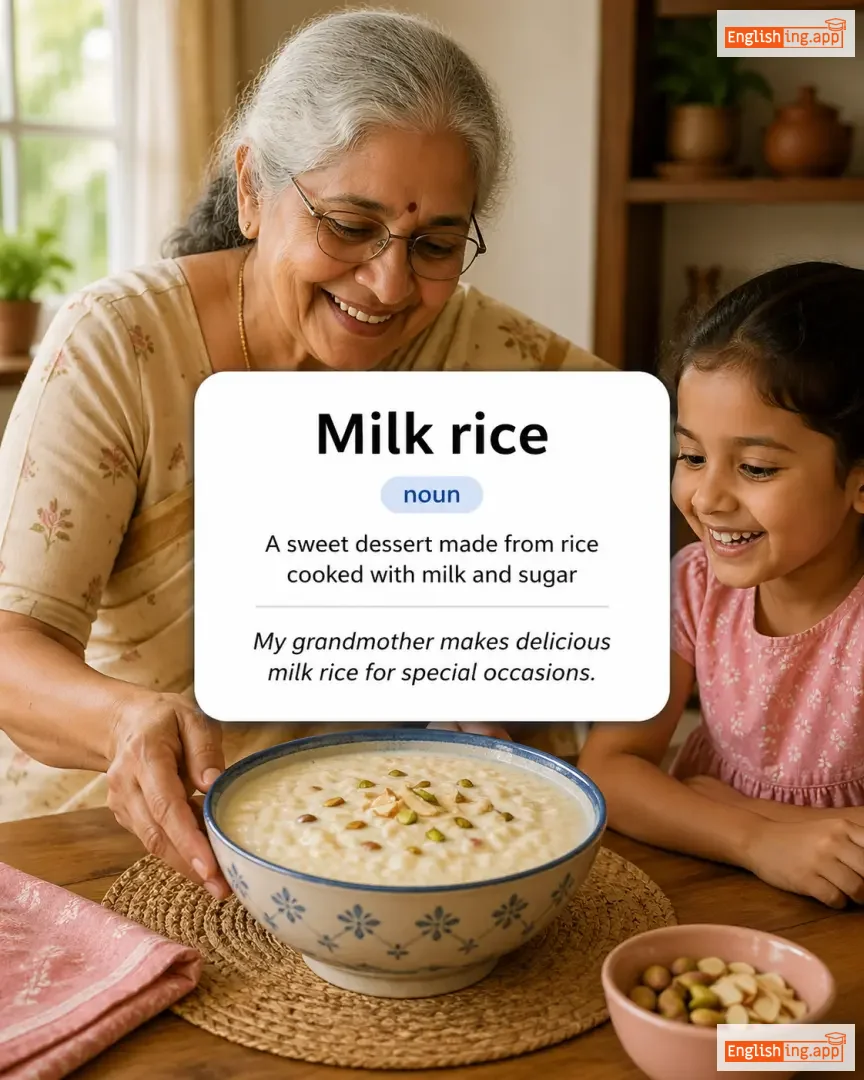
Milk rice definition card — visual illustration of the meaning
noun C2
/mɪlk raɪs/
牛奶饭 (niunai fan)

A sweet dessert made from rice cooked with milk and sugar

"My grandmother makes delicious milk rice for special occasions."

"我的祖母为特殊场合做美味的牛奶饭。" (Wǒ de zǔmǔ wèi tèshū chǎnghé zuò měiwèi de niúnǎi fàn.)
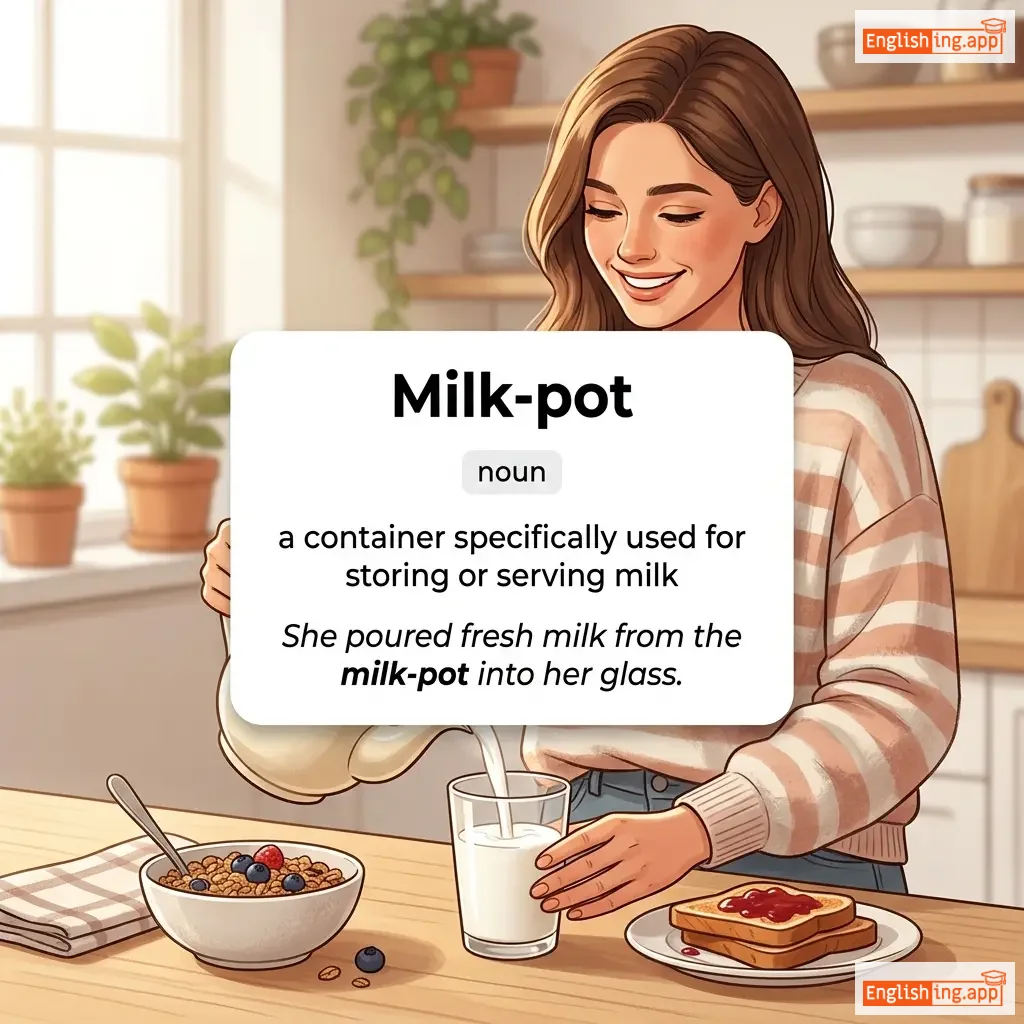
Milk-pot definition card — visual illustration of the meaning
noun C2
/ˈmɪlk pɒt/
牛奶壶 (niúnǎi hú)

a container specifically used for storing or serving milk

"She poured fresh milk from the milk-pot into her glass."

"她将新鲜的牛奶从牛奶壶里倒入玻璃杯中。" (Tā jiāng xīnxiān de niúnǎi cóng niúnǎi hú lǐ dào rù bōlí bēi zhōng)
noun C2
/ˈmɪlɪt/
小米 (xiaomi)

a small-seeded grass cultivated as a cereal crop

"Millet is often used as food in rural areas."

"小米常常作为食物在农村地区使用。" (Xiaomi changchang zuo wei shíwù zài nóngcūn dìqū shǐyòng.)
noun C2
/ˌmɪnəˈrɛt/
宣礼塔 (xuānlǐtǎ)

A tall, slender tower of a mosque, from which the call to prayer is announced.

"The minaret of the mosque could be seen from miles away."

"清真寺的宣礼塔可以从几英里外看到。" (Qīngzhēnsì de xuānlǐtǎ kěyǐ cóng jǐ yīnglǐ wài kàn dào.)
adjective C2
/ˈmɪnətɔːri/
威胁的 (wēixié de)

Expressing a threat; menacing.

"The criminal gave the witness a minatory look."

"罪犯给了证人一个威胁的眼神。" (Zuìfàn gěi le zhèngrén yīgè wēixié de yǎnshén.)
adjective C2
/ˈmɪnsɪŋ/
做作 (zuòzuò)

affectedly delicate, dainty, or refined in manner or movement

"He walked with mincing steps across the stage."

"他走过舞台时步伐轻盈。" (Tā zǒuguò wǔtái shí bùfá qīngyíng.)
adjective C2
/ˈmɪn.dʒi/
小气; 吝啬 (xiaoqi; linse)

mean or stingy; unwilling to spend money

"He is too mingy to spend money on anything but necessities."

"他太小气,不愿意在除必要的东西外花钱。" (Ta tai xiaoqi, buyuan yong zai chu bixiao de dongxi wai huai qian.)
🧑‍🤝‍🧑

minion (米宁)

noun C2
/ˈmɪn.i.ən/
爪牙 (zhuǎyá)

A follower or underling of a powerful person, especially a servile one.

"The dictator was surrounded by loyal minions who carried out his orders."

"独裁者被忠诚的爪牙包围,他们执行他的命令。" (Dúcáizhě bèi zhōngchéng de zhuǎyá bāowéi, tāmen zhíxíng tā de mìnglìng.)
adjective C2
/ˈmɪn.ɪ.skjuːl/
微小 (weixiao)

Extremely small or tiny.

"The error was so miniscule that nobody noticed it."

"这个错误如此微小,以至于没人注意到它。" (Zhege cuowu ruci weixiao, yi zhi yu meirén zhùyì dào tā.)
noun C2
/ˌmɪn.ɪˈstreɪ.ʃən/
服务 (fuwu)

The act of providing care, assistance, or religious service.

"She recovered thanks to the kind ministrations of the nurses."

"她感谢护士们亲切的照料而康复。" (Tā gǎnxiè hùshì men qīnqiè de zhàoliào ér kāngfù.)
noun C2
/maɪˈnjuːʃə/
琐事 (suǒ shì)

a small or trivial detail of something

"He was bored by the minutia of office paperwork."

"他对办公室文件的琐事感到厌倦。" (Tā duì bàngōngshì wénjiàn de suǒ shì gǎndào yànjuàn.)
noun (plural) C2
/maɪˈnjuːʃiiː/
琐事 (suǒ shì)

the small, precise, or trivial details of something

"The lawyer focused on the minutiae of the contract."

"律师专注于合同的琐事。" (Lǜ shī zhuān zhù yú hé tóng de suǒ shì.)
🪵

mire

noun, verb C2
/ˈmaɪər/

A stretch of swampy or boggy ground; as a verb, to entangle or involve someone in a difficult situation.

"The car was stuck in the mire after the heavy rain."

noun C2
/ˌmɪsədˈvɛntʃər/
不幸的事故 (buxing de shigu)

An unlucky accident, mishap, or unfortunate event.

"He broke his leg during a skiing misadventure."

"他在滑雪时发生了一次不幸的事故,摔断了腿。" (Ta zai huaxue shi fasheng le yici buxing de shigu, shuai duan le tui.)
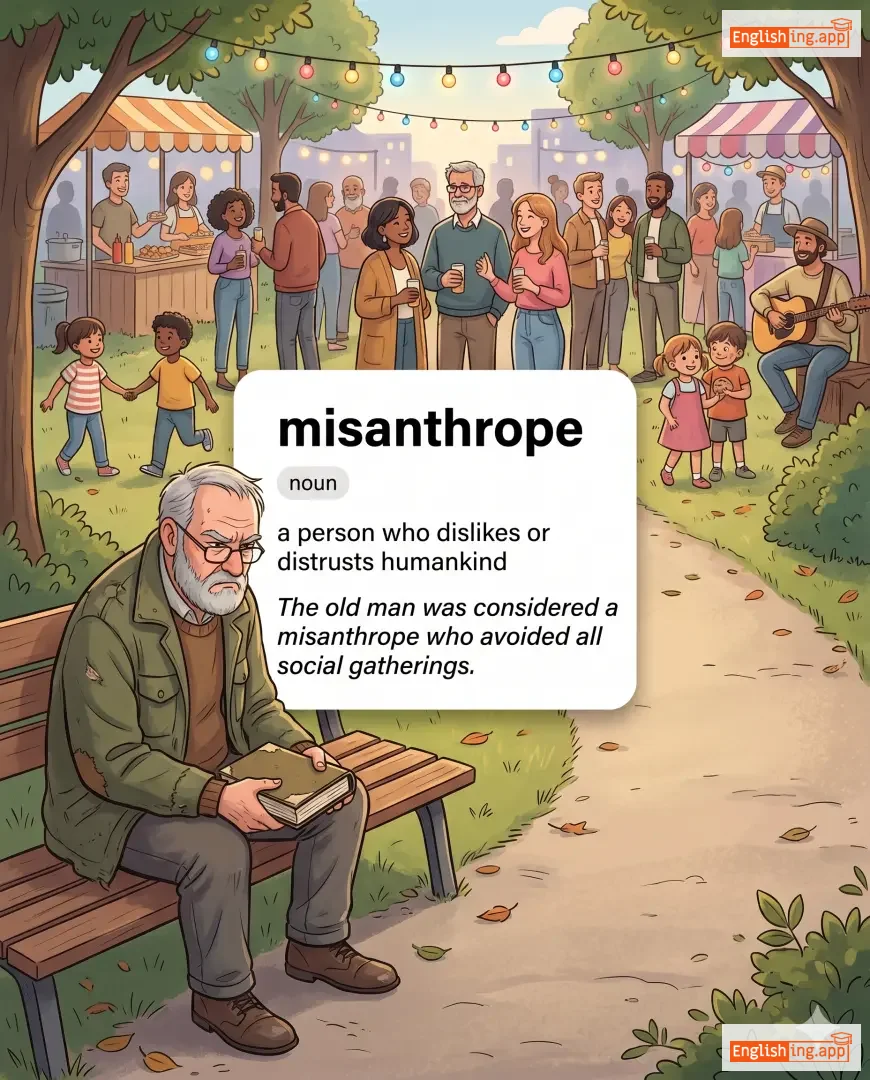
misanthrope definition card — visual illustration of the meaning
noun C2
/ˈmɪsənˌθroʊp/
厌人者 (yànrénzhě)

a person who dislikes or distrusts humankind

"The old man was considered a misanthrope who avoided all social gatherings."

"这个老人被认为是一个回避所有社交活动的厌人者。" (Zhège lǎorén bèi rènwéi shì yī gè huíbì suǒyǒu shèjiāo huódòng de yànrénzhě.)
adjective C2
/ˌmɪsənˈθrɑːpɪk/
厌人症的 (yàn rén zhèng de)

having or showing a dislike of humankind

"His misanthropic attitude made it difficult for him to make friends."

"他那种厌人症的态度让他难以交到朋友。" (Tā nà zhǒng yàn rén zhèng de tàidù ràng tā nán yǐ jiāo dào péngyǒu.)
noun C2
/mɪˈsænθrəpi/
厌人症 (yàn rén zhèng)

a general dislike, distrust, or hatred of humankind

"His misanthropy was evident in the way he avoided people."

"他的厌人症在他回避人群的方式中显而易见。" (Tā de yàn rén zhèng zài tā huíbì rénqún de fāngshì zhōng xiǎn ér yìjiàn.)
verb C2
/ˌmɪsæprɪˈhɛnd/
误解 (wùjiě)

to misunderstand or misinterpret something

"He misapprehended the teacher’s instructions and did the task incorrectly."

"他误解了老师的指示,错误地做了任务。" (Tā wùjiěle lǎoshī de zhǐshì, cuòwù de zuòle rènwù.)
noun C2
/ˌmɪsæprɪˈhɛnʃən/
误解 (wùjiě)

a mistaken belief or misunderstanding

"There is a common misapprehension about the causes of the disease."

"关于疾病原因存在常见的误解。" (Guānyú jíbìng yuányīn cúnzài chángjiàn de wùjiě.)
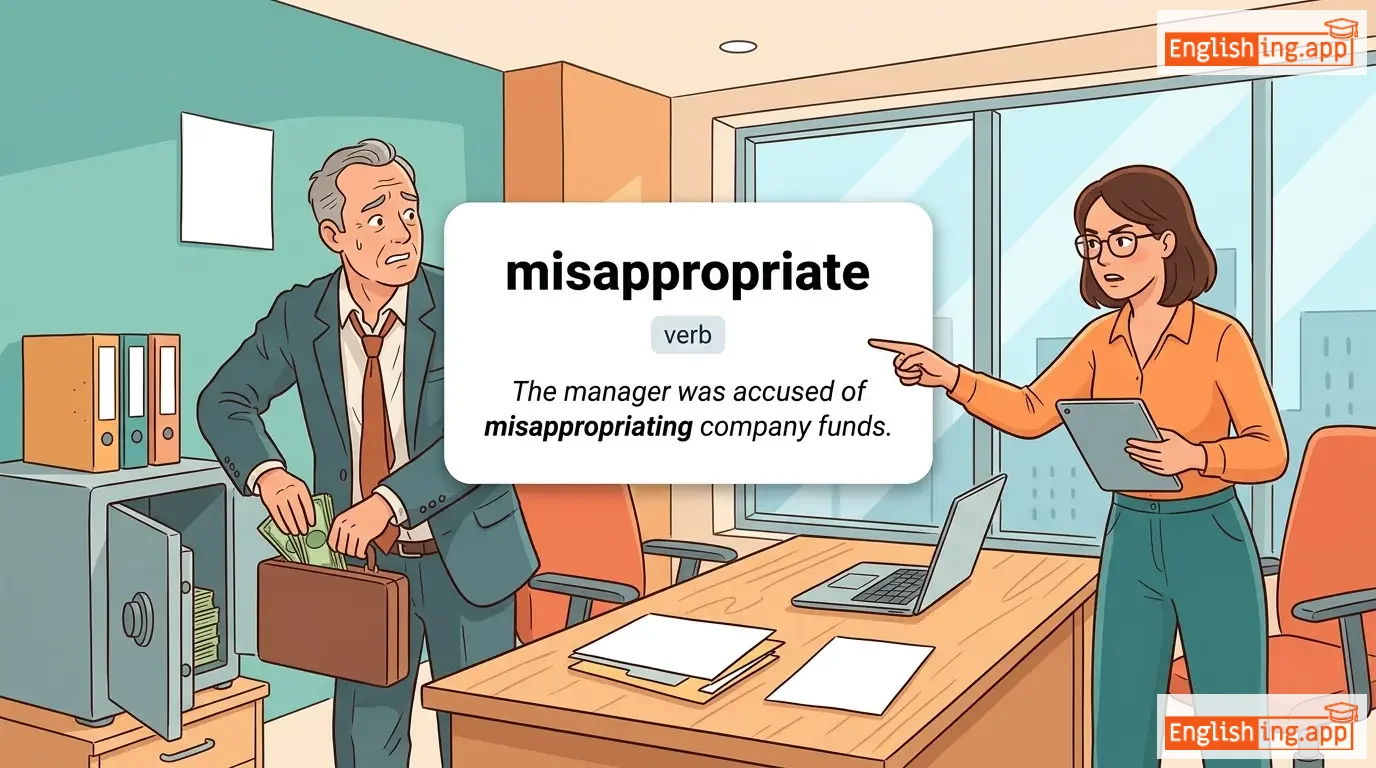
misappropriate definition card — visual illustration of the meaning
verb C2
/ˌmɪsəˈproʊprieɪt/
挪用 (nuóyòng)

to take or use something dishonestly, especially money or property, for one's own use

"The manager was accused of misappropriating company funds."

"经理被指控挪用公司资金。" (Jīnglǐ bèi zhǐkòng nuóyòng gōngsī zījīn.)
verb C2
/ˌmɪs.əˈtrɪb.juːt/
错误归因 (cuo wu gui yin)

to incorrectly credit something, such as a work or remark, to the wrong person or source

"The quote was misattributed to Shakespeare."

"这句话被错误地归因于莎士比亚。" (Zhe ju hua bei cuo wu de gui yin yu Sha Shi Bi Ya.)
noun C2
/mɪˌsɛdʒəˈneɪʃən/
种族通婚 (zhǒngzú tōnghūn)

the interbreeding of people considered to be of different racial types

"The law once prohibited miscegenation in many countries."

"法律曾在许多国家禁止了种族通婚。" (Fǎlǜ céng zài xǔduō guójiā jìnzhǐle zhǒngzú tōnghūn.)
noun C2
/ˈmɪsəleɪni/
杂集 (za ji)

A collection or mixture of various things.

"The book is a miscellany of essays and poems."

"这本书是散文和诗歌的杂集。" (Zhe ben shu shi san wen he shi ge de za ji.)
noun C2
/ˌmɪsˈtʃæns/

An unfortunate accident or event; bad luck.

"By mischance, he missed the last train home."

verb C2
/ˌmɪskənˈsiːv/
误解 (wùjiě)

To misunderstand or form an incorrect idea about something.

"He misconceived the purpose of the project."

"他误解了项目的目的。" (Tā wùjiě le xiàngmù de mùdì.)
verb C2
/ˌmɪskənˈstruː/
误解 (wùjiě)

To interpret something wrongly or misunderstand the meaning.

"She misconstrued his silence as anger."

"她误解了他的沉默为愤怒。" (Tā wùjiěle tā de chénmò wéi fènnù.)
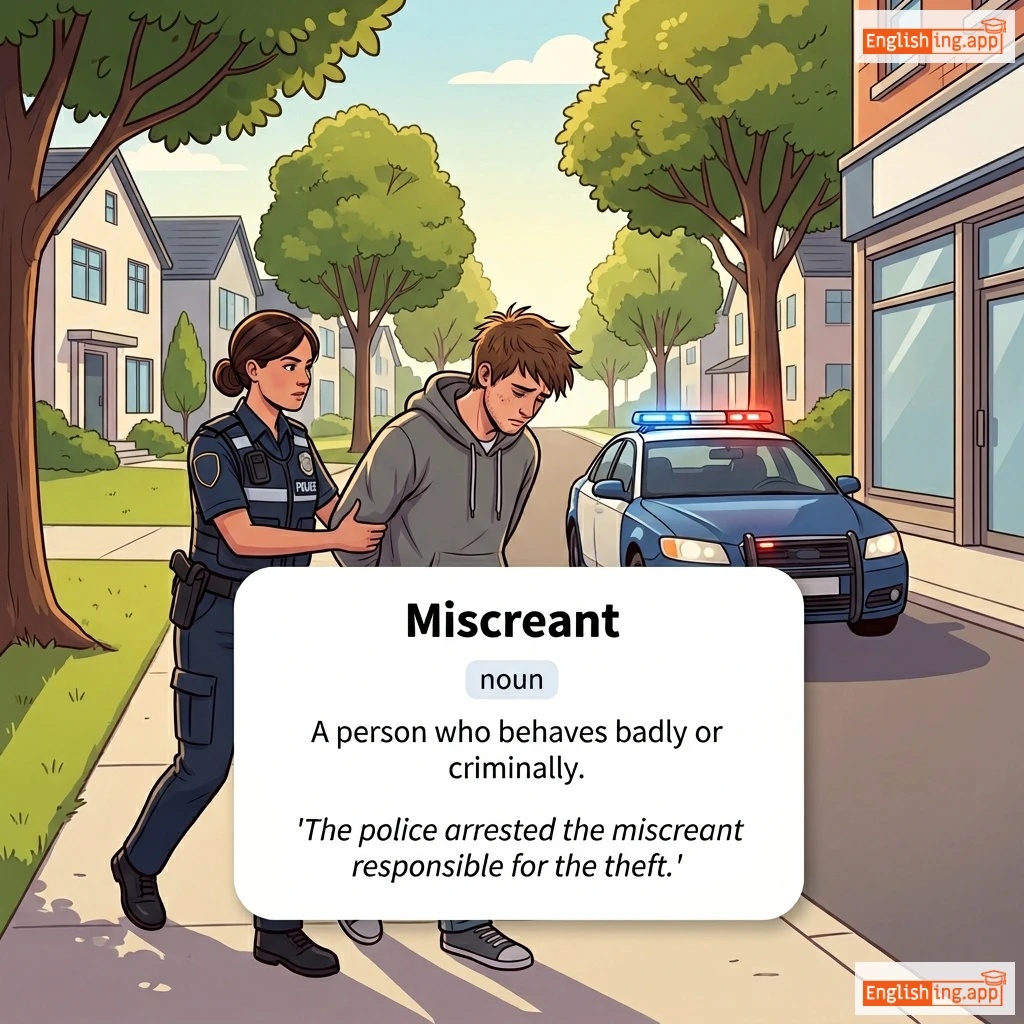
Miscreant definition card — visual illustration of the meaning
noun C2
/ˈmɪskriənt/
恶棍 (ègùn)

A person who behaves badly or criminally.

"The police arrested the miscreant responsible for the theft."

"警察逮捕了负责盗窃的恶棍。" (Jǐngchá dàibǔle fùzé dàoqiè de ègùn.)
verb C2
/ˌmɪsˈleɪ/
暂时丢失 (zan shi diu shi)

to lose something temporarily by putting it in the wrong place

"I must have mislaid my keys somewhere in the house."

"我一定把我的钥匙暂时丢失在屋子里某个地方。" (Wo yiding ba wode yaoshi zan shi diu shi zai wuzi li mou ge difang.)
noun C2
/ˌmɪsˈnoʊmər/
错误的名字 (cuo wu de ming zi)

A wrong or inaccurate name or designation.

"Calling the tiny dog a 'giant' is a misnomer."

"称呼这只小狗为“巨人”是一个错误的名字。" (Cheng hu zhe zhi xiao gou wei 'ju ren' shi yi ge cuo wu de ming zi.)
noun C2
/mɪˈsɑːɡəmi/
厌婚症 (yàn hūn zhèng)

Hatred or dislike of marriage.

"His misogamy prevented him from ever settling down with a partner."

"他的厌婚症让他无法和伴侣定居下来。" (Tā de yàn hūn zhèng ràng tā wúfǎ hé bànlǚ dìngjū xiàlái.)
noun C2
/mɪˈsɑːdʒɪnɪst/
厌女症者 (yàn nǚ zhèng zhě)

A person who dislikes, despises, or is strongly prejudiced against women.

"Many condemned his speech as the words of a misogynist."

"许多人谴责他的演讲是厌女症者的言论。" (Xǔduō rén qiǎn zé tā de yǎnjiǎng shì yàn nǚ zhèng zhě de yánlùn.)
noun C2
/ˌmɪsˈruːl/
恶政 (è zhèng)

bad or poor governance

"The kingdom suffered for decades under misrule."

"王国在几十年里饱受恶政之苦。" (Wángguó zài jǐ shí nián lǐ bǎoshòu è zhèng zhī kǔ.)
noun C2
/ˈmɪsəl/
弥撒书 (misa shu)

a book containing the texts used in the Catholic Mass throughout the year

"The priest read from the missal during the ceremony."

"神父在仪式期间从弥撒书中读出。" (Shénfù zài yíshì qījiān cóng misa shū zhōng dú chū.)
noun C2
/ˈmɪsɪv/
信件 (xìnjiàn)

a written message, especially a formal or official letter

"He sent a long missive to the governor."

"他给州长发送了一封长信。" (Tā gěi zhōuzhǎng fāsòngle yī fēng cháng xìn.)
noun C2
/ˈmaɪtər/
主教帽 (zhǔjiào mào)

a tall, pointed hat worn by bishops; also a type of joint made between two pieces of material

"The bishop placed the miter on his head during the ceremony."

"主教在仪式中把主教帽戴在头上。" (Zhǔjiào zài yíshì zhōng bǎ zhǔjiào mào dài zài tóu shàng.)