Vocabulaires

Découvrez, apprenez et maîtrisez le vocabulaire anglais

noun C2
/ɪnˈfrækʃən/
उल्लंघन (ullanghan)

A violation or breach of a rule, law, or agreement.

"The student was punished for a minor infraction of the school rules."

"छात्र को स्कूल के नियमों के एक छोटे उल्लंघन के लिए दंडित किया गया था।" (Chhatra ko school ke niyamon ke ek chhote ullanghan ke liye dandit kiya gaya tha.)
noun C2
/ɪnˈfriːkwəns/
दुर्लभता (durlabhta)

The state of occurring rarely or at long intervals.

"The infrequence of their meetings made it hard to maintain close ties."

"उनकी बैठकों की दुर्लभता ने करीबी संबंध बनाए रखना कठिन बना दिया था।" (Unki baithako ki durlabhta ne kareebi sambandh banaye rakhna kathin bana diya tha.)
noun C2
/ˈænʒənuː/
निरदोष युवती (nirdosh yuvati)

an innocent, naïve young woman, especially as represented in literature or theater

"She played the role of the ingénue in the play with great charm."

"उसने नाटक में निर्दोष युवती का किरदार बड़ी चपलता से निभाया।" (Usne natak mein nirdosh yuvati ka kirdar badi chaplata se nibhaya.)
ingenuous definition card — visual illustration of the meaning
adjective C2
/ɪnˈdʒɛnjuəs/
साधारण (saadharan)

Innocent, naive, and unsuspecting; showing childlike simplicity and sincerity.

"Her ingenuous smile revealed her genuine kindness."

"उसकी साधारण मुस्कान ने उसकी सच्ची दयालुता को उजागर किया।" (uski saadharan muskan ne uski sachchi dayaluta ko ujagar kiya.)
verb C2
/ɪnˈdʒɛst/
उपभोग करना (upbhog karna)

To take food, drink, or another substance into the body, usually by swallowing.

"The patient must ingest the medicine with water."

"मरीज को दवाई पानी के साथ इंजेस्ट करनी होगी।" (mareez ko dawaai paani ke saath ingest karni hogi.)
adjective C2
/ɪnˈɡlɔːriəs/
अपमानजनक (apmanjanak)

Causing shame or disgrace; not bringing honor or glory.

"The army suffered an inglorious defeat."

"सेना को एक अपमानजनक हार का सामना करना पड़ा।" (senā ko ek apmānjanak hār kā sāmnā karnā paṛā.)
verb C2
/ɪnˈɡrɑːft/
गहरे रूप से लगाना (gahare roop se lagana)

To implant or fix deeply, often used in the sense of grafting an idea or quality.

"The teacher tried to ingraft good manners in the students."

"शिक्षक ने विद्यार्थियों में अच्छे व्यवहार को गहरे रूप से स्थापित करने की कोशिश की।" (shikshak ne vidyarthiyon mein acche vyavhaar ko gahare roop se sthaapit karne ki koshish ki.)
noun C2
/ˈɪnˌɡreɪt/
अकृतज्ञ व्यक्ति (ingrate)

An ungrateful person; someone who shows no appreciation.

"He worked hard for his friend, but the ingrate never thanked him."

"उसने अपने दोस्त के लिए कड़ी मेहनत की, लेकिन वह अकृतज्ञ व्यक्ति ने उसे कभी धन्यवाद नहीं दिया." (Usne apne dost ke liye kadhi mehnat ki, lekin vah akrtagya vyakti ne use kabhi dhanyavaad nahi diya.)
verb C2
/ɪnˈɡreɪʃiˌeɪt/
प्रिय बनाने की कोशिश करना (priya banane ki koshish karna)

To gain favor or approval by deliberate effort, often in a flattering way.

"She tried to ingratiate herself with her boss by complimenting him often."

"उसने अपने बॉस के साथ अक्सर तारीफ करके खुद को प्रिय बनाने की कोशिश की।" (Usne apne boss ke saath aksar tareef karke khud ko priya banane ki koshish ki.)
adjective C2
/ɪnˈɡreɪʃiˌeɪtɪŋ/
चापलूसी करने वाला (chaplusi karne wala)

Charming or flattering in a way intended to gain favor.

"His ingratiating smile made everyone trust him quickly."

"उसकी चापलूसी करने वाली मुस्कान ने सभी को जल्दी ही उस पर विश्वास करने के लिए मजबूर कर दिया।" (Uski chaplusi karne wali muskan ne sabhi ko jaldi hi us par vishwas karne ke liye majbur kar diya.)
noun C2
/ɪnˈɡrætɪˌtjuːd/
अकृतज्ञता (akritajyata)

Lack of gratitude; failure to show thanks or appreciation.

"His ingratitude hurt her feelings after all she had done for him."

"उसकी अकृतज्ञता ने उसे चोट पहुँचाई, जबकि उसने उसके लिए बहुत कुछ किया था।" (Uski akritajyata ne use chot pahunchai, jabki usne uske liye bahut kuch kiya tha.)
adjective C2
/ɪnhɑːrˈmoʊniəs/
बेसुरे (besure)

lacking harmony; discordant in sound; not in tune

"The inharmonious sounds from the broken piano made everyone cover their ears."

"टूटी हुई पियानो से निकलने वाली बेसुरे आवाजों ने सभी को उनके कान ढकने पर मजबूर कर दिया।" (tooti hui piano se nikalne wali besure awajon ne sabhi ko unke kan dhakne par majboor kar diya.)
noun C2
/ɪnˈhɪərəns/
अंतर्निहितता (antarnihitata)

The state of being an essential or permanent part of something.

"The inherence of risk is part of every business venture."

"जोखिम की अंतर्निहितता हर व्यापारिक प्रयास का हिस्सा है।" (Jokhim ki antarnihitata har vyaparik prayaas ka hissa hai.)
verb C2
/ɪnˈhjuːm/
दफनाना (dafnana)

to bury a dead body in the ground

"They inhumed the warrior with full honors."

"उन्होंने योद्धा को पूरे सम्मान के साथ दफनाया।" (Unhone yoddha ko poore sammaan ke saath dafnaaya.)
adjective C2
/ɪˈnɪmɪkəl/
विरोधी / शत्रुतापूर्ण (virodhi / shatrutapurn)

tending to obstruct or harm; unfriendly or hostile

"The policy was inimical to the country's economic growth."

"नीति देश की आर्थिक वृद्धि के लिए विरोधी थी।" (Neeti desh ki aarthik vruddhi ke liye virodhi thi.)
inimitable definition card — visual illustration of the meaning
adjective C2
/ɪˈnɪmɪtəbəl/
अद्वितीय (adwitiya)

so good or unusual as to be impossible to copy; unique

"Her inimitable style made her stand out in the fashion industry."

"उसकी अद्वितीय शैली ने उसे फैशन उद्योग में अलग कर दिया।" (Uski adwitiya shaili ne use fashion udyog mein alag kar diya.)
adjective C2
/ɪˈnɪkwɪtəs/
अन्यायपूर्ण (anyaaypoorN)

grossly unfair and morally wrong

"Slavery was one of the most iniquitous practices in history."

"गुलामी इतिहास के सबसे अन्यायपूर्ण कृत्यों में से एक थी।" (Gulaami itihaas ke sabse anyaaypoorN krityon mein se ek thi.)
noun C2
/ɪˈnɪkwɪti/
अन्याय (anyay)

Immoral or grossly unfair behavior.

"The dictator's regime was marked by corruption and iniquity."

"तानाशाह के शासन को भ्रष्टाचार और अन्याय द्वारा चिह्नित किया गया था।" (Tanaashah ke shaasan ko bhrashtachar aur anyay dwara chihnit kiya gaya tha.)
adjective C2
/ˈɪnmoʊst/
गहरे से गहरा (gahare se gahra)

Situated at the very heart or deepest part; most private or secret.

"She revealed her inmost thoughts to her closest friend."

"उसने अपनी गहरी विचारधारा को अपने सबसे करीबी दोस्त से साझा किया।" (Usne apni gahri vichardhara ko apne sabse kareebi dost se saajha kiya.)
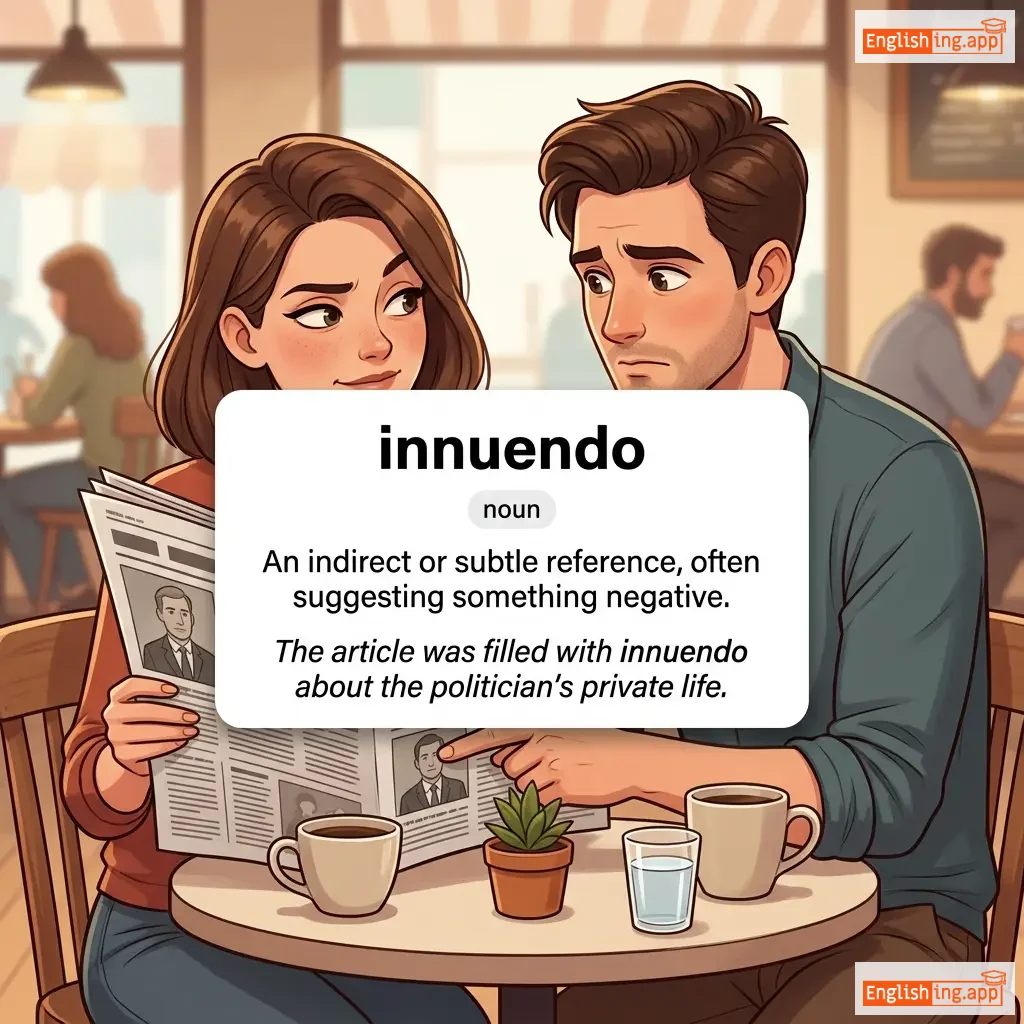
innuendo definition card — visual illustration of the meaning
noun C2
/ˌɪnjuˈɛndoʊ/
संकेत (sanket)

An indirect or subtle reference, often suggesting something negative.

"The article was filled with innuendo about the politician's private life."

"लेख में राजनेता के निजी जीवन के बारे में संकेत भरे थे।" (lekh mein raajneeta ke nijee jeevan ke baare mein sanket bhare the.)
adjective C2
/ˌɪnˌɑːpərˈtuːn/
असुविधाजनक समय (asuvidhajanak samay)

Happening at a bad or inconvenient time.

"His call came at the most inopportune moment."

"उसका कॉल सबसे असुविधाजनक समय पर आया।" (uska call sabse asuvidhajanak samay par aaya.)
noun C2
/ɪnˈkwɪzɪtər/
अन्वेषक (anveshak)

A person who asks many questions, often in an official or harsh manner.

"The inquisitor demanded detailed answers from the witness."

"अन्वेषक ने गवाह से विस्तृत उत्तर मांगे।" (Anveshak ne gawah se vistarit uttar maange.)
noun C2
/ˈɪnroʊd/
प्रगति (pragati)

An advance or significant progress, often at the expense of something else.

"The company made significant inroads into the mobile market."

"कंपनी ने मोबाइल बाजार में महत्वपूर्ण प्रगति की।" (Company ne mobile bazar mein mahatvapurn pragati ki.)
adjective C2
/ˌɪnsəˈluːbriəs/
अस्वस्थ (aswasth)

Unhealthy or not conducive to well-being.

"They moved out of the insalubrious neighborhood for the sake of their health."

"उन्होंने अपनी सेहत के लिए अस्वस्थ इलाके से बाहर जाने का फैसला किया" (Unhone apni sehat ke liye aswasth ilake se baahar jaane ka faisla kiya)
adjective C2
/ɪnˈseɪʃiət/
अतृप्त (atript)

impossible to satisfy; always wanting more

"He had an insatiate desire for power."

"उसके पास शक्ति के लिए एक अतृप्त इच्छा थी।" (uske paas shakti ke liye ek atript ichha thi.)
adjective C2
/ɪnˈskruːtəbl̩/
खुशी (khushi)

impossible to understand or interpret

"His inscrutable expression made it hard to know what he was thinking."

"जब उसे पुरस्कार मिला तो वह अपनी खुशी छिपा नहीं पाई।" (jab use puraskar mila to wah apni khushi chhupa nahin pai.)
adjective C2
/ɪnˈsɛnseɪt/
निर्दय (nirday)

lacking physical sensation or empathy; without feeling or sensitivity

"The dictator's insensate cruelty shocked the world."

"तानाशाह की निर्दय क्रूरता ने दुनिया को हैरान कर दिया।" (taanashaah ki nirday kroorta ne duniya ko hairaan kar diya.)
adjective C2
/ɪnˈsɛnʃənt/
अचेतन (achetan)

Lacking perception, consciousness, or sensation.

"The rock is an insentient object with no awareness."

"चट्टान एक अचेतन वस्तु है जिसमें कोई जागरूकता नहीं है।" (Chattan ek achetan vastu hai jismein koi jagrookta nahi hai.)
noun C2
/ɪnˈsɪɡniə/
चिह्न (chihn)

A badge or symbol that shows rank, position, or membership.

"The soldier proudly wore the insignia of his regiment."

"सैनिक ने गर्व से अपनी रेजिमेंट का चिह्न पहना।" (Sainik ne garv se apni regiment ka chihn pehna.)
insipid definition card — visual illustration of the meaning
adjective C2
/ɪnˈsɪpɪd/
नीरस (niros)

lacking flavor, interest, or excitement; dull

"The soup was insipid and needed more seasoning."

"सूप नीरस था और उसे अधिक मसाले की आवश्यकता थी।" (Soup niros tha aur use adhik masale ki avashyakta thi.)
noun C2
/ˈɪnsələns/
अवहेलना (avhelna)

rude or disrespectful behavior

"The teacher was shocked by the student's insolence."

"अध्यापक छात्र की अवहेलना से चौंक गए थे।" (Adhyapak chhatra ki avhelna se chaunk gaye the.)
adverb C2
/ˌɪnsəʊˈmʌtʃ/
इतना (itna)

to such an extent

"He was insomuch tired that he could hardly stand."

"वह इतना थका हुआ था कि वह मुश्किल से खड़ा हो पा रहा था।" (Vah itna thaka hua tha ki vah mushkil se khada ho pa raha tha.)
noun C2
/ɪnˈsuːsiəns/
उदासीनता (udasinta)

Casual lack of concern; indifference.

"She carried herself with an air of insouciance, unbothered by the challenges ahead."

"वह एक उदासीनता के साथ चल रही थी, आगामी चुनौतियों से बेपरवाह।" (Woh ek udasinta ke saath chal rahi thi, aagami chunautiyon se beparwah.)
insouciant definition card — visual illustration of the meaning
adjective C2
/ɪnˈsuːsiənt/
निर्दय (nirdai)

Showing a casual lack of concern; carefree.

"He gave an insouciant shrug and walked away."

"उसने एक निर्दय इशारा किया और चल पड़ा।" (Usne ek nirdai ishara kiya aur chal pada.)
verb C2
/ɪnˈsteɪt/
पद पर नियुक्त करना (pad par niyukt karna)

To set up in position, office, or authority.

"The board decided to instate her as the new director."

"बोर्ड ने उसे नए निदेशक के रूप में इंस्टेट करने का निर्णय लिया।" (Board ne use naye nideshak ke roop mein instate karne ka nirnay liya.)
noun C2
/ˌɪn.strəˈmɛn.təl.ɪst/
वाद्य यंत्री (vaadya yantri)

A person who plays a musical instrument.

"The instrumentalist played a beautiful solo on the violin."

"वाद्य यंत्री ने वायलिन पर एक सुंदर एकल प्रदर्शन किया।" (Vaadya yantri ne violin par ek sundar ekal pradarshan kiya.)
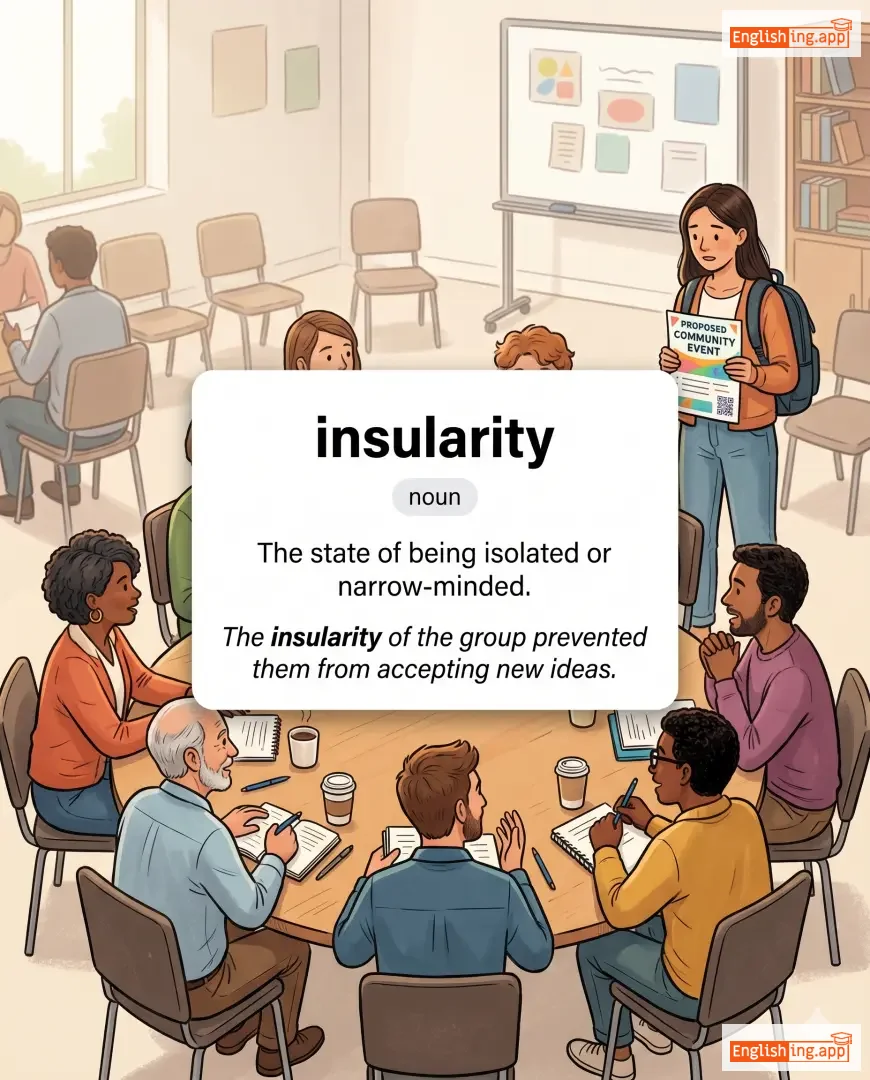
insularity definition card — visual illustration of the meaning
noun C2
/ˌɪnsjəˈlærəti/
संकीर्णता (sankirnta)

The state of being isolated or narrow-minded.

"The insularity of the group prevented them from accepting new ideas."

"ग्रुप की संकीर्णता ने उन्हें नए विचारों को स्वीकारने से रोक दिया।" (grup ki sankirnta ne unhein naye vicharon ko svikarna se rok diya.)
insuperable definition card — visual illustration of the meaning
adjective C2
/ɪnˈsuːpərəbl/
अजेय (ajey)

Impossible to overcome or surpass.

"The team faced insuperable challenges during the expedition."

"टीम ने अभियान के दौरान अजेय चुनौतियों का सामना किया।" (Team ne abhiyan ke dauran ajey chunautiyon ka samna kiya.)
adjective C2
/ˌɪnsəˈpɔːrtəbl̩/
असहनीय (asahniya)

Too extreme or difficult to be endured.

"The heat was insupportable during the long journey."

"लंबी यात्रा के दौरान गर्मी असहनीय थी।" (Lambi yatra ke dauran garmi asahniya thi.)
adjective C2
/ˌɪnsəˈprɛsəbl/
अवरोधनीय (avrodhniya)

That cannot be suppressed or restrained.

"She had an insuppressible urge to laugh during the ceremony."

"उसे समारोह के दौरान हंसने की अवरोधनीय इच्छा हो रही थी।" (Use samaroho ke dauran hansne ki avrodhniya ichcha ho rahi thi.)
noun C2
/ˌɪnsəˈrɛkʃən/
विद्रोह (vidroh)

A violent uprising against an authority or government.

"The army was called in to suppress the insurrection."

"सेना को विद्रोह को दबाने के लिए बुलाया गया था।" (Sena ko vidroh ko dabane ke liye bulaya gaya tha.)
integrative diplomacy definition card — visual illustration of the meaning
noun C2
/ˈɪn.tɪ.ɡreɪ.tɪv dɪˈpləʊ.mə.si/
समन्वयात्मक कूटनीति (samanvayaatmak kutniti)

A diplomatic approach that seeks to combine or coordinate different elements, interests, or parties into a unified whole.

"Integrative diplomacy strengthens alliances."

"समन्वयात्मक कूटनीति गठबंधनों को मजबूत करती है।" (Samanvayaatmak kutniti gathbandhon ko majboot karti hai.)
noun C2
/ɪnˈtɛɡ.jʊ.mənt/
बाहरी आवरण (baahari aavaran)

A natural outer covering, such as skin, shell, or rind.

"The snake sheds its integument as it grows."

"सांप अपना बाहरी आवरण उखाड़ता है जैसे-जैसे वह बढ़ता है।" (saap apna baahari aavaran ukhadta hai jaise-jaise vah badhta hai.)
noun C2
/ɪnˌtɛl.ɪˈdʒɛntsi.ə/
बुद्धिजीवी वर्ग (buddhijeevi varg)

The group of people engaged in intellectual and cultural pursuits in a society.

"The intelligentsia played a key role in shaping public opinion."

"बुद्धिजीवी वर्ग ने जनमत बनाने में महत्वपूर्ण भूमिका निभाई।" (buddhijeevi varg ne janmat banane mein mahatvapurn bhoomika nibhayi.)
noun C2
/ɪnˈtɛmpərəns/
असंयम (asanyam)

Lack of moderation or self-control, especially with drinking or eating.

"His intemperance in drinking ruined his health."

"उसकी असंयमितता ने उसकी सेहत को नुकसान पहुँचाया।" (uski asanyamitā ne uski sehat ko nuksān pahunchāyā.)
adjective C2
/ɪnˈtɛmpərət/
अविनीत (avinit)

Lacking self-control; immoderate, especially in indulgence.

"The politician's intemperate remarks caused controversy."

"राजनीतिक नेता की अविनीत टिप्पणियों ने विवाद पैदा किया।" (rajnitik neta ki avinit tippaniyon ne vivad paida kiya.)
noun C2
/ɪnˈtɛnʃən/
अंतर्निहित अर्थ (antarnihit arth)

The internal content of a concept; the set of attributes implied by a word or phrase.

"The intension of the word 'dog' includes being a mammal and domesticated."

"'कुत्ता' शब्द का इंटेंशन में स्तनपायी होना और पालतू होना शामिल है।" ('kutta' shabd ka intension mein stanpayi hona aur paaltu hona shaamil hai.)
verb C2
/ɪnˈtɜːr/
दफनाना (dafnana)

To bury a dead body in the ground.

"They decided to inter the soldier with full honors."

"वे सैनिक को पूर्ण सम्मान के साथ दफनाने का निर्णय लिया।" (Ve sainik ko poorn sammaan ke saath dafnaane ka nirnay liya.)
verb C2
/ˌɪntərˈsiːd/
दखल देना (dakhal dena)

to act or plead on behalf of someone in difficulty or trouble; to intervene between parties to help resolve a dispute

"She interceded with the teacher to give her brother another chance."

"वह अपने भाई को और एक मौका देने के लिए शिक्षक से दखल दे रही थी।" (Woh apne bhai ko aur ek mauka dene ke liye shikshak se dakhal de rahi thi.)
noun C2
/ˌɪntərˈsɛʃən/
सिफारिश (sifarish)

the act of intervening or pleading on behalf of another person

"The prisoner was released due to the intercession of influential leaders."

"कैदी को प्रभावशाली नेताओं की सिफारिश पर रिहा किया गया था।" (Kaidi ko prabhavshali netaon ki sifarish par riha kiya gaya tha.)