Vocabulaires

Découvrez, apprenez et maîtrisez le vocabulaire anglais

noun C2
/ˈskɜː.vi/
स्कर्वी रोग (skorvi rog)

A disease caused by a deficiency of vitamin C, leading to weakness, gum disease, and bleeding.

"Sailors often suffered from scurvy during long sea voyages without fresh fruits."

"लंबी समुद्री यात्राओं के दौरान ताजे फल के बिना नाविक अक्सर स्कर्वी रोग से ग्रस्त हो जाते थे।" (Lambi samudri yatraon ke dauran taje phal ke bina navik aksar skorvi roge se grast ho jate the.)
adjective C2
/ˈsiːmi/
नीच, कलंकीत (neech, kalankit)

Morally degraded, unpleasant, or sordid.

"The novel reveals the seamy side of city life."

"उपन्यास शहर के जीवन के नीच पक्ष को प्रकट करता है।" (Upanyas shaher ke jeevan ke neech paksh ko prakat karta hai.)
adjective C2
/sɪˈbeɪʃəs/
सीबम संबंधित (seebam sambandhit)

Relating to or secreting sebum, an oily substance from the skin.

"Acne is often caused by overactive sebaceous glands."

"मुँहासे अक्सर अधिक सक्रिय सीबेसियस ग्रंथियों के कारण होते हैं।" (Munhase aksar adhik sakriya sebeshius granthiyon ke karan hote hain.)
noun C2
/ˈsiːkənt/
सीकेंट रेखा (secent rekha)

A straight line that intersects a curve at two or more points.

"In geometry, a secant cuts the circle at two distinct points."

"ज्यामिति में, एक सीकेंट रेखा वृत्त को दो अलग-अलग बिंदुओं पर काटती है।" (Jyaamiti mein, ek secant rekha vrutt ko do alag-alag binduon par kaatati hai.)
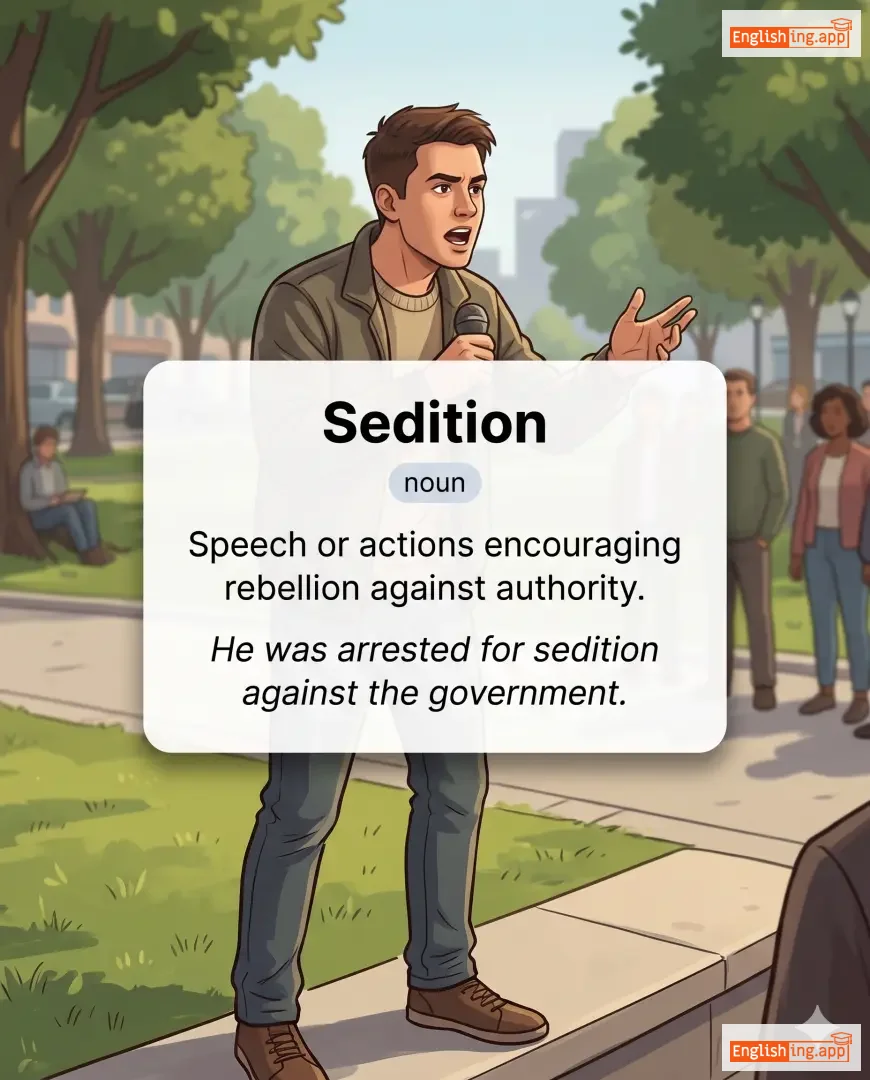
Sedition definition card — visual illustration of the meaning
noun C2
/sɪˈdɪʃən/
राजद्रोह (raajdroh)

Speech or actions encouraging rebellion against authority.

"He was arrested for sedition against the government."

"उसे सरकार के खिलाफ राजद्रोह के आरोप में गिरफ्तार किया गया था।" (Use sarkar ke khilaaf raajdroh ke aarop mein giraftaar kiya gaya tha.)
adjective C2
/sɪˈdɪʃəs/
विद्रोही (vidrohi)

Encouraging rebellion against authority.

"The activist spread seditious pamphlets among the crowd."

"कार्यकर्ता ने भीड़ के बीच विद्रोही पर्चे फैलाए।" (Karyakarta ne bheed ke beech vidrohi parche phailaye.)
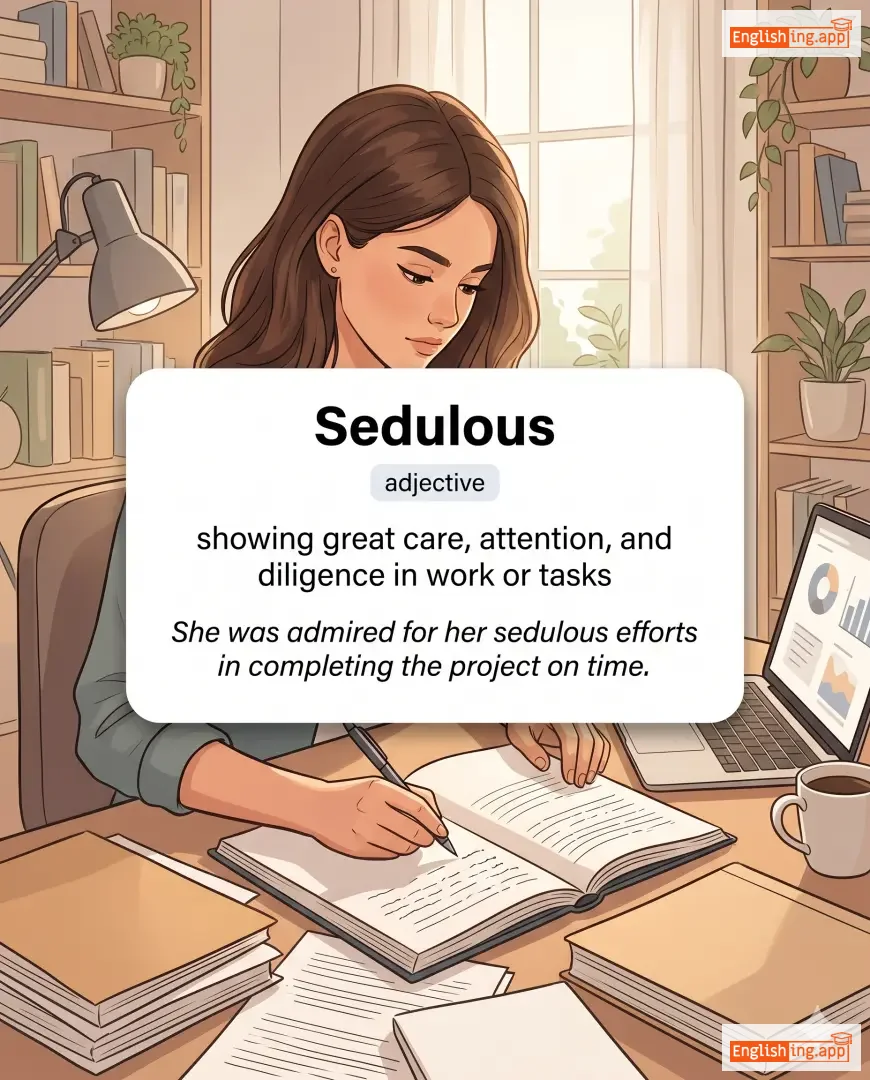
Sedulous definition card — visual illustration of the meaning
adjective C2
/ˈsɛdʒʊləs/
परिश्रमी (parishrami)

showing great care, attention, and diligence in work or tasks

"She was admired for her sedulous efforts in completing the project on time."

"उसकी समय पर प्रोजेक्ट पूरा करने के लिए मेहनत की सराहना की गई थी।" (Uski samay par project poora karne ke liye mehnat ki sarahna ki gayi thi.)
adjective C2
/ˈsiːmli/
उपयुक्त (upayukt)

proper or appropriate in behavior or appearance

"It was not seemly to argue loudly during the ceremony."

"समारोह के दौरान जोर से बहस करना उचित नहीं था।" (Samaroh ke dauran jor se behas karna uchit nahin tha.)
noun C2
/ˈseɪnjər/
जमींदार (jameendar)

A feudal lord; a man of authority in medieval Europe.

"The seignior demanded taxes from the peasants."

"सेनियर ने किसानों से कर की मांग की।" (Senior ne kisāno se kar kī māng kī.)
noun C2
/seɪn/
बड़ा जाल (bada jaal)

A large fishing net that hangs vertically in the water.

"The fishermen cast their seine into the river."

"मछुआरों ने अपनी बड़ी जाल नदी में फेंका।" (Machhuaaron ne apni badi jaal nadi mein phenka.)
noun C2
/ˈsaɪz.mə.ɡræf/
सिस्मोग्राफ (sismograf)

An instrument that measures and records details of earthquakes, such as force and duration.

"The seismograph detected a strong tremor in the area."

"सिस्मोग्राफ ने क्षेत्र में एक मजबूत झटका detect किया।" (Sismograf ne kshetra mein ek majboot jhatka detect kiya.)
noun C2
/ˌself əˈbeɪs.mənt/
स्वयं को हीन बनाना (svayam ko heen banana)

The act of belittling or humiliating oneself.

"His constant self-abasement made others uncomfortable."

"उसकी निरंतर स्वयं को हीन बनाने की आदत दूसरों को असहज कर देती थी।" (Uski nirantar svayam ko heen banane ki aadat doosron ko asahaj kar deti thi.)
adjective C2
/ˌsɛm.iˈsɪv.ə.laɪzd/
अर्धसभ्य (ardh sabhya)

Partially civilized; having some aspects of civilization but not fully developed.

"The tribe was described as semicivilized by early explorers."

"जनजाति को प्रारंभिक अन्वेषकों द्वारा अर्धसभ्य बताया गया था।" (Janjati ko prarambhik anvakshako dwara ardh sabhya bataya gaya tha.)
adjective C2
/ˌsɛm.iˈkɒn.ʃəs/
आधिकारिक रूप से सचेत (aadha sachhetan)

Only partly conscious; not fully aware of surroundings.

"He was semiconscious after the accident and could barely respond."

"वह दुर्घटना के बाद सेमीकॉन्सियस था और मुश्किल से प्रतिक्रिया कर सकता था।" (vah durghatna ke baad semiconscious tha aur mushkil se pratikriya kar sakta tha.)
noun C2
/ˈsɛm.ɪ.nɛr.i/
धर्मशाला (dharmshala)

A school or college for training priests, ministers, or rabbis.

"He decided to enroll in a seminary to study theology."

"उसने धर्मशाला में प्रवेश लेने का फैसला किया ताकि वह धर्मशास्त्र का अध्ययन कर सके।" (Usne dharmshala mein pravesh lene ka faisla kiya taki woh dharmshastra ka adhyayan kar sake.)
noun C2
/səˈnɛs.əns/
बुढ़ापा (budhapa)

The process of growing old or the condition of aging.

"The biologist studied senescence in plants to understand aging."

"जैव विज्ञानी ने बुढ़ापे को समझने के लिए पौधों में बुढ़ापे की प्रक्रिया का अध्ययन किया।" (jaiv vigyani ne budhape ko samajhne ke liye podhon mein budhape ki prakriya ka adhyayan kiya.)
noun C2
/sɛnˈsɔːrɪəm/
सेंसरी केंद्र (sensoriya kendra)

The part of the brain or mind concerned with the reception and interpretation of sensory stimuli.

"The patient’s sensorium was clouded after the accident."

"दुर्घटना के बाद रोगी का सेंसोरियम धुंधला हो गया था।" (durghatna ke baad rogi ka sensoriya kendra dhundhla ho gaya tha.)
adjective C2
/sɛnˈtɛnʃəs/
उपदेशात्मक; नैतिक उपदेश देने वाला (upadeshatmak; naitik upadesh dene wala)

Given to moralizing in a pompous or affected manner.

"His sententious remarks annoyed the audience."

"उसके उपदेशात्मक टिप्पणी ने श्रोताओं को परेशान कर दिया।" (Uske upadeshatmak tippani ne shrotavon ko pareshan kar diya.)
noun C2
/ˈsɛnʃəns/
चेतना; अनुभूतिकता (chetna; anubhootikta)

The capacity to feel, perceive, or experience subjectively.

"Many argue that animals possess sentience."

"कई लोग तर्क करते हैं कि जानवरों में चेतना होती है।" (Kai log tark karte hain ki jaanwaron mein chetna hoti hai.)
adjective C2
/ˈsɛpərəbəl/
विभाज्य (vibhajy)

Capable of being separated or divided.

"The two issues are separable and should be discussed independently."

"दो मुद्दे विभाज्य हैं और उन्हें स्वतंत्र रूप से चर्चा करनी चाहिए।" (do mudde vibhajy hain aur unhe svatantra roop se charcha karni chahiye.)
adjective C2
/sɛpˈtɛnɪəl/
सात वर्षों में होने वाला (sat varsho mein hone wala)

Occurring every seven years.

"The festival is a septennial tradition in the village."

"त्योहार गाँव में सात वर्षों में एक परंपरा है।" (tyohar gaon mein sat varsho mein ek parampara hai.)
noun C2
/ˈsɛpəlkər/
मकबरा (makbara)

A small room or monument, cut in rock or built of stone, in which a dead person is buried.

"The ancient king was laid to rest in a grand sepulcher."

"प्राचीन राजा को एक भव्य मकबरे में दफनाया गया था।" (Prachin raja ko ek bhavya makbare mein dafnaya gaya tha.)
adjective C2
/səˈpʌlkrəl/
समाधि से संबंधित, उदास (samadhi se sambandhit, udaas)

Relating to a tomb or burial; gloomy, dismal.

"The abandoned house had a sepulchral silence about it."

"परित्यक्त घर में एक समाधि जैसी खामोशी थी।" (Parityakt ghar mein ek samadhi jaisi khamoshi thi.)
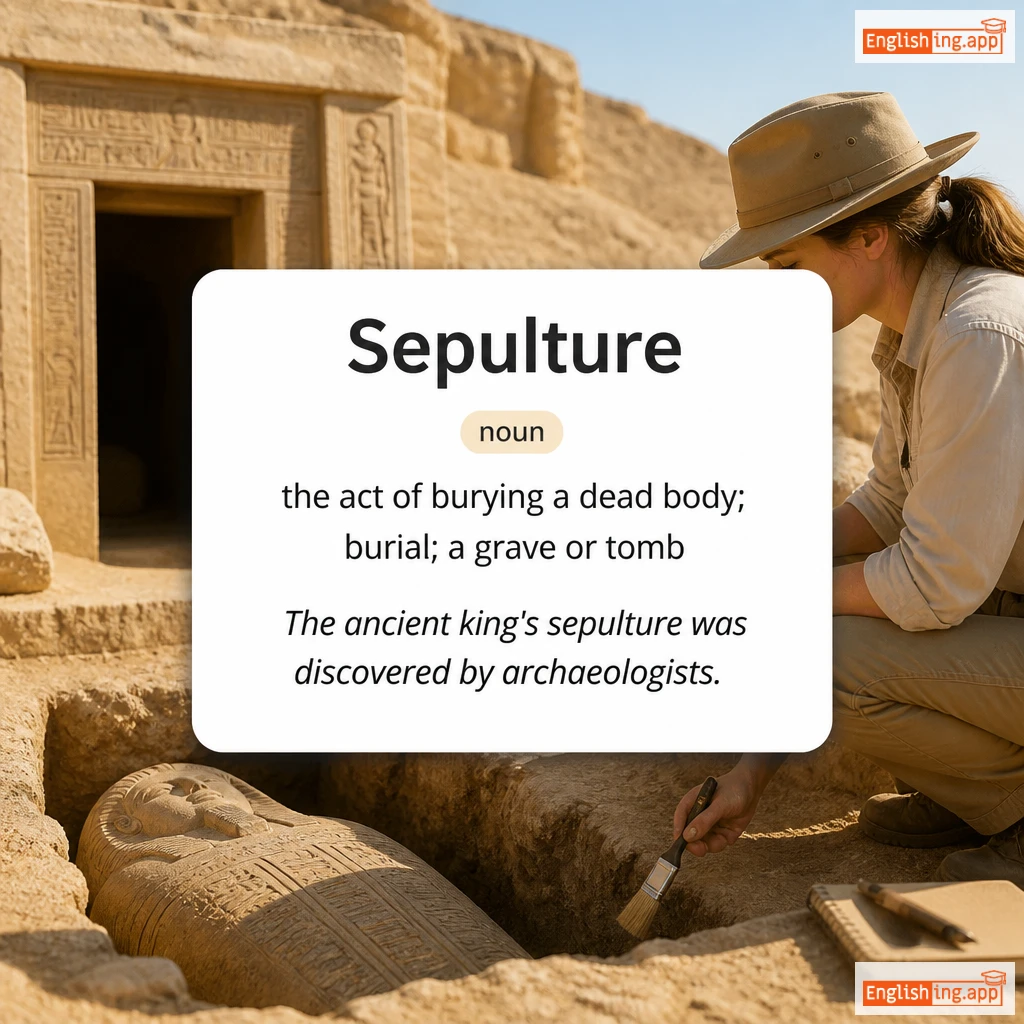
Sepulture definition card — visual illustration of the meaning
noun C2
/ˈsɛpəlˌtʃər/
दफन; कब्रगाह; (dafan; kabragah)

the act of burying a dead body; burial; a grave or tomb

"The ancient king's sepulture was discovered by archaeologists."

"प्राचीन राजा की सेपल्चर पुरातत्वविदों द्वारा खोजी गई थी।" (da prachin raja ki sepaltchar puratatvavidhon dwara khoji gayi thi.)
adjective C2
/sɪˈkweɪʃəs/
अंधाधुंध अनुसरण करने वाला (andhadhundh anusarann karne wala)

Lacking independence of thought; blindly following.

"The sequacious students never questioned their teacher's opinions."

"सिक्वेइशस छात्र कभी अपने शिक्षक के विचारों पर सवाल नहीं उठाते।" (Sikweishas chatra kabhi apne shikshak ke vicharon par sawal nahi uthate.)
noun C2
/sɪˈkwiːlə/
परिणाम (parinaam)

A condition that is the consequence of a previous disease or injury.

"Lung scarring can be a sequela of severe pneumonia."

"गंभीर न्यूमोनिया का एक सिक्वेला फेफड़ों में दाग हो सकता है।" (gambhir pneumonia ka ek sequela fefdon mein daag ho sakta hai.)
adjective C2
/ˈsiːkwənt/
अगला (agla)

Following in order or as a result.

"The sequent events changed the course of history."

"अगले घटनाओं ने इतिहास की दिशा को बदल दिया।" (agle ghatnaon ne itihas ki disha ko badal diya.)
verb C2
/sɪˈkwɛstreɪt/
कब्ज़ा करना (kabza karna)

To take legal possession of assets until a debt is paid or disputes are resolved.

"The court decided to sequestrate the company's property."

"कोर्ट ने कंपनी की संपत्ति को कब्ज़ा करने का निर्णय लिया।" (court ne company ki sampatti ko kabza karne ka nirnay liya.)
noun C2
/ˈsɛrəf/
देवदूत (devdoot)

An angelic being associated with light and purity, often depicted as a high-ranking angel in Christian theology.

"The stained-glass window depicted a seraph with outstretched wings."

"उधारी वाली खिड़की में एक सेराफ़ को विस्तारित पंखों के साथ चित्रित किया गया था।" (udhari wali khidki mein ek seraph ko vistarit pankhon ke saath chitrit kiya gaya tha.)
adjective C2
/səˈræfɪk/
स्वर्गदूत जैसा (swargdoot jaisa)

Of or like a seraph; angelic, pure, and blissful.

"She gave him a seraphic smile that calmed his fears."

"उसने उसे एक स्वर्गदूत जैसा मुस्कान दिया जिसने उसके डर को शांत किया।" (Usne use ek swargdoot jaisa muskaan diya jisne uske dar ko shaant kiya.)
adjective C2
/sɪər/
सूखा (sookha)

Dry or withered, especially vegetation.

"The sere leaves crumbled under his feet."

"सूखे पत्ते उसके पैरों तले रौंदे गए।" (Sookhe patte uske pairon tale raunde gaye.)
noun C2
/ˈsɜːfdəm/
गुलामी (gulaami)

The status or condition of being a serf, bound to work for a lord.

"Many peasants in medieval Europe lived under serfdom."

"कई किसान मध्यकालीन यूरोप में गुलामी की स्थिति में रहते थे।" (Kai kisaan madhyakaaleen Europe mein gulaami ki sthiti mein rahte the.)
noun C2
/ˈsɑːrdʒənt ət ɑːrmz/
सर्जेंट-एट-आर्म्स (sargent-at-arms)

An officer responsible for maintaining order during meetings or legislative sessions.

"The sergeant-at-arms escorted the disruptive member out of the hall."

"सर्जेंट-एट-आर्म्स ने विघटनकारी सदस्य को सभा से बाहर किया।" (Sargent-at-arms ne vighatkari sadasya ko sabha se bahar kiya.)
verb C2
/ˈsɛreɪt/
दांतदार किनारा बनाना (daantdaar kinara banana)

To make a saw-toothed edge or notched margin.

"The craftsman serrated the knife blade for better cutting."

"कारीगर ने बेहतर काटने के लिए चाकू की धार दांतदार बनायी।" (Karigar ne behtar kaatne ke liye chaaku ki dhaar daantdaar banayi.)
adjective C2
/ˈsɛrid/
घनसन्निबद्ध (ghanasannibaddh)

pressed or crowded together, often in rows or ranks

"The soldiers stood in serried ranks, ready for inspection."

"सैनिक घनसन्निबद्ध पंक्तियों में खड़े थे, निरीक्षण के लिए तैयार।" (Sainik ghanasannibaddh panktiyon mein khade the, nirikshan ke liye tayar.)
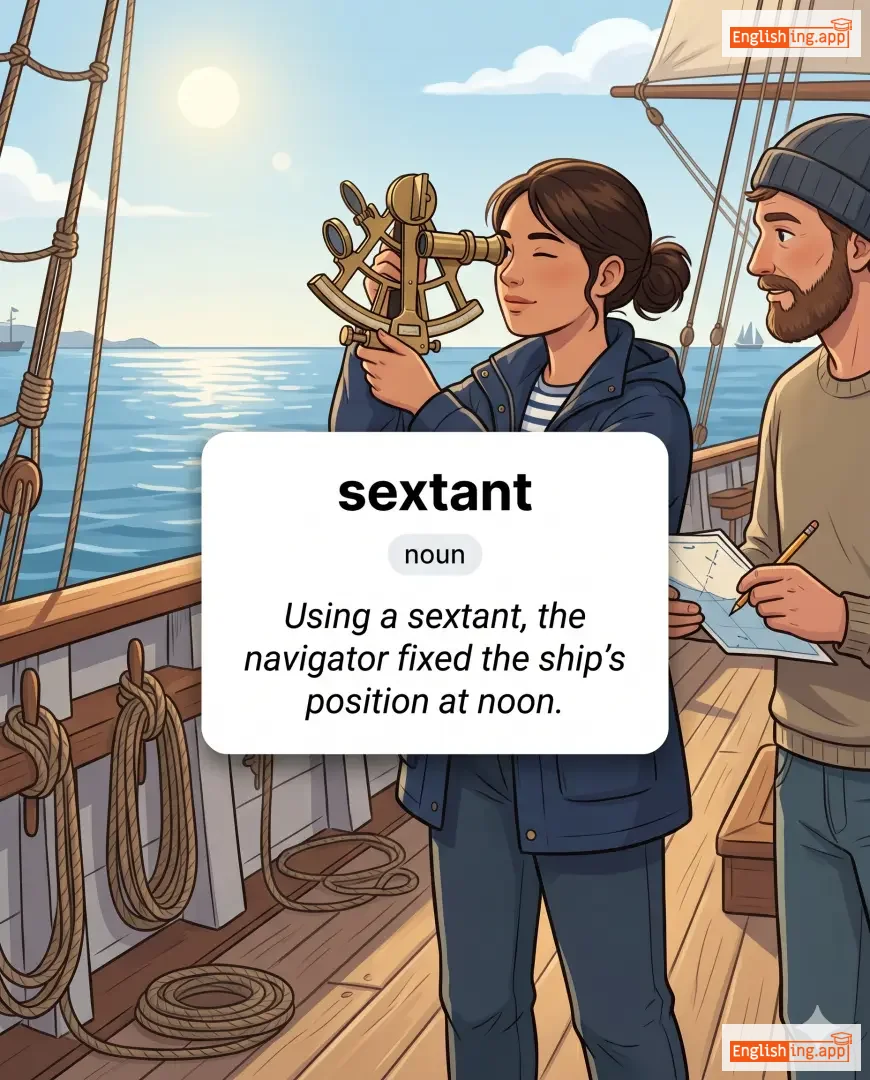
sextant definition card — visual illustration of the meaning
noun C2
/ˈsɛkstənt/
सेक्सटेंट (sekstant)

a navigational instrument with a graduated arc of 60°, used to measure the angle between a celestial object and the horizon

"Using a sextant, the navigator fixed the ship’s position at noon."

"एक सेक्सटेंट का उपयोग करते हुए, नाविक ने दोपहर में जहाज की स्थिति तय की।" (Ek sekstant ka upyog karte hue, navik ne dopahar mein jahaj ki sthiti tay ki.)
noun C2
/sɛkˈstɛt/
छह लोगों का संगीत दल (chhah logon ka sangeet dal)

a group of six people playing music or a piece written for six performers

"The jazz sextet filled the small club with a warm, layered sound."

"जैज सेक्सटेट ने छोटे क्लब को गर्म, स्तरित ध्वनि से भर दिया।" (Jaij seksatet ne chhote klub ko garm, starit dhvani se bhar diya.)
verb C2
/sɛkˈstuːpəl/
छह गुना करना (chhah guna karna)

to make or become six times as great or as many

"Within two quarters, the campaign sextupled their daily sign-ups."

"दो तिमाहियों में, अभियान ने उनके दैनिक साइन-अप्स को छह गुना बढ़ा दिया।" (Do timahiyon mein, abhiyaan ne unke dainik sign-ups ko chhah guna badha diya.)
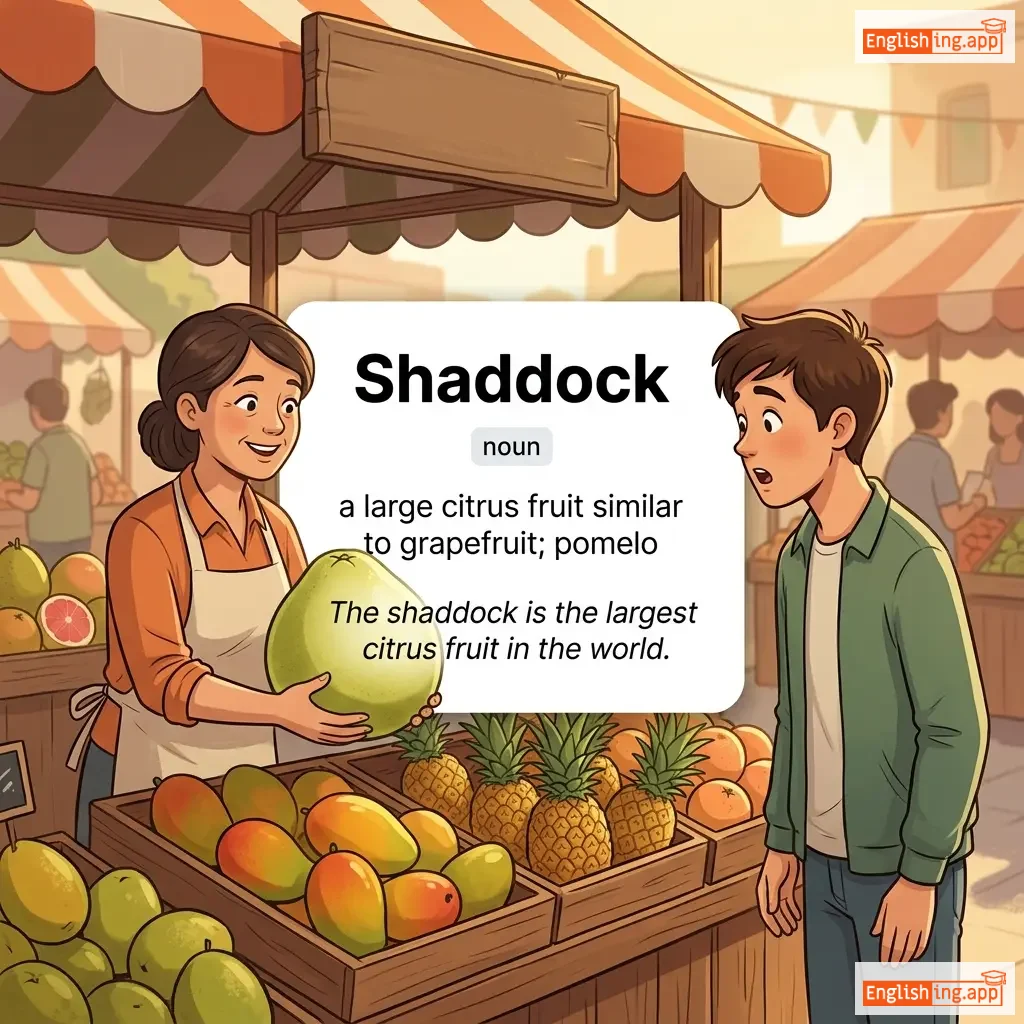
Shaddock definition card — visual illustration of the meaning
noun C2
/ˈʃæd.ək/
शैडोक (shaidak)

a large citrus fruit similar to grapefruit; pomelo

"The shaddock is the largest citrus fruit in the world."

"शैडोक दुनिया का सबसे बड़ा खट्टा फल है।" (shaidak duniya ka sabse bada khatta phal hai.)
noun C2
/ˌʃæŋɡriˈlɑː/
कल्पित स्वर्ग (kalpit swarg)

a remote, beautiful, imaginary place where life is perfect and peaceful

"They described the island as a modern-day Shangri-La."

"उन्होंने द्वीप को एक आधुनिक काल्पनिक स्वर्ग के रूप में वर्णित किया।" (Unhone dweep ko ek aadhunik kalpnik swarg ke roop mein varnit kiya.)
noun C2
/ʃiːf/
गेहूं की बंडल (gehun ki bundel)

a bundle of grain stalks laid lengthwise and tied together after reaping; a bundle of objects tied together

"The farmer carried a sheaf of wheat on his shoulder."

"किसान अपने कंधे पर गेहूं का शीफ़ ले कर चल रहा था।" (Kisan apne kandhe par gehun ka sheaf le kar chal raha tha.)
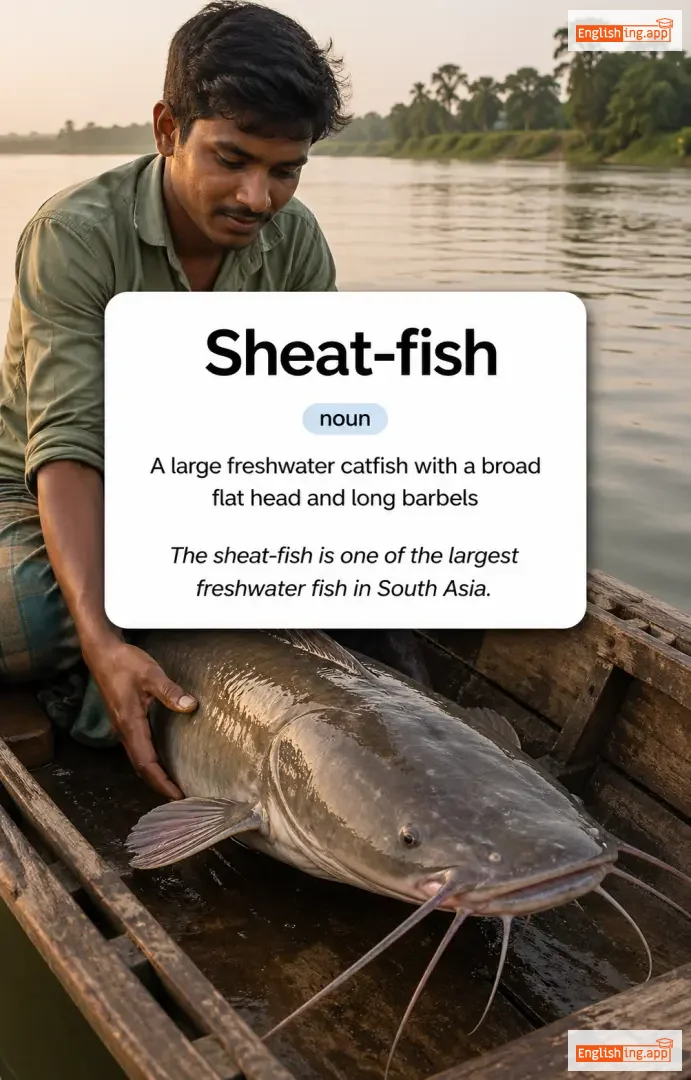
Sheat-fish definition card — visual illustration of the meaning
noun C2
/ʃiːt fɪʃ/
बोयल मछली (boayal machhli)

A large freshwater catfish with a broad flat head and long barbels

"The sheat-fish is one of the largest freshwater fish in South Asia."

"बोयल मछली दक्षिण एशिया की सबसे बड़ी मीठे पानी की मछलियों में से एक है।" (boayal machhli dakshin ashiya ki sabse badi meethe pani ki machhliyon mein se ek hai)
verb C2
/ʃiːð/
खाप में डालना (khap mein daalna)

to put a sword or knife back into its cover

"He quickly sheathed his sword after the duel."

"वह द्वंद्वयुद्ध के बाद जल्दी से अपनी तलवार खापे में डाल दी।" (Vah dvandvayudh ke baad jaldi se apni talwar khape mein daal di.)
noun C2
/ˈʃɪbəˌlɛθ/
विशिष्ट समूह को पहचानने के लिए प्रयोग होने वाला वाक्य या विश्वास (vishisht samuh ko pahchanne ke liye prayog hone wala vaakya ya vishwas)

A custom, phrase, or belief distinguishing a particular group of people, often used to identify outsiders.

"The phrase became a political shibboleth during the campaign."

"यह वाक्य चुनावी प्रचार के दौरान एक राजनीतिक शिब्बोलेथ बन गया था।" (Yeh vaakya chunaavi prachaar ke dauraan ek raajneetik shibboleth ban gaya tha.)
adjective C2
/ˈʃɪft.ləs/
आलसी (aalsi)

Lacking ambition or the ability to accomplish anything; lazy and unmotivated.

"He was seen as a shiftless young man with no goals."

"उसे एक आलसी युवक के रूप में देखा गया, जिसके पास कोई लक्ष्य नहीं था।" (Use ek aalsi yuva ke roop mein dekha gaya, jiske paas koi lakshya nahi tha.)
adjective C2
/ˈʃɑːpwɔːrn/
पुराना / फीका (purana / feeka)

worn or faded from being displayed in a shop; no longer fresh or original

"The shopworn shoes were sold at a discount."

"शॉपवॉर्न जूते डिस्काउंट पर बेचे गए थे।" (Shopworn joote discount par beche gaye the.)
verb C2
/ʃʌk/
छिलका निकालना (chhilka nikaalna)

To remove the outer covering, such as the husk of corn or shell of shellfish.

"She learned how to shuck oysters quickly."

"उसने जल्दी से सीप खोलने का तरीका सीखा।" (Usne jaldi se seep kholne ka tareeka seekha.)
noun C2
/ˈʃaɪstər/
धोखेबाज़ (dhokhebaz)

a person, especially a lawyer, who uses unscrupulous or dishonest methods

"The businessman was exposed as a shyster who cheated clients."

"व्यवसायी को एक धोखेबाज़ के रूप में उजागर किया गया था, जिसने ग्राहकों को धोखा दिया।" (Vyavsayee ko ek dhokhebaz ke roop mein ujagar kiya gaya tha, jisne graahakon ko dhokha diya.)
noun C2
/ˈsɪbɪləns/
सिसिलनस ध्वनि (sibilans dhvani)

A hissing or hushing sound, especially in speech with 's' or 'sh'.

"The poet used sibilance to create a soft, hissing effect in the verse."

"कवि ने कविता में नरम, खिसकती ध्वनि बनाने के लिए सिबिलन्स का उपयोग किया।" (Kavi ne kavita mein naram, khiskti dhvani banane ke liye sibilans ka upyog kiya.)
adjective C2
/ˈsɪbɪlənt/
हिसिंग ध्वनि से युक्त (hissing dhvani se yukt)

Making or characterized by a hissing sound.

"The word 'snake' starts with a sibilant sound."

"'स्नेक' शब्द एक सिबिलेंट ध्वनि से शुरू होता है।" ('Snake' shabd ek sibilant dhvani se shuru hota hai.)