Vocabulaires

Découvrez, apprenez et maîtrisez le vocabulaire anglais

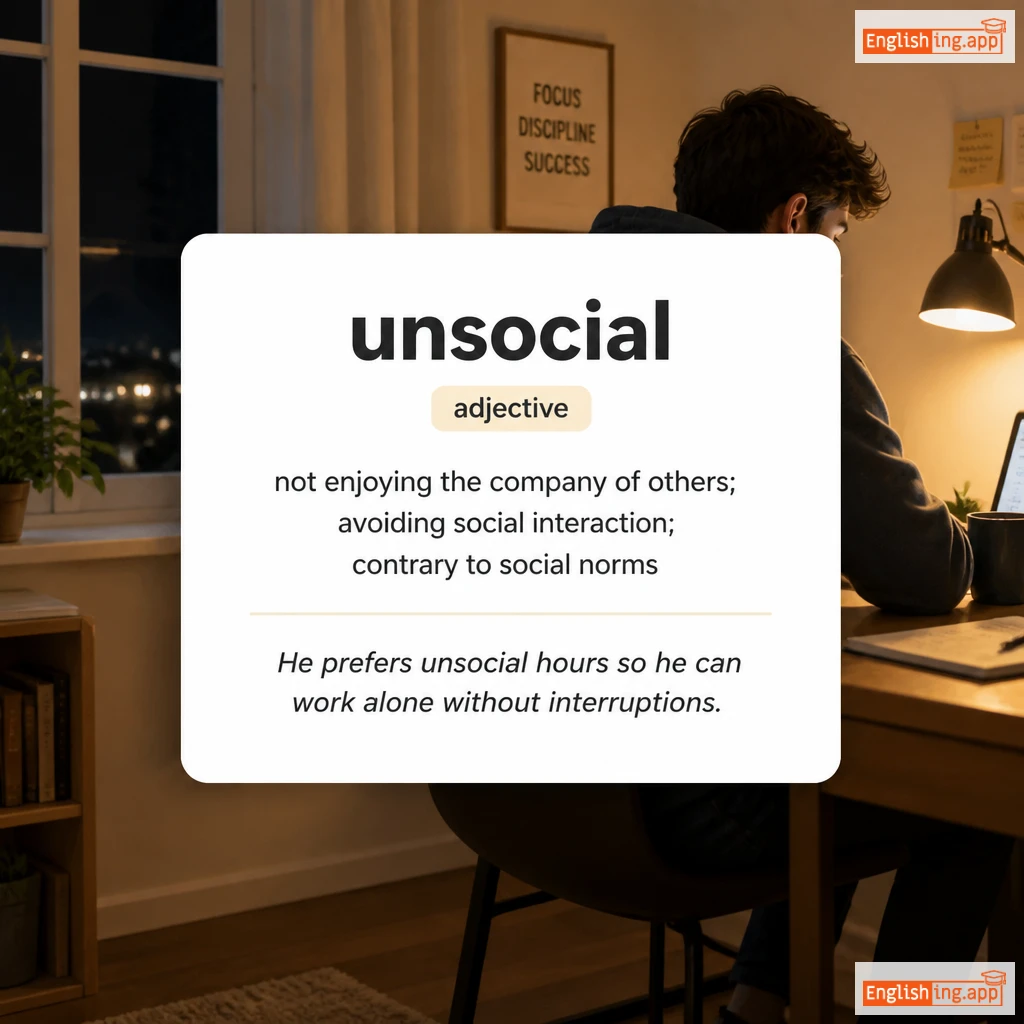
unsocial definition card — visual illustration of the meaning
adjective C1
/ʌnˈsəʊʃəl/
asocial (asocial)

not enjoying the company of others; avoiding social interaction; contrary to social norms

"He prefers unsocial hours so he can work alone without interruptions."

"Il préfère des horaires asociaux pour travailler seul." (il prefere des horaires asociaux pour travailler seul)
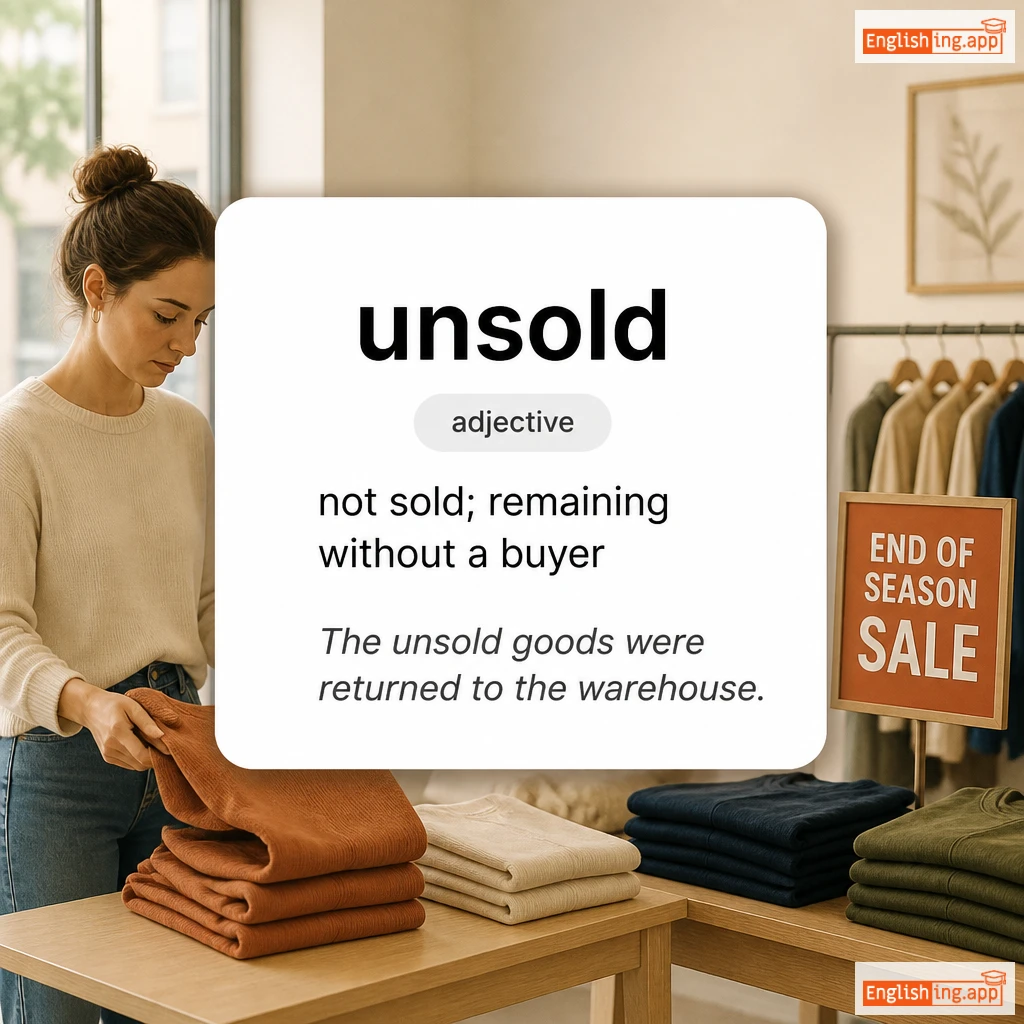
unsold definition card — visual illustration of the meaning
adjective C1
/ʌnˈsoʊld/
invendu (invendu)

not sold; remaining without a buyer

"The unsold goods were returned to the warehouse."

"Les marchandises invendues ont été retournées à l’entrepôt." (les marchandises invendues ont ete retournees a l entrepot)
adjective C1
/ˌʌnsəˈfɪstɪˌkeɪtɪd/
non sophistiqué (non sophistique)

Lacking worldly experience, refinement, or complexity.

"The villagers led an unsophisticated but happy life."

"Les villageois menaient une vie non sophistiquée mais heureuse." (Les villageois menaient une vie non sophistiquée mais heureuse.)
adjective C1
/ʌnˈspiːkəbl/
indicible (indicible)

too bad or shocking to be expressed in words

"The survivors endured unspeakable horrors during the war."

"Les survivants ont enduré des horreurs indicibles pendant la guerre." (Les survivants ont enduré des horreurs indicibles pendant la guerre.)
adjective C1
/ʌnˈsteɪtɪd/
non exprimé (non exprime)

not expressed directly in words; implied or left unsaid

"The contract included several unstated expectations."

"Le contrat incluait plusieurs attentes non exprimées." (Le contrat incluait plusieurs attentes non exprimées.)
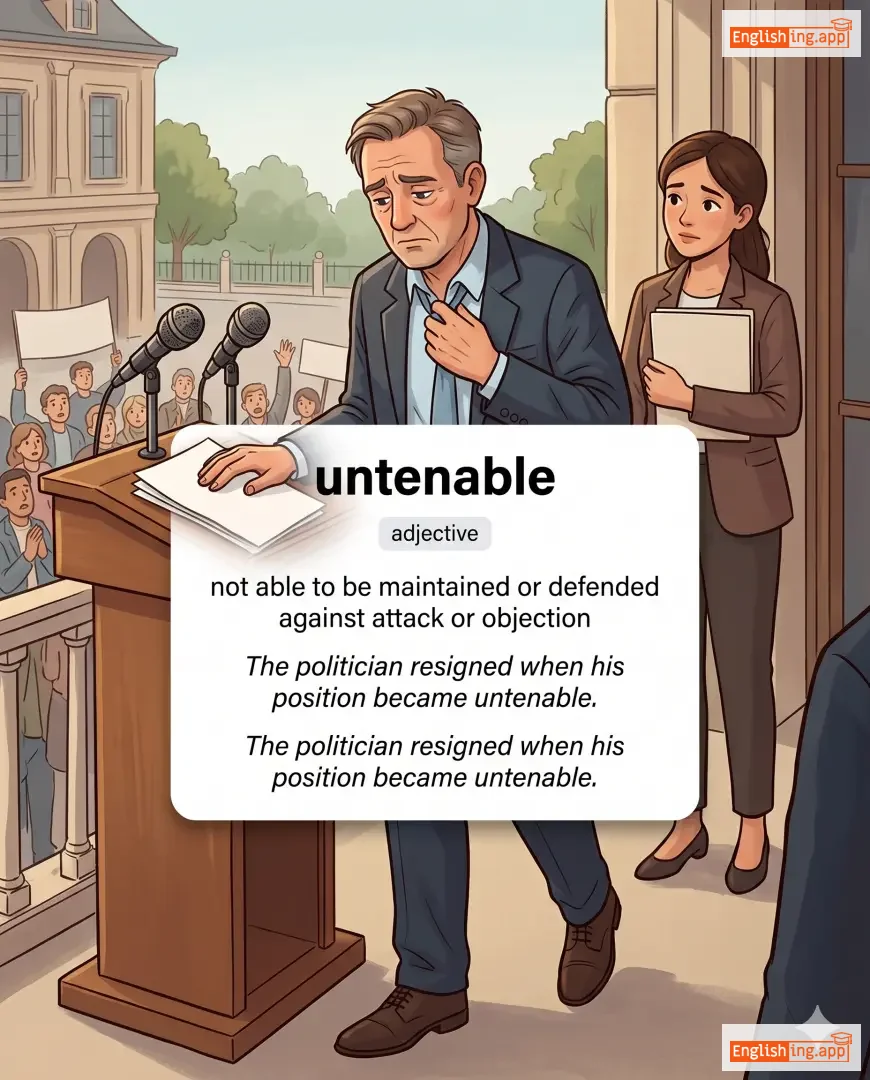
untenable definition card — visual illustration of the meaning
adjective C1
/ʌnˈtɛnəbl/
intenable (intenable)

not able to be maintained or defended against attack or objection

"The politician resigned when his position became untenable."

"Le politicien a démissionné lorsque sa position est devenue intenable." (Le politicien a démissionné lorsque sa position est devenue intenable.)
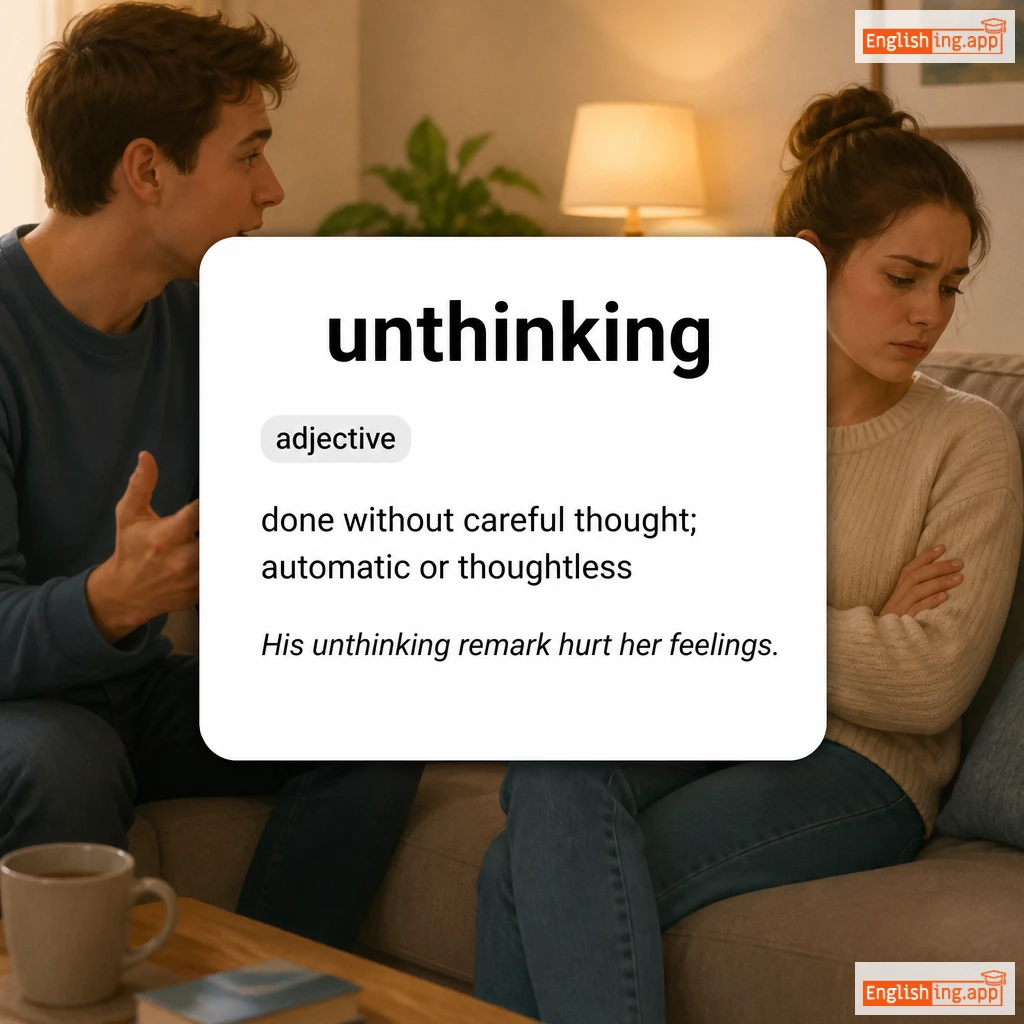
unthinking definition card — visual illustration of the meaning
adjective C1
/ʌnˈθɪŋkɪŋ/
irréfléchi (irreflechi)

done without careful thought; automatic or thoughtless

"His unthinking remark hurt her feelings."

"Sa remarque irréfléchie a blessé ses sentiments." (sa remarque irreflechie a blesse ses sentiments)
adjective C1
/ʌnˈtaɪmli/
prématuré (premature)

Happening or done at an unsuitable or premature time.

"His untimely death shocked the entire community."

"Sa mort prématurée a choqué toute la communauté." (Sa mort prématurée a choqué toute la communauté.)
adjective C1
/ʌnˈtaɪərɪŋ/
inlassable; persévérant; infatigable (inlassable; perseverant; infatigable)

continuing without stopping; persistent; tireless

"Her untiring efforts finally led to success."

"Ses efforts inlassables ont finalement conduit au succès." (Ses efforts inlassables ont finalement conduit au succès.)
adjective C1
/ʌnˈtoʊld/
innombrable (innombrable)

Too great or numerous to be described or counted.

"The project caused untold stress for everyone involved."

"Le projet a causé un stress innombrable pour tous les impliqués." (Le projet a causé un stress innombrable pour tous les impliqués.)
adjective C1
/ʌnˈtʌtʃəbəl/
intouchable; au-delà de la critique ou de l'attaque (intouchable; au-dela de la critique ou de l'attaque)

not able to be touched or affected; beyond criticism or attack

"The CEO seemed untouchable despite the scandal."

"Le PDG semblait intouchable malgré le scandale." (Le PDG semblait intouchable malgre le scandale.)
adjective C1
/ʌnˈvaɪəbl/
invivable (invivable)

Not capable of working successfully; not feasible or practical.

"The project was deemed unviable due to high costs."

"Le projet a été jugé invivable en raison des coûts élevés." (Le projet a ete juge invivable en raison des couts eleves.)
adjective C1
/ʌnˈvɔɪst/
non exprimé (non exprime)

not expressed in speech; in phonetics, a sound produced without vocal cord vibration

"The student kept her opinion unvoiced during the meeting."

"L'étudiante a gardé son opinion non exprimée pendant la réunion." (L'étudiante a gardé son opinion non exprimée pendant la réunion.)
unwarranted definition card — visual illustration of the meaning
adjective C1
/ʌnˈwɒrəntɪd/
injustifié (injustifie)

Not justified or authorized; lacking good reason.

"The employee faced unwarranted criticism from his manager."

"L'employé a fait face à des critiques injustifiées de son responsable." (L'employé a fait face à des critiques injustifiées de son responsable.)
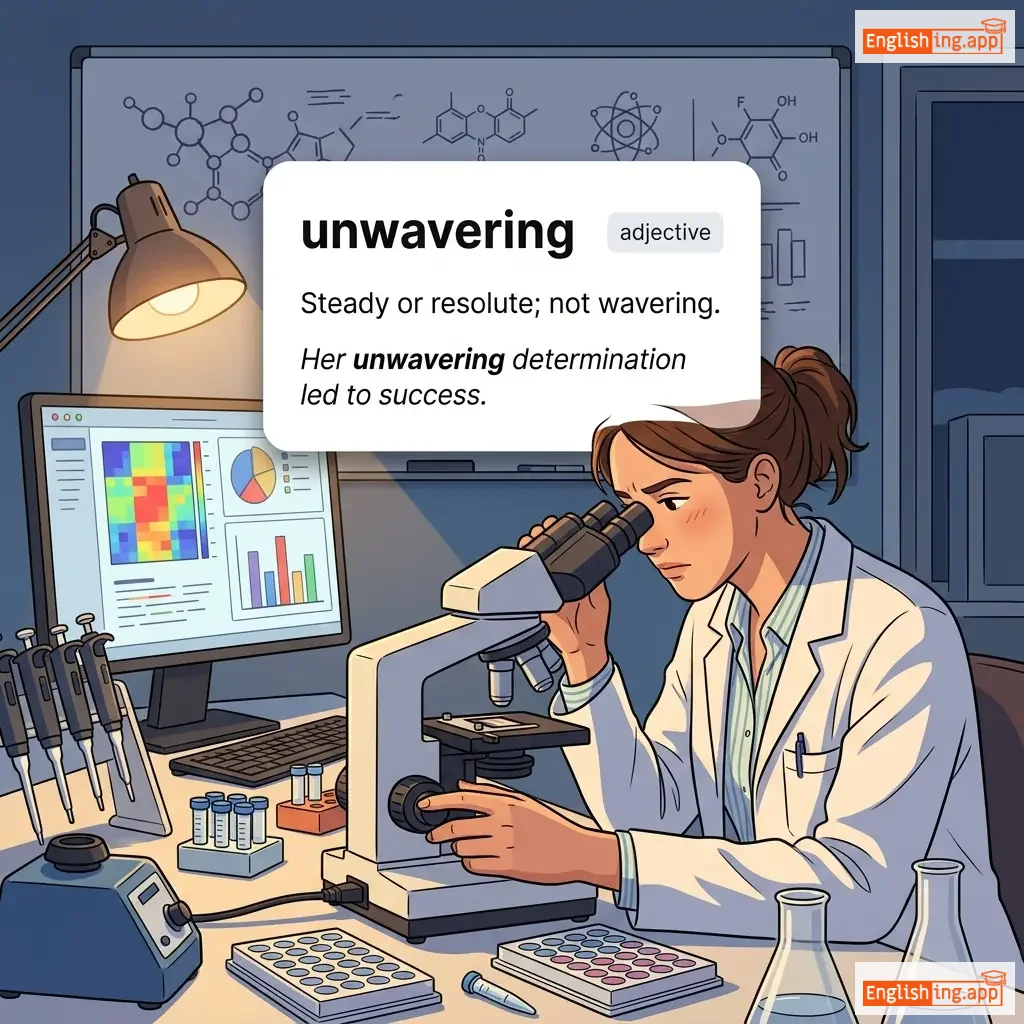
unwavering definition card — visual illustration of the meaning
adjective C1
/ʌnˈweɪ.vər.ɪŋ/
inébranlable, ferme, résolu (inebranlable, ferme, resolu)

Steady or resolute; not wavering.

"Her unwavering determination led to success."

"Sa détermination inébranlable l'a conduite au succès." (Sa détermination inébranlable l'a conduite au succès.)
adjective C1
/ʌnˈwɪtɪŋ/
involontaire (involontaire)

Not aware of what is happening; done without realizing.

"She became an unwitting participant in the scam."

"Elle est devenue une participante involontaire dans l'escroquerie." (Elle est devenue une participante involontaire dans l'escroquerie.)
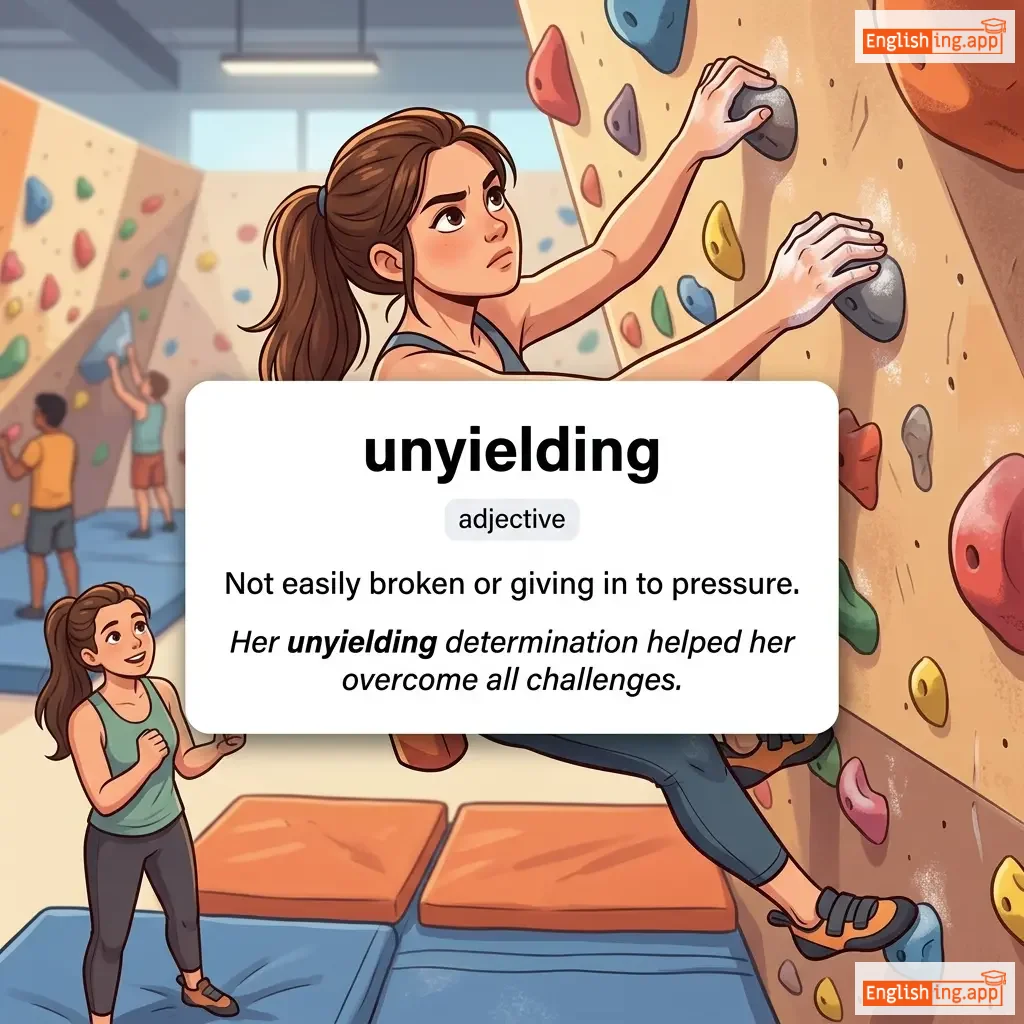
unyielding definition card — visual illustration of the meaning
adjective C1
ʌnˈjiːl.dɪŋ
inébranlable ou ferme (inebranlable ou ferme)

Not easily broken or giving in to pressure.

"Her unyielding determination helped her overcome all challenges."

"Sa détermination inébranlable l'a aidée à surmonter tous les défis." (Sa determination inebranlable l'a aidee a surmonter tous les defis.)
noun C1
/ʌpˈhiːvəl/
bouleversement (bouleversement)

a violent or sudden change or disruption to something

"The company faced a major upheaval after the sudden resignation of its CEO."

"L'entreprise a connu un grand bouleversement après la démission soudaine de son PDG." (L'entreprise a connu un grand bouleversement après la démission soudaine de son PDG.)
adjective C1
/ˈʌpərˌmoʊst/
le plus élevé (le plus eleve)

situated at the highest place or most important

"Her family's safety was uppermost in her mind during the crisis."

"La sécurité de sa famille était la priorité dans son esprit pendant la crise." (La securite de sa famille etait la priorite dans son esprit pendant la crise.)
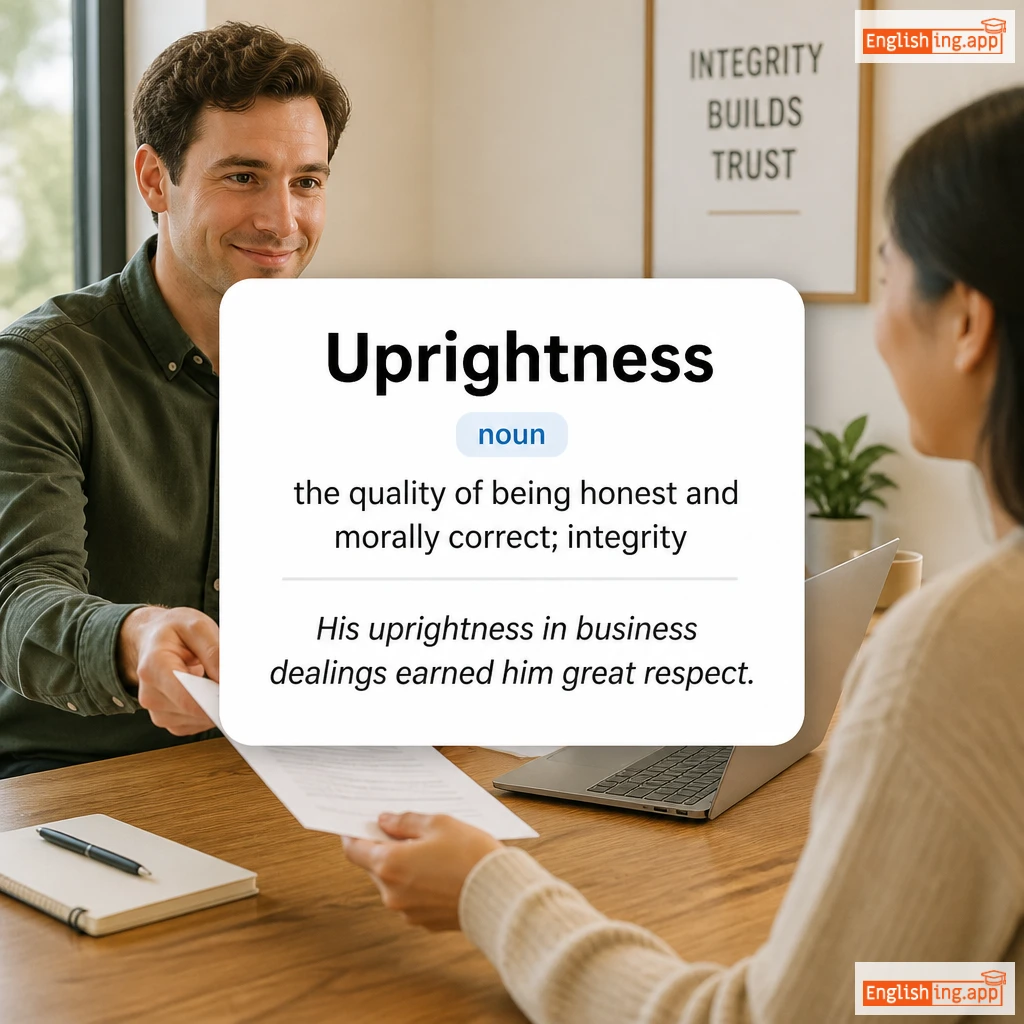
Uprightness definition card — visual illustration of the meaning
noun C1
/ˈʌp.raɪt.nəs/
rectitude; intégrité (rectitude; integrite)

the quality of being honest and morally correct; integrity

"His uprightness in business dealings earned him great respect."

"Sa droiture dans les affaires lui a valu un grand respect." (Sa droiture dans les affaires lui a valu un grand respect.)
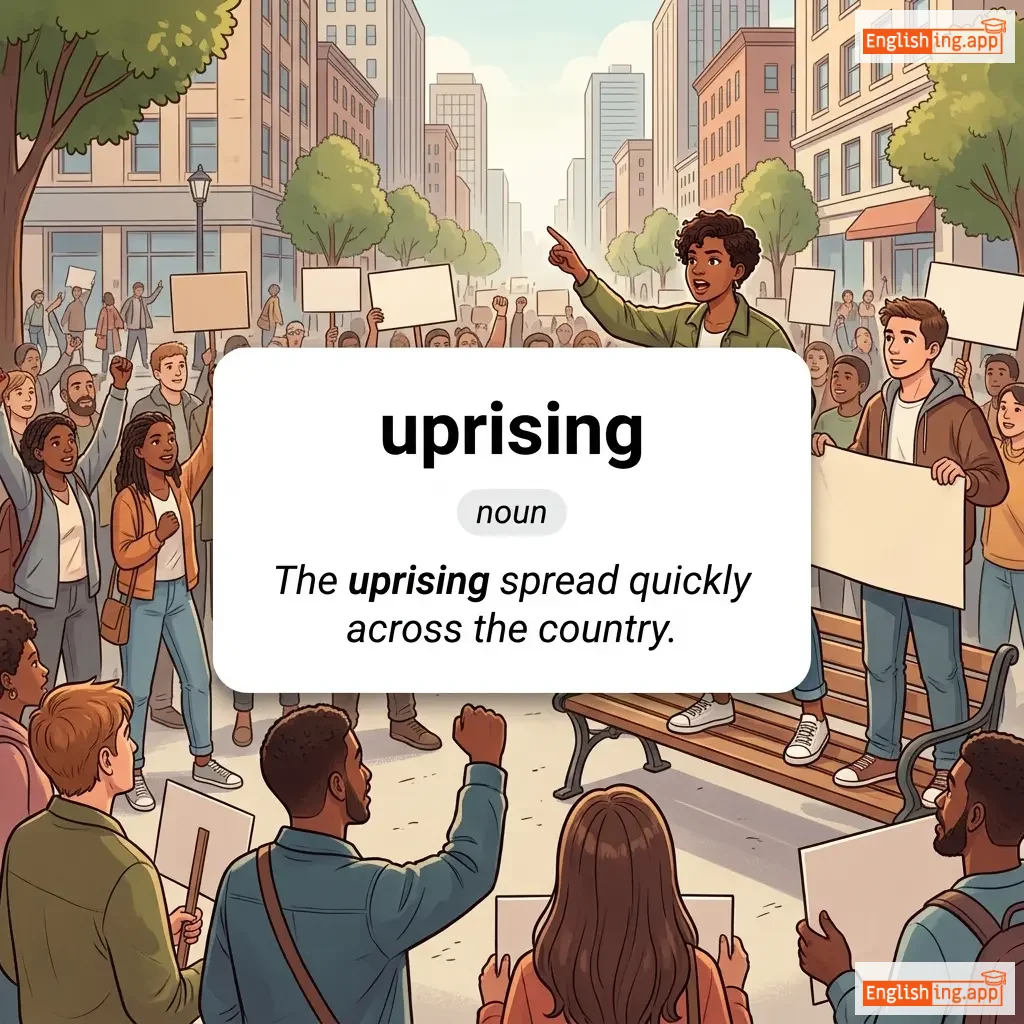
uprising definition card — visual illustration of the meaning
noun C1
/ˈʌpraɪzɪŋ/
révolte (revolte)

An act of resistance or rebellion; an attempt to overthrow authority or government.

"The uprising spread quickly across the country."

"La révolte s'est rapidement répandue dans tout le pays." (La révolte s'est rapidement répandue dans tout le pays.)
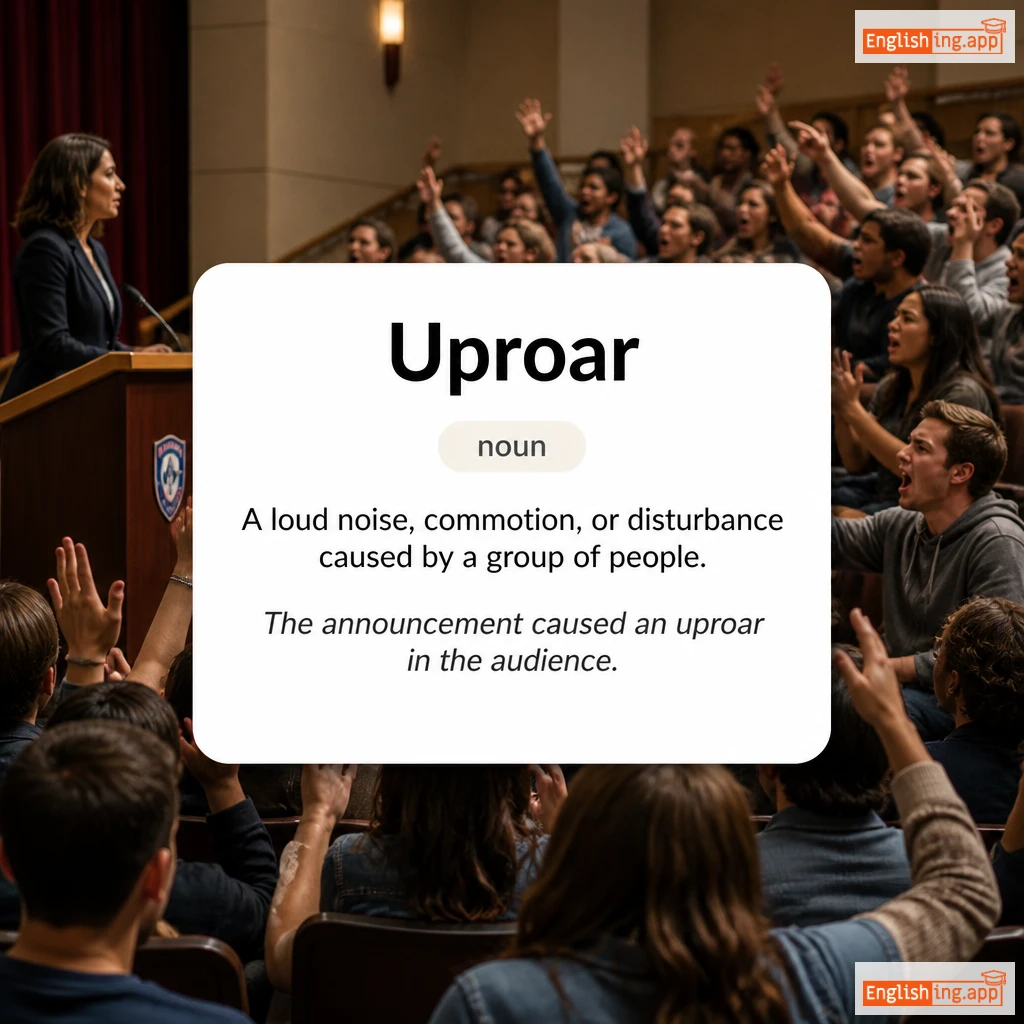
Uproar definition card — visual illustration of the meaning
noun C1
/ˈʌp.rɔːr/
tumulte (tumulte)

A loud noise, commotion, or disturbance caused by a group of people.

"The announcement caused an uproar in the audience."

"L'annonce a provoqué un tumulte dans le public." (L'annonce a provoqué un tumulte dans le public.)
verb C1
/ʌpˈruːt/
déraciner (deraciner)

To pull something out of the ground; to remove or displace completely.

"They uprooted the old tree from the garden."

"Ils ont déraciné l'arbre vieux du jardin." (Ils ont déraciné l'arbre vieux du jardin.)
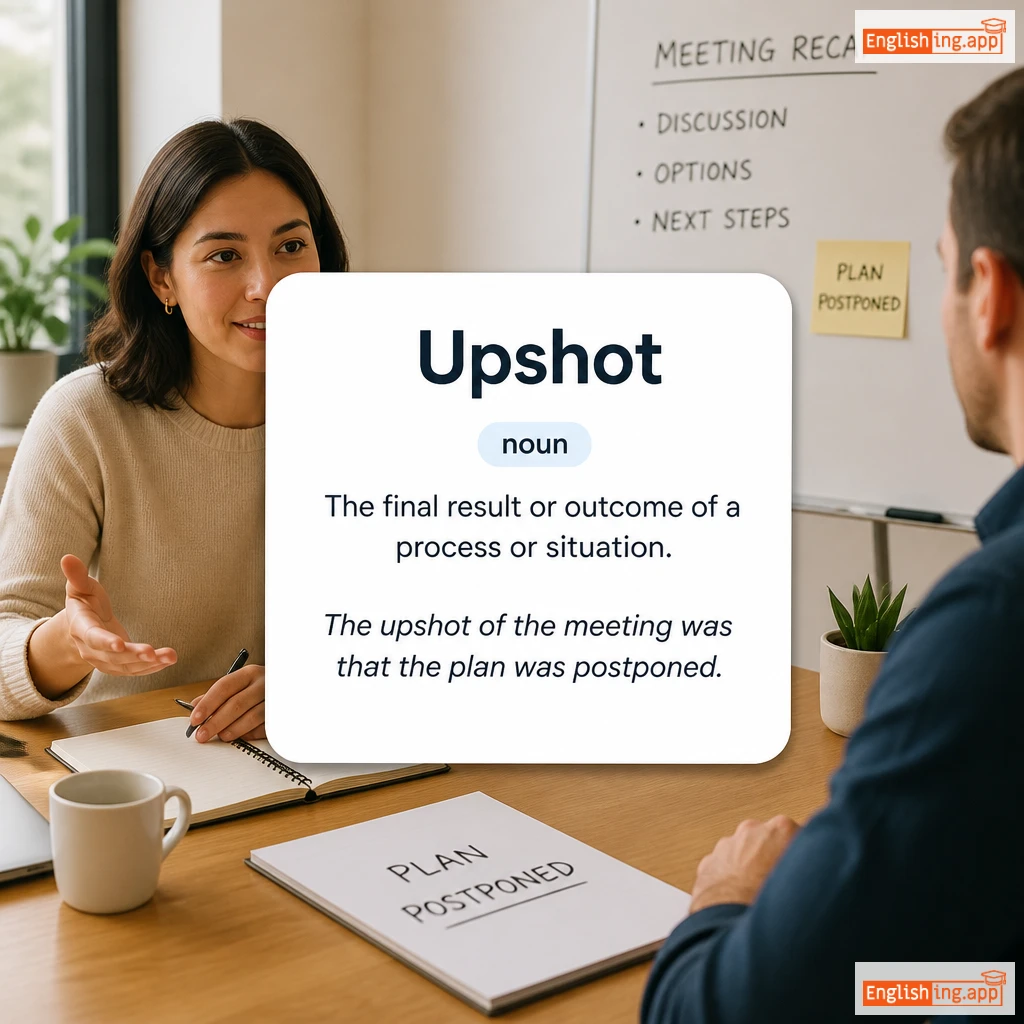
Upshot definition card — visual illustration of the meaning
noun C1
/ˈʌp.ʃɒt/
résultat (resultat)

The final result or outcome of a process or situation.

"The upshot of the meeting was that the plan was postponed."

"Le résultat de la réunion a été que le plan a été reporté." (Le resultat de la reunion a ete que le plan a ete reporte.)
noun C1
/ˈʌp.tɜːn/
amélioration (amelioration)

An improvement or upward trend in a situation, especially in business or economy.

"The company experienced an upturn in sales last quarter."

"L'entreprise a connu une amélioration des ventes le dernier trimestre." (L'entreprise a connu une amelioration des ventes le dernier trimestre.)
adjective C1
/ˌjuːtɪlɪˈtɛəriən/
utilitaire (yutilitairian)

Designed to be useful or practical rather than attractive; relating to the doctrine that actions are right if they are useful or for the benefit of a majority.

"The building had a simple utilitarian design."

"Le bâtiment avait une conception utilitaire simple." (Le batiment avait une conception utilitaire simple)
noun C1
/juːˈtoʊpiə/
utopie (utopie)

An imagined perfect society or place where everything is ideal.

"Many philosophers dreamed of creating a utopia for humanity."

"De nombreux philosophes ont rêvé de créer une utopie pour l'humanité." (De nombreux philosophes ont rêvé de créer une utopie pour l'humanité.)
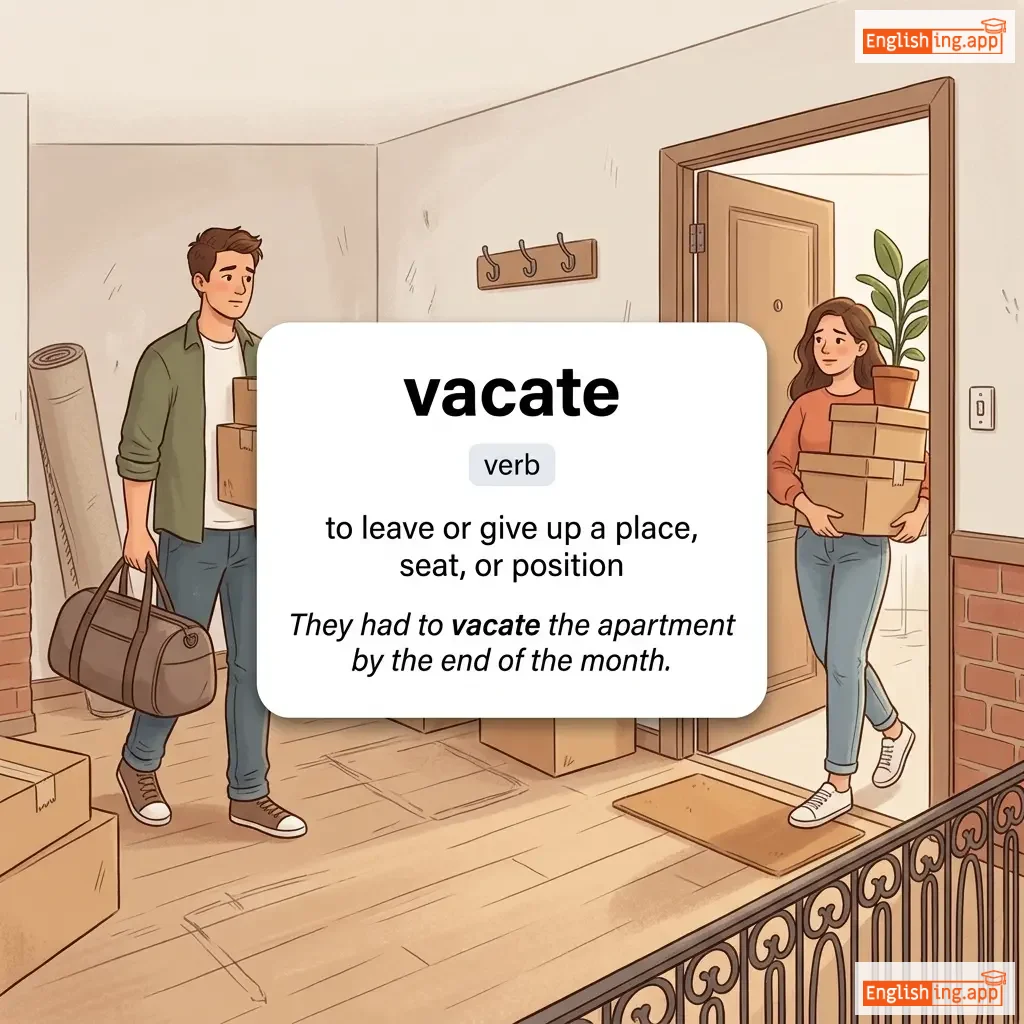
vacate definition card — visual illustration of the meaning
verb C1
/vəˈkeɪt/
libérer (liberer)

to leave or give up a place, seat, or position

"They had to vacate the apartment by the end of the month."

"Ils ont dû libérer l'appartement avant la fin du mois." (Ils ont dû libérer l'appartement avant la fin du mois.)
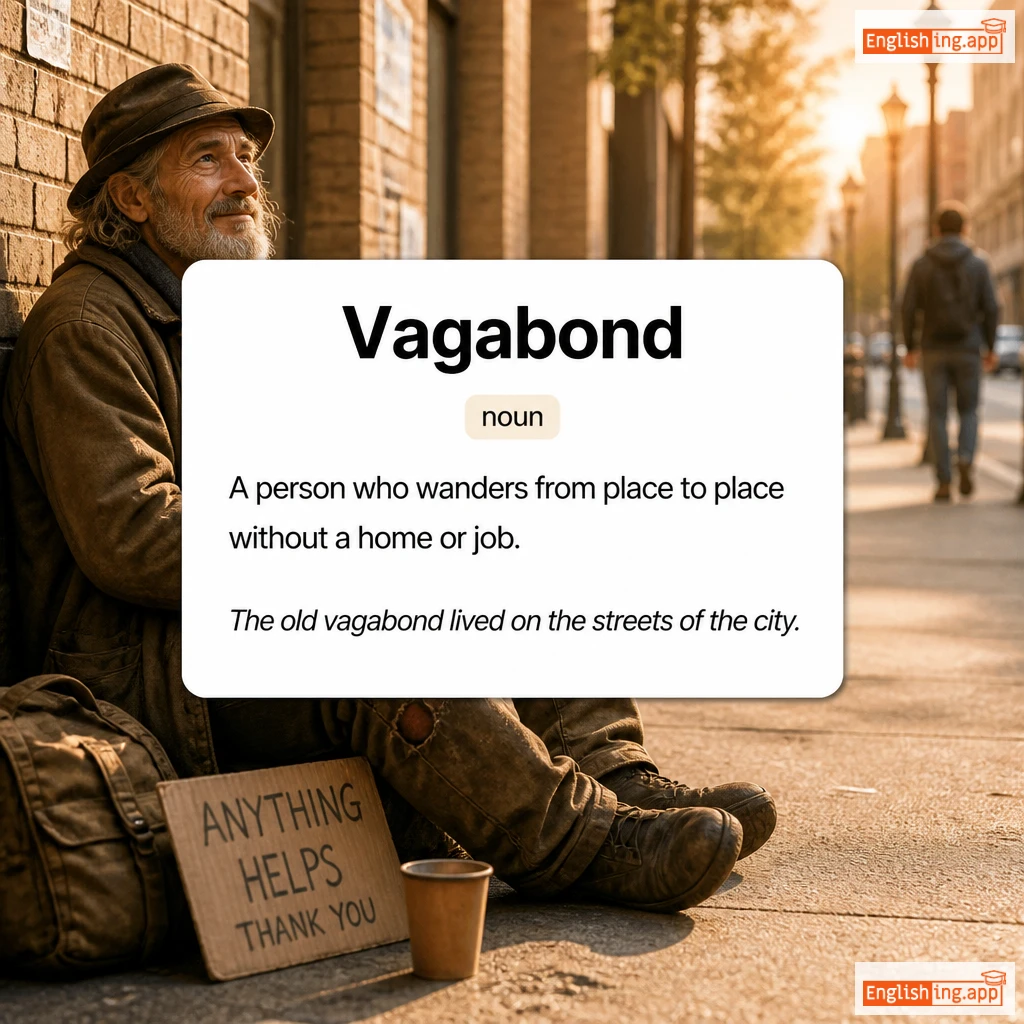
Vagabond definition card — visual illustration of the meaning
noun C1
/ˈvæɡəbɒnd/
vagabond (vagabond)

A person who wanders from place to place without a home or job.

"The old vagabond lived on the streets of the city."

"Le vieux vagabond vivait dans les rues de la ville." (Le vieux vagabond vivait dans les rues de la ville.)
noun C1
/ˈveɪɡrənt/
vagabond (vagabond)

A person without a settled home or regular work who wanders from place to place.

"The police offered shelter to a vagrant sleeping on the street."

"La police a offert un abri à un vagabond qui dormait dans la rue." (La police a offert un abri à un vagabond qui dormait dans la rue.)
noun C1
/veɪl/
vallée (vallee)

A valley, often used in a poetic or literary sense.

"The village lay hidden in a quiet green vale."

"Le village était caché dans une vallée verte et tranquille." (Le village etait cache dans une vallee verte et tranquille.)
adjective C1
/ˈvæliənt/
vaillant (vayan)

Showing courage, determination, and bravery.

"The firefighters made a valiant effort to save the building."

"Les pompiers ont fait un vaillant effort pour sauver le bâtiment." (Les pompiers ont fait un vaillant effort pour sauver le bâtiment.)
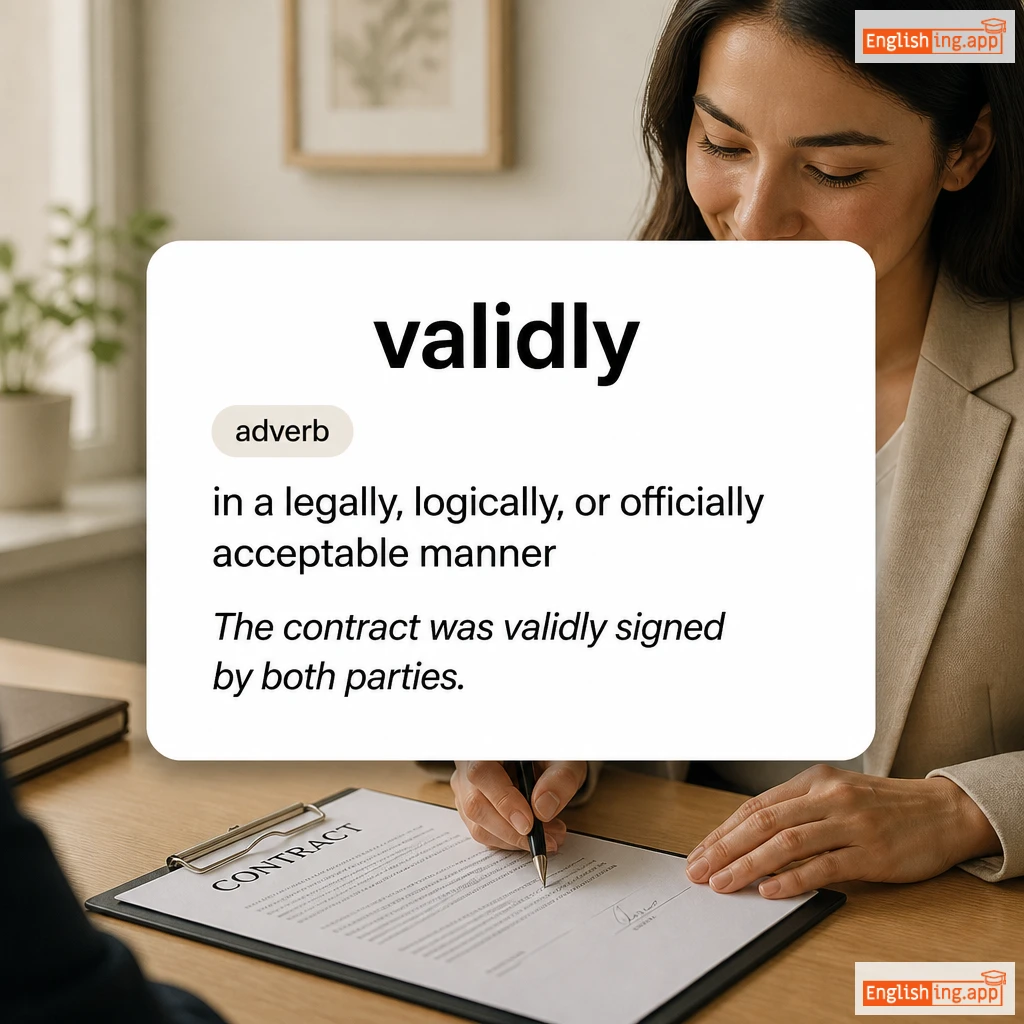
validly definition card — visual illustration of the meaning
adverb C1
/ˈvælɪdli/
valablement (valablement)

in a legally, logically, or officially acceptable manner

"The contract was validly signed by both parties."

"Le contrat a été valablement signé par les deux parties." (Le contrat a ete valablement signe par les deux parties)
noun C1
/ˈvælər/
valeur (valeur)

Great courage in the face of danger, especially in battle.

"The soldier was honored for his valor during the war."

"Le soldat a été honoré pour sa valeur pendant la guerre." (Le soldat a été honoré pour sa valeur pendant la guerre.)
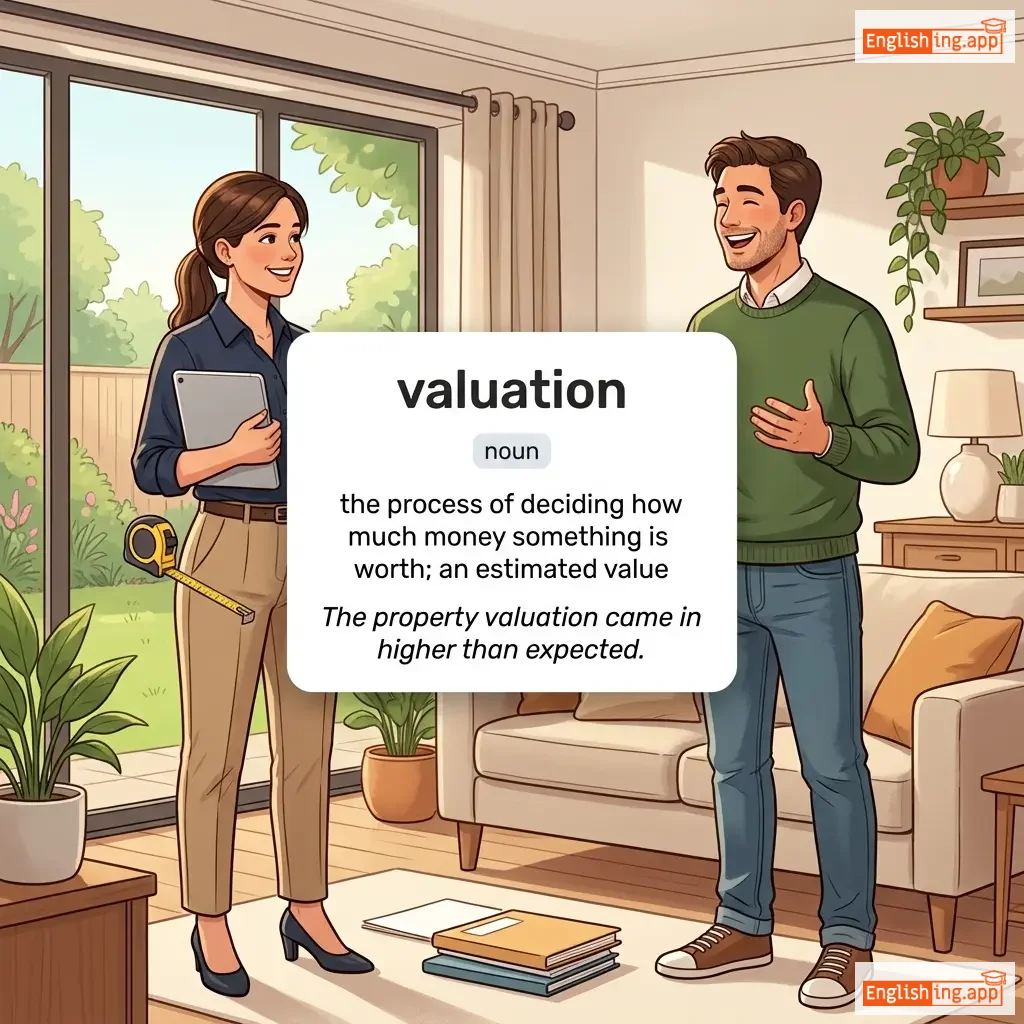
valuation definition card — visual illustration of the meaning
noun C1
/ˌvæl.juˈeɪ.ʃən/
évaluation (evaluation)

the process of deciding how much money something is worth; an estimated value

"The property valuation came in higher than expected."

"L'évaluation de la propriété a été plus élevée que prévu." (L'evaluation de la propriete a ete plus elevee que prevu.)
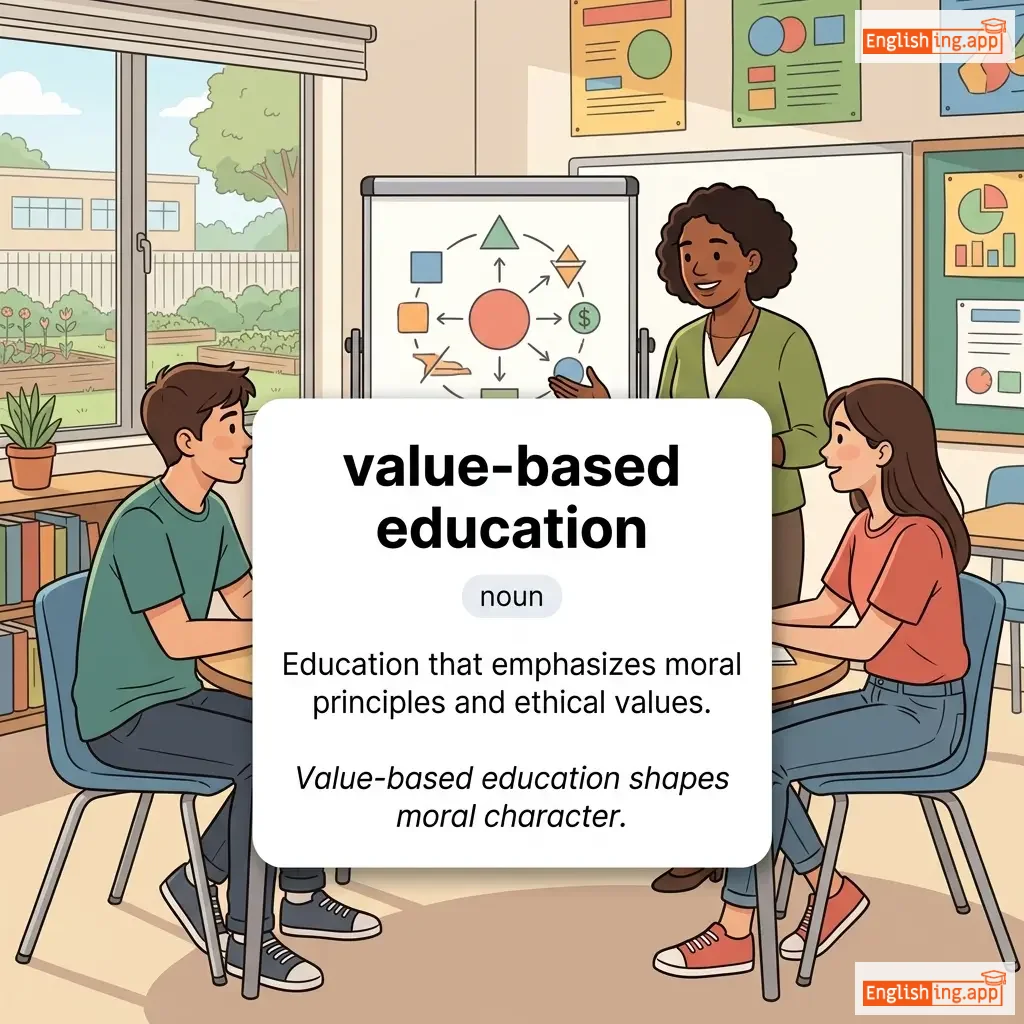
value-based education definition card — visual illustration of the meaning
noun C1
ˈvæljuː beɪst ˌɛdjuːˈkeɪʃən
éducation basée sur les valeurs (education basee sur les valeurs)

Education that emphasizes moral principles and ethical values.

"Value-based education shapes moral character."

"L'éducation basée sur les valeurs façonne le caractère moral." (L'education basee sur les valeurs faconne le caractere moral.)
adjective C1
/ˈvæljuːləs/
sans valeur (san valeur)

having no worth, importance, or usefulness

"The old broken phone was considered valueless."

"Le vieux téléphone cassé a été jugé sans valeur." (Le vieux téléphone cassé a été jugé sans valeur.)
noun C1
/ˈvænɡɑːrd/
avant-garde (avant-garde)

the forefront of an action, movement, or military force

"The company is at the vanguard of technological innovation."

"L'entreprise est à l'avant-garde de l'innovation technologique." (L'entreprise est a l'avant-garde de l'innovation technologique.)
verb C1
/ˈvæŋkwɪʃ/
vaincre (vaincre)

to defeat thoroughly, especially in battle or competition

"The army vanquished its enemies with superior strategy."

"L'armée a vaincu ses ennemis grâce à une stratégie supérieure." (L'armée a vaincu ses ennemis grâce à une stratégie supérieure.)
noun C1
/ˈvæntɪdʒ/
position avantageuse (position avantageuse)

a position or situation that gives an advantage or a good view

"From this vantage, we could see the entire valley."

"Depuis ce point de vue, nous pouvions voir toute la vallée." (Depuis ce point de vue, nous pouvions voir toute la vallée.)
verb C1
/ˈveɪpəraɪz/
vaporiser (vaporiser)

to turn into vapor or gas

"The heat of the sun can vaporize water from the surface."

"La chaleur du soleil peut vaporiser l'eau de la surface." (La chaleur du soleil peut vaporiser l'eau de la surface.)
noun C1
/ˈveɪpəraɪzər/
vaporisateur (vaporisateur)

a device that turns a liquid into vapor, often for inhalation

"She used a vaporizer to ease her cough."

"Elle a utilisé un vaporisateur pour soulager sa toux." (Elle a utilise un vaporisateur pour soulager sa toux.)
noun C1
/ˈvɛriəns/
variance (variance)

the state of being different or inconsistent; in statistics, a measure of the spread between numbers

"There is a wide variance in students' performance levels."

"Il y a une grande variance dans les niveaux de performance des étudiants." (Il y a une grande variance dans les niveaux de performance des étudiants.)
noun/verb C1
/ˈvɑːrnɪʃ/
vernis (vernis)

A liquid that is applied to wood or other materials to form a hard, shiny surface; also to apply such a liquid.

"The carpenter varnished the table to give it a glossy finish."

"Le charpentier a verni la table pour lui donner une finition brillante." (Le charpentier a verni la table pour lui donner une finition brillante.)
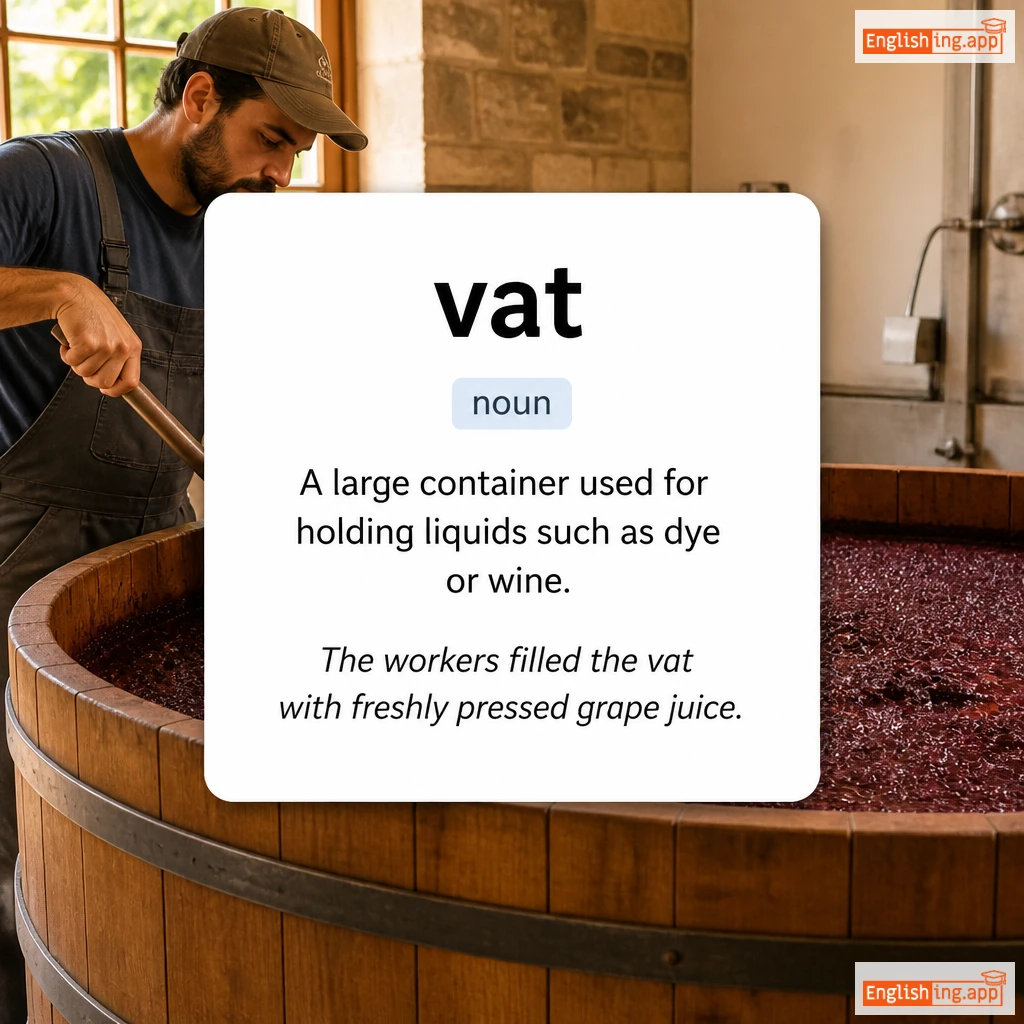
vat definition card — visual illustration of the meaning
🛢️

vat (væt)

noun C1
/væt/
grand réservoir (grand reservoir)

A large container used for holding liquids such as dye or wine.

"The workers filled the vat with freshly pressed grape juice."

"Les travailleurs ont rempli le grand réservoir avec du jus de raisin fraîchement pressé." (Les travailleurs ont rempli le grand réservoir avec du jus de raisin fraîchement pressé.)
noun/verb C1
/vɔːlt/
coffre-fort / sauter (coffre-fort / sauter)

A secure room for storing valuables; also to leap or spring over something.

"The bank kept its gold bars in a secure vault."

"La banque a gardé ses lingots d'or dans une voûte sécurisée." (La banque a garde ses lingots d'or dans une voute securisee.)
verb C1
/vɪə(r)/
changer de direction (changer de direction)

to change direction suddenly

"The car veered off the road to avoid the accident."

"La voiture a viré hors de la route pour éviter l'accident." (La voiture a vire hors de la route pour eviter l'accident.)
adjective C1
/ˈvɛdʒɪtətɪv/
relatif à la croissance ou aux processus fondamentaux de la vie (relatif à la croissance ou aux processus fondamentaux de la vie)

relating to growth or the basic processes of life, often without conscious thought or activity

"The patient remained in a vegetative state after the accident."

"Le patient est resté dans un état végétatif après l'accident." (Le patient est resté dans un état végétatif après l'accident.)
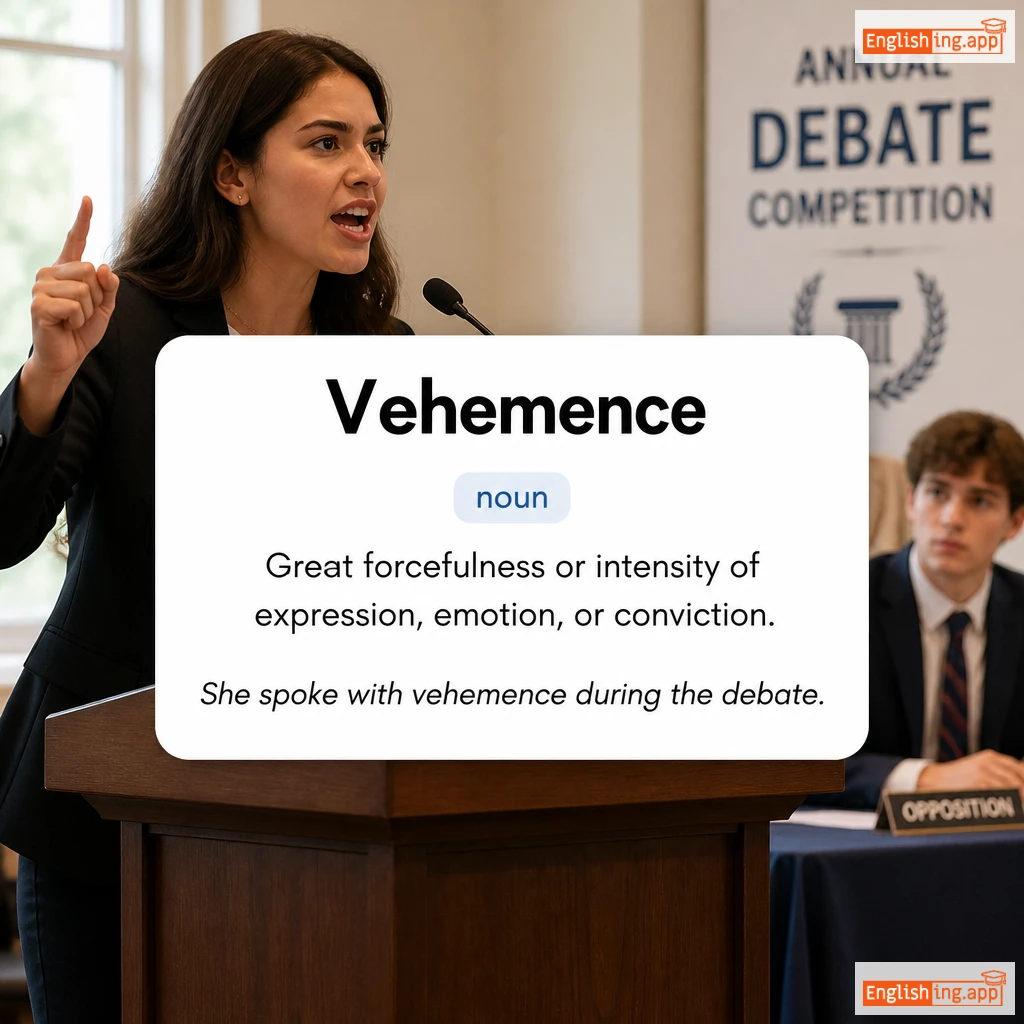
Vehemence definition card — visual illustration of the meaning
noun C1
/ˈviːəməns/
véhémence (vhemens)

Great forcefulness or intensity of expression, emotion, or conviction.

"She spoke with vehemence during the debate."

"Elle a parlé avec véhémence pendant le débat." (Elle a parlé avec véhémence pendant le débat.)
adjective C1
/ˈviːəmənt/
véhément (vehément)

showing strong feeling; forceful, passionate, or intense

"She made a vehement argument against the proposal."

"Elle a fait un argument véhément contre la proposition." (Elle a fait un argument véhément contre la proposition.)