Vocabularios

Descubra, aprenda y domine el vocabulario en inglés

adjective C2
/ˈɪnmoʊst/
самый сокровенный (samyy sokrovennyy)

Situated at the very heart or deepest part; most private or secret.

"She revealed her inmost thoughts to her closest friend."

"Она раскрыла свои самые сокровенные мысли своему ближайшему другу." (Ona raskryla svoi samye sokrovennye mysli svoemu blizhayshemu drugu.)
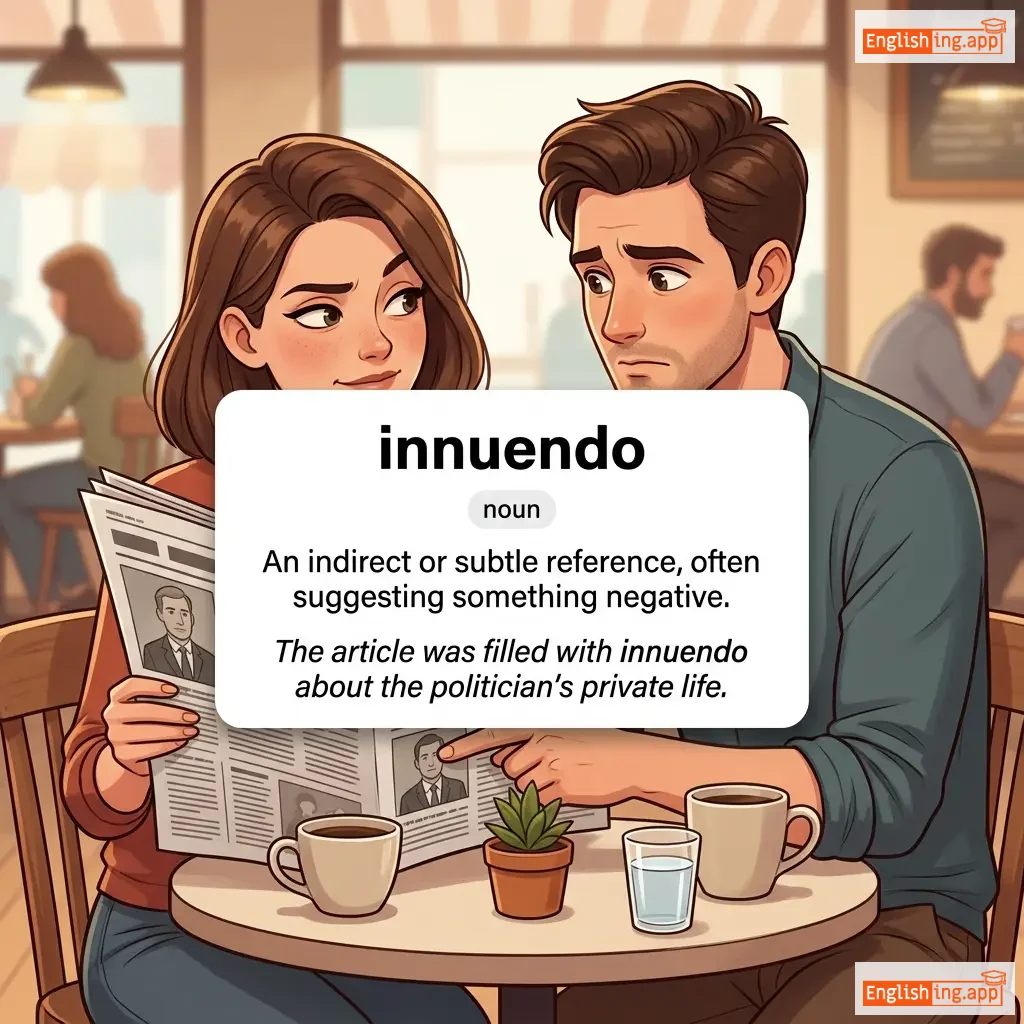
innuendo definition card — visual illustration of the meaning
noun C2
/ˌɪnjuˈɛndoʊ/
намек (namek)

An indirect or subtle reference, often suggesting something negative.

"The article was filled with innuendo about the politician's private life."

"Статья была наполнена намеками на личную жизнь политика." (Stat'ya byla napolnena namekami na lichnuyu zhizn' politika.)
adjective C2
/ˌɪnˌɑːpərˈtuːn/
неудачный момент (neudachny moment)

Happening at a bad or inconvenient time.

"His call came at the most inopportune moment."

"Его звонок пришел в самый неудачный момент." (Yego zvonok prishel v samyj neudachnyj moment.)
noun C2
/ɪnˈkwɪzɪtər/
инквизитор (inkvizitor)

A person who asks many questions, often in an official or harsh manner.

"The inquisitor demanded detailed answers from the witness."

"Инквизитор потребовал подробных ответов от свидетеля." (Inkvizitor potreboval podrobných otvetov ot svidetelya.)
noun C2
/ˈɪnroʊd/
прогресс (progres)

An advance or significant progress, often at the expense of something else.

"The company made significant inroads into the mobile market."

"Компания сделала значительный прогресс на мобильном рынке." (Kompaniya sdelala znachitel'nyy progress na mobil'nom rynke.)
adjective C2
/ˌɪnsəˈluːbriəs/
нездоровый (nezdorovyy)

Unhealthy or not conducive to well-being.

"They moved out of the insalubrious neighborhood for the sake of their health."

"Они переехали из нездорового района ради их здоровья" (Oni pereekhali iz nezdorovogo rayona radi ikh zdorov'ya)
adjective C2
/ɪnˈseɪʃiət/
ненасытный (nenasytniy)

impossible to satisfy; always wanting more

"He had an insatiate desire for power."

"У него было ненасытное желание власти." (U nego bylo nenasytnoe zhelanie vlasti.)
adjective C2
/ɪnˈskruːtəbl̩/
счастье (schastye)

impossible to understand or interpret

"His inscrutable expression made it hard to know what he was thinking."

"Она не могла скрыть своего счастья, когда получила награду." (Ona ne mogla skryt' svoego schast'ya, kogda poluchila nagradu.)
adjective C2
/ɪnˈsɛnseɪt/
бессердечный (besserdechniy)

lacking physical sensation or empathy; without feeling or sensitivity

"The dictator's insensate cruelty shocked the world."

"Безжалостная жестокость диктатора потрясла мир." (Bezzhalostnaya zhestokost' diktatora potryasla mir.)
adjective C2
/ɪnˈsɛnʃənt/
бессознательный (bessoznatel'nyy)

Lacking perception, consciousness, or sensation.

"The rock is an insentient object with no awareness."

"Камень — это бессознательный объект без сознания." (Kamen' — eto bessoznatel'nyy ob'yekt bez soznaniya.)
noun C2
/ɪnˈsɪɡniə/
знак (znak)

A badge or symbol that shows rank, position, or membership.

"The soldier proudly wore the insignia of his regiment."

"Солдат гордо носил знак своего полка." (Soldat gordo nosil znak svoego polka.)
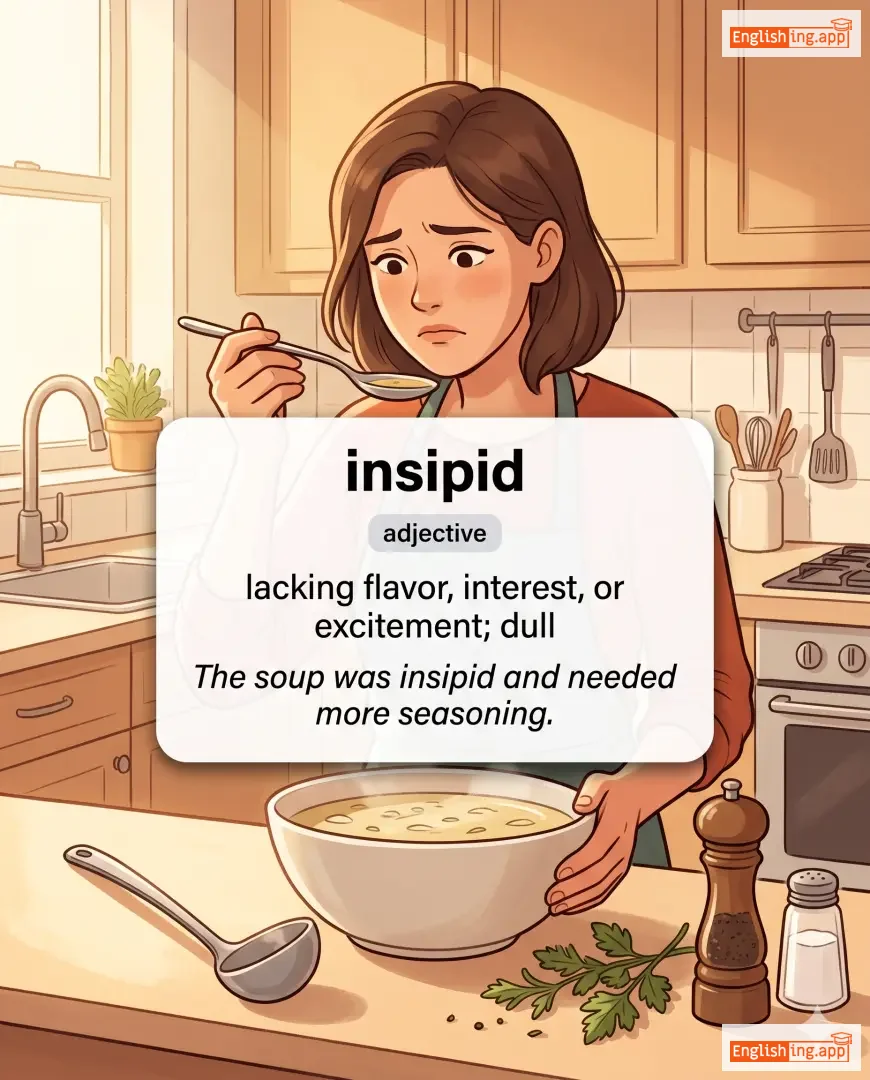
insipid definition card — visual illustration of the meaning
adjective C2
/ɪnˈsɪpɪd/
безвкусный (bezvkusny)

lacking flavor, interest, or excitement; dull

"The soup was insipid and needed more seasoning."

"Суп был безвкусным и требовал больше приправ." (Sup byl bezvkusnym i trebyval bolshe prigrav.)
noun C2
/ˈɪnsələns/
наглость (naglost)

rude or disrespectful behavior

"The teacher was shocked by the student's insolence."

"Учитель был шокирован наглостью студента." (Uchitel' byl shokirovan naglost'yu studenta.)
adverb C2
/ˌɪnsəʊˈmʌtʃ/
настолько (nastol'ko)

to such an extent

"He was insomuch tired that he could hardly stand."

"Он был настолько уставшим, что едва мог стоять." (On byl nastol'ko ustavshim, chto edva mog stoyat'.)
noun C2
/ɪnˈsuːsiəns/
беспечность (bespechnost)

Casual lack of concern; indifference.

"She carried herself with an air of insouciance, unbothered by the challenges ahead."

"Она шла с видом беспечности, не беспокоясь о предстоящих трудностях." (Ona shla s vidom bespechnosti, ne bespokoyas' o predstoyashikh trudnostyakh.)
insouciant definition card — visual illustration of the meaning
adjective C2
/ɪnˈsuːsiənt/
беззаботный (bezzabotnyy)

Showing a casual lack of concern; carefree.

"He gave an insouciant shrug and walked away."

"Он беззаботно пожал плечами и ушел." (On bezzabotno pozhal plechami i ushel.)
verb C2
/ɪnˈsteɪt/
назначать (naznachat)

To set up in position, office, or authority.

"The board decided to instate her as the new director."

"Совет решил назначить её новым директором." (Sovet reshil naznačit' yeyu novym direktorom.)
noun C2
/ˌɪn.strəˈmɛn.təl.ɪst/
инструменталист (instrumentalist)

A person who plays a musical instrument.

"The instrumentalist played a beautiful solo on the violin."

"Инструменталист сыграл красивое соло на скрипке." (Instrumentalist sygral krasivoe solo na skripke.)
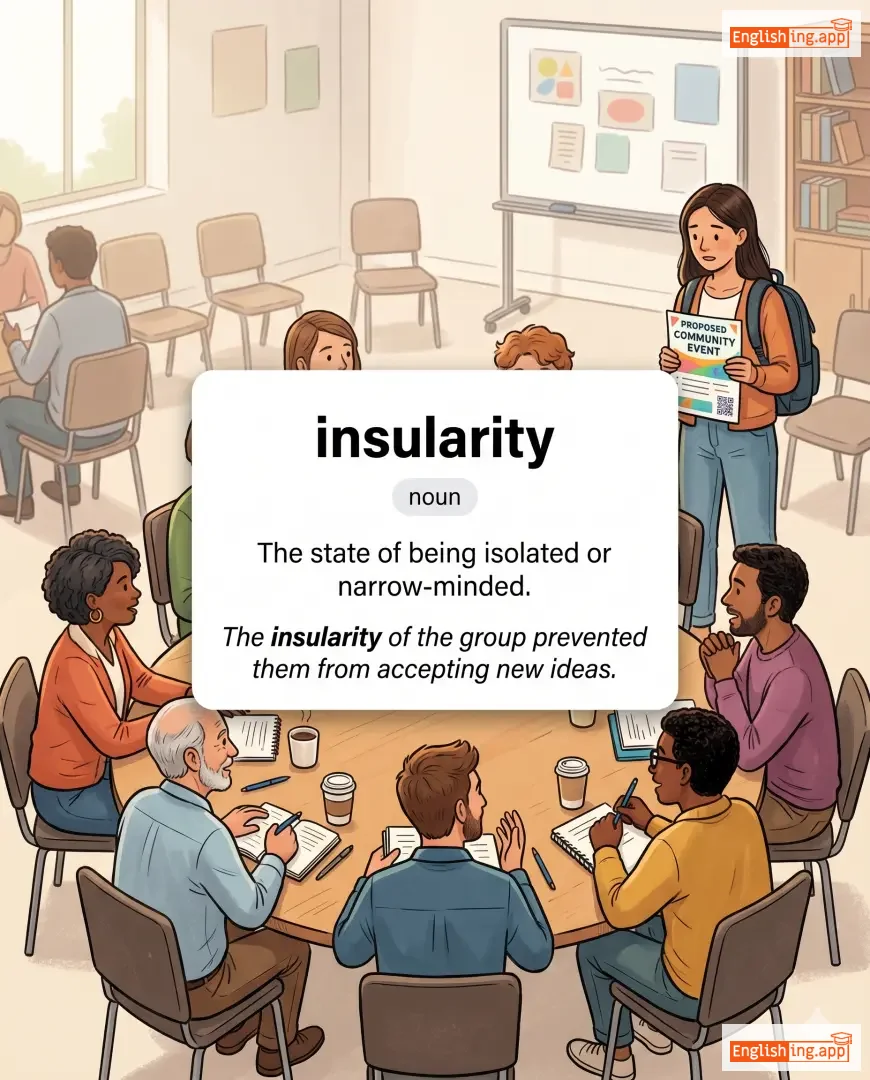
insularity definition card — visual illustration of the meaning
noun C2
/ˌɪnsjəˈlærəti/
инсулярность (insulyarnost)

The state of being isolated or narrow-minded.

"The insularity of the group prevented them from accepting new ideas."

"Инсулярность группы помешала им принять новые идеи." (Insulyarnost gruppy pomeshala im prinyat' novye idei.)
insuperable definition card — visual illustration of the meaning
adjective C2
/ɪnˈsuːpərəbl/
непреодолимый (nepreodolimyy)

Impossible to overcome or surpass.

"The team faced insuperable challenges during the expedition."

"Команда столкнулась с непреодолимыми трудностями во время экспедиции." (Komanda stolknulas' s nepreodolimymi trudnostyami vo vremya ekspeditsii.)
adjective C2
/ˌɪnsəˈpɔːrtəbl̩/
невыносимый (nevynosimy)

Too extreme or difficult to be endured.

"The heat was insupportable during the long journey."

"Жара была невыносимой во время долгого путешествия." (Zhara byla nevynosimoy vo vremya dolgogo puteshestviya.)
adjective C2
/ˌɪnsəˈprɛsəbl/
неудержимый (neudyerzhimyy)

That cannot be suppressed or restrained.

"She had an insuppressible urge to laugh during the ceremony."

"У неё было неудержимое желание смеяться во время церемонии." (U nee bylo neuderzhimoe zhelanie smeyat'sya vo vremya tseremonii.)
noun C2
/ˌɪnsəˈrɛkʃən/
восстание (vostanie)

A violent uprising against an authority or government.

"The army was called in to suppress the insurrection."

"Армия была вызвана для подавления восстания." (Armiya byla vyzvana dlya podavleniya vostaniya.)
integrative diplomacy definition card — visual illustration of the meaning
noun C2
/ˈɪn.tɪ.ɡreɪ.tɪv dɪˈpləʊ.mə.si/
интегративная дипломатия (integrativnaya diplomatiya)

A diplomatic approach that seeks to combine or coordinate different elements, interests, or parties into a unified whole.

"Integrative diplomacy strengthens alliances."

"Интегративная дипломатия укрепляет альянсы." (Integrativnaya diplomatiya ukreplyaet al'yansy.)
noun C2
/ɪnˈtɛɡ.jʊ.mənt/
внешняя оболочка (vneshnyaya obolochka)

A natural outer covering, such as skin, shell, or rind.

"The snake sheds its integument as it grows."

"Змея сбрасывает свою внешнюю оболочку по мере роста." (Zmeyya sbrosivayet svoiyu vneshnyuyu obolochku po mere rosta.)
noun C2
/ɪnˌtɛl.ɪˈdʒɛntsi.ə/
интеллигенция (intelligentsiya)

The group of people engaged in intellectual and cultural pursuits in a society.

"The intelligentsia played a key role in shaping public opinion."

"Интеллигенция сыграла ключевую роль в формировании общественного мнения." (Intelligentsiya sygrala klyuchevuyu rol' v formirovanii obshchestvennogo mneniya.)
noun C2
/ɪnˈtɛmpərəns/
интемперантность (intemperantnost)

Lack of moderation or self-control, especially with drinking or eating.

"His intemperance in drinking ruined his health."

"Его интемперантность в питье разрушила его здоровье." (Ego intemperantnost' v pit'je razrushila ego zdorov'e.)
adjective C2
/ɪnˈtɛmpərət/
неумеренный (neumerenniy)

Lacking self-control; immoderate, especially in indulgence.

"The politician's intemperate remarks caused controversy."

"Неумеренные замечания политика вызвали спор." (Neumerennye zamechaniya politika vyzvali spor.)
noun C2
/ɪnˈtɛnʃən/
внутреннее содержание (vnutrennee soderzhanie)

The internal content of a concept; the set of attributes implied by a word or phrase.

"The intension of the word 'dog' includes being a mammal and domesticated."

"Интенсия слова 'собака' включает в себя быть млекопитающим и одомашненным." (Intensiya slova 'sobaka' vklyuchayet v sebya byt' mlekopitayushchim i odomashnennym.)
verb C2
/ɪnˈtɜːr/
похоронить (pokhoronit')

To bury a dead body in the ground.

"They decided to inter the soldier with full honors."

"Они решили похоронить солдата с полными почестями." (Oni reshilі pokhoronit' soldata s polnymi pochejstvamі.)
verb C2
/ˌɪntərˈsiːd/
вмешаться (vmeshatsya)

to act or plead on behalf of someone in difficulty or trouble; to intervene between parties to help resolve a dispute

"She interceded with the teacher to give her brother another chance."

"Она вмешалась в ситуацию, чтобы дать своему брату еще один шанс." (Ona vmeshalas' v situatsiyu, chtoby dat' svoemu bratu eshche odin shans.)
noun C2
/ˌɪntərˈsɛʃən/
заступничество (zastupnichestvo)

the act of intervening or pleading on behalf of another person

"The prisoner was released due to the intercession of influential leaders."

"Заключённый был освобождён благодаря заступничеству влиятельных лидеров." (Zaklyuchyonnyy byl osvobozhdyon blagodarya zastupnichestvu vliyatel'nykh liderov.)
noun C2
/ˌɪntərˈsɛsər/
посредник (posrednik)

a person who intervenes or pleads on behalf of another

"He acted as an intercessor to resolve the conflict between the two families."

"Он выступил посредником, чтобы разрешить конфликт между двумя семьями." (On vystupil posrednikom, chtoby razreshit' konflikt mezhdu dvyma sem'yami.)
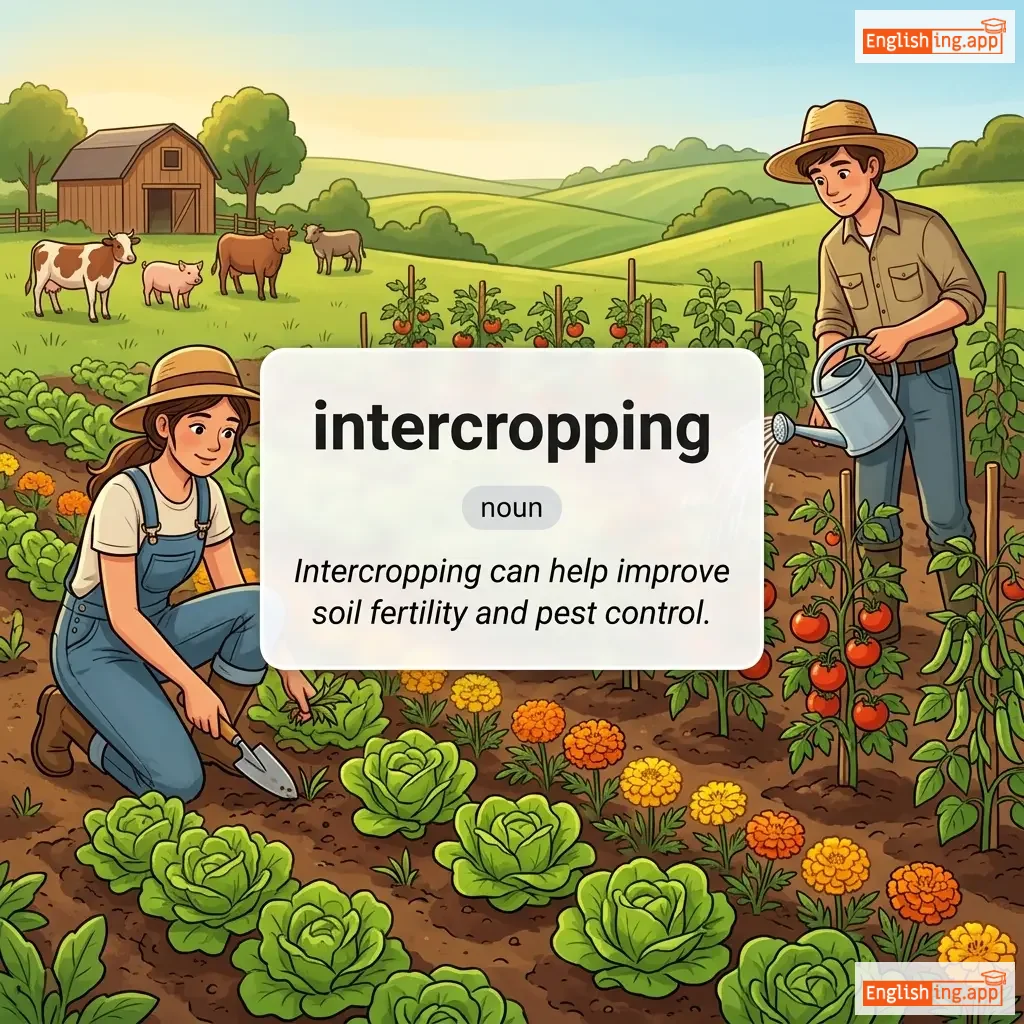
intercropping definition card — visual illustration of the meaning
noun C2
/ˈɪntəˌkrɒpɪŋ/
межкультурное земледелие (mezhkul'turnoe zemledelie)

The agricultural practice of cultivating two or more crops simultaneously in the same field to maximize land use efficiency and improve soil health.

"Intercropping can help improve soil fertility and pest control."

"Межкультурное земледелие может помочь улучшить плодородие почвы и контроль над вредителями." (Mezhkul'turnoe zemledelie mozhet pomoch' uluchshit' plodorodie pochvy i kontrol' nad vreditelyami.)
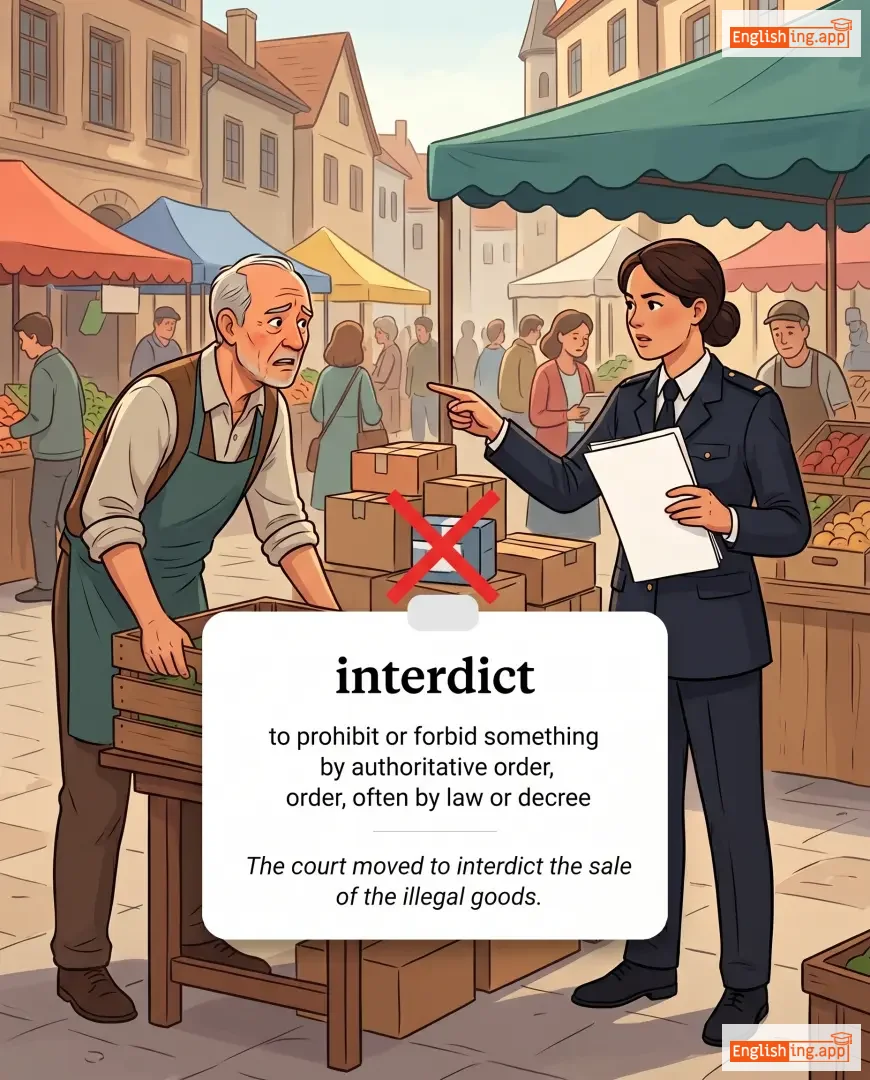
interdict definition card — visual illustration of the meaning
verb C2
/ˈɪntərˌdɪkt/
запрещать (zapreshchat)

to prohibit or forbid something by authoritative order, often by law or decree

"The court moved to interdict the sale of the illegal goods."

"Суд решил запретить продажу незаконных товаров." (Sud reshilsya zapretit' prodazhu nezakonnykh tovarov.)
verb C2
/ˌɪntərˈlɒk/
взаимно сцепляться (vzaimno stseplyatsya)

to fit or connect together securely so that two or more things are joined

"The gears interlock to ensure smooth movement of the machine."

"Зубчатые колеса сцепляются, чтобы обеспечить плавное движение машины." (Zubchatye kolesa stseplyayutsya, chtoby obespechit' plavnoe dvizhene dlya mashiny.)
noun C2
/ˌɪntərˈlɒkjətər/
собеседник (sobesednik)

a person who takes part in a conversation or dialogue

"She was a skilled interlocutor during the debate."

"Она была опытным собеседником в ходе дебатов." (Ona byla opytnym sobesednikom v khode debata.)
adjective C2
/ˌɪntərˈlɒkjətəri/
временный (vremennyy)

Given during the course of a legal action, not final but temporary or provisional.

"The judge issued an interlocutory order to maintain the status quo until the hearing."

"Судья вынес временное постановление, чтобы сохранить статус-кво до слушания." (Sud'ya vynes vremennoye postanovleniye, chtoby sokhranit' status-kvo do slushaniya.)
noun C2
/ˈɪntərˌloʊpər/
нарушитель (narushitel)

A person who becomes involved in a situation or place where they are not wanted.

"He felt like an interloper at the private family gathering."

"Он чувствовал себя нарушителем на частном семейном собрании." (On chuvstvoval sebya narushitelem na chastnom semeynom sobranii.)
noun C2
/ɪnˈtɜːrmənt/
погребение (pogrebenie)

The act of burying a dead body in a grave or tomb.

"The interment took place at the family cemetery."

"Погребение состоялось на семейном кладбище." (Pogrebeniye sostoyalos' na semeynom kladbishche.)
verb C2
/ˌɪntərˈmɪt/
прерывать (preryvat)

To suspend or stop for a time; to pause intermittently.

"The rain would intermit and then start again."

"Дождь будет прерываться, а затем снова начинаться." (Dozhd' budet preryvatsya, a zatem snova nachinatsya.)
internecine definition card — visual illustration of the meaning
adjective C2
/ˌɪntərˈniːsaɪn/
внутренний конфликт (vnutrenniy konflikt)

Relating to conflict within a group, often causing mutual destruction.

"The internecine conflict weakened the organization from within."

"Внутренний конфликт ослабил организацию изнутри" (Vnutrenniy konflikt oslabil organizatsiyu iznutri)
interpolate definition card — visual illustration of the meaning
verb C2
/ɪnˈtɜːrpəˌleɪt/
интерполировать (interpolirovat')

To insert something, often words, into a text or conversation; to estimate values between known data points.

"The editor interpolated a missing paragraph into the manuscript."

"Редактор интерполировал отсутствующий абзац в манускрипт." (Redaktor interpoliroval otsutstvuyushchiy abzat v manuskript.)
noun C2
/ɪnˌtɜːrpəˈleɪʃən/
интерполяция (interpolatsiya)

The act of inserting something into a text or estimating values within a sequence of data.

"The scientist used interpolation to predict the missing data points."

"Учёный использовал интерполяцию для прогнозирования недостающих точек данных." (Uchyonnyy ispol'zoval interpolyatsiyu dlya prognozirovaniya nedostayushchikh tochek dannykh.)
verb C2
/ˌɪntərˈpoʊz/

To place or insert between one thing and another; to intervene in a situation.

"He quickly interposed himself between the fighters to stop the quarrel."

noun C2
/ˌɪntərpəˈzɪʃən/
вмешательство (vmeshatel'stvo)

The act of intervening or coming between two things, often to influence or prevent an outcome.

"The manager’s interposition prevented a heated argument from escalating."

"Вмешательство менеджера предотвратило эскалацию оживленного спора." (Vmeshatel'stvo menedzhera predotvratilo eskalatsiyu ozhivlennogo spora.)
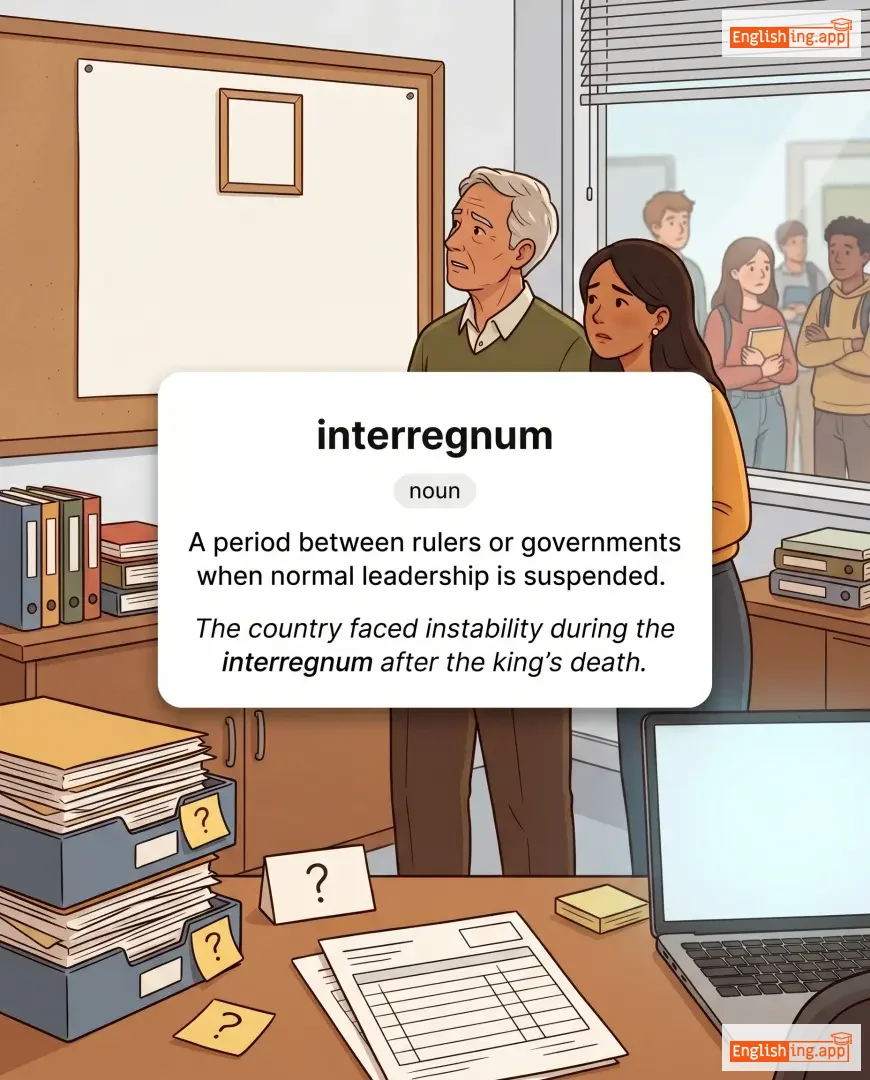
interregnum definition card — visual illustration of the meaning
noun C2
/ˌɪntərˈrɛɡnəm/
интеррегнум (interregnum)

A period between rulers or governments when normal leadership is suspended.

"The country faced instability during the interregnum after the king’s death."

"Страна столкнулась с нестабильностью в период интеррегнума после смерти короля." (Strana stolknulas' s nestabil'nost'yu v period interregnuma posle smerti korolya.)
adjective C2
/ˌɪntəˈrɒɡətəri/
допросный (doprosny)

expressed in the form of a question; relating to questioning

"The lawyer’s interrogatory tone made the witness uncomfortable."

"Допросный тон адвоката заставил свидетеля чувствовать себя неудобно." (Doprosny ton advokata zastavil svidetelya chuvstvovat' sebya neudobno.)
noun C2
/ɪnˈtɜːrstɪs/
щель (shchel)

a small space that lies between things

"Light filtered through the narrow interstices of the wall."

"Свет просочился через узкие щели стены." (Svet prosochelis' cherez uzkiye shcheli steny.)
noun C2
/ˈɪntərˌveɪl/
низменная земля вдоль реки, обычно плодородная и ровная (nizmennaya zemlya vdol' reki, obychno plodorodnaya i rovная)

A low-lying tract of land along a river, usually fertile and flat.

"The farmers cultivated crops on the lush intervale by the river."

"Фермеры выращивали урожай на плодородной низменной земле вдоль реки." (Fermery vyrashchivali urozhay na plodorodnoy nizmennoy zemle vdol' reki.)