|
••••••
|
/ˈwɜːkmənˌʃɪp/
noun
(wɜrkˈmænʃɪp)
••••••
|
••••••
|
habilidad artesanal
habilidad artesanal
••••••
|
-
••••••
|
-
••••••
|
-
••••••
|
-
••••••
|
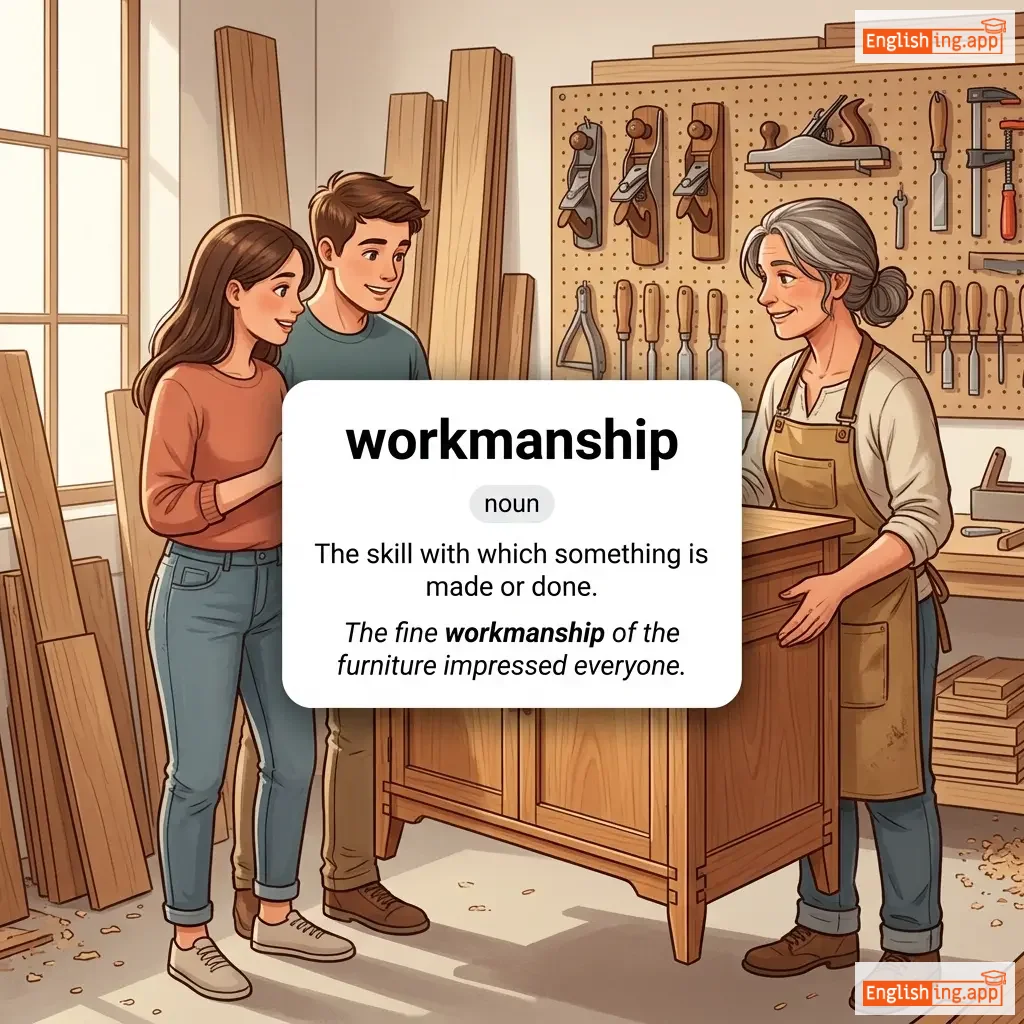
The skill with which something is made or done.
|
The fine workmanship of the furniture impressed everyone.
La excelente artesanía de los muebles impresionó a todos.
••••••
|
La excelente habilidad artesanal de los muebles impresionó a todos.
La excelente habilidad artesanal de los muebles impresionó a todos.
••••••
|
-
••••••
|
-
••••••
|
-
••••••
|
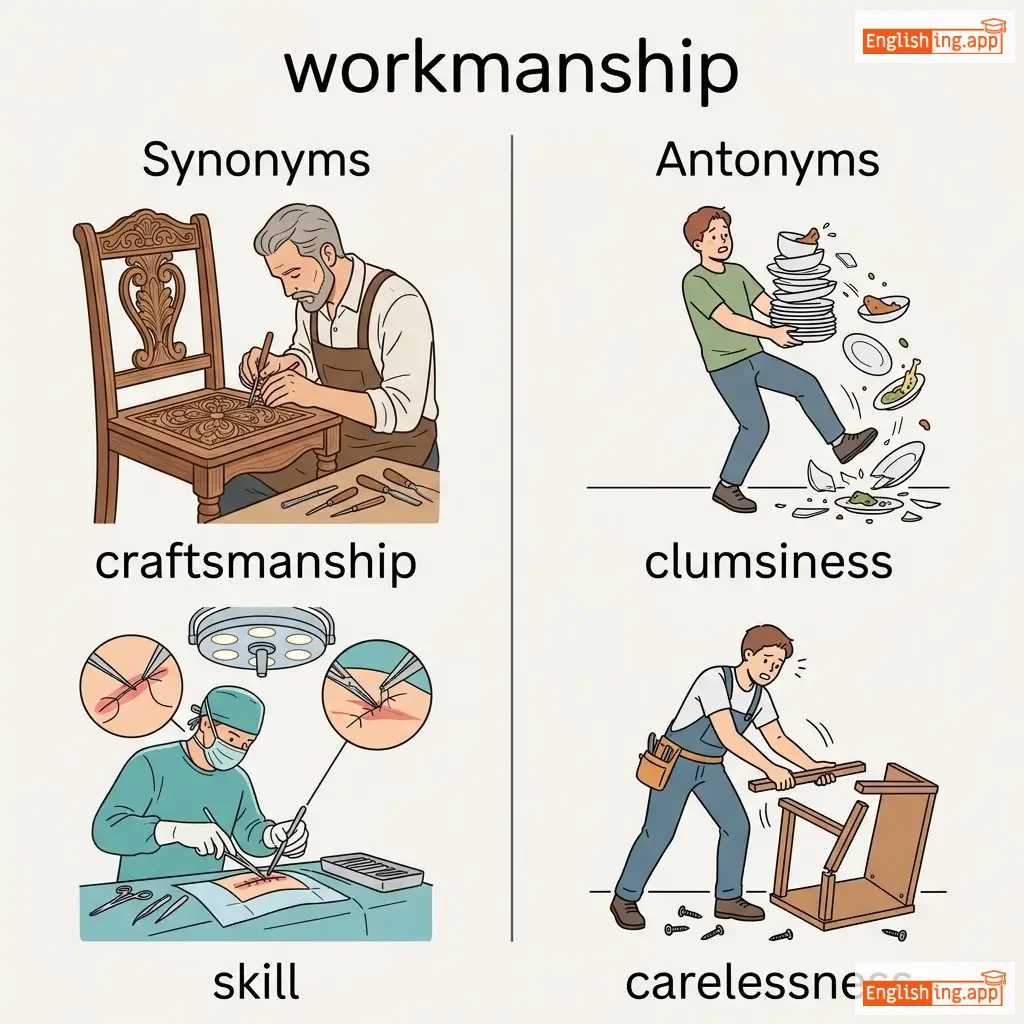
craftsmanship, skill, artistry, quality
|
clumsiness, carelessness, ineptitude
|
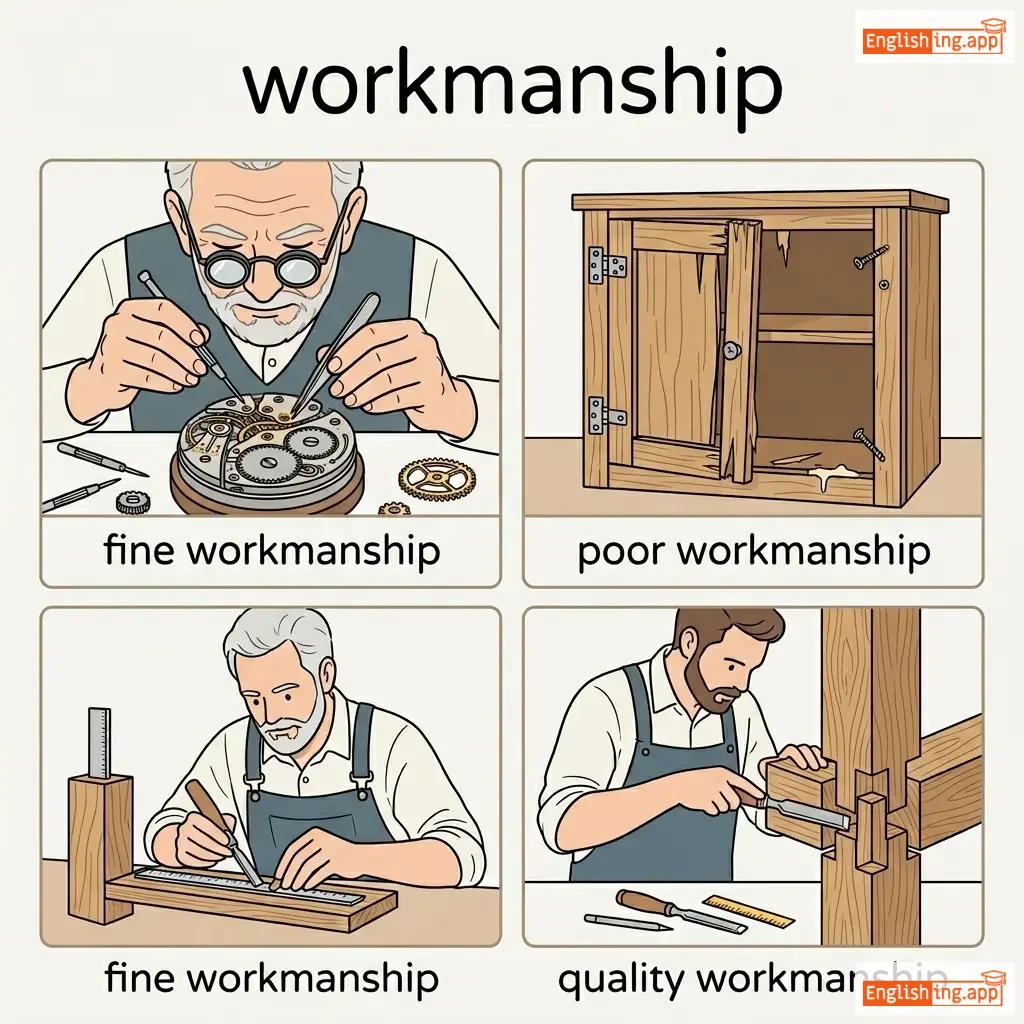
fine workmanship, poor workmanship, quality workmanship
|
Work + ship → habilidad en el trabajo manual, como la artesanía.
••••••
|
|
••••••
|
/ˈrɪŋ.kəl/
noun/verb
(rinkle)
••••••
|
-
••••••
|
arruga
arruga
••••••
|
rinkled
••••••
|
rinkled
••••••
|
wrinkles
••••••
|
wrinkling
••••••
|
A small line or fold in the skin or fabric; to form small folds or lines.
|
The old shirt had many wrinkles.
The old shirt had many wrinkles.
••••••
|
La camisa vieja tenía muchas arrugas.
La camisa vieja tenía muchas arrugas.
••••••
|
iron out the wrinkles
••••••
|
to fix small problems or difficulties
|
arreglar los problemas pequeños
arreglar los problemas pequeños
••••••
|
crease, fold, line, crinkle, furrow
|
••••••
|
deep wrinkles, facial wrinkles, wrinkle cream, iron wrinkles
|
Wrinkle significa arruga, y la crema para arrugas elimina las arrugas.
••••••
|
|
••••••
|
/rɪŋ/
verb
(happiness)
••••••
|
-
••••••
|
felicidad
felicidad
••••••
|
••••••
|
••••••
|
••••••
|
••••••
|
to squeeze and twist something to force liquid out; to extract with effort
|
She had to wring the towel after washing it.
••••••
|
Ella no pudo ocultar su felicidad cuando recibió el premio.
Ella no pudo ocultar su felicidad cuando recibio el premio.
••••••
|
••••••
|
to show worry or distress by twisting one's hands
|
búsqueda de la felicidad
busqueda de la felicidad
••••••
|
twist, squeeze, extract, compress
|
••••••
|
wring out, wring the towel, wring hands, wring a confession
|
Happiness suena como felicidad – piensa en una sonrisa y alegría.
••••••
|
|
••••••
|
/ˈrɛtʃɪdnəs/
noun
(rétchedness)
••••••
|
-
••••••
|
miseria
miseria
••••••
|
-
••••••
|
-
••••••
|
-
••••••
|
-
••••••
|
a state of misery, unhappiness, or poor condition
|
The novel depicts the wretchedness of war victims.
••••••
|
La novela muestra la miseria de las víctimas de la guerra.
La novela muestra la miseria de las victimas de la guerra.
••••••
|
-
••••••
|
-
••••••
|
-
••••••
|
misery, poverty, despair, unhappiness
|
happiness, joy, prosperity
|
human wretchedness, deep wretchedness, state of wretchedness
|
Wretchedness significa miseria – como las víctimas de la guerra viven en miseria.
••••••
|
|
••••••
|
/ˈrɛtʃɪd/
adjective
(ˈrɛtʃɪd)
••••••
|
-
••••••
|
miserable
miserable
••••••
|
-
••••••
|
-
••••••
|
-
••••••
|
-
••••••
|
in a very unhappy, miserable, or poor condition
|
They lived in a wretched hut with no clean water.
••••••
|
Vivían en una choza miserable sin agua limpia.
Vivian en una choza miserable sin agua limpia.
••••••
|
••••••
|
a miserable or poor state
|
condición miserable
condicion miserable
••••••
|
miserable, poor, pitiful, terrible
|
fortunate, blessed, happy
|
wretched condition, wretched life, wretched man, wretched poverty
|
Wretched significa una mala condición, imagina que alguien está en una situación miserable, como 'miserable'.
••••••
|
|
••••••
|
/rɛtʃ/
noun
(retch)
••••••
|
-
••••••
|
miserable
miserable
••••••
|
-
••••••
|
-
••••••
|
-
••••••
|
-
••••••
|
an unfortunate or miserable person; a despicable or contemptible person
|
The poor wretch was left out in the cold with no shelter.
The poor wretch was left out in the cold with no shelter.
••••••
|
El pobre miserable fue dejado afuera en el frío sin refugio.
El pobre miserable fue dejado afuera en el frío sin refugio.
••••••
|
poor wretch
••••••
|
used to describe someone pitiable or miserable
|
pobre miserable
pobre miserable
••••••
|
miserable person, unfortunate, outcast, villain
|
gentleman, lady, nobleman
|
poor wretch, miserable wretch, wretched wretch
|
Wretch significa muy desafortunado, como si al decir 'retch' alguien se sintiera muy mal.
••••••
|
|
••••••
|
/rɛst/
verb
(rest)
••••••
|
-
••••••
|
quitar por la fuerza
quitar por la fuerza
••••••
|
rested
••••••
|
rested
••••••
|
rests
••••••
|
wresting
••••••
|
to forcibly pull something from a person's grasp; to seize with effort or struggle
|
The police had to wrest the weapon from the suspect's hand.
La policía tuvo que quitarle el arma de la mano del sospechoso.
••••••
|
La policía tuvo que arrebatar el arma de la mano del sospechoso.
La policía tuvo que arrebatar el arma de la mano del sospechoso.
••••••
|
quitar control
••••••
|
to take control by force or effort
|
quitar el control
quitar el control
••••••
|
seize, grab, snatch, extract, yank
|
release, surrender, yield
|
wrest control, wrest power, wrest the title, wrest freedom
|
Wrest significa quitar el 'rest' – es como quitar algo de descanso o descanso de alguien.
••••••
|
|
••••••
|
/rɛntʃ/
verb
(rench)
••••••
|
-
••••••
|
torcer bruscamente
torcer bruscamente
••••••
|
renchd
••••••
|
renchd
••••••
|
renches
••••••
|
renching
••••••
|
to pull or twist suddenly and violently
|
He wrenched the door open in anger.
Él forzó la puerta con ira.
••••••
|
Él torció la puerta con ira.
El torció la puerta con ira.
••••••
|
tirar una llave inglesa en
••••••
|
to cause problems or difficulties in a plan or process
|
causar problemas en
causar problemas en
••••••
|
••••••
|
••••••
|
wrench free, wrench away, emotional wrench
|
Wrench es como torcer o forzar: necesitas una llave para girar algo duro
••••••
|
|
••••••
|
/riːk/
verb
(rík)
••••••
|
-
••••••
|
causar daño
causar dano
••••••
|
ríkt
••••••
|
ríkt
••••••
|
ríks
••••••
|
ríking
••••••
|
to cause or inflict something, especially damage or harm
|
The storm wreaked havoc on the coastal villages.
la tormenta ríkt havok en los pueblos costeros.
••••••
|
La tormenta causó grandes daños en los pueblos costeros.
La tormenta causo grandes danos en los pueblos costeros.
••••••
|
ríkt havok
••••••
|
to cause great damage or disruption
|
causar gran daño
causar gran dano
••••••
|
inflict, cause, unleash, impose
|
••••••
|
wreak havoc, wreak destruction, wreak damage
|
Wreak Havoc significa gran destrucción – Wreak causando Weakness.
••••••
|
|
••••••
|
/ræθ/
noun
(rath)
••••••
|
-
••••••
|
ira
ira
••••••
|
-
••••••
|
-
••••••
|
-
••••••
|
-
••••••
|
••••••
|
The king's wrath terrified the villagers.
••••••
|
La ira del rey aterrorizó a los aldeanos.
La ira del rey aterrorizó a los aldeanos.
••••••
|
••••••
|
to make someone extremely angry
|
provocar la ira de alguien
provocar la ira de alguien
••••••
|
anger, fury, rage, outrage
|
calmness, peace, forgiveness
|
divine wrath, wrath of God, unleash wrath
|
Wrath es ira – la ira del rey asusta a los aldeanos
••••••
|
|
••••••
|
/ˈræŋɡlər/
noun
(ránɡler)
••••••
|
-
••••••
|
cuidador de ganado
cuidador de ganado
••••••
|
-
••••••
|
-
••••••
|
-
••••••
|
-
••••••
|
a person who argues noisily; or someone who takes care of livestock on a ranch
|
The cowboy worked as a wrangler on the ranch.
El vaquero trabajó como un rángler en el rancho.
••••••
|
El vaquero trabajó como un rángler en el rancho.
El vaquero trabajó como un rángler en el rancho.
••••••
|
-
••••••
|
-
••••••
|
-
••••••
|
cowboy, herder, rancher, arguer
|
••••••
|
horse wrangler, cattle wrangler, film wrangler
|
Wrangler significa cuidador de ganado – cuida el ganado en el rancho
••••••
|
|
••••••
|
/ˈræŋɡl̩/
verb
(ránguel)
••••••
|
-
••••••
|
discutir
discutir
••••••
|
ránguldo
••••••
|
ránguldo
••••••
|
ránguela
••••••
|
ránguelo
••••••
|
to argue or dispute noisily or angrily
|
The two neighbors wrangled over the property line for hours.
Los dos vecinos discutieron durante horas sobre la línea de propiedad.
••••••
|
Los dos vecinos discutieron durante horas sobre la línea de propiedad.
Los dos vecinos discutieron durante horas sobre la línea de propiedad.
••••••
|
discutir sobre
••••••
|
to argue or dispute about something
|
discutir sobre algo
discutir sobre algo
••••••
|
argue, quarrel, bicker, dispute, squabble
|
••••••
|
wrangle over money, wrangle with authorities, political wrangle
|
Wrangle significa discutir – ¡un wrangle comienza cuando discutes!
••••••
|
|
••••••
|
/reɪθ/
noun
(reɪθ)
••••••
|
-
••••••
|
espectro
espectro
••••••
|
-
••••••
|
-
••••••
|
-
••••••
|
-
••••••
|
A ghost or ghostlike image of someone, especially seen shortly before or after their death.
|
A wraith appeared in the fog near the old castle.
••••••
|
Un espectro apareció en la niebla cerca del viejo castillo.
Un espectro apareció en la niebla cerca del viejo castillo.
••••••
|
-
••••••
|
-
••••••
|
-
••••••
|
ghost, specter, phantom, spirit, apparition
|
••••••
|
wraith-like figure, ghostly wraith, pale wraith
|
Wraith suena similar a espectro, que significa fantasma.
••••••
|
|
••••••
|
/ˈwɜːʃɪp/
verb
(wörship)
••••••
|
-
••••••
|
adoración
adoracion
••••••
|
wörshiped
••••••
|
wörshiped
••••••
|
wörships
••••••
|
wörshiping
••••••
|
To show reverence and adoration for a deity or sacred being.
|
They gathered at the temple to worship together.
Se reunieron en el templo para adorar juntos.
••••••
|
Se reunieron en el templo para adorar juntos.
Se reunieron en el templo para adorar juntos.
••••••
|
worship the ground someone walks on
adorar el suelo por donde alguien camina
••••••
|
To admire or adore someone greatly.
|
admirar a alguien en exceso
admirar a alguien en exceso
••••••
|
adore, revere, venerate, honor, praise
|
despise, dishonor, disrespect
|
worship God, worship in church, idol worship, worship service
|
Worship significa adoración, como adorar en el templo.
••••••
|
|
••••••
|
/ˈwɜːldli/
adjective
(wɜːrldli)
••••••
|
-
••••••
|
materialista
materialista
••••••
|
-
••••••
|
-
••••••
|
-
••••••
|
-
••••••
|
Concerned with material values or ordinary life rather than spiritual matters.
|
He was more interested in worldly success than in spiritual growth.
••••••
|
Él estaba más interesado en el éxito material que en el crecimiento espiritual.
Él estaba más interesado en el éxito material que en el crecimiento espiritual.
••••••
|
••••••
|
Experienced and shrewd in worldly matters.
|
sabio en lo mundano
sabio en lo mundano
••••••
|
materialistic, secular, earthly, sophisticated
|
spiritual, unworldly, naive
|
worldly goods, worldly success, worldly matters, worldly experience
|
Worldly se refiere a lo material, materialista también es lo mismo.
••••••
|
|
••••••
|
/wɪðˈstænd/
verb
(wɪðˈstænd)
••••••
|
-
••••••
|
soportar / resistir
soportar / resistir
••••••
|
wɪðˈstʊd
••••••
|
wɪðˈstʊd
••••••
|
wɪðˈstændz
••••••
|
wɪðˈstændɪŋ
••••••
|
to resist or endure something without being harmed
|
This building can withstand strong earthquakes.
Este edificio puede soportar terremotos fuertes.
••••••
|
Este edificio puede soportar terremotos fuertes.
Este edificio puede soportar terremotos fuertes.
••••••
|
aprobar la prueba del tiempo
••••••
|
to last or remain strong for a long period
|
superar la prueba del tiempo
superar la prueba del tiempo
••••••
|
endure, resist, survive, tolerate, bear
|
surrender, collapse, yield
|
withstand pressure, withstand attack, withstand force, withstand heat
|
With STAND stands for resist, stand strong in life!
••••••
|
|
••••••
|
/ˈwɜːkmənˌlaɪk/
adjective
(wɜːrkˌmaɪnˈlaɪk)
••••••
|
-
••••••
|
trabajoso
trabajoso
••••••
|
-
••••••
|
-
••••••
|
-
••••••
|
-
••••••
|
Showing efficient, competent, and practical skill, but without flair or creativity.
|
The carpenter delivered a workmanlike performance on the project.
El carpintero entregó una actuación de trabajo en el proyecto.
••••••
|
El carpintero entregó una actuación de trabajo en el proyecto.
El carpintero entregó una actuación de trabajo en el proyecto.
••••••
|
-
••••••
|
-
••••••
|
-
••••••
|
competent, efficient, skilled, practical, capable
|
unskilled, incompetent, sloppy
|
workmanlike manner, workmanlike performance, workmanlike approach
|
Trabajo + Like = Trabajo que no es creativo.
••••••
|
|
••••••
|
/ˈwɜːrkɪŋ mæn/
noun
(wɜːrkɪŋ mæn)
••••••
|
-
••••••
|
trabajador
trabajador
••••••
|
-
••••••
|
-
••••••
|
-
••••••
|
-
••••••
|
a man engaged in manual labor or industrial work, often considered as part of the working class
|
The working-man fought hard for better wages and conditions.
••••••
|
El trabajador luchó duramente por mejores salarios y condiciones.
El trabajador luchó duramente por mejores salarios y condiciones.
••••••
|
-
••••••
|
-
••••••
|
-
••••••
|
laborer, worker, employee, breadwinner
|
••••••
|
working-man wages, working-man rights, working-man struggle
|
working-man significa trabajador – un hombre que trabaja.
••••••
|
|
••••••
|
/woʊnt/ or /wɔːnt/
adjective
(wont)
••••••
|
-
••••••
|
acostumbrado
acostumbrado
••••••
|
-
••••••
|
-
••••••
|
-
••••••
|
-
••••••
|
accustomed or used to doing something
|
She rose early, as she was wont to do.
Ella se levantó temprano, como solía hacer.
••••••
|
Ella se levantó temprano, como solía hacer.
Ella se levantó temprano, como solía hacer.
••••••
|
-
••••••
|
-
••••••
|
-
••••••
|
accustomed, used, habituated, inclined
|
••••••
|
as he is wont to, as she was wont to do
|
Ella siempre se levanta temprano, como está acostumbrada.
••••••
|
|
••••••
|
/ˈwoʊ.fəl/
adjective
(wofúl)
••••••
|
-
••••••
|
lamentable
lamentable
••••••
|
-
••••••
|
-
••••••
|
-
••••••
|
-
••••••
|
full of woe; very sad or miserable; also used to mean very bad or deplorable
|
He gave me a woeful look when he lost the match.
••••••
|
Me dio una mirada lamentable cuando perdió el partido.
Me dio una mirada lamentable cuando perdió el partido.
••••••
|
-
••••••
|
-
••••••
|
-
••••••
|
miserable, sorrowful, pitiful, tragic, deplorable
|
cheerful, joyful, pleasant
|
woeful expression, woeful condition, woeful state
|
woe significa pena, por lo tanto, woeful significa lleno de pena.
••••••
|
|
••••••
|
/woʊ/
noun
(wo)
••••••
|
-
••••••
|
pena
pena
••••••
|
-
••••••
|
-
••••••
|
-
••••••
|
-
••••••
|
great sorrow, distress, or trouble
|
Her heart was filled with woe after hearing the sad news.
••••••
|
Su corazón se llenó de pena al escuchar la triste noticia.
Su corazon se lleno de pena al escuchar la triste noticia.
••••••
|
••••••
|
an exclamation of sorrow or distress
|
ay de mí
ay de mi
••••••
|
sorrow, misery, grief, anguish, despair
|
••••••
|
filled with woe, tales of woe, woe upon woe
|
Cuando sientes dolor, 'woe' significa '¡ay de mí!'
••••••
|
|
••••••
|
/ˈwɒb.l̩/
verb
(wóbl)
••••••
|
-
••••••
|
tambalear
tambalear
••••••
|
wóblid
••••••
|
wóblid
••••••
|
wóbles
••••••
|
wóbling
••••••
|
to move unsteadily from side to side; to shake or tremble slightly
|
The table began to wobble when he leaned on it.
La mesa comenzó a wobble cuando se recostó sobre ella.
••••••
|
La mesa comenzó a tambalear cuando él se apoyó sobre ella.
La mesa comenzo a tambalear cuando el se apoyó sobre ella.
••••••
|
en el wobble
••••••
|
in an unstable or uncertain state
|
en una situación inestable
en una situacion inestable
••••••
|
shake, tremble, totter, sway, oscillate
|
stabilize, steady, balance
|
wobble slightly, wobble chair, wobble table, wobble board
|
cuando algo wobble, es como tambalear.
••••••
|
|
••••••
|
/ˈwɪznd/
adjective
(wízend)
••••••
|
-
••••••
|
arrugado
arrugado
••••••
|
-
••••••
|
-
••••••
|
-
••••••
|
-
••••••
|
Shriveled, wrinkled, or withered, often due to age.
|
The wizened tree stood in the field for centuries.
••••••
|
El árbol arrugado estuvo en el campo durante siglos.
El árbol arrugado estuvo en el campo durante siglos.
••••••
|
-
••••••
|
-
••••••
|
-
••••••
|
shriveled, withered, wrinkled, aged
|
fresh, blooming, youthful
|
wizened face, wizened hands, wizened figure, wizened old man
|
Wizened = Viejo + Arrugado - Una persona mayor suele tener la piel arrugada.
••••••
|
|
••••••
|
/ˈwɪzn feɪst/
adjective
(wízen-feisd)
••••••
|
-
••••••
|
cara arrugada y marchita
cara arrugada y marchita
••••••
|
-
••••••
|
-
••••••
|
-
••••••
|
-
••••••
|
Having a dry, wrinkled, and withered face.
|
A wizen-faced old man sat quietly in the corner.
••••••
|
Un hombre con la cara arrugada y marchita se sentó tranquilamente en la esquina.
Un hombre con la cara arrugada y marchita se sentó tranquilamente en la esquina.
••••••
|
-
••••••
|
-
••••••
|
-
••••••
|
wrinkled, shriveled, withered, aged
|
••••••
|
wizen-faced man, wizen-faced woman, old wizen-faced, wizen-faced beggar
|
Wizen-faced se refiere a cara arrugada y marchita.
••••••
|
|
••••••
|
/ˈwɪzn/
verb
(wízen)
••••••
|
-
••••••
|
marchitarse
marchitarse
••••••
|
wízend
••••••
|
wízend
••••••
|
wízend
••••••
|
wízening
••••••
|
To become dry, shrunken, and wrinkled.
|
The flowers began to wizen after days without water.
Las flores comenzaron a marchitarse después de varios días sin agua.
••••••
|
Las flores comenzaron a marchitarse después de varios días sin agua.
Las flores comenzaron a marchitarse después de varios días sin agua.
••••••
|
-
••••••
|
-
••••••
|
-
••••••
|
shrivel, wither, dry, wrinkle
|
••••••
|
wizen face, wizen hands, wizen body, wizen skin
|
Wizen = con Zen, marchitarse lentamente.
••••••
|
|
••••••
|
/ˈwɪzərdri/
noun
(wizárdri)
••••••
|
-
••••••
|
destreza mágica
destreza magica
••••••
|
-
••••••
|
-
••••••
|
-
••••••
|
-
••••••
|
The art or practice of magic; great skill or expertise in something.
|
The programmer's wizardry amazed everyone in the room.
La destreza del programador asombró a todos en la sala.
••••••
|
La destreza del programador asombró a todos en la sala.
La destreza del programador asombró a todos en la sala.
••••••
|
-
••••••
|
-
••••••
|
-
••••••
|
sorcery, magic, enchantment, mastery, expertise
|
clumsiness, incompetence, ineptitude
|
technical wizardry, display of wizardry, computer wizardry, wizardry skills
|
Wizardry es como magia, como un mago con gran destreza.
••••••
|
|
••••••
|
/ˈwɪtɪŋli/
adverb
(wítɪŋli)
••••••
|
-
••••••
|
conscientemente
conscientemente
••••••
|
-
••••••
|
-
••••••
|
-
••••••
|
-
••••••
|
Consciously and intentionally; on purpose.
|
He wittingly withheld information from the police.
Él retuvo información conscientemente de la policía.
••••••
|
Él retuvo información conscientemente de la policía.
El retuvo informacion conscientemente de la policia.
••••••
|
-
••••••
|
-
••••••
|
-
••••••
|
knowingly, deliberately, intentionally, purposely
|
unknowingly, accidentally, unintentionally
|
wittingly or unwittingly, act wittingly, wittingly ignore, wittingly commit
|
Wittingly significa conscientemente (conscientemente) hacer algo a propósito.
••••••
|
|
••••••
|
/ˈwɪtɪˌsɪzəm/
noun
(wɪtɪˌsɪzəm)
••••••
|
-
••••••
|
comentario ingenioso / chiste
comentario ingenioso / chiste
••••••
|
-
••••••
|
-
••••••
|
-
••••••
|
-
••••••
|
••••••
|
Her witticism made everyone laugh during the meeting.
••••••
|
Su comentario ingenioso hizo reír a todos durante la reunión.
Su comentario ingenioso hizo reír a todos durante la reunión.
••••••
|
-
••••••
|
-
••••••
|
-
••••••
|
quip, joke, jest, pun, wisecrack
|
••••••
|
sharp witticism, clever witticism, witty witticism
|
Witty + ism significa comentarios inteligentes y divertidos
••••••
|
|
••••••
|
/ˈwɪtlɪŋ/
noun
(wítling)
••••••
|
-
••••••
|
tonto / farsante sabio
tonto / farsante sabio
••••••
|
-
••••••
|
-
••••••
|
-
••••••
|
-
••••••
|
a person who has little wit or pretends to be witty
|
He acted like a witling among scholars.
Él actuó como un tonto entre los eruditos.
••••••
|
Él actuó como un tonto entre los eruditos.
Él actuó como un tonto entre los eruditos.
••••••
|
-
••••••
|
-
••••••
|
-
••••••
|
fool, jester, clown, dunce
|
••••••
|
silly witling, poor witling, foolish witling
|
Wit-ling es como un tonto que quiere aparentar ser sabio.
••••••
|
|
••••••
|
/ˈwɪtləs/
adjective
(wítles)
••••••
|
-
••••••
|
tonto
tonto
••••••
|
-
••••••
|
-
••••••
|
-
••••••
|
-
••••••
|
lacking intelligence or good sense
|
It was a witless decision to leave the door unlocked.
••••••
|
Fue una decisión tonta dejar la puerta desbloqueada.
Fue una decision tonta dejar la puerta desbloqueada.
••••••
|
-
••••••
|
-
••••••
|
-
••••••
|
foolish, stupid, brainless, senseless, idiotic
|
wise, intelligent, sensible
|
witless remark, witless behavior, witless mistake
|
Wit significa inteligencia, Wit-less significa sin inteligencia
••••••
|