Vokabulare

Englisches Vokabelwörterbuch | Wortbedeutungen, Definitionen & Beispiele

adjective C2
/juːˈnɪsənənt/
和谐的 (héxié de)

Sounding together or in harmony.

"The unisonant voices created a powerful effect."

"和谐的声音创造了强大的效果。" (Héxié de shēngyīn chuàngzàole qiángdà de xiàoguǒ.)
noun C2
/ˌjuːnɪˈtɛəriən/
一神论者 (yīshénlùnzhě)

A person who believes that God exists as one entity rather than as a Trinity; a member of a religious denomination that emphasizes individual freedom of belief.

"The Unitarian church is known for its inclusive and open-minded approach."

"一神论教会以其包容和开放的思想方式而闻名。" (Yīshénlùn jiàohuì yǐ qí bāoróng hé kāifàng de sīxiǎng fāngshì ér wénmíng.)
noun C2
/ˈjuːnɪvəˌlɛns/
单价性 (dānjiàxìng)

The state of having a single valence or combining power, especially in chemistry.

"Hydrogen is characterized by its univalence in chemical reactions."

"氢气在化学反应中以其单价性为特点。" (Qīngqì zài huàxué fǎnyìng zhōng yǐ qí dānjiàxìng wéi tèdiǎn.)
adjective C2
/ʌnˈlɛtəd/
文盲 (wénmáng)

lacking education or the ability to read and write; illiterate

"The unlettered villagers relied on oral traditions to preserve their history."

"那些文盲村民依赖口头传统来保存他们的历史。" (Nàxiē wénmáng cūnmín yīlài kǒutóu chuántǒng lái bǎocún tāmen de lìshǐ.)
adjective C2
/ʌnˈmɪtɪɡeɪtɪd/
完全 (wanquan)

absolute; not lessened or moderated

"The meeting was an unmitigated disaster."

"会议是一次完全的灾难。" (Huiyi shi yici wanquan de zainan.)
adjective C2
/ˌʌnpriːpəˈzɛsɪŋ/
不吸引人 (bù xīyǐn rén)

not attractive or appealing in appearance

"Despite his unprepossessing looks, he was very kind and intelligent."

"尽管他的外貌不吸引人,他还是非常友善和聪明。" (Jǐnguǎn tā de wàibiǎo bù xīyǐn rén, tā hái shì fēicháng yǒushàn hé cōngmíng.)
adjective C2
/ˌʌnprəˈpɪʃəs/
不利 (bùlì)

Not giving or indicating a good chance of success; unfavorable.

"The team began their journey under unpropitious weather conditions."

"团队在不利的天气条件下开始了他们的旅程。" (Tuánduì zài bùlì de tiānqì tiáojiàn xià kāishǐle tāmen de lǚchéng.)
adjective C2
/ˌʌn.rɪˈdʒɛn.ər.ət/
顽固 (wángù)

Not reformed or showing no signs of change; stubbornly refusing to reform or repent.

"He remained an unregenerate opponent of progress."

"他仍然是进步的顽固反对者。" (Tā réngrán shì jìnbù de wángù fǎnduìzhě.)
adjective C2
/ˌʌnrɪˈmɪtɪŋ/
不断的 (buduan de)

Never relaxing or stopping; persistent.

"Her unremitting efforts finally paid off."

"她不懈的努力终于得到了回报。" (Tā bùxiè de nǔlì zhōngyú dédàole huíbào.)
adjective C2
/ʌnˈspɛərɪŋ/
无情的 (wu qing de)

Showing no mercy or generosity; harsh or severe.

"The critic was unsparing in his review of the play."

"评论家在他的剧评中毫不留情。" (Pínglùn jiā zài tā de jùpíng zhōng háo bù liúqíng.)
adjective C2
/ʌnˈstɪntɪŋ/
慷慨的 (kangkai de)

given generously without holding back

"She received unstinting support from her family."

"她从家人那里得到了慷慨的支持。" (Ta cong jiaren nali dedaole kangkai de zhichi.)
adjective C2
/ʌnˈsʌlid/
无暇 (wú xiá)

not spoiled or made impure; perfectly clean or pure

"His reputation remained unsullied despite the accusations."

"尽管有指控,他的声誉仍然无暇。" (Jǐnguǎn yǒu zhǐkòng, tā de shēngyù réngrán wú xiá.)
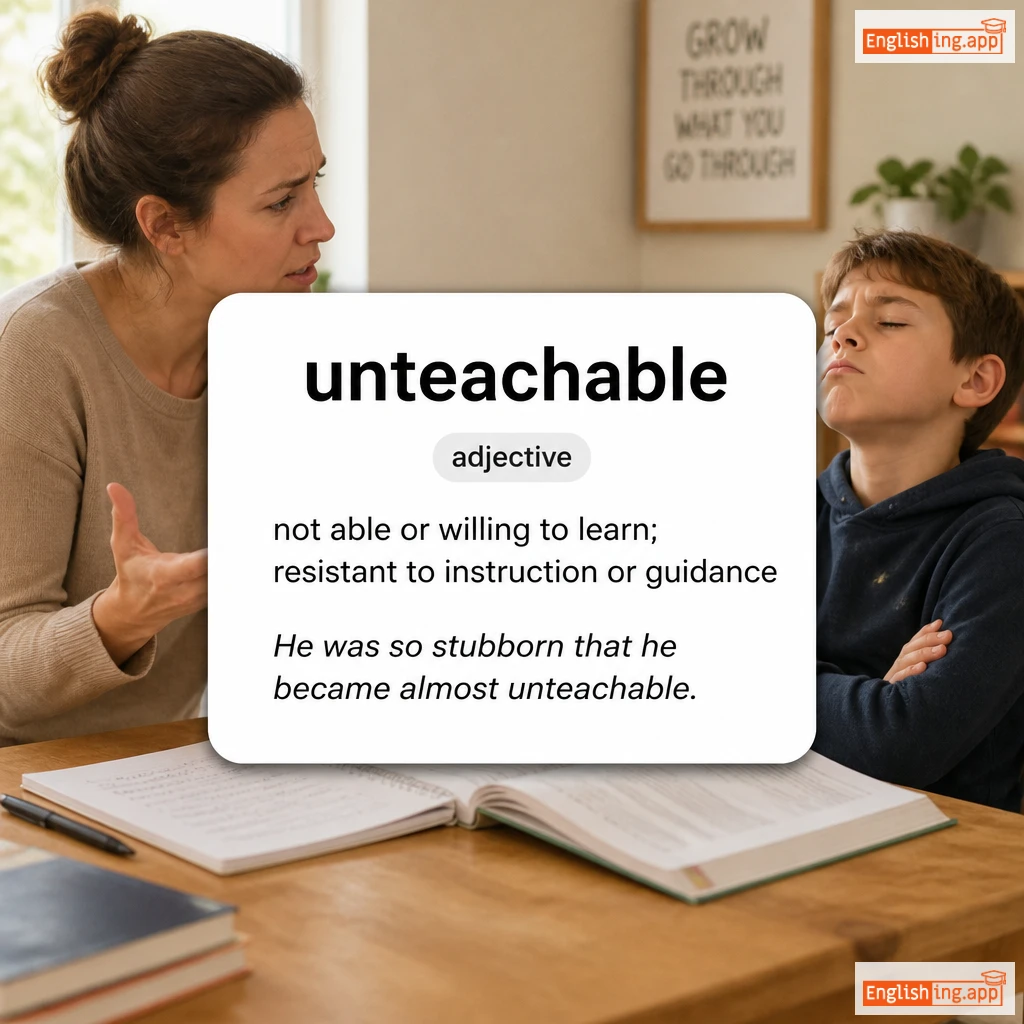
unteachable definition card — visual illustration of the meaning
adjective C2
/ʌnˈtiːtʃəbəl/
不可教的 (bu ke jiao de)

not able or willing to learn; resistant to instruction or guidance

"He was so stubborn that he became almost unteachable."

"他非常固执,几乎变得不可教。" (ta fei chang gu zhi ji hu bian de bu ke jiao)
adjective C2
/ʌnˈtɛmpərd/
失控的 (shīkòng de)

not moderated or softened; lacking proper balance or control

"The untempered anger of the crowd caused chaos."

"人群的失控愤怒引发了混乱。" (Rénqún de shīkòng fènnù yǐnfāle hùnluàn.)
adjective C2
/ˌʌn.təˈwɔːrd/
意外的 (yìwài de)

Unexpected and inappropriate or inconvenient.

"The meeting ended without any untoward incidents."

"会议在没有任何意外事件的情况下结束。" (Huìyì zài méiyǒu rènhé yìwài shìjiàn de qíngkuàng xià jiéshù.)
adjective C2
/ʌnˈtræməld/
无限自由 (wuxian ziyou)

Not restricted or hampered; free and unrestricted.

"She enjoyed untrammeled freedom in her new life abroad."

"她在国外的新生活中享受着无限自由。" (Ta zai guowai de xin shenghuo zhong xiangshouzhe wuxian ziyou.)
adjective C2
/ʌnˈʌtərəbl/
难以言喻 (nanyi yanyu)

Too great, intense, or awful to be expressed or described in words.

"She was filled with unutterable joy at the news of her success."

"她听到成功的消息时充满了难以形容的喜悦。" (Ta ting dao chenggong de xiaoxi shi chong man le nanyi xing rong de xiyue.)
adjective C2
/ʌnˈwiːldi/
笨重 (bènzhòng)

Difficult to carry or move because of its size, shape, or weight.

"The box was too unwieldy to carry up the stairs."

"这个盒子太笨重了,无法把它提上楼梯。" (zhège hézi tài bènzhòng le, wúfǎ bǎ tā tí shàng lóutī.)
adjective C2
/ʌnˈwəʊntɪd/
不寻常 (bù xúncháng)

Unusual, uncommon, or out of the ordinary.

"She spoke with an unwonted gentleness that surprised everyone."

"她以一种不寻常的温柔说话,令所有人都感到惊讶。" (Ta yi zhong bu xunchang de wenrou shuohua, ling suoyouren dou gandao jingya.)
verb C2
/ʌnˈjoʊk/
解开 (jiě kāi)

To release from a yoke or to free from restraint or obligation.

"The farmer unyoked the oxen after a long day of work."

"农民在长时间工作后解开了牛的套索。" (Nóngmín zài cháng shíjiān gōngzuò hòu jiě kāi le niú de tàosuǒ.)
verb C2
/ʌpˈbreɪd/
斥责 (chize)

To scold or criticize someone harshly.

"The teacher upbraided the student for being late again."

"老师因为学生再次迟到而训斥了他。" (Lǎoshī yīnwèi xuéshēng zàicì chídào ér xùnchì le tā.)
noun/verb C2
/ˈʌpˌkæst/
向上投掷 (xiang shang tou zhi)

Verb: To cast or throw upward. Noun: Something thrown or directed upward.

"The fisherman upcast his net into the air."

"渔夫把他的网投向空中。" (Yu fu ba ta de wang tou xiang kong zhong.)
verb C2
/ʌpˈhiːv/
抬起 (tái qǐ)

to lift or raise something forcefully; to cause to rise suddenly

"The workers had to upheave the heavy stone to clear the path."

"工人们不得不抬起重石来清理道路。" (Gōngrén men bùdé bù tái qǐ zhòng shí lái qīnglǐ dàolù.)
adjective C2
/ʌpˈrɔːr.i.əs/
极其滑稽 (jiqi huaji)

Extremely funny or noisy; causing loud laughter or commotion.

"The comedian's jokes were absolutely uproarious."

"喜剧演员的笑话绝对是极其滑稽的。" (Xijuyanyuan de xiaohua jueduishi jiqi huaji de.)
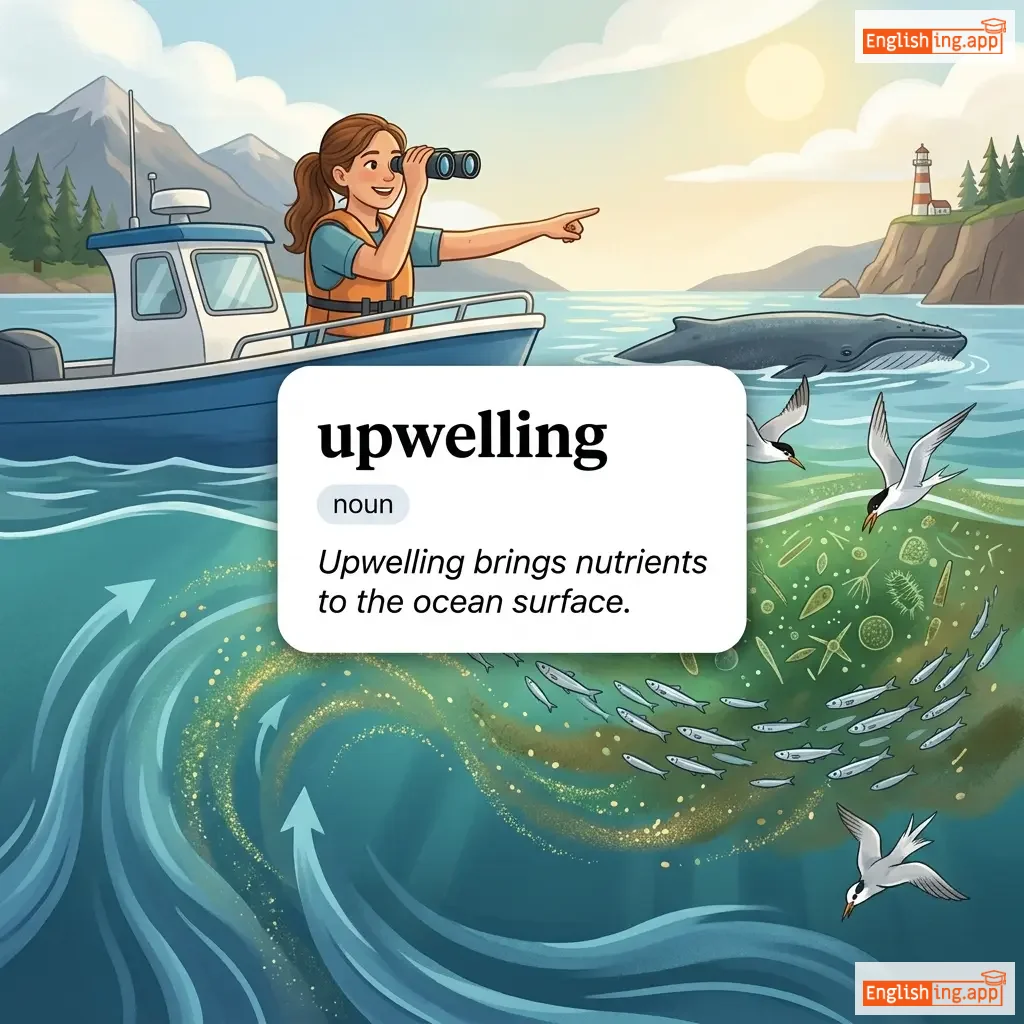
upwelling definition card — visual illustration of the meaning
noun C2
/ˈʌp.wel.ɪŋ/
上升流 (upwelling)

An oceanographic phenomenon that involves wind-driven motion of dense, cooler, and nutrient-rich water towards the ocean surface.

"Upwelling brings nutrients to the ocean surface."

"上升流将营养物质带到海洋表面。" (Shang sheng liu jiang yingyang wuzhi dai dao haiyang biaomian)
adjective C2
/ɜːrˈbeɪn/
都市的 (dūshì de)

showing polished manners, refinement, and sophistication

"He was an urbane gentleman who charmed everyone at the party."

"他是一个都市绅士,在派对上迷住了所有人。" (Tā shì yīgè dūshì shēnshì, zài pàiduì shàng mí zhùle suǒyǒu rén.)
noun C2
/ɜːrˈbænɪti/
都市气质 (dūshì qìzhí)

refined courtesy, elegance, and sophistication in manner

"Her urbanity made her popular among diplomats and leaders."

"她的都市气质让她在外交官和领导人中非常受欢迎。" (Tā de dūshì qìzhí ràng tā zài wàijiāo guān hé lǐngdǎo rén zhōng fēicháng shòu huānyíng.)
noun C2
/ˈɜːrtʃɪn/
街头小孩 (jietou xiaohai)

a mischievous or poorly dressed child, often from the streets

"The ragged urchins played by the riverbank."

"那些穿着破烂的街头小孩在河边玩耍。" (naxie chuanzhuo polan de jietou xiaohai zai he bian wanshua.)
adjective C2
/ˈɜːrsaɪn/
熊似的 (xióng shì de)

Relating to or resembling a bear.

"The man’s ursine strength amazed everyone."

"那个人熊似的力量让所有人都吃惊。" (Nàgè rén xióng shì de lìliàng ràng suǒyǒu rén dōu chījīng.)
noun C2
/ˈjuːzjuːfrʌkt/
使用权 (shiyongquan)

The legal right to use and enjoy the benefits of someone else’s property without owning it.

"The tenant had the usufruct of the land but not its ownership."

"租户有权使用这片土地,但没有所有权。" (Zuhu you quan shiyong zhe pian tudi, dan meiyou suoyouquan.)
adjective C2
/juːˈʒʊəriəs/
高利贷的 (gaoli dai de)

Charging excessively high interest rates on loans.

"The bank was accused of offering loans at usurious rates."

"该银行被指控以高利贷利率提供贷款。" (Gāi yínháng bèi zhǐkòng yǐ gāo lìdài lìlǜ tígōng dàikuǎn.)
usurp definition card — visual illustration of the meaning
verb C2
/juːˈzɜːrp/
非法夺取 (fēi fǎ duó qǔ)

To take someone else's position or power illegally or by force.

"He tried to usurp the throne from the rightful king."

"他试图从合法国王手中篡夺王位。" (Tā shìtú cóng héfǎ guówáng shǒuzhōng cuànduó wángwèi.)
noun C2
/ˌjuːzɜːrˈpeɪʃən/
篡夺 (cuàn duó)

The act of taking someone's power or property illegally or by force.

"The general's usurpation of the presidency led to political unrest."

"将军对总统职位的篡夺导致了政治动荡。" (Jiāngjūn duì zǒngtǒng zhíwèi de cuàn duó dǎozhìle zhèngzhì dòngdàng.)
usury definition card — visual illustration of the meaning
noun C2
/ˈjuːʒəri/
高利贷 (gaolidai)

The practice of lending money at unreasonably high interest rates.

"The law strictly prohibits usury."

"法律严格禁止高利贷。" (Fǎlǜ yángé jìnzhǐ gāo lìdài.)
noun C2
/juːˌtɪlɪˈtɛəriənɪzəm/
功利主义 (gōnglì zhǔyì)

The ethical theory that actions are right if they are useful or for the benefit of the majority.

"Utilitarianism suggests that we should act to maximize overall happiness."

"功利主义认为我们应该采取行动,以最大化整体幸福。" (Gōnglì zhǔyì rènwéi wǒmen yīnggāi cǎiqǔ xíngdòng, yǐ zuìdà huà zhěngtǐ xìngfú.)
adjective C2
/ʌkˈsɔːriəs/
过度宠爱妻子 (guò dù chǒng ài qī zi)

excessively fond of or submissive to one's wife

"He was so uxorious that he agreed with everything his wife said."

"他是如此的宠爱妻子,以至于同意了妻子说的每一件事。" (Tā shì rúcǐ de chǒng'ài qīzi, yǐ zhì yú tóngyìle qīzi shuō de měi yī jiàn shì.)
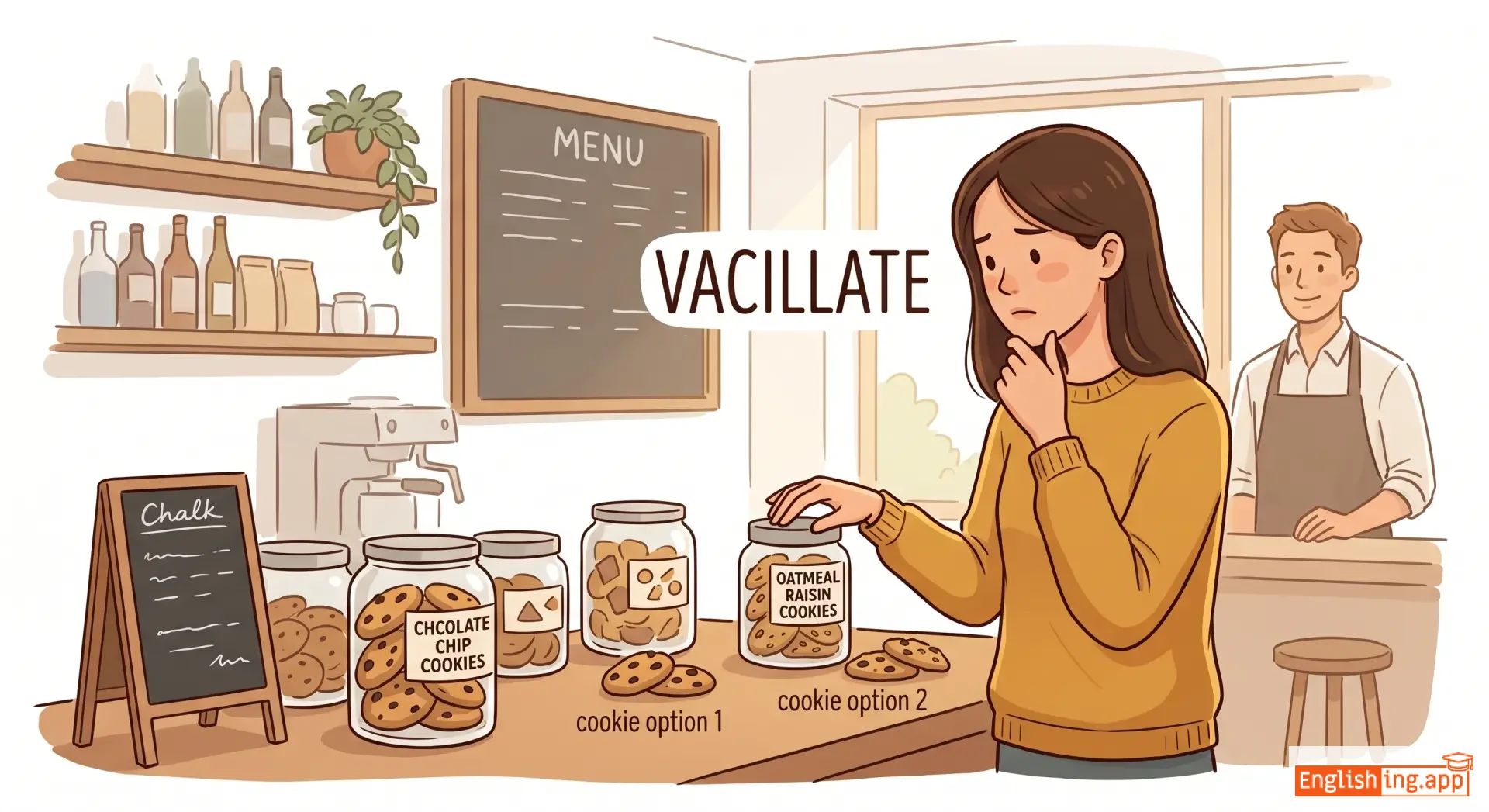
vacillate definition card — visual illustration of the meaning
verb C2
/ˈvæsɪleɪt/
幸福 (xìngfú)

to waver between different opinions or actions; be indecisive

"He vacillated between studying law and becoming a writer."

"她在获得奖项时无法掩饰自己的幸福。" (Tā zài huòdé jiǎngxiàng shí wúfǎ yǎnshì zìjǐ de xìngfú.)
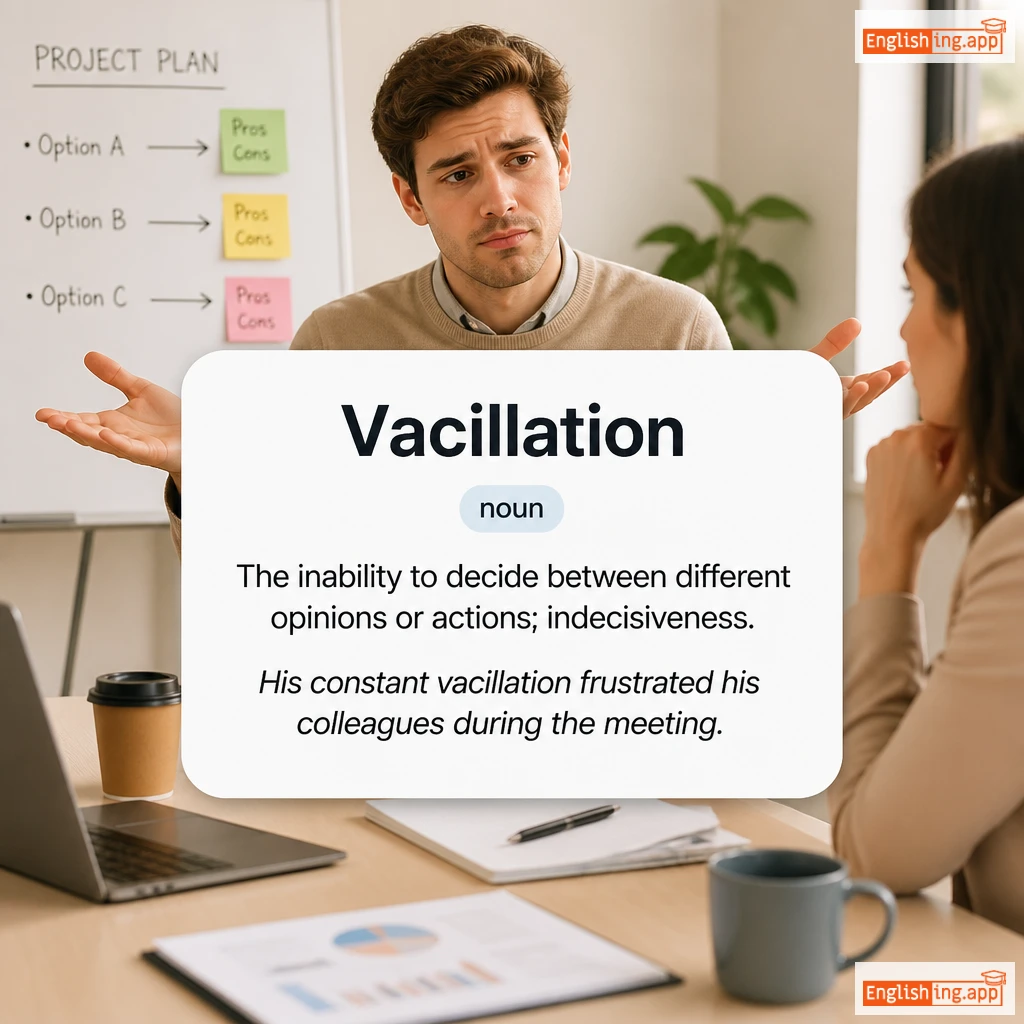
Vacillation definition card — visual illustration of the meaning
noun C2
/ˌvæsɪˈleɪʃən/
摇摆不定 (yao bai bu ding)

The inability to decide between different opinions or actions; indecisiveness.

"His constant vacillation frustrated his colleagues during the meeting."

"他的持续犹豫让他的同事在会议期间感到沮丧。" (Ta de chixu youyu rang ta de tongshi zai huiyi qijian gandu ju shang.)
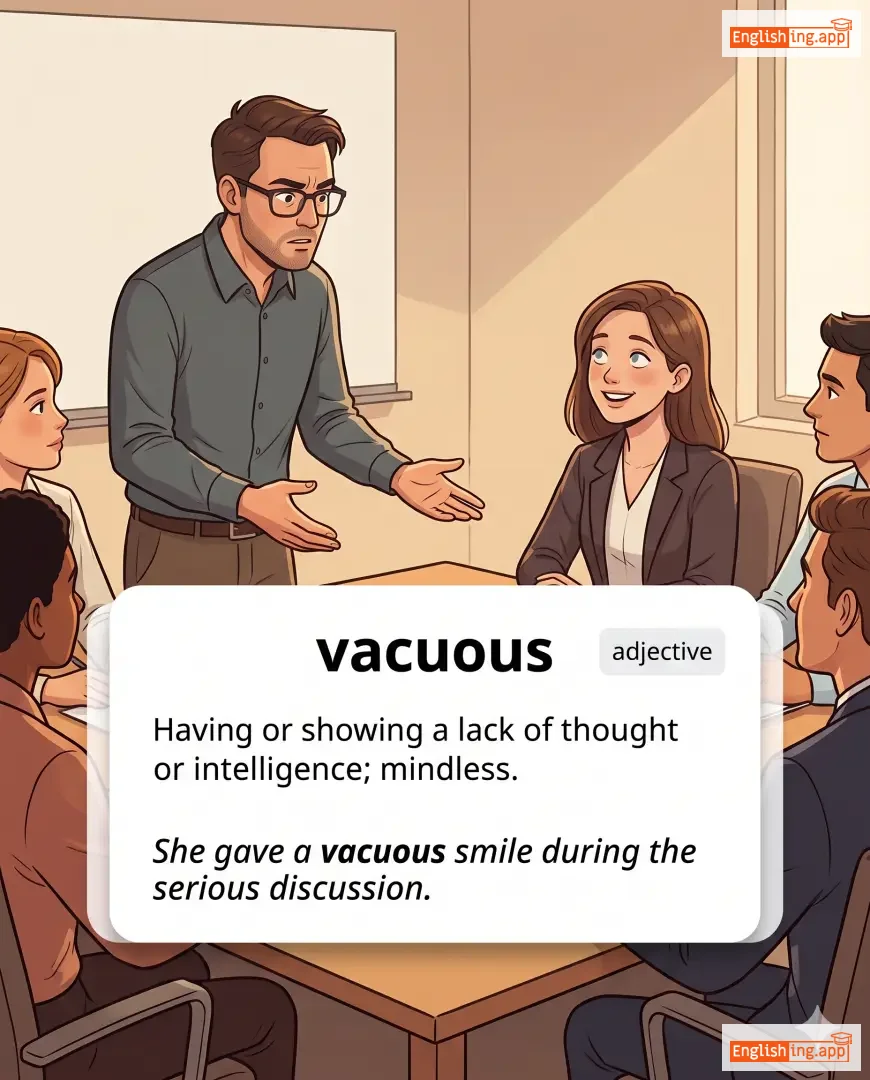
vacuous definition card — visual illustration of the meaning
adjective C2
/ˈvækjuəs/
空洞 (kongdong)

Having or showing a lack of thought or intelligence; mindless.

"She gave a vacuous smile during the serious discussion."

"她在严肃的讨论中露出了空洞的笑容。" (Tā zài yánsù de tǎolùn zhōng lùchūle kōngdòng de xiàoróng.)
noun C2
/ˈveɪɡəri/
意外变化 (yiwai bianhua)

An unexpected and inexplicable change in a situation or someone's behavior.

"The vagaries of the weather made planning difficult."

"天气的变化使得计划变得困难。" (tianqi de bianhua shide jihua biande kunnan.)
adjective C2
/veɪnˈɡlɔːriəs/
自负的 (zì fù de)

Excessively proud of oneself or one’s achievements; boastful.

"The vainglorious leader boasted about his minor achievements."

"那个自负的领导者炫耀着他的微不足道的成就。" (Nàgè zì fù de lǐng dǎo zhě xuàn yào zhe tā de wēi bù zú dào de chéng jiù.)
noun C2
/ˈveɪnɡlɔːri/
虚荣 (xūróng)

Excessive vanity or boastfulness about one's achievements.

"His speech was filled with vainglory and self-praise."

"他的演讲充满了虚荣和自我吹嘘。" (Tā de yǎnjiǎng chōngmǎnle xūróng hé zìwǒ chuīxū.)
noun C2
/ˈvæləns/
装饰帷幔 (zhuang shi wei man)

A decorative drapery hung across the top of a window or bed.

"She chose a floral valance to match the curtains in her bedroom."

"她选择了一款花卉装饰帷幔来搭配她卧室里的窗帘。" (Ta xuan ze le yi kuan hua hui zhuang shi wei man lai da pei ta wo shi li de chuang lian.)
noun C2
/ˌvælɪˈdɪkʃən/
告别辞 (gaobiecí)

The act of saying farewell; a formal goodbye.

"The professor gave a touching valediction at his retirement ceremony."

"教授在退休仪式上发表了感人的告别辞。" (Jiàoshòu zài tuìxiū yíshì shàng fābiǎo le gǎnrén de gàobiécí.)
noun C2
/ˌvælədɪkˈtɔːriən/
最佳学生 (zui jia xue sheng)

The student with the highest academic achievements in a graduating class, often chosen to give the farewell speech.

"She was honored as the valedictorian of her class."

"她被尊为班级的最佳学生。" (Ta bei zun wei banji de zui jia xue sheng.)
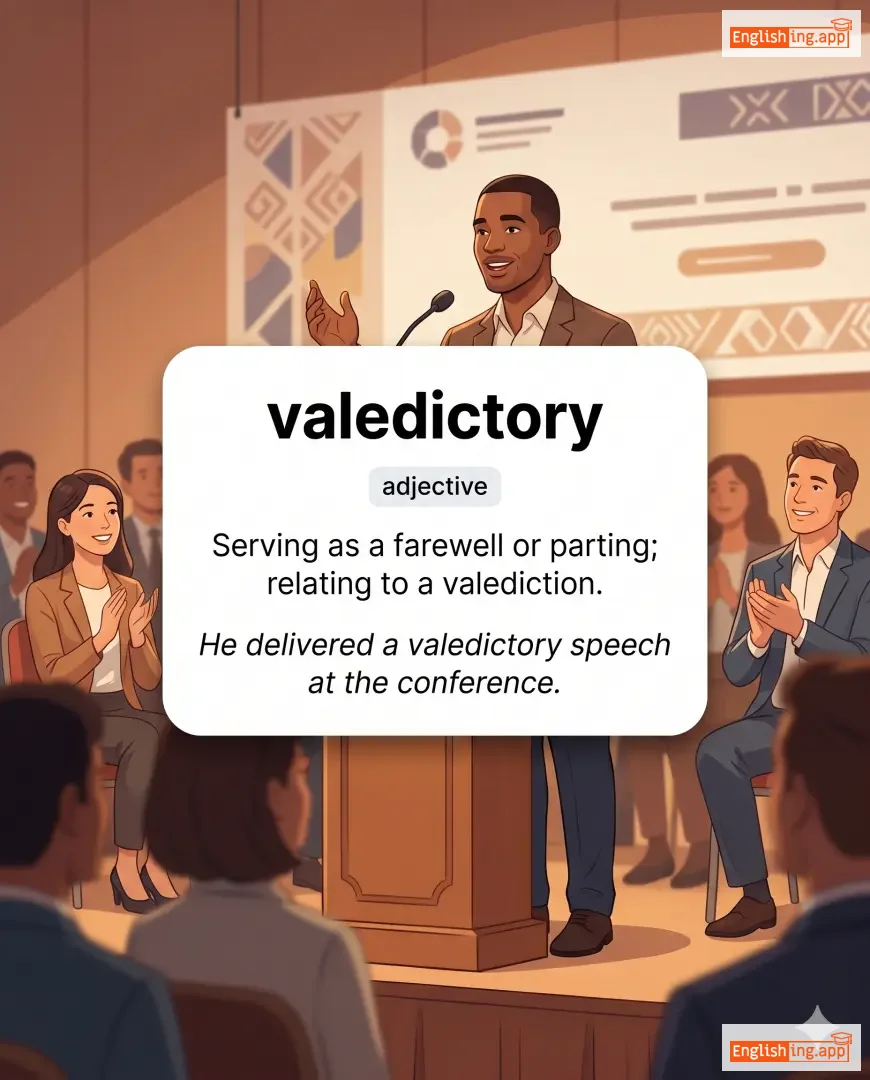
valedictory definition card — visual illustration of the meaning
adjective C2
/ˌvælɪˈdɪktəri/
告别的 (gàobié de)

Serving as a farewell or parting; relating to a valediction.

"He delivered a valedictory speech at the conference."

"他在会议上做了告别演讲。" (Tā zài huìyì shàng zuòle gàobié yǎnjiǎng.)
noun C2
/ˌvælɪˌtjuːdɪˈnɛəriən/
疑病症患者 (yí bìng zhèng huàn zhě)

A person who is unduly anxious about their health or constantly concerned with minor ailments.

"He was regarded as a valetudinarian, always worrying about his health."

"他被认为是一个疑病症患者,总是为自己的健康担忧。" (Tā bèi rènwéi shì yīgè yí bìng zhèng huàn zhě, zǒng shì wèi zìjǐ de jiànkāng dānxīn.)
adjective C2
/ˈvælərəs/
勇敢的 (yǒnggǎn de)

showing great courage and bravery

"The valorous soldier led his troop into battle without hesitation."

"勇敢的士兵毫不犹豫地带领他的部队进入战斗。" (Yǒnggǎn de shìbīng háo bù yóuyù de dàilǐng tā de bùduì jìnrù zhàndòu.)
adjective C2
/ˈvæpɪd/
乏味的 (fámèi de)

lacking liveliness, flavor, or interest; dull and uninspired

"The lecture was so vapid that half the audience fell asleep."

"讲座如此乏味,以至于一半的听众都睡着了。" (Jiǎngzuò rúcǐ fámèi, yǐ zhì yú yībàn de tīngzhòng dōu shuìzhe le.)
adjective C2
/ˈveɪpərəs/
蒸汽的; 模糊的 (zhēngqì de; móhu de)

consisting of vapor; vague or insubstantial

"The morning air was filled with vaporous mist."

"早晨的空气充满了蒸汽般的雾气。" (Zǎochén de kōngqì chōngmǎnle zhēngqì bān de wùqì.)