Vokabulare

Englisches Vokabelwörterbuch | Wortbedeutungen, Definitionen & Beispiele

verb C2
/miːt/
वितरित करना (vitarit karna)

To dispense or allot justice, punishment, or harsh treatment.

"The judge will mete out punishment according to the crime."

"जज अपराध के अनुसार सजा वितरित करेगा।" (Jaj apradh ke anusar saza vitrit karega.)
noun C2
/ˌmɛtəmˌsaɪˈkoʊsɪs/
आत्मा का पुनर्जन्म (atma ka punarjanm)

The supposed transmigration of the soul, especially its reincarnation after death.

"Ancient philosophers often debated the idea of metempsychosis."

"प्राचीन दार्शनिकों ने अक्सर आत्मा के पुनर्जन्म पर बहस की।" (Prachin darshanikon ne aksar atma ke punarjanm par behas ki.)
noun C2
/mɪˈtɒnɪmi/
रूपक प्रतिस्थापन (roopak pratisthapan)

A figure of speech in which one word or phrase is substituted with another closely related word or concept.

"In the phrase 'the crown will decide,' 'crown' is a metonymy for monarchy."

"वाक्य 'क्राउन निर्णय करेगा' में 'क्राउन' एक रूपक है जो राजतंत्र के लिए है।" (Vaaky 'krown nirnay karega' mein 'krown' ek roopak hai jo raajtantra ke liye hai.)
adjective C2
/ˈmɛtrɪkəl/
मापनीय (maapniya)

Relating to or composed in a regular rhythmic pattern of beats or meter, especially in poetry.

"The poet carefully followed metrical rules in his verses."

"कवि ने अपने छंदों में मापनीय नियमों का पालन सावधानी से किया।" (Kavi ne apne chandon mein maapniya niyamon ka paalan saavdhani se kiya.)
noun C2
/ˈmɛtrəˌnoʊm/
मीटरोनोम (meeteronom)

A device that produces regular ticks or beats to help musicians maintain tempo.

"She practiced the piano with a metronome to keep steady timing."

"उसने पियानो बजाने का अभ्यास मेट्रोनोम के साथ किया ताकि समय स्थिर रहे।" (Usne piano bajane ka abhyas metronome ke saath kiya taaki samay sthir rahe.)
noun C2
/ˈmɛtəl/
साहस (sahas)

A person's ability to cope well with difficulties or to face demanding situations with courage.

"The young athlete showed his mettle in the final match."

"युवा एथलीट ने फाइनल मैच में अपना साहस दिखाया।" (Yuva athlete ne final match mein apna sahas dikhaya.)
adjective C2
/ˈmɛtəlˌsʌm/
साहसी (sahasi)

Full of courage and spirit; lively and spirited.

"The mettlesome young rider never backed down from a challenge."

"साहसी युवा सवार कभी भी चुनौती से पीछे नहीं हटा।" (sahasi yuva savaar kabhi bhi chunauti se peeche nahi hata.)
noun C2
/mjuːz/
गली/छोटी सड़क (gali/chhoti sadak)

A row or street of houses or apartments that have been converted from stables or built to look like former stables.

"They rented a small flat in a quiet London mews."

"उन्होंने लंदन के एक शांत म्यूज़ में एक छोटा फ्लैट किराए पर लिया था।" (unhone london ke ek shant mews mein ek chhota flat kiraye par liya tha.)
noun C2
/maɪˈæzmə/
सड़ी हुई हवा (sadi hui hawa)

An unpleasant or unhealthy smell or atmosphere.

"A miasma of decay hung over the abandoned house."

"एक परित्यक्त घर पर सड़ी हुई हवा छाई हुई थी।" (ek parityakt ghar par sadi hui hawa chhai hui thi.)
noun C2
/ˈmaɪkrəˌkɒzəm/
सूक्ष्म ब्रह्मांड (sookshma brahmand)

A small, representative system having analogies to a larger system; a miniature version of something.

"The small town is a microcosm of the entire nation."

"छोटा शहर पूरे राष्ट्र का एक सूक्ष्म ब्रह्मांड है।" (chhota shahar poore rashtr ka ek sookshma brahmand hai.)
noun C2
/maɪˈkrɒmɪtər/
माइक्रोमीटर (micrometer)

A device used for measuring small distances with great accuracy.

"The engineer used a micrometer to measure the thickness of the wire."

"इंजीनियर ने तार की मोटाई मापने के लिए माइक्रोमीटर का उपयोग किया।" (Engineer ne taar ki motai maapne ke liye micrometer ka upyog kiya.)
noun C2
/maɪˈkrɑː.skə.pi/
सूक्ष्मदर्शन (sookshmadarshan)

The use of a microscope to observe small objects or organisms.

"Microscopy revealed the structure of the cells."

"सूक्ष्मदर्शन ने कोशिकाओं की संरचना का पता लगाया।" (Sookshmadarshan ne koshikaon ki sanrachna ka pata lagaya.)
noun C2
/miːn/
मामला (maamla)

A person's appearance or manner, especially as an indication of their character or mood.

"His serious mien made everyone fall silent."

"उसका गंभीर मामला सबको चुप करा दिया।" (Uska gambhir maamla sabko chup kara diya.)
noun C2
/mɪf/
छोटी झगड़ा (chhoti jhagra)

A petty quarrel or annoyance.

"They had a slight miff over the seating arrangement."

"उन्होंने सीटिंग व्यवस्था को लेकर एक हल्का झगड़ा किया।" (Unhone seating vyavastha ko lekar ek halka jhagra kiya.)
verb C2
/ˈmɪlɪˌteɪt/
रोकना (rokna)

to have a strong effect against something; to work as a powerful factor in preventing or influencing an outcome

"His lack of experience will militate against his promotion."

"उसके अनुभव की कमी उसके पदोन्नति के खिलाफ काम करेगी।" (uske anubhav ki kami uske podonnati ke khilaf kaam karegi.)
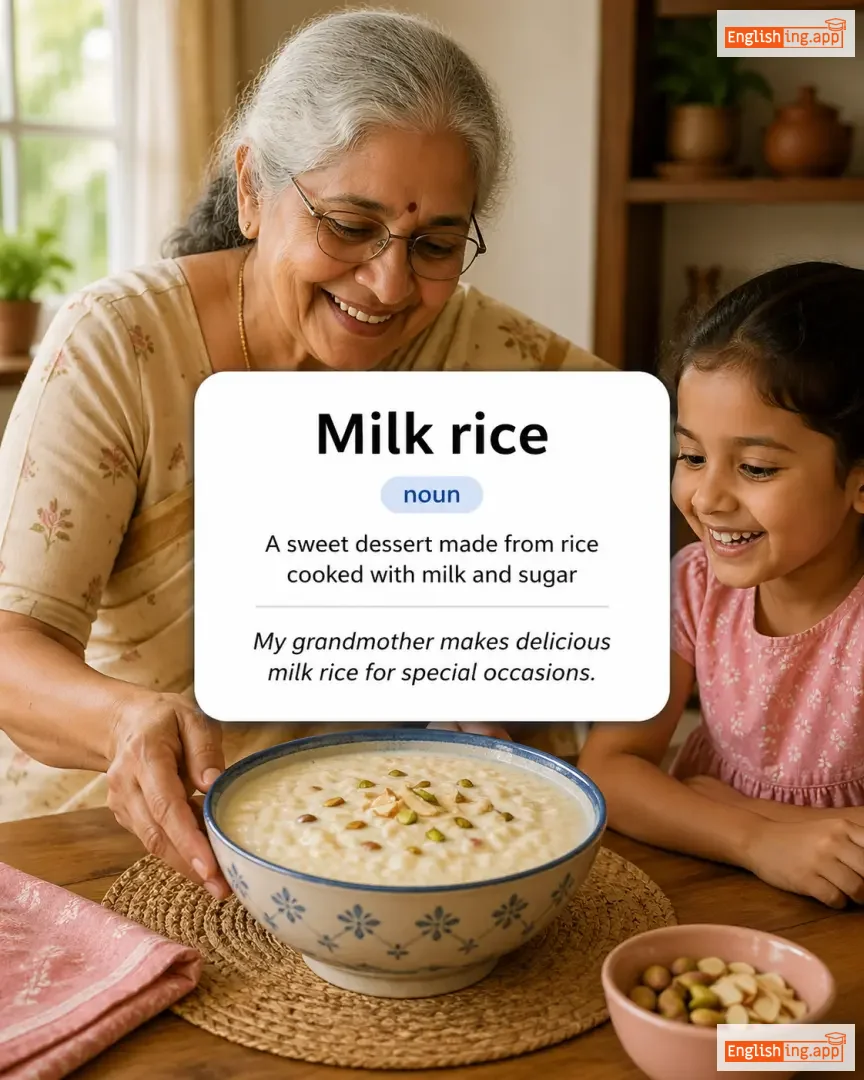
Milk rice definition card — visual illustration of the meaning
noun C2
/mɪlk raɪs/
खीर (kheer)

A sweet dessert made from rice cooked with milk and sugar

"My grandmother makes delicious milk rice for special occasions."

"मेरी दादी खास मौके पर स्वादिष्ट मिल्क राइस बनाती हैं।" (meri daadi khaas mauke par swaadisht milk rice banati hain)
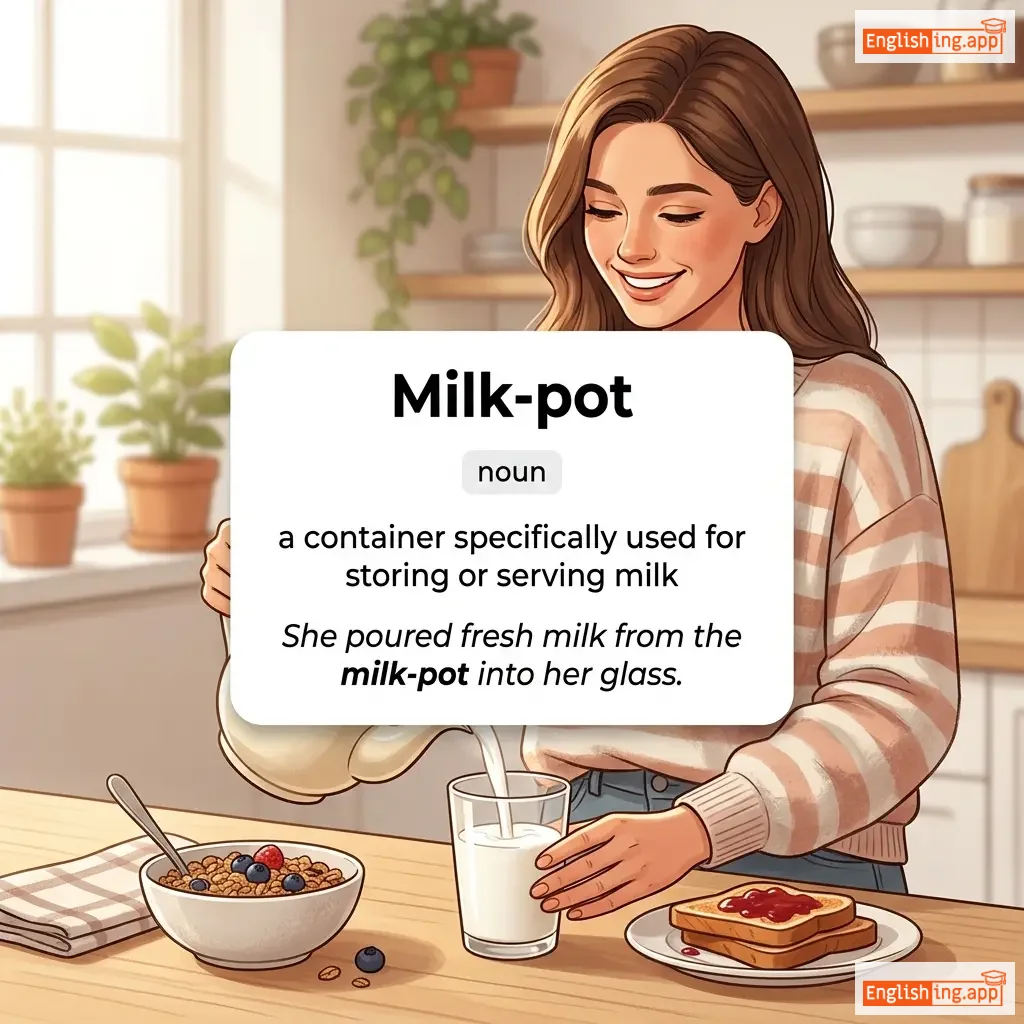
Milk-pot definition card — visual illustration of the meaning
noun C2
/ˈmɪlk pɒt/
दूध का पात्र (dudh ka patra)

a container specifically used for storing or serving milk

"She poured fresh milk from the milk-pot into her glass."

"उसने मिल्क-पॉट से ताजा दूध अपने गिलास में डाला।" (usne milk-pot se taja doodh apne glass mein dala)
noun C2
/ˈmɪlɪt/
बाजरा (bajra)

a small-seeded grass cultivated as a cereal crop

"Millet is often used as food in rural areas."

"बाजरा अक्सर ग्रामीण क्षेत्रों में खाद्य के रूप में उपयोग किया जाता है।" (bajra aksar gramin kshetron mein khadya ke roop mein upyog kiya jata hai.)
noun C2
/ˌmɪnəˈrɛt/
मिनार (minar)

A tall, slender tower of a mosque, from which the call to prayer is announced.

"The minaret of the mosque could be seen from miles away."

"मस्जिद का मीनार कई मील दूर से दिखता था।" (Masjid ka minar kai meel door se dikhta tha.)
adjective C2
/ˈmɪnətɔːri/
धमकी देने वाला (dhamki dene wala)

Expressing a threat; menacing.

"The criminal gave the witness a minatory look."

"अपराधी ने गवाह को धमकी देने वाली नजर से देखा।" (Aparadhi ne gawah ko dhamki dene wali nazar se dekha.)
adjective C2
/ˈmɪnsɪŋ/
अत्यधिक नाटकीय (atyadhik natakiy)

affectedly delicate, dainty, or refined in manner or movement

"He walked with mincing steps across the stage."

"वह मंच पर नाटकीय कदमों से चल रहा था।" (Vah manch par natakiy kadmon se chal raha tha.)
adjective C2
/ˈmɪn.dʒi/
किफ़ायती; सख़्त; आलसी (kifayati; sakht; aalsi)

mean or stingy; unwilling to spend money

"He is too mingy to spend money on anything but necessities."

"वह किसी भी चीज़ पर पैसे खर्च करने के लिए बहुत मिंजी है, सिवाय आवश्यकताओं के।" (vah kisi bhi cheez par paise kharch karne ke liye bahut minji hai, siwaay aavashyaktaon ke.)
noun C2
/ˈmɪn.i.ən/
अनुचर (anuchar)

A follower or underling of a powerful person, especially a servile one.

"The dictator was surrounded by loyal minions who carried out his orders."

"तानाशाह अपने आदेशों को निभाने वाले विश्वासयोग्य अनुचरों से घिरा हुआ था।" (Taanashaah apne aadeshon ko nibhaane wale vishwasyogya anucharon se ghira hua tha.)
adjective C2
/ˈmɪn.ɪ.skjuːl/
सूक्ष्म (sookshm)

Extremely small or tiny.

"The error was so miniscule that nobody noticed it."

"गलती इतनी सूक्ष्म थी कि किसी ने ध्यान नहीं दिया।" (Galti itni sookshm thi ki kisi ne dhyan nahi diya.)
noun C2
/ˌmɪn.ɪˈstreɪ.ʃən/
सेवा (seva)

The act of providing care, assistance, or religious service.

"She recovered thanks to the kind ministrations of the nurses."

"उसकी स्वास्थ्य वापसी नर्सों की दयालु सेवाओं के कारण हुई।" (Uski swasthya wapsi narsoun ki dayalu sevaon ke karan hui.)
noun C2
/maɪˈnjuːʃə/
सूक्ष्म विवरण (sookshm vivaran)

a small or trivial detail of something

"He was bored by the minutia of office paperwork."

"वह कार्यालय के कागजों के सूक्ष्म विवरण से ऊब चुका था।" (Vah karyalay ke kagazon ke sookshm vivaran se oob chuka tha.)
noun (plural) C2
/maɪˈnjuːʃiiː/
सूक्ष्म विवरण (sookshma vivaran)

the small, precise, or trivial details of something

"The lawyer focused on the minutiae of the contract."

"वकील ने अनुबंध के सूक्ष्म विवरण पर ध्यान केंद्रित किया।" (Vakeel ne anubandh ke sookshma vivaran par dhyan kendrit kiya.)
noun, verb C2
/ˈmaɪər/
कीचड़ / जटिलता (keechar / jatilta)

A stretch of swampy or boggy ground; as a verb, to entangle or involve someone in a difficult situation.

"The car was stuck in the mire after the heavy rain."

"गाड़ी भारी बारिश के बाद कीचड़ में फंसी हुई थी।" (gaadi bhaari barish ke baad keechar mein fansi hui thi.)
noun C2
/ˌmɪsədˈvɛntʃər/
अप्रिय घटना (apriya ghatna)

An unlucky accident, mishap, or unfortunate event.

"He broke his leg during a skiing misadventure."

"उसने स्कीइंग के दौरान एक अप्रिय घटना में अपना पैर तोड़ लिया।" (usne skiing ke dauran ek apriya ghatna mein apna pair tod liya.)
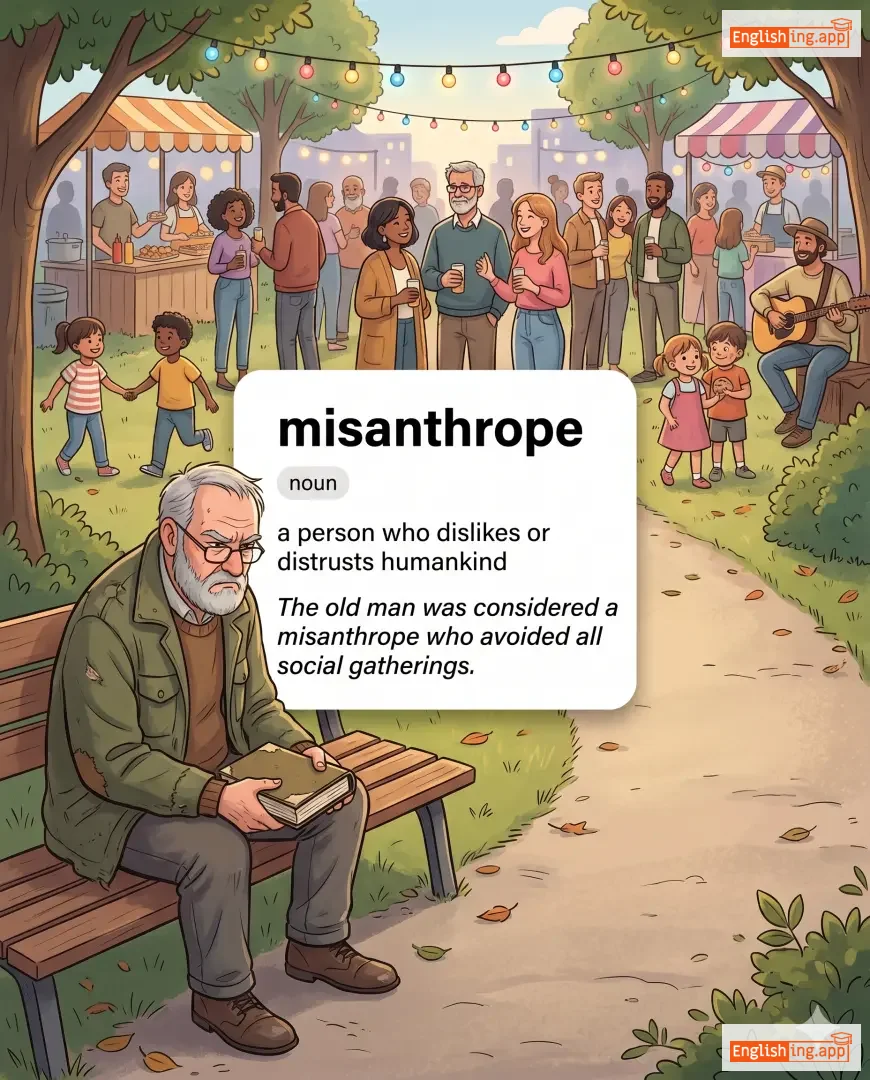
misanthrope definition card — visual illustration of the meaning
noun C2
/ˈmɪsənˌθroʊp/
मनुष्यों से नफरत करने वाला व्यक्ति (manushyon se nafrat karne wala vyakti)

a person who dislikes or distrusts humankind

"The old man was considered a misanthrope who avoided all social gatherings."

"वृद्ध व्यक्ति को एक मिसैनथ्रोप माना जाता था जो सभी सामाजिक आयोजनों से बचता था।" (Vriddh vyakti ko ek misanthrope mana jata tha jo sabhi samajik aayojan se bachata tha.)
adjective C2
/ˌmɪsənˈθrɑːpɪk/
मनुष्यों से घृणा करने वाला (manushyon se ghrina karne wala)

having or showing a dislike of humankind

"His misanthropic attitude made it difficult for him to make friends."

"उसका मनुष्यों से घृणा करने वाला रवैया उसे दोस्त बनाने में मुश्किल डालता था।" (Uska manushyon se ghrina karne wala ravayya use dost banane mein mushkil dalta tha.)
noun C2
/mɪˈsænθrəpi/
मानवद्वेष (manavdwesh)

a general dislike, distrust, or hatred of humankind

"His misanthropy was evident in the way he avoided people."

"उसकी मानवद्वेषिता उस तरीके से स्पष्ट थी, जिस तरह वह लोगों से बचता था।" (Uski manavdweshita us tareeke se spashth thi, jis tarah vah logon se bachta tha.)
verb C2
/ˌmɪsæprɪˈhɛnd/
गलत समझना (galat samajhna)

to misunderstand or misinterpret something

"He misapprehended the teacher’s instructions and did the task incorrectly."

"उसने शिक्षक के निर्देशों को गलत समझा और काम गलत किया।" (Usne shikshak ke nirdeshon ko galat samjha aur kaam galat kiya.)
noun C2
/ˌmɪsæprɪˈhɛnʃən/
गलत धारणा (galat dharana)

a mistaken belief or misunderstanding

"There is a common misapprehension about the causes of the disease."

"रोग के कारणों के बारे में एक सामान्य गलत धारणा है।" (Rog ke karano ke baare mein ek samanya galat dharana hai.)
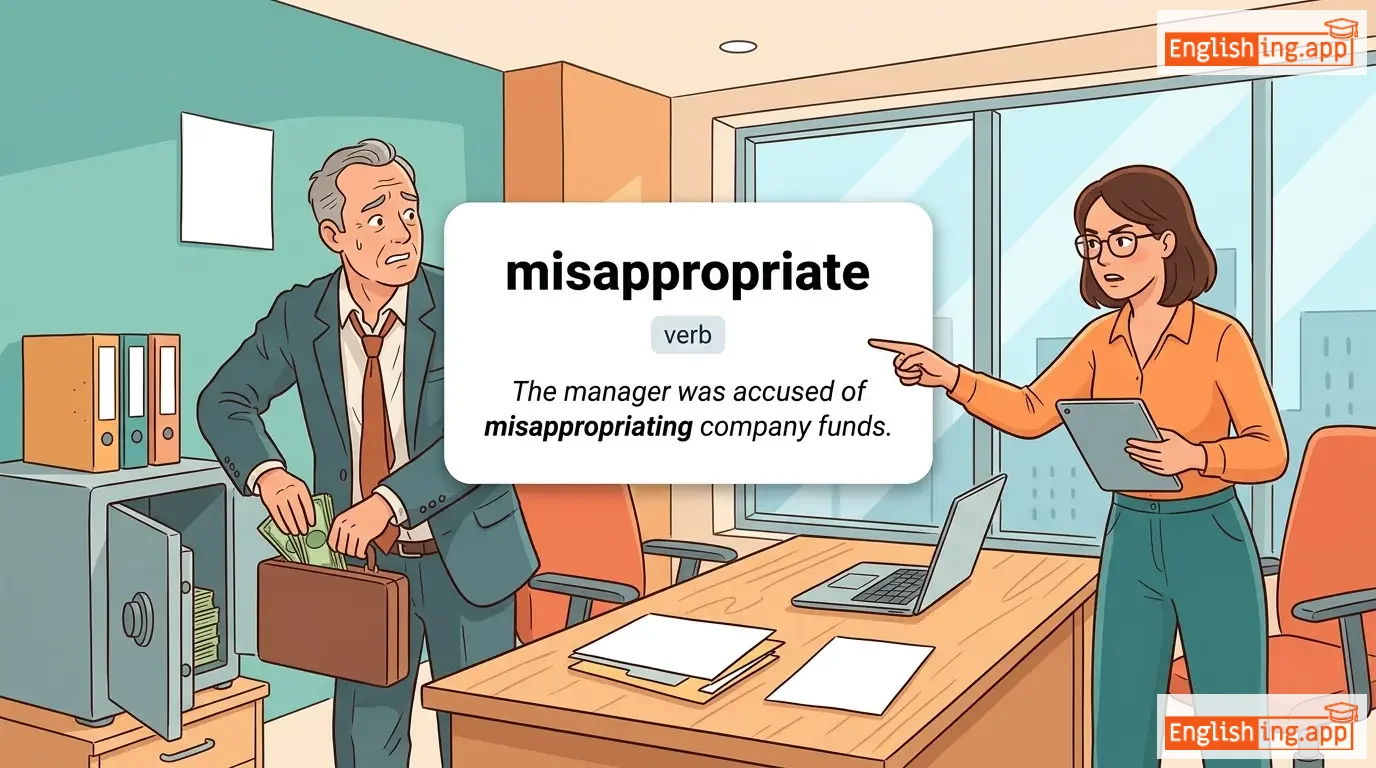
misappropriate definition card — visual illustration of the meaning
verb C2
/ˌmɪsəˈproʊprieɪt/
दुरुपयोग करना (durupyog karna)

to take or use something dishonestly, especially money or property, for one's own use

"The manager was accused of misappropriating company funds."

"मॅनेजर को कंपनी फंड्स को मिसअप्रोप्रिएट करने का आरोप लगा था।" (Da manager ko company funds ko misappropriate karne ka aarop laga tha.)
verb C2
/ˌmɪs.əˈtrɪb.juːt/
गलत तरीके से श्रेय देना (galat tareeke se shrey dena)

to incorrectly credit something, such as a work or remark, to the wrong person or source

"The quote was misattributed to Shakespeare."

"उक्त उद्धरण शेक्सपियर को गलत तरीके से श्रेय दिया गया था।" (Ukt uddharan Shekspiar ko galat tareeke se shrey diya gaya tha.)
noun C2
/mɪˌsɛdʒəˈneɪʃən/
जातीय मिश्रण (jaatiy mishran)

the interbreeding of people considered to be of different racial types

"The law once prohibited miscegenation in many countries."

"कानून ने कई देशों में मिसेगेनेशन को पहले प्रतिबंधित कर दिया था।" (Kanoon ne kai deshon mein miscegenation ko pehle pratibandhit kar diya tha.)
noun C2
/ˈmɪsəleɪni/
विविधता (vividhata)

A collection or mixture of various things.

"The book is a miscellany of essays and poems."

"किताब निबंधों और कविताओं का एक संग्रह है।" (Kitaab nibandhon aur kavitaon ka ek sangrah hai.)
noun C2
/ˌmɪsˈtʃæns/
बदकिस्मती (badkismati)

An unfortunate accident or event; bad luck.

"By mischance, he missed the last train home."

"बदकिस्मती से उसने घर जाने वाली आख़िरी ट्रेन चूक गया।" (badkismati se usne ghar jaane wali aakhri train chook gaya.)
verb C2
/ˌmɪskənˈsiːv/
गलत तरीके से समझना (galat tareeke se samajhna)

To misunderstand or form an incorrect idea about something.

"He misconceived the purpose of the project."

"उसने परियोजना के उद्देश्य को गलत तरीके से समझा।" (Usne pariyojna ke uddeshya ko galat tareeke se samjha.)
verb C2
/ˌmɪskənˈstruː/
गलत अर्थ लगाना (galat arth lagana)

To interpret something wrongly or misunderstand the meaning.

"She misconstrued his silence as anger."

"वह उसकी चुप्पी को गुस्से के रूप में गलत समझ बैठी।" (Wah uski chuppi ko gusse ke roop mein galat samajh baithi.)
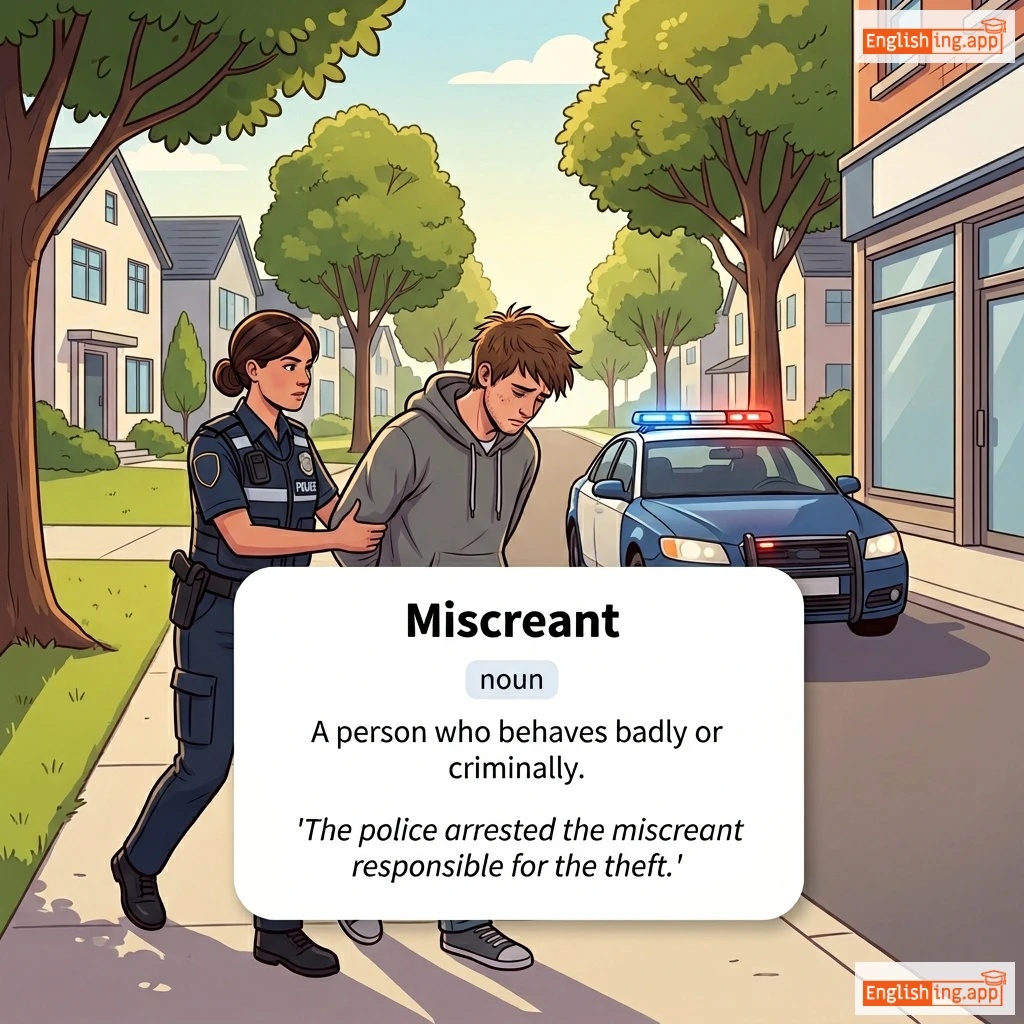
Miscreant definition card — visual illustration of the meaning
noun C2
/ˈmɪskriənt/
दुराचारी (durachari)

A person who behaves badly or criminally.

"The police arrested the miscreant responsible for the theft."

"पुलिस ने चोरी के लिए जिम्मेदार दुराचारी को गिरफ्तार किया।" (Police ne chori ke liye jimmedar durachari ko giraftaar kiya.)
verb C2
/ˌmɪsˈleɪ/
अस्थायी रूप से खोना (asthaayi roop se khona)

to lose something temporarily by putting it in the wrong place

"I must have mislaid my keys somewhere in the house."

"मुझे लगता है कि मैंने अपने चाबियाँ कहीं घर में भूल दी हैं।" (Mujhe lagta hai ki maine apne chabiyaan kahin ghar mein bhool di hain.)
noun C2
/ˌmɪsˈnoʊmər/
गलत नाम (galat naam)

A wrong or inaccurate name or designation.

"Calling the tiny dog a 'giant' is a misnomer."

"छोटे कुत्ते को 'जायंट' कहना एक गलत नाम है।" (Chhote kutte ko 'giant' kehna ek galat naam hai.)
noun C2
/mɪˈsɑːɡəmi/
विवाह विरोध (vivah virodh)

Hatred or dislike of marriage.

"His misogamy prevented him from ever settling down with a partner."

"उसका विवाह विरोध उसे कभी भी किसी साथी के साथ बसा हुआ नहीं बनने देता।" (Uska vivah virodh use kabhi bhi kisi saathi ke saath basa hua nahi banne deta.)
noun C2
/mɪˈsɑːdʒɪnɪst/
महिला द्वेषी (mahila dveshi)

A person who dislikes, despises, or is strongly prejudiced against women.

"Many condemned his speech as the words of a misogynist."

"कई लोगों ने उनके भाषण की निंदा एक महिला द्वेषी के शब्दों के रूप में की।" (Kai logon ne unke bhashan ki ninda ek mahila dveshi ke shabdon ke roop mein ki.)
noun C2
/ˌmɪsˈruːl/
अशासन (ashasan)

bad or poor governance

"The kingdom suffered for decades under misrule."

"राज्य दशकों तक अशासन के तहत पीड़ित रहा।" (Rajya dashako tak ashasan ke tahat peedit raha.)
noun C2
/ˈmɪsəl/
मिसल (misal)

a book containing the texts used in the Catholic Mass throughout the year

"The priest read from the missal during the ceremony."

"पुरोहित समारोह के दौरान मिसल से पढ़ रहे थे।" (Purohit samaroh ke dauran misal se padh rahe the.)
noun C2
/ˈmɪsɪv/
पत्र (patra)

a written message, especially a formal or official letter

"He sent a long missive to the governor."

"उसने गवर्नर को एक लंबा पत्र भेजा।" (Usne governor ko ek lamba patra bheja.)
noun C2
/ˈmaɪtər/
बिशप की टोपी (bishop ki topi)

a tall, pointed hat worn by bishops; also a type of joint made between two pieces of material

"The bishop placed the miter on his head during the ceremony."

"अनुष्ठान के दौरान बिशप ने अपनी सिर पर माइटर टोपी रखी।" (Anushthan ke dauran bishop ne apni sir par miter topi rakhi.)