Vokabulare

Englisches Vokabelwörterbuch | Wortbedeutungen, Definitionen & Beispiele

noun C2
/ˈpæk.ɪ.dɜːrm/
मोटे चमड़े वाला बड़ा स्तनधारी जानवर (motay chamde wala bada stanadhari janwar)

a large mammal with thick skin, such as an elephant, rhinoceros, or hippopotamus

"The zoo had several pachyderms, including elephants and rhinos."

"चिड़ियाघर में कई मोटे चमड़े वाले जानवर थे, जैसे हाथी और गैंडा।" (Chidiya ghar mein kai mote chamde wale janwar the, jaise haathi aur gainda.)
noun C2
/ˈpɑːdreɪ/
पादरी (padri)

A title for a priest, especially in the Roman Catholic Church; also used informally for 'father'.

"The soldiers attended mass led by the padre."

"सैनिकों ने पादरी द्वारा नेतृत्व किए गए मास में भाग लिया।" (sainiko ne padri dwara netritva kiye gaye mass mein bhag liya.)
noun C2
/ˈpiːən/
प्रशंसा गीत (prashansa geet)

A song or piece of writing expressing great praise or triumph.

"The article was a paean to the beauty of nature."

"लेख प्रकृति की सुंदरता की प्रशंसा गीत था।" (lekh prakriti ki sundarta ki prashansa geet tha)
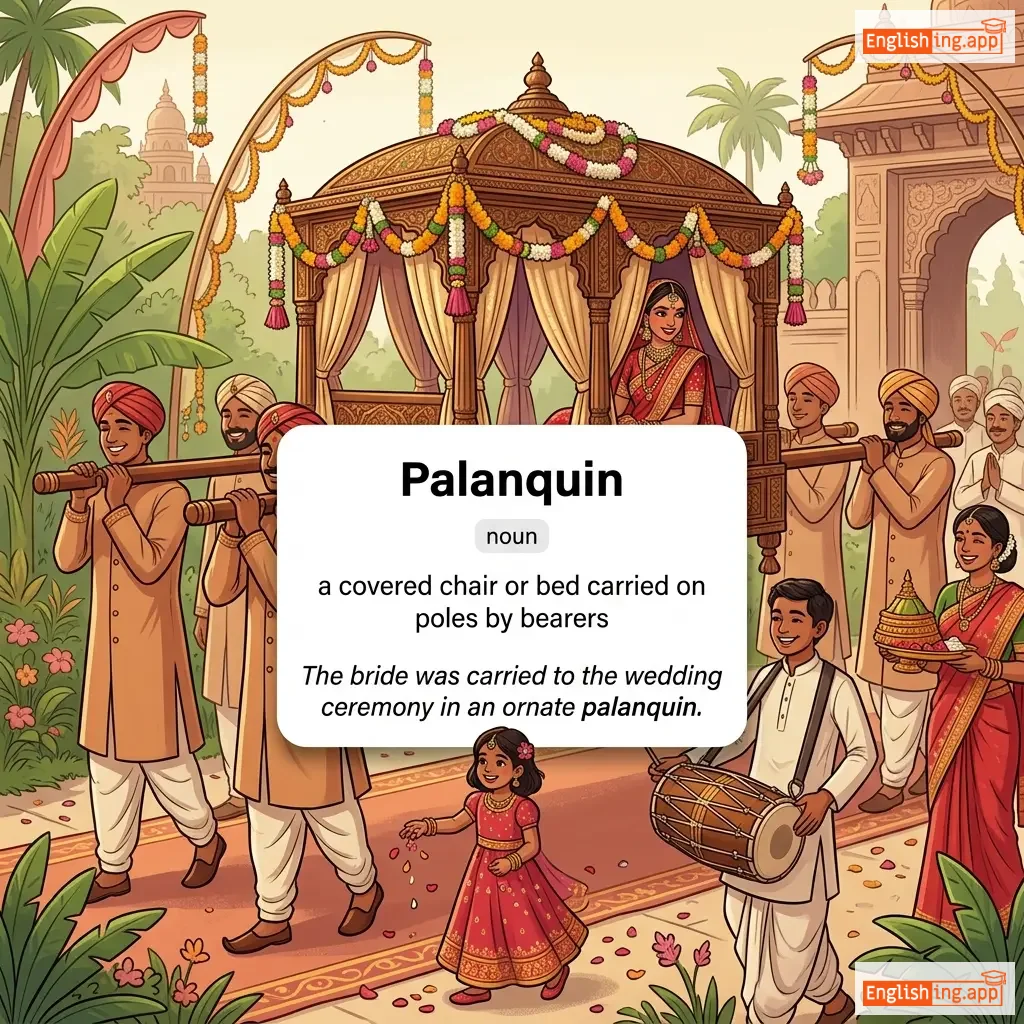
Palanquin definition card — visual illustration of the meaning
noun C2
/ˌpæl.ənˈkiːn/
पालकी (paalki)

a covered chair or bed carried on poles by bearers

"The bride was carried to the wedding ceremony in an ornate palanquin."

"दुल्हन को शादी के समारोह में एक भव्य पलांकिन में ले जाया गया।" (dulhan ko shaadi ke samaroah mein ek bhavya paalakin mein le jaya gaya.)
noun C2
/pəˈlæv.ər/
बेमतलब चर्चा / हंगामा (bematlab charcha / hangama)

prolonged and idle discussion; fuss or unnecessary talk

"After much palaver, they finally agreed on the plan."

"काफी बेमतलब चर्चा के बाद, वे आखिरकार योजना पर सहमत हो गए।" (Kaafi bematlab charcha ke baad, ve aakhirkaar yojna par sahmat ho gaye.)
noun C2
/ˈpælɪmpsɛst/
पुनःलिखित पाण्डुलिपि (punahlikhit pandulipi)

a manuscript or document that has been written over but still bears traces of earlier writing; something reused or altered but still retaining traces of its earlier form

"The ancient manuscript was a palimpsest, showing faint traces of previous texts beneath the new writing."

"प्राचीन पाण्डुलिपि एक पॅलिम्प्सेस्ट थी, जिसमें नई लेखनी के नीचे पुराने लेखन के हल्के निशान थे।" (Prachin pandulipi ek palimpsest thi, jismein nayi lekhani ke neeche purane lekhan ke halke nishan the.)
noun C2
/ˈpælɪˌnoʊd/
क्षमा प्रार्थनापत्र (kshama prarthanapatra)

a poem or statement in which the writer retracts something said in an earlier work

"The poet wrote a palinode to apologize for his earlier harsh words."

"कवि ने अपनी पहले की कठोर शब्दों के लिए क्षमा प्रार्थनापत्र लिखा।" (Kavi ne apni pehle ki kathor shabdon ke liye kshama prarthanapatra likha.)
verb C2
/ˈpælieɪt/
उपशामित करना (upshamit karna)

to make a disease, symptoms, or problem less severe without removing the cause

"The doctor prescribed medicine to palliate the patient's pain."

"डॉक्टर ने रोगी के दर्द को कम करने के लिए दवाइयाँ दीं।" (Doktor ne rogi ke dard ko kam karne ke liye davaiyan din.)
noun C2
/ˌpæliˈeɪʃən/
शांति (shanti)

relief of symptoms without curing the underlying disease or problem

"Palliation is often the focus of care for terminally ill patients."

"पॅलियेशन अक्सर टर्मिनल रूप से बीमार मरीजों की देखभाल का मुख्य फोकस होता है।" (Palliation aksar terminal roop se beemar marijon ki dekhbhaal ka mukhya focus hota hai.)
adjective C2
/ˈpɑːmi/
समृद्ध / गौरवमय (samriddh / gauravmay)

prosperous, flourishing, or relating to palm trees

"He often reminisced about the palmy days of his youth."

"वह अक्सर अपनी जवानी के समृद्ध दिनों को याद करता था।" (Woh aksar apni jawani ke samriddh dino ko yaad karta tha.)
verb C2
/ˈpælpɪˌteɪt/
दिल की धड़कन तेज होना (dil ki dhadkan tez hona)

to beat rapidly and strongly, often because of fear, excitement, or illness

"Her heart began to palpitate with fear."

"उसका दिल डर से पलपिटेट करने लगा।" (Uska dil dar se palpitate karne laga.)
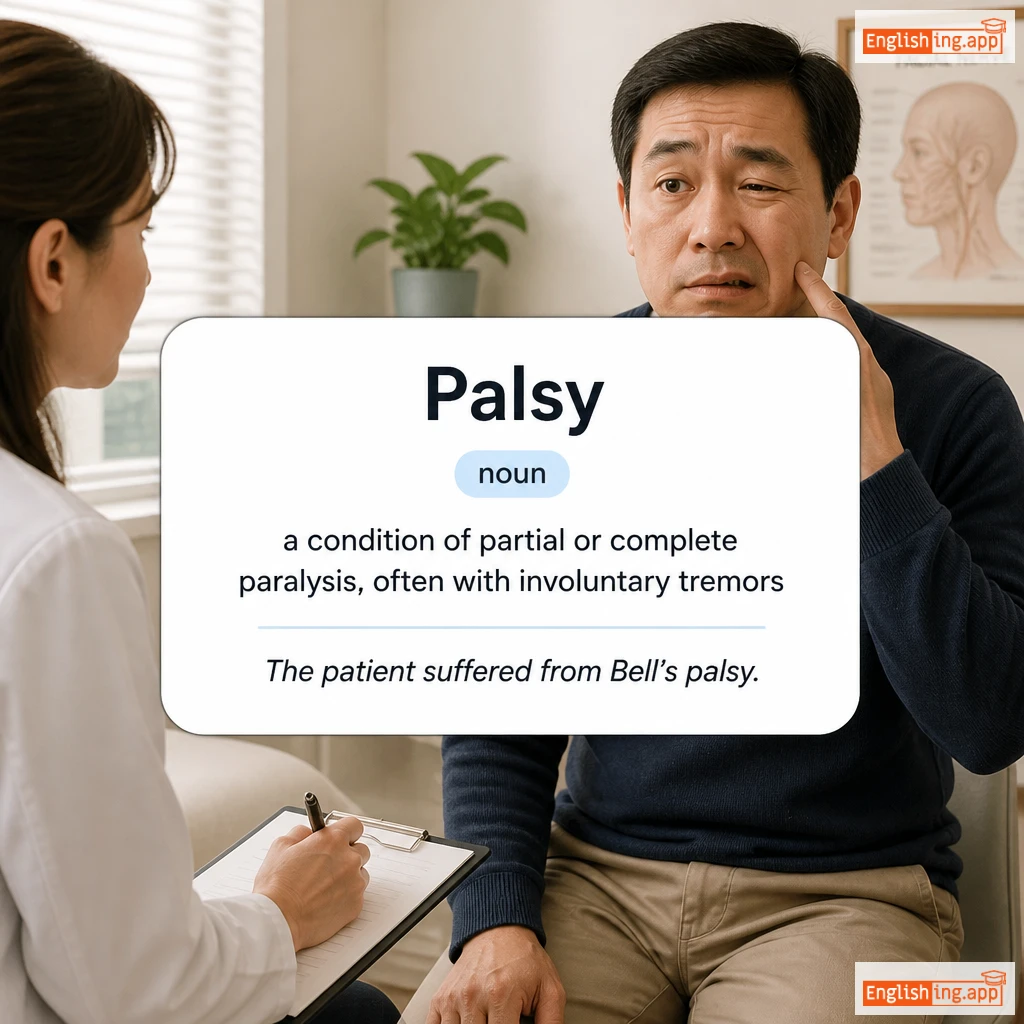
Palsy definition card — visual illustration of the meaning
noun C2
/ˈpɔːlzi/
पक्षाघात (pakshaghat)

a condition of partial or complete paralysis, often with involuntary tremors

"The patient suffered from Bell’s palsy."

"मरीज बेल्स पक्षाघात से पीड़ित था।" (Mareez Bells pakshaghat se peedit tha.)
verb C2
/ˈpɔːltər/
झूठ बोलना, धोखा देना (jhoot bolna, dhokha dena)

to act insincerely or deceitfully; to equivocate or lie

"He paltered when asked about his involvement in the deal."

"जब उससे डील में शामिल होने के बारे में पूछा गया, तो उसने झूठ बोला।" (Jab usse deal mein shamil hone ke baare mein poocha gaya, to usne jhoot bola.)
adjective C2
/ˈpeɪli/
धारीदार (dhaareedaar)

striped with different colors, usually used in heraldry

"The knight’s shield was decorated with paly stripes of red and gold."

"योद्धा की ढाल लाल और सोने के धारीदार पट्टियों से सजी थी।" (Yoddha ki dhaal laal aur sone ke dhaareedaar pattiyon se saji thi.)
noun, verb C2
/ˌpæm.fləˈtɪər/
पुस्तिका लेखक (pustika lekhak)

a person who writes or distributes pamphlets, often to promote a political or social cause

"In the 18th century, many pamphleteers influenced public opinion."

"18वीं सदी में, कई पुस्तिका लेखकों ने सार्वजनिक राय को प्रभावित किया।" (18vi sadi mein, kai pustika lekhako ne sarvajanik rai ko prabhavit kiya.)
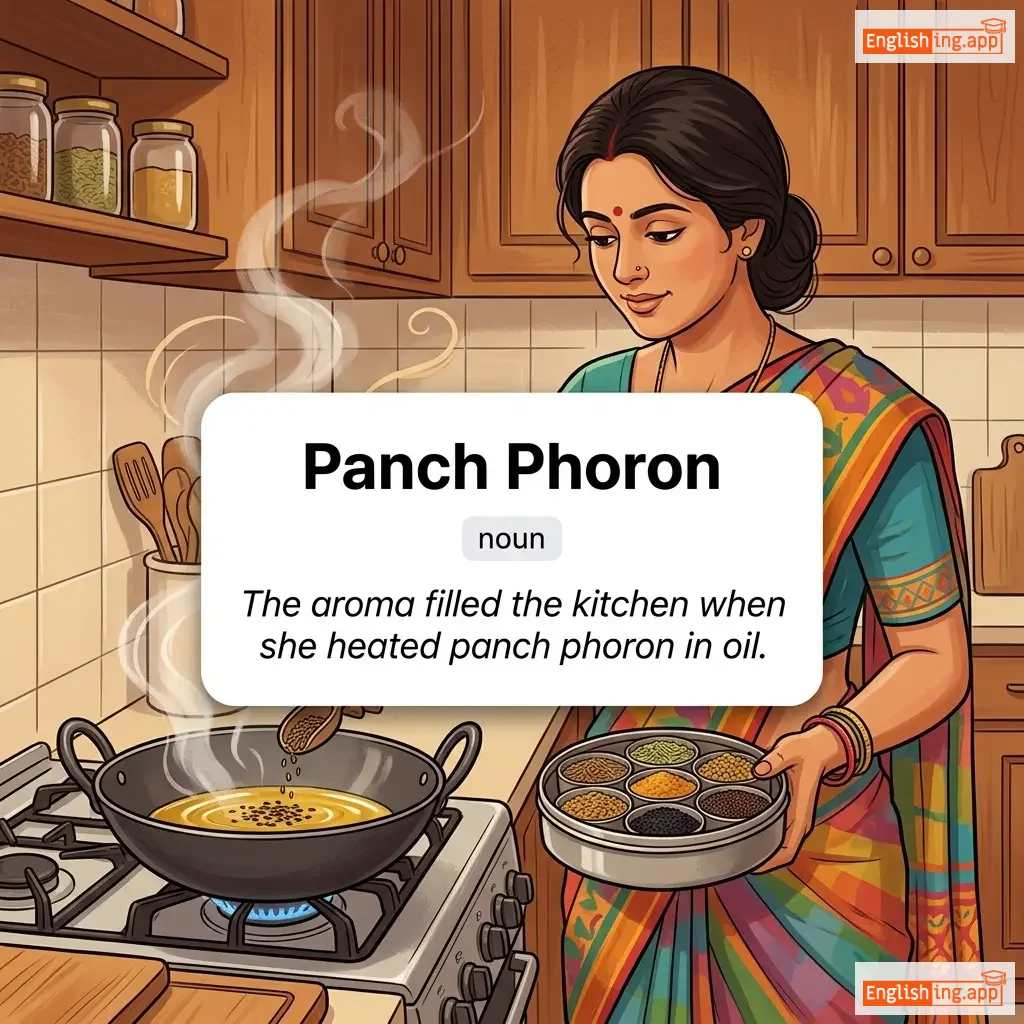
Panch Phoron definition card — visual illustration of the meaning
noun C2
/pʌntʃ ˈfoʊrən/
पाँच फोरोन (panch phoron)

a Bengali spice blend containing five whole spices: cumin, fennel, fenugreek, nigella, and mustard seeds

"The aroma filled the kitchen when she heated panch phoron in oil."

"जब उसने तेल में पाँच फोरोन को गरम किया तो रसोई में खुशबू फैल गई।" (jab usne tel mein paanch phoron ko garam kiya to rasoi mein khushboo phail gayi.)
noun C2
/ˌpænəˈdʒɪrɪk/
प्रशंसा पत्र, प्रशंसा (prashansa patra, prashansa)

a formal speech or piece of writing in praise of someone or something

"The author wrote a panegyric on the bravery of the soldiers."

"लेखक ने सैनिकों की वीरता पर एक प्रशंसा पत्र लिखा।" (Lekhak ne sainikon ki veerta par ek prashansa patra likha.)
/ˈpæn.ə.pli/
सम्पूर्ण संग्रह (sampurn sangrah)

A complete or impressive collection of things; a full set of armor.

"The museum displayed a panoply of ancient weapons."

"संग्रहालय ने प्राचीन हथियारों का सम्पूर्ण संग्रह प्रदर्शित किया।" (Sangrahalay ne pracheen hathiyaron ka sampurn sangrah pradarshit kiya.)
noun C2
/ˈpæn.θi.ɪ.zəm/
पंथीवाद (panthivad)

The belief that God and the universe are identical, or that everything is a manifestation of God.

"Spinoza’s philosophy is often associated with pantheism."

"स्पिनोज़ा का दर्शन अक्सर पंथीवाद से जुड़ा होता है।" (Spinoza ka darshan aksar panthivad se juda hota hai.)
noun C2
/ˈpæntəˌskoʊp/
विस्तृत दृश्य प्रदर्शक यंत्र (vistrit drishya pradarshak yantra)

An optical instrument that provides a wide or panoramic view.

"The scientist used a pantoscope to observe the entire horizon."

"वैज्ञानिक ने पूरे क्षितिज का अवलोकन करने के लिए एक पैंटोसकोप का उपयोग किया।" (Vaigyanik ne poore kshitij ka avlokan karne ke liye ek pantoscope ka upyog kiya.)
noun C2
/ˈpeɪpəsi/
पोप का पद (pop ka pad)

The office or authority of the Pope in the Roman Catholic Church.

"The papacy played a significant role in medieval European politics."

"पापसी ने मध्यकालीन यूरोपीय राजनीति में महत्वपूर्ण भूमिका निभाई।" (Papacy ne madhyakalīn Europīy rājneeti mein mahatvapūrṇ bhūmikā nibhāī.)
adjective C2
/ˌpærəˈdɪɡmətɪk/
आदर्शात्मक (adarshatmak)

Serving as a typical example or model of something.

"Her success story is paradigmatic of the opportunities education can provide."

"उसकी सफलता की कहानी वह अवसरों का आदर्श उदाहरण है, जो शिक्षा प्रदान कर सकती है।" (Uski safalta ki kahani vah avsaron ka adarsh udaharan hai, jo shiksha pradan kar sakti hai.)
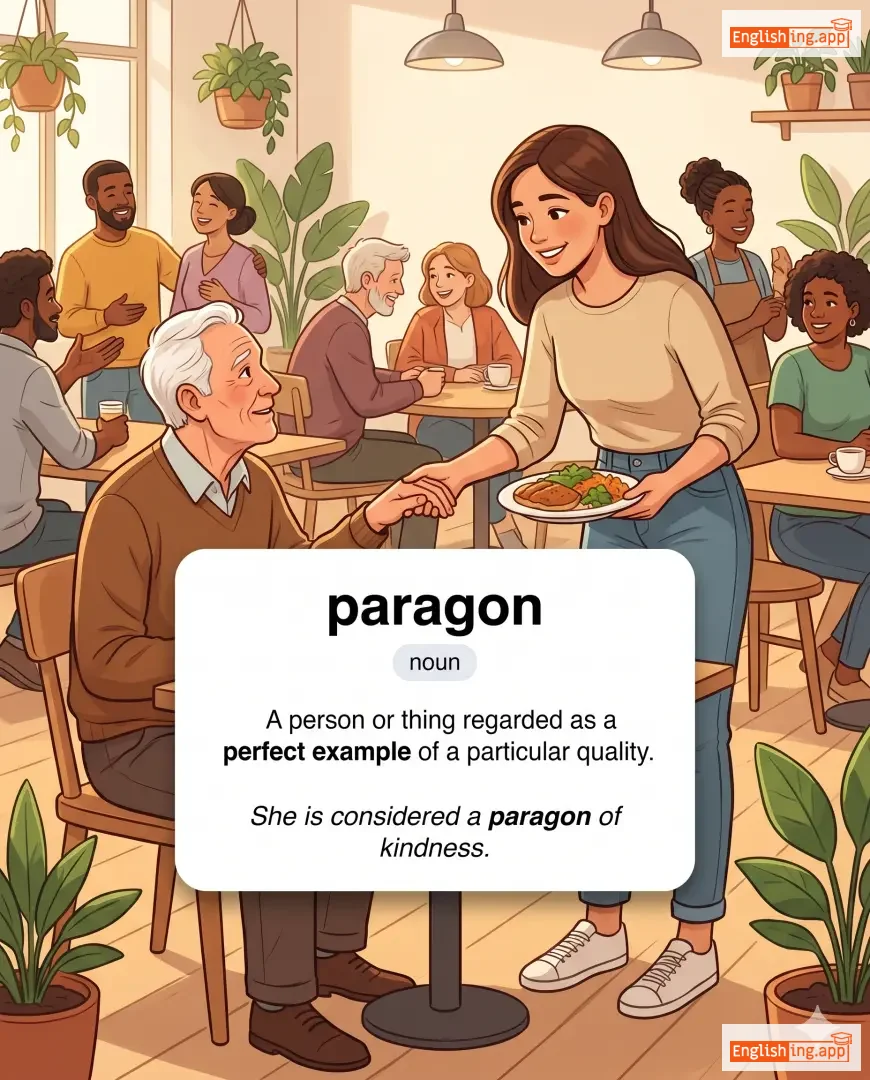
paragon definition card — visual illustration of the meaning
noun C2
/ˈpærəɡɒn/
आदर्श (adarsh)

A person or thing regarded as a perfect example of a particular quality.

"She is considered a paragon of kindness."

"उसे दया का आदर्श माना जाता है।" (Use daya ka adarsh maana jaata hai.)
noun C2
/ˈpærəmʊr/
प्रेमी (premee)

a lover, especially an illicit one

"The secret paramour was finally revealed."

"गुप्त प्रेमी अंततः प्रकट हुआ।" (Gupt premee antatah prakat hua.)
noun C2
/ˌpærəˈnɔɪæk/
पागलपंथी व्यक्ति (paganpanthi vyakti)

A person who suffers from paranoia or exhibits extreme, irrational distrust and suspicion.

"The paranoiac refused to leave his house, fearing everyone was against him."

"पागलपंथी व्यक्ति अपने घर से बाहर जाने से इनकार कर दिया, क्योंकि उसे डर था कि सभी लोग उसके खिलाफ थे।" (Paganpanthi vyakti apne ghar se bahar jane se inkar kar diya, kyonki use dar tha ki sabhi log uske khilaf the.)
noun C2
/ˈpærəpɛt/
सुरक्षात्मक दीवार (surakshatmak deewar)

A low protective wall along the edge of a roof, balcony, or bridge.

"The soldier hid behind the parapet for protection."

"सैनिक सुरक्षा के लिए पैरापेट के पीछे छिप गया था।" (Sainik suraksha ke liye parapet ke peeche chhip gaya tha.)
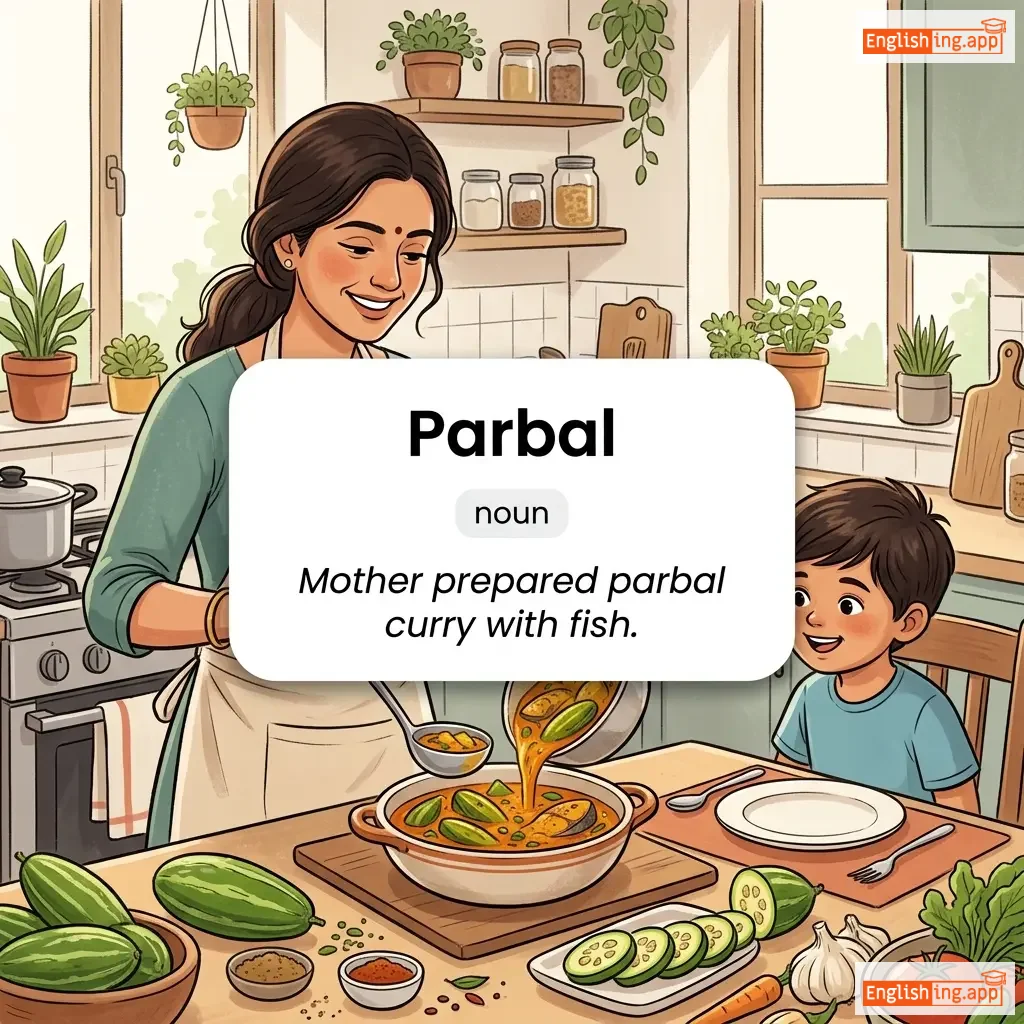
Parbal definition card — visual illustration of the meaning
noun C2
/ˈpɑr.bəl/
पारबल (parbal)

A green vegetable also known as pointed gourd, commonly used in South Asian cuisine

"Mother prepared parbal curry with fish."

"माँ ने मछली के साथ पारबल करी तैयार की।" (ma ne machhli ke saath parbal kari tayar ki)
verb C2
/pɑːrtʃ/
सूखा देना (sookha dena)

to make something extremely dry, especially by exposure to heat

"The scorching sun began to parch the fields."

"तपती धूप ने खेतों को सूखा देना शुरू कर दिया।" (tapti dhoop ne kheton ko sookha dena shuru kar diya.)
noun C2
/ˌpærəˈɡɔːrɪk/
ओपियम युक्त औषधि (opiyam yukt aushadhi)

a medicine containing opium, once used to relieve pain and diarrhea

"Doctors once prescribed paregoric to treat diarrhea in children."

"डॉक्टर पहले बच्चों को दस्त के इलाज के लिए पैरेगोरिक लिखते थे।" (Doktor pehle bachchon ko dast ke ilaaj ke liye paregoric likhte the.)
adjective C2
/ˌpɛrənˈθɛtɪkəl/
सन्निविष्ट टिप्पणी (sannivishṭ tippanī)

Relating to or expressed in parentheses; a side remark or digression.

"He added a parenthetical comment during the lecture."

"उसने व्याख्यान के दौरान एक सन्निविष्ट टिप्पणी जोड़ी।" (usne vyākhyān ke daurān ek sannivishṭ tippanī joṛī.)
noun C2
/ˈpɑːrləns/
भाषा प्रयोग (bhasha prayog)

a particular way of speaking or using words, common to a group

"In legal parlance, the term has a different meaning."

"कानूनी भाषा में, इस शब्द का अर्थ अलग है।" (Kanooni bhasha mein, is shabd ka arth alag hai.)
noun, verb C2
/ˈpɑːrli/
बातचीत (baatcheet)

a discussion between opposing sides, especially to negotiate terms

"The generals met to parley over the terms of surrender."

"जनरलों ने आत्मसमर्पण की शर्तों पर बातचीत करने के लिए मुलाकात की।" (Janralon ne aatmasamarpan ki sharton par baatcheet karne ke liye mulaqat ki.)
adjective C2
/ˈpɑːrləs/
संकटपूर्ण (parlas)

Full of danger or risk; precarious.

"The company is in a parlous financial state."

"कंपनी एक संकटग्रस्त वित्तीय स्थिति में है।" (Company ek sankatgrast vittiya sthiti mein hai.)
adjective C2
/pəˈrɒnɪməs/
समांशब्द (paronimas)

Words that are derived from the same root or sound alike.

"The words 'effect' and 'effective' are paronymous."

"‘Effect’ और ‘Effective’ शब्द पारोणिमस हैं।" ('Effect' aur 'Effective' shabd paronimas hain.)
noun C2
/ˈpær.əkˌsɪz.əm/
अचानक तीव्र उत्तेजना (achanak teevra uttejana)

A sudden, violent outburst of emotion or activity.

"She was seized by a paroxysm of laughter."

"वह अचानक हंसी का एक तिव्र उभार से ग्रसित हो गई।" (Vah achanak hasi ka ek teevra ubhaar se grasit ho gayi.)
noun C2
/ˈpɑːr.kə.tri/
पार्केट फ्लोर बनाने की कला (parket floor banane ki kala)

The art or technique of laying parquet floors.

"The craftsman specialized in parquetry for luxury homes."

"कारीगर लक्ज़री घरों के लिए पार्केट्री में विशेषज्ञ थे।" (Karigar luxury gharon ke liye parquetry mein visheshagya the.)
noun C2
/ˈpær.ɪ.saɪd/
पितृहत्यार (pitrihatya)

The act of killing one's father, mother, or other close relative.

"The court tried him for parricide after the tragic incident."

"न्यायालय ने दुखद घटना के बाद उसे पितृहत्यार के आरोप में मुकदमा चलाया।" (Nyayalay ne dukhad ghatna ke baad use pitrihatya ke aarop mein mukadma chalaya.)
adjective C2
/ˌpɑːrsɪˈmoʊniəs/
कंजूस (kanjoos)

unwilling to spend money or use resources; stingy

"The company was too parsimonious to invest in better equipment."

"कंपनी बेहतर उपकरण में निवेश करने के लिए बहुत कंजूस थी।" (Kampani behtar upkaran mein nivesh karne ke liye bahut kanjoos thi.)
noun C2
/ˈpɑːrsɪmoʊni/
कंजूसी (kanjoosi)

extreme unwillingness to spend money or use resources

"His parsimony was evident in the way he avoided any unnecessary expenses."

"उसकी कंजूसी इस बात से स्पष्ट थी कि वह किसी भी अनावश्यक खर्च से बचता था।" (Uski kanjoosi is baat se spasht thi ki vah kisi bhi anavashyak kharch se bachta tha.)
adjective C2
/ˈpɑːrtəbl/
विभाज्य (vibhajya)

capable of being divided or separated

"The estate was partible among the heirs."

"जमीन को उत्तराधिकारियों के बीच विभाज्य किया गया था।" (Jameen ko uttoradhikariyon ke beech vibhajya kiya gaya tha.)
verb C2
/pərˈtɪkjələrˌaɪz/
विशेष रूप से वर्णन करना (vishesh roop se varnan karna)

to mention or describe something in detail

"The witness was asked to particularize the events of that night."

"गवाह से उस रात की घटनाओं को विस्तार से बताने के लिए कहा गया था।" (Gawah se us raat ki ghatnaon ko vistaar se batane ke liye kaha gaya tha.)
noun C2
/ˌpɑːrtjʊˈrɪʃən/
प्रसव (prasav)

The act of giving birth; childbirth.

"The doctor explained the stages of parturition to the students."

"डॉक्टर ने छात्रों को प्रसव के चरणों के बारे में बताया।" (Doktor ne chhatron ko prasav ke charanon ke baare mein bataya.)
noun C2
/ˈpɑːrvənuː/
हाल ही में अमीर हुआ व्यक्ति (haal hi mein ameera hua vyakti)

A person who has recently gained wealth or influence but is not yet accepted socially.

"He was seen as a parvenu who lacked refinement despite his riches."

"उसे एक ऐसे पारवेनु के रूप में देखा गया था, जिसके पास धन तो था, लेकिन शिष्टता की कमी थी।" (Use ek aise parvenu ke roop mein dekha gaya tha, jiske paas dhan to tha, lekin shishtata ki kami thi.)
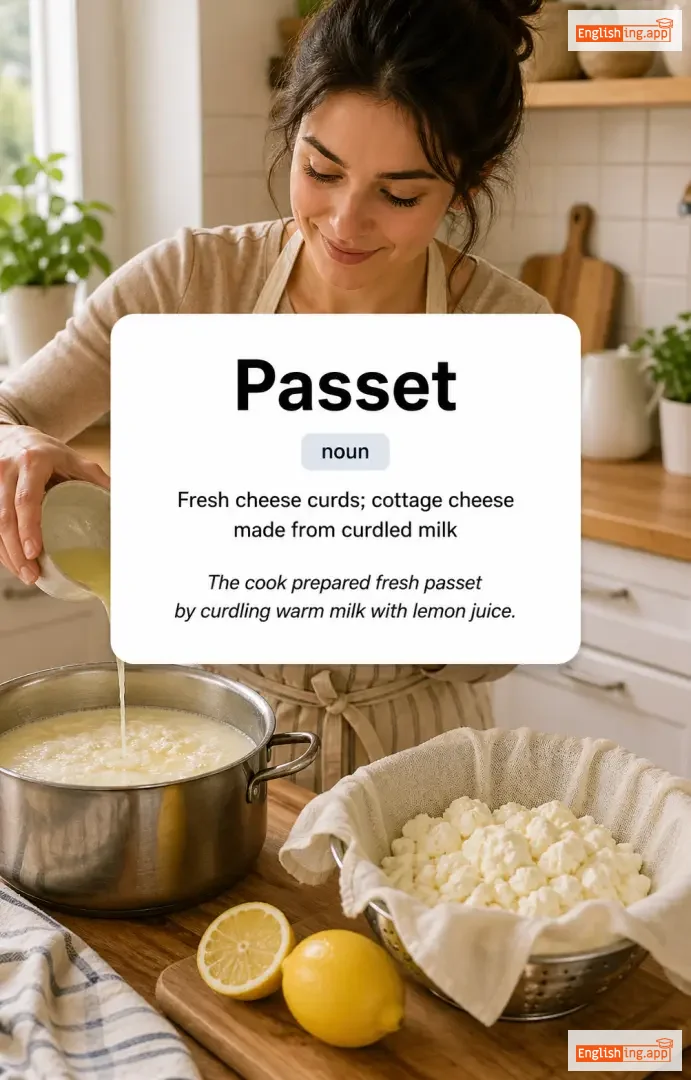
Passet definition card — visual illustration of the meaning
noun C2
/ˈpæsɪt/
पनीर (paneer)

Fresh cheese curds; cottage cheese made from curdled milk

"The cook prepared fresh passet by curdling warm milk with lemon juice."

"रसोइया ने नींबू के रस से गरम दूध को जाम करके ताजे पनीर को तैयार किया।" (rasoiya ne neemboo ke ras se garam dudh ko jam karke taze paneer ko tayar kiya.)
adjective C2
/ˈpæsɪbəl/
अनुभवयोग्य; दुःख भोगने योग्य (anubhavayogya; dukh bhogne yogya)

capable of feeling or suffering; susceptible to sensation or emotion (often theological)

"In some traditions, deities are described as passible, sharing human emotions."

"कुछ परंपराओं में, देवताओं को अनुभवयोग्य के रूप में वर्णित किया जाता है, जो मानव भावनाओं को साझा करते हैं।" (kuch paramparaon mein, devtaon ko anubhavayogya ke roop mein varnita kiya jata hai, jo manav bhavanao ko saanjha karte hain.)
noun C2
/pæˈstiːʃ/
अनुकरणात्मक कृति (anukaranatmak kruti)

a work of art, literature, or music that imitates the style of another artist, period, or genre

"The film was a clever pastiche of 1950s detective movies."

"फिल्म 1950 के दशक की जासूसी फिल्मों का एक चतुर अनुकरण था।" (Film 1950 ke dashak ki jasoosi filmon ka ek chatur anukaran tha.)
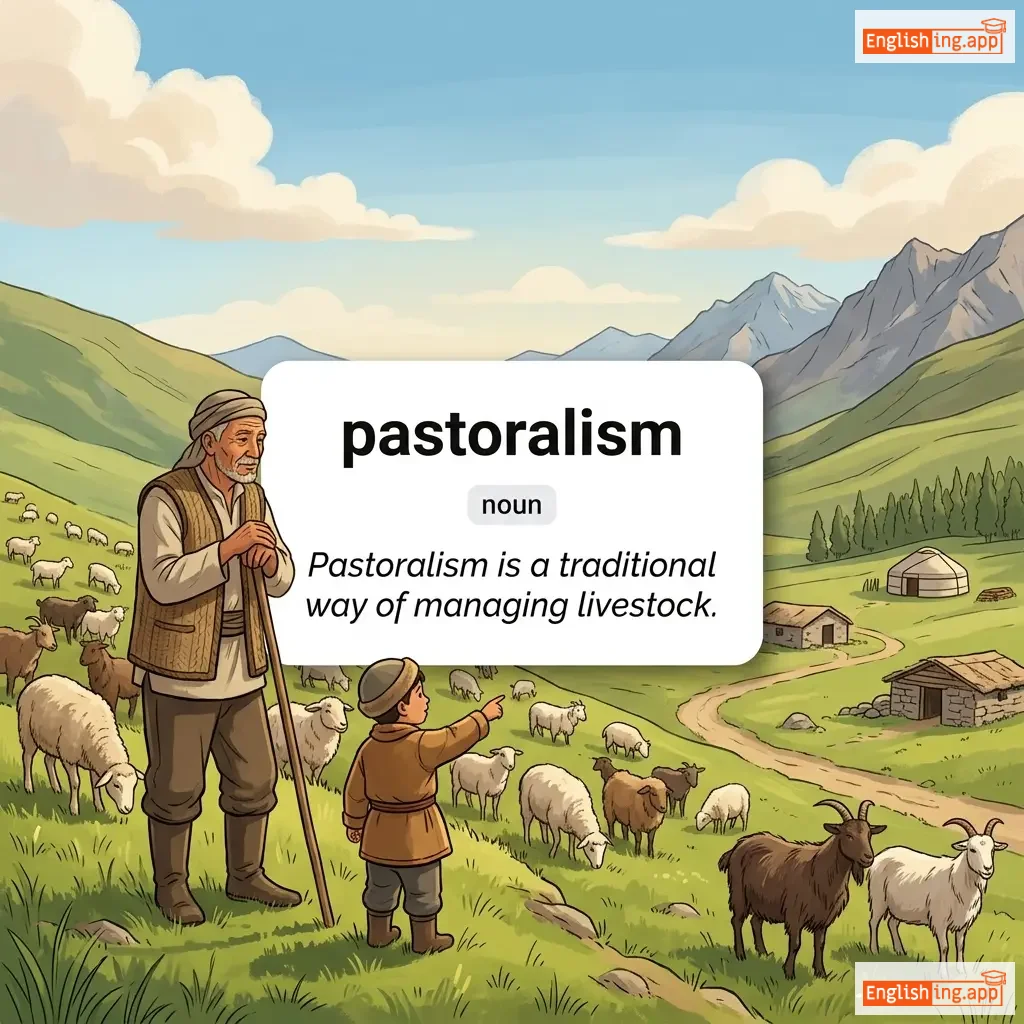
pastoralism definition card — visual illustration of the meaning
noun C2
ˈpɑː.stər.ə.lɪ.zəm
पशुपालन, घास आधारित चराई प्रणाली (pashupalan, ghas aadharit charai pranali)

A form of animal husbandry where domesticated animals are released onto large vegetated outdoor lands for grazing.

"Pastoralism is a traditional way of managing livestock."

"पैस्टोरलिज़म एक पारंपरिक तरीका है जिसमें मवेशियों की देखभाल की जाती है।" (Pastoralism ek paaramparik tareeka hai jismein maveshiyon ki dekhbhaal ki jaati hai.)
noun C2
/pəˈtiːnə/
धातु, पत्थर या लकड़ी पर उम्र या उपयोग के कारण बनने वाली एक परत; साथ ही, एक सतही रूप (dhatu, pathar ya lakdi par umra ya upyog ke karan banne wali ek parat; saath hi, ek satha roop)

a surface film or sheen on metal, stone, or wood due to age or use; also, a superficial appearance

"The bronze statue developed a green patina after years in the sea air."

"सालों तक समुद्र की हवा में रहने के बाद कांस्य की मूर्ति में हरा पैटीना विकसित हो गया।" (Saalon tak samudra ki hawa mein rehne ke baad kaansy ki murti mein hara patina viksit ho gaya.)
noun C2
/ˈpætwɑː/
क्षेत्रीय उपभाषा (kshetriya upabhasha)

a regional or social dialect, especially one considered nonstandard or informal

"The guide slipped into local patois when chatting with the fishermen."

"गाइड मछुआरों के साथ बातचीत करते समय स्थानीय पटुआ में बात करने लगा।" (guide machhuaron ke saath baatcheet karte samay sthanīya patoā mein baat karne laga.)
noun, adjective C2
/pəˈtrɪʃən/
पट्रीशियन (patrishiyan)

A person of noble rank or high social standing; relating to aristocracy.

"The patrician families of Rome wielded great power in politics."

"रोम के पट्रीशियन परिवारों का राजनीति में महत्वपूर्ण प्रभाव था।" (Rom ke patrishiyan parivaron ka rajniti mein mahatvapurn prabhav tha.)