Vokabulare

Englisches Vokabelwörterbuch | Wortbedeutungen, Definitionen & Beispiele

adjective C2
/ˈɪkθiɪk/
मछली जैसा (machhli jaisa)

Relating to or resembling fish.

"The artist's painting had an ichthyic quality."

"कला के चित्र में मछली जैसा गुण था।" (Kala ke chitra mein machhli jaisa gun tha.)
noun C2
/ˌɪkθiˈɒlədʒɪst/
मच्छीशास्त्री (machchhishastri)

A scientist who studies fish.

"The ichthyologist discovered a new species of fish in the river."

"मच्छीशास्त्री ने नदी में मछलियों की एक नई प्रजाति का पता लगाया।" (Machchhishastri ne nadi mein machhliyon ki ek nai prajati ka pata lagaya.)
noun C2
/ˌɪkθiˈɒlədʒi/
मछली विज्ञान (machhli vigyaan)

The branch of zoology that deals with fish.

"He pursued a degree in ichthyology at the university."

"उसने विश्वविद्यालय में मछली विज्ञान में डिग्री प्राप्त की।" (Usne vishwavidyalay mein machhli vigyaan mein degree praapt ki.)
noun C2
/ˈɪkθiəˌsɔːrz/
इक्षीओसॉर्स (एक प्रकार की विलुप्त समुद्री सरीसृप) (ikthiosors)

Extinct marine reptiles that resembled fish and dolphins, dominant during the Mesozoic era.

"Ichthyosaurs were swift predators of the ancient seas."

"इक्षीओसॉर्स प्राचीन सागरों के तेज़ शिकारी थे।" (Ikthiosors prachin sagaron ke tez shikari the.)
adverb C2
/ˈaɪsɪli/
ठंडे तरीके से (thande tareeke se)

In a very cold, unfriendly, or hostile manner.

"She replied icily to his question."

"उसने उसके सवाल का जवाब ठंडे तरीके से दिया।" (Usne uske sawal ka jawab thande tareeke se diya.)
noun C2
/ˈaɪsinəs/
ठंडक (thandak)

The state of being cold in manner or temperature.

"There was a distinct iciness in his voice."

"उसकी आवाज़ में एक स्पष्ट ठंडक थी।" (Uski aawaaz mein ek spashth thandak thi.)
noun C2
/aɪˈkɒnəklæst/
प्रथाभंग करने वाला (prathabhang karne wala)

A person who attacks or criticizes cherished beliefs, traditions, or institutions.

"He was known as an iconoclast who challenged old traditions."

"उसे एक प्रथाभंग करने वाले के रूप में जाना जाता था जो पुरानी परंपराओं को चुनौती देता था।" (Use ek prathabhang karne wale ke roop mein jaana jaata tha jo purani paramparaon ko chunauti deta tha.)
iconoclastic definition card — visual illustration of the meaning
adjective C2
/ˌaɪ.kə.nəˈklæs.tɪk/
प्रचलित विश्वासों या परंपराओं को चुनौती देने वाली विशेषता (iconoclastic)

Characterized by attacking or rejecting cherished beliefs, traditions, or established values.

"Her iconoclastic views challenged the conventional wisdom of the industry."

"उसके आइकोनोक्लास्टिक दृष्टिकोण ने उद्योग की पारंपरिक समझ को चुनौती दी।" (uske iconoclastic drishtikon ne udhyog ki paramparik samajh ko chunauti di.)
ideation definition card — visual illustration of the meaning
noun C2
/ˌaɪdiˈeɪʃən/
विचार निर्माण (vichar nirmaan)

The process of forming ideas or concepts.

"The workshop focused on ideation and brainstorming."

"कार्यशाला विचार निर्माण और मंथन पर केंद्रित थी।" (Karyashala vichar nirmaan aur manthan par kendrit thi.)
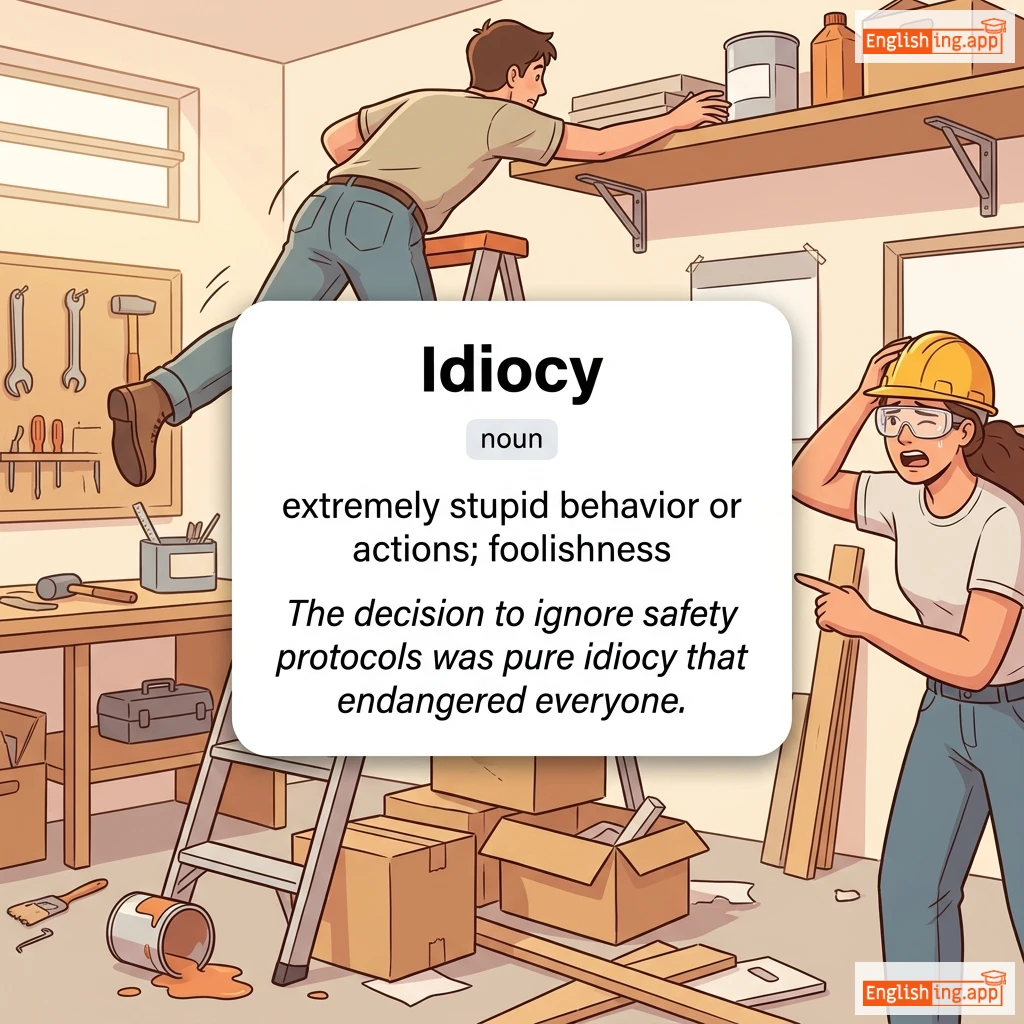
Idiocy definition card — visual illustration of the meaning
noun C2
/ˈɪd.i.ə.si/
मूर्खता (murkhata)

extremely stupid behavior or actions; foolishness

"The decision to ignore safety protocols was pure idiocy that endangered everyone."

"सुरक्षा प्रोटोकॉल्स की अनदेखी करने का निर्णय शुद्ध मूर्खता था जिसने सभी को खतरे में डाला।" (suraksha protocols ki andekhi karne ka nirnay shuddh murkhata tha jismein sabhi ko khatre mein dala.)
noun C2
/ˌɪdiəˈsɪŋkrəsi/
विशेषता (visheshta)

A distinctive or peculiar characteristic, habit, or mannerism unique to an individual.

"One of her idiosyncrasies was humming while working."

"उसकी एक आदत थी काम करते समय गुनगुनाना।" (Uski ek aadat thi kaam karte samay gungunaana.)
noun C2
/ˈaɪdlər/
आलसी व्यक्ति (aalsi vyakti)

A person who avoids work or spends time lazily.

"He was known as an idler who wasted his days."

"वह एक ऐसा आदमी था जिसे आलसी कहा जाता था जो अपने दिन बर्बाद करता था।" (Vah ek aisa aadmi tha jise aalsi kaha jaata tha jo apne din barbaad karta tha.)
adjective C2
/ˌaɪdəˈlɑːtrɪəs/
मूर्ति पूजा करने वाला (moorti pooja karne wala)

Excessively devoted or reverent towards idols or false gods.

"The ancient tribe was known for its idolatrious practices."

"प्राचीन जनजाति अपनी मूर्ति पूजा प्रथाओं के लिए प्रसिद्ध थी।" (Prachin janjati apni moorti pooja prathao ke liye prasiddh thi.)
verb C2
/aɪˈdɒləˌtraɪz/
मूर्ति पूजा करना (moorti pooja karna)

To worship idols; to regard with excessive devotion or admiration.

"They began to idolatrize the statue as a deity."

"उन्होंने उस मूर्ति को देवी के रूप में पूजना शुरू कर दिया।" (unhone us moorti ko devi ke roop mein poojna shuru kar diya.)
adjective C2
/aɪˈdɒlətrəs/
मूर्ति पूजा करने वाला (moorti pooja karne wala)

Excessively admiring or worshipping someone or something as an idol.

"The king was criticized for his idolatrous devotion to wealth."

"राजा को संपत्ति के प्रति अपनी मूर्तिपूजक भक्ति के लिए आलोचना की गई।" (Raja ko sampatti ke prati apni moortipoojak bhakti ke liye alochana ki gayi.)
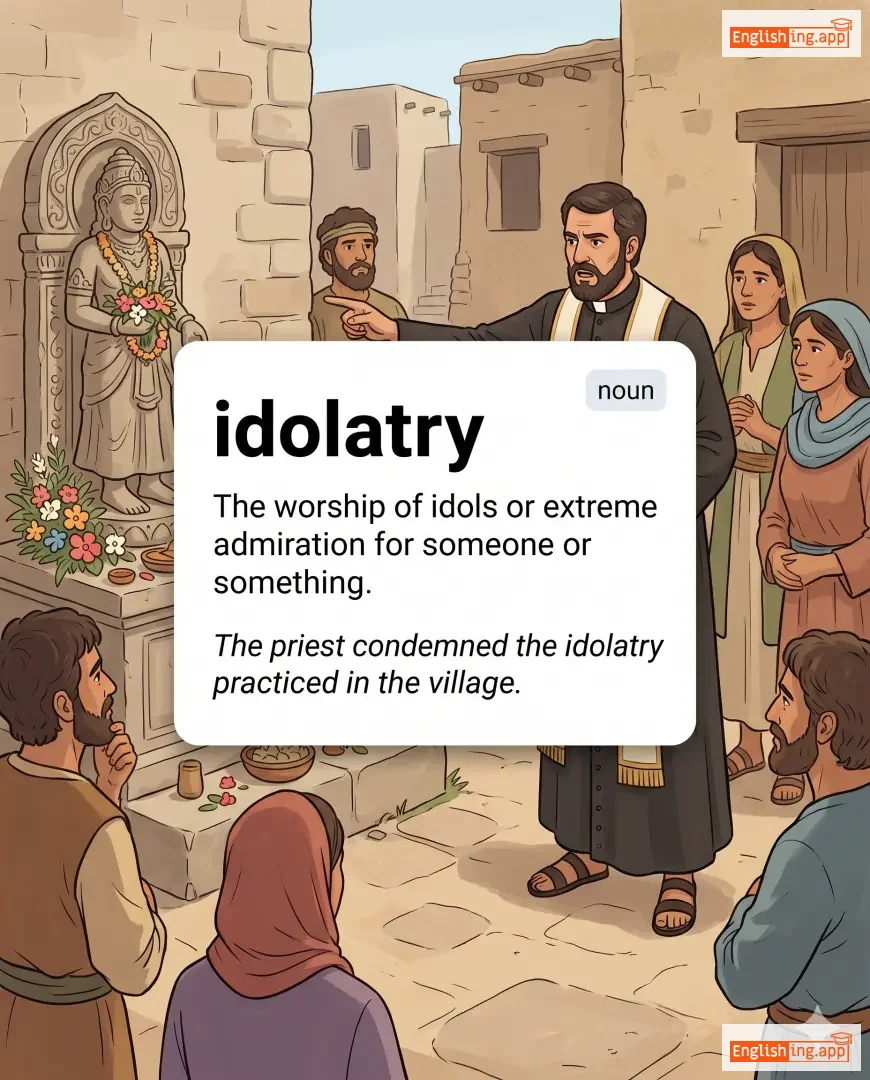
idolatry definition card — visual illustration of the meaning
noun C2
/aɪˈdɒlətri/
प्रतिमा पूजा (pratima pooja)

The worship of idols or extreme admiration for someone or something.

"The priest condemned the idolatry practiced in the village."

"पुरोहित ने गाँव में की जा रही प्रतिमा पूजा की निंदा की।" (Purohit ne gaon mein ki ja rahi pratima pooja ki ninda ki.)
noun C2
/ˈaɪdɪl/
शांतिपूर्ण सुखमय दृश्य (shantipoorn sukhmay drishya)

An extremely happy, peaceful, or picturesque episode or scene, often idealized.

"Their honeymoon was an idyll on a tropical island."

"उनकी हनीमून एक उष्णकटिबंधीय द्वीप पर एक आदर्श सुखमय दृश्य था।" (Unki honeymoon ek ushnakateebandhiy dweep par ek aadarsh sukhmay drishya tha.)
adjective C2
/ɪɡˈnoʊ.bəl/
नीच (neech)

Dishonorable, shameful, or lacking nobility.

"His ignoble actions ruined his reputation."

"उसके नीच कृत्यों ने उसकी प्रतिष्ठा को नष्ट कर दिया।" (Uske neech krityon ne uski pratishtha ko nasht kar diya.)
adjective C2
/ˌɪɡ.nəˈmɪn.i.əs/
लज्जास्पद (lajjaspad)

Marked by shame, disgrace, or humiliation.

"The team suffered an ignominious defeat in the finals."

"टीम ने फाइनल में एक लज्जास्पद हार झेली।" (Teem ne final mein ek lajjaspad haar jheli.)
noun C2
/ˈɪɡ.nəˌmɪn.i/
अपमान (apmaan)

Public shame, disgrace, or dishonor.

"He lived the rest of his life in ignominy after the scandal."

"उसने स्कैंडल के बाद अपने जीवन के बाकी हिस्से को अपमान में बिताया।" (Usne scandal ke baad apne jeevan ke baaki hisse ko apmaan mein bitaya.)
noun C2
/ˈaɪ.kɒn/
धार्मिक चित्र या प्रतीक (dharmik chitra ya pratik)

A religious image or symbol, especially in the Eastern Orthodox Church.

"The church displayed a beautifully painted ikon of the Virgin Mary."

"चर्च ने वर्जिन मैरी की एक खूबसूरती से पेंट की हुई आइकन प्रदर्शित की।" (Charch ne Virgin Mary ki ek khoobsurti se paint ki hui ikon pradarshit ki.)
noun C2
/ˈɪl.i.æd/
इलियड (Iliad)

An ancient Greek epic poem attributed to Homer, describing the events of the Trojan War.

"Students studied the Iliad to understand Greek mythology and heroism."

"छात्रों ने ग्रीक पुराण और वीरता को समझने के लिए इलियड का अध्ययन किया।" (Chhatron ne Greek puran aur veerta ko samajhne ke liye Iliad ka adhyayan kiya.)
adjective C2
/ˈɪl bred/
असभ्य (asabhya)

lacking good manners; rude; showing poor upbringing

"His ill-bred behavior shocked everyone at the dinner party."

"उसके असभ्य आचरण ने डिनर पार्टी में सभी को चौंका दिया." (uske asabhya aacharan ne dinar party mein sabhi ko chaunka diya)
adjective C2
/ˌɪlˈneɪ.tʃəd/
दुष्ट स्वभाव (dusht swabhav)

Having a bad or unpleasant character; unkind or malicious.

"He made an ill-natured remark about his colleague."

"उसने अपने सहकर्मी के बारे में एक दुष्ट स्वभाव वाली टिप्पणी की।" (Usne apne sahakarmi ke baare mein ek dusht swabhav wali tippani ki.)
Illegibility definition card — visual illustration of the meaning
noun C2
/ɪˌledʒ.əˈbɪl.ə.ti/
अस्पष्टता; कठिन पठनीयता (aspashtata; kathin pathneeyata)

the quality of being impossible or difficult to read; unclear writing or print

"The doctor's handwriting was famous for its illegibility among the pharmacy staff."

"चिकित्सक के हस्ताक्षर फार्मेसी स्टाफ के बीच अपनी अस्पष्टता के लिए प्रसिद्ध थे।" (chikitsak ke hastakshar pharmesi staff ke beech apni aspashtata ke liye prasiddh the.)
illiberal definition card — visual illustration of the meaning
adjective C2
/ɪˈlɪbərəl/
अविवेकी (aviveki)

Opposed to liberal principles; restricting freedom of thought or behavior.

"The government was criticized for its illiberal policies."

"सरकार को उसकी अविवेकी नीतियों के लिए आलोचना की गई थी।" (Sarkar ko uski aviveki neetiyon ke liye alochna ki gayi thi.)
noun C2
/ˌɪlɪbəˈræləti/
असहिष्णुता (asahishnuta)

The quality of being illiberal; lack of tolerance or generosity.

"The illiberality of the new laws alarmed the citizens."

"नए कानूनों की असहिष्णुता ने नागरिकों को भयभीत कर दिया।" (Naye kanoonon ki asahishnuta ne nagarikon ko bhaybheet kar diya.)
adjective C2
/ɪˈlɪmɪtəbl/
असीम (aseem)

Without limits or bounds.

"The universe is often described as illimitable."

"ब्रह्मांड को अक्सर असीम के रूप में वर्णित किया जाता है।" (Brahmand ko aksar aaseem ke roop mein varnrit kiya jata hai.)
noun C2
/ɪˈluːmɪnənt/
प्रकाशक (prakashak)

A substance or device that produces light.

"The lamp acted as an illuminant in the dark cave."

"दीपक अंधेरे गुफा में एक प्रकाशक के रूप में काम कर रहा था।" (Deepak andhere gufa mein ek prakashak ke roop mein kaam kar raha tha.)
noun C2
/ɪˌluːmɪˈnɑːti/
इल्युमिनाती (ilyuminati)

a group of people claiming to have special enlightenment or secret knowledge, often linked to conspiracies

"Many conspiracy theories involve the Illuminati as a secret world-controlling group."

"कई षड्यंत्र सिद्धांतों में इल्युमिनाती को एक गुप्त विश्व-नियंत्रण समूह के रूप में शामिल किया जाता है।" (kai shadyantra siddhanton mein ilyuminati ko ek gupt vishv-niyantran samuh ke roop mein shamil kiya jaata hai.)
verb C2
/ɪˈluːmɪn/
प्रकाशित करना (prakashit karna)

to light up or make clear

"The rising sun illumined the mountain peaks."

"उदयमान सूरज ने पहाड़ों की चोटियों को प्रकाशित किया।" (Udaymaan sooraj ne pahaadon ki chhotiyaan ko prakashit kiya.)
noun C2
/ˌɪmbəˈsɪləti/
मूर्खता (moorkhata)

Extreme foolishness, stupidity, or weakness of mind.

"The plan was abandoned due to its sheer imbecility."

"योजना को इसके अत्यधिक मूर्खता के कारण छोड़ दिया गया था।" (Yojna ko iske atyadhik moorkhata ke kaaran chhod diya gaya tha.)
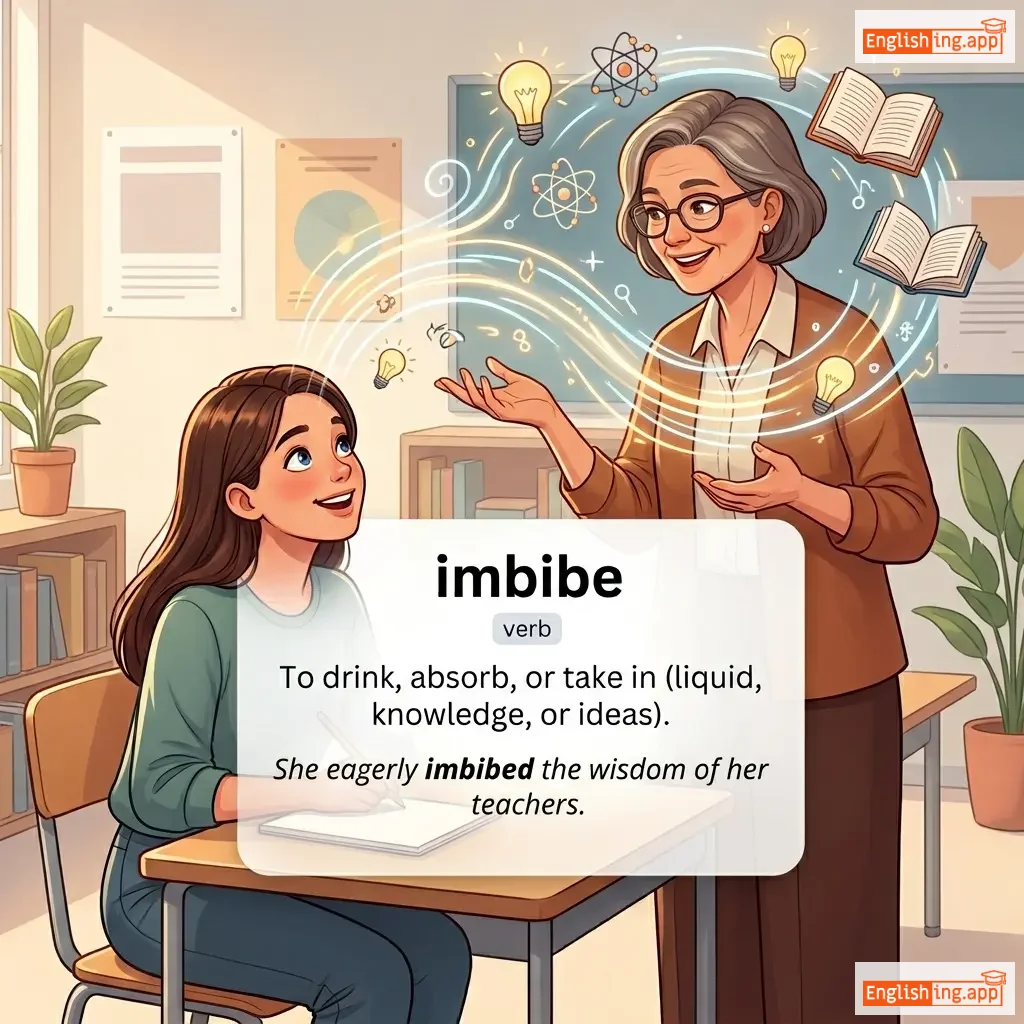
imbibe definition card — visual illustration of the meaning
verb C2
/ɪmˈbaɪb/
पान करना (pan karna)

To drink, absorb, or take in (liquid, knowledge, or ideas).

"She eagerly imbibed the wisdom of her teachers."

"वह अपने शिक्षकों से बुद्धिमता को उत्साह से आत्मसात करती थी।" (Vah apne shikshakon se buddhimta ko utsah se aatmsaat karti thi.)
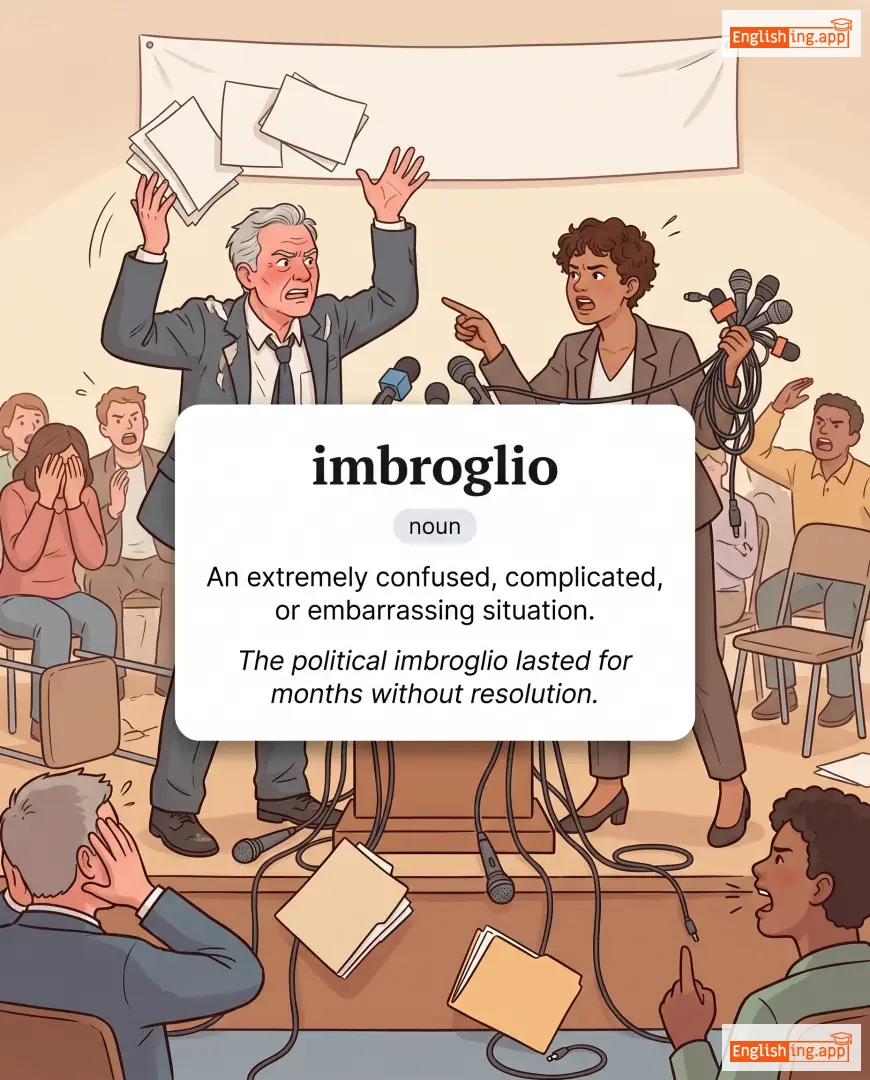
imbroglio definition card — visual illustration of the meaning
noun C2
/ɪmˈbroʊlioʊ/
उलझन (uljhan)

An extremely confused, complicated, or embarrassing situation.

"The political imbroglio lasted for months without resolution."

"राजनीतिक उलझन महीनों तक बिना किसी समाधान के चलती रही।" (Rajneetik uljhan mahino tak bina kisi samaadhan ke chalti rahi.)
verb C2
/ɪmˈbruː/
रंजित करना (ranjit karna)

To stain, especially with blood.

"His hands were imbrued with blood after the battle."

"युद्ध के बाद उसके हाथ खून से रंजित थे।" (Yudh ke baad uske haath khoon se ranjit the.)
noun C2
/ˈɪmɪˌteɪtər/
अनुकरणकर्ता (anukaranakarta)

a person who copies the behavior, style, or actions of others

"He became famous as an imitator of popular singers."

"वह एक लोकप्रिय गायक की नकल करने के कारण प्रसिद्ध हो गया।" (vah ek lokpriya gayak ki nakal karne ke kaaran prasiddh ho gaya.)
adjective C2
/ˈɪmənənt/
अंतर्निहित (antarnihit)

existing or operating within; inherent

"He believed that moral values are immanent in human nature."

"वह विश्वास करते थे कि नैतिक मूल्य मानव स्वभाव में अंतर्निहित हैं।" (Vah vishwas karte the ki naitik moolya manav swabhav mein antarnihit hain.)
adjective C2
/ˌɪməˈmɔːriəl/
प्राचीनकालीन (prachinkaleen)

Extending back beyond memory or record; ancient.

"The tradition has been followed since time immemorial."

"परंपरा समय के प्राचीन काल से अनुसरण की जाती है।" (Parampara samay ke prachin kaal se anusarhan ki jaati hai.)
adjective C2
/ɪˈmɪsəbl/
अविभाज्य (avibhajy)

Describes liquids that do not mix together.

"Oil and water are immiscible liquids."

"तेल और पानी अविभाज्य तरल पदार्थ हैं।" (Tel aur paani avibhajy taral padarth hain.)
noun C2
/ˌɪməʊˈbɪləti/
अचलता (achalata)

The state of being unable to move.

"After the accident, she suffered from immobility in her legs."

"दुर्घटना के बाद, उसे अपने पैरों में अचलता का सामना करना पड़ा।" (Durghatna ke baad, use apne pairon mein achalta ka samna karna pada.)
adjective C2
/ɪˈmɒdərət/
अत्यधिक (atyadhik)

excessive; beyond reasonable limits

"He has an immoderate love for sweets."

"उसकी मिठाइयों के प्रति अत्यधिक प्यार है।" (Uski mithaiyon ke prati atyadhik pyaar hai.)
immodest definition card — visual illustration of the meaning
adjective C2
/ɪˈmɒdɪst/
अक्खड़ / अशालीन (akkhad / ashaleen)

lacking humility or decency; excessively proud or improper

"His immodest remarks offended the audience."

"उसकी अक्खड़ टिप्पणी ने दर्शकों को आहत किया।" (Uski akkhad tipanni ne darshako ko aahat kiya.)
immodesty definition card — visual illustration of the meaning
noun C2
/ɪˈmɒdəsti/
अशालीनता (ashalinata)

lack of modesty or decency; behavior or attitude that is overly bold or improper

"The article was criticized for its tone of immodesty."

"लेख की अशालीनता के स्वर के लिए आलोचना की गई।" (lekh ki ashalinata ke swar ke liye aalochna ki gai)
verb C2
/ˈɪməleɪt/
बलिदान/आग में जलाना (balidan/aag mein jalana)

To kill or sacrifice, especially by burning.

"The protesters threatened to immolate themselves in front of the building."

"प्रदर्शनकारियों ने बिल्डिंग के सामने खुद को आग में जलाने की धमकी दी थी।" (Pradarshankariyon ne building ke samne khud ko aag mein jalane ki dhamki di thi.)
verb C2
/ɪˈmjʊər/
बंद करना (band karna)

to confine or enclose someone against their will

"The prisoner was immured in a dark cell."

"कैदी को अंधेरे सेल में बंद कर दिया गया था।" (Kaidi ko andhere sel mein band kar diya gaya tha.)
noun C2
/ɪmp/
छोटा शरारती दानव (chota shararati danav)

a small mischievous devil or sprite; a playful troublemaker

"The child was acting like a little imp, hiding his toys everywhere."

"बच्चा एक छोटे इम्प की तरह बर्ताव कर रहा था, अपने खिलौने हर जगह छिपा रहा था।" (Baccha ek chhote imp ki tarah bartav kar raha tha, apne khilone har jagah chhupa raha tha.)
verb C2
/ɪmˈpeɪl/
गो़दना (godna)

to pierce or fix something with a sharp object

"The knight was impaled by the enemy’s spear."

"योद्धा को दुश्मन के भाले से गो़द दिया गया था।" (Yoddha ko dushman ke bhale se god diya gaya tha.)
adjective C2
/ɪmˈpælpəbəl/
अस्पर्शनीय (asporshaniya)

unable to be felt by touch; difficult to grasp or understand

"There was an impalpable sense of fear in the room."

"कमरे में एक अस्पर्शनीय डर का अहसास था।" (Kamre mein ek asporshaniya dar ka ahsaas tha.)
adjective C2
/ɪmˈpæsɪbəl/
अकष्टवहनीय (akashtavahaniy)

Incapable of suffering or feeling pain (used mainly in theological or philosophical contexts).

"Some philosophers argue that God is impassible and cannot experience human emotions."

"कुछ दार्शनिकों का कहना है कि भगवान अकष्टवहनीय हैं और मानव भावनाएँ महसूस नहीं कर सकते।" (Kuch darshanikon ka kehna hai ki Bhagwan akashtavahaniy hain aur manav bhavnayein mehsoos nahi kar sakte.)
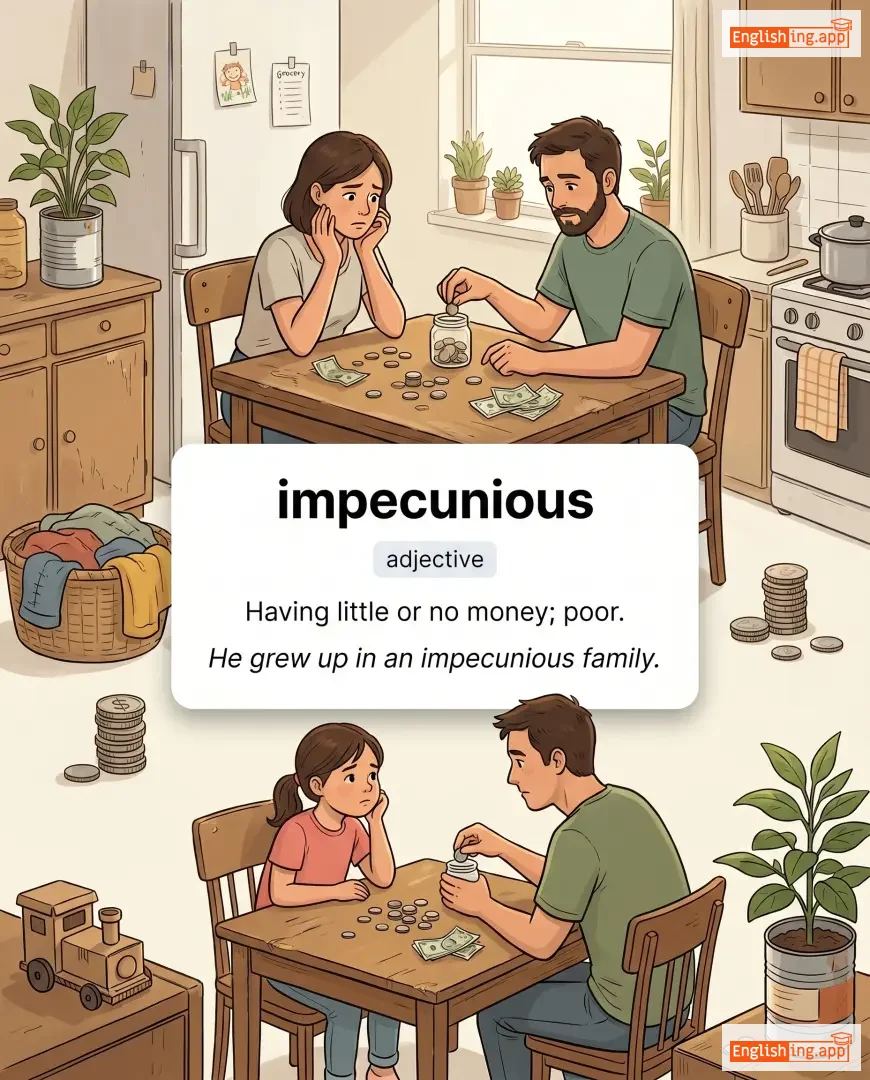
impecunious definition card — visual illustration of the meaning
adjective C2
/ˌɪmpɪˈkjuːniəs/
दरिद्र (daridr)

Having little or no money; poor.

"He grew up in an impecunious family."

"वह एक दरिद्र परिवार में पला बढ़ा।" (Vah ek daridr parivar mein pala badha.)