Vokabulare

Englisches Vokabelwörterbuch | Wortbedeutungen, Definitionen & Beispiele

sideline discussions definition card — visual illustration of the meaning
noun C1
/ˈsaɪd.laɪn dɪˈskʌʃənz/
второстепенные обсуждения (vtorostepennye obsuzhdeniya)

Informal or secondary conversations that occur outside the main agenda of a formal meeting.

"Sideline discussions often lead to agreements."

"Второстепенные обсуждения часто приводят к соглашениям." (Vtorostepennye obsuzhdeniya chasto privodyat k soglasheniyam.)
verb C1
/ˈsaɪdˌstɛp/
уклоняться (uklonyatsya)

To avoid something by stepping aside; to evade a problem or question indirectly.

"The politician tried to sidestep the difficult question."

"Политик попытался уклониться от сложного вопроса." (Politik popytalsya uklonit'sya ot slozhnogo voprosa.)
verb C1
/ˈsaɪdˌtræk/
отвлекать (otvlekat)

To distract from the main subject or activity.

"She was sidetracked by an unexpected phone call."

"Она была отвлечена неожиданным телефонным звонком." (Ona byla otvlechena neozhidannym telefonnyhm zvonkom.)
Sierra Club definition card — visual illustration of the meaning
noun C1
/siˈɛrə klʌb/
Сьерра Клуб (Sierra Klub)

An American environmental organization founded in 1892 by John Muir, focused on promoting conservation of the natural environment by influencing public policy decisions.

"John Muir founded the Sierra Club in 1892 to protect wild areas."

"Джон Мьюир основал Сьерра Клуб в 1892 году для защиты дикой природы." (Dzhon Myuhr osnoval Sierra Klub v 1892 godu dlya zashchity dikoy prirody.)
noun C1
/sɪv/
сито (sito)

a utensil with a mesh or perforated bottom, used for straining or sifting

"She used a sieve to strain the pasta."

"Она использовала сито, чтобы процеживать пасту." (Ona ispol'zovala sito, chtoby protsedzhivat' pastu.)
verb C1
/sɪft/
просеять / внимательно осматривать (proseyat' / vnimatel'no osmatrivat')

to separate or sort through carefully, often using a sieve or by examining closely

"She sifted the flour before adding it to the cake mixture."

"Она просеяла муку, прежде чем добавить ее в тесто для торта." (Ona prosejala muku, prezhde chem dobavit' yeyo v testo dlya torta.)
👁️‍🗨️

Sightless (saytləs)

adjective C1
/ˈsaɪt.ləs/
слепой; без зрения (slepoi; bez zreniya)

unable to see; blind; lacking vision

"The sightless man navigated the street with his guide dog."

"Слепой человек шел по улице с помощью своей собаки-проводника." (Slepoy chelovek shel po ulitse s pomoshch'yu svoey sobaki-provodnika)
noun C1
/sɪlk klɔːθ/
шелковая ткань (shelkovaya tkán)

fabric made from natural fibers produced by silkworms

"The bride wore a beautiful dress made of silk cloth."

"Невеста была в красивом платье из шелкового материала." (Nevesta byla v krasivom plat'ye iz shelkovoy tkan'yi.)
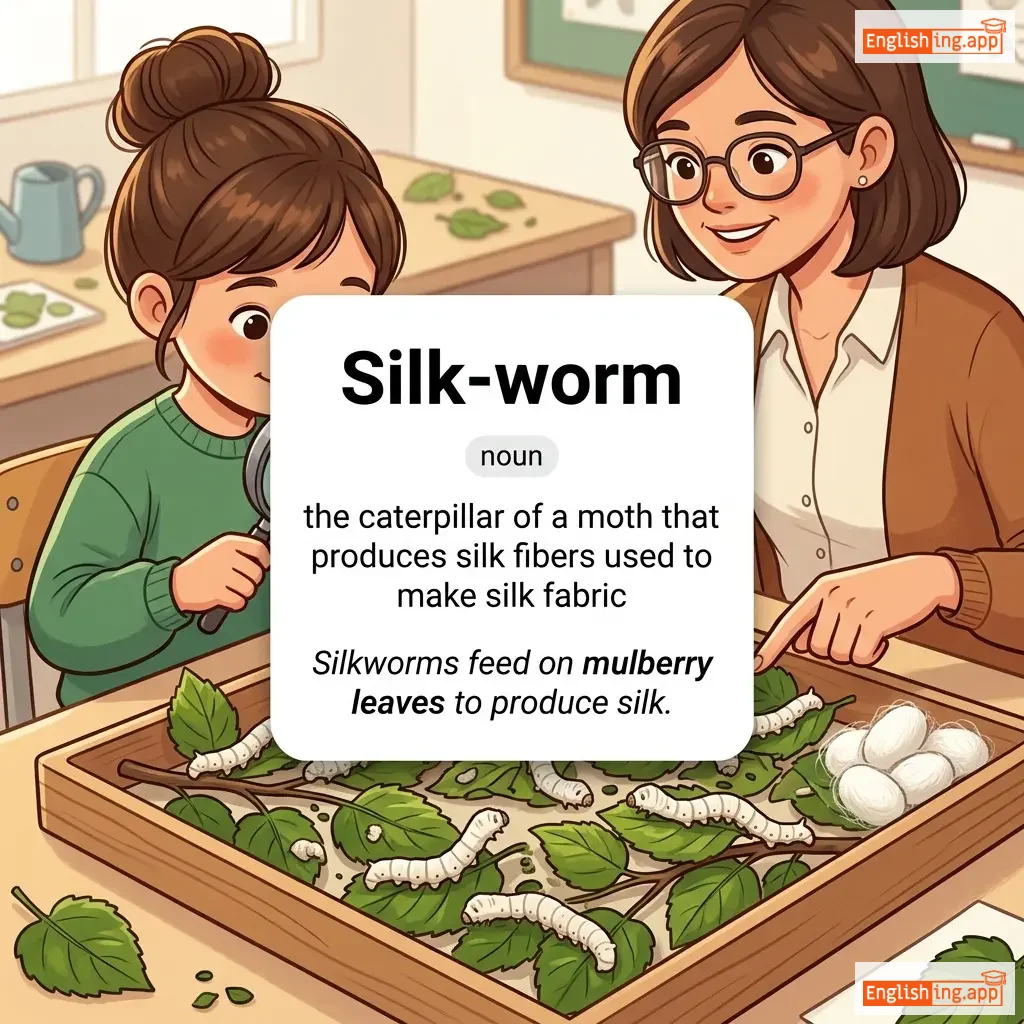
Silk-worm definition card — visual illustration of the meaning
noun C1
/ˈsɪlk.wɜːrm/
шелкопряд (shelkopryad)

the caterpillar of a moth that produces silk fibers used to make silk fabric

"Silkworms feed on mulberry leaves to produce silk."

"Шелкопряды питаются листьями тутового дерева, чтобы производить шелк." (Shelkopryady pitayutsya list'yami tutovogo dereva, chtoby proizvodit shelk.)
adjective C1
/ˈsɪlkən/
шелковый; мягкий; гладкий; (shelkovyy)

made of silk; smooth and soft like silk

"She wore a beautiful silken dress to the party."

"Она надела красивое шелковое платье на вечеринку." (Ona nadela krasivoye shelkovoye plat'ye na vecherinku.)
noun C1
/sɪlt/
ил (il)

Fine sand, clay, or other material carried by running water and deposited as a sediment.

"The river deposited layers of silt along its banks."

"Река отложила слои ила вдоль своих берегов." (Reka otlozhila sloi ila vdol' svoikh beregov.)
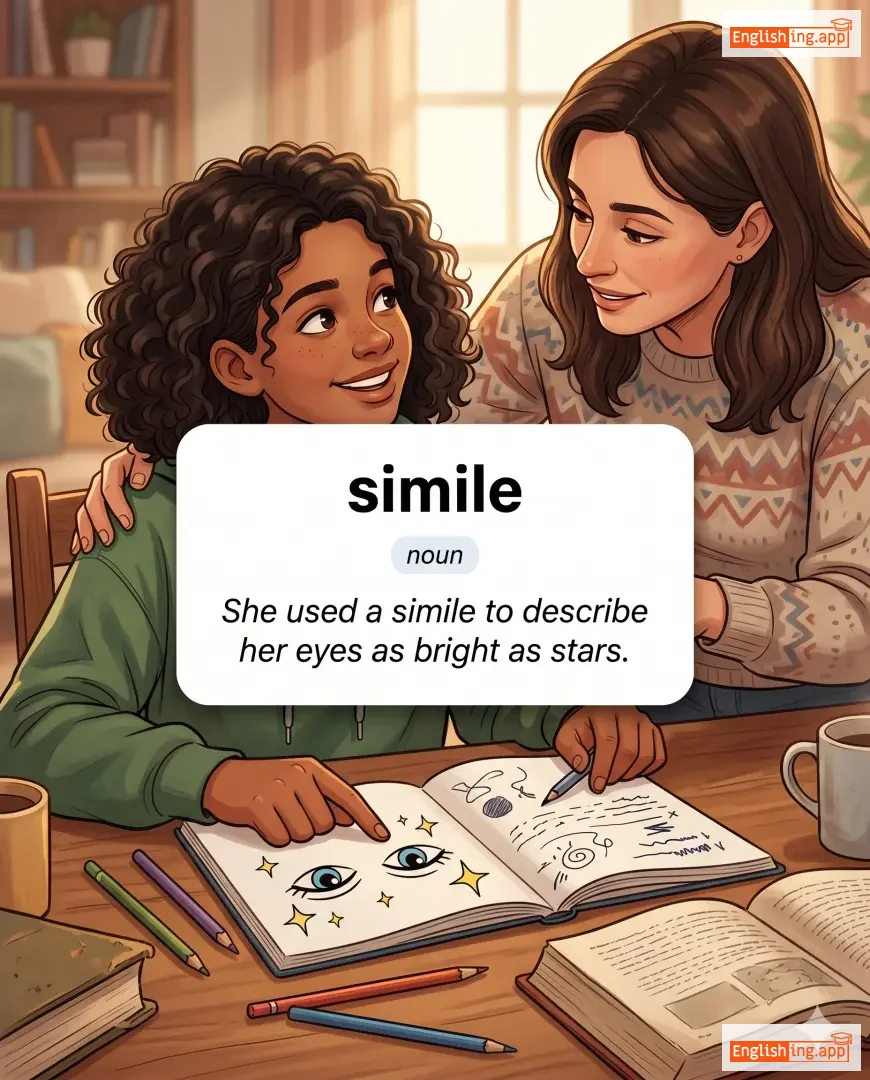
simile definition card — visual illustration of the meaning
noun C1
/ˈsɪməli/
сравнение (sravnenie)

A figure of speech involving the comparison of one thing with another using 'like' or 'as'.

"She used a simile to describe her eyes as bright as stars."

"Она использовала сравнение, чтобы описать свои глаза, как яркие звезды." (Ona ispol'zovala sravnenie, chtoby opisat' svoi glaza, kak yarkie zvezdy.)
adjective C1
/sɪmˈplɪstɪk/
слишком упрощенный (slishkom uproshchyonniy)

treating complex issues as if they were much simpler than they really are

"His explanation was too simplistic and ignored key details."

"Его объяснение было слишком упрощенным и игнорировало ключевые детали." (Ego ob'yasneniye bylo slishkom uproshchyonnym i ignorirovalo klyuchevyye detali.)
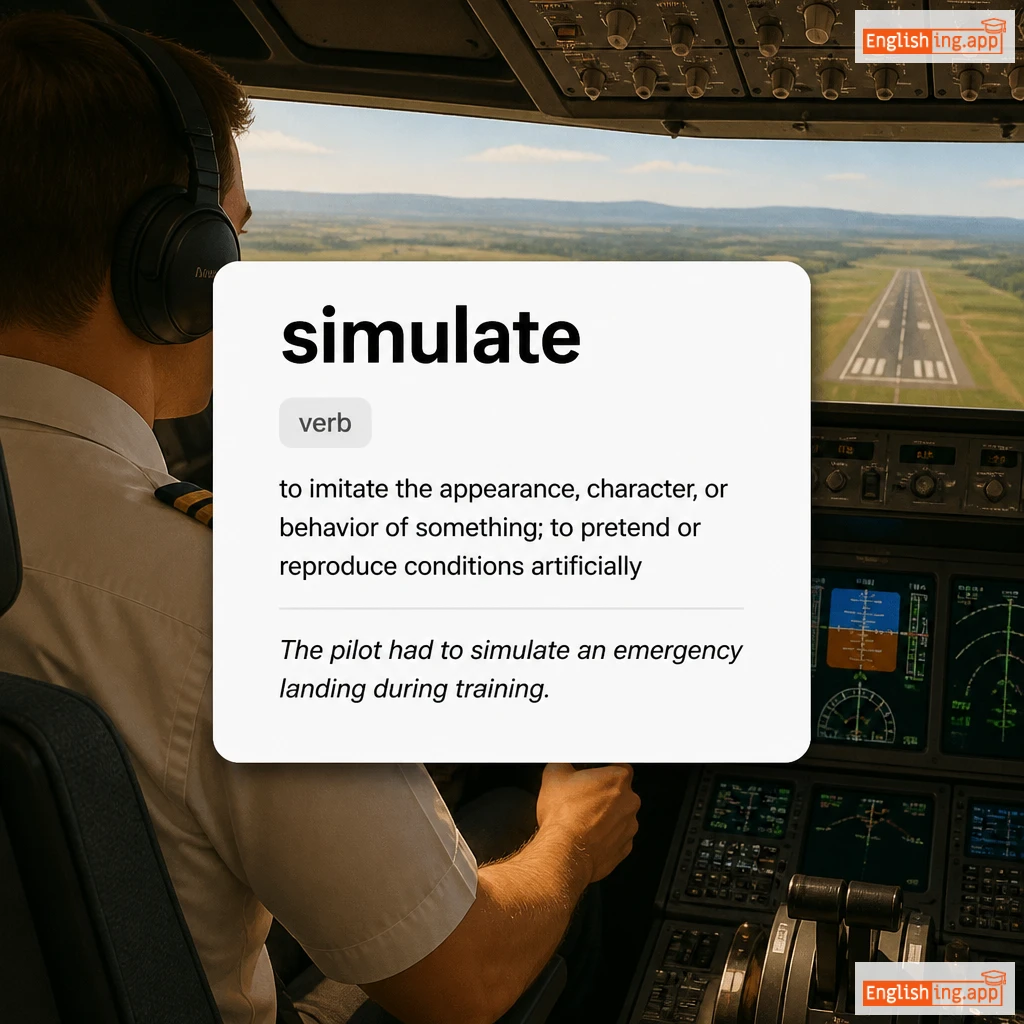
simulate definition card — visual illustration of the meaning
verb C1
/ˈsɪmjʊˌleɪt/
симулировать (simulirovat)

to imitate the appearance, character, or behavior of something; to pretend or reproduce conditions artificially

"The pilot had to simulate an emergency landing during training."

"Пилот должен был смоделировать экстренную посадку во время тренировки." (Pilot dolzhen byl smodelirovat' ekstrennuyu posadku vo vremya trenirovki.)
simulated definition card — visual illustration of the meaning
adjective C1
/ˈsɪm.jʊ.leɪ.tɪd/
моделированный (modelirovannyy)

Artificially created to look real but not actually real.

"The pilot trained in a simulated flight environment."

"Пилот тренировался в смоделированной среде полета." (Pilot trenirovalsya v smodelirovannoy srede poleta.)
verb C1
/sɪndʒ/
легко обжигать (legko obzhigat)

To burn something superficially or lightly, especially at the edges.

"The fire singed his eyebrows."

"Огонь обжег его брови." (Ogon' obzheg ego brovi.)
adjective C1
/ˈsɪnləs/
без греха; невинный; чистый (bez grekha; nevinny; chistyy)

free from sin; pure and innocent; without moral fault

"The innocent child appeared sinless in her pure white dress."

"Невинный ребенок выглядел без греха в своем чистом белом платье." (Nevinnyy rebenok viglyadel bez grekha v svoem chistom belom plat'e.)
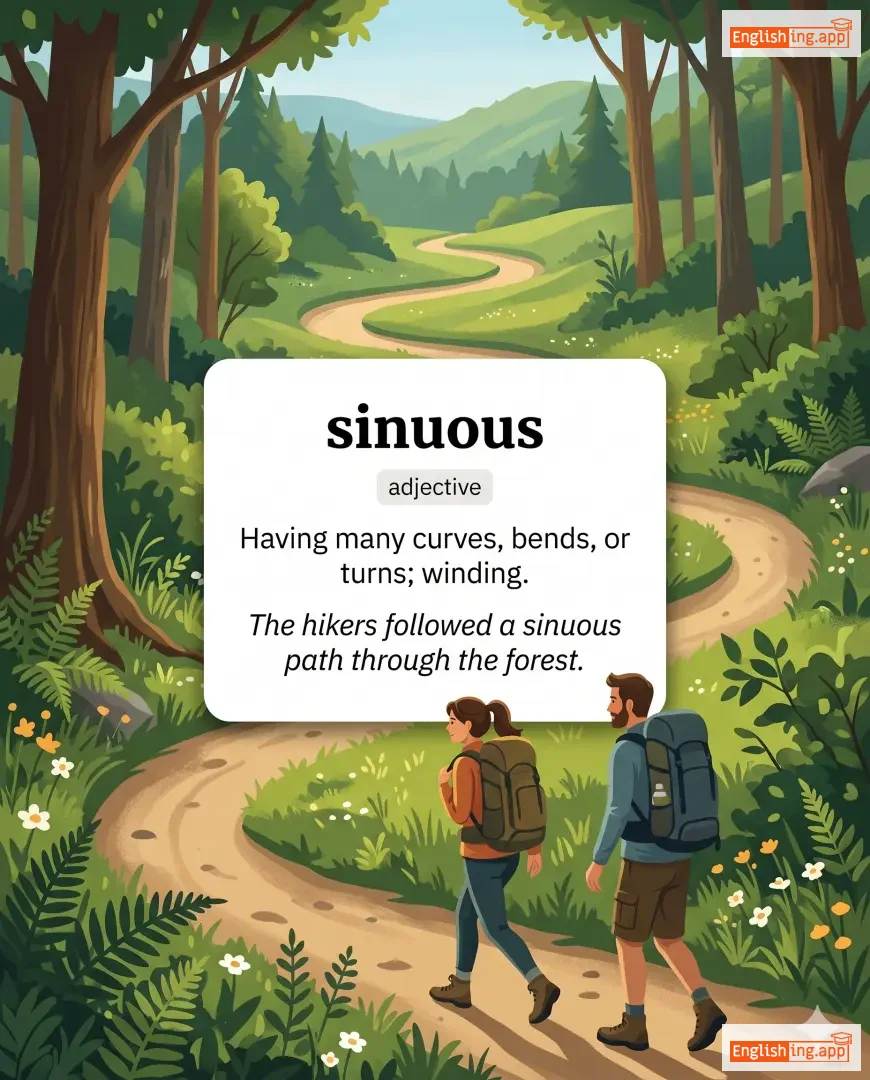
sinuous definition card — visual illustration of the meaning
adjective C1
/ˈsɪnjuəs/
изогнутый (izognutyy)

Having many curves, bends, or turns; winding.

"The hikers followed a sinuous path through the forest."

"Путешественники шли по извилистому пути через лес." (Puteshestvenniki shli po izvilistomu puti cherez les.)
noun C1
/ˈsaɪnəs/
синус (sinus)

A cavity within a bone or tissue, especially those in the bones of the face connected with the nasal cavities.

"He suffered from a sinus infection that caused headaches."

"Он страдал от инфекции синусов, которая вызвала головную боль." (On stradal ot infektsii sinusoov, kotoraya vyzvala golovnuyu bol'.)
noun C1
/ˈsɪstərhʊd/
сестринство (sestrinstvo)

The relationship between sisters, or a community of women united by shared experiences or goals.

"The feminist movement created a strong sense of sisterhood among women."

"Феминистское движение создало сильное чувство сестринства среди женщин." (Feministskoe dvizhdenie sozdalo sil'noe chuvstvo sestrinstva sredi zhenshchin.)
Sitar definition card — visual illustration of the meaning
noun C1
/sɪˈtɑːr/
ситар (sitar)

a traditional Indian stringed musical instrument with a long neck and resonating body

"The sitar creates beautiful ragas in Indian classical music."

"Ситар создает красивые раги в индийской классической музыке." (Sitar sozdayet krasivye ragi v indiyskoy klassicheskoy muzike.)
skeptic definition card — visual illustration of the meaning
noun C1
/ˈskɛptɪk/
скептик (skeptik)

A person who doubts or questions accepted beliefs or claims.

"The scientist was a skeptic of theories without solid evidence."

"Ученый был скептически настроен к теориям без твердых доказательств." (Uchenyy byl skepticheski nastroen k teoriya bez tverdykh dokazatel'stv.)
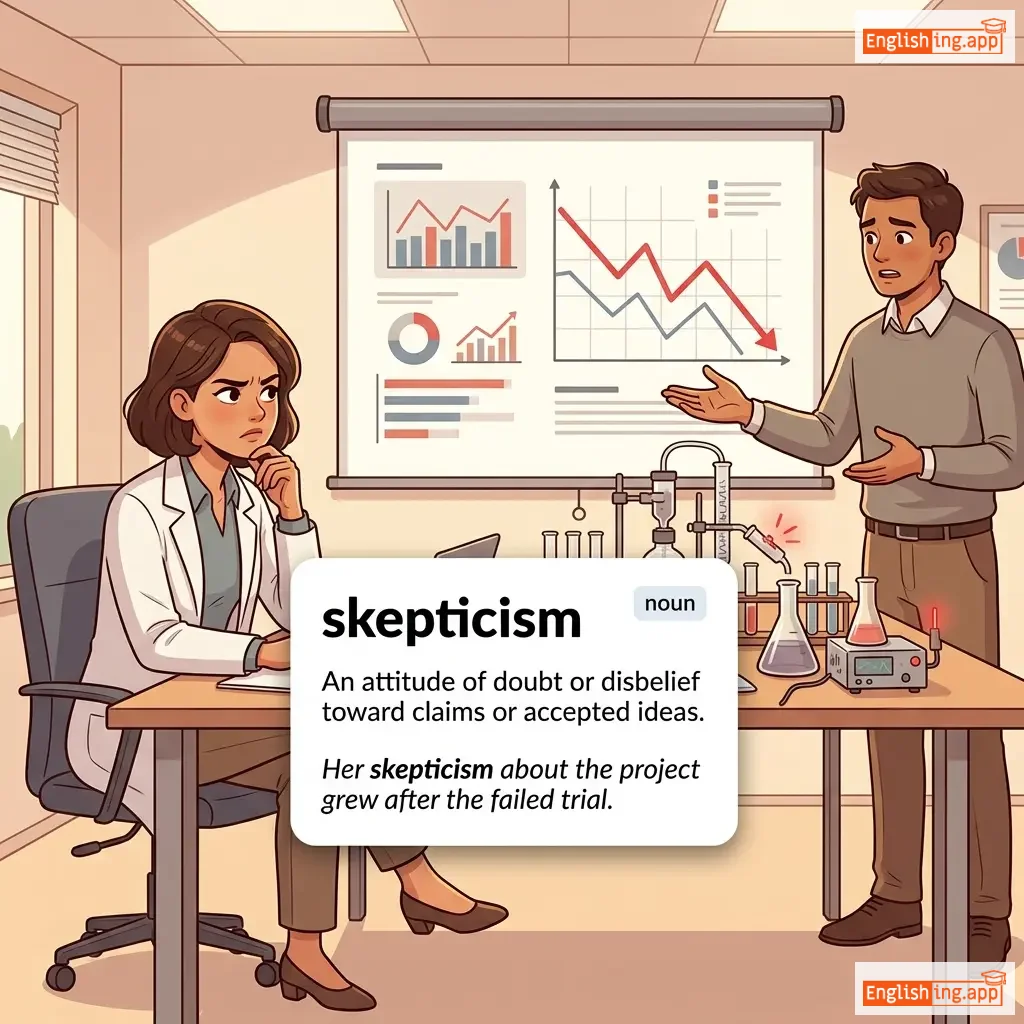
skepticism definition card — visual illustration of the meaning
noun C1
/ˈskɛptɪˌsɪzəm/
скептицизм (skeptitsizm)

An attitude of doubt or disbelief toward claims or accepted ideas.

"Her skepticism about the project grew after the failed trial."

"Её скептицизм по поводу проекта усилился после неудачного испытания." (Yeyo skeptitsizm po povodu proyektu usililsya posle neyudachnogo ispytaniya.)
adjective C1
/ˈskɛtʃi/
незавершенный (nezavershenny)

not thorough or detailed; suspicious or unsafe

"The details of the project were still sketchy."

"Детали проекта все еще были незавершенными." (Detali proekta vse eshche byli nezavershennymi.)
verb C1
/skɪmp/
скупиться (skupit'sya)

to use less of something than is necessary in order to save money or effort

"Don’t skimp on quality when buying a new laptop."

"Не скупись на качество, когда покупаешь новый ноутбук." (Ne skupis' na kachestvo, kogda pokupayesh' novyy noutbuk.)
⚔️

skirmish

noun/verb C1
/ˈskɜːrmɪʃ/

a small or brief fight between groups of soldiers; to engage in such a fight

"The soldiers got into a skirmish near the border."

noun C1
/skɪt/
скетч (sketch)

a short, humorous performance or piece of writing

"The students performed a funny skit at the event."

"Студенты исполнили забавный скетч на мероприятии." (Studenty ispolnili zabavnyy sketch na meropriyatii.)
adjective C1
/ˈskɪtɪʃ/
нервный (nervny)

easily frightened or nervous; unpredictable

"The horse was too skittish to ride."

"Лошадь была слишком нервной для верховой езды." (Loshad' byla slishkom nervnoj dlya verkhovoj ezdy.)
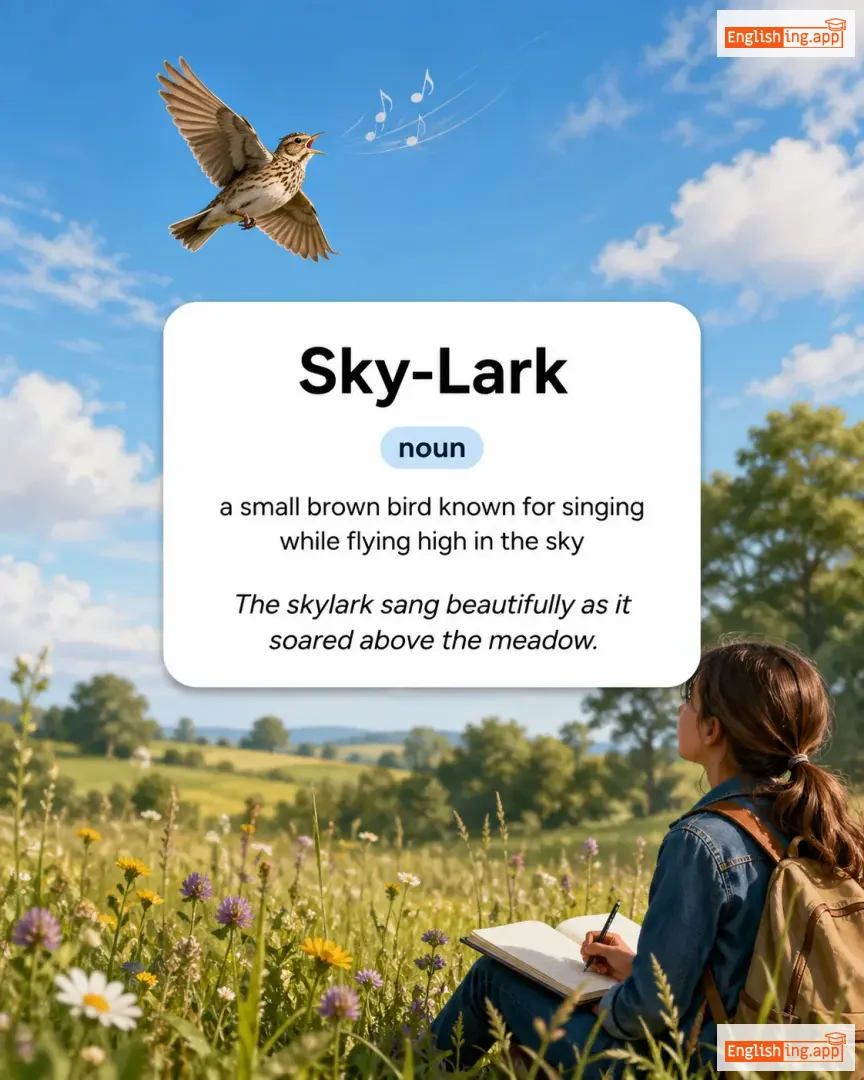
Sky-Lark definition card — visual illustration of the meaning
noun C1
/ˈskaɪ.lɑːrk/
жаворонок (zha-vor-o-nok)

a small brown bird known for singing while flying high in the sky

"The skylark sang beautifully as it soared above the meadow."

"Жаворонок пел красиво, пока он летел над лугом." (Zhavoronok pel krasivo, poka on letel nad lugom)
noun C1
/slæb/
плита (plita)

a large, thick, flat piece of stone, concrete, or other hard material

"The workers laid a concrete slab for the foundation."

"Рабочие положили бетонную плиту для фундамента." (Rabochie polozhili betonnuyu plitu dlya fundamenta.)
verb C1
/ˈslækən/
ослабить (oslabit)

to make or become less tight, less active, or slower

"The driver slackened his speed as he approached the village."

"Водитель сбавил скорость, когда подъезжал к деревне." (Voditel' sbavil skorost', kogda pod'yezhal k derevne.)
noun C1
/slæɡ/
шлак (shlak)

Stony waste matter separated from metals during the smelting process.

"The factory dumped the slag near the river."

"Фабрика сбросила шлак рядом с рекой." (Fabrika sbrosila shlak ryadom s rekoj.)
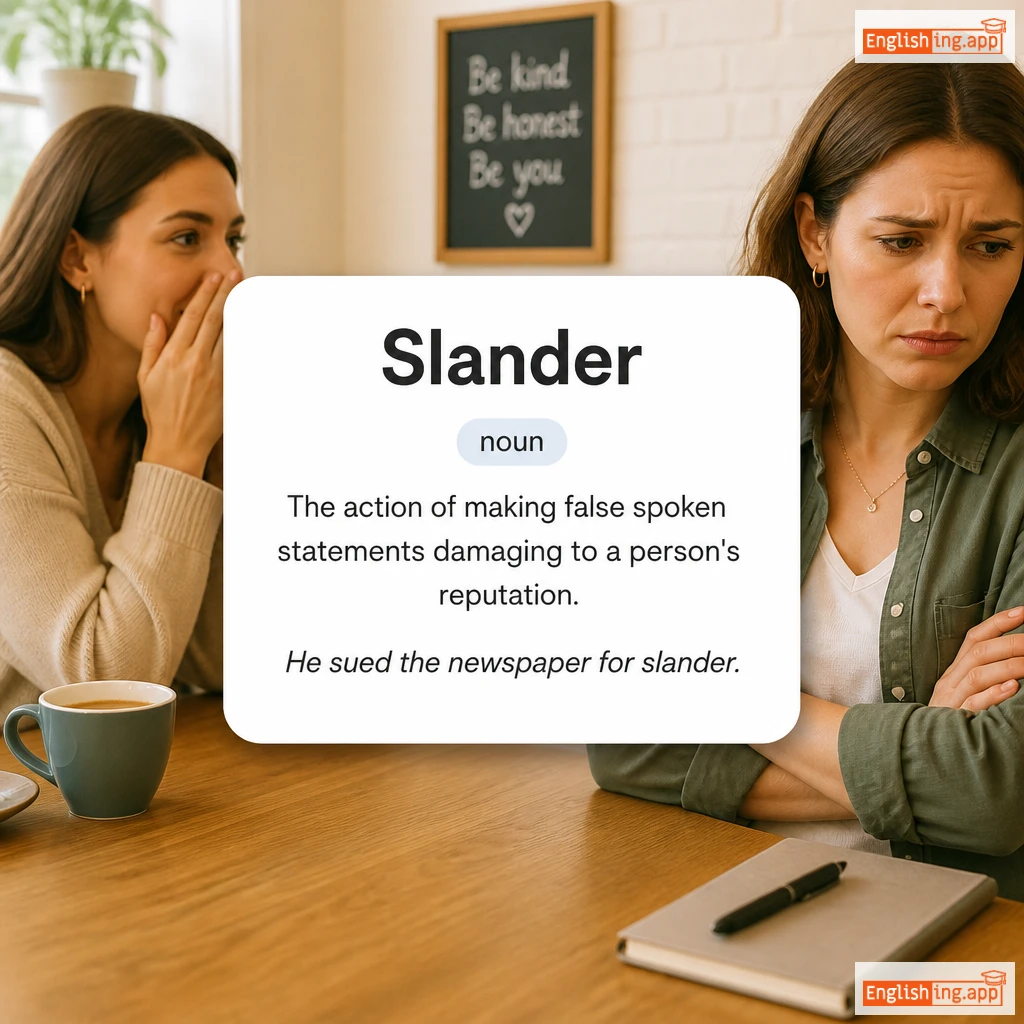
Slander definition card — visual illustration of the meaning
noun C1
/ˈslændər/
клевета (kleventa)

The action of making false spoken statements damaging to a person's reputation.

"He sued the newspaper for slander."

"Он подал в суд на газету за клевету." (On podal v sud na gazetu za kleventu.)
noun/verb C1
/sleɪt/
сланец / планировать (slanets / planirovat)

a fine-grained rock used for roofing or writing; to schedule or designate for a task

"The meeting is slated for next Monday."

"Встреча назначена на следующий понедельник." (Vstrecha naznachena na sleduyushchiy ponedel'nik.)
adjective C1
/ˈsleɪ.vɪʃ/
рабский (rabskij)

showing no originality; completely imitative or overly submissive

"His slavish devotion to tradition prevented any innovation."

"Его рабская преданность традиции предотвратила любые инновации." (Ego rabskaya predannost' traditsii predotvratila lyubye innovatsii.)
verb C1
/sleɪ/
убивать (slay)

to kill violently; informally, to impress greatly

"The hero vowed to slay the dragon."

"Герой поклялся убить дракона." (Geroi poklyalsya ubit drakona.)
adjective C1
/ˈsliːzi/
низкий, грязный или низкого качества (nizkiy, gryaznyy ili nizkogo kachestva)

morally low, dirty, or cheap in quality

"He avoided the sleazy nightclub downtown."

"Он избегал этот убогий ночной клуб в центре города." (On izbegal etot ubogiy nochnoy klub v tsentre goroda.)
adjective C1
/sliːk/
гладкий и блестящий (gladkiy i blestyashchiy)

smooth, shiny, and stylish

"She drove a sleek black sports car."

"Она вела блестящий черный спортивный автомобиль." (Ona vела blestyashchiy chernyy sportivnyy avtomobil'.)
noun C1
/sleɪ/
сани (sani)

A vehicle pulled by horses or reindeer over snow or ice.

"Children were excited to ride in the sleigh through the snowy village."

"Дети были взволнованы, катаясь на санях по заснеженной деревне." (Deti byli vzvolnovany, katayas na sanyakh po zasnezhennoy derevne.)
verb C1
/sluː/
резко повернуть (rezko povernut)

To turn or slide violently in a particular direction.

"The car slewed across the icy road."

"Машина резко повернула на скользкой дороге." (Mashina rezko povernula na skol'zkoj doroge.)
verb C1
/slɪŋ/
подбрасывать, бросать (podbrasyvat, brosat)

to throw or hang something roughly or carelessly

"He slung his bag over his shoulder before leaving."

"Он повесил сумку через плечо перед тем, как уйти." (On povesil sumku cherez plecho pered tem, kak uyti.)
verb C1
/slɪŋk/
скользить (skol'zit')

to move quietly and secretly, often to avoid being noticed

"The cat slunk into the room without making a sound."

"Кошка вошла в комнату, не издавая ни звука." (Koshka voshla v komnatu, ne izdaya ni zvuka.)
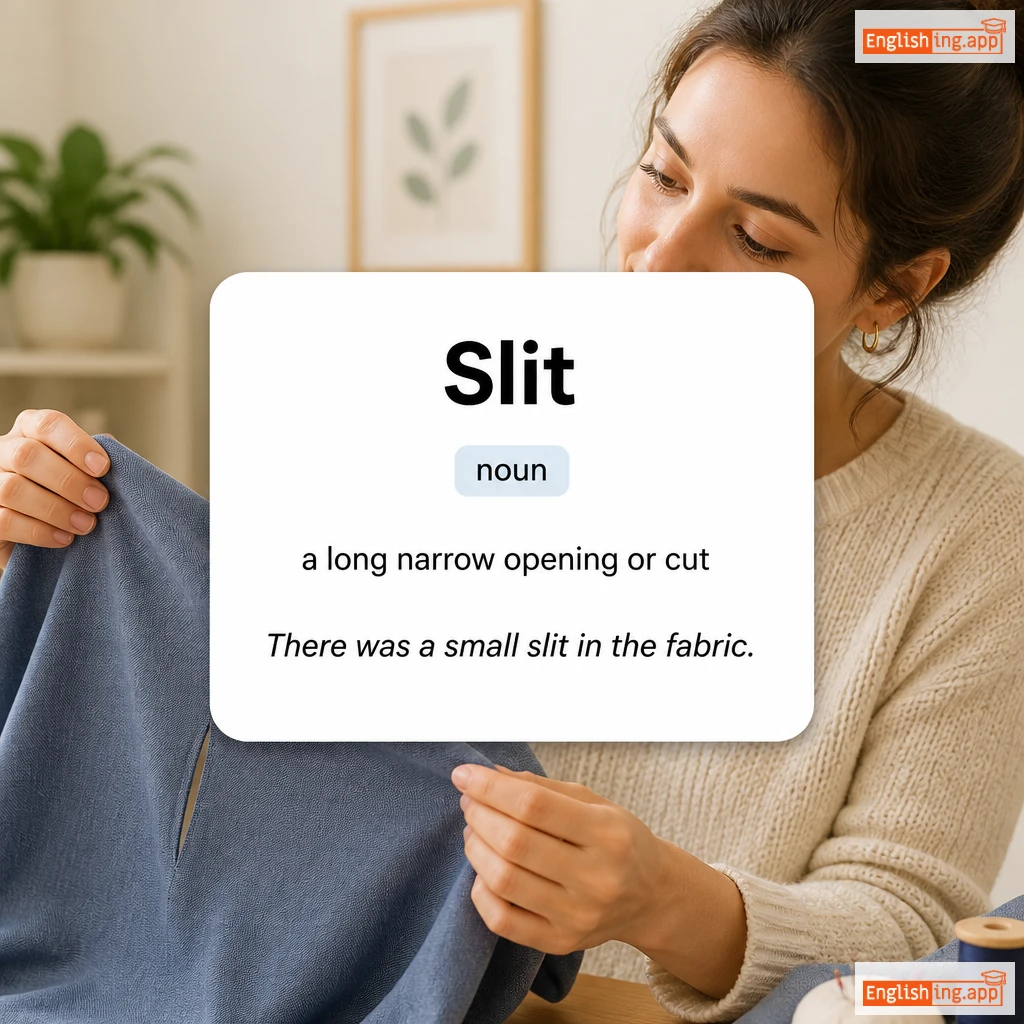
Slit definition card — visual illustration of the meaning
noun C1
/slɪt/
трещина (treshchina)

a long narrow opening or cut

"There was a small slit in the fabric."

"В ткани была маленькая трещина." (V tkani byla malen'kaya treshchina.)
verb C1
/ˈslɪðər/
ползти (polzti)

to move smoothly over a surface with a twisting, sliding motion, like a snake

"The snake slithered through the grass."

"Змея поползла через траву." (Zmey popolzla cherez travu.)
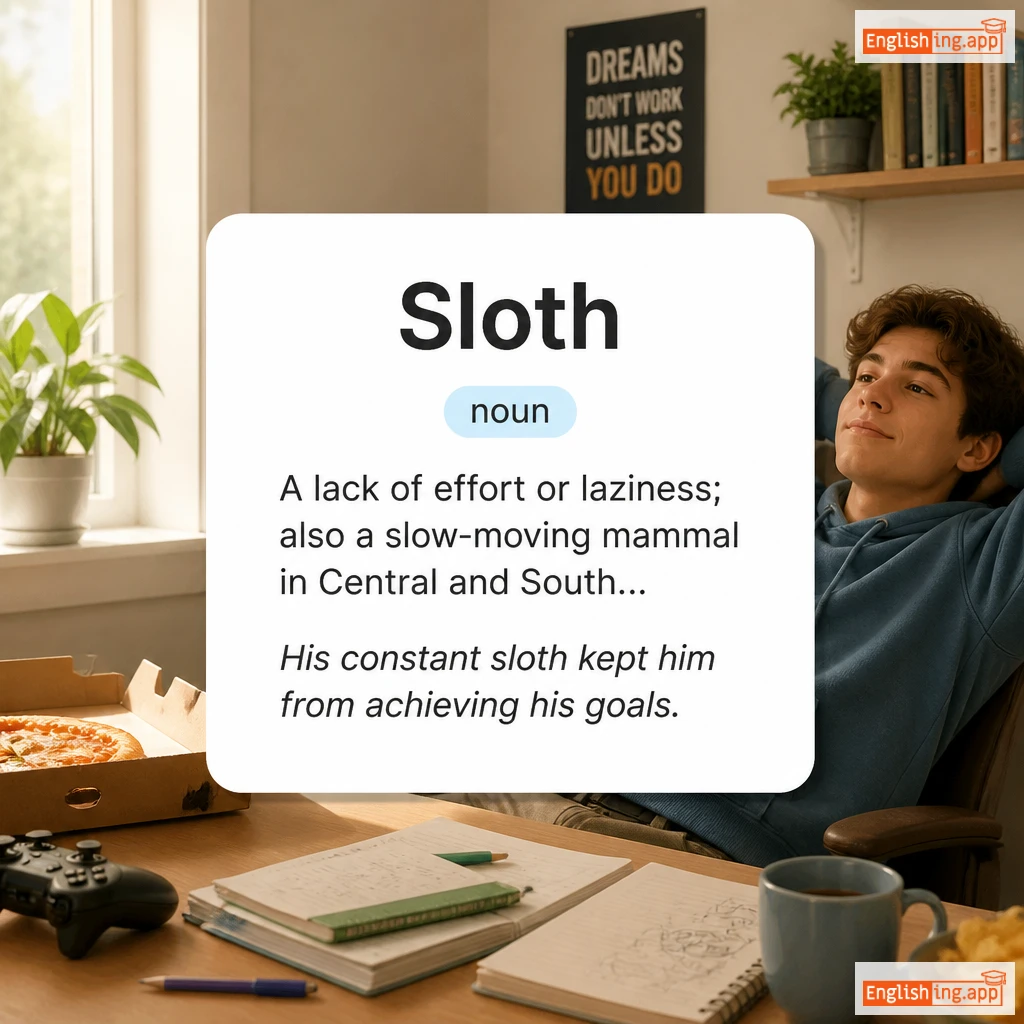
Sloth definition card — visual illustration of the meaning
noun C1
/sloʊθ/ or /slɒθ/
лень (len)

A lack of effort or laziness; also a slow-moving mammal in Central and South America.

"His constant sloth kept him from achieving his goals."

"Его постоянная лень мешала ему достигать своих целей." (Ego postoyannaya len' meshala emu dostigat' svoikh tseley.)
verb C1
/slaʊtʃ/
сутулиться (sutulitsya)

To stand, sit, or move in a lazy or awkward way.

"He slouched in the chair, looking tired."

"Он обрушился в кресло, выглядел уставшим." (On obrushilsya v kreslo, vyglyadel ustavshim.)
noun/verb C1
/ˈslʌmbər/
сон (son)

A state of sleep; to sleep lightly or rest.

"The child slumbered peacefully through the night."

"Ребёнок мирно спал всю ночь." (Rebyonok mirno spal vsyu noch'.)
noun, verb C1
/slɜːr/
оскорбление / обидное замечание (oskorblenie / obidnoe zamechanie)

An insulting remark or suggestion; or to speak indistinctly.

"He made a slur against her character."

"Он сделал оскорбительное замечание о её характере." (On sdelal oskorbitelnoe zamechanie o yeyo kharaktere.)
noun C1
/ˈsmætərɪŋ/
поверхностные знания (poverkhnostnye znaniya)

A small amount or superficial knowledge of something.

"He has a smattering of Spanish."

"У него поверхностные знания испанского." (U nego poverkhnostnye znaniya ispanskogo.)
verb C1
/smɪr/
мазать / клеветать (mazat / klevetat)

to spread or apply a substance messily; to damage someone's reputation with false or unfair words

"The child smeared paint across the wall."

"Ребенок размазал краску по стене." (Rebenok razmazal krasku po stene.)