Vocabularies

English Vocabulary Dictionary | Word Meanings, Definitions & Examples

noun C2
/ˌviːələnsɛloʊ/
चेलो (chelo)

The full name of the cello, a large string instrument played with a bow and held between the knees.

"He practiced the violoncello for hours each day."

"उसने हर दिन घंटों तक वायोलोंचेलो का अभ्यास किया।" (usne har din ghanton tak violoncello ka abhyas kiya.)
noun C2
/vəˈrɑːɡoʊ/
कर्कश या हठी महिला (karkash ya hathi mahila)

a loud, overbearing woman; historically, a strong or courageous woman

"The play depicted the heroine as a fierce virago who defied tradition."

"नाटक में नायिका को एक साहसी विरागो के रूप में दिखाया गया था जो परंपरा को चुनौती देती थी।" (Natak mein nayika ko ek sahasi virago ke roop mein dikhaya gaya tha jo parampara ko chunauti deti thi.)
adjective C2
/ˈvɪrəl/
पुरुषोचित (purushocit)

having traditionally masculine qualities, such as strength, energy, and sexual vigor

"The actor was admired for his virile appearance."

"अभिनेता को उसके पुरुषोचित रूप के लिए सराहा गया।" (Abhineta ko uske purushocit roop ke liye saraha gaya.)
noun C2
/vɜːrˈtuː/
कला के प्रति रुचि (kala ke prati ruchi)

a love of or taste for fine art, antiques, or curiosities

"The collector’s house was filled with objects of virtu."

"कलेक्टर का घर कला के वस्तुओं से भरा हुआ था।" (Collector ka ghar kala ke vastuon se bhara hua tha.)
noun C2
/ˈvɪrjʊləns/
संक्रमणता (sankramanta)

The severity or harmfulness of a disease or poison.

"Scientists studied the virulence of the new virus strain."

"वैज्ञानिकों ने नए वायरस के स्ट्रेन की संक्रमणता का अध्ययन किया।" (Vaigyanikon ne naye virus ke strain ki sankramanta ka adhyayan kiya.)
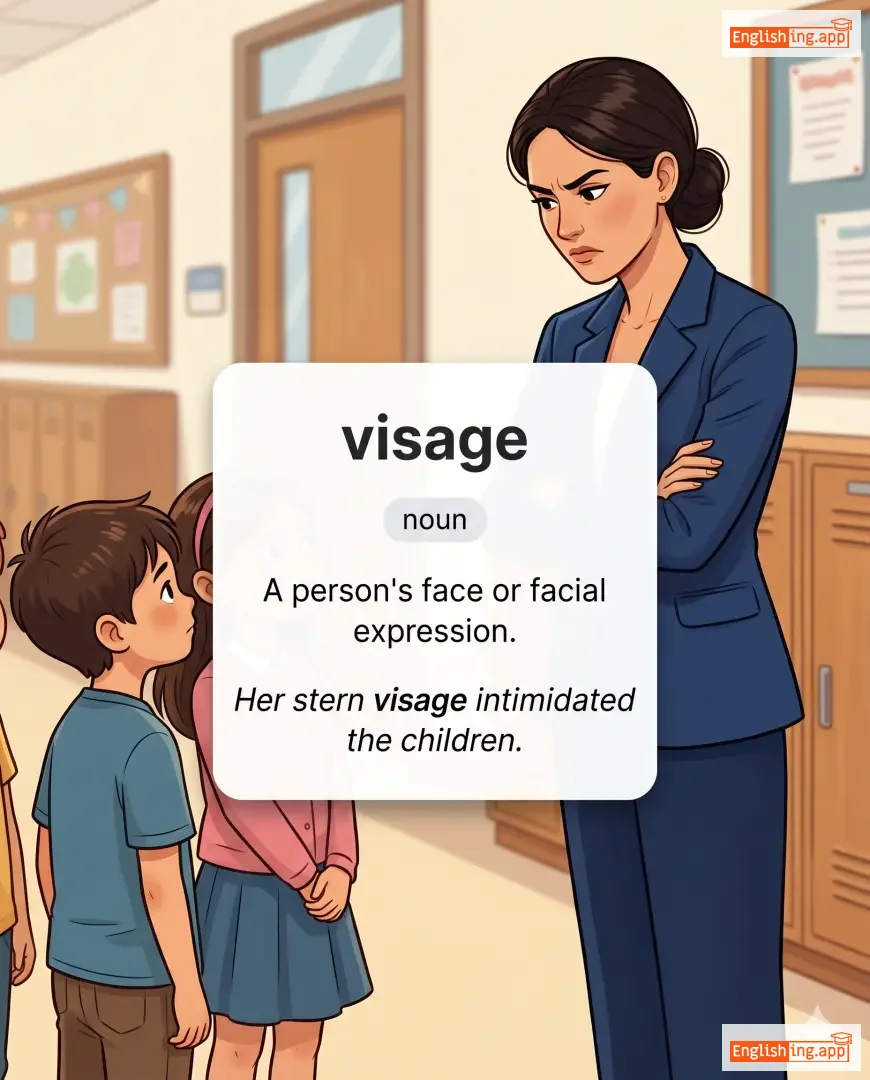
visage definition card — visual illustration of the meaning
noun C2
/ˈvɪzɪdʒ/
ख़ुशी (khushi)

A person's face or facial expression.

"Her stern visage intimidated the children."

"वह पुरस्कार प्राप्त करते समय अपनी खुशी को छिपा नहीं सकी।" (vah puraskaar praapt karte samay apni khushi ko chhupa nahi sakee.)
adjective C2
/ˈvɪsɪd/
चिपचिपा (chipchipa)

Having a thick, sticky consistency.

"The sap had a viscid texture that stuck to his hands."

"रस में चिपचिपा बनावट थी जो उसके हाथों में चिपक गई।" (ras mein chipchipa banawat thi jo uske haathon mein chipak gayi.)
noun C2
/ˈvaɪkaʊnt/
वाइस्काउंट (vaiskaunt)

A British nobleman ranking below an earl and above a baron.

"The viscount inherited the estate from his father."

"वाइस्काउंट ने अपने पिता से संपत्ति विरासत में प्राप्त की।" (Vaiskaunt ne apne pita se sampatti virasat mein prapt ki.)
visuospatial definition card — visual illustration of the meaning
adjective C2
ˌvɪz.ju.oʊˈspeɪ.ʃəl
दृष्टि और वस्तुओं के बीच स्थानिक संबंध से संबंधित (drishti aur vastuon ke beech sthanik sambandh se sambandhit)

Related to understanding the relationship between space and objects through vision.

"Good visuospatial skills are important for architecture and design."

"अच्छे विजुअलस्पेशियल कौशल वास्तुकला और डिज़ाइन के लिए महत्वपूर्ण हैं।" (Achhe visualspatial kaushal vastukala aur design ke liye mahatvapurn hain.)
verb C2
/ˈvaɪtəlaɪz/
जीवन्त करना (jivant karna)

To give life, energy, or strength to something.

"Fresh air and exercise can vitalize the body and mind."

"ताजे हवा और व्यायाम शरीर और मन को जीवन दे सकते हैं।" (Taje hawa aur vyayam sharir aur man ko jeevan de sakte hain.)
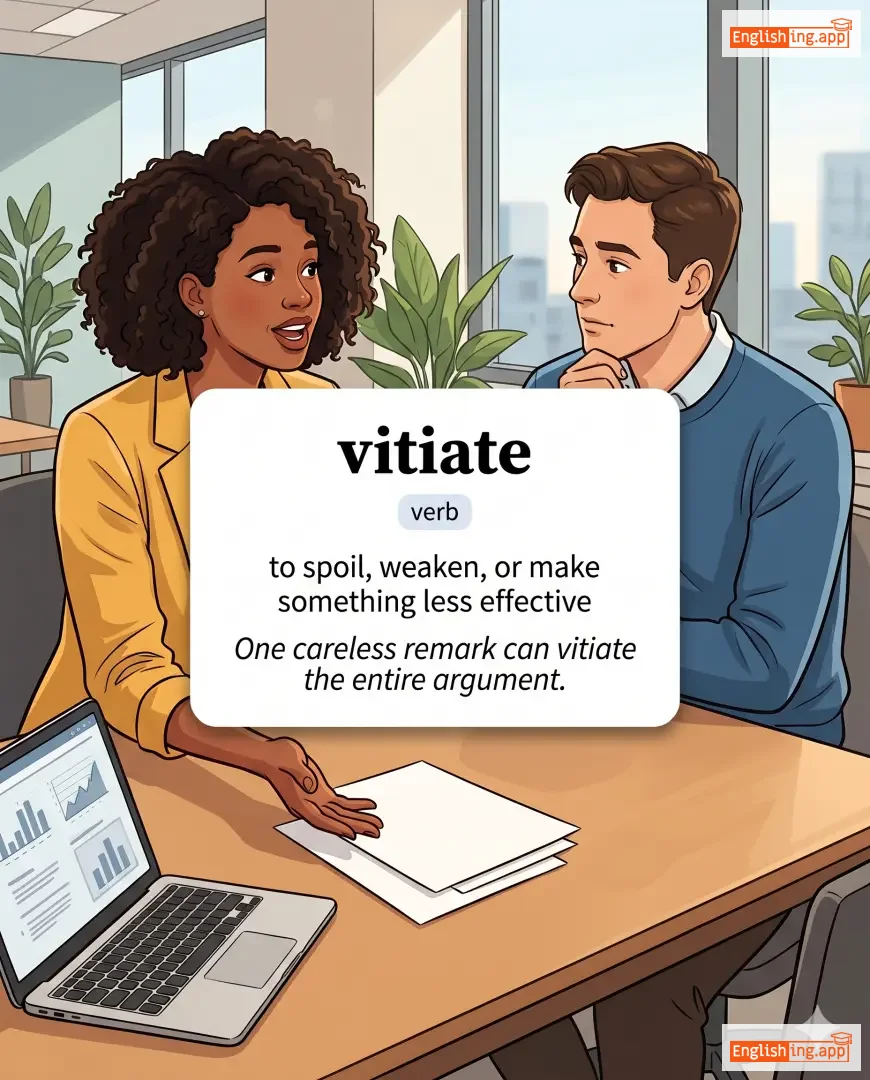
vitiate definition card — visual illustration of the meaning
verb C2
/ˈvɪʃieɪt/
नष्ट करना (nasht karna)

to spoil, weaken, or make something less effective

"One careless remark can vitiate the entire argument."

"एक असावधान टिप्पणी सम्पूर्ण तर्क को नष्ट कर सकती है।" (Ek asavdhan tipanni sampoorn tark ko nasht kar sakti hai.)
adjective C2
/ˈvɪtriəs/
काँच जैसा (kaanch jaisa)

having a glass-like appearance or quality

"The mineral has a vitreous shine."

"खनिज में काँच जैसा चमक है।" (Khanij mein kaanch jaisa chamak hai.)
verb C2
/ˈvɪtrɪfaɪ/
गिलास में बदलना (gilaas mein badalna)

to turn into glass or a glass-like substance by heat

"Sand can vitrify under intense heat."

"गर्मी में रेत गिलास में बदल सकती है।" (Garmi mein ret gilaas mein badal sakti hai.)
noun C2
/ˈvɪtrioʊl/
कठोर आलोचना (kathor alochna)

harsh and bitter criticism

"The politician faced vitriol from the public."

"राजनीतिक नेता को जनता से कठोर आलोचना का सामना करना पड़ा।" (Rajnitiik neta ko janta se kathor alochna ka samna karna pada.)
adjective C2
/ˌvɪtriˈɑːlɪk/
कटु आलोचनात्मक (katu alochanātmaka)

filled with bitter criticism or malice

"His vitriolic remarks hurt everyone in the room."

"उसकी कटु आलोचनात्मक टिप्पणियाँ कमरे में सभी को आहत कर गईं।" (Uski katu alochanātmaka tippaniyan kamre mein sabhi ko ahat kar gayi.)
adjective C2
/vaɪˈtjuːpərəbl̩/
निंदा योग्य (ninda yogya)

Deserving of blame, censure, or harsh criticism.

"His reckless actions made him vituperable in the eyes of his colleagues."

"उसकी लापरवाह हरकतों ने उसे उसके साथियों की नजरों में निंदा योग्य बना दिया।" (Uski laparwah harkaton ne use uske saathiyon ki nazron mein ninda yogya bana diya.)
verb C2
/vɪˈtjuːpəreɪt/
निंदा करना (ninda karna)

To criticize harshly or abuse verbally.

"The politician was quick to vituperate his opponents during the debate."

"राजनीतिज्ञ अपने विरोधियों को बहस के दौरान जल्दी निंदा करने के लिए तत्पर थे।" (rajnitijñ apne virodhiyon ko bahas ke dauran jaldi ninda karne ke liye tatpar the.)
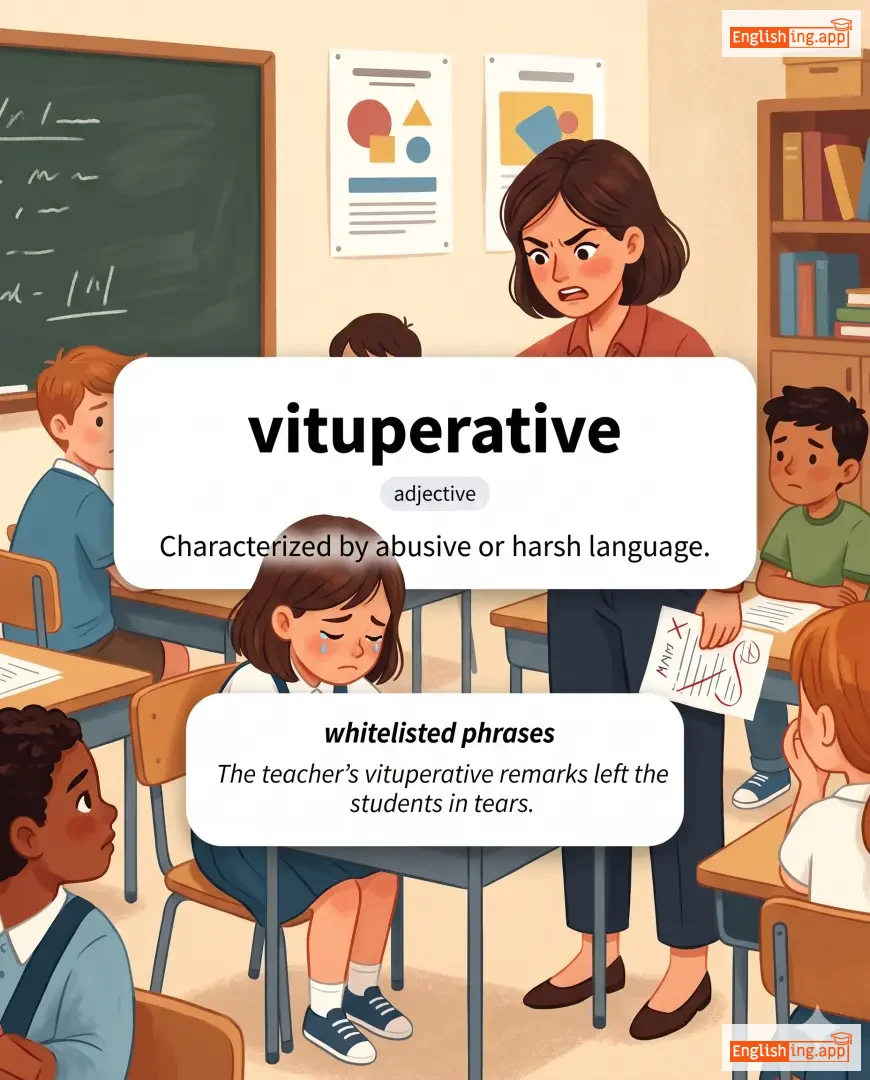
vituperative definition card — visual illustration of the meaning
adjective C2
/vɪˈtjuːpərətɪv/
दुर्व्यक्तिपूर्ण (durvyaktipoorn)

Characterized by abusive or harsh language.

"The teacher’s vituperative remarks left the students in tears."

"शिक्षक की दुर्व्यक्तिपूर्ण टिप्पणियाँ छात्रों को आँसुओं में डुबो गईं।" (shikshak ki durvyaktipoorn tippaniyan chatron ko aansuon mein dubo gayin.)
viva voce definition card — visual illustration of the meaning
noun C2
ˈvaɪ.və ˈvəʊs
मौखिक परीक्षा (maukhik pariksha)

An oral examination, typically for an academic qualification.

"Viva Voce tests communication skills."

"विवा वोसे संचार कौशल का परीक्षण करता है।" (Viva Voce sanchar kaushal ka pariksha karta hai.)
verb C2
/ˈvɪvɪfaɪ/
जीवित करना (jeevit karna)

to give life or energy to something; to animate or enliven

"The teacher’s enthusiasm helped vivify the boring lecture."

"टीचर के उत्साह ने बोरिंग लेक्चर को जीवित किया।" (Teacher ke utsah ne boring lecture ko jeevit kiya.)
vivisection definition card — visual illustration of the meaning
noun C2
/ˌvɪvɪˈsɛkʃən/
जीवित जानवरों पर वैज्ञानिक अनुसंधान के लिए ऑपरेशन करना (jivit janwaron par vaigyanik anusandhan ke liye operation karna)

the practice of performing operations on live animals for scientific research

"Vivisection has long been a controversial topic among scientists and animal rights activists."

"विविसेक्शन लंबे समय से वैज्ञानिकों और पशु अधिकार कार्यकर्ताओं के बीच एक विवादास्पद विषय रहा है।" (Vivisection lambe samay se vigyaniyon aur pashu adhikar karyakartaon ke beech ek vivadaspad vishay raha hai.)
noun C2
/ˈvoʊkəbəl/
शब्द (shabd)

a word, term, or sound that has meaning

"The dictionary contained thousands of vocables from different languages."

"डिक्शनरी में विभिन्न भाषाओं के हजारों शब्द थे।" (Dictionary mein vibhinn bhashaon ke hazaron shabd the.)
adjective C2
/ˈvɒkətɪv/
सम्बोधन कारक (sambodhan karak)

relating to a case in grammar used for directly addressing someone

"In Latin, the vocative case is used when directly calling someone by name."

"लैटिन में, वोकटिव केस का उपयोग किसी को सीधे नाम से पुकारने के लिए किया जाता है।" (Latin mein, voktiv kes ka upyog kisi ko seedhe naam se pukarne ke liye kiya jata hai.)
noun C2
/voʊˈsɪfərəns/
जोश में चिल्लाना (josh mein chillana)

the act of shouting or making a loud outcry

"The vociferance of the protesters filled the streets."

"प्रदर्शनकारियों की जोश में चिल्लाहट सड़कों पर गूंज रही थी।" (Pradarshankariyon ki josh mein chillahat sadkon par goonj rahi thi.)
verb C2
/voʊˈsɪfəˌreɪt/
ज़ोर से विरोध करना (zor se virodh karna)

to shout, complain, or argue loudly or vehemently

"The protesters vociferated against the unfair law."

"प्रदर्शनकारियों ने अन्यायपूर्ण कानून के खिलाफ ज़ोर से विरोध किया।" (Pradarshankariyon ne anyaypoorvak kanoon ke khilaf zor se virodh kiya.)
adjective C2
/voʊˈsɪfərəs/
उच्चारण (uccharan)

expressing feelings or opinions in a loud and forceful way

"The vociferous crowd demanded justice."

"उच्चारण करने वाला झुंड न्याय की मांग कर रहा था।" (Uccharan karne wala jhund nyay ki maang kar raha tha.)
adjective C2
/ˈvoʊlənt/
उड़ने योग्य (udne yogya)

able to fly or moving swiftly

"The volant bird soared gracefully across the sky."

"वो उड़ने योग्य पक्षी आकाश में gracefully उड़ रहा था।" (Vo udne yogya pakshi aakash mein gracefully ud raha tha.)
volition definition card — visual illustration of the meaning
noun C2
/voʊˈlɪʃən/
इच्छाशक्ति (ichchhashakti)

The power or faculty of using one's will; the act of making a conscious choice.

"She signed the agreement of her own volition."

"उसने अपनी इच्छाशक्ति से समझौते पर हस्ताक्षर किए।" (Usne apni ichchhashakti se samjhaute par hastakshar kiye.)
adjective C2
/ˈvɑːlətɪv/
इच्छाशक्ति से संबंधित (ichchashakti se sambandhit)

Relating to the will or the exercise of the will.

"The treaty was signed under volitive agreement between both nations."

"संधि दोनों देशों के इच्छाशक्ति आधारित समझौते के तहत की गई थी।" (Sandhi dono deshon ke ichchashakti aadharit samjhaute ke tahat ki gayi thi.)
noun C2
/ˌvɑːljəˈbɪləti/
वाचालता (vachalata)

The quality of talking fluently, readily, or incessantly.

"His volubility made him a successful radio host."

"उसकी वाचालता ने उसे एक सफल रेडियो होस्ट बना दिया।" (Uski vachalata ne use ek safal radio host bana diya.)
adjective C2
/ˈvɑːljəbl/
बातूनी (baatooni)

Speaking or spoken incessantly and fluently.

"She became more voluble as the evening progressed."

"जैसे-जैसे शाम बढ़ी, वह और ज्यादा बातूनी हो गई।" (Jaise-jaise shaam badhi, wah aur zyada baatooni ho gayi.)
adjective C2
/vəˈlʌptʃuəs/
भोगविलासी (bhogvilasi)

Relating to or characterized by luxury and sensual pleasure; sexually attractive.

"The artist painted a voluptuous figure reclining on the couch."

"कलाकार ने सोफे पर पड़ी भोगविलासी आकृति को चित्रित किया।" (Kalakar ne sofe par padi bhogvilasi aakriti ko chitrait kiya.)
noun C2
/ˈvoʊtəri/
अनुयायी (anuyayi)

A devoted follower or admirer of someone or something.

"He is a votary of classical music and attends every concert."

"वह शास्त्रीय संगीत का एक अनुयायी है और हर संगीत कार्यक्रम में जाता है।" (Vah shastriya sangeet ka ek anuyayi hai aur har sangeet karyakram mein jata hai.)
adjective C2
/ˈvoʊtɪv/
निवेदित (nivedit)

Offered or dedicated in fulfillment of a vow.

"She lit a votive candle in the church as a prayer."

"उसने चर्च में एक निवेदित मोमबत्ती जलायी एक प्रार्थना के रूप में।" (Usne church mein ek nivedit mombatti jalaayi ek prarthna ke roop mein.)
verb C2
/ˈvaʊtʃ.seɪf/
दान देना (dan dena)

to grant or give something in a gracious or condescending manner

"He vouchsafed them a rare smile."

"उसने उन्हें एक दुर्लभ मुस्कान दी।" (Usne unhein ek durlabh muskan di.)
adjective C2
/ˈwæɡ.ɪʃ/
चंचल या शरारती (chanchal ya shararati)

playfully humorous or mischievous

"His waggish remarks made everyone laugh."

"उसकी चंचल टिप्पणी ने सभी को हंसी में डाल दिया।" (uski chanchal tippani ne sabhi ko hansi mein dal diya.)
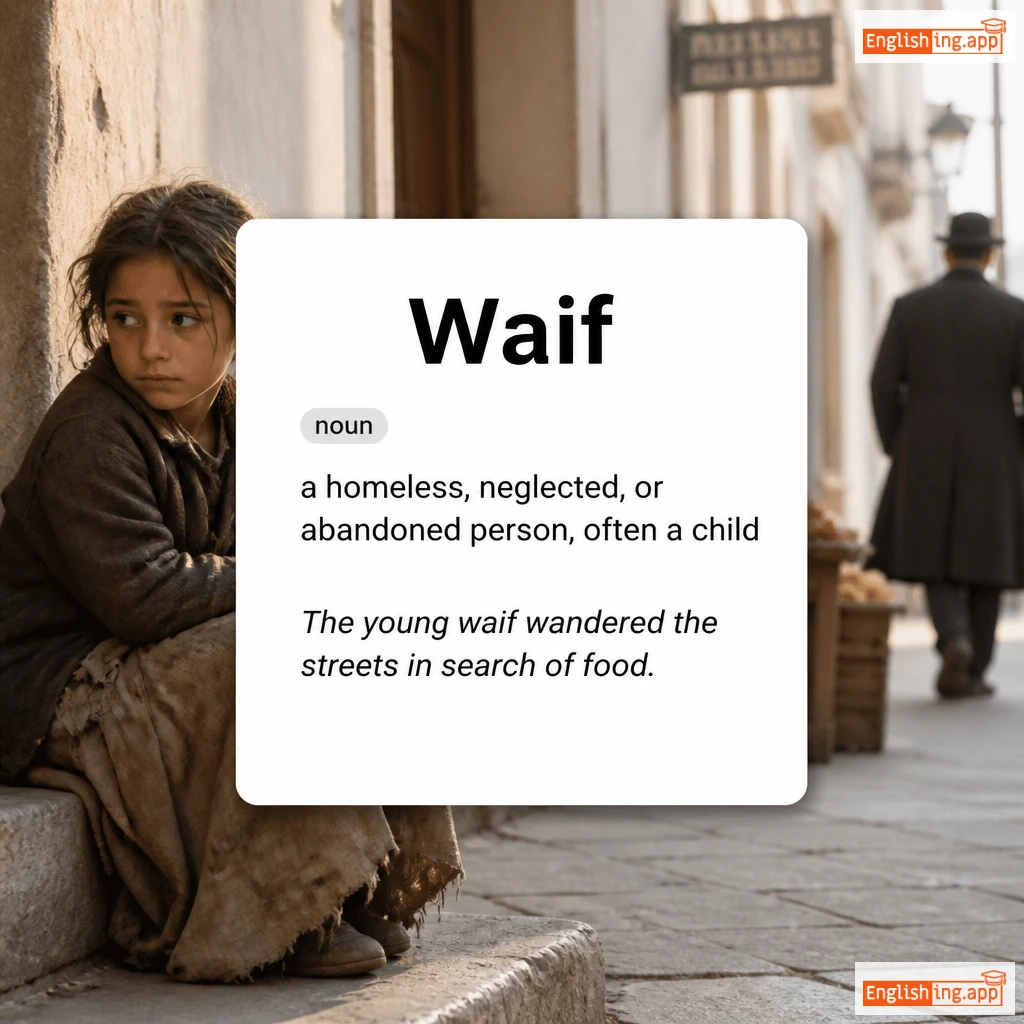
Waif definition card — visual illustration of the meaning
noun C2
/weɪf/
भिखारी बच्चा (bhikhari bachcha)

a homeless, neglected, or abandoned person, often a child

"The young waif wandered the streets in search of food."

"युवक भिखारी बच्चा खाने की तलाश में सड़कों पर भटक रहा था।" (yuvak bhikhari bachcha khane ki talash mein sadkon par bhatak raha tha.)
noun C2
/ˈwɑːmpəm/
शंख की माला (shankh ki mala)

beads made by Native Americans from shells, used as money or decoration

"The tribe traded furs for wampum."

"कबीले ने फरों के बदले वाम्पम का व्यापार किया।" (Kabile ne faron ke badle wampam ka vyapar kiya.)
verb C2
/ˈwaŋɡl/
चालाकी से कुछ हासिल करना (chalaki se kuch hasil karna)

To achieve something by clever or sometimes dishonest persuasion or trickery.

"He wangled a free ticket to the concert."

"उसने चतुराई से एक मुफ्त कंसर्ट टिकट प्राप्त किया।" (usne chaturai se ek muft concert ticket prapt kiya.)
noun C2
/ˈwɒntənnəs/
निरपराध क्रूरता (nirapraadh kroorata)

The quality of being reckless, cruel, or deliberately malicious.

"His wantonness shocked everyone at the gathering."

"उसकी निरपराध क्रूरता ने सभी को चौंका दिया।" (Uski nirapraadh kroorata ne sabhi ko chonka diya.)
verb C2
/ˈwɔːbəl/
मधुर आवाज़ में गाना या सीटी बजाना (madhur awaz mein gana ya seeti bajana)

To sing or whistle with a quavering voice or with trills.

"The bird warbled a sweet tune in the morning."

"पक्षी ने सुबह एक मधुर धुन गाई।" (Pakshi ne subah ek madhur dhun gai.)
noun C2
/ˈwɔːrˌmʌŋɡər/
युद्ध प्रचारक (yudh pracharak)

A person who advocates or promotes war or conflict.

"The leader was criticized as a warmonger by his opponents."

"नेता को उनके विरोधियों ने युद्ध प्रचारक के रूप में आलोचना की थी।" (Neta ko unke virodhiyon ne yudh pracharak ke roop mein alochna ki thi.)
noun C2
/ˈwɒrən/
खरगोश के बिलों का नेटवर्क (warren)

A network of interconnected rabbit burrows; also used metaphorically for a densely populated building or district.

"The old part of the city is a warren of narrow streets."

"शहर का पुराना हिस्सा संकरी गलियों का एक जटिल नेटवर्क है।" (Shahar ka purana hissa sankari galiyon ka ek jatil network hai.)
noun C2
/ˈweɪstrəl/
वक्त बर्बाद करने वाला, अपव्ययी (wastrel)

A person who wastes time, money, or resources; an idler or spendthrift.

"The young man was dismissed as a wastrel by his family."

"युवक को उसके परिवार ने एक बर्बाद करने वाले के रूप में खारिज कर दिया।" (Yuvak ko uske parivaar ne ek barbād karne wale ke roop mein khārij kar diyā.)
noun C2
/ˈweɪvlət/
छोटी लहर (chhoti lehr)

a small wave or ripple on the surface of water or another medium

"The pond was disturbed only by the tiny wavelets caused by the breeze."

"तालाब केवल हवा से उत्पन्न छोटे लहरों के कारण हिल गया था।" (Talab keval hawa se utpann chhote lehron ke karan hil gaya tha.)
verb C2
/ˌweɪˈleɪ/
अचानक किसी को रोकना / हमला करना (achanak kisi ko rokna / hamla karna)

to stop or interrupt someone unexpectedly, often to attack or detain them

"He was waylaid by reporters as he left the courthouse."

"वह क़ोर्टहाउस से बाहर निकलते समय रिपोर्टर्स द्वारा रोक लिया गया।" (Vah korthouse se bahar nikalte samay reporters dwara rok liya gaya.)
adjective C2
/ˈwiːk niːd/
डरपोक (darpok)

Lacking determination or courage; easily frightened or yielding.

"The leader was criticized for being weak-kneed in the face of opposition."

"नेता को विरोध का सामना करने में डरपोक होने के लिए आलोचना की गई।" (Neta ko virodh ka samna karne mein darpok hone ke liye alochana ki gayi.)
noun C2
/wiːl/
सुख (sukh)

A raised mark on the skin left after a blow; or general well-being and prosperity.

"The charity worked for the common weal of the community."

"जब उसे पुरस्कार मिला, तो वह अपनी खुशी छिपा नहीं सकी।" (Jab use puraskar mila, to vah apni khushi chhupa nahi saki.)
noun C2
/ˈwɛlkɪn/
आकाश (aakash)

The sky, the heavens, or the upper air.

"The eagle soared high into the welkin."

"ईगल आकाश में ऊँचाई पर उड़ गया।" (Eagle aakash mein unchai par ud gaya.)
noun C2
/wɛlt/
उभार (ubhaar)

A raised mark on the skin, usually from a blow or allergic reaction.

"He had a red welt on his arm after the bee sting."

"मधुमक्खी के डंक के बाद उसके हाथ पर एक लाल उभार था।" (Madhumakkhi ke dank ke baad uske haath par ek lal ubhaar tha.)