Vocabularies

English Vocabulary Dictionary | Word Meanings, Definitions & Examples

noun C2
/ˈtʊrnɪkɪt/
रक्तस्राव रोधी पट्टी (raktasraav rodhi patti)

a device used to stop bleeding by compressing blood vessels

"The medic applied a tourniquet to stop the bleeding."

"मेडिकल ने रक्तस्राव रोकने के लिए टूर्निकेट लगाया।" (Medical ne raktasraav rokne ke liye tourniquet lagaya.)
tractable definition card — visual illustration of the meaning
adjective C2
/ˈtræktəbəl/
आसान से नियंत्रित या प्रभावित करने योग्य (asaan se niyantrit ya prabhavit karne yogya)

easy to control or influence

"The child was surprisingly tractable during the long journey."

"बच्चा लंबी यात्रा के दौरान आश्चर्यजनक रूप से नियंत्रित था।" (Baccha lambi yatra ke dauran aascharyajanak roop se niyantrit tha.)
verb C2
/trəˈdjuːs/
बदनाम करना (badnaam karna)

To speak badly of someone or tell lies to damage their reputation.

"He was furious when he found out that his rivals had traduced him."

"वह गुस्से में था जब उसने पाया कि उसके प्रतिद्वंद्वियों ने उसे बदनाम किया था।" (Wah gusse mein tha jab usne paaya ki uske pratidwandviyon ne use badnaam kiya tha.)
noun, verb C2
/ˈtræməl/
बाधा (baadha)

A restriction or impediment to freedom of action; to restrict.

"The strict rules trammel the creativity of the students."

"कठोर नियम छात्रों की रचनात्मकता को बाधित करते हैं।" (Kathor niyam chhatron ki rachnatmakta ko baadhit karte hain.)
adjective C2
/trænzˈæl.paɪn/
आल्प्स के पार (alps ke paar)

situated beyond or across the Alps, especially from the viewpoint of Italy

"The Romans referred to France as Transalpine Gaul."

"रोमनों ने फ्रांस को ट्रांज़लपाइन गॉल कहा।" (Romans ne France ko Transalpine Gaul kaha.)
noun C2
/ˌtrænsfəˈriː/
प्राप्तकर्ता (prahptakarta)

A person to whom a right, property, or responsibility is transferred.

"The transferee must sign the contract before taking ownership."

"प्राप्तकर्ता को स्वामित्व प्राप्त करने से पहले अनुबंध पर हस्ताक्षर करना होगा।" (Prahptakarta ko swamitva prapt karne se pehle anubandh par hastakshar karna hoga.)
verb C2
/trænsˈfɪɡjʊər/
रूपांतरित करना (roopantarit karna)

To transform the outward appearance or form, often in a way that elevates or glorifies.

"The artist managed to transfigure simple clay into a beautiful sculpture."

"कलाकार ने साधारण मिट्टी को एक सुंदर मूर्ति में रूपांतरित कर दिया।" (Kala ke kalakar ne saadharan mitti ko ek sundar murti mein roopantarit kar diya.)
verb C2
/trænsˈfjuːz/
रक्त या अन्य तरल को नस में स्थानांतरित करना (rakt ya anya taral ko nas mein sthantarit karna)

to transfer blood or another fluid into a vein or body part; to instill a quality or idea into someone or something

"The doctor had to transfuse blood into the patient after the surgery."

"सर्जरी के बाद डॉक्टर को मरीज में रक्त ट्रांसफ्यूज़ करना पड़ा।" (Sarjari ke baad doktor ko mareez mein rakt transfuse karna pada.)
adjective C2
/trænsˈfjuːzəbl̩/
संवहन योग्य (sanvahan yogya)

capable of being transfused, especially referring to blood or fluids

"Only transfusible blood types are used in the hospital."

"केवल संवहन योग्य रक्त प्रकारों का अस्पताल में उपयोग किया जाता है।" (Keval sanvahan yogya rakt prakarom ka aspataal mein upyog kiya jaata hai.)
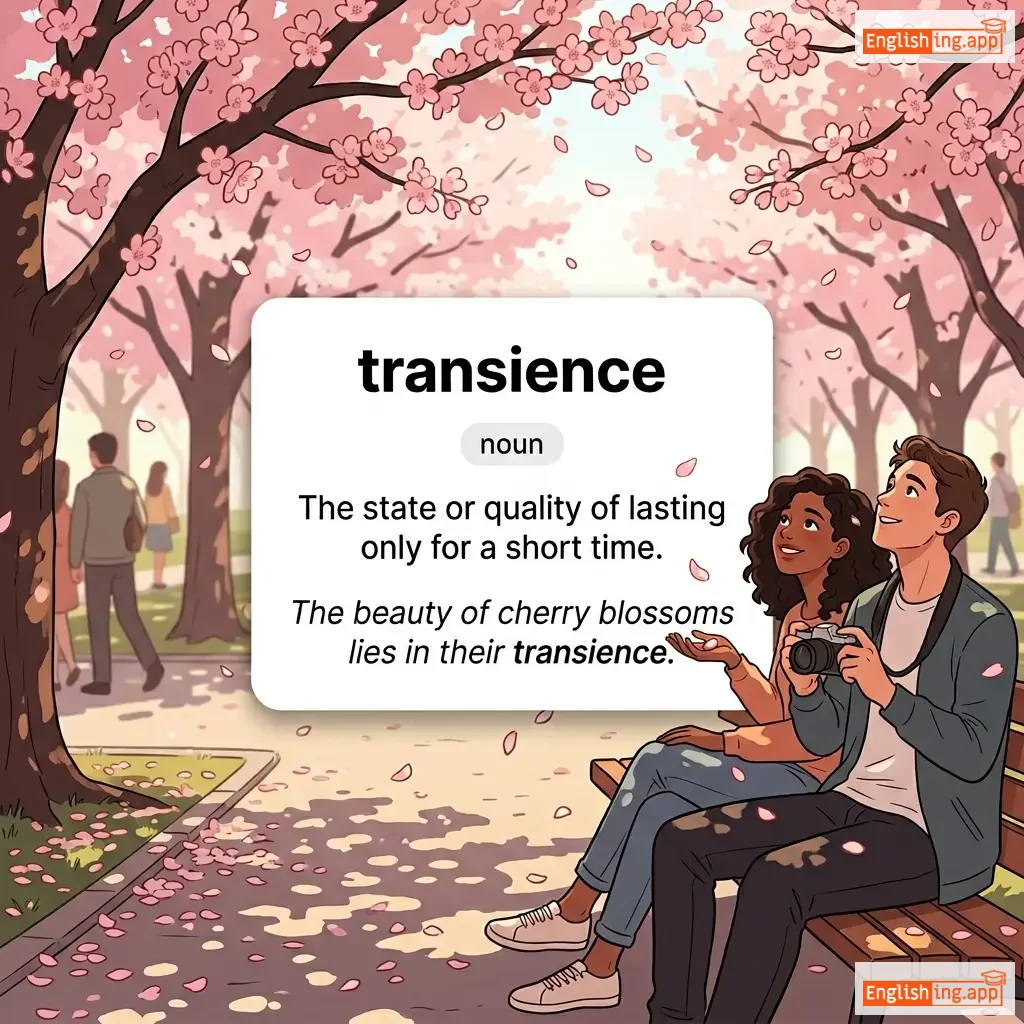
transience definition card — visual illustration of the meaning
noun C2
/ˈtrænziəns/
क्षणिकता (kshanikta)

The state or quality of lasting only for a short time.

"The beauty of cherry blossoms lies in their transience."

"चेरी के फूलों की सुंदरता उनके क्षणिकता में निहित है।" (cherry ke phoolon ki sundarta unke kshanikta mein nihit hai.)
noun C2
/trænsˈluːsəns/
आधा पारदर्शिता (aadha paardarshita)

the quality of allowing light to pass through but not detailed shapes

"The translucence of the curtains filled the room with soft light."

"परदे की आधी पारदर्शिता कमरे को मुलायम रोशनी से भर देती है।" (Parde ki aadha paardarshita kamre ko mulayam roshni se bhar deti hai.)
adjective C2
/trænzˈmɪsəbl/
संक्रामक (sankramak)

able to be passed or spread from one person or thing to another

"COVID-19 is a highly transmissible disease."

"COVID-19 एक अत्यधिक संक्रामक रोग है।" (COVID-19 ek atyadhik sankramak rog hai.)
verb C2
/trænzˈmjuːt/
रूपांतरित करना (roopantarit karna)

to change in form, nature, or substance

"Alchemy aimed to transmute lead into gold."

"अल्केमी ने सीसे को सोने में बदलने की कोशिश की।" (Alkemi ne seese ko sone mein badalne ki koshish ki.)
verb C2
/trænˈspoʊz/
स्थानांतरित करना (sthanantarit karna)

to change the order or position of something

"The editor transposed two paragraphs in the article."

"संपादक ने लेख में दो पैरेग्राफ़ स्थानांतरित किए।" (Sampadak ne lekh mein do paragraph sthanantrit kiye.)
noun C2
/ˌtrænspəˈzɪʃən/
स्थानांतरण (sthanantaran)

the act of changing the order or position of something

"The transposition of digits caused an error in the calculation."

"संख्याओं के स्थानांतरण से गणना में गलती हो गई।" (Sankhyayon ke sthanantaran se ganana mein galti ho gayi.)
travail definition card — visual illustration of the meaning
noun C2
/trəˈveɪl/
कठिन परिश्रम (kathin parishram)

Painful or laborious effort; suffering or hardship.

"After years of travail, she finally completed her degree."

"सालों की कठिनाई के बाद, उसने आखिरकार अपनी डिग्री पूरी की।" (Saalo ki kathinaai ke baad, usne aakhirkaar apni degree poori ki.)
adjective C2
/ˈtriːkli/
अत्यधिक मीठा या भावुक, जैसे ट्रैकल। (atyadhik meetha ya bhavuk, jaise trackal.)

Excessively sweet or sentimental, like treacle.

"The movie was too treacly for my taste."

"फिल्म मेरे स्वाद के लिए बहुत ज्यादा ट्रैकली थी।" (film mere swaad ke liye bahut zyada trackal thi.)
adjective C2
/ˈtriːzənəbl/
राजद्रोहपूर्ण (raajdrohopurn)

Relating to or involving the crime of treason.

"The general was accused of treasonable conduct."

"जनरल पर ट्रेज़नबल आचरण का आरोप था।" (general par trezonbal aacharan ka aarop tha.)
adverb C2
/ˈtrɛbli/
तीन गुना (trebli)

in a triple manner or to a threefold degree

"The sound was trebly distorted through the old speakers."

"आवाज़ पुराने स्पीकर्स के जरिए तीन गुना विकृत हो गई थी." (di sound vaaz trebali distorted thru di old speekars)
tremulous definition card — visual illustration of the meaning
adjective C2
/ˈtrɛmjələs/
काँपता हुआ (kaampata hua)

shaking or quivering slightly, often from nervousness or weakness

"Her voice was tremulous as she gave her speech."

"उसका आवाज़ कांपते हुए था जब उसने अपना भाषण दिया।" (Uska awaaz kaampte hue tha jab usne apna bhashan diya.)
adjective C2
/ˈtrɛntʃənt/
तीव्र (teevr)

expressed strongly, effectively, and clearly; sharp or cutting in style or expression

"Her trenchant criticism of the policy left no room for misunderstanding."

"उसकी तीव्र आलोचना ने नीतियों को लेकर कोई गलतफहमी का मौका नहीं छोड़ा।" (Uski teevr alochana ne neetiyon ko lekar koi galatfehmi ka moka nahin chhoda.)
noun C2
/ˈtrɛntʃərmən/
खाद्य प्रेमी (khadya premi)

a person who eats in a hearty or robust manner; a big eater

"The trencherman devoured the feast with great enthusiasm."

"खाद्य प्रेमी ने बड़ी उत्सााह के साथ दावत को निगल लिया।" (Khadya premi ne badi utsaah ke saath daawat ko nigal liya.)
noun C2
/ˈtrɛsəl/
ट्रेसल (tresel)

a frame or support consisting of a horizontal beam held up by two pairs of sloping legs, used especially for supporting a bridge or table

"The workers built a wooden trestle to support the temporary bridge."

"कर्मचारियों ने अस्थायी पुल को समर्थन देने के लिए एक लकड़ी का ट्रेसल बनाया।" (Karmachariyon ne asthayi pul ko samarthan dene ke liye ek lakdi ka tresel banaya.)
noun C2
/ˈtrɪbjuːn/
जनता का प्रतिनिधि (tribyoon)

a person or platform representing the people; historically, a Roman official elected to protect citizens' rights

"He was seen as a tribune of the common people."

"उसे आम जनता का प्रतिनिधि माना गया था." (use aam janta ka pratinidhi maana gaya tha.)
noun/adjective C2
/ˈtraɪkʌlər/
तिरंगा ध्वज (tiranga dhvaj)

A flag with three colors; consisting of three colors.

"The French tricolor is one of the most famous national flags in the world."

"फ्रांसीसी तिरंगा ध्वज दुनिया के सबसे प्रसिद्ध राष्ट्रीय ध्वजों में से एक है।" (Phraansisee tiranga dhvaj duniya ke sabse prasiddh rashtriya dhvajon mein se ek hai.)
noun C2
/ˈtraɪdənt/
त्रिशूल (trishul)

A three-pronged spear, often associated with Neptune or Poseidon.

"The statue of Poseidon holds a mighty trident."

"पोसीडॉन का प्रतिमा एक शक्तिशाली त्रिशूल पकड़े हुए है।" (Poseidon ka pratima ek shaktishali trishul pakde hue hai.)
adjective C2
/traɪˈɛniəl/
त्रैवार्षिक (traivarsik)

Occurring once every three years.

"The art festival is a triennial event in the city."

"कला महोत्सव शहर में एक त्रैवार्षिक कार्यक्रम है।" (Kala mahotsav shahar mein ek traivarsik karyakram hai.)
noun C2
/ˈtrɪmnəs/
साफ-सफाई (saaf-safaai)

the quality of being neat, orderly, or slender and well-proportioned

"Her room’s trimness reflected a habit of putting everything back in its place."

"उसके कमरे की साफ-सफाई इस बात को दर्शाती है कि वह हमेशा चीजों को अपनी जगह पर रखती है।" (Uske kamre ki saaf-safaai is baat ko darshaati hai ki wah hamesha cheezon ko apni jagah par rakhti hai.)
noun C2
/ˈtrɪp.lɪ.kət/
तीन प्रति (teen prati)

A set of three identical copies of something.

"The documents were prepared in triplicate for official use."

"दस्तावेज़ों को आधिकारिक उपयोग के लिए तीन प्रतियों में तैयार किया गया था।" (Dastavezon ko adhikarik upyog ke liye teen pratiyon mein tayar kiya gaya tha.)
noun C2
/trɪˈplɪs.ə.ti/
त्रैतीयकता (traiteeyakta)

The state of being triple or consisting of three parts.

"The design shows a triplicity of forms combined harmoniously."

"डिज़ाइन में तीन रूपों की त्रैतीयकता को सामंजस्यपूर्ण रूप से संयोजित किया गया है।" (Design mein teen roopon ki traitayikta ko samanjasypurn roop se sanyojit kiya gaya hai.)
verb C2
/traɪˈsɛkt/
तीन भाग करना (teen bhag karna)

To divide into three parts.

"The teacher asked the students to trisect the line segment."

"शिक्षक ने छात्रों से लाइन सेगमेंट को तीन हिस्सों में बांटने को कहा।" (Shikshak ne chhatron se line segment ko teen hisso mein baantne ko kaha.)
noun C2
/traɪˈʌmvɪər/
त्रैतीयक शासक (traiteeyak shasak)

One of a group of three men holding power in ancient Rome.

"Caesar was a triumvir in the first Roman triumvirate."

"सीज़र था पहले रोमन ट्राईअमविराट में एक ट्राईअमविर।" (Caesar tha pehle Roman triumvirate mein ek triumvir.)
noun C2
/traɪˈʌmvɪrət/
त्रैतीयक शासन (traitiyak shasan)

A political regime ruled or dominated by three powerful individuals.

"The Roman Republic was once governed by a triumvirate."

"रोमन गणराज्य कभी त्रैतीयक शासन द्वारा शासित था।" (Roman ganrajya kabhi traitiyak shasan dvara shasit tha.)
noun C2
/ˈtrɒɡlədaɪt/
गुफ़ावासी (gufavasi)

A person who lives in a cave or is considered old-fashioned and out of touch.

"Some called him a troglodyte for refusing to use modern technology."

"कुछ लोगों ने उसे आधुनिक तकनीक का उपयोग न करने के लिए गुफ़ावासी कहा।" (Kuch logon ne use aadhunik takneek ka upyog na karne ke liye gufavasi kaha.)
noun C2
/troʊp/
साहित्यिक प्रवृत्ति (sahityik pravritti)

A common or overused theme, idea, or device in literature, film, or speech.

"The film avoided the usual superhero tropes."

"फिल्म ने सामान्य सुपरहीरो ट्रोप्स से बचने की कोशिश की।" (Film ne samanya superhero tropes se bachne ki koshish ki.)
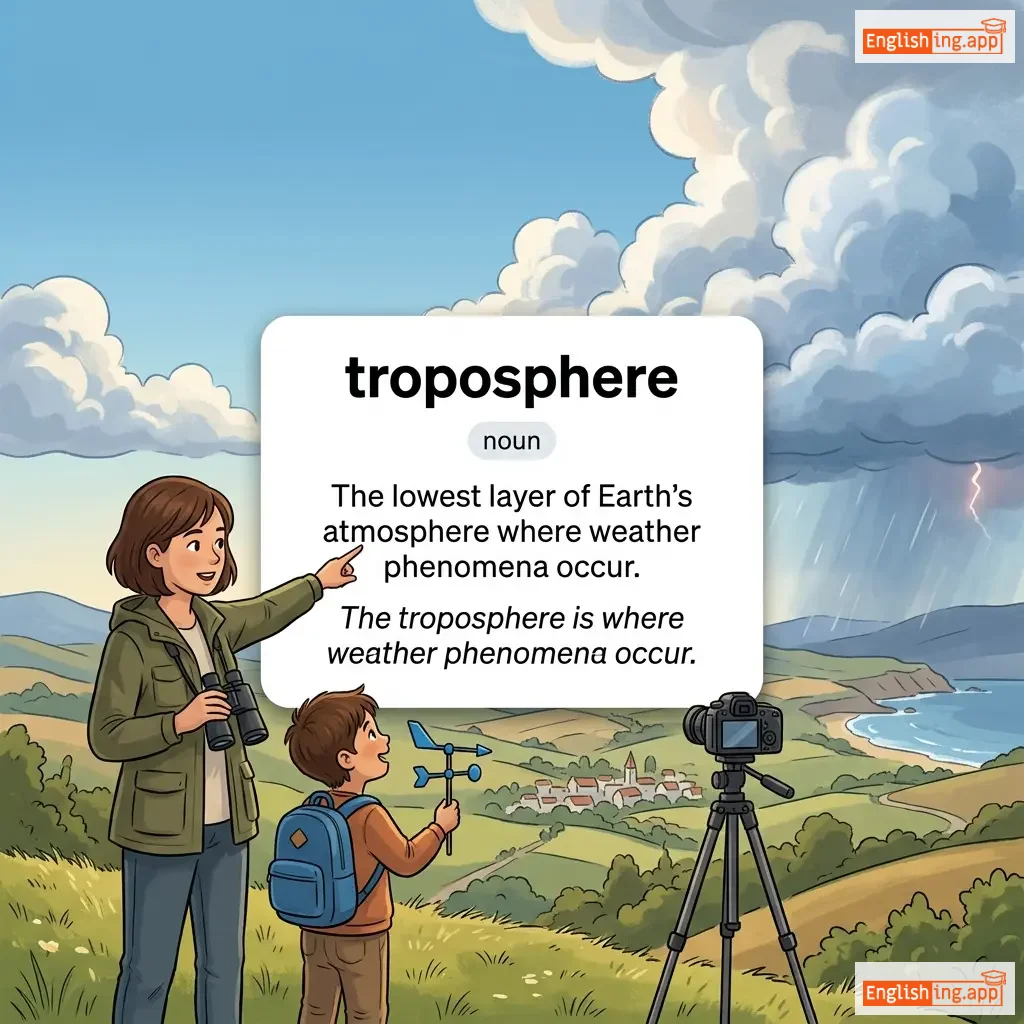
troposphere definition card — visual illustration of the meaning
noun C2
ট্রোপোস্ফিয়ার
ट्रॉपोस्फीयर (troposphere)

The lowest layer of Earth's atmosphere where weather phenomena occur.

"The troposphere is where weather phenomena occur."

"ट्रॉपोस्फीयर वह स्थान है जहाँ मौसमीय घटनाएं होती हैं।" (Troposphere vah sthan hai jahan mausami ghatnayein hoti hain.)
noun C2
/troʊθ/
प्रतिबद्धता, निष्ठा (pratibaddhata, nishtha)

Faith or loyalty when pledged in a solemn agreement or vow, especially in marriage.

"He pledged his troth to her before the gathering."

"उसने समागम से पहले उसे अपनी प्रतिबद्धता अर्पित की।" (Usne samagam se pehle use apni pratibaddhata arpit ki.)
verb C2
/ˈtrʌk.əl/
नम्र होना (namra hona)

To submit or yield obsequiously to someone in power.

"He refused to truckle to the demands of the corrupt officials."

"उसने भ्रष्ट अधिकारियों की मांगों के सामने नम्र होने से इनकार कर दिया।" (Usne bhrasht adhikariyon ki maangon ke saamne namra hone se inkaar kar diya.)
truculence definition card — visual illustration of the meaning
noun C2
/ˈtrʌk.jʊ.ləns/
आक्रामकता (aakramakta)

Aggressiveness or eagerness to fight.

"His speech was full of truculence and threats."

"उसकी भाषण आक्रामकता और धमकियों से भरी हुई थी।" (Uski bhashan aakramakta aur dhamkiyon se bhari hui thi.)
adjective C2
/ˈtrʌk.jʊ.lənt/
आक्रामक (aakramak)

Eager or quick to argue, fight, or show aggression.

"She became truculent when her ideas were challenged."

"वह आक्रामक हो गई जब उसके विचारों को चुनौती दी गई।" (Vah aakramak ho gayi jab uske vicharon ko chunauti di gayi.)
noun C2
/ˈtruːɪzəm/
सर्वविदित सत्य (sarvavidit satya)

a statement that is obviously true and says nothing new or interesting

"It is a truism that hard work leads to success."

"यह एक सर्वविदित सत्य है कि कठिन परिश्रम सफलता की ओर ले जाता है।" (Yah ek sarvavidit satya hai ki kathin parishram safalta ki or le jata hai.)
noun C2
/ˈtrʌmpəri/
निरर्थक बकवास या दिखावटी लेकिन निरर्थक चीज़ें (nirarthak bakwaas ya dikhavati lekin nirarthak cheezen)

worthless nonsense or showy but worthless things

"The speech was full of political trumpery."

"वह भाषण राजनीतिक ट्रम्परी से भरा हुआ था।" (Vah bhashan rajnaitik trumpery se bhara hua tha.)
verb C2
/ˈtrʌŋkeɪt/
संक्षिप्त करना (sankshipt karna)

to shorten something by cutting off the top or the end

"The article was truncated to fit the limited space."

"लेख को सीमित स्थान में फिट करने के लिए संक्षिप्त किया गया था।" (Lekh ko seemit sthan mein fit karne ke liye sankshipt kiya gaya tha.)
adjective C2
/ˈtrʌŋkeɪtɪd/
संक्षिप्त (sankshipt)

shortened by cutting off a part; cut short

"The meeting was truncated due to time constraints."

"बैठक समय की पाबंदियों के कारण संक्षिप्त की गई थी।" (Baithak samay ki pabandiyon ke karan sankshipt ki gayi thi.)
noun C2
/trʌs/
ढांचा (dhanchaa)

a framework, typically consisting of rafters, posts, and struts, supporting a roof, bridge, or other structure

"The engineer designed a strong truss for the new bridge."

"इंजीनियर ने नए पुल के लिए एक मजबूत ट्रस डिज़ाइन किया।" (injinier ne naye pul ke liye ek mazboot trus dizain kiya)
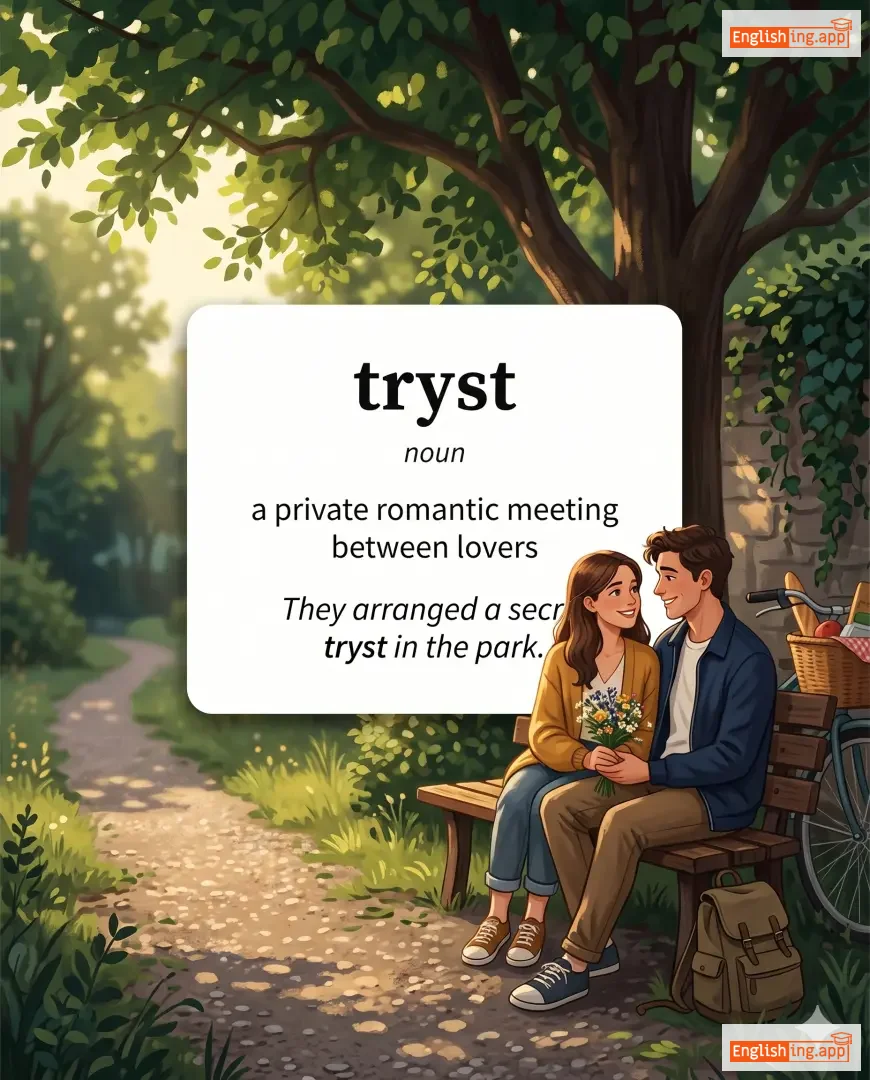
tryst definition card — visual illustration of the meaning
noun C2
/traɪst/
गुप्त मुलाकात (gupt mulaakat)

a private romantic meeting between lovers

"They arranged a secret tryst in the park."

"उन्होंने पार्क में एक गुप्त मुलाकात की व्यवस्था की।" (Unhone park mein ek gupt mulaakat ki vyavastha ki.)
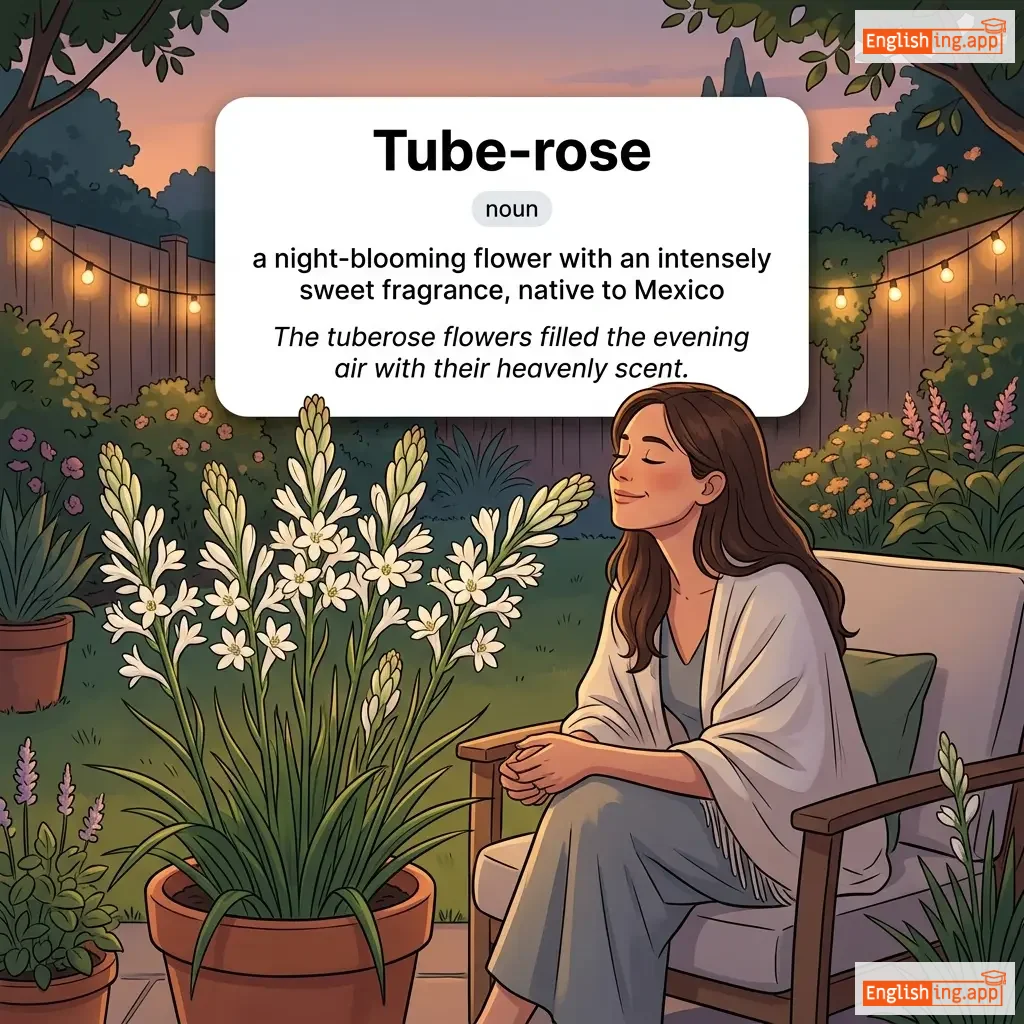
Tube-rose definition card — visual illustration of the meaning
noun C2
/ˈtuːb.roʊz/
ट्यूबरोज़ (tuberoz)

a night-blooming flower with an intensely sweet fragrance, native to Mexico

"The tuberose flowers filled the evening air with their heavenly scent."

"ट्यूबरोज़ फूलों ने शाम की हवा को अपनी स्वर्गीय खुशबू से भर दिया।" (Tuberoz phoolon ne shaam ki hawa ko apni swargiya khushboo se bhar diya.)
noun C2
/ˈtʌmbrəl/
दो पहिए वाली गाड़ी (tumbrel)

A two-wheeled cart, especially one used during the French Revolution to carry prisoners to the guillotine.

"The prisoners were carried to the square in a wooden tumbrel."

"कैदियों को लकड़ी की एक तुम्ब्रेल में चौक तक ले जाया गया।" (kaidiyon ko lakdi ki ek tumbrel mein chaauk tak le jaaya gaya)
tumid definition card — visual illustration of the meaning
adjective C2
/ˈtjuːmɪd/
सूजा हुआ, उभरा हुआ, या अभिमानी शैली में (sujha hua, ubhra hua, ya abhimani shaili mein)

Swollen, enlarged, or pompous in style.

"His tumid prose was difficult to read."

"उसकी सूजी हुई गद्य पढ़ना मुश्किल था।" (Uski suji hui gady padhna mushkil tha.)
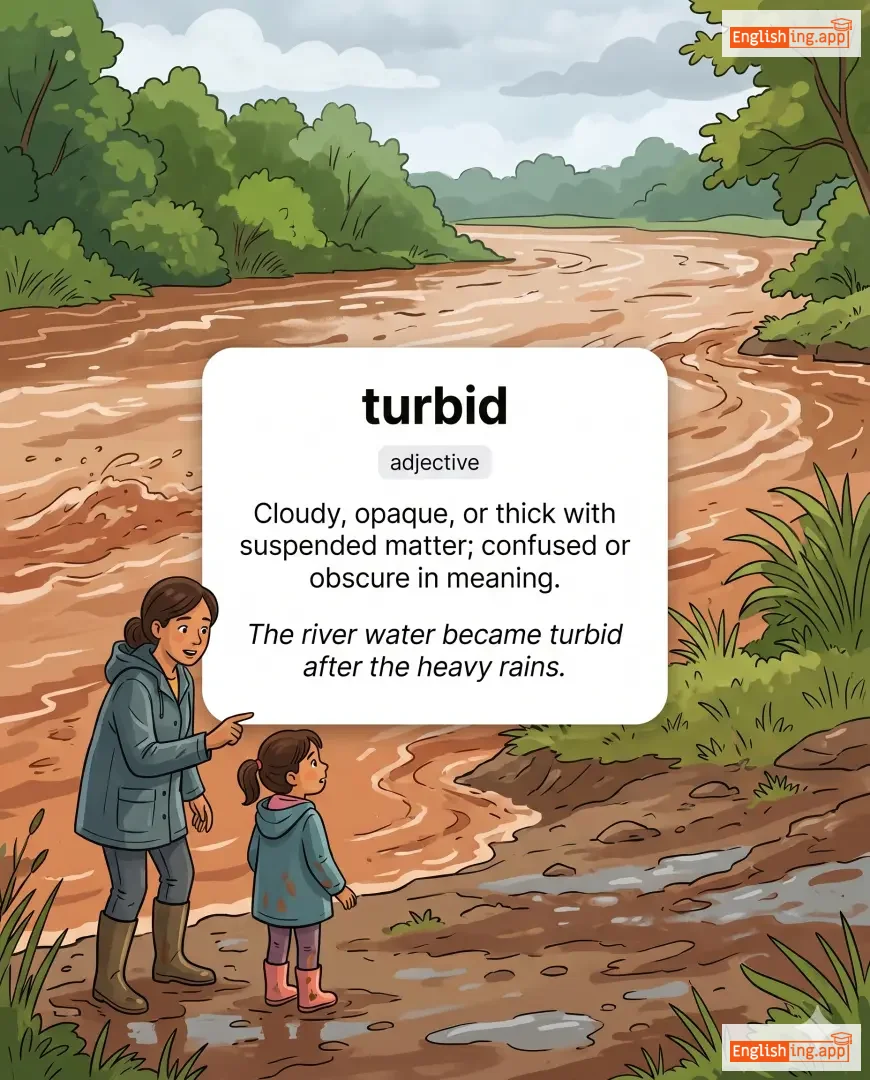
turbid definition card — visual illustration of the meaning
adjective C2
/ˈtɜːrbɪd/
मलिन (malin)

Cloudy, opaque, or thick with suspended matter; confused or obscure in meaning.

"The river water became turbid after the heavy rains."

"भारी बारिश के बाद नदी का पानी मलिन हो गया था।" (Bari barish ke baad nadi ka pani malin ho gaya tha.)