Vocabularies

English Vocabulary Dictionary | Word Meanings, Definitions & Examples

verb C2
/miːt/
分配する (bunkai suru)

To dispense or allot justice, punishment, or harsh treatment.

"The judge will mete out punishment according to the crime."

"裁判官は犯行に応じて罰を分配します。" (Saibankan wa hankō ni ōjite batsu o bunkai shimasu.)
noun C2
/ˌmɛtəmˌsaɪˈkoʊsɪs/
魂の転生 (tamashī no tensei)

The supposed transmigration of the soul, especially its reincarnation after death.

"Ancient philosophers often debated the idea of metempsychosis."

"古代の哲学者たちは、しばしば魂の転生について議論していました。" (Kodai no tetsugakusha-tachi wa, shibashiba tamashī no tensei ni tsuite giron shite imashita.)
noun C2
/mɪˈtɒnɪmi/
換喩 (kan'yu)

A figure of speech in which one word or phrase is substituted with another closely related word or concept.

"In the phrase 'the crown will decide,' 'crown' is a metonymy for monarchy."

"フレーズ「王冠が決定する」では、「王冠」が君主制の換喩です。" (Furēzu 'ōkan ga kettei suru' de wa, 'ōkan' ga kunshusei no kan'yu desu.)
adjective C2
/ˈmɛtrɪkəl/
韻律の (inritsu no)

Relating to or composed in a regular rhythmic pattern of beats or meter, especially in poetry.

"The poet carefully followed metrical rules in his verses."

"詩人は自分の詩の中でメトリカルなルールを慎重に守った。" (Shijin wa jibun no shi no naka de metorikaru na rūru o shinchō ni mamotta.)
noun C2
/ˈmɛtrəˌnoʊm/
メトロノーム (metoronōmu)

A device that produces regular ticks or beats to help musicians maintain tempo.

"She practiced the piano with a metronome to keep steady timing."

"彼女は安定したタイミングを保つためにメトロノームを使ってピアノを練習していた。" (Kanojo wa antei shita taimingu o tamotsu tame ni metoronōmu o tsukatte piano o renshū shite ita.)
noun C2
/ˈmɛtəl/
勇気 (yūki)

A person's ability to cope well with difficulties or to face demanding situations with courage.

"The young athlete showed his mettle in the final match."

"その若いアスリートは決勝戦で勇気を示しました。" (Sono wakai asurīto wa kesshōsen de yūki o shimeshimashita.)
adjective C2
/ˈmɛtəlˌsʌm/
勇敢な (yūkan na)

Full of courage and spirit; lively and spirited.

"The mettlesome young rider never backed down from a challenge."

"その勇敢な若い騎手は挑戦から決して後退しなかった。" (Sono yūkan na wakai kishu wa chōsen kara kesshite kōtai shinakatta.)
noun C2
/mjuːz/
路地/小道 (roji/kodou)

A row or street of houses or apartments that have been converted from stables or built to look like former stables.

"They rented a small flat in a quiet London mews."

"彼らはロンドンの静かなミューズに小さなアパートを借りました。" (Karera wa Rondon no shizukana myūzu ni chiisana apāto o karimashita.)
noun C2
/maɪˈæzmə/
悪臭の空気 (akushu no kūki)

An unpleasant or unhealthy smell or atmosphere.

"A miasma of decay hung over the abandoned house."

"腐敗の気配が廃墟の上に漂っていた。" (Fuhai no kehai ga haikyo no ue ni tadayotte ita.)
noun C2
/ˈmaɪkrəˌkɒzəm/
ミクロコスム (mikurokosumu)

A small, representative system having analogies to a larger system; a miniature version of something.

"The small town is a microcosm of the entire nation."

"その小さな町は、国全体のミクロコスムです。" (Sono chiisana machi wa, kuni zentai no mikurokosumu desu.)
noun C2
/maɪˈkrɒmɪtər/
マイクロメーター (maikuromētā)

A device used for measuring small distances with great accuracy.

"The engineer used a micrometer to measure the thickness of the wire."

"エンジニアはワイヤーの厚さを測るためにマイクロメーターを使いました。" (Enjinia wa waiyā no atsusa o hakaru tame ni maikuromētā o tsukaimashita.)
noun C2
/maɪˈkrɑː.skə.pi/
顕微鏡学 (kenbikyōgaku)

The use of a microscope to observe small objects or organisms.

"Microscopy revealed the structure of the cells."

"顕微鏡学は細胞の構造を明らかにしました。" (Kenbikyōgaku wa saibo no kōzō o akiraka ni shimashita.)
noun C2
/miːn/
表情 (hyōjō)

A person's appearance or manner, especially as an indication of their character or mood.

"His serious mien made everyone fall silent."

"彼の真剣な表情は皆を黙らせた。" (Kare no shinken na hyōjō wa mina o damaraseta.)
noun C2
/mɪf/
小さな争い (chiisana araso)

A petty quarrel or annoyance.

"They had a slight miff over the seating arrangement."

"彼らは座席配置について小さな争いを起こしました。" (Karera wa zaseki haichi ni tsuite chiisana arasoi o okoshimashita.)
verb C2
/ˈmɪlɪˌteɪt/
妨げる (samatageru)

to have a strong effect against something; to work as a powerful factor in preventing or influencing an outcome

"His lack of experience will militate against his promotion."

"彼の経験不足が昇進に対して障害となるだろう。" (kare no keiken fusoku ga shōshin ni taishite shōgai to naru darou.)
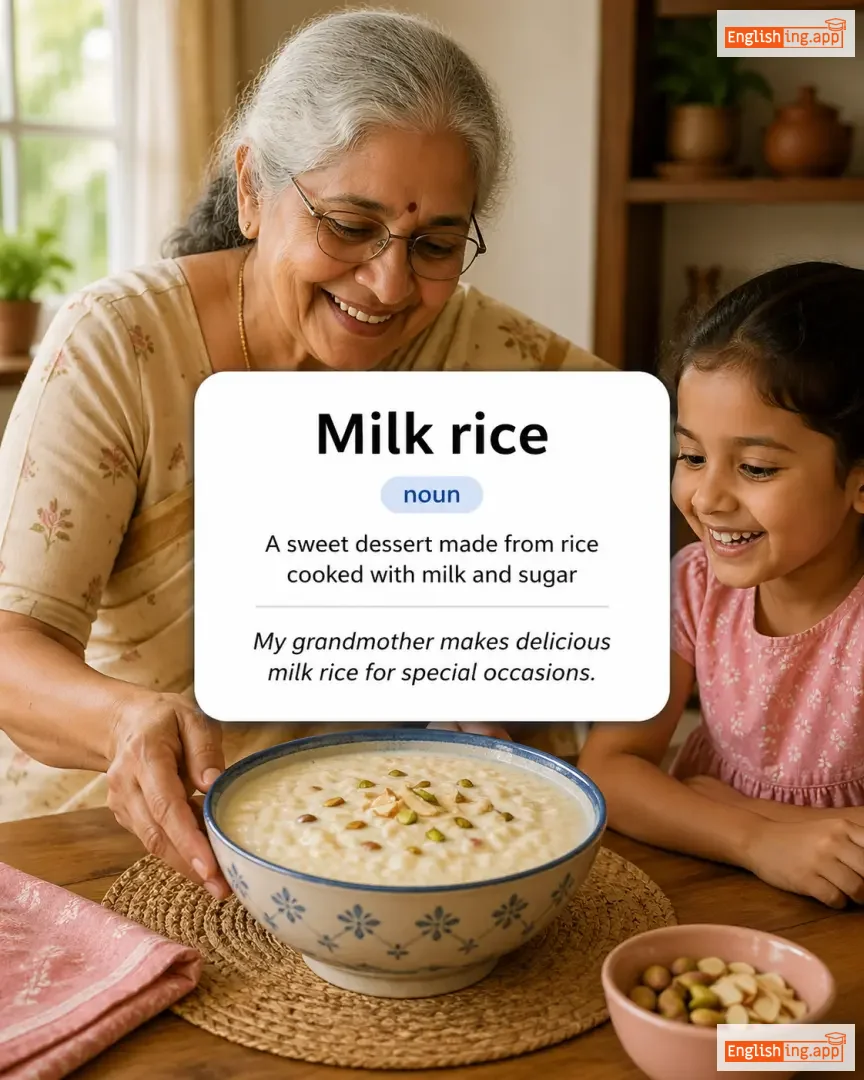
Milk rice definition card — visual illustration of the meaning
noun C2
/mɪlk raɪs/
おかゆ (okayu)

A sweet dessert made from rice cooked with milk and sugar

"My grandmother makes delicious milk rice for special occasions."

"私の祖母は特別な機会においしいミルクライスを作ります。" (Watashi no sobo wa tokubetsu na kikai ni oishī mirukuraisu o tsukurimasu.)
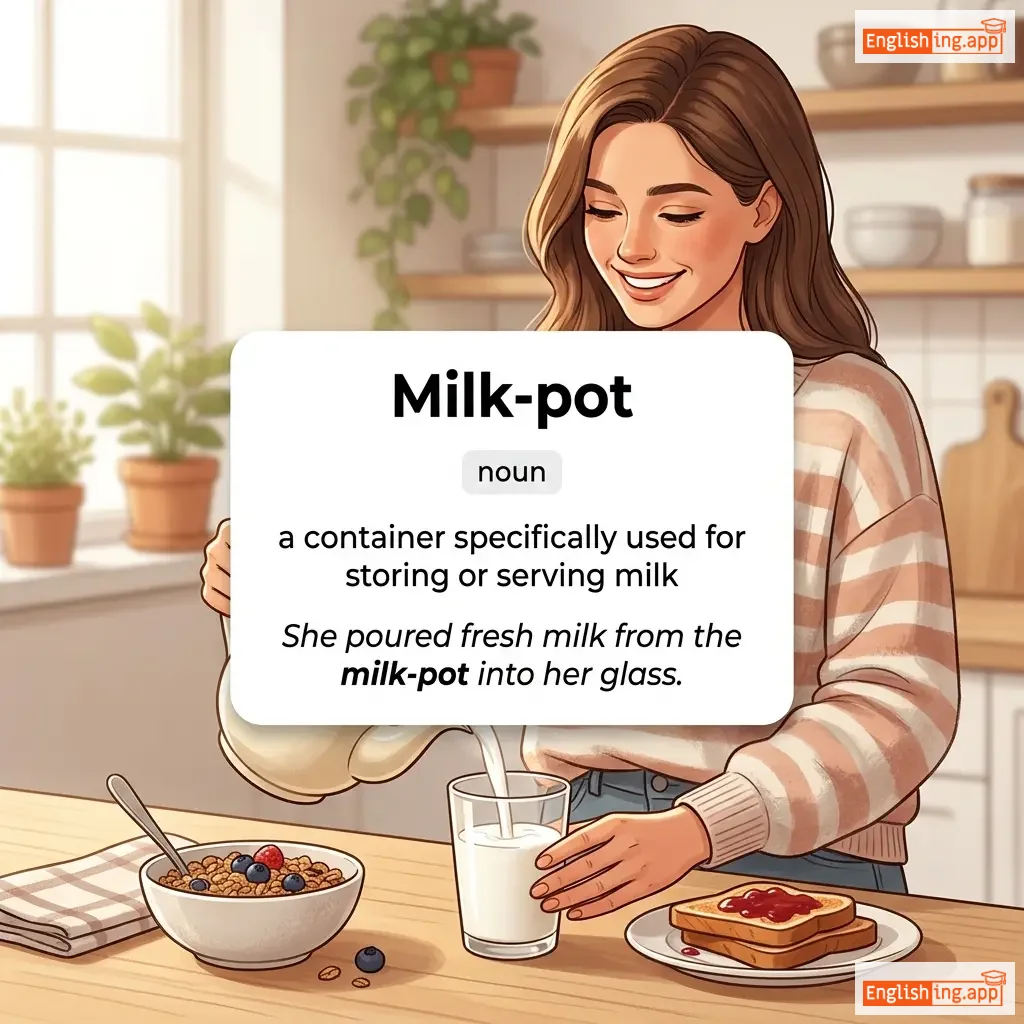
Milk-pot definition card — visual illustration of the meaning
noun C2
/ˈmɪlk pɒt/
ミルクポット (miruku potto)

a container specifically used for storing or serving milk

"She poured fresh milk from the milk-pot into her glass."

"彼女はミルクポットから新鮮なミルクをグラスに注いだ。" (Kanojo wa miruku potto kara shinsen na miruku o gurasu ni sosoi da)
noun C2
/ˈmɪlɪt/
ヒエ (hie)

a small-seeded grass cultivated as a cereal crop

"Millet is often used as food in rural areas."

"ミレットは農村地域で食品としてよく使われます。" (Miretto wa nōson chiiki de shokuhin toshite yoku tsukawaremasu.)
noun C2
/ˌmɪnəˈrɛt/
ミナレット (minaretto)

A tall, slender tower of a mosque, from which the call to prayer is announced.

"The minaret of the mosque could be seen from miles away."

"モスクのミナレットは数マイル先から見ることができました。" (Mosuku no minaretto wa suu mairu saki kara miru koto ga dekimashita.)
adjective C2
/ˈmɪnətɔːri/
威嚇的な (ikakuteki na)

Expressing a threat; menacing.

"The criminal gave the witness a minatory look."

"犯人は証人に威嚇的な視線を送った。" (Hannin wa shōnin ni ikakuteki na shisen o okutta.)
adjective C2
/ˈmɪnsɪŋ/
気取った (kidotta)

affectedly delicate, dainty, or refined in manner or movement

"He walked with mincing steps across the stage."

"彼はステージを歩くとき、気取った足取りで歩いていました。" (Kare wa suteeji o aruku toki, kidotta ashidori de aruite imashita.)
adjective C2
/ˈmɪn.dʒi/
ケチ; 吝嗇 (kechi; rinshaku)

mean or stingy; unwilling to spend money

"He is too mingy to spend money on anything but necessities."

"彼は必要なもの以外にお金を使うのがあまりにもケチだ。" (Kare wa hitsuyou na mono igai ni okane o tsukau no ga amari ni mo kechi da.)
🧑‍🤝‍🧑

minion (ミニオン)

noun C2
/ˈmɪn.i.ən/
手先 (tesaki)

A follower or underling of a powerful person, especially a servile one.

"The dictator was surrounded by loyal minions who carried out his orders."

"独裁者は忠実な手先に囲まれていて、彼の命令を実行していた。" (Dokusai-sha wa chūjitsu na tesaki ni kakomarete ite, kare no meirei o jikkō shite ita.)
adjective C2
/ˈmɪn.ɪ.skjuːl/
微小 (bishou)

Extremely small or tiny.

"The error was so miniscule that nobody noticed it."

"その誤りは非常に微小で、誰もそれに気づかなかった。" (Sono ayamari wa hijou ni bishou de, dare mo sore ni kizukanakatta.)
noun C2
/ˌmɪn.ɪˈstreɪ.ʃən/
奉仕 (houshi)

The act of providing care, assistance, or religious service.

"She recovered thanks to the kind ministrations of the nurses."

"彼女は看護師の親切な奉仕のおかげで回復した。" (Kanojo wa kangoshi no shinsetsuna houshi no okage de kaifuku shita.)
noun C2
/maɪˈnjuːʃə/
細かい事 (komakai koto)

a small or trivial detail of something

"He was bored by the minutia of office paperwork."

"彼はオフィスの書類の細かい事に飽きていた。" (Kare wa ofisu no shorui no komakai koto ni akite ita.)
noun (plural) C2
/maɪˈnjuːʃiiː/
細部 (saibu)

the small, precise, or trivial details of something

"The lawyer focused on the minutiae of the contract."

"弁護士は契約の細部に集中しました。" (Bengoshi wa keiyaku no saibu ni shuuchuu shimashita.)
🪵

mire

noun, verb C2
/ˈmaɪər/

A stretch of swampy or boggy ground; as a verb, to entangle or involve someone in a difficult situation.

"The car was stuck in the mire after the heavy rain."

noun C2
/ˌmɪsədˈvɛntʃər/
不運な出来事 (fuun na dekigoto)

An unlucky accident, mishap, or unfortunate event.

"He broke his leg during a skiing misadventure."

"彼はスキー中に不運な出来事で足を骨折した。" (Kare wa sukii-chuu ni fuun na dekigoto de ashi o kossetsu shita.)
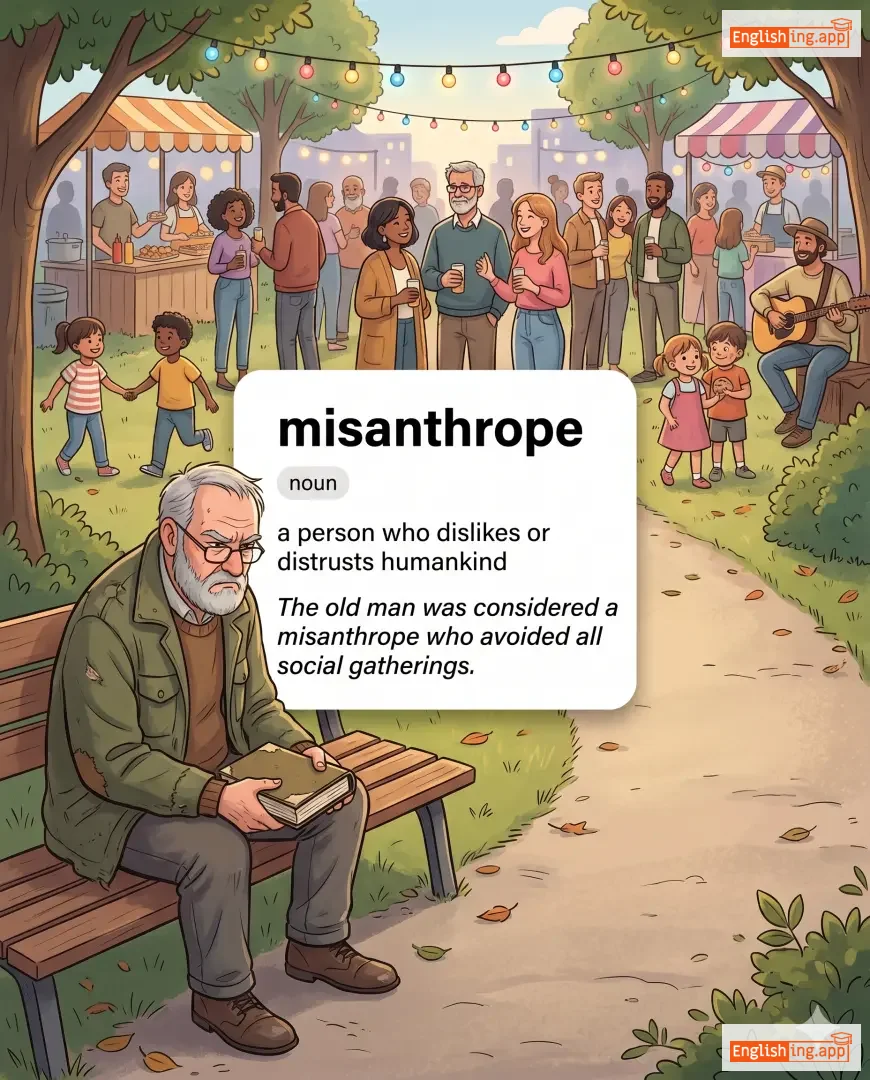
misanthrope definition card — visual illustration of the meaning
noun C2
/ˈmɪsənˌθroʊp/
人間嫌い (ningengirai)

a person who dislikes or distrusts humankind

"The old man was considered a misanthrope who avoided all social gatherings."

"その老人は、すべての社交的な集まりを避けるミサントロープと見なされていました。" (Sono rōjin wa, subete no shakaiteki na atsumari o yokeru misantoroopu to minasareteimashita.)
adjective C2
/ˌmɪsənˈθrɑːpɪk/
人間嫌いの (ningen girai no)

having or showing a dislike of humankind

"His misanthropic attitude made it difficult for him to make friends."

"彼の人間嫌いの態度は、友達を作るのを難しくした。" (Kare no ningen girai no taido wa, tomodachi o tsukuru no o muzukashiku shita.)
noun C2
/mɪˈsænθrəpi/
人類嫌悪 (jinrui ken'o)

a general dislike, distrust, or hatred of humankind

"His misanthropy was evident in the way he avoided people."

"彼の人類嫌悪は、彼が人々を避ける方法に明らかに現れていました。" (Kare no jinrui ken'o wa, kare ga hitobito o sakeru hōhō ni akiraka ni arawarete imashita.)
verb C2
/ˌmɪsæprɪˈhɛnd/
誤解する (gokai suru)

to misunderstand or misinterpret something

"He misapprehended the teacher’s instructions and did the task incorrectly."

"彼は先生の指示を誤解し、課題を間違って行いました。" (Kare wa sensei no shiji o gokai shi, kadai o machigatte okonaimashita.)
noun C2
/ˌmɪsæprɪˈhɛnʃən/
誤解 (gokai)

a mistaken belief or misunderstanding

"There is a common misapprehension about the causes of the disease."

"病気の原因についての一般的な誤解がある。" (Byōki no gen'in ni tsuite no ippanteki na gokai ga aru.)
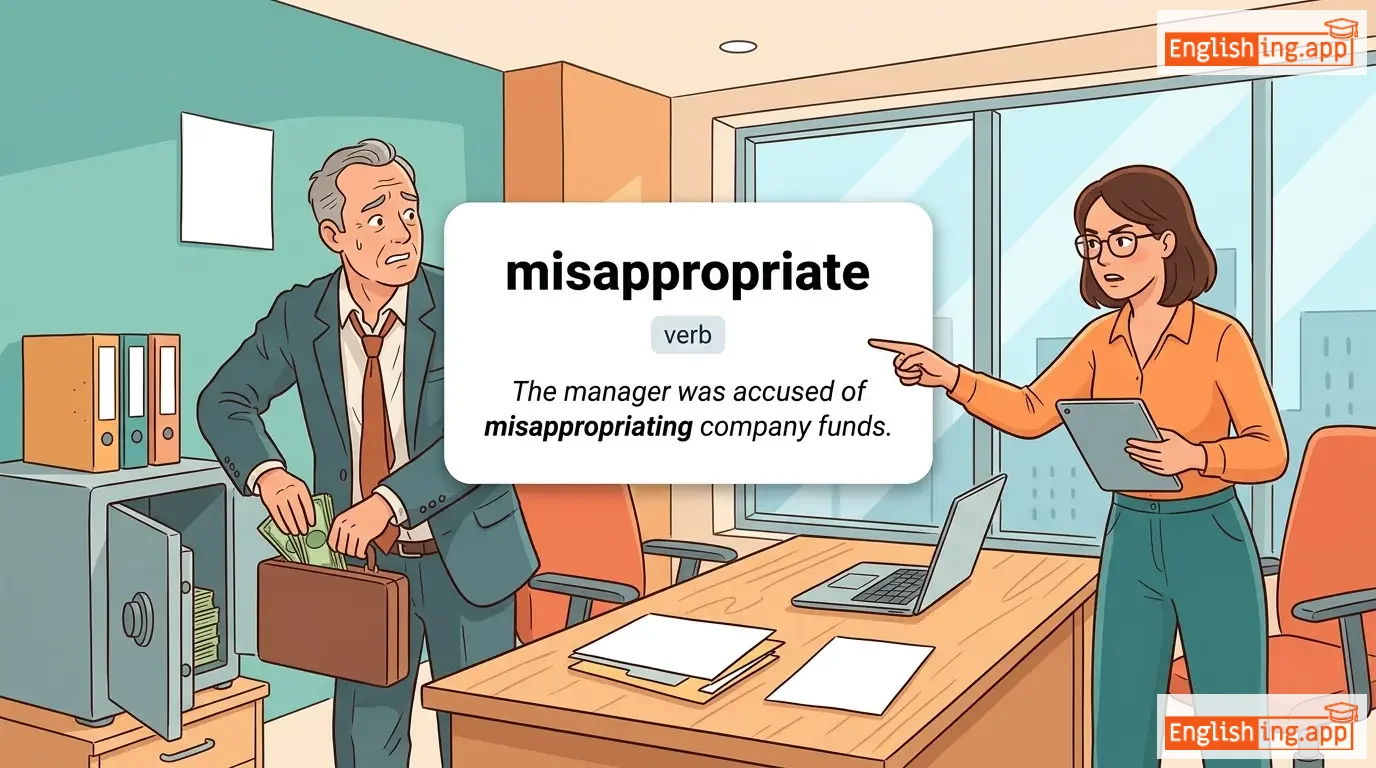
misappropriate definition card — visual illustration of the meaning
verb C2
/ˌmɪsəˈproʊprieɪt/
不正流用する (fusei ryūyō suru)

to take or use something dishonestly, especially money or property, for one's own use

"The manager was accused of misappropriating company funds."

"マネージャーは会社の資金を不正に使ったとして告発されました。" (Manējā wa kaisha no shikin o fusei ni tsukatta to shite kokuhatsu saremashita.)
verb C2
/ˌmɪs.əˈtrɪb.juːt/
誤って帰属する (ayamatte kizoku suru)

to incorrectly credit something, such as a work or remark, to the wrong person or source

"The quote was misattributed to Shakespeare."

"その引用はシェイクスピアに誤って帰属されました。" (Sono inyo wa Sheikusupia ni ayamatte kizoku saremashita.)
noun C2
/mɪˌsɛdʒəˈneɪʃən/
人種間結婚 (jinshukan kekkon)

the interbreeding of people considered to be of different racial types

"The law once prohibited miscegenation in many countries."

"その法律は多くの国で人種間結婚を禁じていました。" (Sono hōritsu wa ōku no kuni de jinshukan kekkon o kinjite imashita.)
noun C2
/ˈmɪsəleɪni/
寄せ集め (yoseatsume)

A collection or mixture of various things.

"The book is a miscellany of essays and poems."

"その本はエッセイと詩の寄せ集めです。" (Sono hon wa essei to shi no yoseatsume desu.)
noun C2
/ˌmɪsˈtʃæns/

An unfortunate accident or event; bad luck.

"By mischance, he missed the last train home."

verb C2
/ˌmɪskənˈsiːv/
誤解する (gokai suru)

To misunderstand or form an incorrect idea about something.

"He misconceived the purpose of the project."

"彼はプロジェクトの目的を誤解しました。" (Kare wa purojekuto no mokuteki o gokai shimashita.)
verb C2
/ˌmɪskənˈstruː/
誤解する (gokai suru)

To interpret something wrongly or misunderstand the meaning.

"She misconstrued his silence as anger."

"彼女は彼の沈黙を怒りだと誤解した。" (Kanojo wa kare no chinmoku o ikari da to gokai shita.)
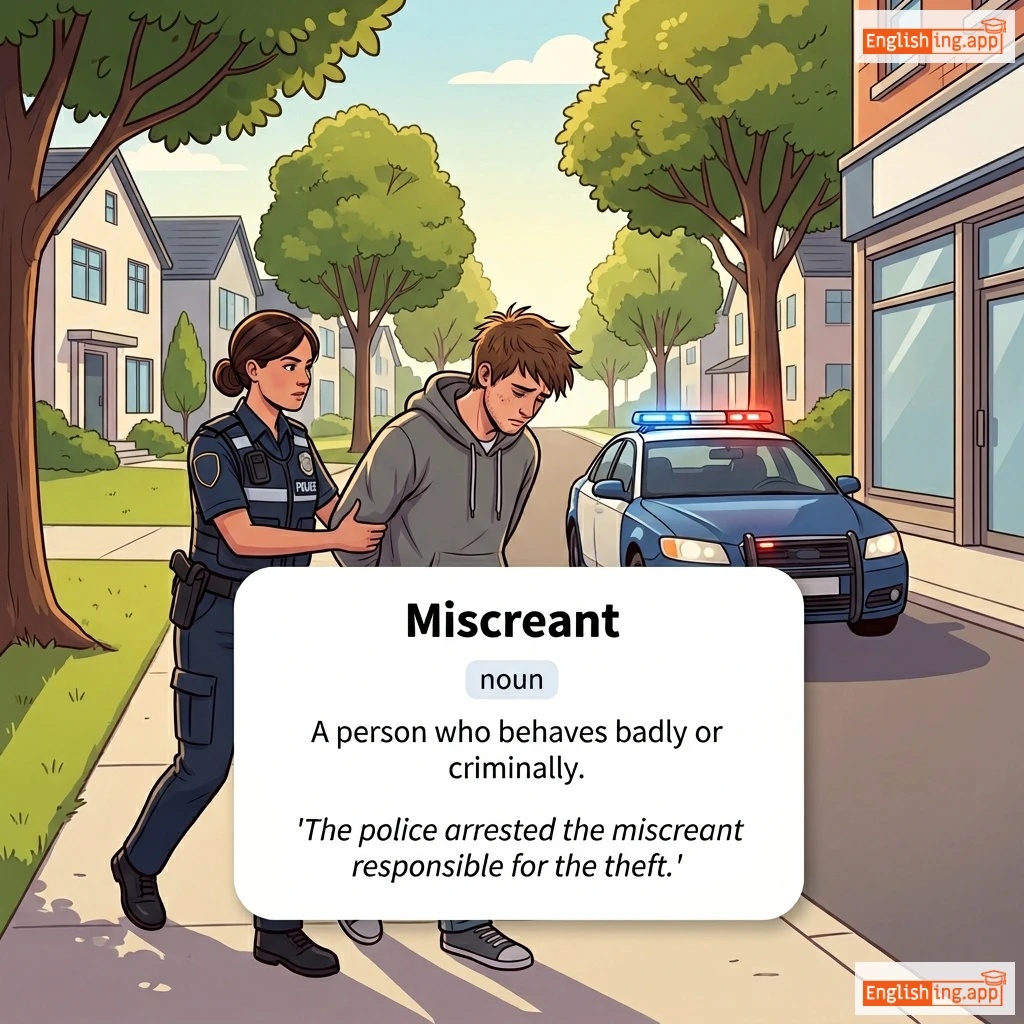
Miscreant definition card — visual illustration of the meaning
noun C2
/ˈmɪskriənt/
悪党 (akutou)

A person who behaves badly or criminally.

"The police arrested the miscreant responsible for the theft."

"警察は盗みの責任を負う悪党を逮捕しました。" (Keisatsu wa nusumi no sekinin o ou akutou o taiho shimashita.)
verb C2
/ˌmɪsˈleɪ/
一時的に失う (ichijiteki ni ushinau)

to lose something temporarily by putting it in the wrong place

"I must have mislaid my keys somewhere in the house."

"私は家のどこかで鍵を一時的に失ったに違いない。" (Watashi wa ie no dokoka de kagi o ichijiteki ni ushinatta ni chigai nai.)
noun C2
/ˌmɪsˈnoʊmər/
誤った名前 (ayamatta namae)

A wrong or inaccurate name or designation.

"Calling the tiny dog a 'giant' is a misnomer."

"小さな犬を「ジャイアント」と呼ぶのは誤った名前です。" (Chiisana inu wo 'Jaianto' to yobu no wa ayamatta namae desu.)
noun C2
/mɪˈsɑːɡəmi/
ミソガミー (misogamī)

Hatred or dislike of marriage.

"His misogamy prevented him from ever settling down with a partner."

"彼のミソガミーは、パートナーと一緒に落ち着くことを妨げた。" (Kare no misogamī wa, pātonā to issho ni ochitsuku koto o samatage ta.)
noun C2
/mɪˈsɑːdʒɪnɪst/
女性嫌悪者 (josei ken'oshā)

A person who dislikes, despises, or is strongly prejudiced against women.

"Many condemned his speech as the words of a misogynist."

"多くの人々は彼のスピーチを女性嫌悪者の言葉として非難しました。" (Ōku no hitobito wa kare no supīchi o josei ken'oshā no kotoba to shite hinan shimashita.)
noun C2
/ˌmɪsˈruːl/
悪政 (akusei)

bad or poor governance

"The kingdom suffered for decades under misrule."

"王国は数十年にわたって悪政の下で苦しんだ。" (Ōkoku wa suujūnen ni watatte akusei no moto de kurushinda.)
noun C2
/ˈmɪsəl/
ミサの書 (Misa no sho)

a book containing the texts used in the Catholic Mass throughout the year

"The priest read from the missal during the ceremony."

"祭司は儀式中にミサの書から読んでいました。" (Saishi wa gishiki-chū ni misa no sho kara yonde imashita.)
noun C2
/ˈmɪsɪv/
書簡 (shokan)

a written message, especially a formal or official letter

"He sent a long missive to the governor."

"彼は知事に長い書簡を送った。" (Kare wa chiji ni nagai shokan o okutta.)
noun C2
/ˈmaɪtər/
司教帽子 (shikyō bōshi)

a tall, pointed hat worn by bishops; also a type of joint made between two pieces of material

"The bishop placed the miter on his head during the ceremony."

"司教は儀式の間に司教帽子を頭に載せました。" (Shikyō wa gishiki no aida ni shikyō bōshi o atama ni nose mashita.)