Vocabularies

English Vocabulary Dictionary | Word Meanings, Definitions & Examples

verb C2
/ɪmˈpɛnd/
se profiler (se profiler)

to be about to happen; to loom threateningly

"Dark clouds suggested that a storm was impeding."

"Les nuages sombres suggéraient qu'une tempête était imminente." (Les nuages sombres suggéraient qu'une tempête était imminente.)
adjective C2
/ɪmˈpɛn.ɪ.tənt/
impénitent (impénitent)

Not feeling regret or shame about one's actions.

"The criminal remained impenitent after the trial."

"Le criminel est resté impénitent après le procès." (Le criminel est resté impénitent après le procès.)
adjective C2
/ˌɪm.pəˈfɛk.tə.bəl/
imparfaitible (imparfaitible)

Incapable of being made perfect or complete.

"Some human qualities are considered imperfectible."

"Certaines qualités humaines sont considérées comme imparfaitibles." (Certaines qualités humaines sont considérées comme imparfaitibles.)
adjective C2
/ɪmˈpɪəriəs/
impérieux (impérayö)

Arrogantly domineering or overbearing.

"Her imperious tone made it hard for others to argue."

"Son ton impérieux rendait difficile pour les autres de discuter." (Son ton impérieux rendait difficile pour les autres de discuter.)
adjective C2
/ɪmˈperɪʃəbəl/
imperissable; éternel; immortel (imperissable; eternel; immortel)

not subject to decay; lasting forever; eternal

"The imperishable beauty of classical art continues to inspire generations."

"La beauté impérissable de l'art classique continue d'inspirer les générations." (La beaute imperissable de l'art classique continue d'inspirer les generations.)
adjective C2
/ˌɪmpəˈmɪsəbl/
interdit (interdit)

Not permitted or allowed.

"Such behavior is impermissible in the workplace."

"Un tel comportement est interdit sur le lieu de travail." (Un tel comportement est interdit sur le lieu de travail.)
adjective C2
/ɪmˌpɜːrˈsweɪdəbl/
impossible à persuader (impossible a persuader)

not able to be convinced or persuaded

"She remained impersuadable despite all our arguments."

"Elle est restée impossible à persuader malgré tous nos arguments." (Elle est restée impossible à persuader malgré tous nos arguments.)
noun C2
/ɪmˌpɜːrtərbəˈbɪləti/
imperturbabilité (imperturbabilite)

The quality of being calm and not easily disturbed or upset.

"Her imperturbability during the crisis impressed everyone."

"Son imperturbabilité pendant la crise a impressionné tout le monde." (Son imperturbabilite pendant la crise a impressionne tout le monde.)
imperturbable definition card — visual illustration of the meaning
adjective C2
/ɪmˈpɜːrtərbəbəl/
imperturbable (imperturbable)

Unable to be upset or excited; calm.

"He remained imperturbable even when faced with tough questions."

"Il est resté imperturbable même lorsqu'il a été confronté à des questions difficiles." (Il est resté imperturbable même lorsqu'il a été confronté à des questions difficiles.)
noun C2
/ˌɪmpəˈtjuːəsəti/
impétuosité (impetuosite)

The quality of being rash or impulsive.

"His impetuosity often got him into trouble."

"Son impétuosité le mettait souvent dans des ennuis." (Son impetuosite le mettait souvent dans des ennuis.)
Impiety definition card — visual illustration of the meaning
noun C2
/ɪmˈpaɪəti/
impiété (impiete)

lack of respect for religion or sacred things

"The priest condemned the impiety of neglecting the temple rituals."

"Le prêtre a condamné l'impieté de négliger les rituels du temple." (Le pretre a condamné l'impiete de négliger les rituels du temple.)
adjective C2
/ˈɪmpɪəs/
impie (impie)

showing a lack of respect for God or religion

"It was considered impious to joke about sacred traditions."

"Il était considéré comme impie de se moquer des traditions sacrées." (Il était considéré comme impie de se moquer des traditions sacrées.)
implacable definition card — visual illustration of the meaning
adjective C2
/ɪmˈplækəbl/
implacable (implacable)

unable to be appeased, calmed, or pacified

"The soldiers faced an implacable enemy who refused to surrender."

"Les soldats ont affronté un ennemi implacable qui a refusé de se rendre." (Les soldats ont affronté un ennemi implacable qui a refusé de se rendre.)
adjective C2
/ɪmˈplaɪəbl/
impliquable (impliquable)

Capable of being implied or suggested.

"The meaning of the statement is not directly clear but is impliable from the context."

"Le sens de la déclaration n'est pas directement clair, mais il est impliquable à partir du contexte." (Le sens de la déclaration n'est pas directement clair, mais il est impliquable à partir du contexte.)
adjective C2
/ɪmˈpɑːlɪtɪk/
imprudent (imprudent)

Unwise or imprudent; not showing good judgment.

"It would be impolitic to criticize them openly."

"Il serait imprudent de les critiquer ouvertement." (Il serait imprudent de les critiquer ouvertement.)
adjective C2
/ɪmˈpɒndərəbl̩/
impondérable (imponderable)

Something difficult or impossible to estimate, assess, or understand

"The outcome of the election depends on many imponderable factors."

"Le résultat des élections dépend de nombreux facteurs impondérables." (Le résultat des élections dépend de nombreux facteurs impondérables.)
adjective C2
/ɪmˈpɔːrtʃənət/
importun (importun)

Persistent to the point of annoyance or intrusion

"The importunate salesman kept calling despite repeated refusals."

"Le vendeur importun a continué à appeler malgré les refus répétés." (Le vendeur importun a continué à appeler malgré les refus répétés.)
verb C2
/ˌɪmpɔːrˈtuːn/
demander insistant (demander insistant)

To ask someone persistently or pressingly for something

"The child importuned his mother for a new toy."

"L'enfant importunait sa mère pour un nouveau jouet." (L'enfant importunait sa mère pour un nouveau jouet.)
verb C2
/ˌɪmpɔːrˈtuːnd/
demander de manière insistante (demander de maniere insistante)

asked someone persistently and pressingly for something

"She importuned her boss for a raise until he finally gave in."

"Elle demandait de manière insistante une augmentation à son patron jusqu'à ce qu'il cède enfin." (Elle demandait de manière insistante une augmentation à son patron jusqu'à ce qu'il cède enfin.)
Imposture definition card — visual illustration of the meaning
noun C2
/ɪmˈpɒstʃər/
imposture (imposture)

The act of pretending to be someone else in order to deceive others; deception or fraud.

"The imposture was discovered when the man failed to answer basic questions about his supposed identity."

"L'imposture a été découverte lorsque l'homme n'a pas pu répondre à des questions de base sur sa soi-disant identité." (L'imposture a été découverte lorsque l'homme n'a pas pu répondre à des questions de base sur sa soi-disant identité.)
adjective C2
/ɪmˈpræktɪkəbl/
impraticable (impraticable)

Not capable of being carried out or put into practice.

"The plan seemed impracticable due to limited resources."

"Le plan semblait impraticable en raison des ressources limitées." (Le plan semblait impraticable en raison des ressources limitées.)
verb C2
/ˈɪmprɪkeɪt/
imprécation (imprecation)

To utter a curse or invoke evil upon someone.

"The old woman imprecated her enemies with dark words."

"La vieille femme a impréqué ses ennemis avec des mots sombres." (La vieille femme a impréqué ses ennemis avec des mots sombres.)
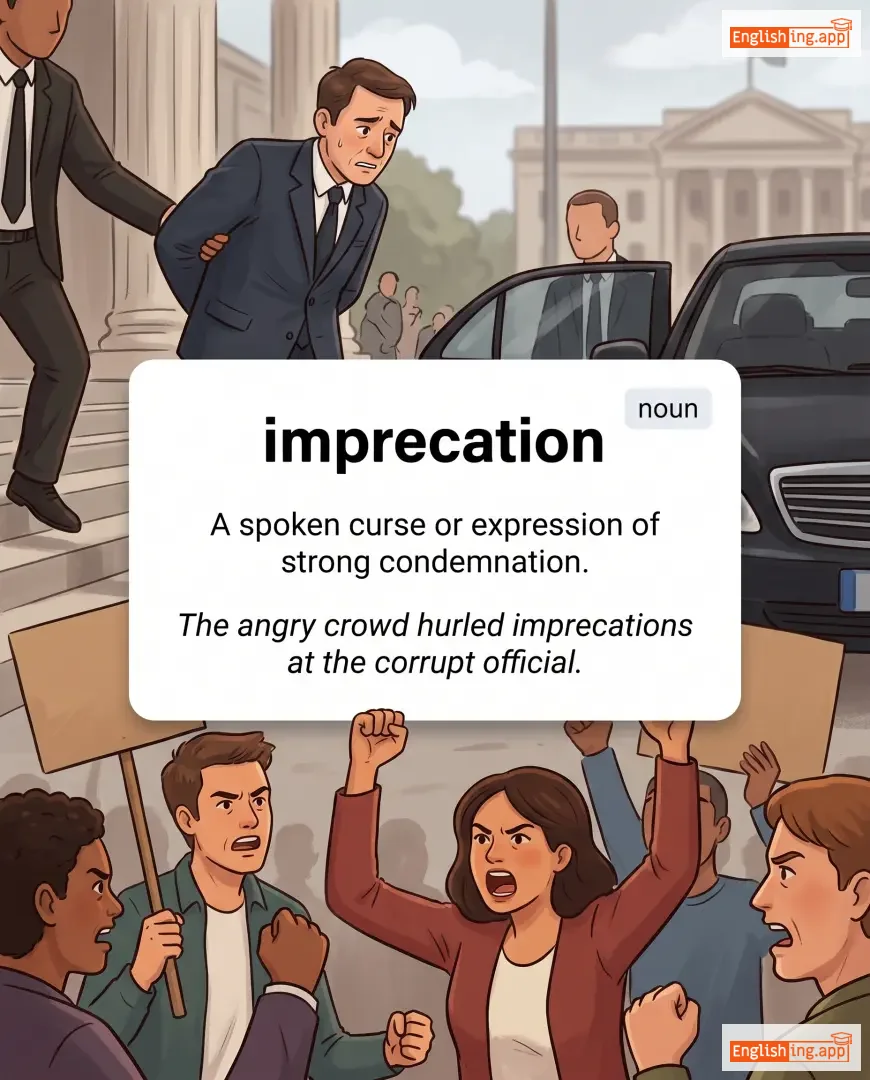
imprecation definition card — visual illustration of the meaning
noun C2
/ˌɪmprɪˈkeɪʃən/
malédiction (malediction)

A spoken curse or expression of strong condemnation.

"The angry crowd hurled imprecations at the corrupt official."

"La foule en colère a lancé des malédictions à l'officiel corrompu." (La foule en colere a lance des maledictions a l'officiel corrompu.)
adjective C2
/ɪmˈprɛɡnəbl̩/
imprenable (imprenable)

Unable to be captured, broken into, or defeated.

"The fortress was considered impregnable by the enemy."

"La forteresse était considérée comme imprenable par l'ennemi." (La forteresse était considérée comme imprenable par l'ennemi.)
verb C2
/ˈɪmprɛɡneɪt/
imprégner / rendre enceinte (imprégner / rendre enceinte)

To make pregnant; to fill or saturate with something.

"The scientist used a method to impregnate the material with resin."

"Le scientifique a utilisé une méthode pour imprégner le matériau de résine." (Le scientifique a utilisé une méthode pour imprégner le matériau de résine.)
noun C2
/ˌɪmprəˈsɑːrioʊ/
impresario (impresario)

A person who organizes or finances concerts, plays, or operas.

"The impresario arranged a series of concerts for the rising star."

"L'impresario a organisé une série de concerts pour la star montante." (L'impresario a organisé une série de concerts pour la star montante.)
noun C2
/ˌɪmprɪˈmɑːtər/
imprimatur (imprimatur)

An official license or approval, especially to publish a book.

"The book was released with the official imprimatur of the church."

"Le livre a été publié avec l'imprimatur officiel de l'église." (Le livre a été publié avec l'imprimatur officiel de l'église.)
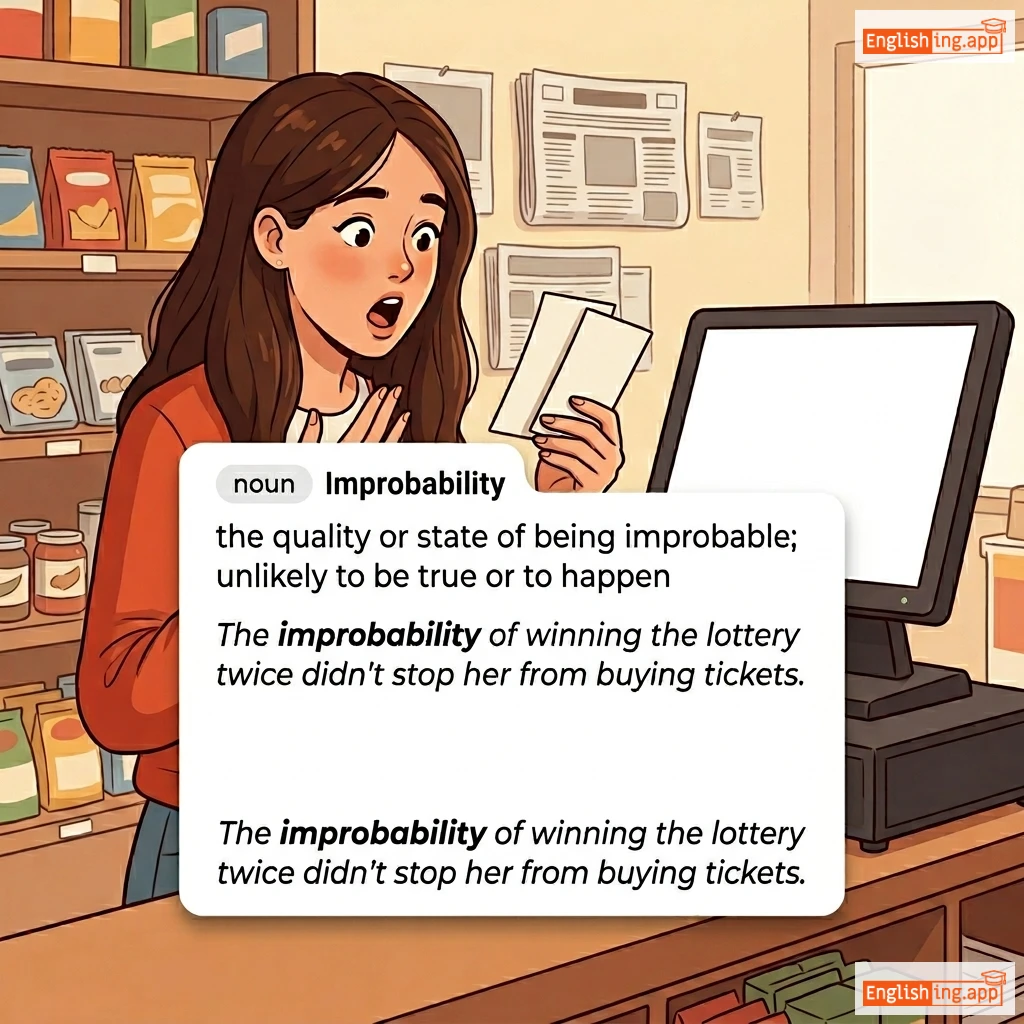
Improbability definition card — visual illustration of the meaning
noun C2
/ɪmˌprɒb.əˈbɪl.ə.ti/
improbabilité (improbabilité)

the quality or state of being improbable; unlikely to be true or to happen

"The improbability of winning the lottery twice didn't stop her from buying tickets."

"L'improbabilité de gagner à la loterie deux fois ne l'a pas empêchée d'acheter des billets." (L'improbabilité de gagner à la loterie deux fois ne l'a pas empêchée d'acheter des billets.)
noun C2
/ˌɪmprəˈpraɪəti/
impropriété (impropriete)

Failure to observe standards of honesty or modesty; improper behavior.

"The politician was accused of financial impropriety."

"Le politicien a été accusé d'impropriété financière." (Le politicien a ete accuse d'impropriete financiere.)
noun C2
/ɪmˈprɑːvɪdəns/
imprévoyance (imprevoyance)

Lack of foresight or care for future needs.

"His improvidence led to financial difficulties."

"Son imprévoyance l'a conduit à des difficultés financières." (Son imprévoyance l'a conduit à des difficultés financières.)
adjective C2
/ɪmˈprɒvɪdənt/
imprudent (imprudent)

Not having or showing foresight; spending wastefully or without thought for the future.

"His improvident habits left him with no savings."

"Ses habitudes imprudentes l'ont laissé sans économies." (Ses habitudes imprudentes l'ont laissé sans économies.)
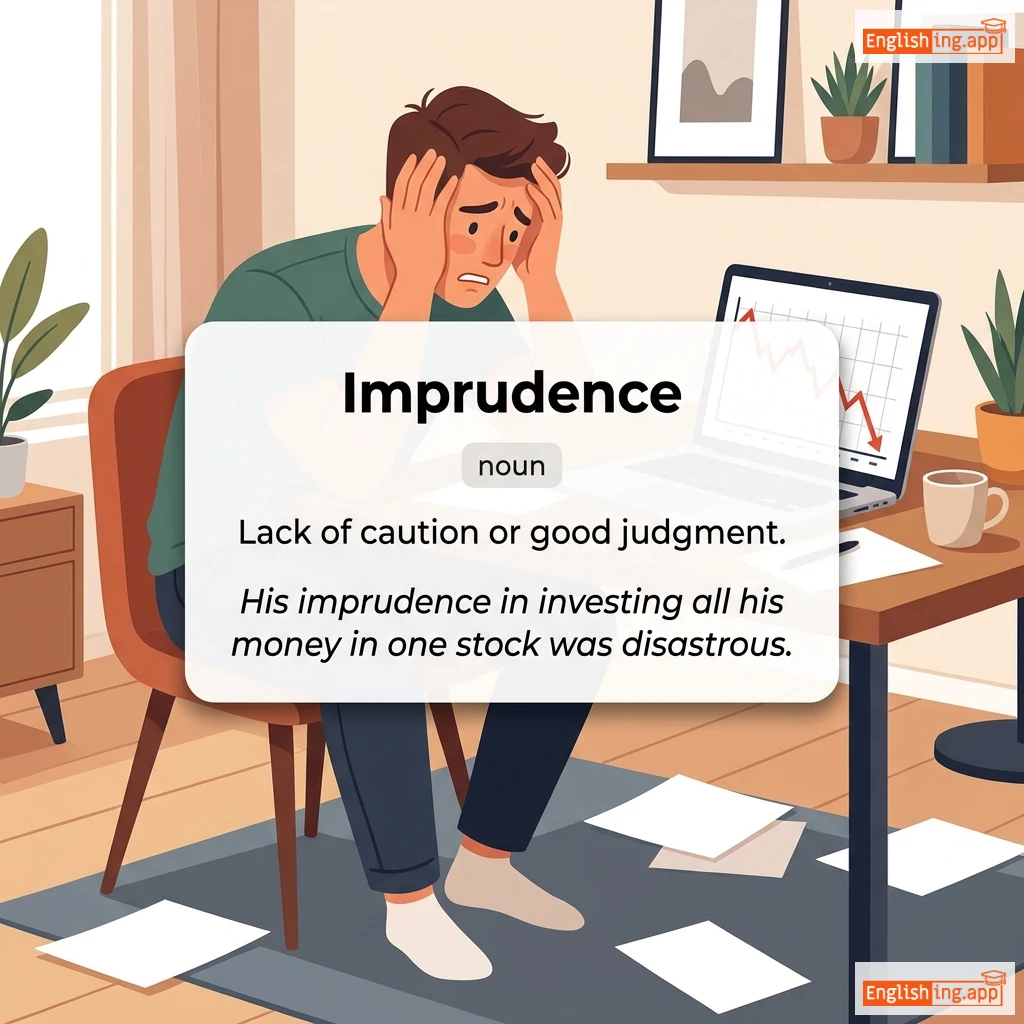
Imprudence definition card — visual illustration of the meaning
noun C2
/ɪmˈpruːdəns/
imprudence (imprudence)

Lack of caution or good judgment.

"His imprudence in investing all his money in one stock was disastrous."

"Son imprudence en investissant tout son argent dans une seule action a été désastreuse." (Son imprudence en investissant tout son argent dans une seule action a ete desastreuse.)
adjective C2
/ɪmˈpruːdənt/
imprudent (imprudent)

Not showing care for the consequences of an action.

"It was imprudent to drive in such stormy weather."

"C'était imprudent de conduire par un temps aussi orageux." (C'etait imprudent de conduire par un temps aussi orageux.)
noun C2
/ˈɪmpjʊdəns/
impudence (impudence)

Rude and disrespectful behavior.

"The student's impudence shocked the entire class."

"L'impudence de l'étudiant a choqué toute la classe." (L'impudence de l'étudiant a choqué toute la classe.)
verb C2
/ɪmˈpjuːn/
contester la vérité, la validité ou l'honnêteté d'une déclaration ou d'un motif (contester la verite, la validite ou l'honnetete d'une declaration ou d'un motif)

to dispute the truth, validity, or honesty of a statement or motive

"The lawyer tried to impugn the credibility of the witness."

"L'avocat a essayé de contester la crédibilité du témoin." (L'avocat a essaié de contester la crédibilité du témoin.)
noun C2
/ɪmˈpjuːɪsəns/
impuissance (impwisans)

inability to take effective action; helplessness

"The government’s impuissance in the face of crisis frustrated the people."

"L’impuissance du gouvernement face à la crise a frustré la population." (L’impuissance du gouvernement face à la crise a frustre la population.)
noun C2
/ɪmˈpʌlʃən/
impulsion (impulsion)

a strong urge or drive to act; the act of impelling

"His impulsion to travel made him leave his job suddenly."

"Son impulsion de voyager l'a poussé à quitter son travail soudainement." (Son impulsion de voyager l a pousse a quitter son travail soudainement.)
noun C2
/ɪmˈpjuːnɪti/
impunité (impunite)

freedom from punishment or harmful consequences for an action

"The dictator ruled with impunity, ignoring international laws."

"Le dictateur a régné en toute impunité, ignorant les lois internationales." (Le dictateur a régné en toute impunité, ignorant les lois internationales.)
noun C2
/ˌɪmpjuˈteɪʃən/
imputation (imputation)

an accusation or attribution of blame

"The politician denied the imputation of corruption."

"Le politicien a nié l'imputation de corruption." (Le politicien a nie l'imputation de corruption.)
verb C2
/ɪmˈpjuːt/
imputer (imputer)

to attribute a fault or responsibility to someone

"They imputed the company's success to good leadership."

"Ils ont imputé le succès de l'entreprise à un bon leadership." (Ils ont imputé le succès de l'entreprise à un bon leadership.)
noun C2
/ˌɪnədˈvɜːrtəns/
inadvertance (inadvertance)

Failure to pay attention; carelessness.

"The error happened through sheer inadvertence."

"L'erreur est survenue par pure inadvertance." (L'erreur est survenue par pure inadvertance.)
adjective C2
/ɪnˈeɪliənəbl/
inaliénable (inalienable)

Unable to be taken away or transferred; absolute and permanent.

"Freedom of speech is an inalienable right."

"La liberté d'expression est un droit inaliénable." (La liberte d'expression est un droit inalienable.)
noun C2
/ˌɪnəməˈrɑːtə/
amante (amante)

A woman with whom someone is in love; a female lover.

"He wrote a poem dedicated to his inamorata."

"Il a écrit un poème dédié à son amante." (Il a ecrit un poeme dedie a son amante.)
noun C2
/ɪˈnænɪti/
ineptie, absurdité (ineptie, absurdité)

a nonsensical remark or action; silliness; emptiness

"The speech was full of inanities that bored the audience."

"Le discours était rempli d'inepties qui ennuyaient le public." (Le discours était rempli d'inepties qui ennuyaient le public.)
adjective C2
/ˌɪnæprɪˈhɛnsəbl/
incompréhensible (incomprehensible)

not understandable; incomprehensible

"The concept was so abstract that it seemed inapprehensible to most students."

"Le concept était si abstrait qu'il semblait incompréhensible pour la plupart des étudiants." (Le concept était si abstrait qu'il semblait incompréhensible pour la plupart des étudiants.)
adjective C2
/ɪnˈæpt/
inapproprié (inapproprié)

not suitable or appropriate in the circumstances

"His inapt choice of words offended many people."

"Son choix inapproprié de mots a offensé de nombreuses personnes." (Son choix inapproprié de mots a offensé de nombreuses personnes.)
adverb C2
/ˌɪnəzˈmʌtʃ/
dans la mesure où (dans la mesure ou)

To the extent that; considering that.

"Inasmuch as you are their teacher, you should guide them carefully."

"Dans la mesure où vous êtes leur enseignant, vous devez les guider soigneusement." (Dans la mesure où vous êtes leur enseignant, vous devez les guider soigneusement.)
conjunction C2
/ˌɪnəzˈmʌtʃ æz/
puisque (puisque)

Because; since.

"He cannot attend, inasmuch as he is unwell."

"Il ne peut pas assister, puisque qu'il est malade." (Il ne peut pas assister, puisque qu'il est malade.)
adjective C2
/ˌɪnɔːˈspɪʃəs/
néfaste (nefast)

Not conducive to success; unpromising or unlucky.

"The event began under inauspicious circumstances."

"L'événement a commencé dans des circonstances défavorables." (L'evenement a commence dans des circonstances defavorables.)
adjective C2
/ˈɪnˌbrɛd/
inné (inne)

existing naturally in a person or animal; also related to reproduction within a limited community

"He has an inbred sense of loyalty."

"Il a un sens inné de la loyauté." (Il a un sens iné de la loyauté.)