Vocabularies

English Vocabulary Dictionary | Word Meanings, Definitions & Examples

adjective C2
/ˈɪkθiɪk/
鱼类的 (yú lèi de)

Relating to or resembling fish.

"The artist's painting had an ichthyic quality."

"艺术家的画作具有鱼类的特质。" (Yìshùjiā de huàzuò jùyǒu yúlèi de tèzhì.)
noun C2
/ˌɪkθiˈɒlədʒɪst/
鱼类学家 (yuleixuejia)

A scientist who studies fish.

"The ichthyologist discovered a new species of fish in the river."

"鱼类学家在河里发现了一种新的鱼类。" (Yuleixuejia zai heli faxianle yizhong xinde yulei.)
noun C2
/ˌɪkθiˈɒlədʒi/
鱼类学 (yú lèi xué)

The branch of zoology that deals with fish.

"He pursued a degree in ichthyology at the university."

"他在大学获得了鱼类学学位。" (Tā zài dàxué huòdéle yúlèi xué xuéwèi.)
noun C2
/ˈɪkθiəˌsɔːrz/
鱼龙(已灭绝的海洋爬行动物) (yulong)

Extinct marine reptiles that resembled fish and dolphins, dominant during the Mesozoic era.

"Ichthyosaurs were swift predators of the ancient seas."

"鱼龙是古代海洋的迅猛掠食者。" (Yulong shi gudai haiyang de xunmeng lueshizhe.)
adverb C2
/ˈaɪsɪli/
冷漠地 (lěngmò de)

In a very cold, unfriendly, or hostile manner.

"She replied icily to his question."

"她冷漠地回答了他的问题。" (Tā lěngmò de huídále tā de wèntí.)
noun C2
/ˈaɪsinəs/
冰冷 (bīng lěng)

The state of being cold in manner or temperature.

"There was a distinct iciness in his voice."

"他的声音中有一种明显的冰冷感。" (Tā de shēngyīn zhōng yǒu yī zhǒng míngxiǎn de bīng lěng gǎn.)
noun C2
/aɪˈkɒnəklæst/
破坏偶像者 (pòhuài ǒuxiàng zhě)

A person who attacks or criticizes cherished beliefs, traditions, or institutions.

"He was known as an iconoclast who challenged old traditions."

"他被认为是一个破坏偶像者,挑战旧传统。" (Tā bèi rènwéi shì yīgè pòhuài ǒuxiàng zhě, tiǎozhàn jiù chuántǒng.)
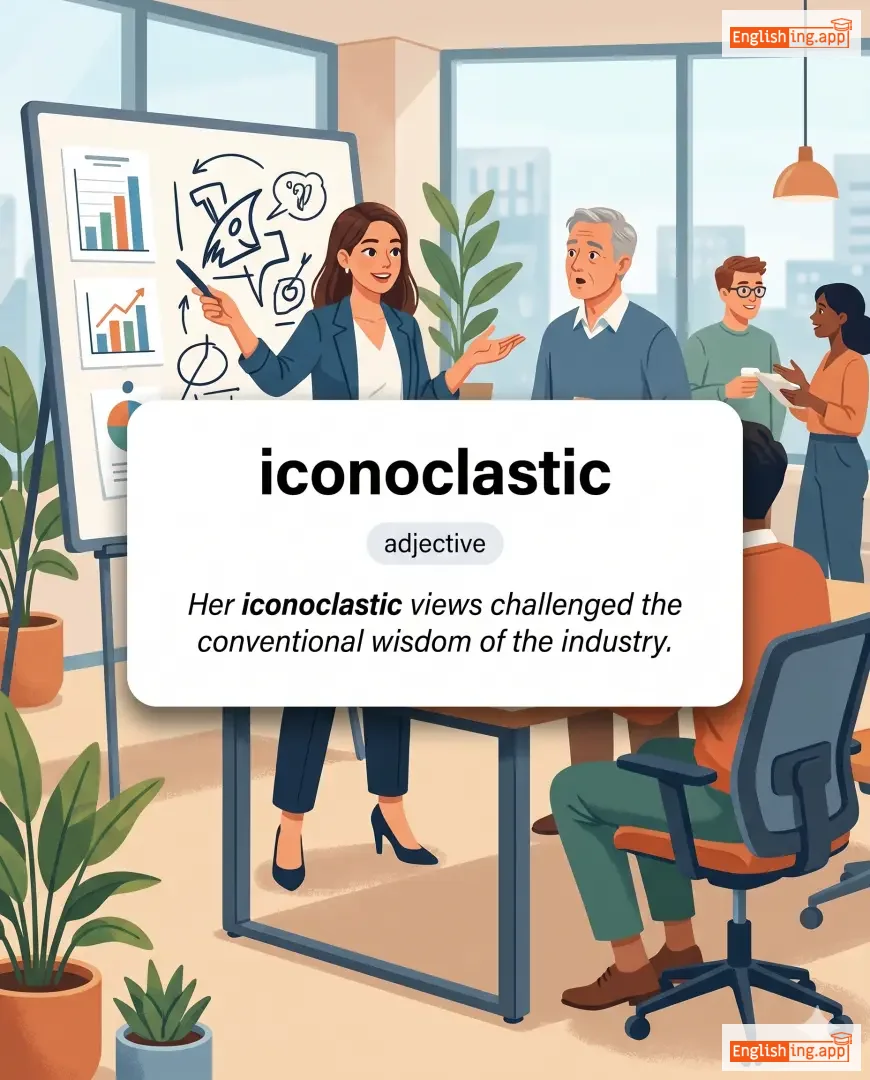
iconoclastic definition card — visual illustration of the meaning
adjective C2
/ˌaɪ.kə.nəˈklæs.tɪk/
特指攻击或拒绝已建立的信仰、传统或价值观 (tè zhǐ gōng jī huò jù jué yǐ jiàn lì de xìn yǎng, chuán tǒng huò jià zhí guān)

Characterized by attacking or rejecting cherished beliefs, traditions, or established values.

"Her iconoclastic views challenged the conventional wisdom of the industry."

"她的偶像破坏主义观点挑战了行业的传统智慧。" (tā de ǒu xiàng pò huài zhǔ yì guān diǎn tiǎo zhàn le háng yè de chuán tǒng zhì huì.)
ideation definition card — visual illustration of the meaning
noun C2
/ˌaɪdiˈeɪʃən/
创意生成 (chuangyi shengcheng)

The process of forming ideas or concepts.

"The workshop focused on ideation and brainstorming."

"研讨会集中于创意生成和头脑风暴。" (Yantao hui jizhong yu chuangyi shengcheng he tounaofengbao.)
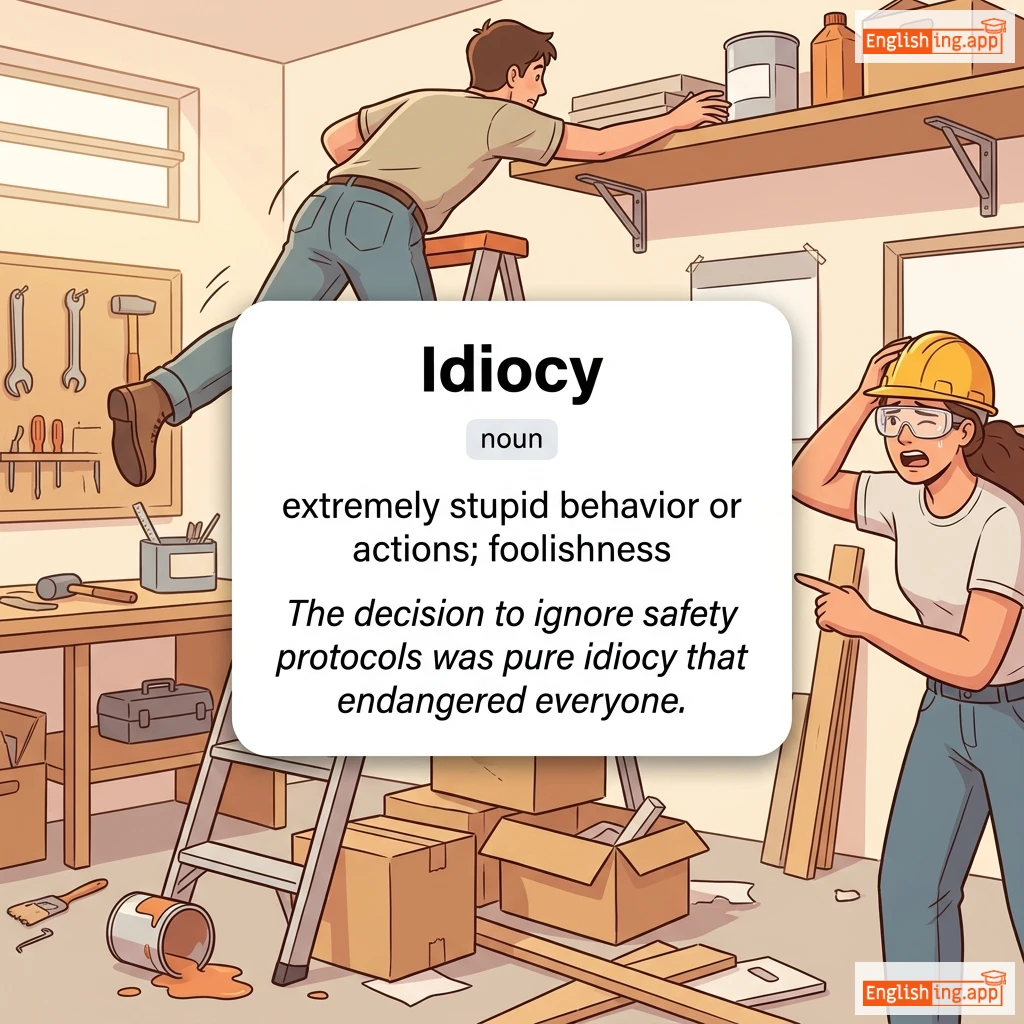
Idiocy definition card — visual illustration of the meaning
noun C2
/ˈɪd.i.ə.si/
愚蠢 (yúchǔn)

extremely stupid behavior or actions; foolishness

"The decision to ignore safety protocols was pure idiocy that endangered everyone."

"忽视安全协议的决定是纯粹的愚蠢,危及了每个人。" (Hūshì ānquán xiéyì de juédìng shì chúncuì de yúchǔn, wéijíle měi gèrén.)
noun C2
/ˌɪdiəˈsɪŋkrəsi/
特徵 (te zheng)

A distinctive or peculiar characteristic, habit, or mannerism unique to an individual.

"One of her idiosyncrasies was humming while working."

"她的一个偶发性特征是工作时哼歌。" (Ta de yi ge ou fa xing te zheng shi gong zuo shi heng ge.)
noun C2
/ˈaɪdlər/
懒汉 (lǎn hàn)

A person who avoids work or spends time lazily.

"He was known as an idler who wasted his days."

"他被称为一个懒汉,浪费了他的日子。" (Tā bèi chēng wèi yīgè lǎn hàn, làngfèi le tā de rìzi.)
adjective C2
/ˌaɪdəˈlɑːtrɪəs/
偶像崇拜的 (ǒu xiàng chóng bài de)

Excessively devoted or reverent towards idols or false gods.

"The ancient tribe was known for its idolatrious practices."

"这个古老的部落因其偶像崇拜的习惯而闻名。" (Zhège gǔlǎo de bùluò yīn qí ǒu xiàng chóng bài de xíguàn ér wénmíng.)
verb C2
/aɪˈdɒləˌtraɪz/
偶像崇拜 (ǒuxiàng chóngbài)

To worship idols; to regard with excessive devotion or admiration.

"They began to idolatrize the statue as a deity."

"他们开始把这尊雕像当作神明崇拜。" (Tāmen kāishǐ bǎ zhè zhūn diāoxiàng dàngzuò shénmíng chóngbài.)
adjective C2
/aɪˈdɒlətrəs/
偶像崇拜者 (ouxiang chongbai zhe)

Excessively admiring or worshipping someone or something as an idol.

"The king was criticized for his idolatrous devotion to wealth."

"国王因其对财富的偶像崇拜而受到批评。" (Guowang yin qi dui cai fu de ouxiang chongbai er shoudao piping.)
idolatry definition card — visual illustration of the meaning
noun C2
/aɪˈdɒlətri/
偶像崇拜 (ouxiang chongbai)

The worship of idols or extreme admiration for someone or something.

"The priest condemned the idolatry practiced in the village."

"牧师谴责了在村里实践的偶像崇拜。" (Mushi qianze le zai cun li shijian de ouxiang chongbai.)
noun C2
/ˈaɪdɪl/
田园诗般的场景 (tianyuanshi ban de changjing)

An extremely happy, peaceful, or picturesque episode or scene, often idealized.

"Their honeymoon was an idyll on a tropical island."

"他们的蜜月是在一个热带岛屿上的田园诗般的场景。" (Tamen de miyue shi zai yige re dai daoyu shang de tianyuanshi ban de changjing.)
adjective C2
/ɪɡˈnoʊ.bəl/
卑鄙的 (bēibǐ de)

Dishonorable, shameful, or lacking nobility.

"His ignoble actions ruined his reputation."

"他的卑鄙行为毁掉了他的声誉。" (Tā de bēibǐ xíngwéi huǐ diào le tā de shēngyù.)
adjective C2
/ˌɪɡ.nəˈmɪn.i.əs/
可耻的 (kechi de)

Marked by shame, disgrace, or humiliation.

"The team suffered an ignominious defeat in the finals."

"队伍在决赛中遭遇了可耻的失败。" (Duiwu zai jue sai zhong zao yu le kechi de shibai.)
noun C2
/ˈɪɡ.nəˌmɪn.i/
耻辱 (chiru)

Public shame, disgrace, or dishonor.

"He lived the rest of his life in ignominy after the scandal."

"他在丑闻后余生都活在耻辱中。" (Tā zài chǒuwén hòu yúshēng dōu huó zài chīrǔ zhōng.)
noun C2
/ˈaɪ.kɒn/
宗教图像或符号 (zongjiao tushang huo fuhuo)

A religious image or symbol, especially in the Eastern Orthodox Church.

"The church displayed a beautifully painted ikon of the Virgin Mary."

"教堂展示了美丽的圣母玛利亚圣像。" (Jiàotáng zhǎnshìle měilì de shèngmǔ mǎlìyà shèngxiàng.)
noun C2
/ˈɪl.i.æd/
伊利亚特 (Iliate)

An ancient Greek epic poem attributed to Homer, describing the events of the Trojan War.

"Students studied the Iliad to understand Greek mythology and heroism."

"学生们学习了《伊利亚特》,以理解希腊神话和英雄主义。" (Xueshengmen xuexi le 'Iliate', yi lijie Xila shenhua he yingxiong zhuyi.)
adjective C2
/ˈɪl bred/
无教养的 (illbred)

lacking good manners; rude; showing poor upbringing

"His ill-bred behavior shocked everyone at the dinner party."

"他的无教养行为让晚宴上的每个人都震惊。" (ta de wujiaoyang xingwei rang wan yan shang de mei ge ren dou zhenjing)
adjective C2
/ˌɪlˈneɪ.tʃəd/
性格恶劣 (xingge e lie)

Having a bad or unpleasant character; unkind or malicious.

"He made an ill-natured remark about his colleague."

"他对他的同事做出了恶意的评论。" (Ta dui tade tongshi zuo chule eyi de pinglun.)
Illegibility definition card — visual illustration of the meaning
noun C2
/ɪˌledʒ.əˈbɪl.ə.ti/
难以辨认 (nanyi bianren)

the quality of being impossible or difficult to read; unclear writing or print

"The doctor's handwriting was famous for its illegibility among the pharmacy staff."

"医生的字迹因其难以辨认而在药房工作人员中广为人知。" (Yisheng de ziji yin qi nanyi bianren er zai yaofang gongzuoren yuan zhong guangwei renzhi.)
illiberal definition card — visual illustration of the meaning
adjective C2
/ɪˈlɪbərəl/
非自由主义的 (fei zi you zhu yi de)

Opposed to liberal principles; restricting freedom of thought or behavior.

"The government was criticized for its illiberal policies."

"政府因其非自由主义的政策而受到批评。" (Zhengfu yin qi fei ziyou zhuyi de zhengce er shoudao piping.)
noun C2
/ˌɪlɪbəˈræləti/
不宽容 (bù kuānróng)

The quality of being illiberal; lack of tolerance or generosity.

"The illiberality of the new laws alarmed the citizens."

"新法律的不宽容让市民感到警觉。" (Xīn fǎlǜ de bù kuānróng ràng shìmín gǎndào jǐngjué.)
adjective C2
/ɪˈlɪmɪtəbl/
无限 (wuxian)

Without limits or bounds.

"The universe is often described as illimitable."

"宇宙常被描述为无限的。" (Yuzhou chang bei miaoshu wei wuxian de.)
noun C2
/ɪˈluːmɪnənt/
光源 (guāngyuán)

A substance or device that produces light.

"The lamp acted as an illuminant in the dark cave."

"这盏灯在黑暗的洞穴中充当了光源。" (Zhè zhǎn dēng zài hēi'àn de dòngxué zhōng chōngdāngle guāngyuán.)
noun C2
/ɪˌluːmɪˈnɑːti/
光明会 (guangming hui)

a group of people claiming to have special enlightenment or secret knowledge, often linked to conspiracies

"Many conspiracy theories involve the Illuminati as a secret world-controlling group."

"许多阴谋论涉及光明会,认为它是一个秘密的、控制世界的组织。" (Xǔ duō yīn móu lùn shè jí guāng míng huì, rèn wéi tā shì yí gè mìmì de, kòng zhì shì jiè de zǔ zhī.)
verb C2
/ɪˈluːmɪn/
照亮 (zhaoliang)

to light up or make clear

"The rising sun illumined the mountain peaks."

"初升的太阳照亮了山峰。" (Chusheng de taiyang zhaoliang le shanfeng.)
noun C2
/ˌɪmbəˈsɪləti/
愚蠢 (yúchǔn)

Extreme foolishness, stupidity, or weakness of mind.

"The plan was abandoned due to its sheer imbecility."

"由于其极端的愚蠢,计划被放弃。" (Yóuyú qí jíduān de yúchǔn, jìhuà bèi fàngqì.)
imbibe definition card — visual illustration of the meaning
verb C2
/ɪmˈbaɪb/
吸收 (xishou)

To drink, absorb, or take in (liquid, knowledge, or ideas).

"She eagerly imbibed the wisdom of her teachers."

"她热衷于吸收老师们的智慧。" (Ta rezhong yu xishou laoshimen de zhihui.)
imbroglio definition card — visual illustration of the meaning
noun C2
/ɪmˈbroʊlioʊ/
混乱 (hunluan)

An extremely confused, complicated, or embarrassing situation.

"The political imbroglio lasted for months without resolution."

"政治上的混乱持续了几个月,没有得到解决。" (Zhengzhi shang de hunluan chixu le ji ge yue, mei you dedao jiejue.)
verb C2
/ɪmˈbruː/
玷污 (dian wu)

To stain, especially with blood.

"His hands were imbrued with blood after the battle."

"他的手在战斗后被血染。" (Tā de shǒu zài zhàndòu hòu bèi xuè rǎn.)
noun C2
/ˈɪmɪˌteɪtər/
模仿者 (mófǎng zhě)

a person who copies the behavior, style, or actions of others

"He became famous as an imitator of popular singers."

"他因模仿流行歌手而出名。" (Tā yīn mófǎng liúxíng gēshǒu ér chūmíng.)
adjective C2
/ˈɪmənənt/
内在的 (neizai de)

existing or operating within; inherent

"He believed that moral values are immanent in human nature."

"他相信道德价值在人的本性中是内在的。" (Ta xiangxin daode jiazhi zai ren de benxing zhong shi neizai de.)
adjective C2
/ˌɪməˈmɔːriəl/
古老的 (gǔlǎo de)

Extending back beyond memory or record; ancient.

"The tradition has been followed since time immemorial."

"这个传统自古以来就被遵循。" (Zhège chuántǒng zì gǔ yǐlái jiù bèi zūnxún.)
adjective C2
/ɪˈmɪsəbl/
不相溶 (bù xiāng róng)

Describes liquids that do not mix together.

"Oil and water are immiscible liquids."

"油和水是无法混合的液体。" (Yóu hé shuǐ shì wúfǎ hùn hé de yètǐ.)
noun C2
/ˌɪməʊˈbɪləti/
不动 (budong)

The state of being unable to move.

"After the accident, she suffered from immobility in her legs."

"事故发生后,她的腿部出现了不动的症状。" (Shigu fasheng hou, ta de tui bu chuxian le budong de zhengzhuang.)
adjective C2
/ɪˈmɒdərət/
过度的 (guòdù de)

excessive; beyond reasonable limits

"He has an immoderate love for sweets."

"他对糖果有过度的喜爱。" (Tā duì tángguǒ yǒu guòdù de xǐ'ài.)
immodest definition card — visual illustration of the meaning
adjective C2
/ɪˈmɒdɪst/
傲慢 / 不得体 (aoman / bude ti)

lacking humility or decency; excessively proud or improper

"His immodest remarks offended the audience."

"他的傲慢言辞冒犯了观众。" (Tā de àomàn yáncí màofànle guānzhòng.)
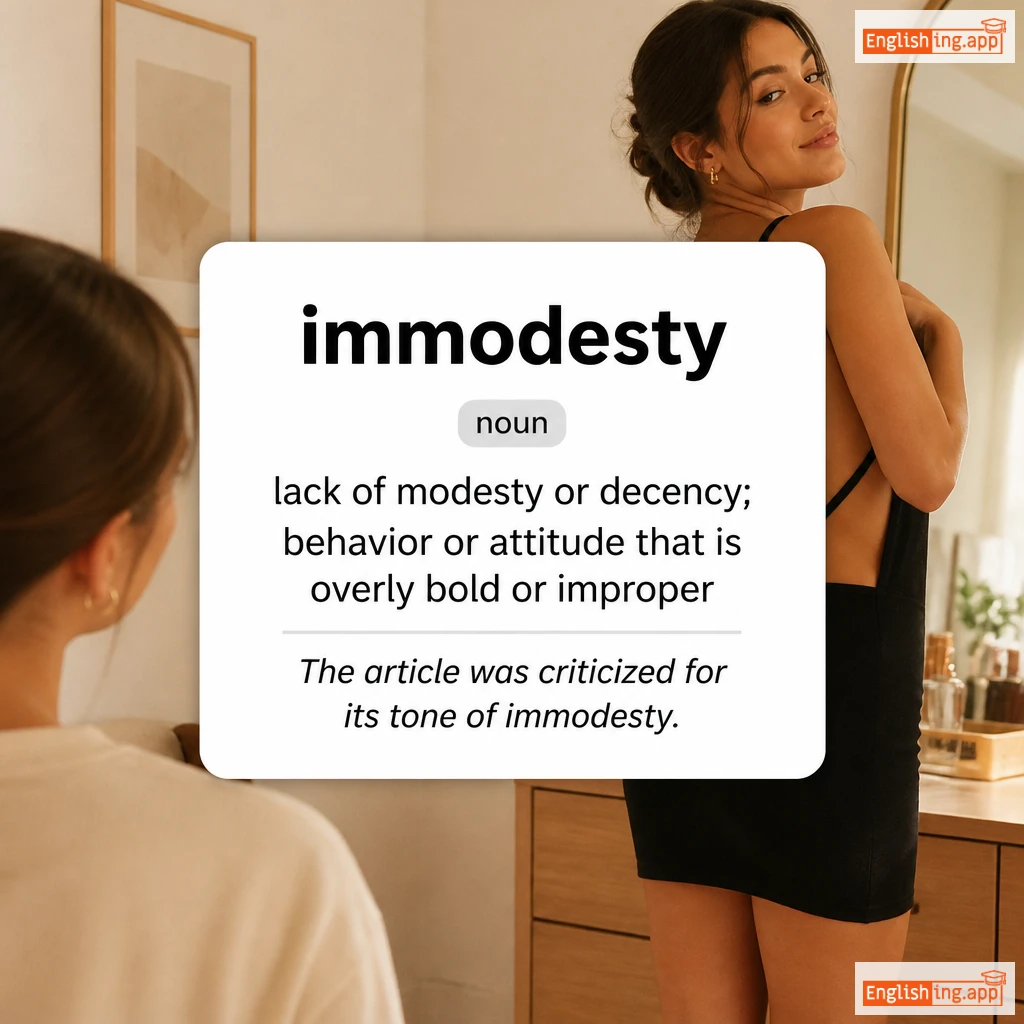
immodesty definition card — visual illustration of the meaning
noun C2
/ɪˈmɒdəsti/
不谦逊 (bu qianxun)

lack of modesty or decency; behavior or attitude that is overly bold or improper

"The article was criticized for its tone of immodesty."

"这篇文章因其不谦逊的语气而受到批评。" (zhe pian wenzhang yin qi bu qianxun de yuqi er shoudao piping)
verb C2
/ˈɪməleɪt/
自焚 (zìfén)

To kill or sacrifice, especially by burning.

"The protesters threatened to immolate themselves in front of the building."

"抗议者威胁要在建筑物前自焚。" (Kàngyì zhě wēixié yào zài jiànzhúwù qián zìfén.)
verb C2
/ɪˈmjʊər/
囚禁 (qiújìn)

to confine or enclose someone against their will

"The prisoner was immured in a dark cell."

"囚犯被禁闭在一个黑暗的牢房里。" (Qiúfàn bèi jìnbì zài yīgè hēi'àn de láofáng lǐ.)
noun C2
/ɪmp/
小顽皮精灵 (xiao wanpi jingling)

a small mischievous devil or sprite; a playful troublemaker

"The child was acting like a little imp, hiding his toys everywhere."

"那个孩子像一个小顽皮精灵,四处藏玩具。" (Na ge haizi xiang yi ge xiao wanpi jingling, sichu cang wanju.)
verb C2
/ɪmˈpeɪl/
刺穿 (cìchuān)

to pierce or fix something with a sharp object

"The knight was impaled by the enemy’s spear."

"骑士被敌人的长矛刺穿。" (Qíshì bèi dírén de chángmáo cìchuān.)
adjective C2
/ɪmˈpælpəbəl/
难以触及的 (nanyi chuji de)

unable to be felt by touch; difficult to grasp or understand

"There was an impalpable sense of fear in the room."

"房间里有一种难以触及的恐惧感。" (Fangjian li you yizhong nanyi chuji de kongju gan.)
adjective C2
/ɪmˈpæsɪbəl/
不可忍受的 (bukener shou de)

Incapable of suffering or feeling pain (used mainly in theological or philosophical contexts).

"Some philosophers argue that God is impassible and cannot experience human emotions."

"一些哲学家认为上帝是不可忍受的,无法体验人类的情感。" (Yixie zhexuejia renwei Shangdi shi bukener shou de, wufa tijian renlei de qinggan.)
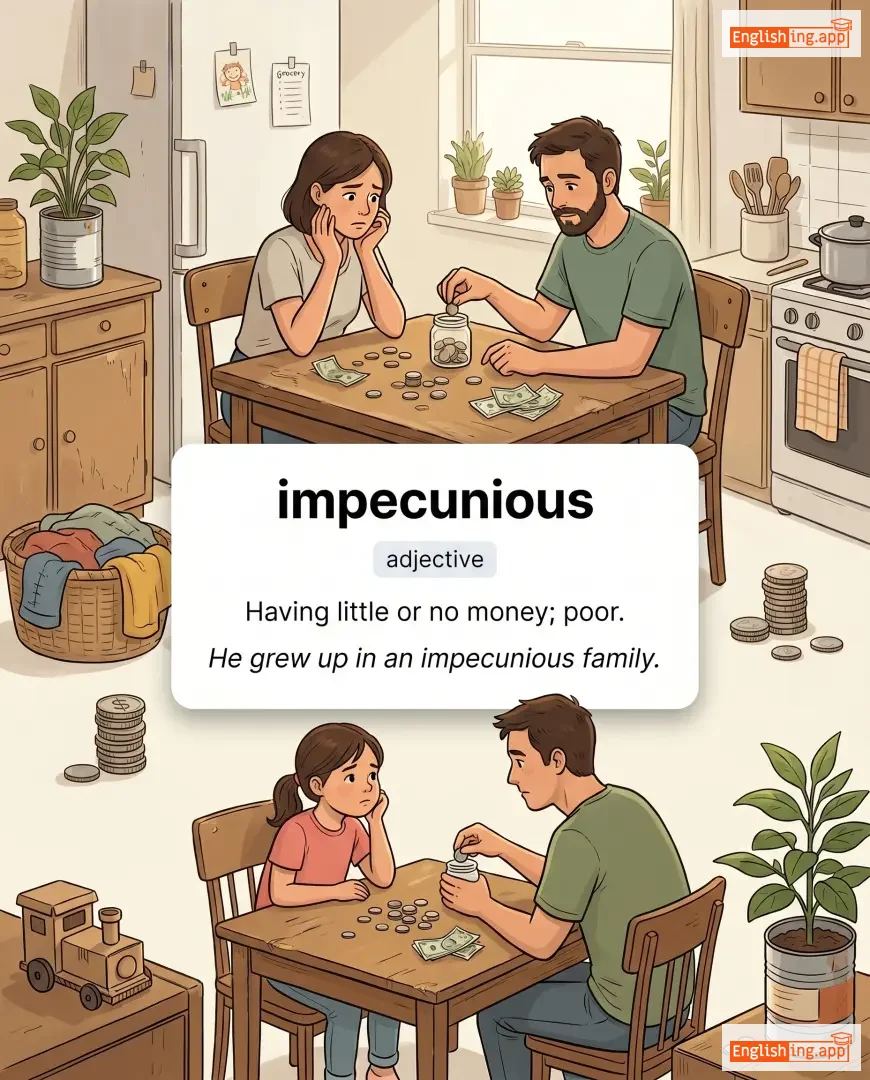
impecunious definition card — visual illustration of the meaning
adjective C2
/ˌɪmpɪˈkjuːniəs/
贫穷 (pinqiong)

Having little or no money; poor.

"He grew up in an impecunious family."

"他在一个贫穷的家庭中长大。" (Ta zai yi ge pinqiong de jiating zhong zhangda.)