Vocabularies

English Vocabulary Dictionary | Word Meanings, Definitions & Examples

adjective C1
/ˌɔː.riˈen.təl/
与东亚国家相关的;东方的 (dongfang)

relating to the countries of East Asia; eastern

"The museum has a beautiful collection of oriental art."

"博物馆收藏有美丽的东方艺术作品。" (Bowuguan shoucang you mei li de dongfang yishu zuopin)
adjective C1
/ˌɔːrnəˈmɛntl/
装饰性的 (zhuāngshì xìng de)

Serving as decoration; decorative rather than functional.

"The garden was filled with ornamental plants."

"花园里满是装饰性的植物。" (Huāyuán lǐ mǎn shì zhuāngshì xìng de zhíwù.)
adjective C1
/ɔːˈneɪt/
华丽的 (huálì de)

elaborately or highly decorated

"The palace hall was filled with ornate furniture and paintings."

"宫殿的大厅里充满了华丽的家具和画作。" (Gōngdiàn de dàtīng lǐ chōngmǎn le huálì de jiājù hé huàzuò.)
adjective C1
/ˈɔːrθədɑːks/

conforming to traditional beliefs or practices

"He comes from a very orthodox family."

noun C1
/ˈɔːrθədɑːksi/
正统 (zhèngtǒng)

traditional or generally accepted beliefs and practices

"The religious leader defended the orthodoxy of the faith."

"宗教领袖捍卫了信仰的正统性。" (Zōngjiào lǐngxiù hànwèi le xìnyǎng de zhèngtǒngxìng.)
adjective C1
/ˌɔːrθəˈpiːdɪk/
与骨骼或肌肉畸形的矫正有关 (yǔ gǔgé huò jīròu jīxíng de jiǎozhèng yǒuguān)

Relating to the correction of deformities of bones or muscles.

"She visited an orthopedic surgeon for her back pain."

"她因为背痛去看了骨科医生。" (Tā yīnwèi bèi tòng qù kànle gǔkē yīshēng.)
oscillate definition card — visual illustration of the meaning
verb C1
/ˈɑːsɪleɪt/
幸福 (xìngfú)

To move or swing back and forth at a regular speed.

"The fan oscillates to spread air around the room."

"她获得奖项时无法掩饰她的幸福。" (Tā huòde jiǎngxiàng shí wúfǎ yǎnshì tā de xìngfú.)
noun C1
/ˌɑːsɪˈleɪʃən/
摆动 (bǎidòng)

The movement back and forth at a regular speed.

"The oscillation of the pendulum controls the clock."

"摆锤的摆动控制着时钟。" (Bǎichuí de bǎidòng kòngzhì zhe shízhōng.)
adjective C1
/ɒˈstɛnsəbl/
表面上 (biaomian shang)

stated or appearing to be true, but not necessarily so

"His ostensible reason for leaving was illness, but many doubted it."

"他离开的表面上原因是生病,但许多人对此表示怀疑。" (Tā líkāi de biǎomiàn shàng yuányīn shì shēngbìng, dàn xǔduō rén duì cǐ biǎoshì huáiyí.)
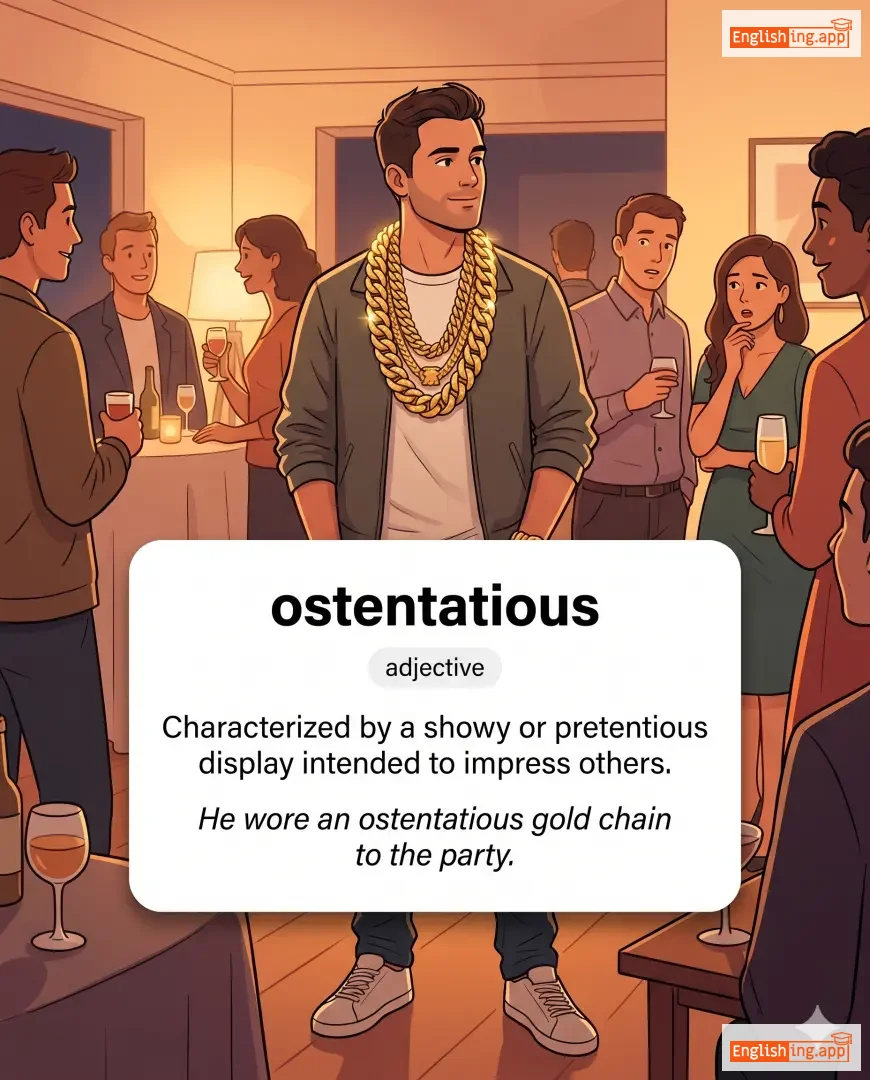
ostentatious definition card — visual illustration of the meaning
adjective C1
/ˌɒstɛnˈteɪʃəs/
炫耀的 (xuànyào de)

Characterized by a showy or pretentious display intended to impress others.

"He wore an ostentatious gold chain to the party."

"他在派对上戴着一条炫耀的金链子。" (Tā zài pàiduì shàng dàizhe yītiáo xuànyào de jīn liànzi.)
noun C1
/ˈɒstrəsɪzəm/
排斥 (paichi)

The act of excluding someone from a group or society.

"The student faced ostracism after breaking the rules."

"学生在违反规则后遭受了排斥。" (Xuesheng zai weifan guize hou zaoshou le paichi.)
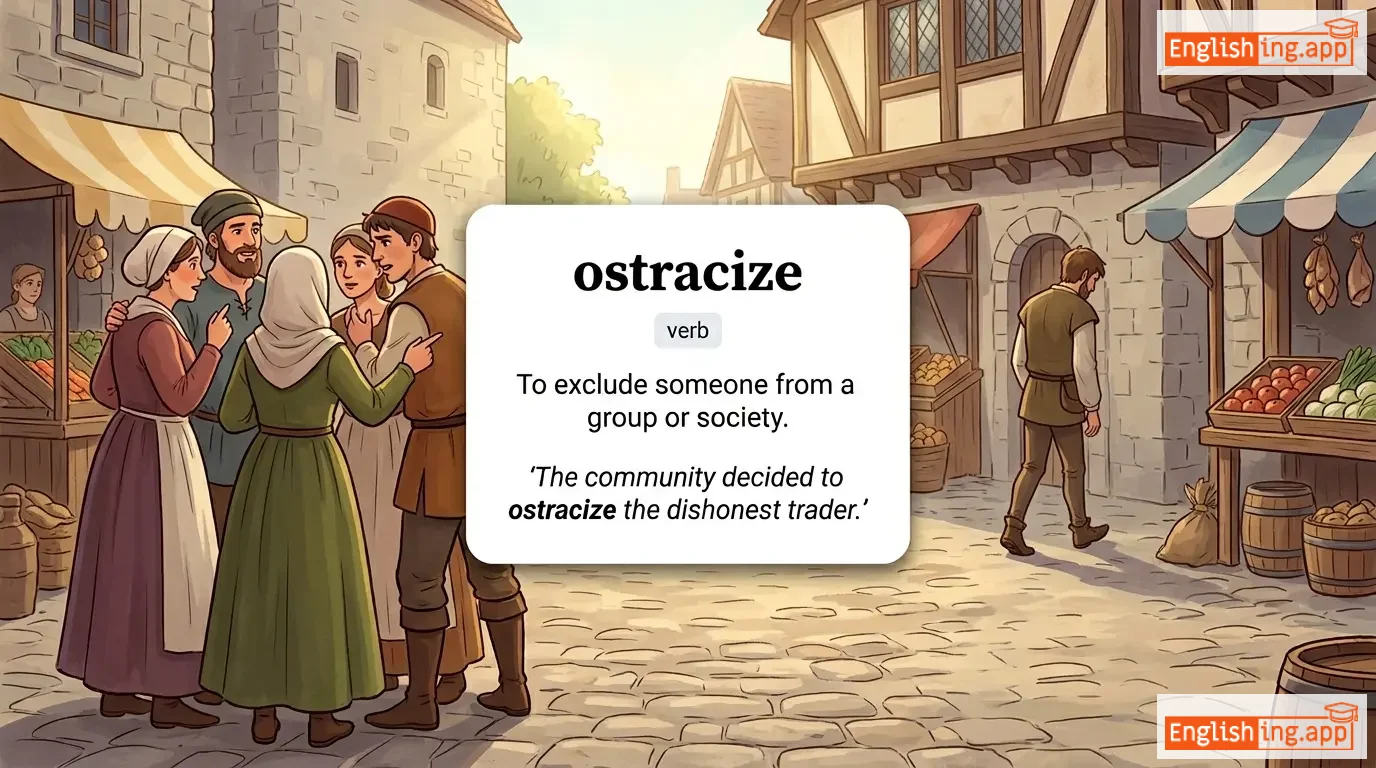
ostracize definition card — visual illustration of the meaning
verb C1
/ˈɒstrəsaɪz/
排斥 (paichi)

To exclude someone from a group or society.

"The community decided to ostracize the dishonest trader."

"社区决定将不诚实的商人排斥在外。" (Shequ jueding jiang buchengshi de shangren paichi zaiwai.)
verb C1
/aʊst/
驱逐 (qūzhú)

To remove someone from a position or place of power or authority.

"The rebels ousted the dictator from power."

"叛乱者将独裁者赶下台。" (Pànluàn zhě jiāng dúcáizhě gǎn xià tái.)
adjective C1
/ˌaʊt ən ˈaʊt/
完全 (wanquan)

complete; absolute; used to emphasize something extreme

"The speech was an out-and-out lie."

"这个演讲是一个完全的谎言。" (Zhe ge yanjiang shi yi ge wanquan de huangyan.)
adjective C1
/ˌaʊt əv ðə ˈweɪ/
偏远的或不寻常的 (pianyuan de huo bu xunzhang de)

remote or unusual; not in a convenient or usual location

"They stayed in an out-of-the-way village."

"他们住在一个偏远的村庄里。" (Tāmen zhù zài yīgè piānyuǎn de cūnzhuāng lǐ.)
noun C1
/ˈaʊtkæst/
被排斥者 (bèi páichī zhě)

a person who is rejected or excluded from society or a group

"He felt like an outcast at school."

"他在学校里觉得自己像个被排斥者。" (Tā zài xuéxiào lǐ juédé zìjǐ xiàng gè bèi páichī zhě.)
noun C1
/ˈaʊtˌkraɪ/
抗议 (kangyi)

A strong expression of public anger or disapproval.

"The decision sparked an outcry among the citizens."

"这个决定在市民中引发了抗议。" (Zhege jueding zai shimin zhong yinfa le kangyi.)
verb C1
/ˌaʊtˈduː/
超越 (chaoyue)

To do better than someone else; to surpass.

"She always tries to outdo her classmates in exams."

"她总是尽力在考试中超越她的同学。" (Tā zǒng shì jìnlì zài kǎoshì zhōng chāoyuè tā de tóngxué.)
noun C1
/ˈaʊtˌɡroʊθ/
衍生物 (yǎnshēngwù)

something that grows out of something else; a natural development or result

"The new policy was an outgrowth of years of debate."

"新政策是多年辩论的衍生物。" (Xīn zhèngcè shì duōnián biànlùn de yǎnshēngwù.)
adjective C1
/ˌaʊtˈlændɪʃ/
奇异 (qiyi)

Looking or sounding bizarre or unfamiliar; strange.

"He wore an outlandish costume to the festival."

"他穿着一件奇异的服装参加了节日。" (Ta chuanzhe yijian qiyi de fuzhuang canjia le jieri.)
verb C1
/aʊtˈlæst/
比...持续更久 (bǐ... chíxù gèng jiǔ)

to continue longer than; to endure beyond someone or something else

"The old castle has outlasted many generations."

"这座古老的城堡已经比许多代人持续得更久。" (Zhè zuò gǔlǎo de chéngbǎo yǐjīng bǐ xǔduō dài rén chíxù de gèng jiǔ.)
verb C1
/aʊtˈlɪv/
比…活得长 (bǐ… huó de cháng)

to live longer than someone or something else

"She outlived all her siblings."

"她活过了所有的兄弟姐妹。" (Tā huóguò le suǒyǒu de xiōngdì jiěmèi.)
adjective C1
/aʊtˈmoʊdɪd/
过时的 (guòshí de)

No longer in fashion or useful; outdated.

"That old computer is completely outmoded."

"那台旧电脑完全过时了。" (nà tái jiù diànnǎo wánquán guòshí le.)
noun C1
/ˈaʊtpoʊst/
前哨站 (qiánshàozhàn)

A small military camp or position at some distance from the main force, used especially as a guard.

"The soldiers were stationed at a remote outpost."

"士兵们被驻扎在一个偏远的前哨站。" (Shìbīngmen bèi zhùzhā zài yīgè piānyuǎn de qiánshàozhàn.)
noun C1
/ˈaʊtriːtʃ/
援助扩展 (yuánzhù kuòzhǎn)

The act of providing services or support to people who might not otherwise have access to them.

"The charity launched a new outreach program for the homeless."

"慈善机构为无家可归的人推出了一个新的援助扩展计划。" (Císhàn jīgòu wèi wújiā kěguī de rén tuīchūle yīgè xīn de yuánzhù kuòzhǎn jìhuà.)
outsourcing definition card — visual illustration of the meaning
noun C1
ˈaʊt.sɔː.sɪŋ
外包 (waibao)

The practice of having certain job functions done outside a company instead of having an in-house department or employee handle them.

"Many companies use outsourcing to reduce operational costs."

"许多公司通过外包来减少运营成本。" (Xǔduō gōngsī tōngguò wàibāo lái jiǎnshǎo yùnyíng chéngběn.)
adjective C1
/ˌaʊtˈspoʊkən/
直言不讳 (zhí yán bù huì)

Expressing opinions or feelings freely and openly.

"She is known for being outspoken about social issues."

"她以公开表达对社会问题的看法而闻名。" (Tā yǐ gōngkāi biǎodá duì shèhuì wèntí de kànfǎ ér wénmíng.)
verb C1
/ˌaʊtˈstrɛtʃ/
伸展 (shen zhan)

To extend or stretch something outward.

"He outstretched his hand to help her up."

"他伸出手来帮助她站起来。" (Ta shenchu shou lai bangzhu ta zhan qilai.)
verb C1
/ˌaʊtˈstrɪp/
超越 (chaoyue)

To go faster or do better than someone or something; to surpass.

"The company outstripped its competitors in sales last year."

"公司在去年超越了它的竞争对手。" (Gongsi zai qunian chaoyue le ta de jingzheng duishou.)
adverb C1
/ˈaʊtwədli/
表面上; 外观上; (biaomian shang; waiguan shang;)

on the surface; externally; in appearance

"Outwardly, he seemed calm, but inside he was nervous."

"表面上,他看起来很冷静,但内心却很紧张。" (Biaomian shang, ta kanqilai hen lengjing, dan neixin que hen jinzhang.)
verb C1
/ˌaʊtˈweɪ/
比...更重要 (bi... geng zhongyao)

To be more important, valuable, or significant than something else.

"The benefits of the new policy outweigh the risks."

"新政策的好处超过了风险。" (Xin zhengce de haochu chao guo le fengxian.)
verb C1
/aʊtˈwɪt/
智胜 (zhì shèng)

to defeat or gain an advantage over someone by being more clever or cunning

"The fox managed to outwit the hunters."

"狐狸成功地智胜了猎人。" (Húlí chénggōng de zhì shèng le lièrén.)
noun C1
/oʊˈveɪʃən/
掌声 (zhǎngshēng)

an enthusiastic show of approval, especially by clapping hands

"The actor received a standing ovation after his performance."

"演员在表演后收到了站立的掌声。" (Yǎnyuán zài biǎoyǎn hòu shōudào le zhànlì de zhǎngshēng.)
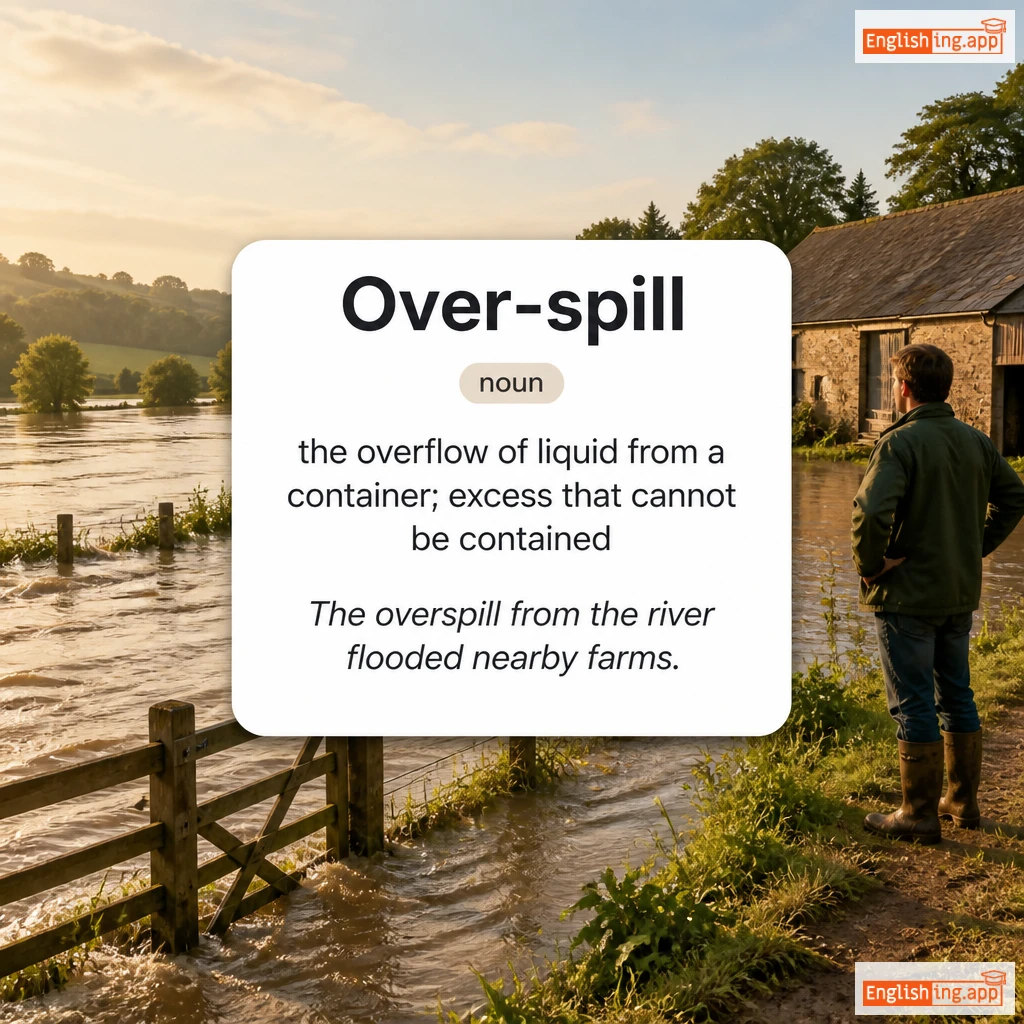
Over-spill definition card — visual illustration of the meaning
noun C1
/ˈoʊ.vər spɪl/
溢出 (yī chū)

the overflow of liquid from a container; excess that cannot be contained

"The overspill from the river flooded nearby farms."

"河水溢出导致附近的农田被淹没。" (He shui yi chu da zhi fu jin de nong tian bei yan mo.)
overarching definition card — visual illustration of the meaning
adjective C1
/ˌoʊ.vɚˈɑːr.tʃɪŋ/
全面或广泛 (quánmiàn huò guǎngfàn)

Having comprehensive and widespread influence or coverage.

"Sustainability is an overarching goal in modern business."

"可持续性是现代商业中的一个全面目标。" (Kěchíxùxìng shì xiàndài shāngyè zhōng de yīgè quánmiàn mùbiāo.)
adjective C1
/ˌoʊvərˈbɛrɪŋ/
专横 (zhuānhéng)

unpleasantly or arrogantly domineering

"His overbearing attitude made everyone uncomfortable."

"他的专横态度让所有人都感到不舒服。" (Tā de zhuānhéng tàidù ràng suǒyǒu rén dōu gǎndào bù shūfu.)
adjective C1
/ˌoʊvərˈbloʊn/
夸张 (kuazhang)

excessively exaggerated or inflated

"The controversy was overblown by the media."

"媒体过度夸大了争议。" (Měitǐ guòdù kuādàle zhēngyì.)
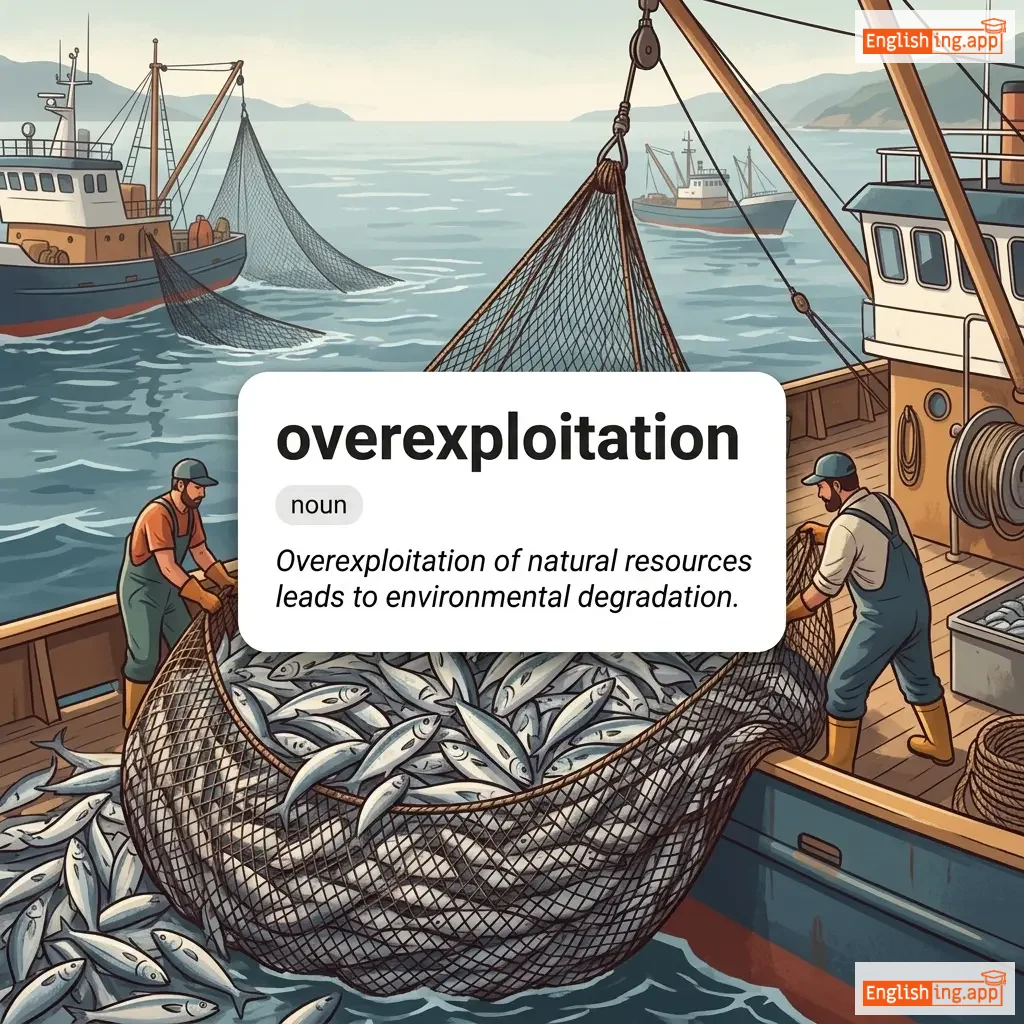
overexploitation definition card — visual illustration of the meaning
noun C1
/ˌəʊvərɪksˌplɔɪˈteɪʃən/
过度开发 (guòdù kāifā)

The unsustainable use of natural resources at a rate that exceeds their ability to regenerate, leading to depletion and environmental degradation.

"Overexploitation of natural resources leads to environmental degradation."

"过度开发自然资源会导致环境退化。" (Guòdù kāifā zìrán zīyuán huì dǎozhì huánjìng tuìhuà.)
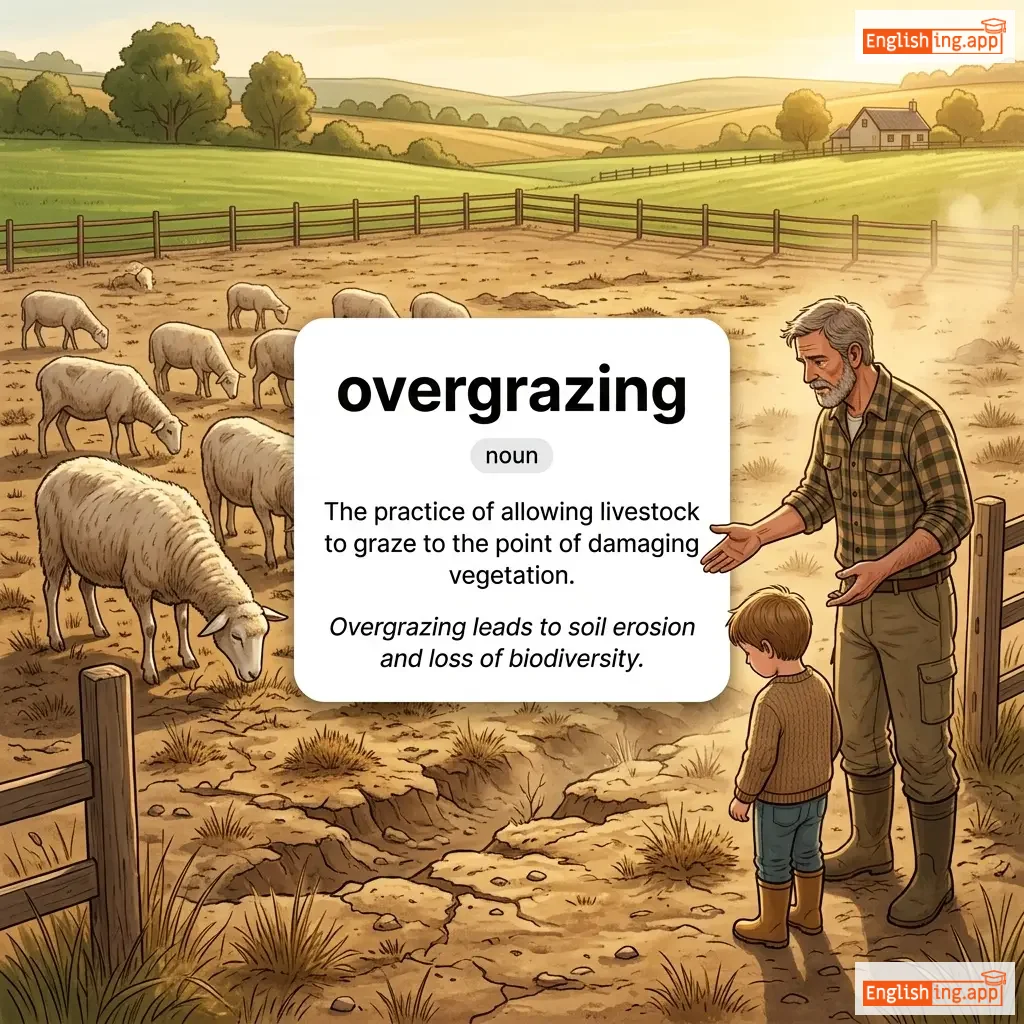
overgrazing definition card — visual illustration of the meaning
noun C1
ˌoʊ.vɚˈɡreɪ.zɪŋ
过度放牧 (guòdù fàngmù)

The practice of allowing livestock to graze to the point of damaging vegetation.

"Overgrazing leads to soil erosion and loss of biodiversity."

"过度放牧导致土壤侵蚀和生物多样性的丧失。" (Guòdù fàngmù dǎozhì tǔrǎng qīnshí hé shēngwù duōyàngxìng de sàngshī.)
noun/verb C1
/ˈoʊvərˌhæŋ/
悬垂 (xuán chuí)

To extend outward and hang over something; a projecting part.

"The roof overhang provides shade in the summer."

"屋顶的悬垂部分在夏天提供阴凉。" (Wūdǐng de xuánchuí bùfen zài xiàtiān tígōng yīnliáng.)
verb C1
/ˈoʊvərˌhɔːl/
全面改革 (quánmiàn gǎigé)

to examine thoroughly and repair or improve something that is worn or ineffective

"The company decided to overhaul its outdated computer system."

"公司决定彻底改革其过时的计算机系统。" (Gōngsī juédìng chèdǐ gǎigé qí guòshí de jìsuànjī xìtǒng.)
verb C1
/ˌoʊvərˈpaʊər/
征服 (zhēng fú)

To defeat or gain control over someone or something by using greater strength or force.

"The soldiers managed to overpower the enemy forces."

"士兵们成功压倒了敌军。" (Shìbīng men chénggōng yādǎo le dí jūn.)
noun C1
/ˌoʊvərprəˈdʌkʃən/
过度生产 (guò dù shēng chǎn)

The act of producing more of something than is needed or can be consumed.

"The economic crisis was caused by the overproduction of goods."

"经济危机是由商品的过度生产引起的。" (Jīngjì wéijī shì yóu shāngpǐn de guò dù shēng chǎn yǐnqǐ de.)
verb C1
/ˌoʊvərˈriːtʃ/
过度伸展 (guòdù shēnzhǎn)

to go beyond what is proper, acceptable, or achievable; to overextend

"The politician overreached by making promises he couldn't keep."

"那位政治家在做出无法兑现的承诺时,过度伸展了自己。" (Nà wèi zhèngzhìjiā zài zuò chū wúfǎ duìxiàn de chéngnuò shí, guòdù shēnzhǎnle zìjǐ.)
overrule definition card — visual illustration of the meaning
verb C1
/ˌoʊvərˈruːl/
驳回 (bohui)

to reject or disallow by exercising one's superior authority; to override a decision

"The judge overruled the objection from the defense attorney."

"法官驳回了辩护律师的反对。" (Faguan bohui le bianhu lushi de fandui.)
verb C1
/ˌoʊvərˈrʌn/
侵占 (qīnzhàn)

to spread over or occupy completely; to exceed a limit or time

"The garden was overrun with weeds."

"花园被杂草淹没。" (Huāyuán bèi zácǎo yānmò.)
noun C1
/ˈoʊvərˌsiːər/
监督员 (jiāndūyuán)

a person who supervises work or workers; a manager

"The overseer made sure the workers followed safety rules."

"监督员确保工人遵守安全规则。" (Jiāndūyuán quèbǎo gōngrén zūnshǒu ānquán guīzé.)
verb C1
/ˌoʊvərˈʃædoʊ/
掩盖 (yǎngài)

to appear more important or significant than something else, reducing its impact

"The scandal overshadowed his achievements."

"丑闻掩盖了他的成就。" (Chǒuwén yǎngài le tā de chéngjiù.)
overstimulated definition card — visual illustration of the meaning
adjective C1
/ˌəʊvərˈstɪmjʊˌleɪtɪd/
过度刺激的 (guo du ci ji de)

Excessively excited or aroused, overwhelmed by too much stimulus.

"Overstimulated minds can lead to burnout and decreased productivity."

"过度刺激的头脑可能导致倦怠和生产力下降。" (guodu ciji de tounao keneng daozhi juan dai he shengchanli xiajiang)
adjective C1
/oʊˈvɜːrt/
公开的 (gongkai de)

Done or shown openly; not hidden or secret.

"There was an overt display of hostility between the rivals."

"在对手之间有一种公开的敌意表现。" (Zai duishou zhijian you yizhong gongkai de diyi biaoxian.)