Vocabularies

English Vocabulary Dictionary | Word Meanings, Definitions & Examples

adjective C1
/prəˈfɛtɪk/
prophétique (prophetique)

accurately predicting or describing what will happen in the future

"His prophetic words came true after many years."

"Ses paroles prophétiques se sont réalisées après de nombreuses années." (Ses paroles prophétiques se sont réalisées après de nombreuses années.)
noun C1
/prəˈpoʊnənt/
partisan, promoteur (partisan, promoteur)

a person who advocates for or supports a particular idea, cause, or plan

"She is a strong proponent of renewable energy."

"Elle est une forte partisane de l'énergie renouvelable." (Elle est une forte partisane de l'énergie renouvelable.)
adjective C1
/prəˈpɔːrʃənət/
proportionnel (proportionnel)

Corresponding in size, degree, or intensity; balanced in relation.

"The punishment should be proportionate to the crime."

"La peine doit être proportionnelle au crime." (La peine doit etre proportionnelle au crime.)
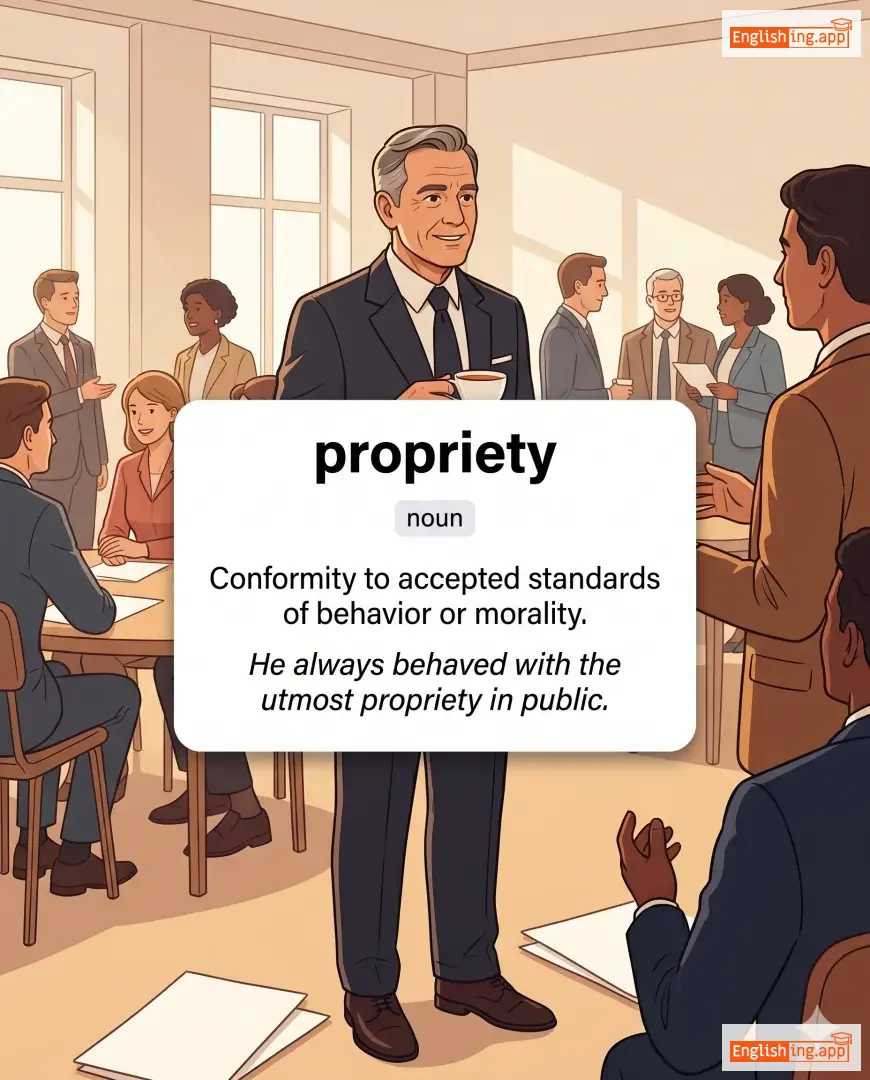
propriety definition card — visual illustration of the meaning
noun C1
/prəˈpraɪəti/
propreté (proprete)

Conformity to accepted standards of behavior or morality.

"He always behaved with the utmost propriety in public."

"Il se comportait toujours avec la plus grande propreté en public." (Il se comportait toujours avec la plus grande propreté en public.)
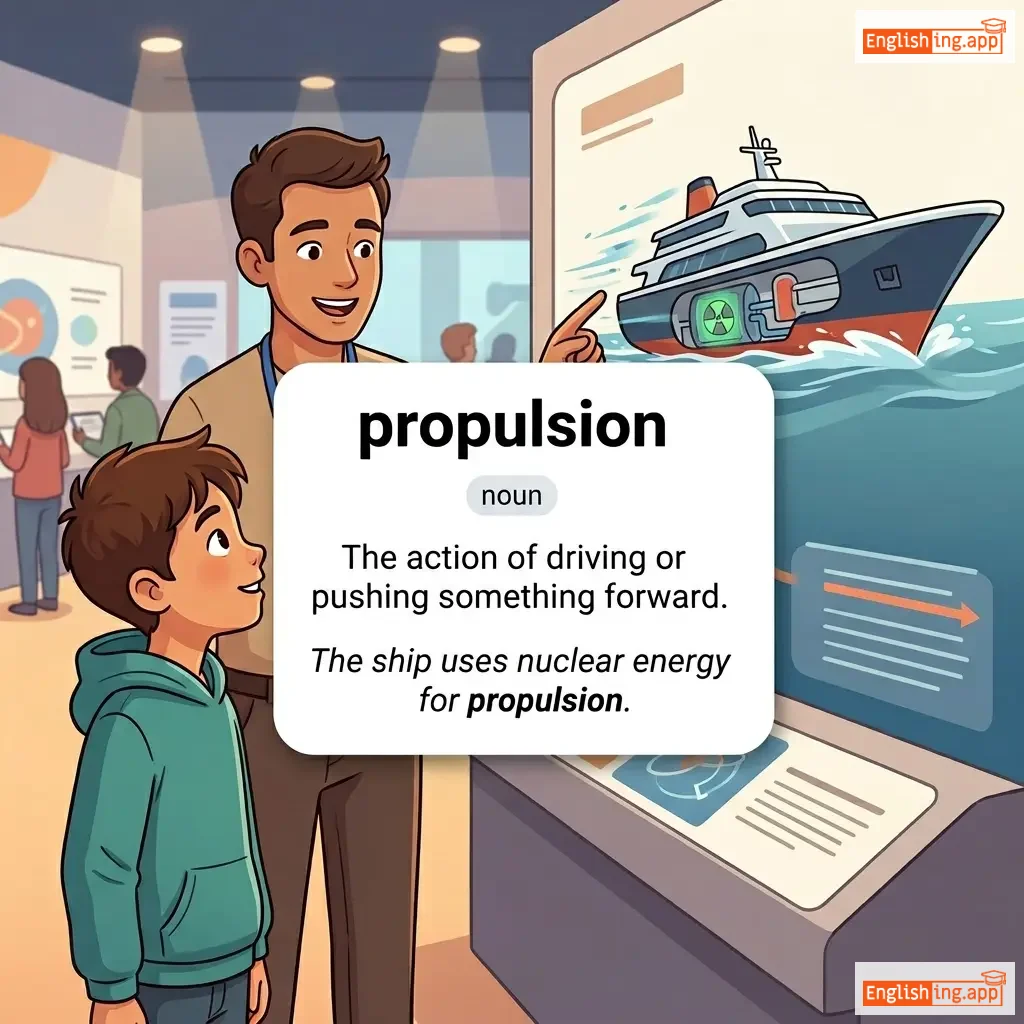
propulsion definition card — visual illustration of the meaning
noun C1
/prəˈpʌlʃən/
propulsion (propulsion)

The action of driving or pushing something forward.

"The ship uses nuclear energy for propulsion."

"Le navire utilise l'énergie nucléaire pour la propulsion." (Le navire utilise l'energie nucleaire pour la propulsion.)
adjective C1
/proʊˈzeɪ.ɪk/
prosaïque (prosaïque)

ordinary, dull, or lacking imagination

"The teacher’s explanation was accurate but rather prosaic."

"L'explication du professeur était précise, mais plutôt prosaïque." (L'explication du professeur était précise, mais plutôt prosaïque.)
noun C1
/ˈprɒspɛktər/
prospecteur minier (prospecteur minier)

a person who searches for mineral deposits, especially gold

"The prospector spent years in the mountains searching for gold."

"Le prospecteur a passé des années dans les montagnes à chercher de l'or." (Le prospecteur a passé des années dans les montagnes à chercher de l'or.)
noun C1
/prəˈspɛktəs/
prospectus (prospectus)

a printed document that advertises or describes a school, business, or investment offering

"The university sent out a prospectus to attract new students."

"L'université a envoyé un prospectus pour attirer de nouveaux étudiants." (L'université a envoyé un prospectus pour attirer de nouveaux étudiants.)
adjective/verb C1
/ˈprɒstreɪt/
prosterné (prosterné)

lying stretched out on the ground with one's face downward, often as a sign of submission or exhaustion

"He lay prostrate on the ground after the long battle."

"Il s'est allongé prosterné après la longue bataille." (Il s'est allongé prosterné après la longue bataille.)
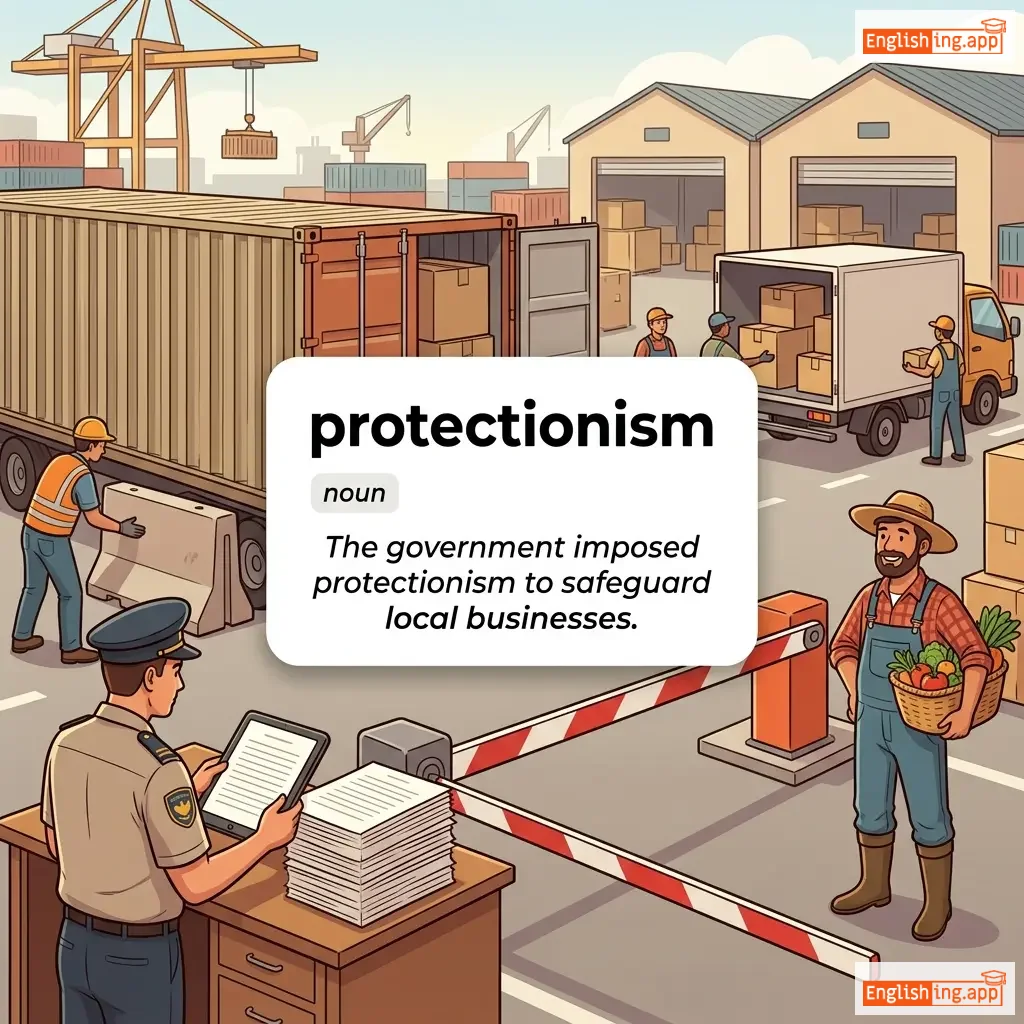
protectionism definition card — visual illustration of the meaning
noun C1
/prəˈtɛk.ʃəˌnɪz.əm/
protectionnisme (protectionnisme)

A trade policy that restricts imports to safeguard domestic industries through trade restriction, economic nationalism, or isolationism.

"The government imposed protectionism to safeguard local businesses."

"Le gouvernement a imposé le protectionnisme pour protéger les entreprises locales." (Le gouvernement a impose le protectionnisme pour proteger les entreprises locales.)
noun C1
/ˈproʊtəˌʒeɪ/
protégé (protege)

a person who is guided and supported by an older and more experienced person

"The young artist was the protege of a famous painter."

"Le jeune artiste était le protégé d'un peintre célèbre." (Le jeune artiste était le protégé d'un peintre célèbre.)
noun C1
/ˈprɑːtɪstənt/
protestant (protestant)

a member of the Christian church that separated from the Roman Catholic Church during the Reformation

"Martin Luther was a key figure in the Protestant Reformation."

"Martin Luther a été une figure clé dans la Réforme protestante." (Martin Luther a été une figure clé dans la Réforme protestante.)
verb C1
/proʊˈtrækt/
prolonger (prolonger)

To prolong or extend in time or duration.

"Negotiations were protracted for several months."

"Les négociations ont été prolongées pendant plusieurs mois." (Les négociations ont été prolongées pendant plusieurs mois.)
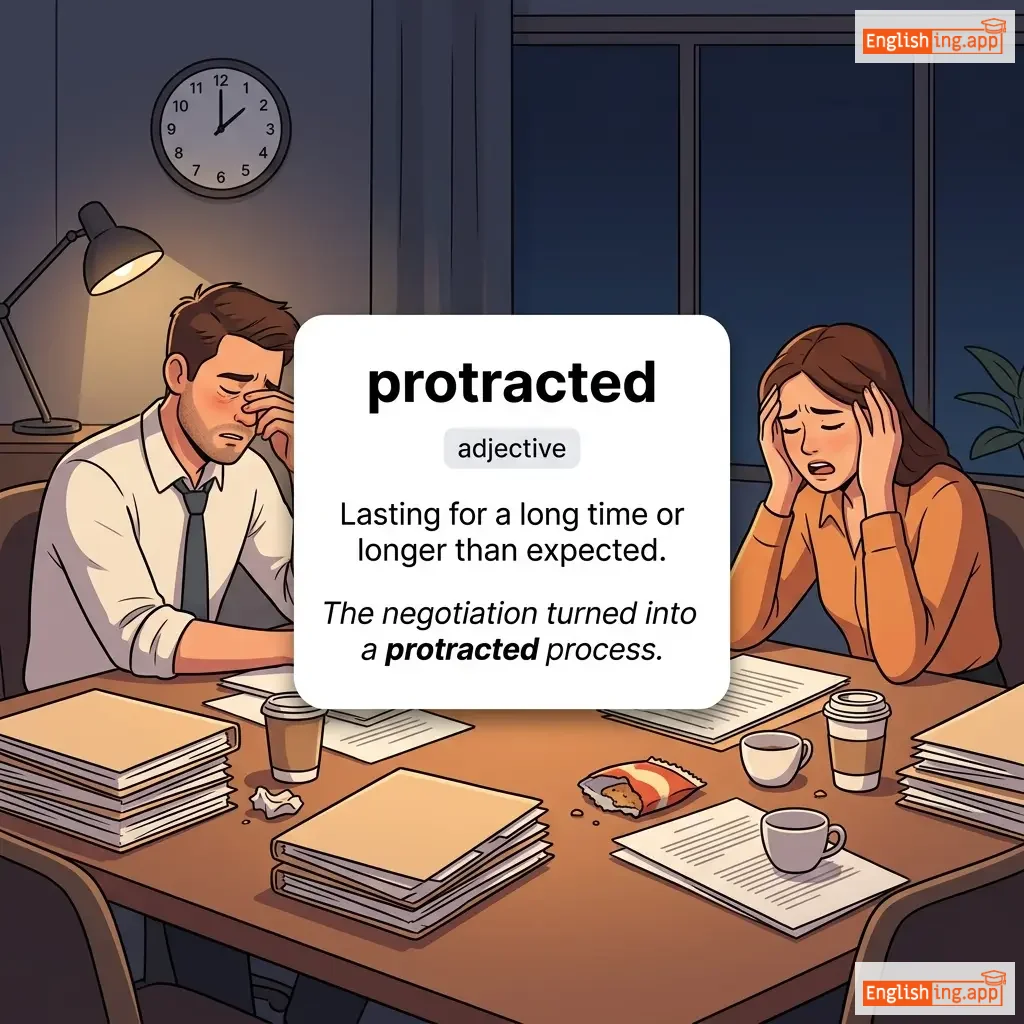
protracted definition card — visual illustration of the meaning
adjective C1
/prəˈtræktɪd/
prolongé (prolonge)

Lasting for a long time or longer than expected.

"The negotiation turned into a protracted process."

"La négociation s'est transformée en un processus prolongé." (La negociation s'est transformee en un processus prolonge.)
verb C1
/proʊˈtruːd/
dépasser (depasser)

To stick out or extend beyond a surface.

"A nail was protruding from the wooden board."

"Un clou dépassait du panneau de bois." (Un clou depassait du panneau de bois.)
noun C1
/prəˈtruːʒən/
saillie (saillie)

Something that sticks out or projects from a surface.

"The protrusion on the wall made it difficult to move the furniture."

"La saillie sur le mur a rendu difficile de déplacer les meubles." (La saillie sur le mur a rendu difficile de déplacer les meubles.)
noun C1
/ˈprɒvənəns/
provenance (provenance)

The origin or source of something.

"The museum verified the provenance of the ancient manuscript."

"Le musée a vérifié l'origine du manuscrit ancien." (Le musée a vérifié l'origine du manuscrit ancien.)
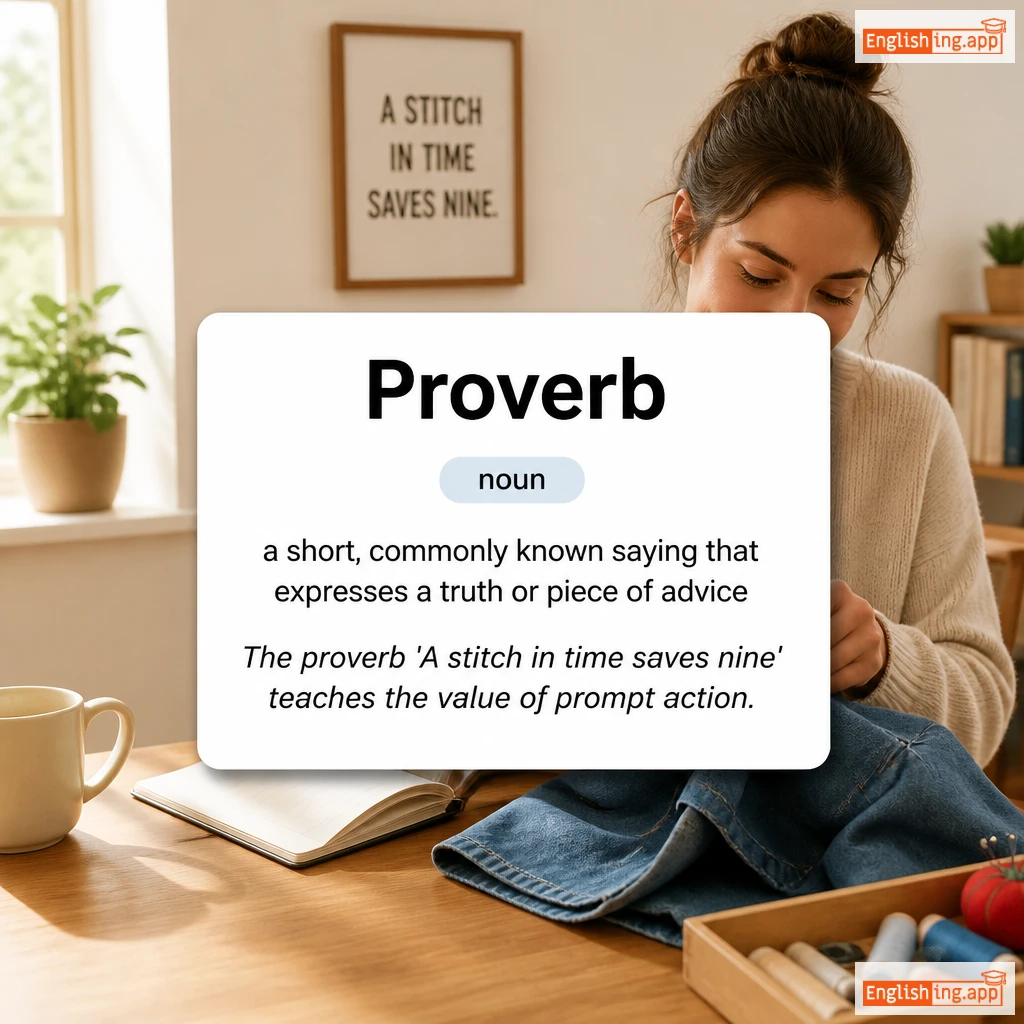
Proverb definition card — visual illustration of the meaning
noun C1
/ˈprɒvərb/
proverbe (proverbe)

a short, commonly known saying that expresses a truth or piece of advice

"The proverb 'A stitch in time saves nine' teaches the value of prompt action."

"Le proverbe 'Un sou est un sou' enseigne l'importance d'agir rapidement." (Le proverbe 'Un sou est un sou' enseigne l'importance d'agir rapidement.)
noun C1
/ˈprɒvɪdəns/
providence divine (providence divine)

the protective care of God or nature as a spiritual power; foresight or prudence

"They believed their survival was due to divine providence."

"Ils croyaient que leur survie était due à la providence divine." (Ils croyaient que leur survie etait due a la providence divine.)
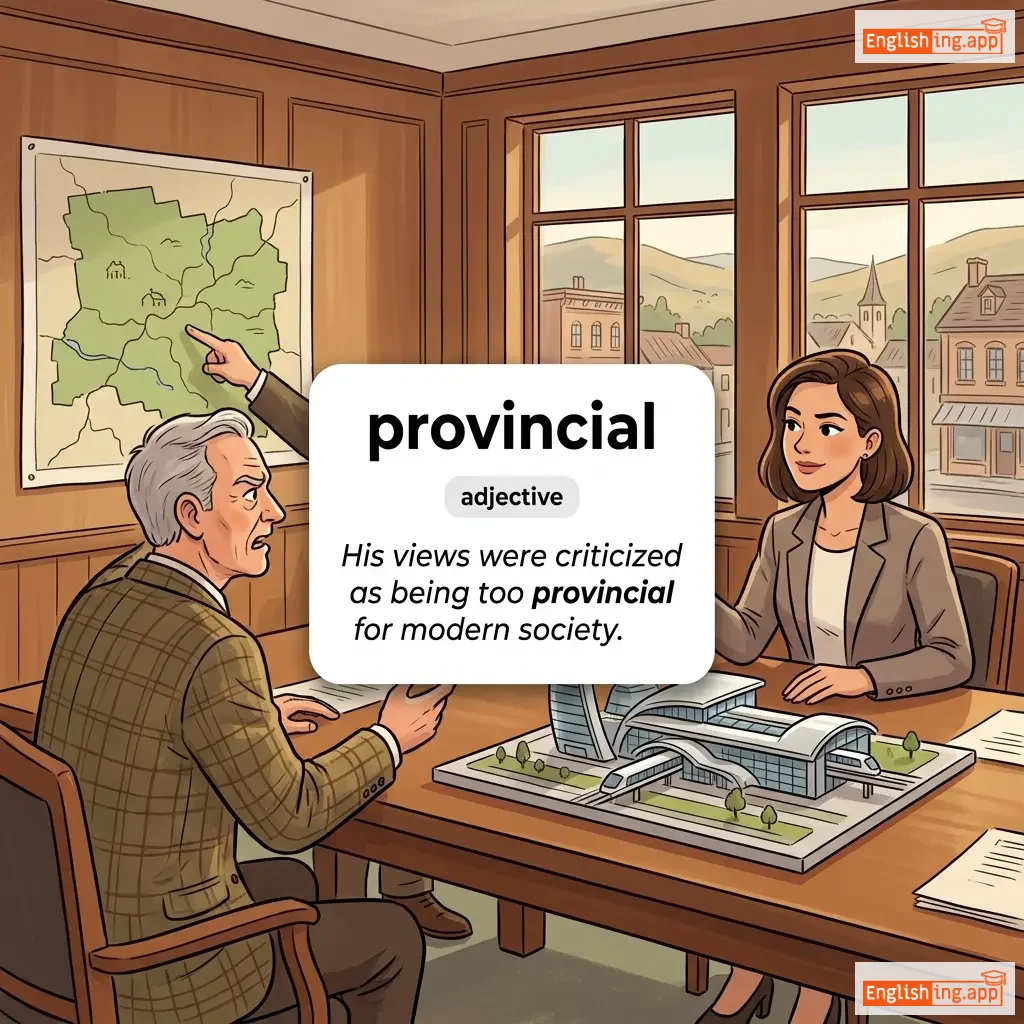
provincial definition card — visual illustration of the meaning
adjective C1
/prəˈvɪnʃəl/
provincial (provincial)

relating to a province or the regions outside the capital city; often suggesting narrow-mindedness

"His views were criticized as being too provincial for modern society."

"Ses opinions ont été critiquées comme étant trop provinciales pour la société moderne." (Ses opinions ont été critiquées comme étant trop provinciales pour la société moderne.)
noun C1
/prəˈvaɪzoʊ/
condition (condition)

a condition or stipulation attached to an agreement

"He accepted the job offer with the proviso that he could work remotely twice a week."

"Il a accepté l'offre d'emploi sous la condition qu'il puisse travailler à distance deux fois par semaine." (Il a accepte l'offre d'emploi sous la condition qu'il puisse travailler a distance deux fois par semaine.)
noun C1
/ˌprɒvəˈkeɪʃən/
provocation (provocation)

An action or statement that is intended to make someone angry or to cause a reaction.

"His rude comment was a clear provocation."

"Son commentaire impoli était une provocation évidente." (Son commentaire impoli etait une provocation evidente.)
adjective C1
/prəˈvɒkətɪv/
provocant (provokant)

Intended to make people angry, excited, or interested.

"She wore a provocative dress to the party."

"Elle portait une robe provocante à la fête." (Elle portait une robe provocante à la fête.)
adjective C1
/prəˈvoʊkɪŋ/
provocateur (provokateu)

causing anger or strong reaction; irritating; stimulating

"His provoking comments made everyone angry."

"Ses commentaires provocateurs ont mis tout le monde en colère." (Ses commentaires provocateurs ont mis tout le monde en colère.)
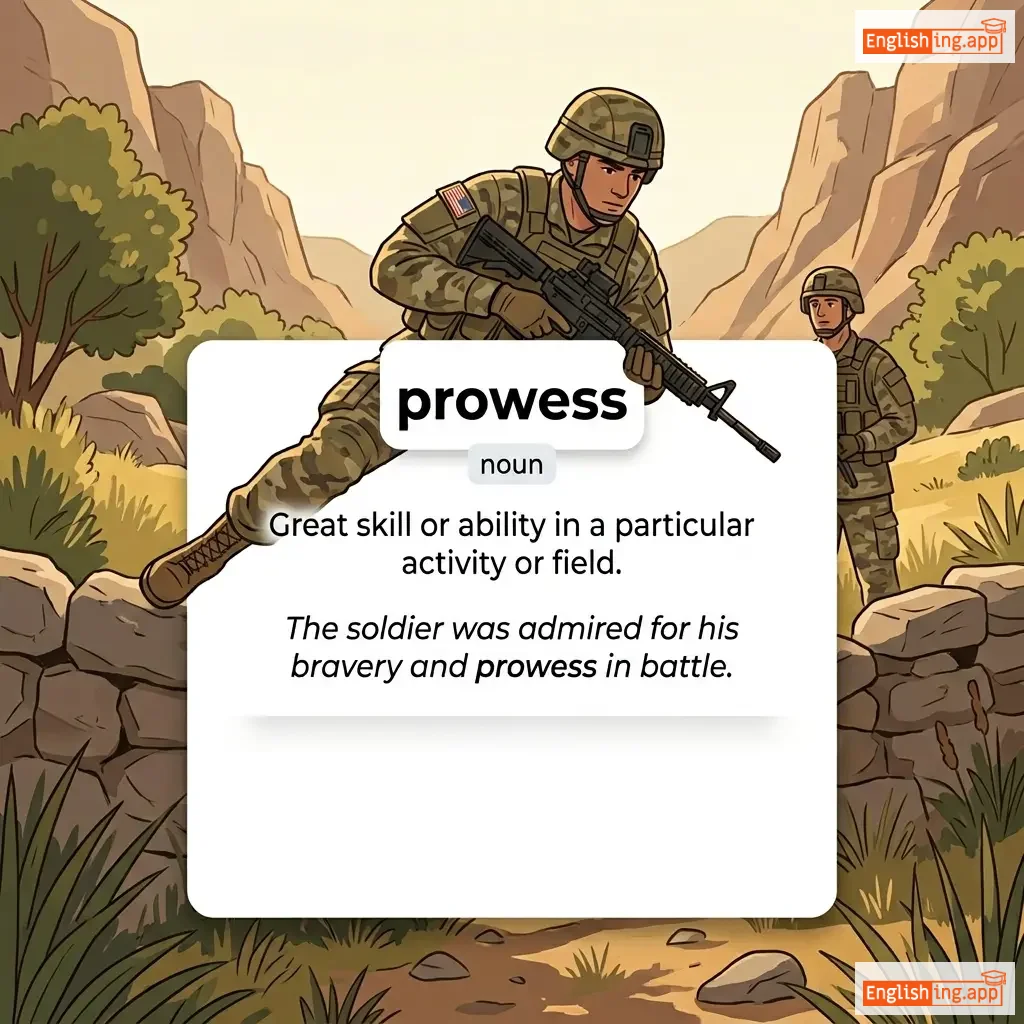
prowess definition card — visual illustration of the meaning
noun C1
/ˈpraʊəs/
habileté (habilite)

Great skill or ability in a particular activity or field.

"The soldier was admired for his bravery and prowess in battle."

"Le soldat a été admiré pour son courage et sa habileté au combat." (Le soldat a été admiré pour son courage et sa habileté au combat.)
verb C1
/praʊl/
rôder (pour chasser ou chercher) (roder (pour chasser ou chercher))

To move around quietly and secretly, especially while hunting or searching.

"The cat prowled around the garden at night."

"Le chat a rôdé autour du jardin la nuit." (Le chat a rôdé autour du jardin la nuit.)
🧑‍💼

proxy (proxy)

noun C1
/ˈprɒksi/
représentant (representant)

A person authorized to act on behalf of another; a substitute.

"She voted by proxy at the meeting."

"Elle a voté par procuration lors de la réunion." (Elle a voté par procuration lors de la réunion.)
noun C1
/ˈpruːdəns/
prudence (prudence)

The quality of being cautious, wise, and exercising good judgment.

"She invested her money with great prudence."

"Elle a investi son argent avec une grande prudence." (Elle a investi son argent avec une grande prudence.)
adjective C1
/ˈpruːdənt/
prudent (prudent)

acting with or showing care and thought for the future

"It is always prudent to save some money for emergencies."

"Il est toujours prudent d'économiser de l'argent pour les urgences." (il est toujours prudent d'economiser de l'argent pour les urgences.)
verb C1
/praɪ/
fouiner / s'immiscer (fouiner / s'immiscer)

to look closely into something; to try to find out private information

"She tried to pry into her neighbor’s private life."

"Elle a essayé de fouiner dans la vie privée de son voisin." (Elle a essaye de fouiner dans la vie privee de son voisin.)
noun C1
/ˈsuːdənɪm/
pseudonyme (pseudonyme)

a fictitious name used by an author instead of their real name

"Mark Twain was the pseudonym of Samuel Clemens."

"Mark Twain était le pseudonyme de Samuel Clemens." (Mark Twain etait le pseudonyme de Samuel Clemens.)
noun C1
/ˈsaɪkiː/
âme / esprit (ame / esprit)

the human soul, mind, or spirit

"The novel explores the depths of the human psyche."

"Le roman explore les profondeurs de la psyché humaine." (Le roman explore les profondeurs de la psyché humaine.)
adjective C1
/ˌsaɪkəˈpæθɪk/
psychopathe (psychopathe)

Relating to or affected by psychopathy; showing chronic mental disorder with abnormal or violent behavior.

"The film portrayed a psychopathic killer with no sense of empathy."

"Le film dépeignait un tueur psychopathe sans aucune empathie." (Le film dépeignait un tueur psychopathe sans aucune empathie.)
noun C1
/saɪˈkoʊsɪs/
psychose (psychose)

A severe mental disorder in which thought and emotions are impaired, leading to a loss of contact with reality.

"The patient was diagnosed with psychosis after experiencing hallucinations."

"Le patient a été diagnostiqué avec une psychose après avoir expérimenté des hallucinations." (Le patient a été diagnostiqué avec une psychose après avoir expérimenté des hallucinations.)
adjective C1
/ˌsaɪkoʊsəˈmætɪk/
psychosomatique (psychosomatique)

Relating to a physical illness or condition caused or aggravated by mental factors such as stress.

"Her stomach pain was diagnosed as psychosomatic, linked to stress."

"Sa douleur à l'estomac a été diagnostiquée comme psychosomatique, liée au stress." (Sa douleur a l'estomac a ete diagnostiquee comme psychosomatique, liee au stress.)
noun C1
/ˌsaɪkoʊˈθɛrəpi/
psychothérapie (psychotherapie)

The treatment of mental disorder by psychological rather than medical means.

"She attended weekly psychotherapy sessions to cope with her anxiety."

"Elle a assisté à des séances hebdomadaires de psychothérapie pour faire face à son anxiété." (Elle a assisté à des séances hebdomadaires de psychothérapie pour faire face à son anxiété.)
noun C1
/ˌtɛrəˈdæktɪl/
reptile volant éteint (reptile volant eteint)

An extinct flying reptile of the Jurassic period, with a long slender head and wings formed by a membrane stretching along the body.

"The museum displayed a fossil of a giant pterodactyl."

"Le musée a exposé un fossile de ptérodactyle géant." (Le musée a exposé un fossile de ptérodactyle géant.)
adjective C1
/ˈpʌlməˌneri/
pulmonaire (pulmonaire)

relating to the lungs

"The patient suffered from a serious pulmonary infection."

"The patient suffered from a serious pulmonary infection." (Le patient souffrait dune grave infection pulmonaire.)
noun C1
/ˈpʊlpɪt/
chaire (chaire)

a raised platform in a church from which the preacher delivers a sermon

"The pastor stood at the pulpit to address the congregation."

"Le pasteur s'est tenu à la chaire pour s'adresser à l'assemblée." (Le pasteur s'est tenu à la chaire pour s'adresser à l'assemblée.)
verb C1
/ˈpʌlseɪt/
pulsar (pulsar)

to expand and contract rhythmically; to throb or beat

"The neon lights pulsated with a steady rhythm."

"Les lumières au néon pulsaient avec un rythme constant." (Les lumieres au neon pulsaient avec un rythme constant.)
verb C1
/ˈpʌməl/
rouer de coups (rouer de coups)

To strike repeatedly with the fists; to beat or hit forcefully.

"The boxer pummeled his opponent in the final round."

"Le boxeur a roué son adversaire de coups dans le dernier round." (Le boxeur a roué son adversaire de coups dans le dernier round.)
noun C1
/pʌn/
jeu de mots (jeu de mots)

A humorous use of words that suggests different meanings or words that sound alike.

"He made a clever pun about the bakery's bread rising."

"Il a fait un jeu de mots intelligent sur la montée du pain à la boulangerie." (Il a fait un jeu de mots intelligent sur la montée du pain à la boulangerie.)
noun C1
/ˈpʌntʃ laɪn/
chute finale (chute finale)

The final part of a joke or story that makes it funny.

"Everyone laughed loudly at the punch line of his joke."

"Tout le monde a ri fortement à la chute finale de sa blague." (Tout le monde a ri fortement à la chute finale de sa blague.)
noun C1
/ˈpʌndɪt/
expert (expert)

An expert in a particular subject or field who is frequently called upon to give opinions to the public.

"Political pundits debated the election results on television."

"Les experts politiques ont débattu des résultats des élections à la télévision." (Les experts politiques ont débattu des résultats des élections à la télévision.)
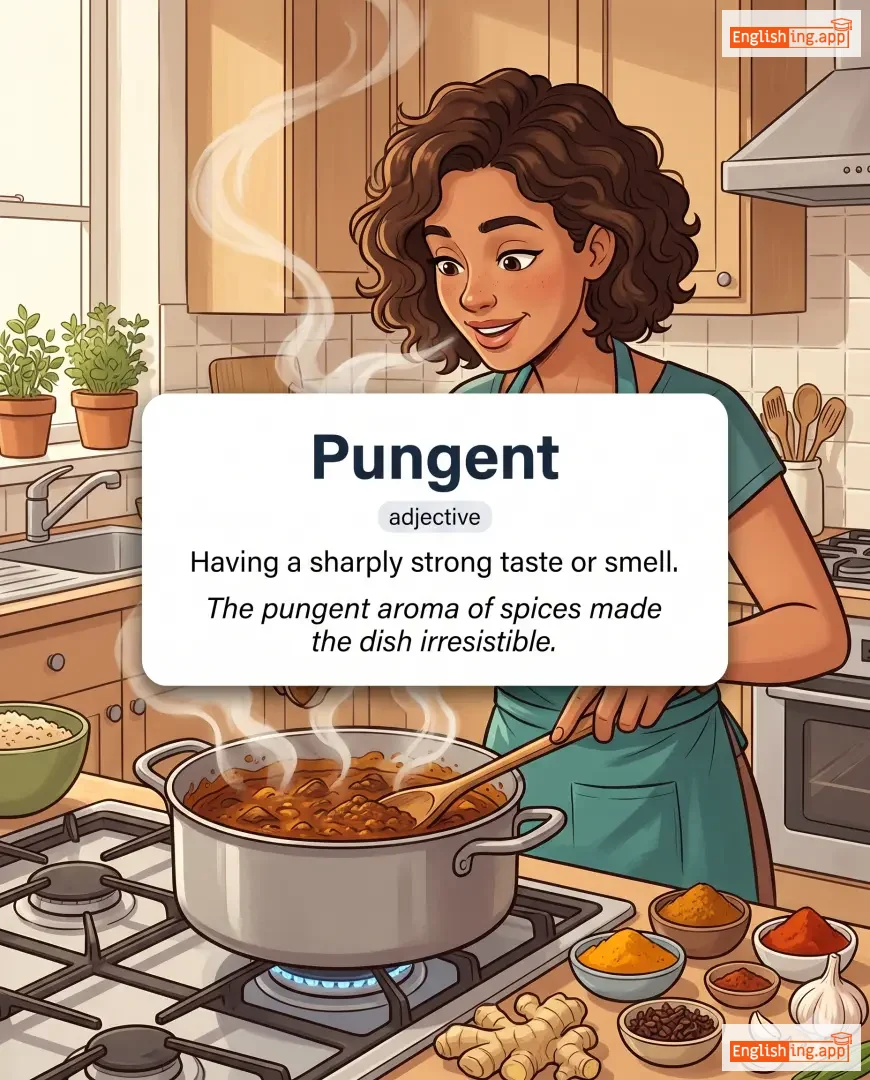
Pungent definition card — visual illustration of the meaning
adjective C1
/ˈpʌndʒənt/
forte odeur ou saveur (forte odeur ou saveur)

Having a sharply strong taste or smell.

"The pungent aroma of spices made the dish irresistible."

"L'arôme fort des épices rendait le plat irrésistible." (L'arôme fort des épices rendait le plat irrésistible.)
adjective C1
/ˈpjuː.nɪ.tɪv/
punitif (punitif)

Inflicting or intended as punishment.

"The company faced punitive measures for violating the law."

"L'entreprise a dû faire face à des mesures punitives pour avoir violé la loi." (L'entreprise a du faire face a des mesures punitives pour avoir viole la loi.)
noun C1
/pʌnˈdʒɑː.bi/
punjabi (punjabi)

a traditional long shirt worn in South Asia, typically loose-fitting

"He wore a white punjabi for the festival celebration."

"Il portait un punjabi blanc pour la célébration du festival." (Il portait un punjabi blanc pour la célébration du festival.)
adjective C1
/ˈpjuː.ni/
faible (faible)

Small, weak, or insignificant.

"He felt puny compared to his stronger classmates."

"Il se sentait faible comparé à ses camarades de classe plus forts." (Il se sentait faible compare a ses camarades de classe plus forts.)
noun C1
/ˈpɜːrɡəˌtɔːri/
un lieu ou un état de souffrance habité par les âmes des pécheurs expiant leurs péchés avant d'aller au paradis (un lieu ou un état de souffrance habité par les âmes des pécheurs expiant leurs péchés avant d'aller au paradis)

A place or state of suffering inhabited by the souls of sinners who are expiating their sins before going to heaven; a temporary condition of torment or suffering.

"After the accident, the long recovery felt like a kind of purgatory."

"Après l'accident, la longue récupération ressemblait à une sorte de purgatoire." (Après l'accident, la longue récupération ressemblait à une sorte de purgatoire.)
verb C1
/pɜːrdʒ/
purger (purger)

To remove unwanted feelings, people, or things; to cleanse or purify.

"The new leader promised to purge corruption from the government."

"Le nouveau leader a promis de purger la corruption du gouvernement." (Le nouveau leader a promis de purger la corruption du gouvernement.)