Vocabularies

English Vocabulary Dictionary | Word Meanings, Definitions & Examples

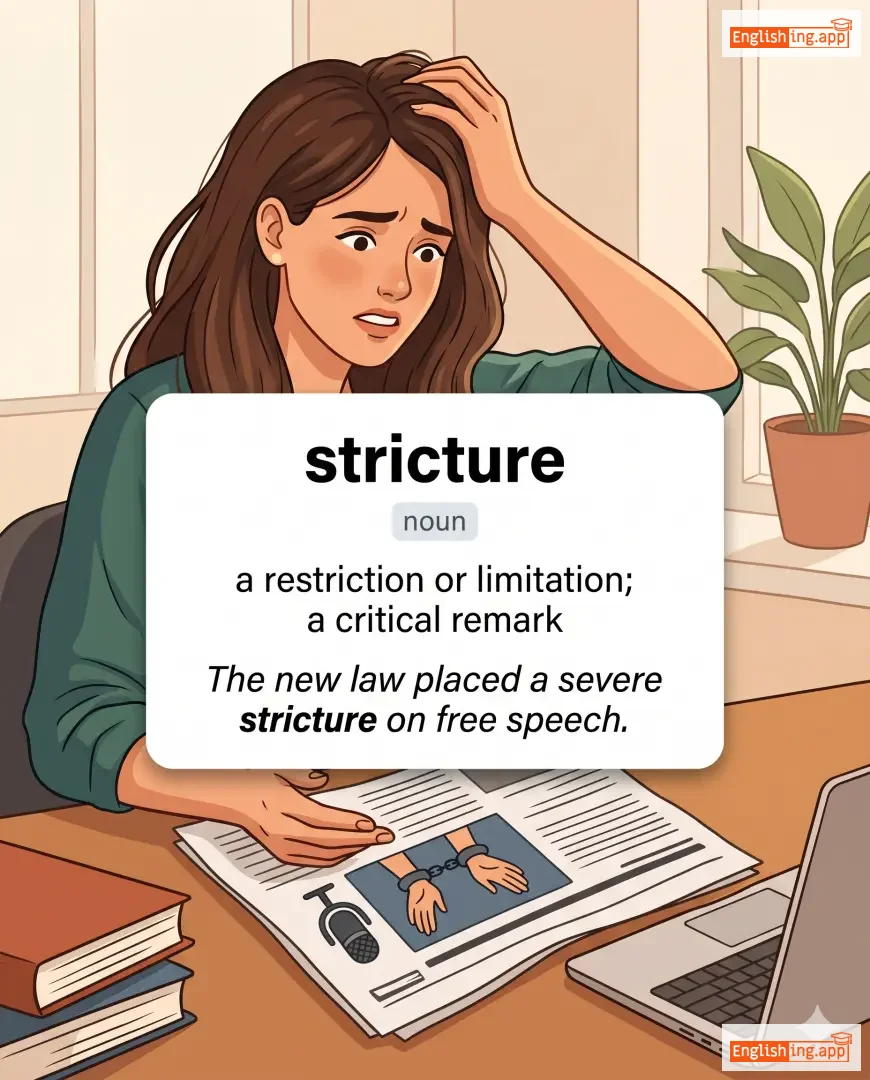
stricture definition card — visual illustration of the meaning
noun C2
/ˈstrɪk.tʃər/
प्रतिबंध, आलोचना (pratibandh, aalochana)

a restriction or limitation; a critical remark

"The new law placed a severe stricture on free speech."

"नया कानून स्वतंत्र भाषण पर कड़ा प्रतिबंध लगाता है।" (Naya kanoon svatantra bhaashan par kada pratibandh lagaata hai.)
noun C2
/ˈstrɪndʒənsi/
कठोरता (kathorata)

the quality of being strict, precise, or severe

"The stringency of the new rules surprised everyone."

"नए नियमों की कठोरता ने सभी को हैरान कर दिया।" (Naye niyamon ki kathorata ne sabhi ko hairan kar diya.)
noun C2
/ˈstrɪplɪŋ/
युवक (yuvak)

a young man who is not yet fully grown

"The stripling dreamed of becoming a brave knight."

"युवक ने एक बहादुर नाइट बनने का सपना देखा।" (Yuvak ne ek bahadur knight banne ka sapna dekha.)
verb C2
/ˈstʌltɪfaɪ/
मूर्ख बनाना या प्रभावशीलता और उत्साह को बाधित करना (moorkh banana ya prabhavsheelta aur utsah ko baadhit karna)

to make someone or something appear foolish, or to hinder effectiveness and enthusiasm

"The repetitive tasks seemed to stultify the workers' creativity."

"दोहराए गए कार्यों ने श्रमिकों की रचनात्मकता को रोक दिया था।" (Dohraaye gaye kaaryon ne shramikon ki rachnatmakta ko rok diya tha.)
verb C2
/ˈstjuːpɪˌfaɪ/
हैरान करना (hairan karna)

to make someone unable to think clearly, usually because of surprise or shock

"The magician's tricks stupefied the audience."

"जादूगर के करतबों ने दर्शकों को हैरान कर दिया।" (Jadugar ke kartabon ne darshako ko hairan kar diya.)
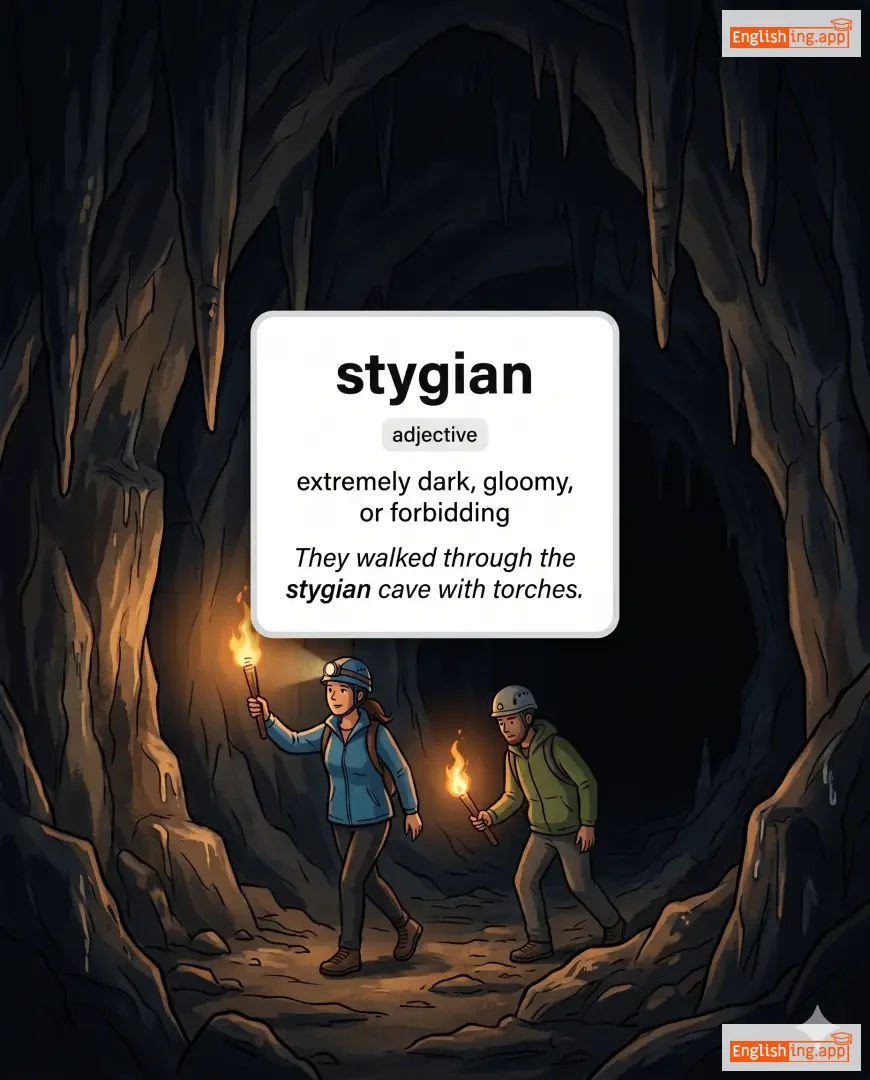
stygian definition card — visual illustration of the meaning
adjective C2
/ˈstɪdʒiən/
अंधकारमय (andhkaramay)

extremely dark, gloomy, or forbidding

"They walked through the stygian cave with torches."

"वे मशालों के साथ अंधकारमय गुफा में चल रहे थे।" (Ve mashalon ke sath andhkaramay gufah mein chal rahe the.)
noun C2
/ˈsweɪʒən/
प्रेरणा (prerna)

the act of persuading or influencing someone

"The leader used gentle suasion to win support for the plan."

"नेता ने योजना के लिए समर्थन प्राप्त करने के लिए कोमल प्रेरणा का उपयोग किया।" (Neta ne yojana ke liye samarthan prapt karne ke liye komal prerna ka upyog kiya.)
noun C2
/ˈswɑːvɪti/
मृदुता और आकर्षण (mriduta aur aakarshan)

smoothness and charm in manner

"His suavity made him popular in social gatherings."

"उसकी मृदुता और आकर्षण ने उसे सामाजिक आयोजनों में लोकप्रिय बना दिया।" (Uski mriduta aur aakarshan ne use samajik aayojan mein lokpriya bana diya.)
adverb C2
/ˌsʌb ˈroʊzə/
गोपनीय रूप से (gopneeya roop se)

secretly, in confidence, or in private

"The deal was made sub rosa to avoid public scrutiny."

"सौदा सब रोसा किया गया था ताकि सार्वजनिक जांच से बचा जा सके।" (Sauda sab rosa kiya gaya tha taki saarvajanik jaanch se bacha ja sake.)
adjective C2
/ˈsʌb.æs.ɪd/
हल्का खट्टा (halka khatta)

Slightly sour or acidic in taste or nature.

"The fruit had a subacid flavor that was refreshing on a hot day."

"फलों का हल्का खट्टा स्वाद था जो गर्मी के दिन में ताजगी प्रदान करता था।" (phalon ka halka khatta swad tha jo garmi ke din mein tajgi pradan karta tha.)
noun C2
/sʌbˈɔːl.tən/
किसी व्यक्ति जो अधीनस्थ स्थिति में हो; सैन्य में, एक जूनियर अधिकारी (subaltern)

A person holding a subordinate position; in the military, a junior officer.

"The subaltern was responsible for leading a small platoon of soldiers."

"सबऑल्टर्न छोटे सैनिकों के एक प्लाटून का नेतृत्व करने के लिए जिम्मेदार था।" (subaltern chhote sainikon ke ek platoon ka netritva karne ke liye zimmedar tha.)
adjective C2
/ˌsʌb.əˈkwɒt.ɪk/
जलमग्न (jalmagn)

Existing, living, or located under water.

"Divers explored the subaquatic cave system filled with rare fish."

"डाइवर्स ने दुर्लभ मछलियों से भरे जलमग्न गुफा प्रणाली का अन्वेषण किया।" (divers ne durlabh machhliyon se bhare jalmagn gufha pranali ka anvshan kiya.)
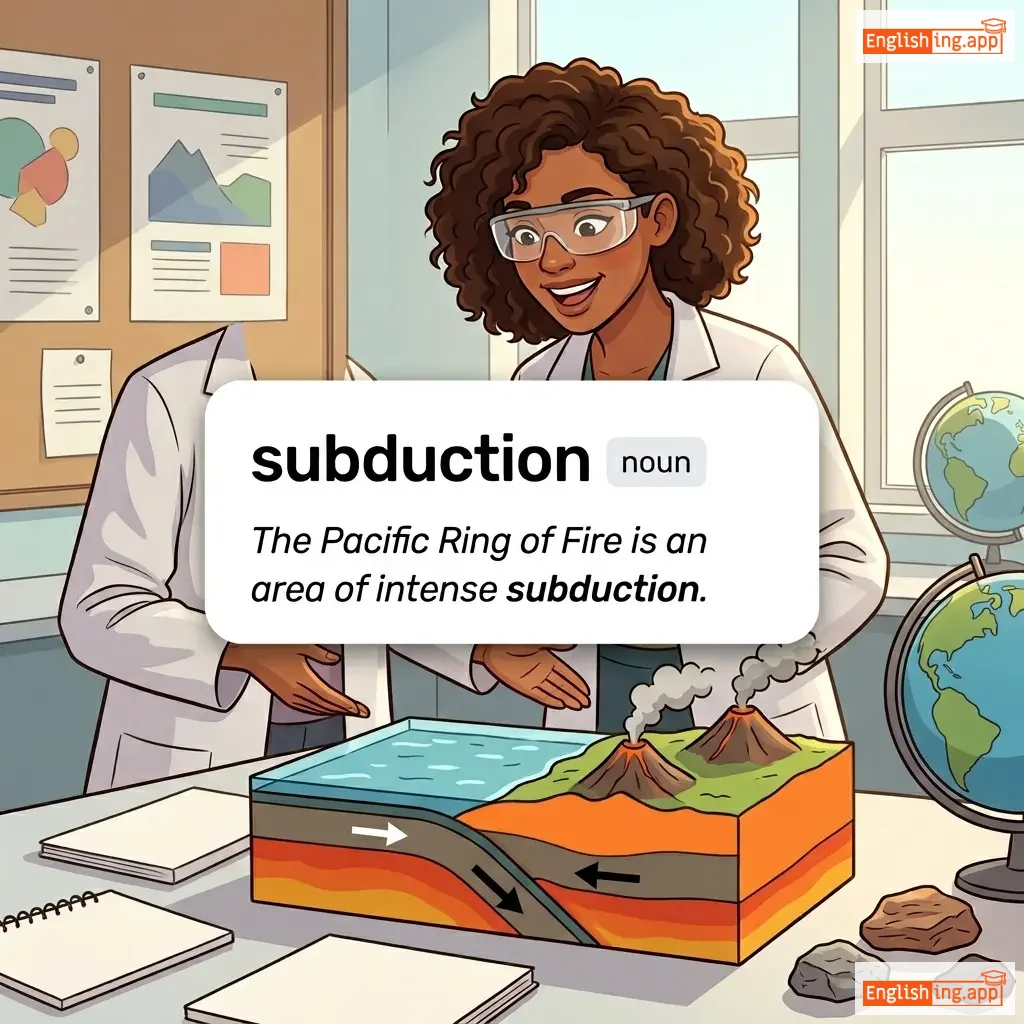
subduction definition card — visual illustration of the meaning
noun C2
/səbˈdʌk.ʃən/
पृथ्वी की सतह की एक परत का दूसरी परत के नीचे जाना (prithvi ki sathah ki ek parat ka doosri parat ke neeche jana)

The lateral and downward movement of the edge of a plate of the earth's crust into the mantle beneath another plate.

"The Pacific Ring of Fire is an area of intense subduction."

"पैसिफिक रिंग ऑफ फायर एक क्षेत्र है जहाँ गहरी सबडक्शन होती है।" (Pacific ring of fire ek kshetra hai jahan gehri subduction hoti hai.)
adjective C2
/sʌbˈdʒeɪsənt/
नीचे स्थित (neeche sthit)

lying immediately beneath; underlying

"The geological survey revealed subjacent layers of rock."

"भूतत्वीय सर्वेक्षण ने नीचे स्थित चट्टानों की परतें प्रकट कीं।" (Bhootatviy survey ne neeche sthit chattanon ki paratein prakat ki.)
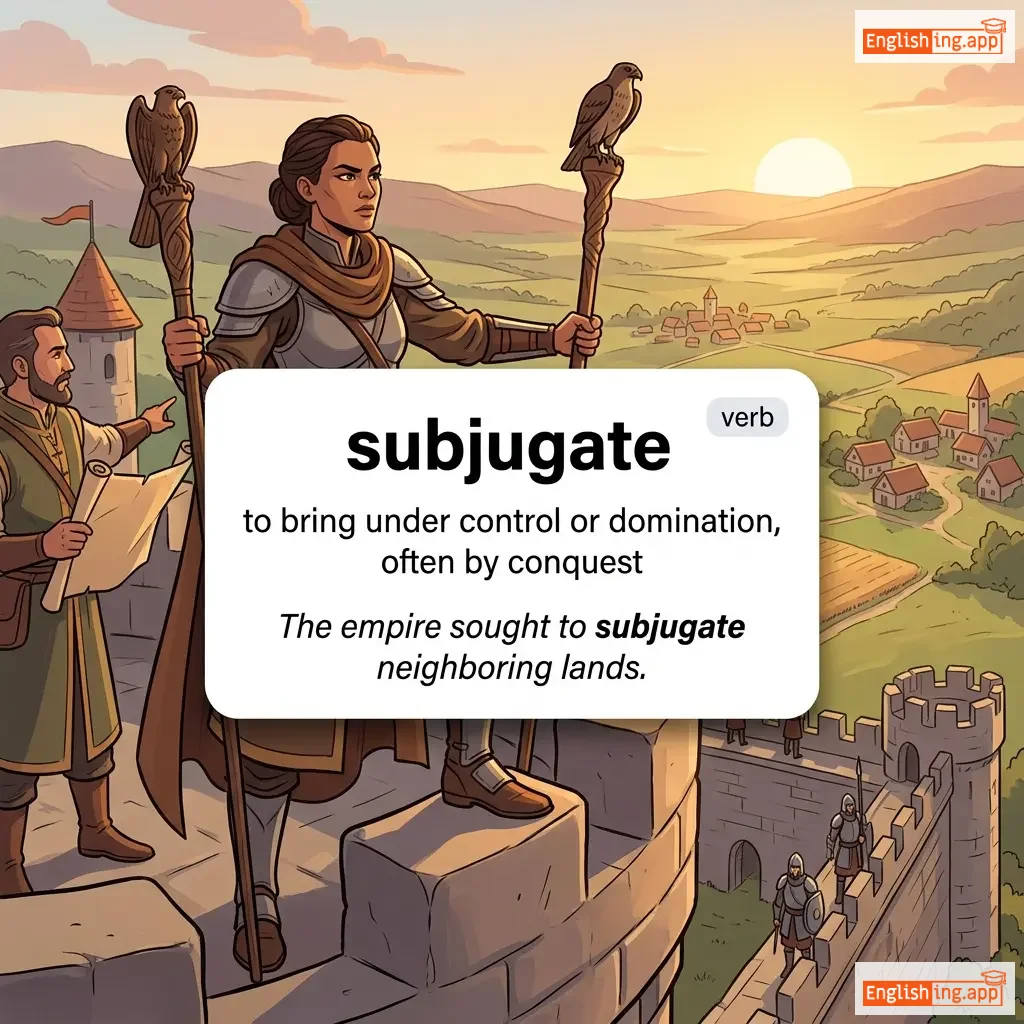
subjugate definition card — visual illustration of the meaning
verb C2
/ˈsʌbdʒʊˌɡeɪt/
अधीन करना (adhin karna)

to bring under control or domination, often by conquest

"The empire sought to subjugate neighboring lands."

"साम्राज्य ने पड़ोसी भूमि को अधीन करने का प्रयास किया।" (Samrajya ne padosi bhumi ko adheen karne ka prayaas kiya.)
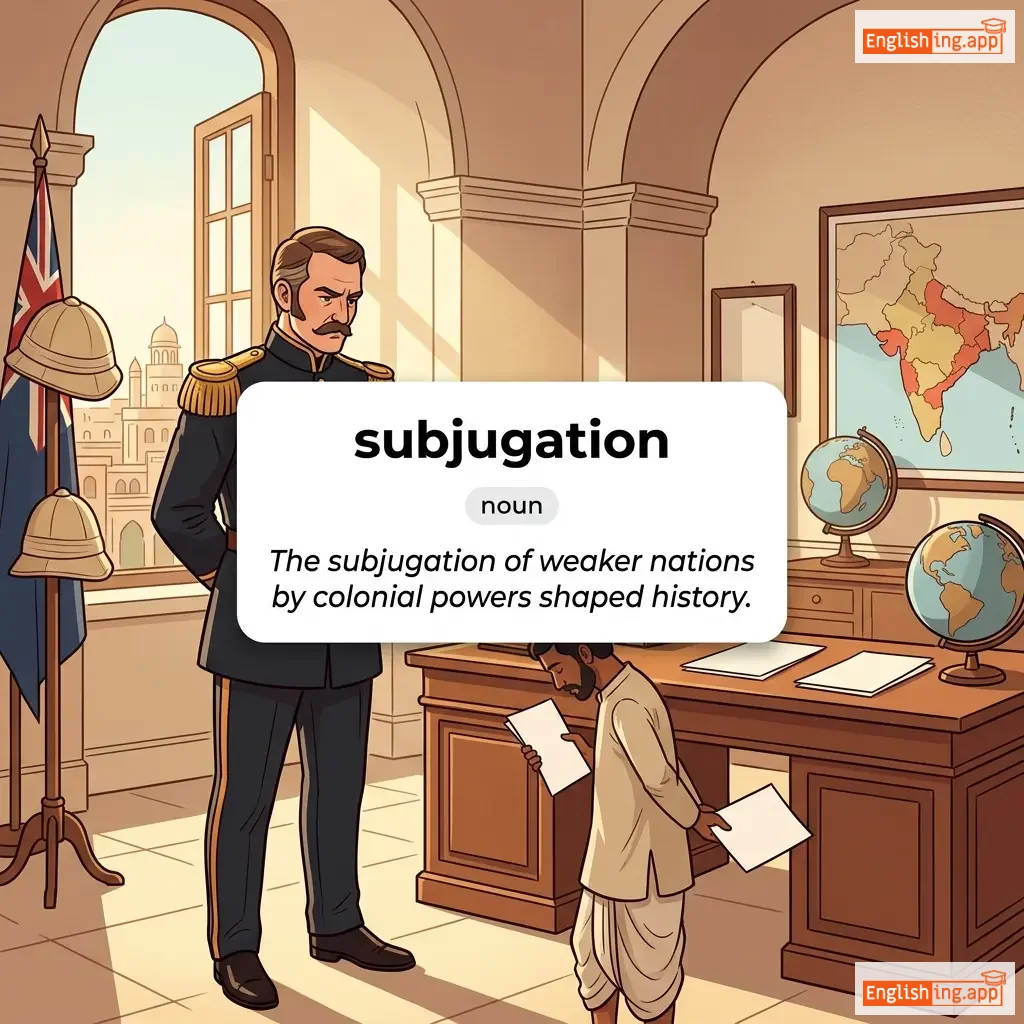
subjugation definition card — visual illustration of the meaning
noun C2
ˌsʌb.dʒʊˈɡeɪ.ʃən
वर्चस्व या अधीनता (varchasv ya adheenta)

The action of bringing someone or something under domination or control, especially by force.

"The subjugation of weaker nations by colonial powers shaped history."

"औपनिवेशिक शक्तियों द्वारा कमजोर देशों का वर्चस्व इतिहास को आकार देता है।" (Aupniveshik shaktiyon dwara kamzor deshon ka varchasv itihas ko aakar deta hai.)
verb C2
/ˈsʌblɪmeɪt/
उच्चतर गतिविधियों में रूपांतरित करना (uchchtar gatividhiyon mein roopantarit karna)

to redirect strong emotions or desires into socially acceptable activities or channels

"She sublimated her anger into painting beautiful landscapes."

"उसने अपने गुस्से को खूबसूरत लैंडस्केप्स पेंट करने में सब्लीमेट किया।" (Usne apne gusse ko khoobsurat landscape paint karne mein sublimate kiya.)
adjective C2
/sʌbˈlɪŋɡwəl/
जीभ के नीचे (jeebh ke neeche)

situated or applied under the tongue

"The doctor prescribed a sublingual tablet for faster absorption."

"डॉक्टर ने तेज अवशोषण के लिए एक सबलिंग्वल टैबलेट निर्धारित की।" (Doktar ne tez avshoshan ke liye ek sublingual tablet nirdharit ki.)
adjective, noun C2
/səbˈmɜːrsəbl/
जलमग्न यान (jalmagn yan)

capable of being submerged; a small underwater craft

"The scientists explored the deep ocean using a submersible."

"वैज्ञानिकों ने एक जलमग्न यान का उपयोग करके गहरे महासागर की खोज की।" (vaigyanikon ne ek jalmagn yan ka upyog karke gahre mahasagar ki khoj ki.)
noun C2
/səbˈmɜːrʒən/
जलमग्नता (jalmagnata)

the state of being under water

"The submersion of the fields lasted for several days after the heavy rain."

"भारी बारिश के बाद खेतों की जलमग्नता कई दिनों तक चली।" (bhaari baarish ke baad kheton ki jalmagnata kai dinon tak chali.)
verb C2
/səˈbɔːrn/
घूस देकर बहलाना (ghus dekar bahlana)

to bribe or induce someone unlawfully to perform an act, especially to commit perjury

"The lawyer was accused of trying to suborn a witness."

"वकील पर एक गवाह को बहलाने की कोशिश करने का आरोप था।" (Vakil par ek gawah ko bahlane ki koshish karne ka aarop tha.)
noun C2
/səbˈsɜːviəns/
अधीनता (adhinata)

the condition of being too willing to obey or serve others

"His subservience to authority annoyed his colleagues."

"उसकी अधीनता से अधिकारियों के प्रति उसकी सहकर्मी परेशान हो गए।" (uski adhinata se adhikarion ke prati uski sahakarmi pareshan ho gaye.)
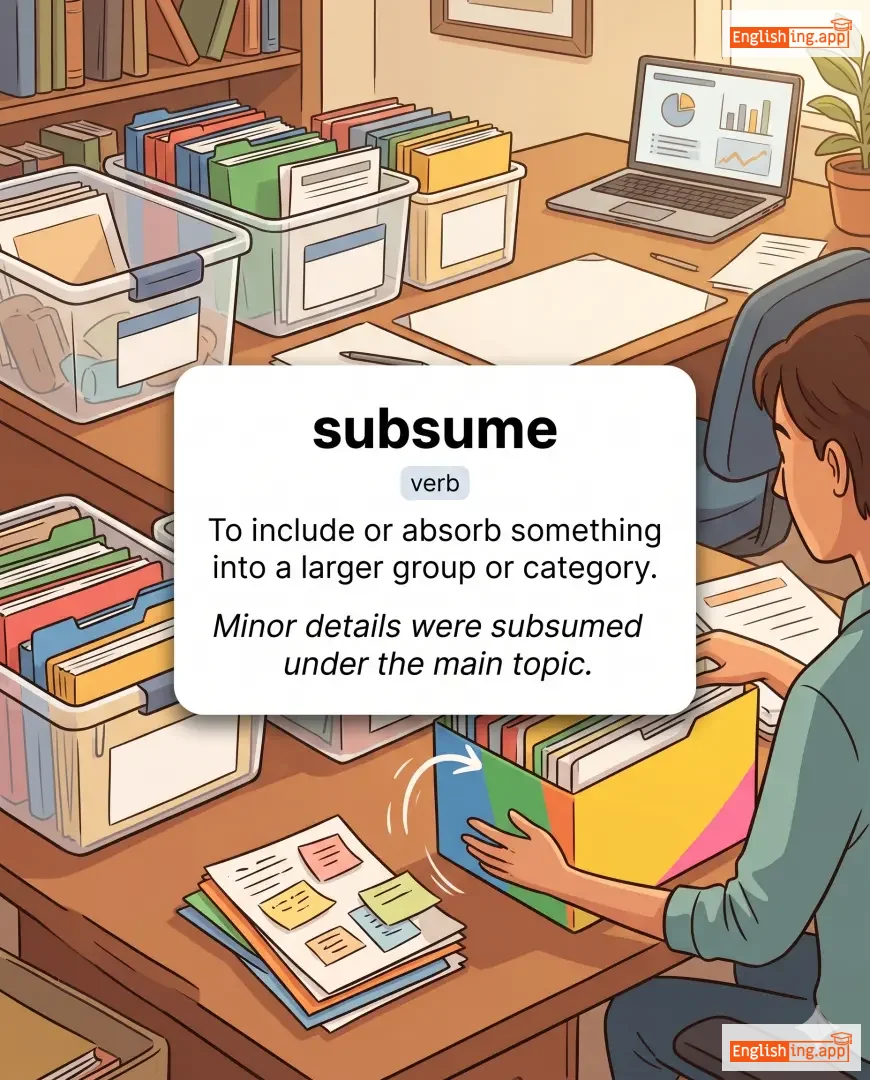
subsume definition card — visual illustration of the meaning
verb C2
/səbˈsjuːm/
शामिल करना (shamil karna)

To include or absorb something into a larger group or category.

"Minor details were subsumed under the main topic."

"माइनर डिटेल्स को मुख्य विषय के तहत सब्स्यूम किया गया।" (Minor details ko mukhya vishay ke tahat subsume kiya gaya.)
verb C2
/sʌbˈtɛnd/
कोण बनाना (kon banana)

To extend across or form an angle at a particular point, often used in geometry.

"The arc subtends a 60-degree angle at the center of the circle."

"आर्क सर्कल के केंद्र पर 60 डिग्री का कोण बनाता है।" (Arc circle ke kendre par 60 digri ka kon banata hai.)
noun C2
/ˈsʌbtərˌfjuːdʒ/
चतुराई (chaturai)

Deceit used to achieve one's goal; a trick or excuse to evade something.

"They used subterfuge to avoid paying taxes."

"उन्होंने कर चुकाने से बचने के लिए चतुराई का सहारा लिया।" (Unhone kar chukane se bachne ke liye chaturai ka sahara liya.)
noun C2
/ˈsʌbtrəˌhɛnd/
घटाव्य (ghatavya)

a number that is to be subtracted from another number

"In the equation 10 - 4, the number 4 is the subtrahend."

"समीकरण 10 - 4 में, 4 घटाव्य है।" (Samikaran 10 - 4 mein, 4 ghatavya hai.)
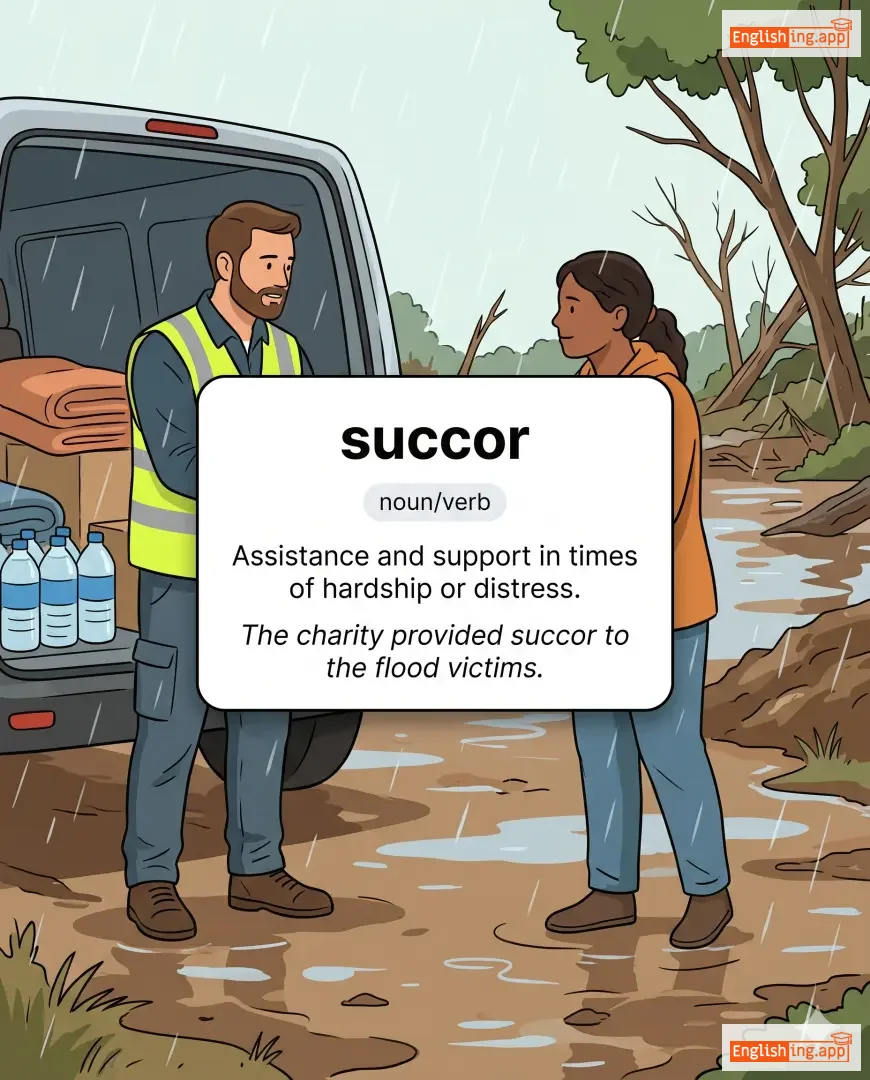
succor definition card — visual illustration of the meaning
noun/verb C2
/ˈsʌkər/
सहायता (sahayata)

Assistance and support in times of hardship or distress.

"The charity provided succor to the flood victims."

"चैरिटी ने बाढ़ पीड़ितों को सहायता प्रदान की।" (charity ne baadh peediton ko sahayata pradan ki.)
verb C2
/ˈsʌk.əl/
दूध पिलाना (dudh pilana)

to feed a baby or young animal with milk from the breast or udder

"The mother cat suckled her kittens in the basket."

"माँ बिल्ली ने अपने बिल्लियों को बास्केट में दूध पिलाया।" (Maa billi ne apne billiyon ko basket mein dudh pilaya.)
adjective C2
/ˌsuːdəˈrɪfɪk/
पसीना उत्पन्न करने वाला (pasina utpann karne wala)

causing or increasing sweating

"The doctor prescribed a sudorific drug to help reduce the fever."

"डॉक्टर ने बुखार कम करने के लिए एक पसीना उत्पन्न करने वाली दवा दी।" (Doktar ne bukhar kam karne ke liye ek pasina utpann karne wali dawa di.)
noun C2
/ˈsʌfərəns/
सहनशीलता (sahansheelta)

patient endurance of pain, hardship, or delay; passive consent or tolerance

"He lived in poverty with quiet sufferance."

"वह गरीबी में शांतिपूर्वक सहनशीलता के साथ जीता था।" (Wah gareebi mein shaantipoorvak sahansheelta ke saath jeeta tha.)
noun C2
/ˈsʌfrədʒɪst/
मताधिकार समर्थक (matadhikar samarthak)

a person advocating the extension of suffrage, especially to women

"The suffragists organized rallies to demand voting rights for women."

"सफ़्रेजिस्टों ने महिलाओं के लिए मतदान अधिकार की मांग करने के लिए रैलियाँ आयोजित कीं।" (Suffragiston ne mahilaon ke liye matdaan adhikar ki maang karne ke liye rallyen aayojit ki.)
verb C2
/səˈfjuːz/
व्याप्त होना (vyaapt hona)

to gradually spread through or over something

"A warm glow suffused her face as she smiled."

"जब वह मुस्काई, तो उसके चेहरे पर एक गर्म आभा फैल गई।" (Jab vah muskaai, to uske chehre par ek garm abha phail gayi.)
adjective C2
/səˈdʒɛstəbəl/
आसानी से प्रभावित (aasani se prabhavit)

easily influenced by the suggestions of others

"Children are highly suggestible and may believe what they are told."

"बच्चे बहुत आसानी से प्रभावित होते हैं और जो उन्हें बताया जाता है, उस पर विश्वास कर सकते हैं।" (Bacche bahut aasani se prabhavit hote hain aur jo unhe bataya jata hai, us par vishwas kar sakte hain.)
verb C2
/ˈsʌli/
कलंकित करना (kalankit karna)

to damage the purity, integrity, or reputation of something

"The scandal sullied the politician’s reputation."

"केलेंकार ने राजनेता की प्रतिष्ठा को कलंकित किया।" (Kelenkar ne rajneta ki pratishtha ko kalankit kiya.)
adjective C2
/ˈsʌmp.tʃuˌɛr.i/
वैशिष्ट्यपूर्ण खर्च से संबंधित (vaishishtyapurn kharch se sambandhit)

Relating to laws or regulations intended to limit personal spending on luxury goods.

"In medieval Europe, sumptuary laws restricted the wearing of expensive fabrics to the nobility."

"मध्यकालीन यूरोप में, संपूर्ण खर्च कानूनों ने महंगे कपड़ों के पहनने को केवल अभिजात वर्ग तक सीमित कर दिया था।" (Madhyakalīn Yūrop mein, sampūrn kharch kānūno ne mahenge kapdon ke pehennē ko keval abhjāt varg tak sīmit kar diyā thā.)
verb C2
/ˈsʌn.dər/
विभाजित करना (vibhajit karna)

To split apart or separate, especially with force.

"The war sundered families and friends."

"युद्ध ने परिवारों और दोस्तों को विभाजित कर दिया।" (Yudh ne parivaron aur doston ko vibhajit kar diya.)
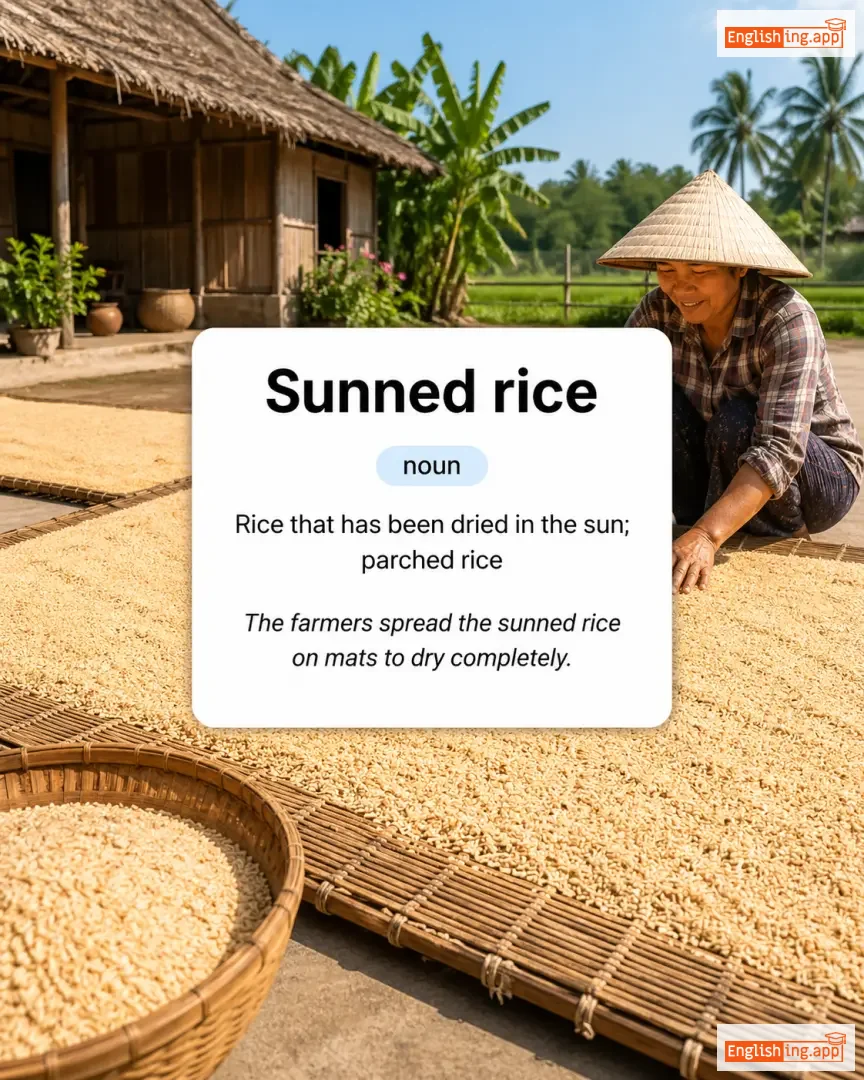
Sunned rice definition card — visual illustration of the meaning
noun C2
/sʌnd raɪs/
सूरज में सूखा हुआ चावल (sooraj mein sukha hua chawal)

Rice that has been dried in the sun; parched rice

"The farmers spread the sunned rice on mats to dry completely."

"किसानों ने सनड राइस को पूरी तरह से सूखने के लिए चटाइयों पर फैलाया।" (Kisano ne sunned rice ko poori tarah se sukhne ke liye chataiyon par phailaya.)
noun C2
/ˌsuː.pər.əˈbʌn.dəns/
अत्यधिक प्रचुरता (atyadhik prachurta)

An excessive or overflowing amount of something.

"The garden was filled with a superabundance of flowers."

"बग़ीचे में फूलों की अत्यधिक प्रचुरता थी।" (Bagiche mein phoolon ki atyadhik prachurta thi.)
verb C2
/ˌsuːpərˈæd/
अतिरिक्त जोड़ना (atirikt jodna)

to add something to what has already been added

"The author chose to superadd a new chapter to the revised edition."

"लेखक ने संशोधित संस्करण में एक नया अध्याय अतिरिक्त जोड़ने का निर्णय लिया।" (lekhak ne sanshodhit sanskaran mein ek naya adhyay atirikt jodne ka nirnay liya.)
verb C2
/ˌsuːpərˈæn.ju.eɪt/
पेंशन के साथ सेवानिवृत्त करना (penshan ke saath sevanivrtt karna)

to retire someone with a pension, usually due to age or long service

"The company decided to superannuate its senior employees after thirty years of service."

"कंपनी ने तीस साल की सेवा के बाद अपने वरिष्ठ कर्मचारियों को पेंशन के साथ सेवानिवृत्त करने का निर्णय लिया।" (kampani ne tees saal ki seva ke baad apne varishth karmachariyon ko penshan ke saath sevanivrtt karne ka nirnay liya.)
adjective C2
/ˌsuːpərˈæn.ju.eɪ.tɪd/
पुराना और अब उपयोगी नहीं; उम्र के कारण सेवानिवृत्त (purana aur ab upyogi nahi; umra ke karan sevanivritt)

old and no longer useful or valid; retired due to age

"The factory was filled with superannuated machines that slowed production."

"कारख़ाना सुपरऐन्यूएटेड मशीनों से भरा था जो उत्पादन को धीमा कर रहे थे।" (karkhana supereinyueted mashinon se bhara tha jo utpadan ko dheema kar rahe the.)
adjective C2
/ˌsuː.pɚˈsɪl.i.əs/
अहंकारी (ahankari)

Behaving or looking as though one thinks one is superior to others; arrogant and disdainful.

"She gave him a supercilious smile as if he was beneath her."

"उसने उसे एक अहंकारी मुस्कान दी जैसे वह उसके नीचे था।" (Usne use ek ahankari muskaan di jaise vah uske neeche tha.)
adjective C2
/ˌsuː.pər.ɪˈrɑː.ɡə.tɔːr.i/
अतिरिक्त आवश्यकतारहित (atirikt avashyakatarhit)

Going beyond what is required or expected; more than necessary.

"His donation was supererogatory, far beyond what anyone had asked for."

"उसका दान अत्यधिक था, जो किसी ने भी नहीं मांगा था।" (Uska daan atyadhik tha, jo kisi ne bhi nahi maanga tha.)
noun C2
/ˌsuː.pɚˈfluː.ə.t̬i/
अत्यधिकता (atyadhikta)

An excessive amount of something; more than what is needed.

"The room was filled with a superfluity of decorations."

"कक्ष में सजावट का अत्यधिकता था।" (Kaksh mein saajawat ka atyadhikta tha.)
verb C2
/ˌsuːpərˈhiːt/
अत्यधिक गर्म करना (atyadhik garm karna)

to heat a substance beyond its normal boiling point without it becoming vapor

"Engineers superheat the steam to increase the efficiency of the turbine."

"इंजीनियर टरबाइन की कार्यक्षमता बढ़ाने के लिए भाप को अधिक गर्म करते हैं।" (Engineer turbine ki karyakshemtā badhāne ke liye bhāp ko adhik garm karte hain.)
verb C2
/ˌsuːpərɪnˈtɛnd/
निगरानी करना (nigrani karna)

to oversee and direct the work or operation of something

"She was hired to superintend the construction project."

"उसे निर्माण परियोजना की निगरानी करने के लिए नियुक्त किया गया था।" (Use nirmaan pariyojana ki nigrani karne ke liye niyukt kiya gaya tha.)
noun C2
/ˌsuːpərɪnˈtɛndəns/
पर्यवेक्षण (paryavekshan)

the act of overseeing, supervising, or managing

"The superintendence of the school is the principal’s duty."

"स्कूल का पर्यवेक्षण प्रधानाचार्य का कर्तव्य है।" (School ka paryavekshan pradhanacharya ka kartavya hai.)
adjective C2
/suːˈpɜːrnəl/
आकाशीय (aakaashiy)

Relating to the heavens; celestial or divine.

"The painting captured a supernal beauty that felt otherworldly."

"चित्रकला ने एक आकाशीय सुंदरता को कैद किया जो अन्य दुनिया की तरह महसूस हो रही थी।" (chitrakala ne ek aakaashiy sundarta ko kaid kiya jo anya duniya ki tarah mahsus ho rahi thi.)
adjective C2
/ˌsuːpərˈnuːmərɛri/
अतिरिक्त (atirikt)

Exceeding the usual number; extra or unnecessary.

"The play included several supernumerary actors to fill the background scenes."

"नाटक में पृष्ठभूमि दृश्यों को भरने के लिए कई अतिरिक्त अभिनेता थे।" (naatak mein prishthabhoomi drishyoon ko bharne ke liye kai atirikt abhineta the.)
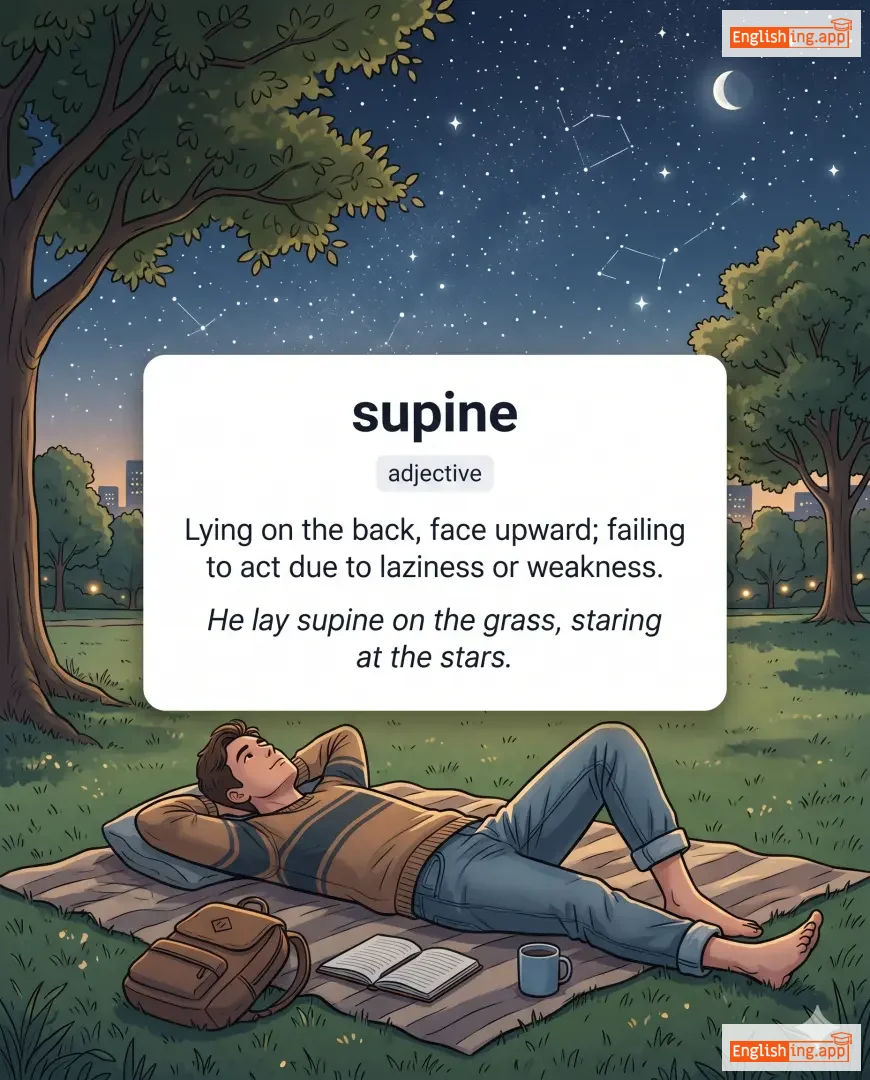
supine definition card — visual illustration of the meaning
adjective C2
/ˈsuːpaɪn/
पीठ के बल लेटना (peeth ke bal letna)

Lying on the back, face upward; failing to act due to laziness or weakness.

"He lay supine on the grass, staring at the stars."

"वह घास पर पीठ के बल लेटा हुआ था, तारों को देख रहा था।" (vah ghas par peeth ke bal leta hua tha, taaron ko dekh raha tha.)