Vocabularies

English Vocabulary Dictionary | Word Meanings, Definitions & Examples

noun C2
/ˈprɛlət/
उच्चपदस्थ धर्मगुरु (uchchapodsth dharmguru)

A high-ranking member of the clergy, especially a bishop or abbot.

"The prelate delivered a sermon to the congregation."

"प्रेलेट ने सभा को उपदेश दिया।" (Prelet ne sabha ko updesh diya.)
adjective C2
/prɪˈmɒnɪtəri/ or /ˌpriːməˈnɪtəri/
पूर्वसूचक (purvasoochak)

giving a warning or prediction about something, especially something unpleasant

"He ignored the premonitory signs of illness."

"उसने बीमारी के पूर्वसूचक लक्षणों को नज़रअंदाज़ कर दिया।" (Usne bimari ke purvasoochak lakshanon ko nazarandaaz kar diya.)
verb C2
/ˌpriːɔːrˈdeɪn/
पूर्व निर्धारित करना (purv nirdharit karna)

To decide or determine an outcome in advance, especially by fate or divine will.

"They believed their meeting was preordained by destiny."

"वे मानते थे कि उनकी मुलाकात पहले से तय थी।" (ve maante the ki unki mulaakaat purv se tay thi.)
noun C2
/prɪˈpɒndərəns/
अधिकता (adhikata)

The quality or fact of being greater in number, quantity, or importance.

"There was a preponderance of evidence against the defendant."

"वहां अभियुक्त के खिलाफ प्रमाणों की अधिकता थी।" (Wahan abhiyaukt ke khilaf pramanon ki adhikata thi.)
adjective C2
/prɪˈpɒndərənt/
प्रमुख (pramukh)

Having superior weight, force, influence, or importance.

"The preponderant influence of the media shapes public opinion."

"मीडिया का प्रमुख प्रभाव सार्वजनिक राय को आकार देता है।" (Media ka pramukh prabhav sarvajanik ray ko aakar deta hai.)
verb C2
/prɪˈpɒndəreɪt/
प्रभावशाली होना (prabhavshali hona)

To be greater in influence, weight, or number.

"In the debate, logical arguments preponderated over emotional appeals."

"विवाद में, तार्किक तर्क भावनात्मक अपीलों से अधिक प्रभावी थे।" (Vivad mein, tarkik tark bhavnaatmak apeelon se adhik prabhavi the.)
adjective C2
/ˌpriːpəˈzɛsɪŋ/
आकर्षक (aakarshak)

Attractive or appealing in appearance or manner.

"She had a prepossessing smile that charmed everyone."

"उसके पास एक आकर्षक मुस्कान थी जिसने सभी को मंत्रमुग्ध कर दिया।" (Uske paas ek aakarshak muskaan thi jisne sabhi ko mantramugdh kar diya.)
noun C2
/ˌpriːpəˈzɛʃən/
पूर्वाग्रह (purvagrah)

An opinion or feeling formed beforehand; a prejudice or preoccupation.

"His prepossession in favor of tradition made him resist change."

"परंपरा के पक्ष में उसकी पूर्वाग्रह ने उसे बदलाव के खिलाफ बना दिया।" (Parampara ke paksh mein uski purvagrah ne use badlav ke khilaf bana diya.)
verb C2
/ˈprɛsɪdʒ/
पूर्वानुमान देना (purvanuman dena)

to be a sign or warning that something will happen; to foreshadow

"Dark clouds presage a storm."

"अंधेरे बादल तूफान का पूर्वानुमान देते हैं।" (Andhere badal toofan ka purvanuman dete hain。)
noun C2
/ˈprɛʃəns/ or /ˈpriːʃəns/
पूर्वज्ञान (purvagyan)

the ability to know or predict what will happen in the future

"Her prescience about market trends saved the company."

"उसकी मार्केट ट्रेंड्स के बारे में पूर्वज्ञान ने कंपनी को बचा लिया।" (Uski market trends ke baare mein purvagyan ne company ko bacha liya.)
adjective C2
/ˈprɛʃənt/ or /ˈpriːʃənt/
पूर्वज्ञान (purvagyaan)

having or showing knowledge of events before they take place

"The prescient investor sold his shares just before the market crashed."

"पूर्वज्ञान वाले निवेशक ने बाजार गिरने से पहले अपने शेयर बेच दिए थे।" (Purvagyaan wale niveshak ne bajar girne se pehle apne shear bech diye the.)
noun C2
/ˈpriːskrɪpt/
निर्देश (nirdesh)

An authoritative rule or direction; something laid down as a command.

"The prescript of the organization required strict punctuality."

"संगठन के निर्देश ने कड़ी समयपालन की मांग की।" (Sangthan ke nirdesh ne kadi samayapan ki maang ki.)
adjective C2
/prɪˈskrɪptɪbəl/
निर्धारणीय (nirdharaniy)

Capable of being prescribed or laid down as a rule or directive.

"Certain regulations are prescriptible under the law."

"कुछ नियम कानून के तहत निर्धारित किए जा सकते हैं।" (Kuch niyam kanoon ke tahat nirdharit kiye ja sakte hain.)
adjective C2
/prɪˈsɛnʃənt/
पूर्वानुमान करने वाला (purvanuman karne wala)

Having a feeling or sense of something about to happen; predictive.

"She was presentient of the coming disaster."

"वह आने वाली आपदा का पूर्वानुमान लगा रही थी।" (Vah aane wali aapda ka purvanuman laga rahi thi.)
noun C2
/prɪˈsɛntɪmənt/
पूर्वाभास (purvabhas)

An intuitive feeling about the future, especially of something bad about to happen.

"He had a strong presentiment that the plan would fail."

"उसे यह मजबूत पूर्वाभास था कि योजना विफल हो जाएगी।" (Use yah majboot purvabhas tha ki yojna viphal ho jaayegi.)
noun C2
/prɪˈzɛntmənt/
प्रस्तुति (prastuti)

The act of presenting something formally or officially; a formal statement or document.

"The lawyer made a presentment of the evidence to the court."

"वकील ने अदालत में साक्ष्य की प्रस्तुति की।" (Vakil ne adalat mein sakshya ki prastuti ki.)
adjective C2
/prɪˈzʌmptɪv/
अनुमानित (anumanit)

Based on probability or assumption rather than proof.

"She is the presumptive nominee for the party."

"वह पार्टी के लिए अनुमानित उम्मीदवार है।" (vah party ke liye anumanit ummidvaar hai.)
adjective C2
/ˌpriːtərˈnætʃərəl/
अलौकिक (aloukik)

Beyond what is normal or natural; extraordinary or supernatural.

"She had a preternatural ability to remain calm in any crisis."

"वह किसी भी संकट में शांत रहने की असाधारण क्षमता रखती थी।" (vah kisi bhi sankat mein shaant rehne ki asadharan kshamata rakhti thi.)
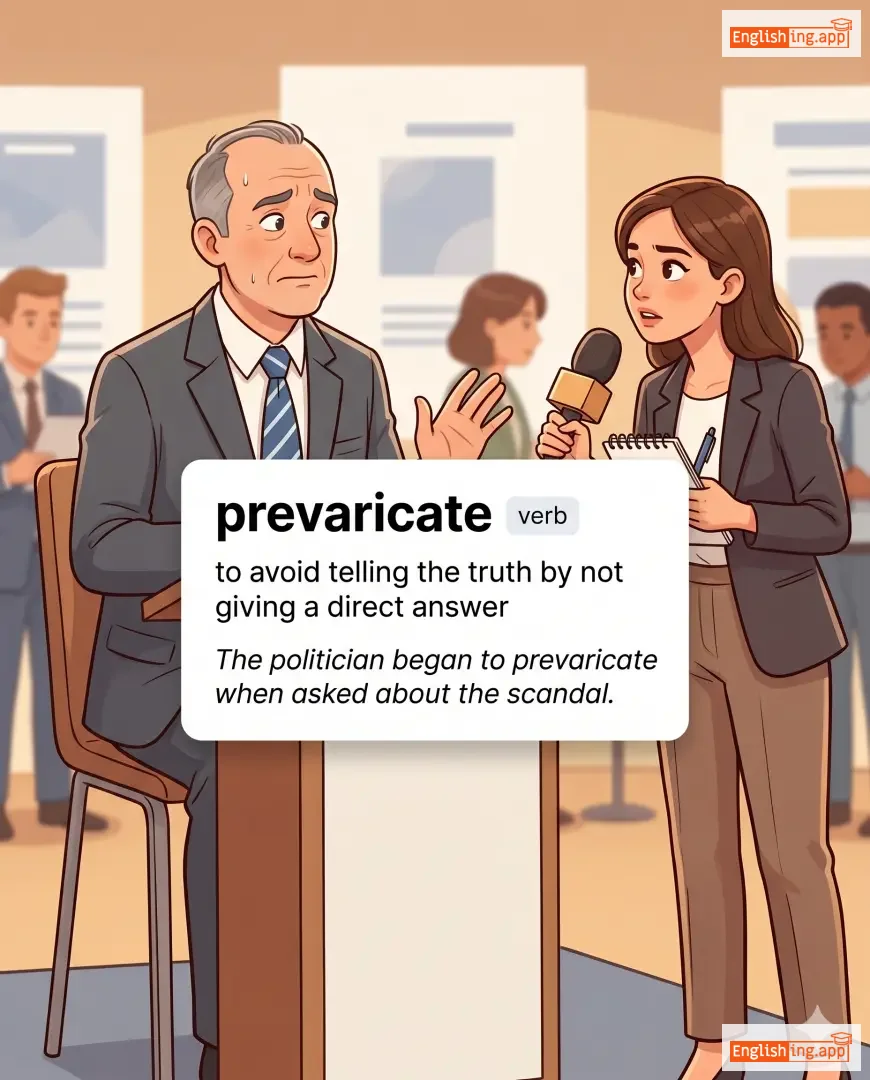
prevaricate definition card — visual illustration of the meaning
verb C2
/prɪˈværɪkeɪt/
सच न बताना (sach na batana)

to avoid telling the truth by not giving a direct answer

"The politician began to prevaricate when asked about the scandal."

"राजनेता ने स्कैंडल के बारे में पूछे जाने पर सच बताने से बचना शुरू कर दिया।" (raajneeta ne scandal ke baare mein pooche jaane par sach batane se bachna shuru kar diya.)
adjective C2
/ˈprɪɡɪʃ/
अत्यधिक नैतिक और आत्मनिर्भर (atyadhik naitik aur aatmanirbhar)

self-righteously moralistic and superior

"He came across as priggish when correcting everyone's manners."

"वह जब सभी के शिष्टाचार को सुधारने की कोशिश करता था, तो वह अत्यधिक नैतिक और आत्मनिर्भर लगता था।" (Vah jab sabhi ke shishtachar ko sudharne ki koshish karta tha, to vah atyadhik naitik aur aatmanirbhar lagta tha.)
noun C2
/ˌpraɪmoʊˈdʒɛnɪtʃər/
प्रथम पुत्राधिकार (pratham putroadhikar)

The right of the firstborn child to inherit the family estate or title.

"Under primogeniture, the eldest son inherited the entire estate."

"प्रथम पुत्राधिकार के तहत, सबसे बड़े बेटे ने सम्पत्ति का पूरा अधिकार प्राप्त किया।" (Pratham putroadhikar ke tahat, sabse bade bete ne sampatti ka poora adhikar prapt kiya.)
verb C2
/prɪmp/
खुशी (khushi)

To spend time making minor adjustments to one's appearance.

"She primped in front of the mirror before the party."

"वह पुरस्कार मिलने पर अपनी खुशी छुपा नहीं पाई।" (Wah puraskaar milne par apni khushi chhupa nahi paayi.)
noun C2
/ˌprɪnsɪˈpæləti/
राज्य (rajya)

a state ruled by a prince

"Monaco is a famous principality in Europe."

"मोनाको यूरोप का एक प्रसिद्ध राज्य है।" (Monaco Europe ka ek prasiddh rajya hai.)
noun C2
/ˈpraɪəri/
मठ (math)

a small monastery or convent governed by a prior or prioress

"The old priory was converted into a museum."

"पुराना प्रायोरी एक संग्रहालय में बदल दिया गया था।" (Purana priory ek sangrahalay mein badal diya gaya tha.)
noun C2
/ˌpraɪvəˈtɪə/
निजी जहाज (niji jahaj)

A privately owned armed ship authorized by a government to attack enemy ships during war.

"The privateer captured several enemy vessels during the conflict."

"प्राइवेटियर ने संघर्ष के दौरान कई शत्रु जहाजों को कब्जा कर लिया।" (Privateer ne sangharsh ke dauran kai shatru jahazon ko kabza kar liya.)
noun C2
/praɪˈveɪʃən/
अभाव, दरिद्रता (abhav, daridrita)

A state in which things essential for human well-being such as food and warmth are lacking.

"The refugees suffered great privation during the harsh winter."

"शरणार्थियों ने कठोर सर्दियों में भारी अभाव का सामना किया।" (Sharanarthiyon ne kathor sardiyon mein bhaari abhaav ka samna kiya.)
noun C2
/ˈprɪvɪti/
निजी संबंध, अनुबंध संबंध (niji sambandh, anubandh sambandh)

A close, private, or special relationship; in law, the direct connection between parties to a contract.

"There was no privity of contract between the supplier and the customer."

"सप्लायर और ग्राहक के बीच अनुबंध का कोई निजी संबंध नहीं था।" (supplier aur grahak ke beech anubandh ka koi niji sambandh nahi tha.)
probity definition card — visual illustration of the meaning
noun C2
/ˈproʊbɪti/
नैतिक ईमानदारी (naitik imandari)

The quality of having strong moral principles; honesty and decency.

"The judge was admired for his integrity and probity."

"न्यायधीश को उसकी ईमानदारी और नैतिकता के लिए सराहा गया।" (Nyayadhish ko uski imandari aur naitikta ke liye saraha gaya.)
noun C2
/proʊˈbɑːsɪs/
हाथी की सूंढ़ (haathi ki sundh)

The long, flexible nose of some animals, especially an elephant, or a tubular feeding and sucking organ in insects.

"The elephant used its proboscis to grab food."

"हाथी ने अपनी सूंढ़ का इस्तेमाल भोजन लेने के लिए किया।" (Haathi ne apni sundh ka istemal bhojan lene ke liye kiya.)
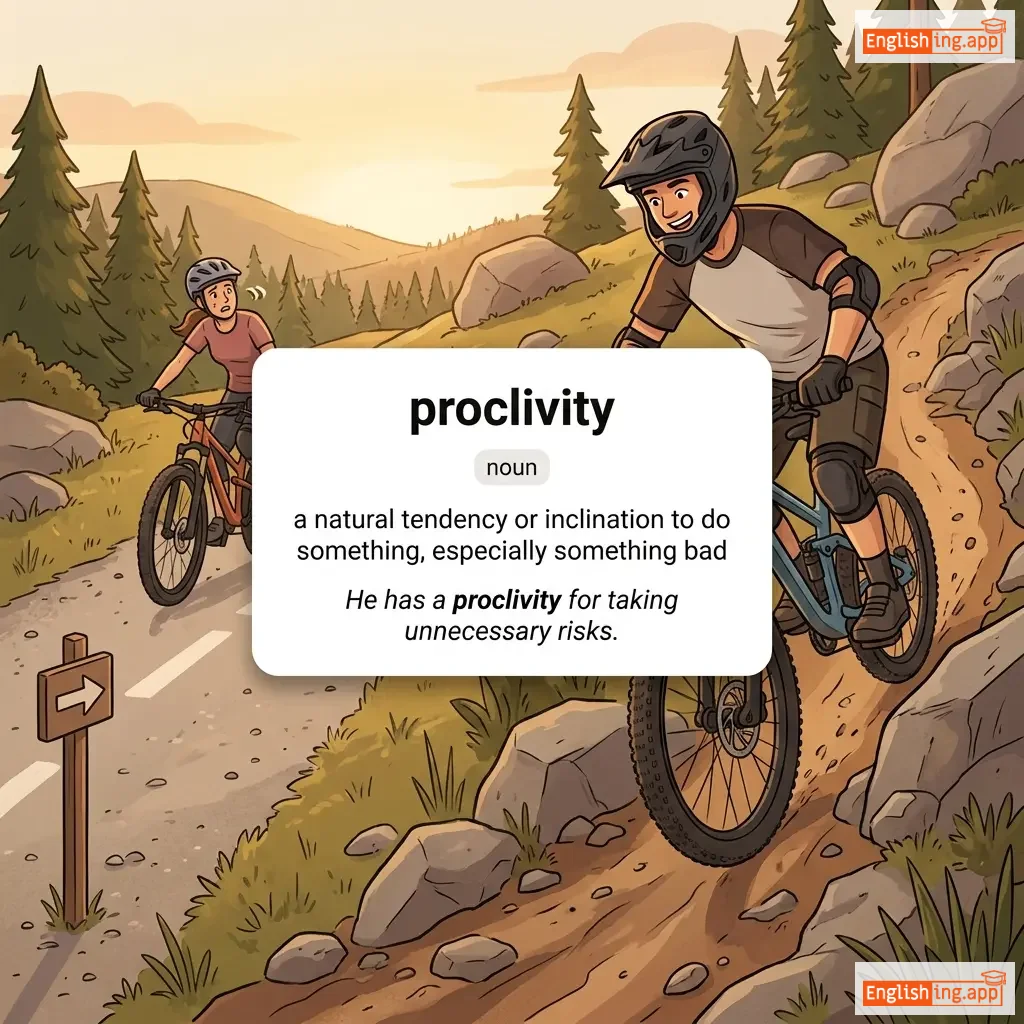
proclivity definition card — visual illustration of the meaning
noun C2
/prəˈklɪvɪti/
प्रवृत्ति (pravritti)

a natural tendency or inclination to do something, especially something bad

"He has a proclivity for taking unnecessary risks."

"उसकी अनावश्यक जोखिम उठाने की प्रवृत्ति है।" (Uski anavashyak jokhim uthane ki pravritti hai.)
noun C2
/ˌprɒdɪˈɡæləti/
विलासिता (vilaasita)

the quality of being wastefully extravagant

"His prodigality with money left him bankrupt."

"उसकी विलासिता के कारण वह दिवालिया हो गया।" (Uski vilaasita ke kaaran woh diwaliya ho gaya.)
noun C2
/ˈprɑːflɪɡəsi/
व्ययितता (vyayitata)

reckless wastefulness or extravagance

"His profligacy with money led him to bankruptcy."

"उसकी व्ययितता ने उसे दिवालिया बना दिया।" (Uski vyayitata ne use deewaliya bana diya.)
adjective C2
/ˈprɑːflɪɡət/
अत्यधिक खर्चीला (atyadhik kharchila)

recklessly extravagant or wasteful in resources

"The king was known for his profligate lifestyle."

"राजा अपनी अत्यधिक खर्चीली जीवनशैली के लिए प्रसिद्ध था।" (Raja apni atyadhik kharchili jeevanshaili ke liye prasiddh tha.)
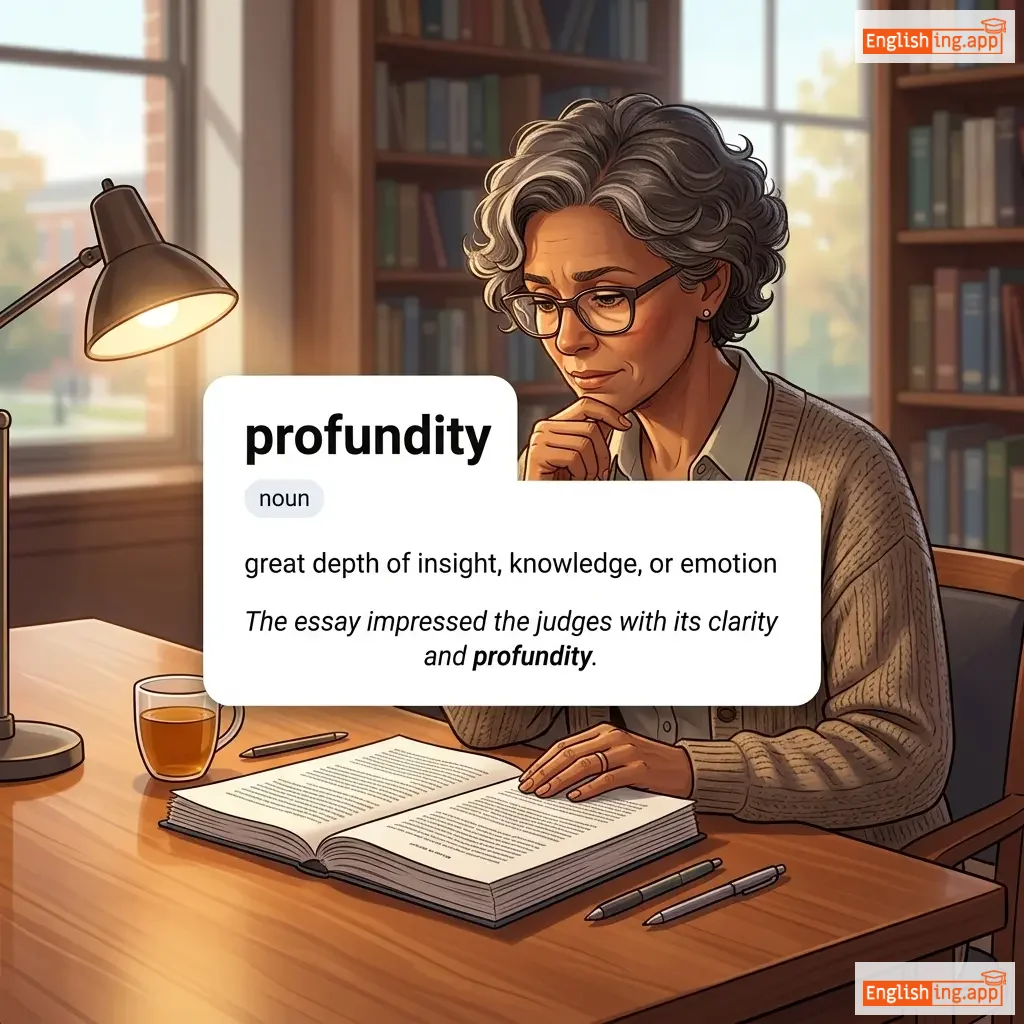
profundity definition card — visual illustration of the meaning
noun C2
/prəˈfʌndɪti/
गंभीरता (gambhirata)

great depth of insight, knowledge, or emotion

"The essay impressed the judges with its clarity and profundity."

"निबंध ने अपने स्पष्टता और गंभीरता से जजों को प्रभावित किया।" (Nibandh ne apne spashtata aur gambhirata se jajo ko prabhavit kiya.)
noun C2
/prəˈfjuːʒən/
प्रचुरता (prachurta)

an abundance or large quantity of something

"Spring brought a profusion of wildflowers to the valley."

"वसंत ने घाटी में जंगली फूलों की प्रचुरता ला दी।" (Vasant ne ghaati mein jangli phoolon ki prachurta la di.)
noun C2
/proʊˈdʒɛnɪtər/
पूर्वज (purvaj)

a direct ancestor; a person or thing that originates something

"Researchers traced the custom back to a common progenitor."

"शोधकर्ताओं ने परंपरा का पता एक सामान्य पूर्वज तक लगाया।" (shodhkartao ne parampara ka pata ek samanya purvaj tak lagaya.)
adjective C2
/ˈprɒɡnəθəs/
अग्रकंठ (agrakanth)

Having jaws that project forward beyond the rest of the face.

"The fossil displayed a distinctly prognathous skull structure."

"जीवाश्म में एक विशेष रूप से अग्रकंठ खोपड़ी संरचना प्रदर्शित की गई।" (Jeevashm mein ek vishesh roop se agrakanth khopdi sanrachna pradarshit ki gayi.)
verb C2
/prɒɡˈnɒstɪkeɪt/
पूर्वानुमान करना (purvanuman karna)

To foretell or predict future events, especially based on current signs.

"Experts attempted to prognosticate the outcome of the election."

"विशेषज्ञों ने चुनाव के परिणाम का अनुमान लगाने की कोशिश की।" (Visheshagyon ne chunaav ke parinaam ka anuman lagane ki koshish ki.)
noun C2
/prɒɡˌnɒstɪˈkeɪʃən/
पूर्वानुमान (purvanuman)

The act of foretelling or predicting future events.

"The astrologer's prognostication fascinated the audience."

"ज्योतिषी का पूर्वानुमान दर्शकों को मंत्रमुग्ध कर दिया था।" (Jyotishi ka purvanuman darshako ko mantrmugdh kar diya tha.)
noun C2
/ˌproʊɪˈbɪʃənɪst/
निषेधवादी (nishedhvadi)

A person who supports or advocates prohibition, especially of alcohol.

"The prohibitionist campaigned against the sale of liquor in the town."

"निषेधवादी ने शहर में शराब की बिक्री के खिलाफ प्रचार किया था।" (Nishedhvadi ne shahar mein sharab ki bikri ke khilaf prachar kiya tha.)
adjective C2
/prəˈhɪbɪtɔːri/
प्रतिबंधात्मक (pratibandhatmak)

Serving or tending to prohibit or forbid.

"The prohibitory laws were strictly enforced in the region."

"प्रतिबंधात्मक क़ानूनों को क्षेत्र में कड़ाई से लागू किया गया था।" (Pratibandhatmak kanoonon ko kshetra mein kadayi se lagu kiya gaya tha.)
adjective C2
/ˈprəʊ.lɪks/
अत्यधिक लंबा (atyadhik lamba)

using too many words; tediously lengthy

"The professor’s prolix lecture put many students to sleep."

"प्रोफेसर का अत्यधिक लंबा व्याख्यान कई छात्रों को सोने पर मजबूर कर दिया।" (Professor ka atyadhik lamba vyakhyan kai chatron ko sone par majboor kar diya.)
noun C2
/prəˈlɪksɪti/
अत्यधिक शब्दजालिता (atyadhik shabdajalita)

the quality of being tediously wordy and long

"The book’s prolixity made it difficult to read in one sitting."

"पुस्तक की अत्यधिक शब्दजालिता ने इसे एक ही बैठक में पढ़ना कठिन बना दिया।" (Pustak ki atyadhik shabdajalita ne ise ek hi baithak mein padhna kathin bana diya.)
adjective C2
/ˈprɒmɪsəri/
प्रति‌श्रुतिमूलक (pratishrutimulak)

Containing or conveying a promise, especially in writing.

"He signed a promissory note to repay the loan."

"उसने ऋण चुकाने के लिए एक प्रति‌श्रुतिमूलक नोट पर हस्ताक्षर किए।" (Usne rin chukane ke liye ek pratishrutimulak note par hastakshar kiye.)
noun C2
/ˈprɒm.ən.tɔːr.i/
कटी हुई भूमि (kati hui bhumi)

A high point of land or rock projecting into a body of water.

"The lighthouse stood on a promontory overlooking the sea."

"灯塔 खाड़ी के ऊपर एक कटी हुई भूमि पर खड़ा था।" (Dengta khadi ke upar ek kati hui bhumi par khada tha.)
verb C2
/ˈprɑː.məl.ɡeɪt/
घोषित करना (ghoshit karna)

To announce or make a law, decree, or idea officially known.

"The government promulgated new regulations on data privacy."

"सरकार ने डेटा प्राइवेसी पर नए नियम घोषित किए।" (Sarkar ne data privacy par naye niyam ghoshit kiye.)
noun C2
/prɔːŋ/
चमच की नोक (chamach ki nok)

a projecting pointed part, such as one of the pointed ends of a fork

"The fork has four prongs."

"चमच में चार नोकें होती हैं।" (Chamach mein chaar nokein hoti hain.)
adjective C2
/ˌprɒfɪˈlæktɪk/
रोकथाम करने वाला (roktam karne wala)

intended to prevent disease or an unwanted outcome; protective

"The doctor prescribed a prophylactic treatment to prevent infection."

"डॉक्टर ने संक्रमण को रोकने के लिए एक रोकथाम उपचार निर्धारित किया।" (Daktar ne sankraman ko rokne ke liye ek roktam upchar nirdharit kiya.)
noun C2
/prəˈpɪŋkwɪti/
निकटता (nikatata)

the state of being close to someone or something; proximity

"The propinquity of their houses made them close friends."

"उनके घरों की निकटता ने उन्हें करीबी दोस्त बना दिया।" (Unke gharon ki nikatata ne unhe kareebi dost bana diya.)
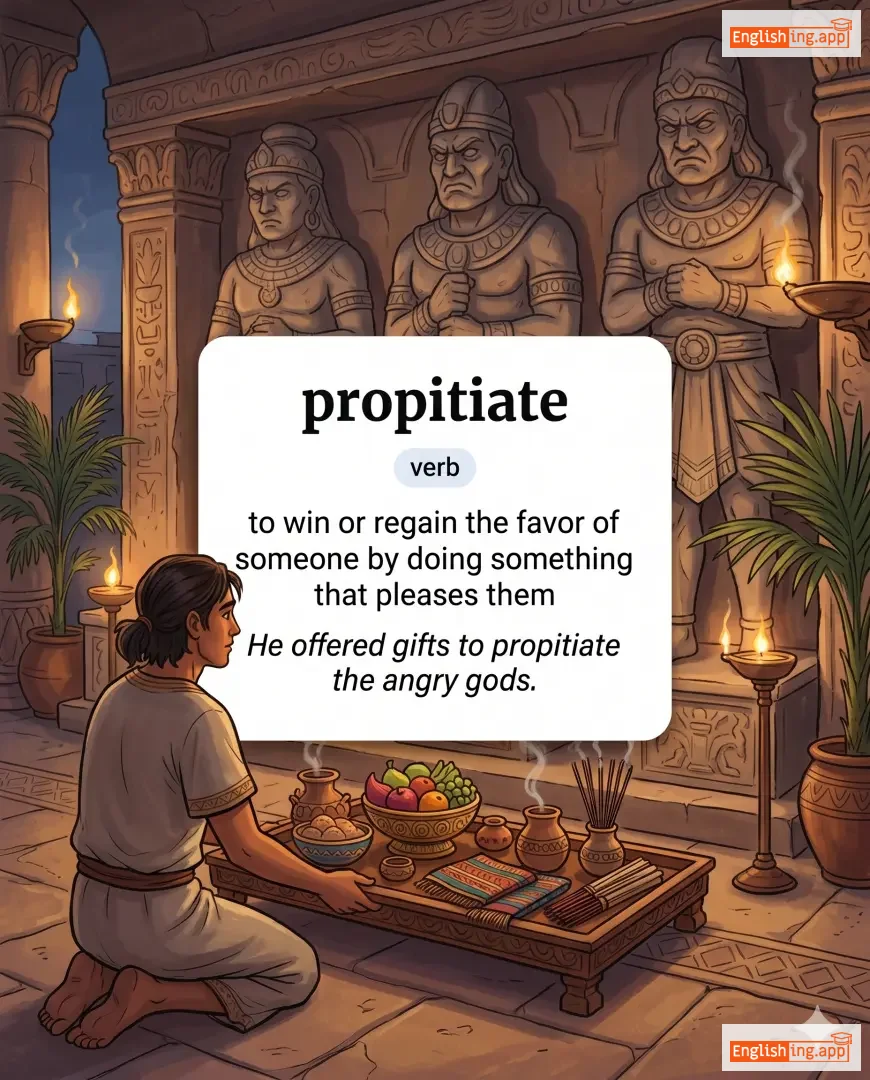
propitiate definition card — visual illustration of the meaning
verb C2
/prəˈpɪʃieɪt/
किसी को प्रसन्न करने के लिए उसका आशीर्वाद प्राप्त करना (kisi ko prasann karne ke liye uska aashirwad prapt karna)

to win or regain the favor of someone by doing something that pleases them

"He offered gifts to propitiate the angry gods."

"उसने गुस्साए हुए देवताओं को प्रसन्न करने के लिए उपहार दिए।" (Usne gussaaye huye devtaon ko prasann karne ke liye uphaar diye.)