Vocabularies

English Vocabulary Dictionary | Word Meanings, Definitions & Examples

adjective C2
/ˈɪnmoʊst/
गहरे से गहरा (gahare se gahra)

Situated at the very heart or deepest part; most private or secret.

"She revealed her inmost thoughts to her closest friend."

"उसने अपनी गहरी विचारधारा को अपने सबसे करीबी दोस्त से साझा किया।" (Usne apni gahri vichardhara ko apne sabse kareebi dost se saajha kiya.)
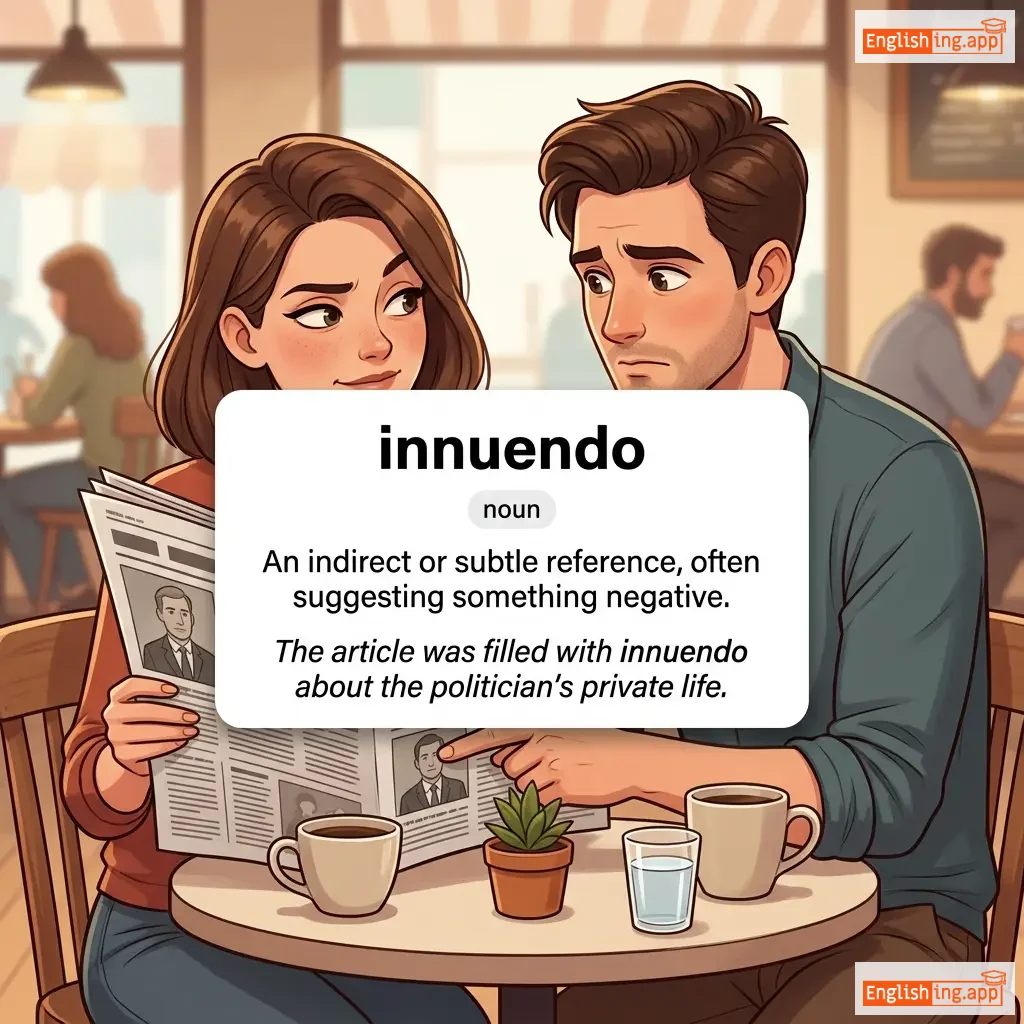
innuendo definition card — visual illustration of the meaning
noun C2
/ˌɪnjuˈɛndoʊ/
संकेत (sanket)

An indirect or subtle reference, often suggesting something negative.

"The article was filled with innuendo about the politician's private life."

"लेख में राजनेता के निजी जीवन के बारे में संकेत भरे थे।" (lekh mein raajneeta ke nijee jeevan ke baare mein sanket bhare the.)
adjective C2
/ˌɪnˌɑːpərˈtuːn/
असुविधाजनक समय (asuvidhajanak samay)

Happening at a bad or inconvenient time.

"His call came at the most inopportune moment."

"उसका कॉल सबसे असुविधाजनक समय पर आया।" (uska call sabse asuvidhajanak samay par aaya.)
noun C2
/ɪnˈkwɪzɪtər/
अन्वेषक (anveshak)

A person who asks many questions, often in an official or harsh manner.

"The inquisitor demanded detailed answers from the witness."

"अन्वेषक ने गवाह से विस्तृत उत्तर मांगे।" (Anveshak ne gawah se vistarit uttar maange.)
noun C2
/ˈɪnroʊd/
प्रगति (pragati)

An advance or significant progress, often at the expense of something else.

"The company made significant inroads into the mobile market."

"कंपनी ने मोबाइल बाजार में महत्वपूर्ण प्रगति की।" (Company ne mobile bazar mein mahatvapurn pragati ki.)
adjective C2
/ˌɪnsəˈluːbriəs/
अस्वस्थ (aswasth)

Unhealthy or not conducive to well-being.

"They moved out of the insalubrious neighborhood for the sake of their health."

"उन्होंने अपनी सेहत के लिए अस्वस्थ इलाके से बाहर जाने का फैसला किया" (Unhone apni sehat ke liye aswasth ilake se baahar jaane ka faisla kiya)
adjective C2
/ɪnˈseɪʃiət/
अतृप्त (atript)

impossible to satisfy; always wanting more

"He had an insatiate desire for power."

"उसके पास शक्ति के लिए एक अतृप्त इच्छा थी।" (uske paas shakti ke liye ek atript ichha thi.)
adjective C2
/ɪnˈskruːtəbl̩/
खुशी (khushi)

impossible to understand or interpret

"His inscrutable expression made it hard to know what he was thinking."

"जब उसे पुरस्कार मिला तो वह अपनी खुशी छिपा नहीं पाई।" (jab use puraskar mila to wah apni khushi chhupa nahin pai.)
adjective C2
/ɪnˈsɛnseɪt/
निर्दय (nirday)

lacking physical sensation or empathy; without feeling or sensitivity

"The dictator's insensate cruelty shocked the world."

"तानाशाह की निर्दय क्रूरता ने दुनिया को हैरान कर दिया।" (taanashaah ki nirday kroorta ne duniya ko hairaan kar diya.)
adjective C2
/ɪnˈsɛnʃənt/
अचेतन (achetan)

Lacking perception, consciousness, or sensation.

"The rock is an insentient object with no awareness."

"चट्टान एक अचेतन वस्तु है जिसमें कोई जागरूकता नहीं है।" (Chattan ek achetan vastu hai jismein koi jagrookta nahi hai.)
noun C2
/ɪnˈsɪɡniə/
चिह्न (chihn)

A badge or symbol that shows rank, position, or membership.

"The soldier proudly wore the insignia of his regiment."

"सैनिक ने गर्व से अपनी रेजिमेंट का चिह्न पहना।" (Sainik ne garv se apni regiment ka chihn pehna.)
insipid definition card — visual illustration of the meaning
adjective C2
/ɪnˈsɪpɪd/
नीरस (niros)

lacking flavor, interest, or excitement; dull

"The soup was insipid and needed more seasoning."

"सूप नीरस था और उसे अधिक मसाले की आवश्यकता थी।" (Soup niros tha aur use adhik masale ki avashyakta thi.)
noun C2
/ˈɪnsələns/
अवहेलना (avhelna)

rude or disrespectful behavior

"The teacher was shocked by the student's insolence."

"अध्यापक छात्र की अवहेलना से चौंक गए थे।" (Adhyapak chhatra ki avhelna se chaunk gaye the.)
adverb C2
/ˌɪnsəʊˈmʌtʃ/
इतना (itna)

to such an extent

"He was insomuch tired that he could hardly stand."

"वह इतना थका हुआ था कि वह मुश्किल से खड़ा हो पा रहा था।" (Vah itna thaka hua tha ki vah mushkil se khada ho pa raha tha.)
noun C2
/ɪnˈsuːsiəns/
उदासीनता (udasinta)

Casual lack of concern; indifference.

"She carried herself with an air of insouciance, unbothered by the challenges ahead."

"वह एक उदासीनता के साथ चल रही थी, आगामी चुनौतियों से बेपरवाह।" (Woh ek udasinta ke saath chal rahi thi, aagami chunautiyon se beparwah.)
insouciant definition card — visual illustration of the meaning
adjective C2
/ɪnˈsuːsiənt/
निर्दय (nirdai)

Showing a casual lack of concern; carefree.

"He gave an insouciant shrug and walked away."

"उसने एक निर्दय इशारा किया और चल पड़ा।" (Usne ek nirdai ishara kiya aur chal pada.)
verb C2
/ɪnˈsteɪt/
पद पर नियुक्त करना (pad par niyukt karna)

To set up in position, office, or authority.

"The board decided to instate her as the new director."

"बोर्ड ने उसे नए निदेशक के रूप में इंस्टेट करने का निर्णय लिया।" (Board ne use naye nideshak ke roop mein instate karne ka nirnay liya.)
noun C2
/ˌɪn.strəˈmɛn.təl.ɪst/
वाद्य यंत्री (vaadya yantri)

A person who plays a musical instrument.

"The instrumentalist played a beautiful solo on the violin."

"वाद्य यंत्री ने वायलिन पर एक सुंदर एकल प्रदर्शन किया।" (Vaadya yantri ne violin par ek sundar ekal pradarshan kiya.)
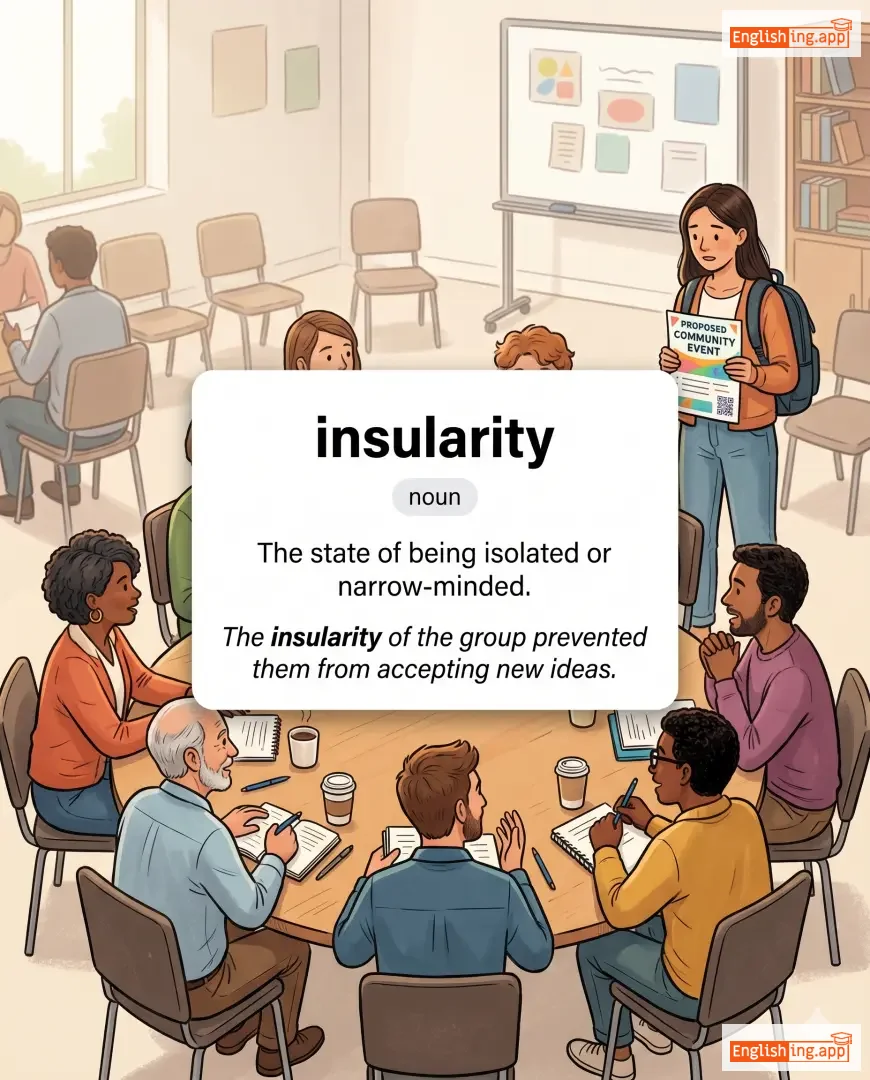
insularity definition card — visual illustration of the meaning
noun C2
/ˌɪnsjəˈlærəti/
संकीर्णता (sankirnta)

The state of being isolated or narrow-minded.

"The insularity of the group prevented them from accepting new ideas."

"ग्रुप की संकीर्णता ने उन्हें नए विचारों को स्वीकारने से रोक दिया।" (grup ki sankirnta ne unhein naye vicharon ko svikarna se rok diya.)
insuperable definition card — visual illustration of the meaning
adjective C2
/ɪnˈsuːpərəbl/
अजेय (ajey)

Impossible to overcome or surpass.

"The team faced insuperable challenges during the expedition."

"टीम ने अभियान के दौरान अजेय चुनौतियों का सामना किया।" (Team ne abhiyan ke dauran ajey chunautiyon ka samna kiya.)
adjective C2
/ˌɪnsəˈpɔːrtəbl̩/
असहनीय (asahniya)

Too extreme or difficult to be endured.

"The heat was insupportable during the long journey."

"लंबी यात्रा के दौरान गर्मी असहनीय थी।" (Lambi yatra ke dauran garmi asahniya thi.)
adjective C2
/ˌɪnsəˈprɛsəbl/
अवरोधनीय (avrodhniya)

That cannot be suppressed or restrained.

"She had an insuppressible urge to laugh during the ceremony."

"उसे समारोह के दौरान हंसने की अवरोधनीय इच्छा हो रही थी।" (Use samaroho ke dauran hansne ki avrodhniya ichcha ho rahi thi.)
noun C2
/ˌɪnsəˈrɛkʃən/
विद्रोह (vidroh)

A violent uprising against an authority or government.

"The army was called in to suppress the insurrection."

"सेना को विद्रोह को दबाने के लिए बुलाया गया था।" (Sena ko vidroh ko dabane ke liye bulaya gaya tha.)
integrative diplomacy definition card — visual illustration of the meaning
noun C2
/ˈɪn.tɪ.ɡreɪ.tɪv dɪˈpləʊ.mə.si/
समन्वयात्मक कूटनीति (samanvayaatmak kutniti)

A diplomatic approach that seeks to combine or coordinate different elements, interests, or parties into a unified whole.

"Integrative diplomacy strengthens alliances."

"समन्वयात्मक कूटनीति गठबंधनों को मजबूत करती है।" (Samanvayaatmak kutniti gathbandhon ko majboot karti hai.)
noun C2
/ɪnˈtɛɡ.jʊ.mənt/
बाहरी आवरण (baahari aavaran)

A natural outer covering, such as skin, shell, or rind.

"The snake sheds its integument as it grows."

"सांप अपना बाहरी आवरण उखाड़ता है जैसे-जैसे वह बढ़ता है।" (saap apna baahari aavaran ukhadta hai jaise-jaise vah badhta hai.)
noun C2
/ɪnˌtɛl.ɪˈdʒɛntsi.ə/
बुद्धिजीवी वर्ग (buddhijeevi varg)

The group of people engaged in intellectual and cultural pursuits in a society.

"The intelligentsia played a key role in shaping public opinion."

"बुद्धिजीवी वर्ग ने जनमत बनाने में महत्वपूर्ण भूमिका निभाई।" (buddhijeevi varg ne janmat banane mein mahatvapurn bhoomika nibhayi.)
noun C2
/ɪnˈtɛmpərəns/
असंयम (asanyam)

Lack of moderation or self-control, especially with drinking or eating.

"His intemperance in drinking ruined his health."

"उसकी असंयमितता ने उसकी सेहत को नुकसान पहुँचाया।" (uski asanyamitā ne uski sehat ko nuksān pahunchāyā.)
adjective C2
/ɪnˈtɛmpərət/
अविनीत (avinit)

Lacking self-control; immoderate, especially in indulgence.

"The politician's intemperate remarks caused controversy."

"राजनीतिक नेता की अविनीत टिप्पणियों ने विवाद पैदा किया।" (rajnitik neta ki avinit tippaniyon ne vivad paida kiya.)
noun C2
/ɪnˈtɛnʃən/
अंतर्निहित अर्थ (antarnihit arth)

The internal content of a concept; the set of attributes implied by a word or phrase.

"The intension of the word 'dog' includes being a mammal and domesticated."

"'कुत्ता' शब्द का इंटेंशन में स्तनपायी होना और पालतू होना शामिल है।" ('kutta' shabd ka intension mein stanpayi hona aur paaltu hona shaamil hai.)
verb C2
/ɪnˈtɜːr/
दफनाना (dafnana)

To bury a dead body in the ground.

"They decided to inter the soldier with full honors."

"वे सैनिक को पूर्ण सम्मान के साथ दफनाने का निर्णय लिया।" (Ve sainik ko poorn sammaan ke saath dafnaane ka nirnay liya.)
verb C2
/ˌɪntərˈsiːd/
दखल देना (dakhal dena)

to act or plead on behalf of someone in difficulty or trouble; to intervene between parties to help resolve a dispute

"She interceded with the teacher to give her brother another chance."

"वह अपने भाई को और एक मौका देने के लिए शिक्षक से दखल दे रही थी।" (Woh apne bhai ko aur ek mauka dene ke liye shikshak se dakhal de rahi thi.)
noun C2
/ˌɪntərˈsɛʃən/
सिफारिश (sifarish)

the act of intervening or pleading on behalf of another person

"The prisoner was released due to the intercession of influential leaders."

"कैदी को प्रभावशाली नेताओं की सिफारिश पर रिहा किया गया था।" (Kaidi ko prabhavshali netaon ki sifarish par riha kiya gaya tha.)
noun C2
/ˌɪntərˈsɛsər/
मध्यस्थ (madhyasth)

a person who intervenes or pleads on behalf of another

"He acted as an intercessor to resolve the conflict between the two families."

"उसने दो परिवारों के बीच संघर्ष को सुलझाने के लिए एक मध्यस्थ के रूप में कार्य किया।" (Usne do parivaron ke beech sangharsh ko suljhane ke liye ek madhyasth ke roop mein karya kiya.)
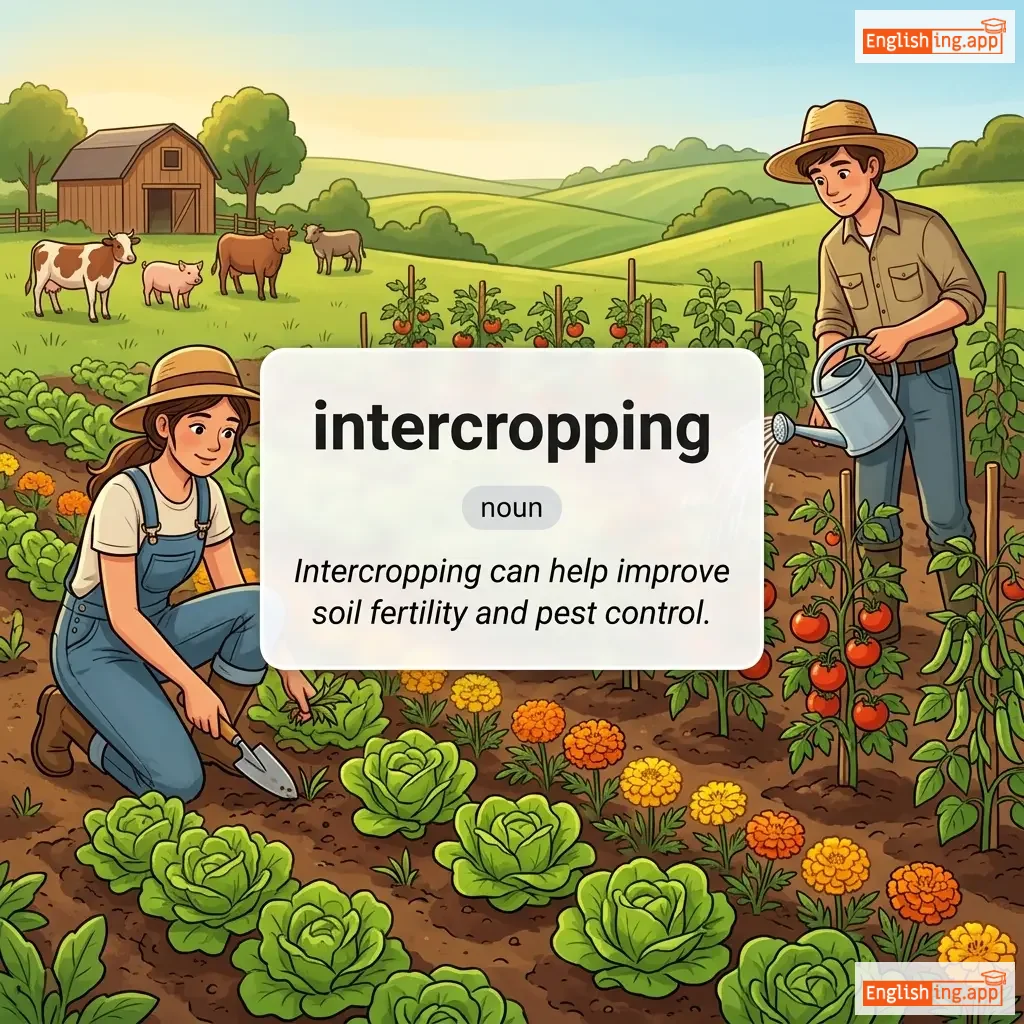
intercropping definition card — visual illustration of the meaning
noun C2
/ˈɪntəˌkrɒpɪŋ/
सहफसल कृषि (sahafasal krishi)

The agricultural practice of cultivating two or more crops simultaneously in the same field to maximize land use efficiency and improve soil health.

"Intercropping can help improve soil fertility and pest control."

"सहफसल कृषि मिट्टी की उर्वरता और कीट नियंत्रण में सुधार कर सकता है।" (Sahafasal krishi mitti ki urvarataa aur kit niyantran mein sudhaar kar sakta hai.)
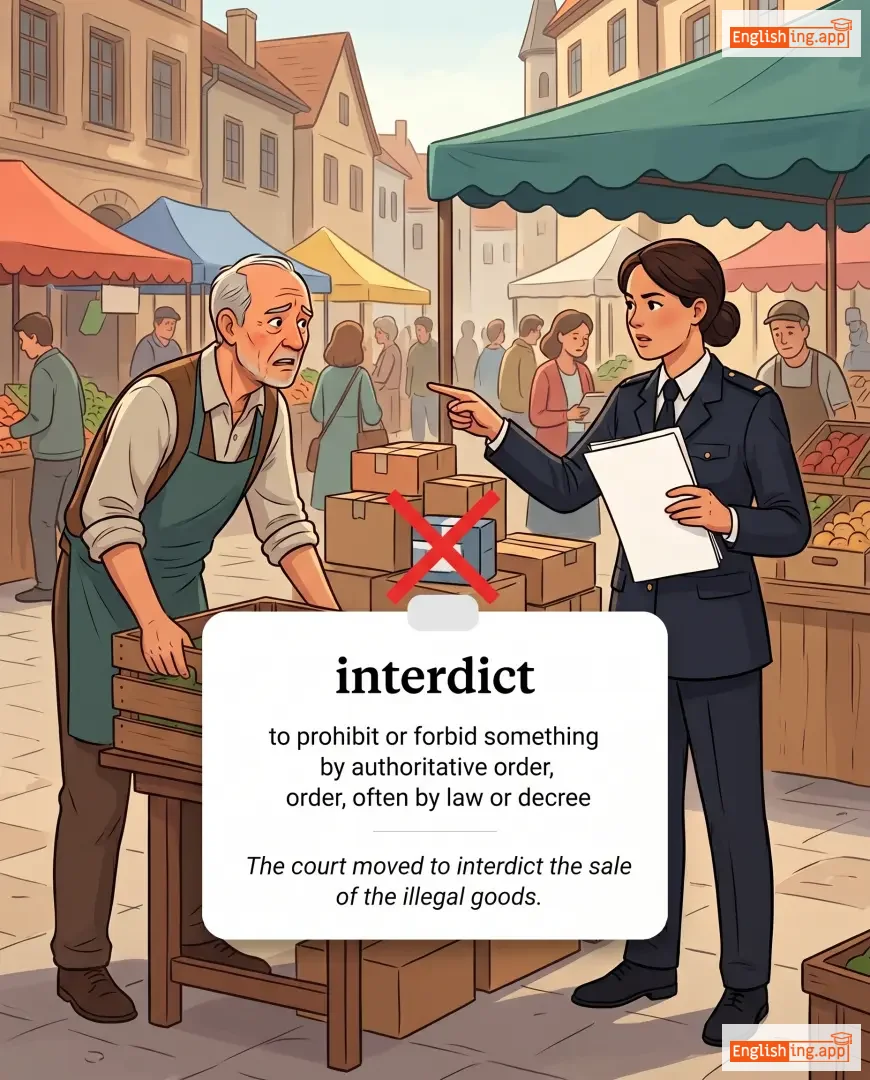
interdict definition card — visual illustration of the meaning
verb C2
/ˈɪntərˌdɪkt/
निषेध करना (nishedh karna)

to prohibit or forbid something by authoritative order, often by law or decree

"The court moved to interdict the sale of the illegal goods."

"कोर्ट ने अवैध सामान की बिक्री पर रोक लगाने का निर्णय लिया।" (Court ne avaidh samaan ki bikri par rok lagane ka nirnay liya.)
verb C2
/ˌɪntərˈlɒk/
आपस में जुड़ना (aapas mein judna)

to fit or connect together securely so that two or more things are joined

"The gears interlock to ensure smooth movement of the machine."

"गियर्स मशीन की स्मूथ मूवमेंट सुनिश्चित करने के लिए आपस में जुड़ते हैं।" (Gears machine ki smooth movement sunishchit karne ke liye aapas mein judte hain.)
noun C2
/ˌɪntərˈlɒkjətər/
संलापकर्ता (sanlapkarta)

a person who takes part in a conversation or dialogue

"She was a skilled interlocutor during the debate."

"वह बहस के दौरान एक कुशल संलापकर्ता थी।" (vah bahas ke dauran ek kushal sanlapkarta thi.)
adjective C2
/ˌɪntərˈlɒkjətəri/
अंतरिम (antarim)

Given during the course of a legal action, not final but temporary or provisional.

"The judge issued an interlocutory order to maintain the status quo until the hearing."

"न्यायाधीश ने सुनवाई तक स्थिति बनाए रखने के लिए एक अंतरिम आदेश जारी किया।" (Nyayadhish ne sunwai tak sthiti banaye rakhne ke liye ek antarim aadesh jaari kiya.)
noun C2
/ˈɪntərˌloʊpər/
अतिक्रमणकर्ता (atikramankarta)

A person who becomes involved in a situation or place where they are not wanted.

"He felt like an interloper at the private family gathering."

"वह निजी पारिवारिक सभा में एक अतिक्रमणकर्ता की तरह महसूस कर रहा था।" (Vah niji parivarik sabha mein ek atikramankarta ki tarah mahsus kar raha tha.)
noun C2
/ɪnˈtɜːrmənt/
दफनाना (dafnana)

The act of burying a dead body in a grave or tomb.

"The interment took place at the family cemetery."

"दफन प्रक्रिया परिवारिक कब्रिस्तान में हुई।" (Dafan prakriya parivarik kabristan mein hui.)
verb C2
/ˌɪntərˈmɪt/
विराम लेना (viraam lena)

To suspend or stop for a time; to pause intermittently.

"The rain would intermit and then start again."

"बारिश रुकती और फिर शुरू होती।" (Barish rukti aur phir shuru hoti.)
internecine definition card — visual illustration of the meaning
adjective C2
/ˌɪntərˈniːsaɪn/
आंतरिक संघर्ष (aantarik sangharsh)

Relating to conflict within a group, often causing mutual destruction.

"The internecine conflict weakened the organization from within."

"आंतरिक संघर्ष ने संगठन को भीतर से कमजोर कर दिया था" (aantarik sangharsh ne sangathan ko bhitar se kamzor kar diya tha)
interpolate definition card — visual illustration of the meaning
verb C2
/ɪnˈtɜːrpəˌleɪt/
सम्मिलित करना (sammilit karna)

To insert something, often words, into a text or conversation; to estimate values between known data points.

"The editor interpolated a missing paragraph into the manuscript."

"संपादक ने मैन्यूस्क्रिप्ट में एक गायब पैराग्राफ सम्मिलित किया।" (sampadak ne manuuskript mein ek gayab paraagraaph sammilit kiya.)
noun C2
/ɪnˌtɜːrpəˈleɪʃən/
इंटरपोलेशन (interpolation)

The act of inserting something into a text or estimating values within a sequence of data.

"The scientist used interpolation to predict the missing data points."

"वैज्ञानिक ने अनुपस्थित डेटा बिंदुओं का अनुमान लगाने के लिए इंटरपोलेशन का उपयोग किया।" (vaigyanik ne anupasthit data binduon ka anuman lagane ke liye interpolation ka upyog kiya.)
verb C2
/ˌɪntərˈpoʊz/
हस्तक्षेप करना (hastakshep karna)

To place or insert between one thing and another; to intervene in a situation.

"He quickly interposed himself between the fighters to stop the quarrel."

"उसने झगड़े को रोकने के लिए खुद को लड़ाकों के बीच में जल्दी से इंटरपोज़ किया।" (usne jhagda rokne ke liye khud ko ladako ke beech mein jaldi se interpose kiya.)
noun C2
/ˌɪntərpəˈzɪʃən/
हस्तक्षेप (hastakshep)

The act of intervening or coming between two things, often to influence or prevent an outcome.

"The manager’s interposition prevented a heated argument from escalating."

"मैनेजर का हस्तक्षेप एक गरमागरम बहस को बढ़ने से रोक दिया।" (Manager ka hastakshep ek garamgaram behas ko badhne se rok diya.)
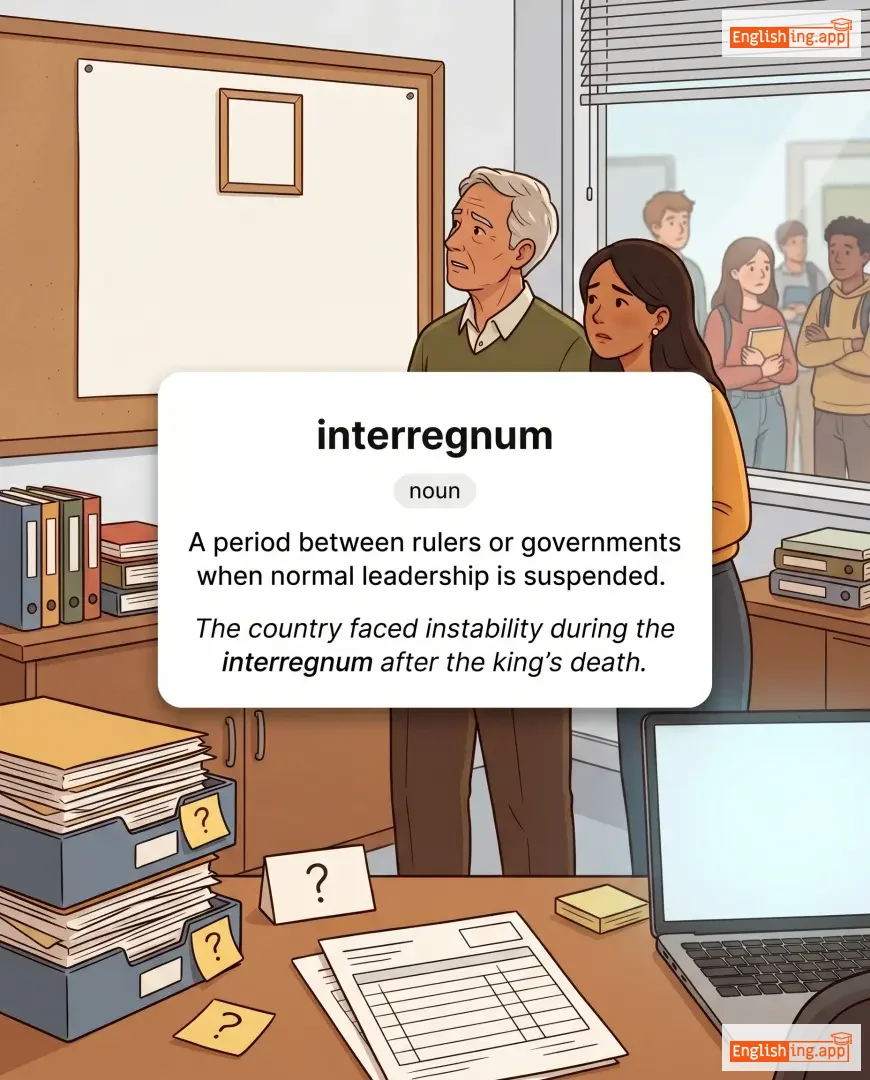
interregnum definition card — visual illustration of the meaning
noun C2
/ˌɪntərˈrɛɡnəm/
अंतरकाल (antarkal)

A period between rulers or governments when normal leadership is suspended.

"The country faced instability during the interregnum after the king’s death."

"राजा की मृत्यु के बाद देश ने अंतरकाल के दौरान अस्थिरता का सामना किया।" (Raja ki mrityu ke baad desh ne antarkal ke dauran asthirata ka samna kiya.)
adjective C2
/ˌɪntəˈrɒɡətəri/
प्रश्नात्मक (prashnatmak)

expressed in the form of a question; relating to questioning

"The lawyer’s interrogatory tone made the witness uncomfortable."

"वकील की प्रश्नात्मक आवाज ने गवाह को असहज कर दिया।" (Vakeel ki prashnatmak awaaz ne gawah ko asahaj kar diya.)
noun C2
/ɪnˈtɜːrstɪs/
दरार (daraar)

a small space that lies between things

"Light filtered through the narrow interstices of the wall."

"रोशनी दीवार की संकरी दरारों से छनकर आई।" (Roshni deewar ki sankari daraaron se chhankar aayi.)
noun C2
/ˈɪntərˌveɪl/
नदी किनारे का समतल उपजाऊ भूमि (nadi kinare ka samatal upjaoo bhoomi)

A low-lying tract of land along a river, usually fertile and flat.

"The farmers cultivated crops on the lush intervale by the river."

"किसानों ने नदी के किनारे की समतल भूमि पर फसल उगाई।" (Kisano ne nadi ke kinare ki samatal bhoomi par fasal ugayi.)