Vocabularies

English Vocabulary Dictionary | Word Meanings, Definitions & Examples

adjective, noun, verb C1
/ˈtrɛbəl/
三倍,尖高音 (san bei, jian gao yin)

triple; consisting of three parts; high-pitched sound in music

"The company's profits trebled in just two years."

"公司的利润在两年内翻了三倍。" (Gongsi de liru yin liangnian nei fanle san bei.)
noun C1
/ˈtrɛmər/
颤动 (chandong)

a slight shaking movement in a person’s body or in the ground

"A small tremor was felt before the earthquake."

"在地震前感到了轻微的颤动。" (Zài dìzhèn qián gǎndào le qīngwéi de chandong.)
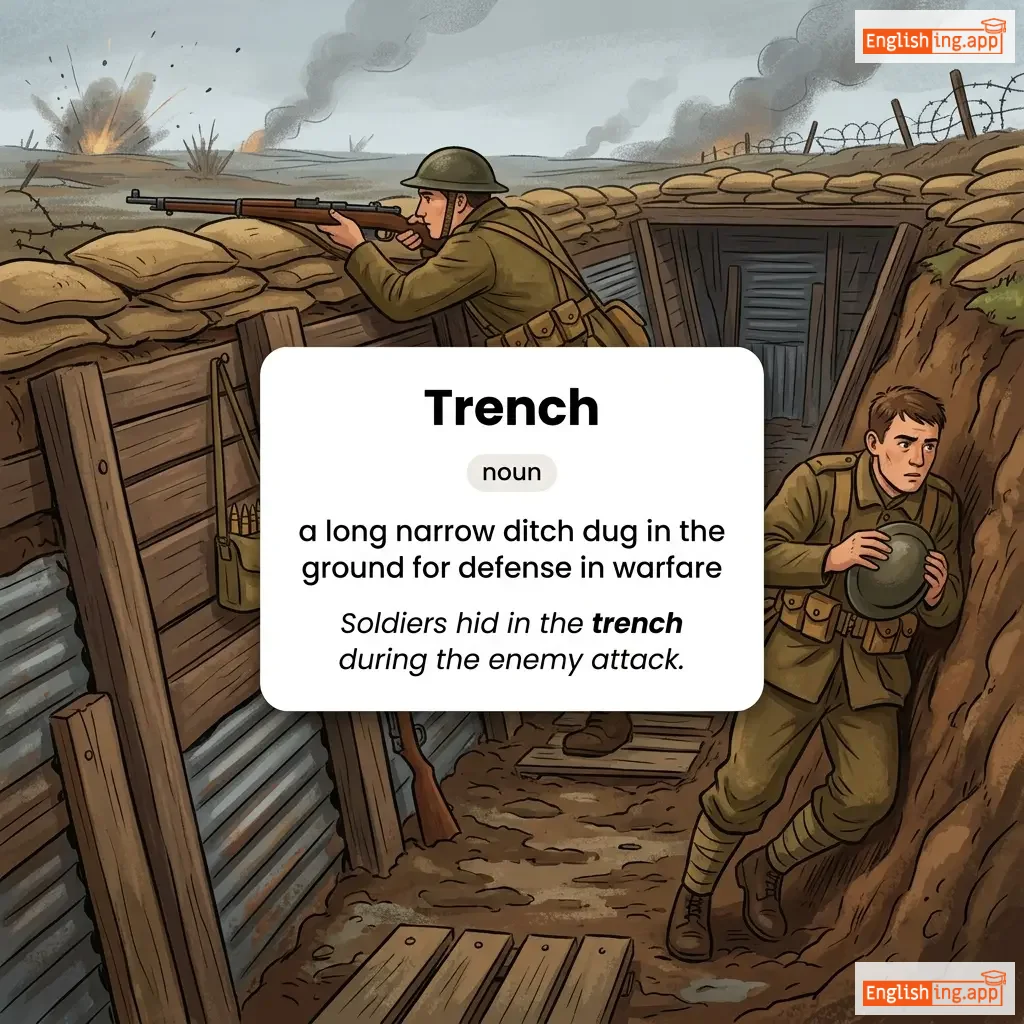
Trench definition card — visual illustration of the meaning
noun C1
/trentʃ/
战壕 (zhànháo)

a long narrow ditch dug in the ground for defense in warfare

"Soldiers hid in the trench during the enemy attack."

"士兵们在敌人的攻击期间藏身于战壕中。" (Shìbīngmen zài dírén de gōngjí qījiān cángshēn yú zhànháo zhōng.)
trepidation definition card — visual illustration of the meaning
noun C1
/ˌtrɛpɪˈdeɪʃən/
忧虑 (yōulǜ)

a feeling of fear or anxiety about something that may happen

"She opened the letter with some trepidation."

"她带着一些忧虑打开了信件。" (Tā dàizhe yīxiē yōulǜ dǎkāile xìnjiàn.)
verb C1
/ˈtrɛspəs/

to enter someone's land or property without permission

"He was fined for trespassing on private land."

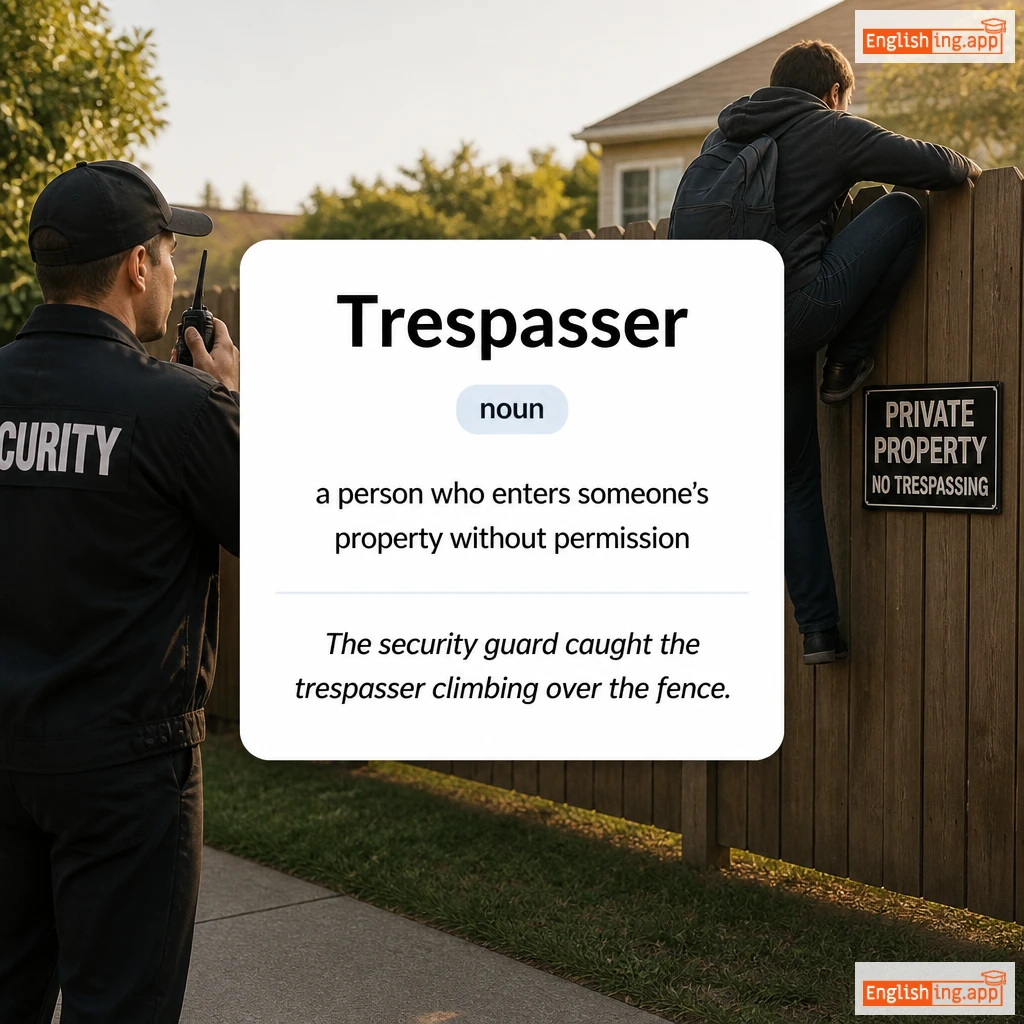
Trespasser definition card — visual illustration of the meaning
noun C1
/ˈtres.pæs.ər/
擅闯者 (shan chuang zhe)

a person who enters someone's property without permission

"The security guard caught the trespasser climbing over the fence."

"安保人员抓住了翻越围栏的擅闯者。" (Anbao renyuan zhuazhu le fan yue weilan de shanchuang zhe.)
noun C1
/ˈtraɪæd/
三合会 (sanhehui)

a group of three closely related people or things

"The project was managed by a triad of experts."

"该项目由一个三人专家小组管理。" (Gai xiangmu you yi ge san ren zhuanjia xiaozu guanli.)
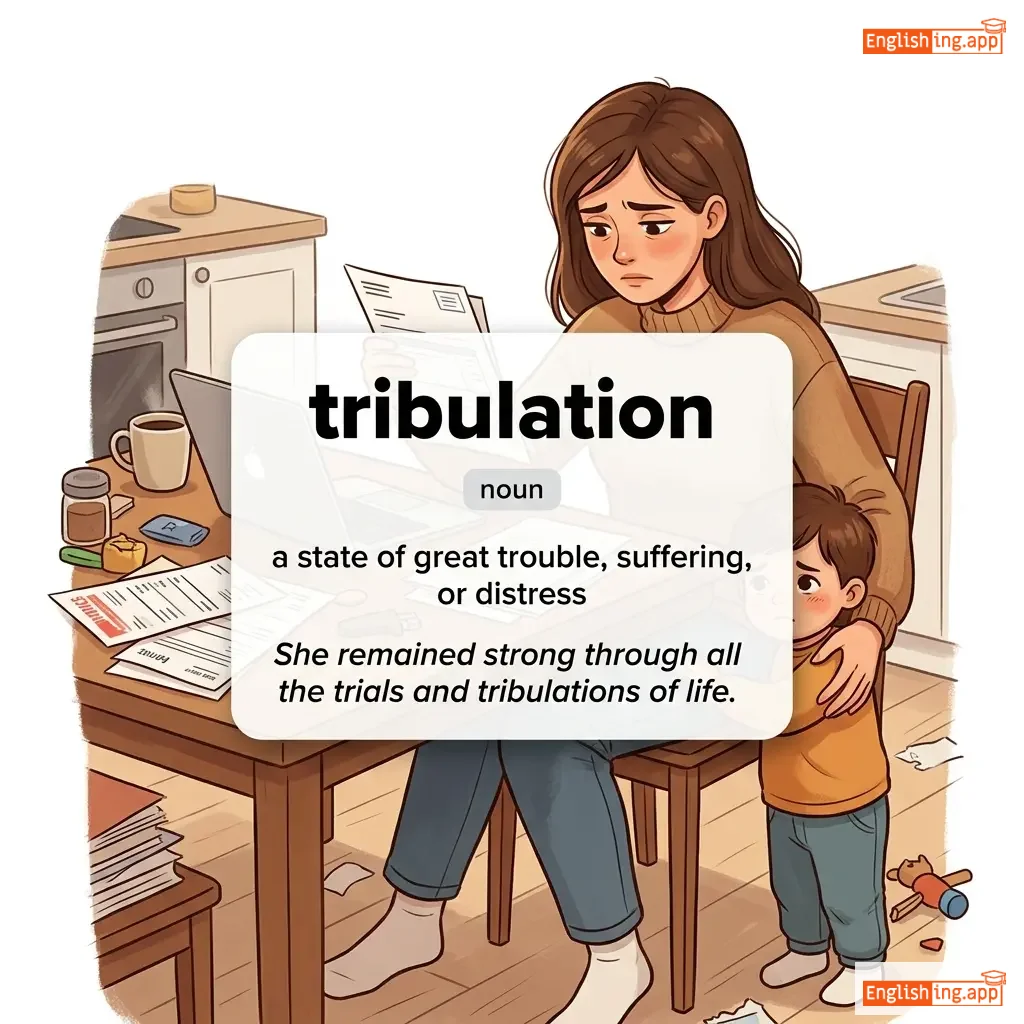
tribulation definition card — visual illustration of the meaning
noun C1
/ˌtrɪbjʊˈleɪʃən/

a state of great trouble, suffering, or distress

"She remained strong through all the trials and tribulations of life."

noun C1
/traɪˈbjuːnəl/
法庭 (fating)

a court of justice or body established to settle disputes

"The case was heard in an international tribunal."

"案件在国际法庭审理。" (Anjian zai guoji fating shenli.)
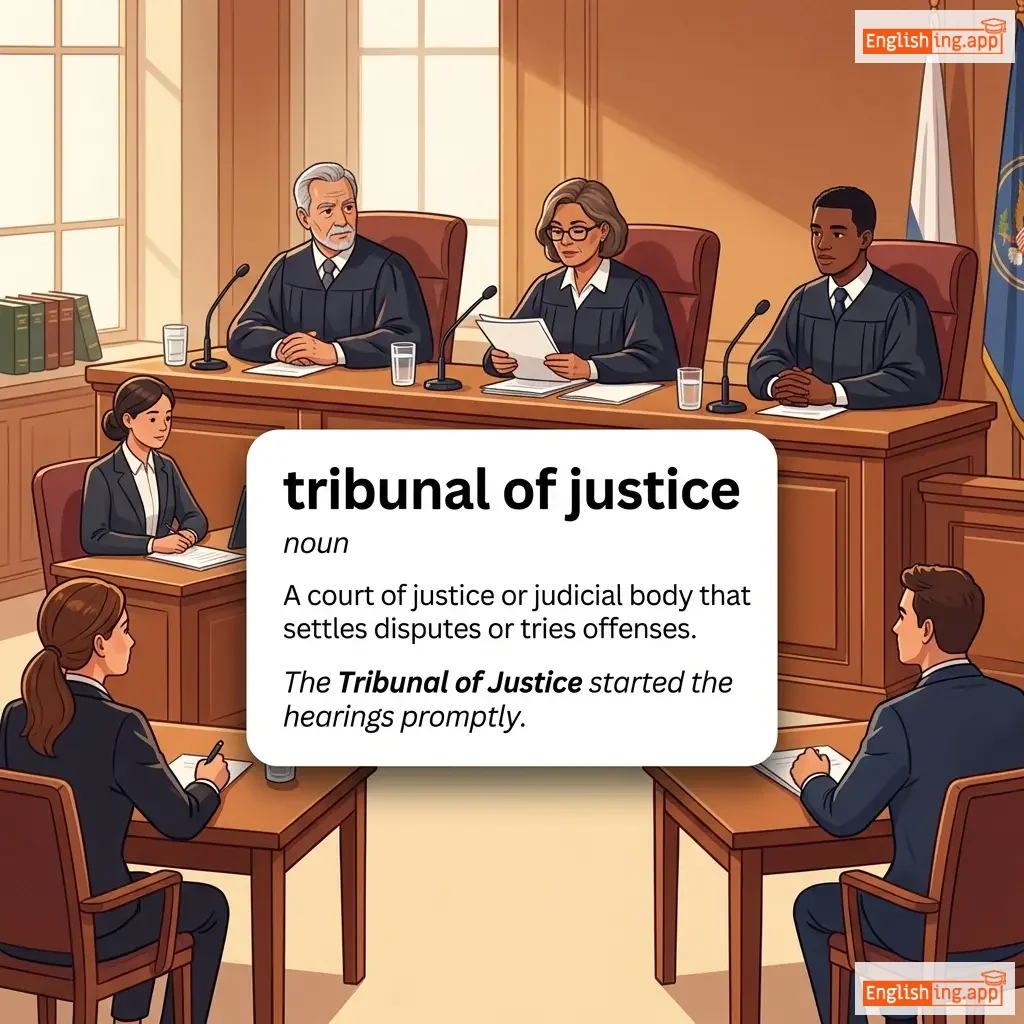
tribunal of justice definition card — visual illustration of the meaning
noun C1
ˌtraɪ.bjuˈnæl əv ˈdʒʌs.tɪs
司法法院 (sifa fayuan)

A court of justice or judicial body that settles disputes or tries offenses.

"The Tribunal of Justice started the hearings promptly."

"司法法院立即开始了听证会。" (Sifa fayuan liming kaishi le tingzhenghui.)
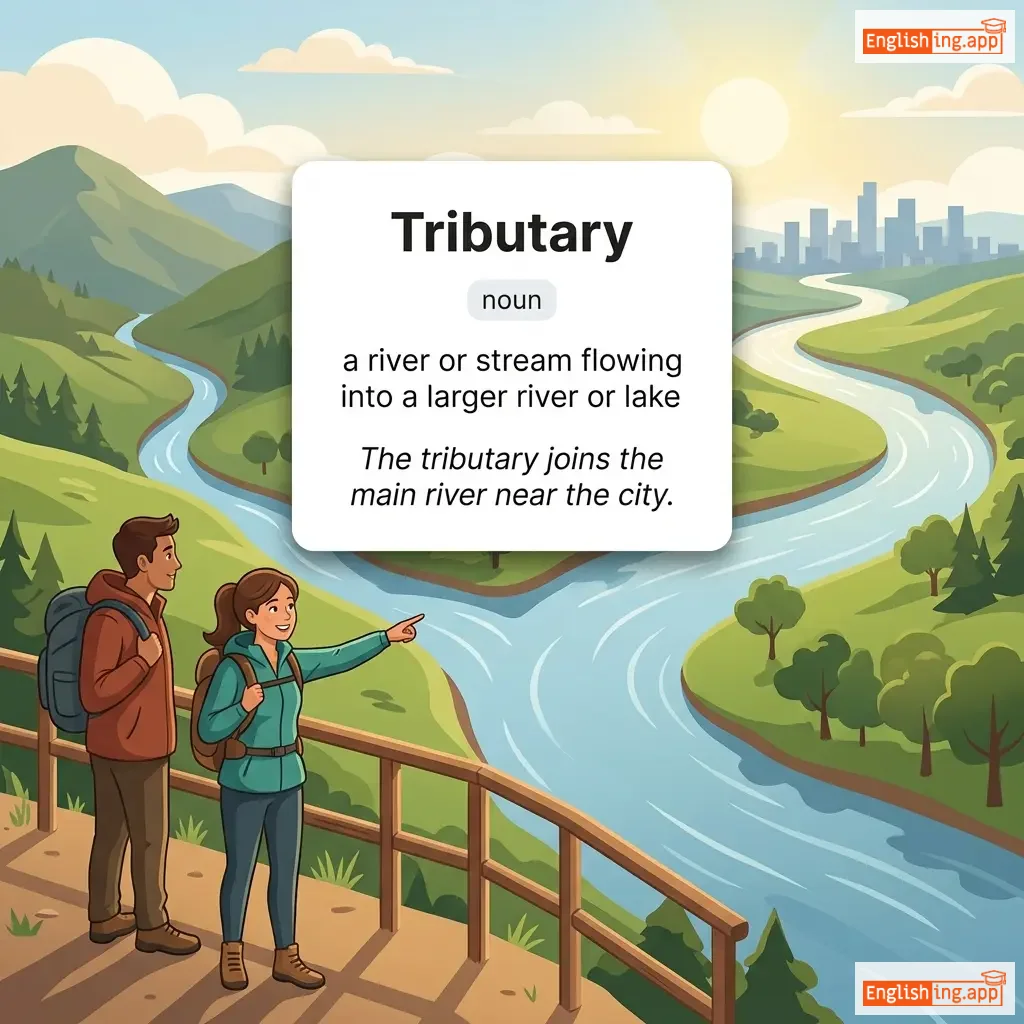
Tributary definition card — visual illustration of the meaning
noun C1
/ˈtrɪb.jə.ter.i/
支流 (zhīliú)

a river or stream flowing into a larger river or lake

"The tributary joins the main river near the city."

"支流在城市附近与主河汇合。" (zhīliú zài chéngshì fùjìn yǔ zhǔ hé huìhé)
noun C1
/ˈtrɪkəri/

The use of dishonest methods to deceive or cheat someone.

"The politician was accused of winning the election through trickery."

verb C1
/ˈtrɪkl̩/
涓滴 (juāndī)

To flow or fall in a small, slow stream or drops.

"Water began to trickle down the wall after the heavy rain."

"在强烈的雨后,水开始慢慢地沿墙流下。" (Zài qiángliè de yǔ hòu, shuǐ kāishǐ màn man de yán qiáng liú xià.)
noun C1
/ˈtrɪkstər/
骗子 (pianzi)

A person who cheats or deceives people.

"The old man turned out to be a clever trickster who fooled everyone."

"那位老人竟然是个聪明的骗子,骗了所有人。" (Nà wèi lǎorén jìngrán shì gè cōngmíng de piànzi, piànle suǒyǒu rén.)
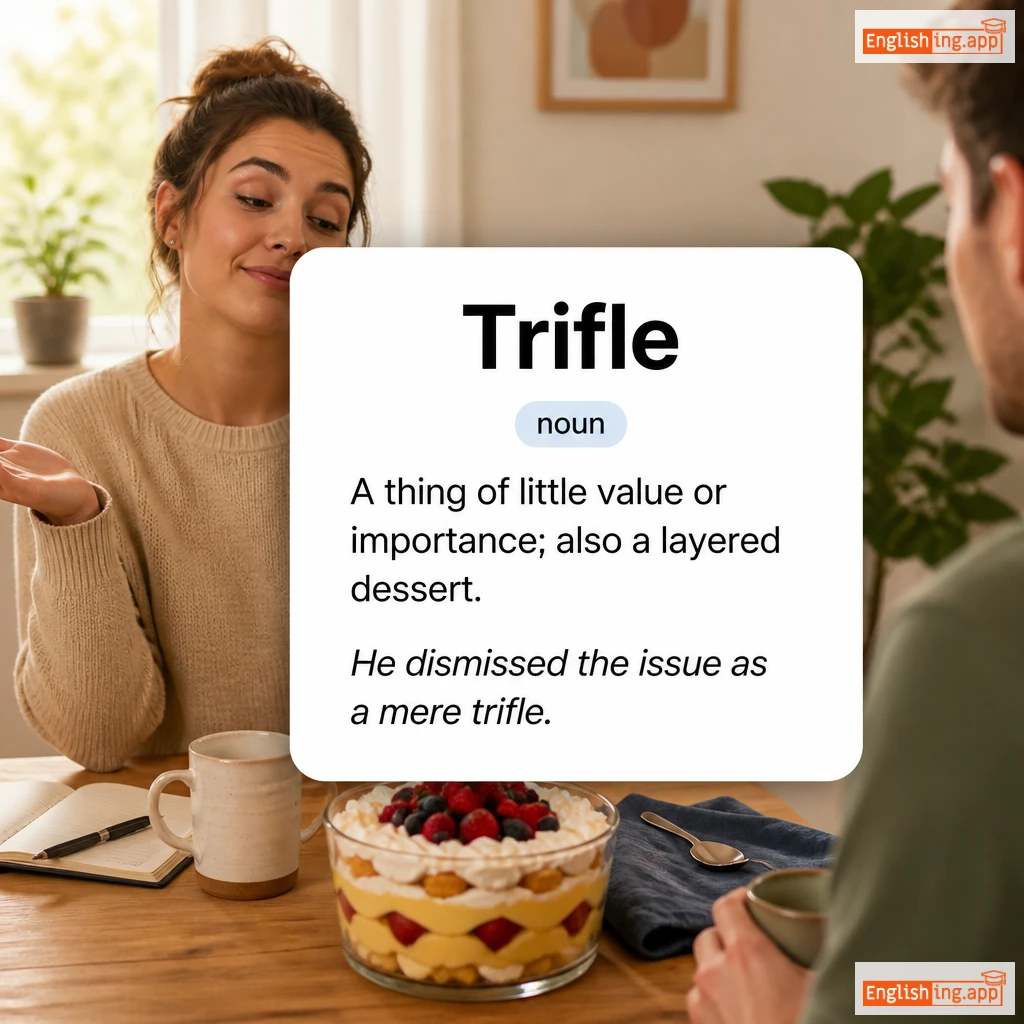
Trifle definition card — visual illustration of the meaning
noun C1
/ˈtraɪfəl/
小事 (xiaoshi)

A thing of little value or importance; also a layered dessert.

"He dismissed the issue as a mere trifle."

"他把这个问题当作无关紧要的小事。" (Ta ba zhege wenti dangzuo wuguan jinyao de xiaoshi.)
adjective C1
/ˈtraɪflɪŋ/
微不足道 (wēi bù zú dào)

Of little importance or value; trivial.

"The mistake was trifling and easily corrected."

"这个错误微不足道,很容易纠正。" (Zhège cuòwù wēi bù zú dào, hěn róngyì jiūzhèng.)
noun C1
/ˈtrɪlədʒi/
三部曲 (san bu qu)

a set of three related works, usually books or films, that form a connected story

"The director finally released the third film to complete the sci-fi trilogy."

"导演最终发布了第三部电影,完成了这部科幻三部曲。" (Dao yan zui zhong fa bu le di san bu dian ying, wan cheng le zhe bu ke huan san bu qu.)
noun C1
/ˈtrɪnɪti/
三位一体 (sanwei yiti)

a group of three closely related things; in Christianity, the Father, the Son, and the Holy Spirit

"The museum’s exhibit focused on a trinity of themes: memory, identity, and power."

"博物馆的展览专注于三种主题的三位一体:记忆、身份和力量。" (Bowuguan de zhanlan zhuanzhu yu sanzhong zhutide sanwei yiti: jiyi, shenfen he liliang.)
noun C1
/ˈtrɪŋkɪt/
小饰品 (xiao shipin)

a small ornament or piece of jewelry that is not expensive

"She bought a little trinket from the beach market as a souvenir."

"她从海滩市场买了一个小饰品作为纪念品。" (Tā cóng hǎitān shìchǎng mǎile yīgè xiǎo shìpǐn zuòwéi jìniànpǐn.)
noun C1
/ˈtrɪp.lət/
三胞胎 (san bao tai)

One of three children or animals born at the same time to the same mother.

"The family was surprised to have triplets instead of twins."

"这个家庭很惊讶他们有三胞胎而不是双胞胎。" (Zhe ge jiating hen jingya tamen you san baotai er bushi shuangbaotai.)
noun C1
/ˈtraɪ.pɒd/
三脚架 (san jiao jia)

A three-legged stand used to support a camera, telescope, or other object.

"The photographer set up his camera on a tripod."

"摄影师将他的相机放在三脚架上。" (Sheying shi jiang ta de xiangji fang zai san jiao jia shang.)
adjective C1
/traɪt/
陈腐的 (chénfǔ de)

Overused and lacking originality.

"The speech was full of trite phrases."

"演讲中充满了陈词滥调。" (Yǎnjiǎng zhōng chōngmǎnle chéncí làn diào.)
noun C1
/ˈtrɪviə/
琐事 (suǒ shì)

Details or information that are considered unimportant or of little value.

"The quiz was filled with fun trivia about movies and music."

"测验中充满了关于电影和音乐的有趣琐事。" (Cè yàn zhōng chōngmǎnle guānyú diànyǐng hé yīnyuè de yǒuqù suǒ shì.)
noun C1
/trɔːf/
槽, 低谷 (cáo, dī gǔ)

A long, narrow container from which animals eat or drink; also, a low point between waves or in business cycles.

"The cows drank water from the wooden trough."

"奶牛从木槽里喝水。" (nǎi niú cóng mù cáo lǐ hē shuǐ.)
noun C1
/truːp/
剧团 (jutuan)

A group of dancers, actors, or performers who work together.

"The theater troupe performed brilliantly on stage."

"剧团在舞台上表现出色。" (Jutuan zai wutai shang biaoxian chuse.)
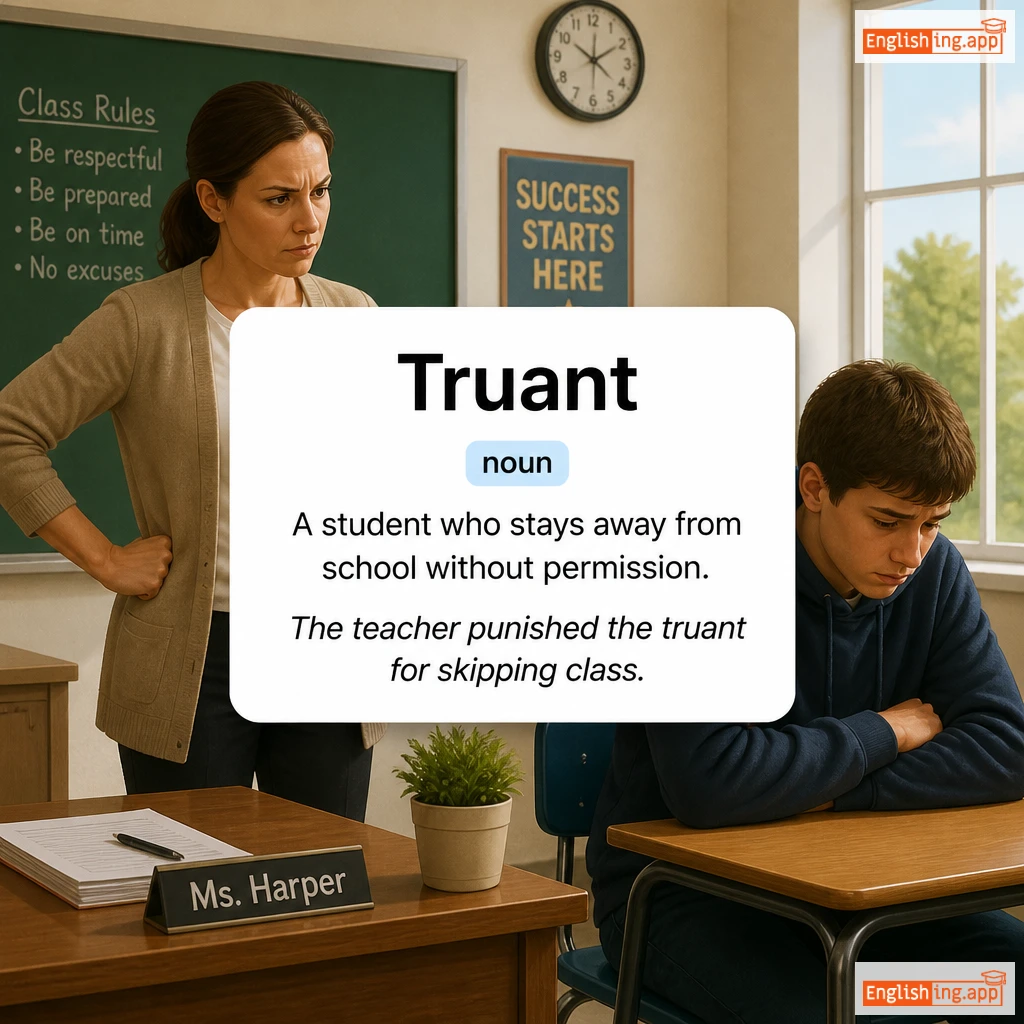
Truant definition card — visual illustration of the meaning
noun C1
/ˈtruː.ənt/
逃学的学生 (tao xue de xuesheng)

A student who stays away from school without permission.

"The teacher punished the truant for skipping class."

"老师因为学生逃课而惩罚了他。" (laoshi yinwei xuesheng taoke er chengfa le ta.)
noun C1
/truːs/
停战 (ting zhan)

An agreement between enemies or opponents to stop fighting for a certain time.

"The two countries agreed to a truce after weeks of intense fighting."

"经过几周激烈的战斗后,两国同意了停战协议。" (Jīngguò jǐ zhōu jīliè de zhàndòu hòu, liǎng guó tóngyì le tíngzhàn xiéyì.)
verb C1
/trʌdʒ/
艰难行走 (jian nan xing zou)

To walk slowly and with heavy steps, typically because of exhaustion or harsh conditions.

"They had to trudge through the snow to reach the village."

"他们不得不在雪中艰难地行走才能到达村庄。" (Tamen bude bu zai xue zhong jian nan de xing zou cai neng dao da cun zhuang.)
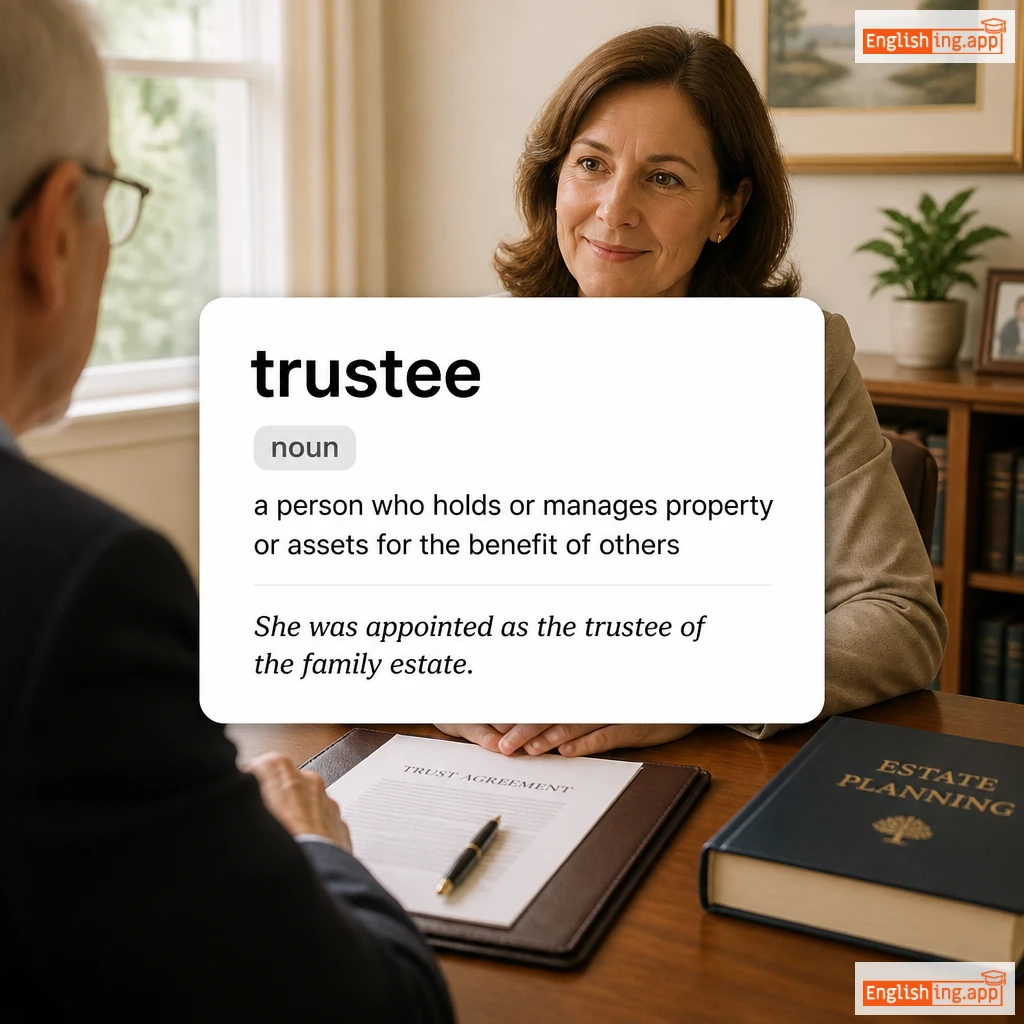
trustee definition card — visual illustration of the meaning
noun C1
/trʌsˈtiː/
受托人 (shòutuōrén)

a person who holds or manages property or assets for the benefit of others

"She was appointed as the trustee of the family estate."

"她被任命为家庭财产的受托人。" (Tā bèi rènmìng wéi jiātíng cáichǎn de shòutuōrén.)
adjective C1
/ˈtʌf.tɪd/
有小束的; 装饰着小束 (you xiao shu de; zhuangshi zhe xiao shu)

having a tuft or tufts; furnished with a tuft or clump of threads, hairs, or other material

"The tufted sofa looked elegant in the living room."

"有小束的沙发在客厅里看起来很优雅。" (Yǒu xiǎo shù de shāfā zài kètīng lǐ kàn qǐlái hěn yōuyǎ.)
noun C1
/ˈtʌɡboʊt/
拖船 (tuō chuán)

a small, powerful boat used for towing or pushing ships

"The tugboat guided the massive ship safely into the harbor."

"拖船将巨大的船只安全地引导进港口。" (Tuō chuán jiāng jù dà de chuán zhī ān quán de yǐn dǎo jìn gǎng kǒu.)
noun C1
/ˈtjuːmʌlt/
骚动 (saodong)

A loud, confused noise, especially caused by a crowd; commotion or disorder.

"The protest created a tumult in the city square."

"抗议活动在城市广场上引发了骚动。" (Kàngyì huódòng zài chéngshì guǎngchǎng shàng yǐnfāle sāodòng.)
adjective C1
/tjuːˈmʌltʃuəs/
动荡 (dongtang)

Characterized by disorder, noisy excitement, or emotional agitation.

"They had a tumultuous relationship full of ups and downs."

"他们有一段充满波动的关系,起伏不定。" (Tamen you yi duan chongman bodong de guanxi, qifu budi.)
noun C1
/ˈtɜːrbjələns/

Violent or unsteady movement of air, water, or some other fluid; disorder or conflict.

"The plane experienced severe turbulence during the flight."

adjective C1
/ˈtɜːrbjələnt/
动荡 (dongdang)

Characterized by conflict, disorder, or confusion; not stable or calm.

"The country went through a turbulent period of political change."

"这个国家经历了一个动荡的政治变革时期。" (Zhe ge guo jia jing li le yi ge dong dang de zheng zhi bian ge shi qi.)
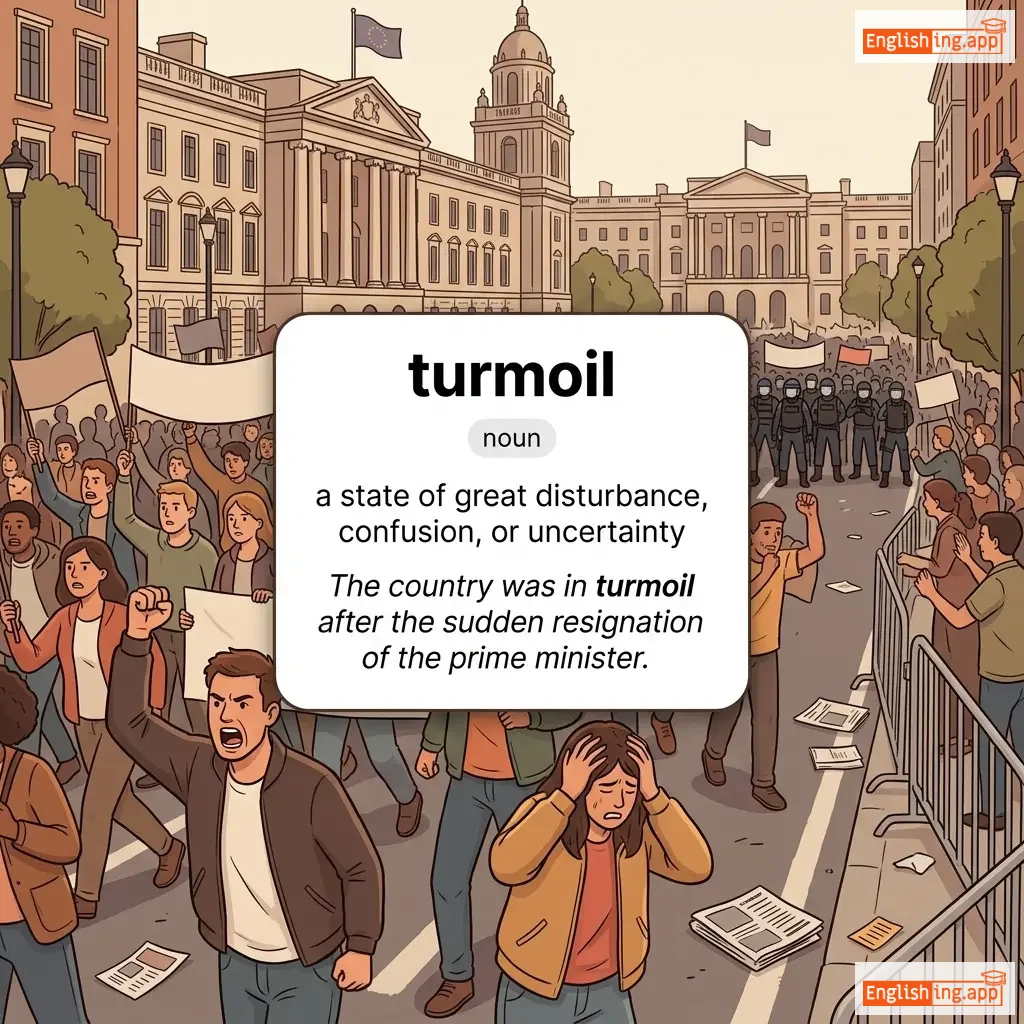
turmoil definition card — visual illustration of the meaning
noun C1
/ˈtɜːrmɔɪl/
混乱 (hunluan)

a state of great disturbance, confusion, or uncertainty

"The country was in turmoil after the sudden resignation of the prime minister."

"在总理突然辞职后,国家陷入了混乱。" (Zai zongli tuuran cizhi hou, guojia xianru le hunluan.)
adjective C1
/ˈtɜːrnkiː/
交钥匙 (jiao yaoshi)

ready for immediate use; a complete product or solution

"The company provides turnkey solutions for small businesses."

"公司为小企业提供交钥匙解决方案。" (Gongsi wei xiao qiye tigong jiao yaoshi jiejue fang'an.)
noun C1
/ˈtʌrɪt/
一个较大塔楼或建筑物顶部的小塔 (yīgè jià dà tǎlóu huò jiànzhúwù dǐngbù de xiǎo tǎ)

A small tower on top of a larger tower or building, often used in castles or fortifications.

"The castle was guarded by soldiers stationed in the turret."

"城堡由驻守在塔楼中的士兵守卫。" (Chéngbǎo yóu zhùshǒu zài tǎlóu zhōng de shìbīng shǒuwèi.)
noun C1
/twɪndʒ/
剧烈的痛苦 (julie de tongku)

a sudden, sharp pain or an emotional pang

"He felt a twinge of guilt after lying to his friend."

"他在对朋友撒谎后感到一阵罪恶感的剧烈痛苦。" (Tā zài duì péngyǒu sāhuǎng hòu gǎndào yī zhèn zuì'è gǎn de jùliè tòngkǔ.)
noun C1
/ˈtwɪstər/
龙卷风 (longjuanfeng)

A tornado or something that twists; also refers to a challenging tongue twister.

"The twister destroyed several houses in the village."

"龙卷风摧毁了村庄里的几栋房子。" (Longjuanfeng cuihui le cunzhuang li de ji dong fangzi.)
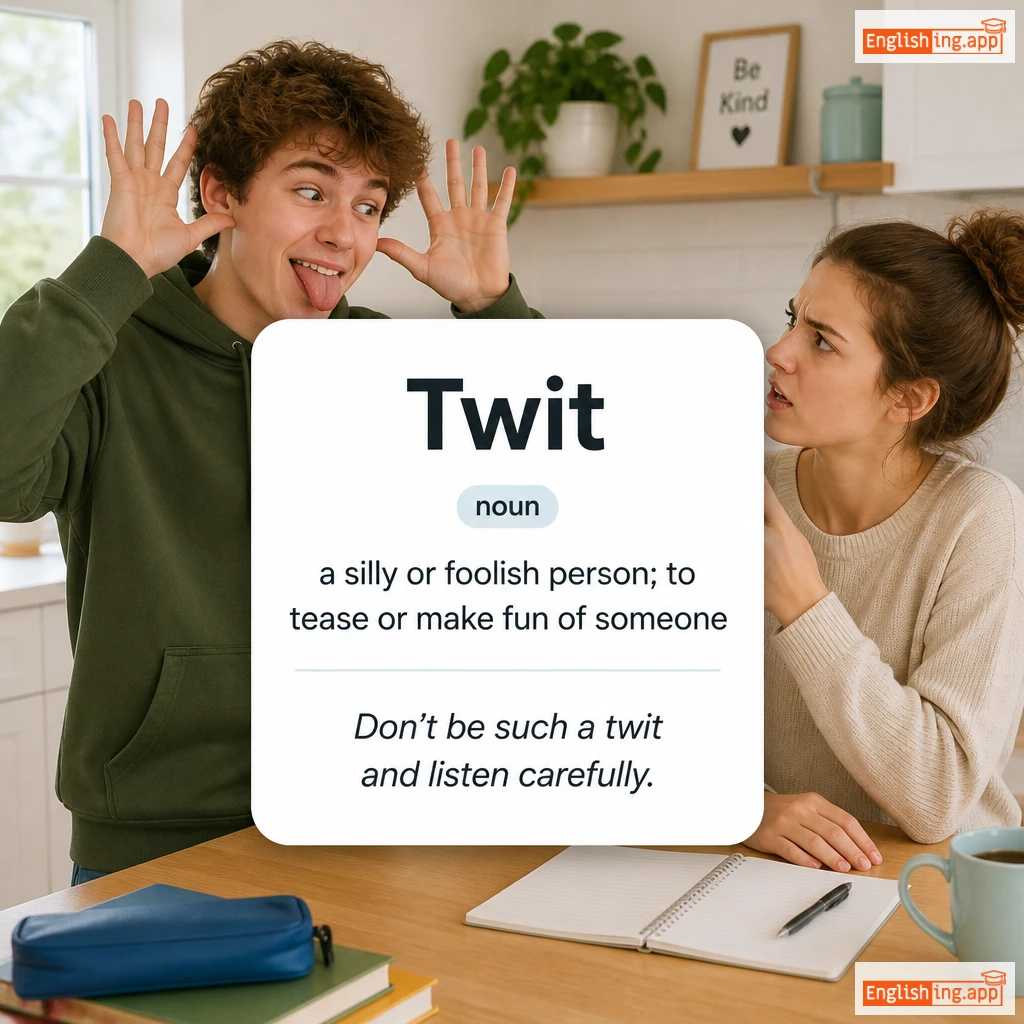
Twit definition card — visual illustration of the meaning
noun C1
/twɪt/
傻瓜; 嘲笑 (shǎguā; cháoxiào)

a silly or foolish person; to tease or make fun of someone

"Don't be such a twit and listen carefully."

"不要做傻瓜,仔细听。" (Bùyào zuò shǎguā, zǐxì tīng.)
noun C1
/ˈtuːsəm/
一对 (yī duì)

A pair of people considered together, often in a romantic or competitive context.

"They entered the dance competition as a twosome."

"他们作为一对参加了舞蹈比赛。" (Tāmen zuòwéi yī duì cānjiāle wǔdǎo bǐsài.)
noun C1
/taɪˈkuːn/
富豪 (fù háo)

a wealthy, powerful businessperson

"The real estate tycoon invested in several skyscrapers."

"房地产富豪投资了多座摩天大楼。" (Fáng dìchǎn fù háo tóuzī le duō zuò mótiān dàlóu.)
verb C1
/ˈtɪpɪfaɪ/
代表 (dàibiǎo)

to represent or be a typical example of something

"His leadership style typifies the new corporate culture."

"他的领导风格体现了新的企业文化。" (Tā de lǐngdǎo fēnggé tǐxiànle xīn de qǐyè wénhuà.)
adjective C1
/ˌtaɪpəˈɡræfɪkəl/
印刷错误 (yinshua cuowu)

relating to the style, arrangement, or appearance of printed text

"There was a typographical error in the book."

"书中有一个印刷错误。" (Shū zhōng yǒu yīgè yìnshuā cuòwù.)
noun C1
/taɪˈpɒɡrəfi/
排版 (paiban)

the art and technique of arranging type to make written language legible and visually appealing

"Good typography improves the readability of a website."

"良好的排版提高了网站的可读性。" (Lianghao de paiban tigao le wangzhan de kexuduxing.)
adjective C1
/tɪˈrænɪkəl/
暴虐 (bàonuè)

exercising power in a cruel or arbitrary way

"The tyrannical ruler silenced all opposition."

"暴虐的统治者让所有的反对派都沉默了。" (Bàonuè de tǒngzhì zhě ràng suǒyǒu de fǎnduì pài dōu chénmòle.)
noun C1
/ˈtɪrəni/
暴政 (baozheng)

Cruel and oppressive government or rule by a tyrant.

"The people revolted against the tyranny of their ruler."

"人民反抗他们统治者的暴政。" (Rénmín fǎnkàng tāmen tǒngzhì zhě de bàozhèng.)
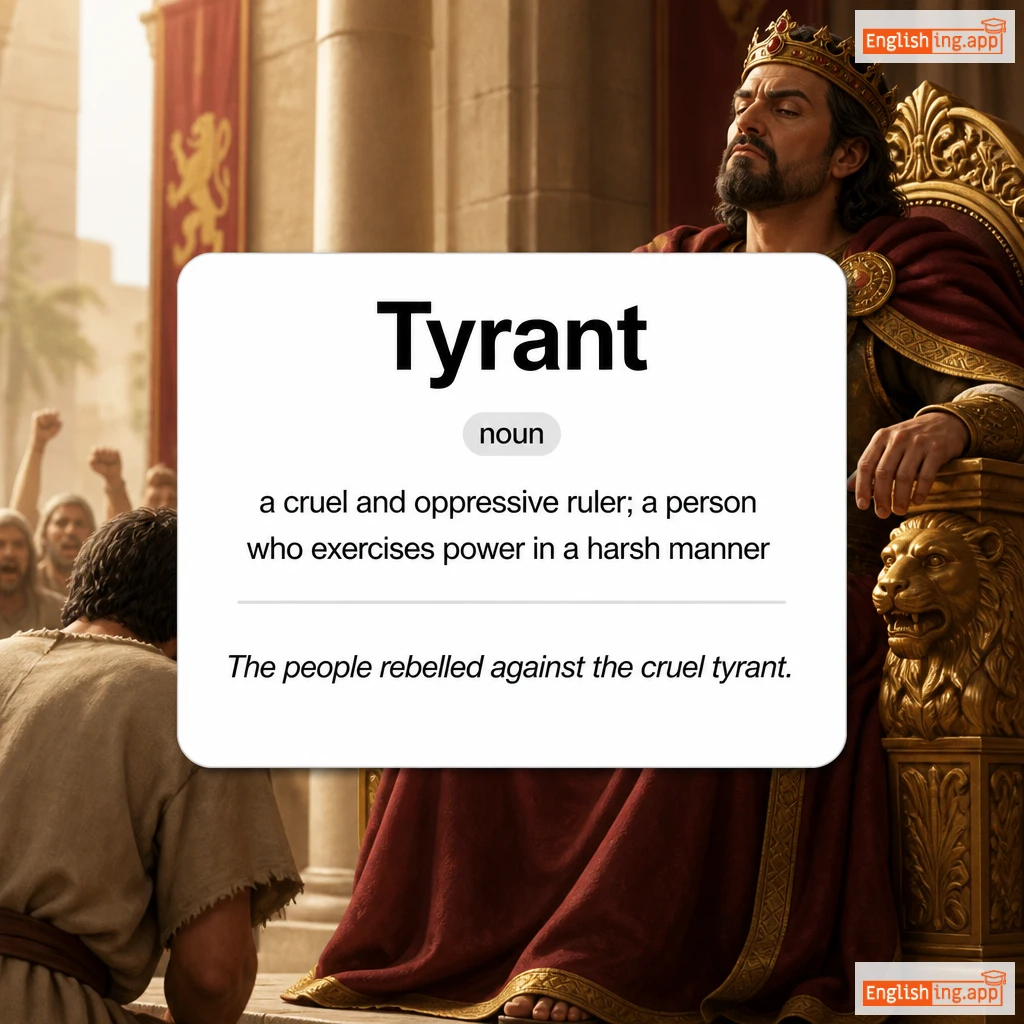
Tyrant definition card — visual illustration of the meaning
noun C1
/ˈtaɪ.rənt/
暴君 (baojun)

a cruel and oppressive ruler; a person who exercises power in a harsh manner

"The people rebelled against the cruel tyrant."

"人民反抗了残忍的暴君。" (rénmín fǎnkàngle cánrěn de bàojūn)
adjective C1
/juːˈbɪkwɪtəs/
无处不在 (wuchubuzai)

Existing or being everywhere at the same time.

"Social media has become ubiquitous among young people."

"社交媒体在年轻人中变得无处不在。" (Shejiao meiti zai nianqingren zhong biande wuchubuzai.)